- 311 -
Quality Characteristics of Apple Wine Fermented with Rosa rugosa Thunb.
Woo-Cheul Han, Seol-Hee Ji, Jae-Cheol Lee, Chul Cheong1, Soon-Ah Kang1 and Ki-Hyo Jang†
Department of Food and Nutrition, Kangwon National University, Gangwon 245-711, Korea
1
Department of Fermented Food Science, Seoul University of Venture and Information, Seoul 137-070, Korea
해당화로 가향한 사과 발효주의 품질특성
한우철․지설희․이재철․정 철1․강순아1․장기효†
강원대학교 식품영양학과, 1서울벤처정보대학원대학교 발효식품과학과
Abstract
Changes in physiochemical properties and polyphenol activities of wine fermented with apples and Rosa rugosa Thun were investigated. To this end, four different mixing ratios of apple and R. rugosa, including R. rugosa:apple 2:1 (Apple 33), R. rugosa:apple 1:2 (Apple 67), R. rugosa:apple 1:5 (Apple 83), and apple alone (Apple 100), were prepared and fermented by Saccharomyces bayanus for 14 days at 24℃ with a further 14 days of post-fermentation at 20℃. The final ethanol content ranged from 8.2–10.2%, with no significant difference between the four groups after fermentation and post-fermentation. Final Brix, pH, and total acidity of the four samples ranged from 7.1–7.5 Brix, pH 3.85–4.07, and acidity 0.73–1.19%. As the proportion of R. rugosa increased, the anthocyanin content and color intensity of wine also increased, whereas the free amino acid concentration decreased.
Key words:apple, fermentation, malic acid, Rosa rugosa Thunb., wine
Introduction
1)
With increasing interest in the well-being life‐style, fermentation beverage has been received attention. According to the annual beverage consumption report in 2007 by National Tax Service, the wine consumption in Korea was 3.8 × 10⁷ L in 2007, which is 2.5 times higher than that in year 2000(1).
Among various fruits, apple (Malus domestica) is currently one of the most cultivated fruits in Korea. Most apple grown in Korea are of the Fuji varities, but other varities, including Ryohong, Seokwang, and Mihong, are also available. It is a rich source of vitamin C, minerals, sugars, organic acids, cellulose, and pectic substances(2). Apple usually consumed
†Corresponding author. E-mail:[email protected], Phone:82-33-570-6882, Fax:82-33-570-6889
as raw material but also can be used for making juice, vinegar, and wine(3). It is very difficult to obtain an apple variety which would have all of the important constituents, such as carbohydates, color and flavor, organic acids, and phenolic compounds, in an ideal proportion. Therefore, a combination of varieties should be used to obtain the most desirable composition in the apple wine(4).
Korean medicinal herbs including Nidium offoconale, Paeonia lactiflora Pall, Chrysanthemi Flos, Zizyphi Fructus, Glycyrrhiza glabra, Angelica acutiloba Kitag, Lycii Fructus, and Astragallus Membranaceus, were used for the rice wine fermentation(5). Yoon et al.(6) demonstrated that the supplementation of ginseng into the mash improved the flavor of Korean rice wine. Using the similar strategy, mixed fermentation system containing Rosa rugosa Thun and apple was applied in the present study. Rosa rugosa Thun, which contains phenolic compounds, has been used as a traditonal
medicine in Korea and Japan(7-8). Rosa species are rich in essential oils and rose essential oils are applicable for fragrance and production of perfumes and cosmetic. It is used as a flavor in tea and liquire(9). It has been reported that Rosa rugosa Thun has antioxidant, antiobesity, and antidiabetes activities(7-8).
This study was aimed to investigate the physiochemical properties and polyphenol activities of wine fermented with apple and Rosa rugosa Thun.
Materials and Methods
Materials
Apple (Fuji, Malus domestica) was purchased from a commercial market in Jecheon-si (Chungbuk province, Korea) in 2006. Fruits of Rosa rugosa Thunb. was harvested in Samcheok-si (Kangwon province, Korea) in 2007. Saccharomyces bayanus was from Red Star Premier Cuvee (LeSaffre, France).
Sugar and K2S2O5 were from Cheiljedang (Seoul, Korea) and Sigma (St. Louis, MO., U.S.A.), respectively.
Preparation of Enzymatic Lysate of Rosa rugosa Thunb.
To prepare enzymatic lysate of Rosa rugosa Thun paste, Rosa rugosa Thun was trimmed, cut into 4 pieces, mixed together with water at a ratio of 1:1 (Rosa rugosa Thun/water), and then homogenized together using a mixer (HMF 370, Hanil Electric Co., Seoul, Korea) for 1 min. After supplementation of 4 mL of α‐amylase (Termamyl 120L, Novo Nordisk, Denmark) to 2 L of the mixture, Rosa rugosa Thun paste were incubated at 80℃ for 2 hr. Subsequently, after cooling down temperature to 65℃, 4 mL of gluco-amylase (AMG300L, Novo Nordisk) was supplemented to the mixture, then further incubated at 65℃ for 2 hr. This was used as the source of enzymatic lysate of Rosa rugosa Thun paste.
Fermentation
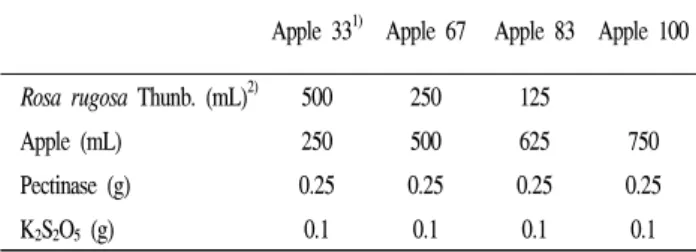
As seen in Table 1, four different mixing ratios of apple and Rosa rugosa Thun, including Rosa rugosa Thun two vs. apple one (Apple 33), Rosa rugosa Thun one vs. apple two (Apple 67), Rosa rugosa Thun one vs. apple five (Apple 83), and apple (Apple 100), were prepared. Concentrations of sugar in four groups in 1.6-L fermentor were adjusted to 24 °brix using sucrose, then supplemented by the addition of 0.5 g of pectinase (Pectinex 100 L, Novozyme, Denmark) and 0.2 g of K2S2O5. After incubation at room temperature for 16 hr, fermentation was started by the addition of 0.5
g of yeast to the fermentor. Fermentation was continued at 23-24℃ for 14 days, and post-fermentation process was followed at 20℃ for 14 days.
Table 1. Proportion of Rosa rugosa Thunb.-apple for wine brewing Apple 331) Apple 67 Apple 83 Apple 100
Rosa rugosa Thunb. (mL)2) 500 250 125 ‐
Apple (mL) 250 500 625 750
Pectinase (g) 0.25 0.25 0.25 0.25
K2S2O5 (g) 0.1 0.1 0.1 0.1
1)Rosa rugosa Thun two vs. apple one (Apple 33), Rosa rugosa Thun one vs. apple two (Apple 67), Rosa rugosa Thun one vs. apple five (Apple 83), and apple (Apple 100).
2)Enzymatic lysate of Rosa rugosa Thun paste were prepared as described in the Materials and methods section.
General Analysis
The pH vlaues was determined using a pH meter (lstek Co., Seoul, Korea). The titratable acidity (TA) was determined by titrating 10 mL of the filtrate with 0.1 N NaOH to a pH of 8.0, and was expressed as the quantity of tartaric acid produced in wine. Sugar concentration(°brix) was determined using a hand-held refractometer (model N-1α, Atago, Japan).
Concentration of frucose, glucose and sucrose were determined using high performance liquid chromatography (HPLC). Briefly, wine was passed through a 0.44 m filter, then 20 μL of the filtrate was injected directly into the HPLC (LC-10 Avp, Shimadzu, Tokyo, Japan). The HPLC was equipped with a column (Kromasil 100-10NH2 column, Eka Chemicals, Bohus, Sweden). The HPLC conditions were as follows: mobile phase, acetonitrile 75%/water 25%; flow rate, 1.0 mL/min; detector, refractive index; running time: 30 min.
For determination of the ethanol content, wine were centrifuged at 10,000 × g for 10 min, then the supernatant was passed through the 0.45 μm filter. The filtrate of eluted was injected directly into a gas chromatograph (6890, Agilent Technologies Inc., Santa Clara, CA, U.S.A.) equipped with flame ionization detector. HP‐Innowax column(0.25 μm, 30 m × 0.25 mm, Agilent Technologies Inc.) was used for the analysis. The oven temperature was programmed from 35℃
(5 min) to 150℃ (0 min) at a rate of 5℃/min and then to 250℃ (2 min) 20℃/min. Injection volumn was 10 μL and split ratio was 10:1. Injection port temperature and detector port temperature were 225℃ and 260℃, respectively.
Coloring degree and ultraviolet absorption were obtained by absorbance measurement at 280, 320, 420, and 520 nm, respectively using a UV-1650 PC UV-visible spectrophotometer
(Shimadzu, Japan) and 10 mm glass cuvette.
Enumeration of Yeast
Following sampling, 10-fold serial dilutions of cells were made and appropriate dilutions spread onto YPD agar(Difco, St. Louis, MO, U.S.A.) to enumerate viable cells of the yeast.
Numbers were counted in triplicate after incubation at 30℃
for 36 hr. Results of viable cell counts were presented as the average values of colony‐forming units (CFU) per mL of wine.
Sensory Evaluation
After the post-fermentation period was terminated, Rosa rugosa Thun-apple wines were stored in a refrigerator for 20 hr. The sensory evaluation was conducted with 21-student panel of university. Nine-point hedonic scales (1 = dislike extremely, 9 = like extremely) for color, taste and flavor were used.
Statistical Analysis
Data were analyzed using one-way analysis of variance (ANOVA) at 95% level of significance(10). All experiments were replicated twice and all analyses were carried out in triplicates. The results presented are a mean of 6 observations
± standard deviations (SD), unless otherwise stated.
Results and Discussion
Characterisitics of Apple and Rosa rugosa Thunb.
At the most beginning of the fermentation, the viable yeast cells was 6.4 × 10⁵±1.2 × 10² CFU/mL. In group Apple 100, the most abundant sugar was fructose (6.6%), but glucose (4.4%) was also found. pH in apple and enzymatic lysate of Rosa rugosa Thunb. paste were 3.9 and 4.0, respectively.
Enzymatic lysate of Rosa rugosa Thunb. paste contained 1.7%
fructose and 1.6% glucose.
pH and Titratable Acidity
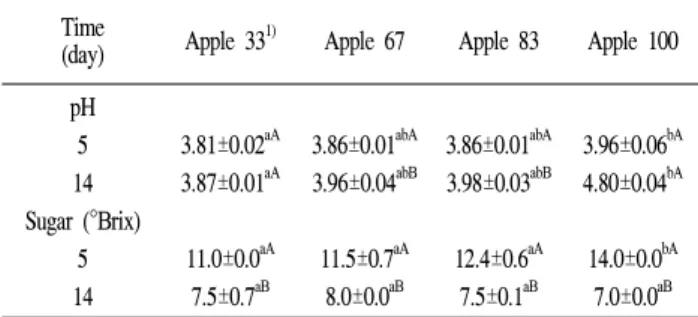
As seen in Table 2 and 3, the pH increased during the fermentation, then remained relatively constant during the following 14 days in post‐fermentaton. As increased the proportion of Rosa rugosa Thunb. in apple wine, final pHs were significantly decreased (Table 3). In contrast, titratable acidity was higher in group Apple 33 than in group Apple 100 (Table 3). Chung et al.(11) reported that final pH of apple wine made from Fuji apple with a concentration of
20 °brix was 3.81 after 14 days in fermentation at 25℃.
According to the previous results by others, the titratable acidity varied dependent upon several factors. These include:
apple varieties, time of harvest, growing conditions, storage and maturation (12-13).
Table 2. Changes in pH and sugar concentration during alcohol fermentation for 14 days at 24℃
Time(day) Apple 331) Apple 67 Apple 83 Apple 100
pH 5 14 Sugar (°Brix)
5 14
3.81±0.02aA 3.87±0.01aA
11.0±0.0aA 7.5±0.7aB
3.86±0.01abA 3.96±0.04abB
11.5±0.7aA 8.0±0.0aB
3.86±0.01abA 3.98±0.03abB
12.4±0.6aA 7.5±0.1aB
3.96±0.06bA 4.80±0.04bA
14.0±0.0bA 7.0±0.0aB
1)See Table 1.
Values are the means of 3 observations at 95% level of confidence.
abcMeans in the same column with different alphabets are significantly different within a particular treatment.
ABCMeans in the same row with different alphabets are significantly different for a particular day of fermentation.
Ethanol Concentration and Brix
Final ethanol concentration ranged between 8.20~10.20, but there was no significant difference among the group.
Chung et al.(14) prepared an apple wine by propagation at 25℃ for 2 weeks using S. cerevisiae KCCM 12224, following aging process at 15℃. These authors found that the ethanol concentration was changed from 7% at the most beginning of aging to 12% at the 8 weeks in aging. By the same authors, it was also found that there were little change in titratable acidity and pH during aging, whilst sugar concentration was gradually reduced as increased the aging. As far as sugar content is concern, a decrease during fermentation and post-fermentation appears to be the general trend of changes(13-14). Thus, the present results seen in Table 2 and Table 3 are also supportive to the results reported previously.
Phenolic Compounds
In the apple wines, amounts of total phenolic compounds(A280) were significantly increased in the dose dependent manner, as increased the ratio of Rosa rugosa Thunb. to apple(Table 3). In group Apple 33, total phenolic compounds was more than 2 times higher than that of group Apple 100. Anthocyanins (A520) and color intensity (A420+ A520) were tendency to increase as increased the ratio of Rosa rugosa Thun to apple, but there was no significant difference
among the groups. In cases of hydroxycinnamate (A320) and browning (A420), there were no significant difference among the groups. It was reported by Campo et al.(13), who were working with apple, the values of browning (A420) in the five apple juices were ranged 0.29~3.56. Phenolic compounds are secondary metabolites of plant(15-16). Apples are rich in phenolics and contain substantial amounts of hydroxycinnamate derivatives, anthocyanins, flavonols, cyanidins, and dihydrochalcones(15,17). It was reviewed that apple-derived products in which anthocyanins are the main compounds responsible for the colour are cyanidin-3-glucoside, cyanidin-3-galactoside, and cyanidin-3-arabinoside (17). It was also suggested that there may be an association between the intake of phenolic compounds and protection against cancer and coronary heart disease(15,17). These compounds are also relevant to the appearance, taste and flavour of food products(15,17).
Table 3. Component of Rosa rugosa Thunb.-apple wine from fermentation at 24℃ for 14 days and post-fermentation at 20℃
for 14 days
Component Apple 331) Apple 67 Apple 83 Apple 100
Ethanol(%) pH
Total acidity(%) Brix(%)
8.40±2.97a 3.85±0.01a 1.19±0.08a 7.5±0.6a
8.35±5.30a 3.93±0.01b 0.96±0.03b 7.1±0.1a
10.20±4.67a 3.99±0.01c 0.82±0.04c 7.2±0.3a
8.20±1.41a 4.07±0.01d 0.73±0.01c 7.5±0.1a A280
A320
A420
A520
Color intensity (A420+A520)
26.33±0.67a 8.52±0.13a 0.76±0.25a 0.32±0.05a
1.08
19.33±2.39b 5.64±1.18a 0.49±0.23a 0.25±0.04ab
0.74
15.46±2.11bc 6.62±0.56a 0.35±0.15a 0.20±0.03ab
0.55
10.50±1.41c 6.61±0.01a 0.26±0.02a 0.08±0.03b
0.34
1)See Table 1.
Values are the means of 3 observations at 95% level of confidence.
Changes in Free Amino Acids
Free amino acids have been implicated as being responsible for the characteristic flavors of wine. Amino acid are produced by breaking down protein sources in fruits, but some of amino acids can be produced during fermentation(18-20). Some of amino acids (alanine, glycine, serine and threonine) confer a sweet taste. Leucine, phenylalanine, and valine confer a bitter taste. In apple juice, asparagine is most abundant, and aspartic and glutamic acids are other prominent amino acids(2). Ackerman et al.(2) reported that the total amino acid content of apple (cv. Glockenapfel) was 41 mg in 100 g of fresh weight of apple. According to the published report, Korean apple contains 2,400 mg of aspartic acid and 610
mg of glutamic acid per gram of nitrogen, respectively(21).
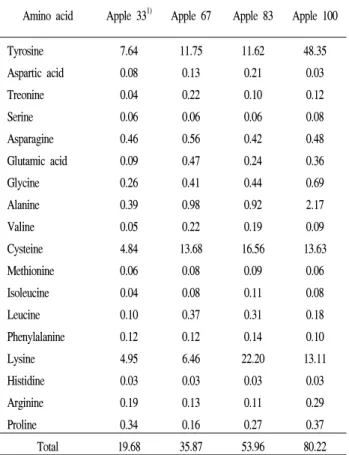
In the present study, 33-100% of the wine is occupied respectively by apple. Amino acid analysis revealed that the concentration of free amino acids and their related compounds in group Apple 100 was 80.2 mg/100 g of wine (Table 4).
After 4 weeks in fermentation and following post-fermentation, tyrosine was the dominant amino acid in group Apple 100, and cysteine and lysine followed (Table 4). Similar trends were seen in other three groups. Overall, total free amino acid in wine was high in group Apple 100 than in group Apple 33, indicating that supplementation of Rosa rugosa Thun to apple wine reduced the sensory characteristics of apple wine generated by free amino acids.
Table 4. Changes in free amino acids (mg/100 g of wine) in Rosa rugosa Thunb.-apple wine from fermentation at 24℃ for 14 days and post-fermentation at 20℃ for 14 days
Amino acid Apple 331) Apple 67 Apple 83 Apple 100
Tyrosine 7.64 11.75 11.62 48.35
Aspartic acid 0.08 0.13 0.21 0.03
Treonine 0.04 0.22 0.10 0.12
Serine 0.06 0.06 0.06 0.08
Asparagine 0.46 0.56 0.42 0.48
Glutamic acid 0.09 0.47 0.24 0.36
Glycine 0.26 0.41 0.44 0.69
Alanine 0.39 0.98 0.92 2.17
Valine 0.05 0.22 0.19 0.09
Cysteine 4.84 13.68 16.56 13.63
Methionine 0.06 0.08 0.09 0.06
Isoleucine 0.04 0.08 0.11 0.08
Leucine 0.10 0.37 0.31 0.18
Phenylalanine 0.12 0.12 0.14 0.10
Lysine 4.95 6.46 22.20 13.11
Histidine 0.03 0.03 0.03 0.03
Arginine 0.19 0.13 0.11 0.29
Proline 0.34 0.16 0.27 0.37
Total 19.68 35.87 53.96 80.22
1)See Table 1.
Sensory Evaluation
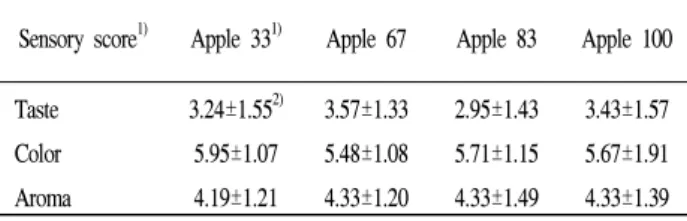
The mean sensory scores of four Rosa rugosa Thunb.-apple wine are given in Table 5. Since the result showed no significant difference between wines, we concluded that there were not any quality differences among these four groups.
The typical sensory attributes of apples wine depends not
only acidity but also the taste sensations. In the present work, supplementation of Rosa rugosa Thunb. to apple wine prior to fermentation increased acidity but decreased free amino acids. In order to get more accurate information, different concentrations of apple to Rosa rugosa Thunb. wine prior to fermentation ranging from 83% to 100% are warranted.
It is important to note that Rosa rugosa Thunb. is rich in terpenoid compounds, tocophenols and carotenes, in addition to sugars and ascorbic acid(22). The fruit color is mainly due to beta-carotene and lycopene(22). Beta-carotene act as a radical scavenger and a physical scavenger of singlet oxygen and is believed to have a protective role against cancer(23).
The amount of beta-carotene in apple juice and Rosa rugosa Thun ranged from 1.4~2.3 μg/100 mL(23) and 13.8 mg/100 g in Rosa rugosa Thunb.(24), respectively.
In conclusion, the mixed combinations of Rosa rugosa Thunb.-apple wine on physiochemical properties and polyphenol activities of wine were investigated. As, increased the ratio of Rosa rugosa Thunb. to apple, the wine became sour with increase in polyphenol activities. Although the sensory score was not different between four Rosa rugosa Thunb.-apple wines, supplementation of Rosa rugosa Thun to apple juice prior to fermentation may help to improve the functionality of the apple wine.
Table 5. Sensory evaluation of Rosa rugosa Thunb.-apple wine from fermentation at 24℃ for 14 days and post-fermentation at 20℃ for 14 days
Sensory score1) Apple 331) Apple 67 Apple 83 Apple 100
Taste 3.24±1.552) 3.57±1.33 2.95±1.43 3.43±1.57 Color 5.95±1.07 5.48±1.08 5.71±1.15 5.67±1.91 Aroma 4.19±1.21 4.33±1.20 4.33±1.49 4.33±1.39
1)1=dislike extremely, 9 = like extremely.
2)Means in the same column with different alphabets are significantly different within a particular treatment.
요 약
사과와 해당화의 혼합비율을 4가지로 달리하여 제조후 에 14일 동안의 발효와 다시 14일 동안의 숙성기간을 거쳐 서 사과‐해당화주를 만들었다. 4가지 그룹에서 발효와 숙 성중에 에탄올 함량에서 유의적인 차이는 없었으며, 최종 적인 에탄올 함량은 8.20~10.20%으로 나타났다. 4가지 그 룹에서 최종제품은 각각 7.1~7.5 °brix, pH 3.85~4.07, 산도 0.73~1.19%를 보였다. 해당화즙의 첨가는 사과주의 anthocyanin 함량, 색도를 강화시키는 효과가 있는 것으로
나타났으나, 관능검사에서는 유의적인 차이는 보이지 않았 으므로 해당화즙의 함량을 낮추어서 사과‐해당화주의 기 호성을 증가시키는 농도를 찾는 후속연구가 요구된다.
References
1. National Tax Service. (2007) Annual report on alcoholic beverage cosuming trend. National Tax Service, Republic of Korea
2. Ackermann, J., Fischer, M. and Amado, R. (1992) Changes in sugars, acids, and amino acids during ripening and storage of apple (cv. Glockenapfel). J. Agric. Food Chem., 40, 1131-1134
3. Jung, Y.J., Seo, J.H., Lee, G.D., Park, N.Y. and Choi, T.H. (1999) The quality comparison of apple vinegar by two stage fermentation with commercial apple vinegar.
Korean J. Soc. Food Sci. Nutr., 28, 353-358
4. Dhamadhikari, M. (1996) Apple wine. Vineyard Vintage View, 11, 1-6
5. Kim, Y.S. and Park, Y.S. (2007) The production of traditional alcoholic beverage in containing medicinal herb. Food Sci. Industry, 40, 83-89
6. Yoon, Y.J., Kim, N.Y., Rhee, Y.K. and Han, M.J. (2007) Quality characterisitics and biological activities of traditionally fermented gingseng wine. Food Sci.
Biotechnol., 16, 198-204
7. Park, J.C. and Ok, K.D. (1993) Phenolic compounds isolated from Rosa rugosa Thun in Korea. Yakhak Hoeji, 37, 365-369
8. Hashidoko, Y. (1996) The phytochemistry of Rosa rugosa.
Phytochem., 43, 535-549
9. Khan, M.A. and Shoaib-ur-Rehman. (2005) Extraction and analysis of essential oil of Rosa species. Int. J. Agric.
Biol., 7, 973-974
10. Albright, S.C., Winston, W.L. and Zappe, C. (1999) Data analysis and decision making with Microsoft Excel.
Pacific Grove, Brooks/Cole Publishing Co. CA, U.S.A.
11. Chung, K.T., Hong, S.D., Yu, T.S. and Song, H.I. (1978) Studies on brewing of apple wine. Korean J. Mycol., 6, 29-42
12. Suni, M., Nyman, M., Eriksson, N.A., Bjork, L. and Bjork, I. (2000) Carbohydrate composition and content of organic acids in fresh and stored apples. J. Sci. Food Agric., 80, 1538-1544
13. del Campo, G., Berregi, I., Iturriza, N. and Santos, J.I.
(2006) Ripening and changes in chemical composition
of seven cider apple varities. Food Sci. Technol. Int., 12, 477-487
14. Chung, J.H., Mok, C.K., Lim, S.B. and Park, Y.S. (2003) Ultrafiltration for quantity improvement of apple wine.
J. Korean Soc. Agric. Chem. Biotechnol., 46, 201-206 15. Marks, S.C., Mullen, W. and Crozier, A. (2007) Flavonoid and chlorogenic acid profiles of english cider apples. J.
Sci. Food Agric., 87, 719-728
16. Sarneckis, C., Dambergs, R.G., Jones, P., Mercurio, M., Herderich, M.J. and Smith, P. (2006) Quantification of condensed tannins by precifitation with methyl cellulose:
development and validation of an optimised tool for grape and wine analysis. Aust. J. Grape Wine Res., 12, 39-49 17. Tomás-Barberán, F.A. and Espín, J.C. (2001) Phenolic compounds and related enzymes as determinants of quality in fruits and vegetables. J. Sci. Food Agric., 81, 853-876
18. Cho, Y. and Rhee, H.S. (1979) A study on flavorous taste components in Kimchi-on free amino acids. Korean J. Food. Sci. Technol., 11, 26-31
19. National Tax Service Technology Institute. (2003) Productive method for ordered and delicious liquor using neutral spirits. Korea Patent 10-0373985
20. The Textbook of Liquor Manufacture. (1997) National Tax Service Technology Institute, Seoul, Korea 21. National Rural Living Science Institute. (2001) Food
Composition Table. 6th ed. Rural Development Administration, Suwon, Korea
22. Bruun, H.H. (2005) Rosa rugosa Thunb. ex Murray. J.
Ecol., 93, 441-470
23. Chiosa, V., Mandravel, C., Kleinjans, J.C.S. and Moonen, E. (2005) Determination of β-carotene concentration in orange and apple juice and in vitamin supplementation drinks. Analele Universitatii din Bucuresti, 1-2, 253-258 24. Kim, M.J., Kim, J.S., Kim, K.E., Shin, K.H., Heo, K.,
Cho, D.H., Park, C.H. and Yu, C.Y. (2001) Comparison of antioxidative activities from different organs of Rosa rugosa Thunb. J. Med. Crop Sci., 9, 40-44
(접수 2009년 2월 11일, 채택 2009년 5월 15일)