[논 문] 한국재료학회지 DOI: 10.3740/MRSK.2008.18.9.503 Kor. J. Mater. Res.
Vol. 18, No. 9 (2008)
503
†Corresponding author
E-Mail : [email protected] (H. H. Park)
은 나노입자가 함침된
Poly (3, 4-ethylenedioxythiphene) : poly (styrenesulfonate)
필름의 전자 구조상태에 미치는 열처리효과 연구왕석주·이초영·박형호†
연세대학교 신소재공학과
Effect of Annealing Temperature with Silver Nanoparticles Incorporation on the Electronic Structure of
Poly (3, 4-ethylenedioxythiphene) : poly (styrenesulfonate) Film
Seok-Joo Wang, Cho-Young Lee and Hyung-Ho Park†
Department of Ceramic Engineering, Yonsei University, 134 Shinchon-dong, Seodaemun-gu, Seoul 120-749, Korea
(2008년 9월 2일접수 : 2008년 9월 6일최종수정 : 2008년 9월 8일 채택)
Abstract The effect of silver nanoparticles (NPs) incorporation on the electronic properties of poly (3, 4- ethylenedioxythiphene) : poly(styrenesulfonate) (PEDOT : PSS) films was investigated. The surface of silver NPs was stabilized with trisodium citrate to control the size of silver NPs and prevent their aggregation. We obtained ca. 5 nm sized silver NPs and dispersed NPs in PEDOT : PSS solution. Sheet resistance, surface morphology, bonding state, and work function values of the PEDOT : PSS films were modified by silver NPs incorporation as well as annealing temperature. Sodium in silver NPs solution could lead to a decrease of work function of PEDOT : PSS; however, large content of silver NPs have an effect on the increase in work function, resulting from charge localization on the silver NPs and a decrease in the number of charge-trapping-related defects by chemical bond formation.
Key words PEDOT : PSS; silver; nanoparticle; work function; charge localization.
1. Introduction
In optoelectronic devices based on conjugated organic materials, the use of intrinsic conducting polymers (ICPs) as electrodes, hole injection layers, and electrochromic layers is essential for the successful implementation of organic electronics. One of the most widely used ICPs today is based on aqueous dispersions of poly (3,4-ethylene- dioxythiphene) : poly (styrenesulfonate) (PEDOT : PSS).
For instance, PEDOT : PSS has been used for the fabrication of highly efficient organic light emitting diodes and field-effect transistors.1-5) However, reported values for the work function (Φ) of PEDOT : PSS exhibit a significant spread from ~4.8 to 5.2 eV due to different formulations and processing conditions.6,7) This incon- sistency in the value of work function makes it difficult to predict adequate properties in actual devices, in
particular, when they are fabricated under various conditions.
Besides the work function, it has been shown that the surface composition of PEDOT : PSS is also an important factor governing device function and efficiency. PSS forms a insulating shell around PEDOT interface and reduces the maximum overall film conductivity to about 10 S/cm.
Recently, to modulate interface properties, there has been increasing interest in combining the nanotechnology advances with organic devices. For example, the composite materials consisting of polymer and inorganic nano- structures can exhibit improved charge transport and stability characteristics, while retaining the fabrication advantages, i.e., easy processing, low production and material cost, and possibility of fabrication of large area and/or flexible devices. Particularly, metal nanoparticles (NPs) exhibit properties differing from bulk metal due to quantum size effects, including novel electronic, optical and chemical behavior. The properties of composites may be tuned via control of shape, size, inter-particle spacing and dielectric environment of NPs, and methods to vary
504 왕석주·이초영·박형호
these parameters have been developed.8,9) Nano-composites of conjugated materials and metal NPs also have been recently prepared from a range of different metals, and many different types of conjugated polymers and oligomer linkers.10)
In this work, we adopted silver NPs to tune the properties of PEDOT:PSS. The effect of annealing temperature on the electronic properties of silver NPs doped PEDOT : PSS nanocomposite films were characterized.
2. Experimental procedure
Commercial PEDOT:PSS (Baytron P AI 4300), which is presently being used as standard ICP as buffer layer in organic light emitting devices was purchased for the preparation of silver doped PEDOT:PSS nanocomposite films. Controlled processing and treatment schemes allowed us to show that the intrinsic work function of PEDOT : PSS can be as high as 5.2 eV. Silver NPs were fabricated using Ag 2-ethylhexanoate in the solvent of dimethyl sulfoxide (DMSO) and Trisodium citrate as a stabilizing agent. The several silver NPs/PEDOT:PSS composition were selected (0.1, 0.25, 0.5, 1 wt.% of the silver NPs solution stabilized with trisodium citrate in water). The solutions were spin-coated on Si substrate with 500 rpm for 30 s. The PEDOT : PSS/silver nano- composite films were heat treated at 80, 100oC for 15 min to remove the solvents. PEDOT : PSS films with 1 wt.% silver incorporation were annealed at 120, 190, 220, and 250oC for 10 min. Surface morphology was analyzed using the atomic force microscopy (AFM) and chemical bonding state and electronic structure of the films were characterized by the synchrotron radiation photoemission spectroscopy (SRPES), and ultra-violet photoelectron spectroscopy (UPS) with energy of He I (21.21 eV). For synchrotron radiation, specimens were loaded into a vacuum chamber, equipped with an electron analyzer, in the 4B1 beam line at the Pohang Accelerator Laboratory (PAL). For SRPES, the incident photon energy of 650 eV was used to obtain spectra and calibrated with the core level spectrum of Au 4f.
3. Results and discussion
Sheet resistance of PEDOT:PSS/silver nanocomposite films according to annealing temperature is plotted in Fig. 1. We used ca. 5 nm sized silver NPs stabilized with
Fig. 1. Sheet resistance of PEDOT : PSS films with or without 1 wt.% of Ag nanoparticles after anneal at various temperatures.
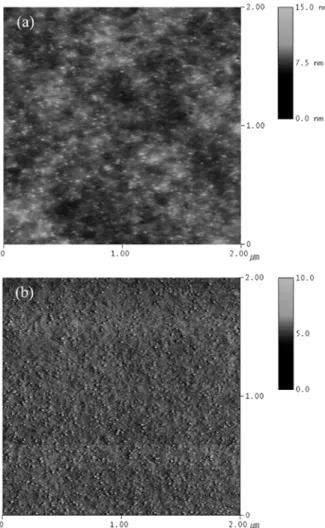
Fig. 2. Topography (a) and phase image (b) of PEDOT : PSS film containing 1 wt.% of Ag nanoparticles.
은 나노입자가 함침된 Poly (3, 4-ethylenedioxythiphene) : poly (styrenesulfonate)필름의 전자 구조상태에 미치는 열처리효과 연구 505
trisodium citrate.11) PEDOT : PSS/silver nanocomposite have the lower sheet resistance than undoped PEDOT : PSS by 1/4−1/2 and slightly enhanced resistant behavior for thermal degradation could be confirmed from the slower reversal of sheet resistance between 220 and 250oC. From these results, it could be inferred that silver NPs enhanced film conductivity by the formation of chemical bonding with PEDOT : PSS or decreasing defects and thermal resistance by the suppression of chain transfer and scission with the roles of energy barrier and high heat capacity.12)
Surface morphologies of silver NPs doped PEDOT : PSS film were studied by AFM. Very smooth surface is shown in topography Fig. 2(a) with the rms roughness of 0.860 nm. Silver NPs in the spun coated films were non- agglomerated and well dispersed over a wide area from small white spots. Presence of doped silver NPs could be also identified as bright spot area in the phase image of figure 2(b). In phase mode AFM, phase contrast is sensitive to the material composition, the presence of multiple phases in a blend. Brownish and bright features in this image are interpreted as PEDOT : PSS-rich and Ag NPs, respectively. It is known that spin-coated films of PEDOT : PSS form grain-like structures with a non- homogeneous distribution of the PEDOT and PSS species upon spin coating.13) Uniform distribution of polymer chains with good connectivity and silver NPs are responsible for good morphology with low roughness and charge carriers can move or hop more easily.14) Small value of surface roughness can also provide good interface and charge transfer in layer structure.
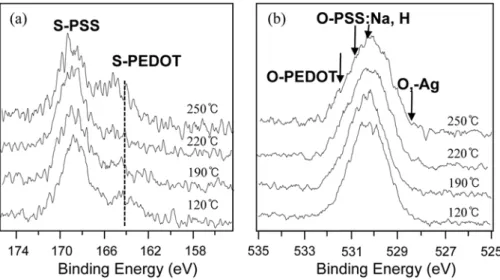
Surface bonding states of PEDOT : PSS/silver nano- composite films might be also changed through annealing temperature. This was revealed by PES from S 2p and O 1s core level in Fig. 3. In S 2p, intensity and binding energy of sulfur in PEDOT was increased with annealing temperature. Conductive PEDOT rich surface means rearrangement of PEDOT : PSS and high binding energy induced by charge localization on silver NPs and scavenging of charge trapping defect by inorganic silver NPs. Core level of O 1s (Fig. 3(b)) shows a broadening in the peak shape by increased O-Na, O-Ag and citrate-O bonds in PEDOT with annealing temperature. Stabilizing agent, trisodium citrate induced the formation of PSS-Na and PEDOT-citrate capped Ag bonds.15)
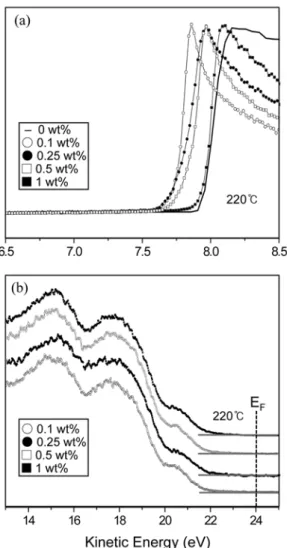
The dependence of the work function and valence band spectra of PEDOT : PSS/silver on the silver content are shown in Fig. 4. Work function decreased from its initial value of 5.2 eV to ca. 4.75 eV with incorporation of 0.1 wt.% silver NPs, but increased with further incorporation, for example, to ca. 5.1 eV with 1.0 wt.% of silver NPs content. It could be explained that lowering of the work function in the film inhibited electrostatic bond between PEDOT and PSS by charge donation from sodium and direct incorporation of PSS with sodium in silver NPs solution. However, recovery of the work function of PEDOT : PSS with increased silver NPs content could be explained by the decrease in charge trapping defect and electron localization on the large content of small sized silver NPs (ca. 5 nm) in PEDOT : PSS. Consuming of defect or sole charged bond in PEDOT : PSS by silver NPs overwhelmed the lowering effect of work function by
Fig. 3. S 2p PES spectra (a) and O 1s PES spectra (b) of PEDOT : PSS film containing 1 wt.% of silver nanoparticles.
506 왕석주·이초영·박형호
charge donation of sodium and formation of PSS : Na.
However, in valence band spectra of Fig. 4(b), there are little change in the valence band structure with varying the silver NPs content. It can be also ascribed to the balanced dedoping effect from electron donation by sodium bond and doping effect by electron localization on the silver NPs from PEDOT with increasing silver content.
4. Conclusions
In summary, the effects of silver NPs incorporation on the surface properties of PEDOT : PSS films have been investigated. Using AFM, PES, UPS and sheet resistance measurements, it was suggested that the sodium turns some of PSS bond states in PEDOT : PSS to PSS : Na,
charge donation and lowering work function, however, electron localization and the number of the charge- trapping-related defects is reduced with increase of silver content and annealing temperature, resulting in an increase in the work function and the conductivity of PEDOT : PSS films. Understanding in the role of stabilizing molecule and silver NPs could be useful for the control of conductivity, hole injection, and charge transfer in optoelectronic devices and organic transistor.
Acknowledgements
This work was supported by the Korea Research Foundation Grant funded by the Korean Government (MOEHRD, Basic Research Promotion Fund) (KRF-2006- 311-D00636). The experiments at the PLS were supported in part by the MOST and the POSTECH.
References
1. R. H. Friend, R. W. Gymer, A. B. Holmes, J. H. Burroughes, R. N. Marks, C. Taliani, D. D. C. Bradley, D. A. Dos Santos, J. L. Bre das, M. Lo gdlund, and W. R. Salaneck, Nature, 397, 121 (1999).
2. C. Dimitrakopoulos and P. R. L. Malenfant, Adv. Mater., 14, 99 (2002).
3. J. S. Kim, R. H. Friend and F. Cacialli, Appl. Phys. Lett., 74, 3084 (1999).
4. Y. J. Lin, W. Y. Chou and S. T. Lin, Appl. Phys. Lett., 88, 071108 (2006).
5. J. Lu, N. J. Pinto and A. G. MacDiarmid, J. Appl. Phys., 92, 6033 (2002).
6. N. Koch, J. Ghijsen, J. J. pireaux, J. Schwartz, R. L.
Johnson, A. Elschaner and A. Kahn, Appl. Phys. Lett., 82, 70 (2003).
7. N. Koch and A. Vollmer, Appl. Phys. Lett., 89, 162107 (2006).
8. J. J. Mock, D. R. Smith and S. Schultz, Nano. Lett., 3, 485 (2003).
9. C. J. Murphy and N. R. Jana, Adv. Mater., 14, 80 (2002).
10. T. L. Stott and M. O. Wolf, Coordin. Chem. Rev., 246, 89 (2003).
11. G. R. Gattorno, D. Diaz, L. Rendon and G. O. Hernandez- Segura, J. Phys. Chem. B., 106, 2482 (2002).
12. W. Schnabel, Polymer degradation: Principles and Practical Applications, p. 25-63, Macmillan Publishing Co.
Inc., New York (1981).
13. G. Greczynski, T. Kugler, and W. R. Salaneck, Thin Solid Films, 354, 129 (1999).
14. W. H. Kim, G. P. Kushto, H. Kim, and Z. H. Kafafi, J. of Polym. Sci. Part B: Polym. Phys., 41, 2522 (2003).
15. C. H. L. Weijtens, V. Van Elsbergen, M. M. de Kok, S. H.
P. M de Winter, Org. Electron., 6, 97 (2005).
Fig. 4. The secondary electron cut off spectra (a) and valence band spectra (b) using He I UPS (21.21eV) of PEDOT : PSS films by silver nanoparticles content.