Bioconversion of Rare Sugars by Isomerases and Epimerases from Microorganisms
Yeong-Su Kim
1, Sang Jin Kim
2, Dong Wook Kang
3,4and Chang-Su Park
2,3*
1Baekdudaegan National Arboretum, Plant Resource Industry Division, Bonghwa 36209, Korea
2Department of Food Science and Technology, Daegu Catholic University, Hayang 38430, Korea
3Advanced Medical Industry Research Center, Daegu Catholic University, Hayang 38430, Korea
4Department of Pharmaceutical Science and Technology, Daegu Catholic University, Gyeongsansi 712-702, Korea Received November 22, 2018 /Revised December 14, 2018 /Accepted December 14, 2018
The International Society of Rare Sugars (ISRS) defines rare sugars as monosaccharides and their de- rivatives that rarely occur in nature. Rare sugars have recently received much attention because of their many uses including low-calorie sweeteners, bulking agents, and antioxidants, and their various applications including as immunosuppressants in allogeneic rat liver transplantation, as potential in- hibitors of various glycosidases and microbial growth, in ischemia-reperfusion injury repair in the rat liver, and in segmented neutrophil production without detrimental clinical effects. Because they rarely exist in nature, the production of rare sugars has been regarded as one of the most important research areas and, generally, they are produced by chemical synthesis. However, the production of rare sugars by bioconversion using enzymes from microorganisms has been receiving increased attention as an environmentally friendly alternative production method. In particular, D-allulose, D-allose, and D-ta- gatose are of interest as low-calorie sweeteners in various industries. To date, D-tagatose 3-epimerase, D-psicose 3-epimerase, and D-allulose 3-epimerase have been reported as D-allulose bioconversion en- zymes, and L-rhamnose isomerase, Galactose 6-phosphate isomerase, and Ribose 5-phosphate isomer- ase have been identified as D-allose production enzymes. Elsewhere, D-tagatose has been produced by L-arabinose isomerase from various microorganisms. In this study, we report the production of D-allulose, D-allose, and D-tagatose by microorganism enzymes.
Key words : Bio-conversion, D-Allose, D-Allulose, D-Tagatose, rare sugars
*Corresponding author
*Tel : +82-53-850-3216, Fax : +82-53-850-3219
*E-mail : [email protected]
This is an Open-Access article distributed under the terms of the Creative Commons Attribution Non-Commercial License (http://creativecommons.org/licenses/by-nc/3.0) which permits unrestricted non-commercial use, distribution, and reproduction in any medium, provided the original work is properly cited.
Journal of Life Science 2018 Vol. 28. No. 12. 1545~1553 DOI : https://doi.org/10.5352/JLS.2018.28.12.1545
서 론
희소당(Rare Sugars)은 지구상에 극히 미량으로 존재하는 단당 또는 단당 유래 물질로서 국제 희소당 학회(International Society of Rare Sugars)에 의해 정의되어 있다. 희소당에 대한 연구는 폭넓게 진행되고 있지는 않지만 현재까지 핀란드, 영 국을 중심으로 한 유럽 그리고 한국, 일본을 중심으로 한 동아 시아 지역에서 꾸준하게 진행되어오고 있다. 최근에는 중국에 서도 희소당이 내포하고 있는 높은 산업적 활용가치에 주목하 여 희소당 관련 연구 결과들이 지속적으로 보고되고 있는 상 황이다. 희소당이 가지고 있는 가장 대표적인 특성은 감미를 가지고 있으면서 체내 흡수율이 낮아 저칼로리의 특성을 가지 고 있다는 것이다. 그리고, 감미 및 저칼로리 이외에도 항암,
항염증, 항비만 및 항산화와 같은 유용한 생리활성을 보유하 고 기능성 소재이기도 하다(Table 1) [4, 10, 26-28]. 현대 사회 에서 설탕을 감미료로 첨가한 식품 섭취가 증가하면서 비만, 당뇨와 같은 건강적 문제가 큰 사회적 문제로 대두되고 있으 면서 설탕을 대체할 수 있는 대체 감미료 개발에 대한 필요성 이 나날이 증가하고 있다. 설탕을 대체하는 감미료와 관련하 여 현대 산업사회에서는 이당류, 올리고당, 스테비아, 사카린, 및 아스파탐등과 같은 대체 감미료가 활용되고 있는데, 희소 당이 내포하고 있는 감도 및 다양한 생리활성을 고려한다면 향 후 희소당이 기능성을 보유한 대체 감미료로서 높은 잠재 적 활용가치를 내포하고 있다는 것이 시사되고 있다[5, 30].
현재까지 Xylitol, D,L-Allulose, D,L-Allose, D,L-Galactose, D,L-Gulose, D,L-Talose, L-Fructose, D,L-Tagatose, D,L-Lyxose, L-Xylose, L-Ribose, D,L-Xylulose, D,L-Ribulose와 같은 약 50 여종 이상의 천연 단당류가 희소당으로서 보고되어져 있으며, 이러한 희소당중에는 설탕과 거의 동일한 감도를 나타내면서 유용한 생리활성을 보유하고 있는 희소당도 보고되어져 있다 [6, 7, 68, 69]. 현재까지 보고되어져 있는 대부분의 희소당은 저칼로리 또는 무칼로리의 특성을 나타내는 것으로 보고되어 져 있으므로 설탕을 감미료로서 첨가하고 있는 다양한 제품에
- Review -
Table 1. Functions and applications of rare sugars
Classification Monosaccharides Function and Application
Pentose
D-Lyxose D-Arabinose D-Ribose D-Xylulose L-Lyxose Xylitol
Stater of anti-tumor
Stater of anti-tumor, Precursor of mytansinoid and azinomycin Inhibitor of Hepatitis B virus (HBV) and Epstein Barr virus (EBV) Inhibitor of glycosidase, Antidiabetic
Starter of anti-tumor
Anticacity, Low calorie sweetener
Hexose
D-Tagatose D-Allulose D-Allose D-Sorbose D-Gulose D-Fructose D-Tagatose L-Glucose L-Idose L-Talose L-Sorbose Talitol
Bulking agent, Functional sweetener Inhibition of fat synthesis, Low calorie Immunosuppressor, Inhibition of Cancer cell Starter of L-threo-2,5-hexodiulose
Food additives, Drug hoof shaped material Insecticide, Glycosidase inhibitor, Antidiabetic Starter of 1-deoxygalactonojirimycin
Starter of glycoconjugate vaccine Heparan sulfate synthesis L-talofuranosyladenine
Starter of L-threo-2,5-hexodiulose Glycosidase inhibitor, Antidiabetic
희소당을 대체 감미료로서 적용한다면 칼로리 문제 개선과 함께 기능성을 부여한 신제품 개발에도 희소당을 적용 할 수 있을 것으로 기대되어진다. 하지만, 희소당을 산업적 소재로 서 활용을 하기 위해서는 희소당이 내포하고 있는 근본적인 한계인 자연계에 매우 미량 존재한다는 존재의 희소성을 극복 하는 것이다. 일반적으로 자연계에 풍부하게 존재하고 있는 천연단당류는 D-Glucose를 중심으로 D-Galactose, D-Fructose, D-Mannose, D-Xylose, L-Arabinose, D-Ribose와 같은 7종류의 단당들이 보고되어져 있으며, 대부분의 단당들 은 자연계에 극히 미량으로 존재하는 희소당의 형태로 존재하 는 것으로 알려져 있다. 따라서, 희소당을 원활하게 활용하기 위해서는 희소당 생산에 관한 연구가 반드시 선행되어야 하는 필요성이 있다. 현대사회에서 일부 활용되고 있는 희소당의 대부분은 화학적 합성 방법에 의해 생산되고 있는데, 최근에 는 친환경적이며 작업환경도 안전한 미생물 또는 미생물 유래 효소를 이용한 생물전환 방법에 의한 희소당 생산 연구가 미 래 지향적 연구 기술로서 많은 주목을 받고 있다. 특히, 현대 산업에 있어서 미생물 및 미생물 유래 효소와 같은 생물자원 을 활용한 생물산업이 지속적으로 발전하고 있으며, 이러한 생물산업의 발전과 함께 다양한 분야에서 효과적으로 활용할 수 있는 미생물 및 미생물 유래 효소 자원이 지속적으로 발굴 되고 있다. 희소당의 경우 가까운 일본에서 가장 적극적으로 연구가 진행되어져 왔으며, 특히 일본 카가와 대학의 Ken Izumori교수는 미생물 및 미생물 유래 효소 자원을 이용하여 생물학적 방법으로 희소당을 생산하는 연구기술을 정리한 Izumoring을 발표함으로써 지구상에 희소하게 존재하는 희소 당을 생물학적 방법으로 생산하는 학문적, 산업적 연구활동의
기폭제가 되었다고 할 수 있다. Ken Izumori 교수를 중심으로 한 카가와대학 연구그룹은 산, 학, 관 공동연구를 통하여 카가 와현을 중심으로 희소당 D-Allulose와 D-Allose를 적용한 음 료, 제과류, 제방류, 농산물 및 면류등을 개발하면서 식품을 비롯한 다양한 산업분야에 희소당을 적용하기 위한 활발한 연구활동을 수행하고 있다. 최근 국내에서도 희소당 중에서 D-Allulose와 D-Tagatose가 제품 생산에 적용이 가능한 소재 로서 인정이 되면서 향 후 국내에서의 희소당의 활용성이 지 속적으로 증가할 것으로 기대되어지며, 희소당 기능성에 대한 지속적인 규명 또한 높게 요구될 것으로 기대되어진다. 본 연 구에서는 최근에 대표적인 희소당으로서 주목을 받고 있는 D-Allulose, D-Allose, D- Tagatose에 대하여 목적 희소당 생 산에 이용되어지는 미생물 유래 효소를 소개하고 이러한 효소 들이 활성조건으로 요구하는 효소반응 조건에 대하여 제공함 으로써 생물자원을 이용한 희소당 생산 연구에 대한 전반적인 이해를 돕고자 한다.
D-Allulose 생물전환 생산
D-Allulose는 이전에는 D-psicose라는 명칭으로 통용되고
있었으나 2013년도 이후부터 국제희소당학회(ISRS)에 의해
D-Allulose라는 명칭이 추천되어 현재는 D-allulose라는 명칭
으로 통용되고 있다. 따라서, 이전에 D-psicose라는 명칭의 당
은 현재의 D-allulose와 동일한 희소당을 나타내고 있는 것이
며, 본 총설에서는 현재 통용되고 있는 D-allulose라는 명칭을
사용하고자 한다. D-Allulose는 자연계에 극히 미량 존재하는
6탄당 케토오스 희소당으로서 자연계에 풍부하게 존재하는
대표적인 케토오스 천연당질인 D-fructose의 3번 탄소위치에
Fig. 1. Bio-conversion of D-allulsoe from D-fructose by enzymes from microorganisms. DTEase and DAEase mean D-ta- gatose 3-epimerase and D-Allulose 3-epimerase, respec- tively .
서 -OH기의 방향이 반대인 D-fructose 에피머 단당이다(Fig.
1). D-Allulose는 농산물과 같은 천연식품소재 및 탄수화물을 함유하고 있는 가공제품에 소량으로 함유되어 있는것으로 보 고되어져 있으며 인슐린저항성, 항산화제 기능, 저칼로리 및 지방합성 억제와 같은 다양한 생리활성이 보고되어져 있다.
D-Allulose는 화학적 생산 방법으로도 생산이 가능하지만 미 생물 유래 효소자원을 이용하여 D-fructose로부터 생산이 가 능하다. D-Fructose로부터 D-allulose를 생산하기 위한 미생물 유래 효소로서는D-fructose 의 3번째 탄소 위치에서 –OH기 의 방향을 반대로 전환하는 epimerase가 요구된다. 현재까지 D-fructose로부터 D-allulose를 생산하는 epimerase로 보고되 어져 있는 효소는 D-tagatose 3-epimerase와 D-allulose(또는 psicose) 3-epimerase 2종류가 보고되어져 있다[9, 12-18, 38-41].
먼저, D-tagatose 3-epimerase (DTEase)를 생산하는 미생물 로서는 Pseudomonas cichorii, Clostridium scindens, Rhodobacter
sphaeroide등이 보고되어져 있으며, D-allulose (또는 Psicose)3-epimerase (DAEase)를 생산하는 미생물로는 Agrobacterium
tumefaciens, Agrobacterium sp. ATCC31749, Arthrobacter globi- formi, Dorea sp., Clostridium cellulolyticum, Desmospra sp. 등이보고되어져 있다[51, 53, 54, 59].
특히, P. cichorii 유래 DETase는 재조합 효소로서 대량생산 되는 시스템이 구축되었고 재조합효소는 고정화효소로 제조 되어 D-fructose로부터 D-allulose를 연속생산할 수 있는 시스 템이 구축되어져 있다. 본 효소는 pH7.0, 45℃ 조건에서D- fructose로부터 D-allulose를 최대로 생산하며 D-allulose 대량 및 산업화 생산 연구를 통해 효소를 이용한 희소당 생산 연구 에 많은 연구적 정보를 제공한 효소이기도 하다. Clostridium
scindens 유래 DTEase 또한 재조합 효소로서 대량 생산되는시스템이 구축되어져 있으며, 본 효소의 D-fructose로부터 D- allulose 생산에 있어서 효소특성은 최적온도 60℃, 효소활성 에 Co
2+금속이온을 요구하는 금속의존성효소이다. 하지만, Cu
2+와 Ca
2+금속이온에 의해서는 효소활성에 강한 저해를 받 는 특징을 보이고 있다. Rhodobacter sphaeroides 유래 DTEase의 경우는 단일 효소로 정제되어 효소특성이 규명되어져 있으며,
D-fructose로부터 D-allulose를 생산하는데 있어서 최적 pH 9.0, 최적온도 45℃, 그리고 금속비의존성 효소로서 Zn
2+과 Cu
2+금속이온에 대해서 강한 효소활성 저해를 받는 것으로 보고되어져 있다.
Agrobacterium sp.유래 DAEase는 재조합효소로서 대량생
산되는 시스템이 구축되었으며, 효소반응에 있어서 최적온도 및 pH는 pH7.5-8.0, 55-60℃로 보고되어져 있다. 효소활성에 있어서 Co
2+금속이온을 요구하는 금속요구성 효소이기도 하 다. Arthrobacter globiformis 유래 DAEase는 단일 효소로 정제 되어 효소고정화를 통하여 D-allulose 연속 생산시스템이 구 축되어져 있으며, 효소 반응에 있어서 요구되는 조건으로는 pH7.0-8.0, 온도 45℃로 보고되어져 있으며, 효소반응에 있어 서 Mn
2+금속이온을 요구하는 금속요구성 효소로 보고되어져 있다. Agrobacterium tumefaciens유래 DAEase는 재조합효소로 서 대량생산되는 시스템이 구축되어져 있으며 D-allulose 생 산에 있어서 최적 pH및 온도는 각각 pH8.5와 60℃로 보고되 어져 있다. Dorea sp. 유래 DAEase 또한 재조합 효소로서 대 량생산되는 시스템이 구축되어져 있으며, 효소활성의 최적pH 는 6.0, 최적 온도는 70℃로 보고되어져 있다. 그리고 금속요구 성 효소로서 Co
2+를 효소활성에 요구하는것으로 보고되어져 있다. 그밖에 Clostridium cellulolyticum 그리고 Desmospora sp.
유래 DPEase가 보고되어져 있으며, 이들 효소의 D-allulose 생산 최적의 반응 조건은 각각 pH 8.0, 55℃, Co
2+이온 요구 그리고 pH 7.5, 60℃, Co
2+이온 요구성 효소로서 보고되어져 있다.
이상과 같이 D-allulose는 D-fructose로부터 생산 연구가 지 속적으로 수행되어져 왔으며, D-allulose 생산에 적용되는 미 생물 유래 효소로는 DAEase 또는 DTEase가 대표적으로 보고 되어져 있다[61, 64-67]. 향 후 D-allulose가 가지고 있는 생리 활성 기능 및 산업적 활용 가능성을 고려해 보면 D-allulose 생산의 필요성은 지속적으로 증가 될 것으로 기대되어지며, DAEase 또는 DTEase 를 이용한 D-allulose 생산에 있어서 효 소활성 증진, D-allulose 생산량 향상 및 연속 D-allulose 생산 기술 개발에 대한 연구가 지속적으로 이루어질 것으로 기대되 어진다.
D-Fructose로부터 D-allulose를 생산하는 미생물 유래
DTEase, DAEase의 경우 D-fructose의 3번 탄소 위치에서
-OH기의 방향을 반대방향으로 전환시키는 활성을 보유하고
있는 효소이다. 따라서, 이러한 3번 탄소 위치에서 -OH기의
방향을 전환시키는 epimerase 기능을 보유한 효소를 다양한
aldose 및 ketose 단당에 적용하였을 때 다양한 형태의 희소당
생산이 가능할 것으로 기대되어지므로, 향 후 다양한 희소당
을 기능성 탄수화물로서 개발하기 위해서는 단당의 3번 탄소
위치에서 epimerization 기능을 보유한 효소 자원의 지속적인
발굴이 무엇보다도 중요하다고 할 수 있겠다. 생물이 널리 활
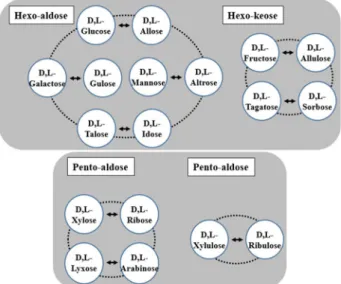
용하고 있는 5탄당 및 6탄당 Aldose 그리고 ketose에 3번 탄소
Fig. 2. Rare sugars produced by epimerization reaction of DTEase and DAEase. Various rare sugars can be produced by epimerization at a C-3 position on D,L-form aldo-hexo- ses, keto-hexoses, aldo-pentoses, and keto-pentoses by DTEase and DAEase from environmental microorgan- isms.
Fig. 3. Bio-conversion of D-allose from D-allulose by enzymes from microorganisms. RipB, LacAB, and Rhalase mean Ribose 5-phosphate isomerase, Galactose 6-phosphate isomerase, and L-rhamnose isomerase, respectively.
위치에서 epimerization 기능을 보유한 효소를 적용하였을 때 생산 가능한 단당을 Fig. 2에 정리하여 나타내었다.
D-Allose 생물전환 생산
D-Allose는 D-allulose와 비교하여 의약품 생산에 효과적인 기능들이 중심적으로 알려져 있다. 허혈작용에 의한 장기손상 을 억제하는 기능외에도 암세포의 증식을 효과적으로 억제하 는 기능이 대표적인 기능으로 보고되어져 있으며, D-allulose 와 마찬가지로 저칼로리의 특징을 가지고 있는 희소당으로서 도 알려져 있다. 의약품과 관련된 기능이 보고되어져 있는 D-allose이지만 일본에서 제품화된 희소당 첨가 시럽 및 음료 에는 D-allose가 첨가되어서 많은 주목을 받았기에 저칼로리 의 특성은 향 후 식품을 비롯한 다양한 제품개발에 적용될 수 있을 것으로 기대되어진다. D-Allose의 미생물 유래 효소에 의한 생산은 현재까지 D-allulose를 기질로 하여 L-Rhamnose Isomerase (RhaIase)를 이용한 생산이 가장 대표적이며 널리 알려져 있다[1, 2, 23, 24, 27]. D-Allose는 6탄당 알도오스로서 D-allulose의 이성화 단당으로서 존재한다(Fig. 3). 따라서, 이 성화 효소에 의한 이성화반응으로 케토오스인 D-allulose를 D-allose로 전환시킴으로써 생산이 가능하다. D-Allulose로부 터 D-allose 를 생산 가능한 L-rhamnose isomeras (Rhalase)는 다양한 미생물들에 의해 보고되어져 있으며, 해당 미생물 유 래 RhaIase에 의한 D-allose 생산 특성도 아래에 정리하였다 [42, 43, 45, 46]. D-Allulose로부터 D-allose를 생산하는 미생물 유래 효소로서 Pseudomonas stutzeri 유래 RhaIase에 의한 D-allose생산 연구가 가장 선구적으로 수행된 대표적인 연구
라고 할 수 있다. 본 효소는 pH 7.0, 50°C에서 가장 높은 효소 활성을 보였으며, 기본적으로는 금속이온 비의존성 효소로 분 류되어지지만 Mn
2+, Li
+, Al
3+과 같은 금속이온에 대해서는 효 소활성이 10% 미만이기는 하지만 효소 활성이 다소 향상된다 고 보고되어져 있다. P. stutzeri 유래 RhaIase는 이 이외에도 폭넓은 단당 이성화 반응에 관여하는 기질특이성을 보유하고 있으므로 본 효소를 이용한다면 다양한 종류의 희소당을 이성 화반응에 의해 생산할 수 있을것으로 기대되어진다. 본 효소 는 재조합효소로서 대량 생산 될 수 있는 시스템 또한 구축되 어져 있으며, BCW-2510 Chitopearl 담체에 고정화 효소로서 고정화 되어 50% D-allulose를 기질로 이용하여 30%의 전환율 로 D-allose를 연속생산할 수 있는 시스템이 구축되어져 있다.
Thermobacillus composti 유래 RhaIase는 D-allulose로부터
D-allose 생산에 있어서 pH 7.5, 60℃에서 가장 높은 효소활성
을 보였으며 본 효소는 효소활성에 Mn
2+금속이온을 요구하는
금속이온 요구성 효소이다. Bacillus subtilis 유래 RhaIase에 의
해서도 D-allulose로부터 D-allose 생물전환이 보고되어져 있
는데, 본 효소는 재조합효소로서 대량발현 시스템이 구축되어
져 있으며, 효소반응에 있어서 Mn
2+금속이온을 요구하는 금
속요구성 효소이다. 효소 반응조건으로는 pH 8.0, 60℃에서
가장 높은 효소 활성을 보였으며, 본 효소는 알도오스 단당의
2, 3번째 탄소위치에서 -OH기가 오른쪽 방향으로 배치되어
있는 단당에 대하여 이성화반응을 보이는 기질특이성을 가지
는 효소로서 보고되어져 있다. Phosphate sugar에 활성을 가
지는 phosphate sugar계열 isomerase에 의해서도 D-allulose
로부터 D-allose 생산 연구가 진행된 경우가 있는데 Lacctococ-
cus lactis 유래 galactose 6-phosphate isomerase와 ribose5-phosphate isomerase가 대표적인 예이다. Lacctococcus lactis
유래 galactose 6-phosphate isomerase (LacAB)는 LacA, LacB
두 종류의 단백질이 4차구조를 이루는 독특한 구조를 가진
효소로서 정제효소로서 정제된 후 D-allulsoe 생산 조건이 검
토되었는데. 본 효소는pH 7.0, 30℃조건에서 25%의 전환율로
D-allulose로부터 D-allose를 생산하는 특성을 보였으며, 동일
반응에서 부산물로서 D-altrose를 생산하는것으로 보고되어
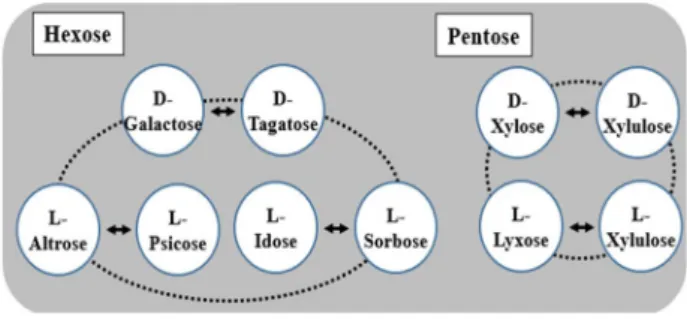
Fig. 4. Rare sugars produced by Isomerization reaction of Rhalase, RpiB, and LacAB. Various rare sugars can be produced by isomerization of aldo-hexoses and al- do-pentoses having hydroxyl groups oriented in the right-handed configuration at C-2, C-3 or C-2, C-3, C-4 position by Rhalase, RpiB, and LacAB from environ- mental microorganisms.
Fig. 5. Bio-conversion of D-tagatose from D-galactose by enzymes from microorganisms. Arabiase means L-arabinose isom- erase.
져 있다. 그리고 또다른 D-allulose를 생산하는 RpiB로는
Clostridium thermocellum 유래 RpiB가 보고되어져있는데, 본효소도 2, 3, 4번째 탄소위치에서 –OH 기의 방향이 동일방향 으로 배열되어 있는 알도오스 단당에 대한 이성화 반응을 일 으키는 기질특이성으로부터 D-allose가 생산되는것으로 보고 되어져 있으며, 본 효소의 최적반응조건은 pH7.5, 65℃로 보고 되어져 있다. D-Allose에 대한 연구는 D-allulose와 비교하여 생산연구도 진행되어 있지만 D-allulose를 생산하는 생물자원 으로서 보고되어져 있는 효소만큼 다양한 효소자원이 보고되 어 있지는 않다. 하지만, D-allose가 가지고 있는 유용한 생리 활성으로 인하여 제약을 중심으로 한 식품산업으로도 잠재적 활용 가치가 높은 희소당으로서 시사되고 있다[52, 56, 60, 62].
D-Allose를 생산하는 효소의 기질특이성은 단당의 2, 3번 또는 2,3, 4번째 탄소위치에서의 -OH기가 오른쪽으로 배열하고 있 는 5탄당과 6탄당에 대해서는 Rhalase가 이성화 활성을 나타 낼 수 있는 것으로 기대되며, 특히 이러한 구조를 가지고 있는 단당에는 희소당중에서도 자연계에 매우 희소하게 존재하는 L-form의 희소당이 다수 포함되어 있기에 RhaIase가 나타내는 당류에 대한 기질특이성을 적용한다면 이성화 반응을 통하여 다양한 희소당 생산이 가능할 것으로 기대되어진다. Rhalase 기질특이성을 적용하여 생산가능한 희소당은 Fig. 4에 정리하 였다.
D-Tagatose 생물전환 생산
D-Tagatose는 감도 및 감미에 있어서는 현재 가장 널리 통 용되고 있는 설탕(sucrose)와 가장 유사하다고 보고되어져 있 으며, 설탕을 대체하는 감미료로 보고되어져 있는 일부 감미 료에서 보이는 설사 유발과 관련한 부작용도 없으며 체내에서 흡수가 거의 이루어지지 않는 특징으로부터 칼로리는 제로에 가까워 향 후 설탕을 대체하는 감미료로서 높은 잠재적 활용
가치를 내포하고 있는 희소당이라고 할 수 있다[3, 8, 11, 17, 19-22]. D-Tagatose는 국내외에서도 다른 희소당과는 달리 매 우 이른 시기에 제품화 되어 시판이 되어왔으며, 향 후 이를 적용한 제품 개발이 지속적으로 이루어질 것으로 기대되어진 다. D-Tagatose는 D-galactose의 이성화 반응에 의해 생산이 가능하며 현재까지 미생물 유래 L-arabinose isomerase (Ara- biase)를 이용한 D-tagatose 생산 연구가 중점적으로 보고되어 져 있다(Fig. 5). D-Tagatose를 생산하는 미생물 유래 효소와 효소반응의 특성은 다양한 보고들이 있으며 주요 내용들은 다음과 같다[29, 31, 33-36, 44, 47]. Pediococcus pentosaceus 유래 Arabiase 는 재조합효소로서 대량생산되는 시스템이 구축되 어져 있으며, pH6.0, 50℃에서 가장 높은 효소활성을 나타내 며, Mn
2+과 Co
2+금속이온을 효소활성에 요구하는 금속의존성 효소이다. Lactobacillus fermentum 유래 Arabiase 도 재조합효 소로서 대량생산되는 시스템이 구축되어져 있으며, pH6.6, 65
℃에서 가장 높은 효소활성을 나타내며, Pediococcus pentosa-
ceus 유래 L-arabinose Isomerse와 마찬가지로 Mn2+과 Co
2+두종류의 금속이온을 효소활성에 요구하는 금속의존성 효소
이다. Thermoanaerobacterium saccharolyticum 유래 Arabiase는
pH 7-7.5, 70°C에서 가장 높은 효소활성을 나타내었으며,
pH6.5-9.5범위에서도 안정한 효소활성을 나타내었으며, 55-6
5℃에서의 2시간 열처리에 의해서도 효소활성이 명확하게 유
지되는 높은 온도안정성을 나타내는 효소로 보고되어져 있다
[57, 58, 63]. 본 효소도 또한 Mn
2+과 Co
2+두가지 금속이온을
요구하는 금속요구성 효소이다. Bacillus stearothermophilus 유
래 Arabiase 는 최적pH가 7.5이며, 최적온도는 80℃로서 고온
에서 최적의 효소활성을 나타내는 열안정성 효소로서 보고되
어져 있다. 그리고, 특징적으로 65°C 이상의 온도에서는 금속
비의존성 효소의 특성을 보이지만, Co
2+의 존재하에서는 매우
높은 온도 안정성을 나타내는 효소특성을 보유하고 있는 효소
이다. Actinotalea fermentans 유래 Arabiase 는 효소유전자는
클로닝되고 발현되어 재조합효소로서 대량생산되는 시스템
이 구축되어져 있으며, pH 8.0, 45℃에서 최대효소활성을 나타
내었다. 그리고, 다른 Arabiase 와는 달리 금속비의존성 효소
로서 규명되었다. D-Tagatose를 생산하는 Arabiase의 기질특
Fig. 6. Rare sugars produced by Isomerization reaction of Ara- biase. Various rare sugars can be produced by isomer- ization of aldo-hexoses and aldo-pentoses having hy- droxyl groups oriented in the right-handed and left- handed configuration at C-2 and C-3 position, respec- tively by Arabiase from environmental microorganisms.
이성으로서 단당 알도오스의 2번째 탄소위치에서 -OH기가 오 른쪽으로 배열되어 있고, 3 번째 탄소위치에서 -OH기의 방향 이 왼쪽으로 배열되어 있는 당에 대하여 이성화반응을 보이는 것으로 보고되어져 있기에 이러한 효소활성을 적용한다면 다 양한 희소당을 확보할 수 있을 것으로 기대되어지며, Arabiase 가 가지고 있는 기질특이성으로부터 생산가능한 희소당은 Fig. 6에 정리하였다.
희소당의 산업적 응용
희소당 소재가 가지고 있는 가장 주목이 되는 특성은 설탕 과 같이 감도를 보유하고 있음과 동시에 항암, 항염증, 항산화, 저칼로리등과 같은 식품, 의약을 비롯한 인류의 건강증진에 도움이 될 수 있는 유용한 생리활성을 보유하고 있다는 것이 다[32, 37]. 현대사회에서는 인간의 건강증진에 대하여 높은 관심을 보이고 있음과 동시에 다양한 질병 또한 인간의 삶에 깊게 자리잡고 있다. 특히, 일상에서 식품 섭취로 인해 다양한 질병을 유발할 수 있는 식습관으로서 지나친 설탕 섭취가 대 두되고 있다. 이러한 문제점을 대변하듯이 최근 설탕을 대체 하고자 하는 대체 감미료 시장이 매년 증가하고 있는 상황이 다. 대체 감미료에 대한 사회적 요구성을 대변하듯 자일리톨, 에리스리톨, 올리고당류, 스테비아등 다양한 저칼로리 감미료 가 지속적으로 개발되어 식품산업에 적용되고 있다. 이러한 상황으로부터 희소당 또한 설탕 유사 감도 및 유용한 생리활 성 특성으로 인해 향 후 칼로리 및 기능성 개선 식품에 적용될 수 있는 차세대 기능성 대체 감미료로서의 높은 잠재적 활용 가치를 내포하고 있다고 할 수 있겠다[48-50, 55].
결 론
희소당은 감도를 보유하고 있는 기능성 천연 소재로서 향 후 설탕을 대체하는 기능성 감미료로서 높은 잠재적 활용가치 를 내포하고 있다. 희소당은 저칼로리 특성 이외에도 항암,
항염증, 항비만, 항산화와 같은 유용한 생리활성을 보유하고 있는 기능성 소재로서 향 후 식품, 의약 산업뿐만 아니라 농업 분야등 광법위한 분야에서의 활용성이 기대되어진다. 이러한 높은 잠재적 활용가치를 내포하고 있는 희소당임에도 불구하 고 자연계에 극히 소량으로 존재하는 희소당은 기능성 소재로 서 다양한 산업에 적극적으로 활용되기에는 많은 한계를 가지 고 있다. 이러한 이유로 인하여 희소당 생산 기술의 개발을 통한 원활한 희소당 공급은 희소당의 산업적 활용에 매우 중 요한 요소라고 할 수 있다. 희소당은 미생물이 생산하는 당질 관련 이성화효소 및 에피머효소에 의해 천연 당질로부터 생산 이 가능한데, 현재 보고되어져 있는 약 50종류 이상의 희소당 중에서 D-Allulose, D-Allose, 그리고 D-Tagatose가 높은 주목 을 받고 있다. 저칼로리 및 항비만에 대한 생리활성으로부터 저칼로리 감미료로서 무엇보다도 높은 주목을 받고 있는 D- Allulose는 미생물 유래의 D-Tagatose 3-epimerase (DTEase), D-Allulose (Psicose) 3-epimerase (DAEase)에 의해 D-Fruc- tose의 에피머화 반응에 의해 생산이 가능하다. 그리고, 항산 화에 대한 높은 생리활성으로부터 향 후 의약산업에 높은 활 용성이 기대되는 D-Allose는 미생물 유래 L-Rhamnose Isom- erase (Rhalase), Galactose 6-phosphate Isomerase (LacAB), Ribose 5-phosphate Isomerase (RipB)에 의한 D-Allulose의 이성화반응에 의해 생산이 가능하다. 설탕과 감도 및 감미가 가장 유사하며 저칼로리 특성으로부터 향 후 설탕 대체 감미 료로서 가장 높은 주목을 받고 있는 D-Tagatose는 미생물 유 래 L-Arabinose Isomerase (Arabiase)에 의해 D-Galactose의 이성화반응에 의해 생산이 가능하다. 향 후 희소당이 보유하 고 있는 다양한 생리활성으로부터 희소당의 산업적 활용성은 지속적으로 증가할 것으로 기대되며 이러한 산업적 요구성에 의해 희소당을 생산할 수 있는 신규의 활성을 가진 미생물 유래 효소의 발굴 및 특성 규명에 대한 중요성은 나날이 증가 할 것으로 기대되어진다.
References
1. Bai, W., Shen, J., Zhu, Y., Men, T., Sun, Y. and Ma, Y. 2015.
Characteristics and Kinetic Properties of L-Rhamnose Isom- erase from Bacillus Subtilis by Isothermal Titration Calorim- etry for the Production of D-Allose. Food sci. Technol. Res.
21, 13-22.
2. Bhuiyan, S. H., Itami, Y., Rokui, Y., Katayama, T. and Izu- mori, K. 1998. D-Allose production from D-psicose using immobilized L-rhamnose isomerase. J. Ferment. Bioeng. 85, 539-541.
3. Cheng, L., Mu, W. and Jiang, B. 2010. Thermostable L-arabi- nose isomerase from Bacillus stearothermophilus IAM 11001 for D-tagatose production: gene cloning, purification and characterization. J. Sci. Food Agric. 90, 1327-1333.
4. Doong, S. L., Tsai, C. H., Schinazi, R. F., Liotta, D. C. and Cheng, Y. C. 1991. Inhibition of the replication of hepatitis
B virus in vitro by 2',3'-dideoxy-3'-thiacytidine and related analogues. Proc. Natl. Acad. Sci. USA. 88, 8495-8499.
5. Fathilah, A. R., Baharuddin, B. A., Akbar, E. F., Norizan, A. H., Ibrahim, N. F. and Musa, M. Y. A. 2017. Alternative sweetenners influence the biomass of oral biofilm. Trends Food Sci. Technol. 80, 180-184.
6. Gao, D., Kobayashi, T. and Adachi, S. 2015. Production of rare sugars from common sugars in subcritical aqueous ethanol. Food Chem. 175, 465-470.
7. Granström, T. B., Takada, G., Tokuda, M. and Izumori, K.
2004. Izumoring: A novel and complete strategy for bio- production of rare sugars. J. Biosci. Bioeng. 97, 89-94.
8. Guo, Q., An, Y., Yun, J., Yang, M., Magocha, T. A., Zhu, J., Xue, Y., Qi, Y., Hossain, Z., Sun, W. and Qi, X. 2018.
Enhanced D-tagatose production by spore surface-displayed l-arabinose isomerase from isolated Lactobacillus brevis PC16 and biotransformation. Bioresour. Technol. 247, 940-946.
9. He, X., Zhou, X., Yang, Z., Xu, L., Yu, Y., Jia, L. and Guoqing, L. 2015. Cloning, expression and purification of D-tagatose 3-epimerase gene from Escherichia coli JM109. Protein Expr.
Purif. 114, 77-81.
10. Hossain, M. A., Wakabayashi, H., Goda, F., Kobayashi, S., Maeba, T. and Maeta, H. 2000. Effect of the immunosup- pressants FK506 and D-allose on allogenic orthotopic liver transplantation in rats. Transplant Proc. 32, 2021-2023.
11. Hung, X. G., Teseng, W. C., Liu, S. M., Tzou, W. S. and Fang, T. Y. 2014. Characterization of a thermophilic L-arabi- nose isomerase from Thermoanaerobacterium saccharolyticum NTOU1. Biochem. Eng. J. 83, 121-128.
12. Ishida, Y., Kamiya, T. and Izumori, K. 1997. Production of d-tagatose 3-epimerase of Pseudomonas cichorii ST-24 using recombinant Escherichia coli. J. Ferment. Bioeng. 84, 348-350.
13. Ishida, Y., Kamiya, T., Itoh, H., Kimura, Y. and Izumori, K. 1997. Cloning and characterization of the D-tagatose 3-epimerase gene from Pseudomonas cichorii ST-24. J. Ferment.
Bioeng. 83, 529-534.
14. Itoh, H., Okaya, H., Khan, A. R., Tajima, S., Hayakawa, S.
and Izumori, K. 1994. Purification and Characterization of D-Tagatose 3-Epimerase from Pseudomonas sp. ST-24. Biosci.
Biotechnol. Biochem. 58, 2168-2171.
15. Itoh, H., Sato, T. and Izumori, K. 1995. Preparation of D-psi- cose from D-fructose by immobilized D-tagatose 3-epimerase.
J. Ferment. Bioeng. 80, 101-103.
16. Jia, M., Mu, W., Chu, F., Zhang X., Jiang, B., Zhou, L. L.
and Zhang, T. 2014. A D-psicose 3-epimerase with neutral pH optimum from Clostridium bolteae for D-psicose pro- duction: cloning, expression, purification, and characterization. Appl. Microbiol. Biotechnol. 98, 717-725.
17. Kim, B. C., Lee, Y. H., Lee, H. S., Lee, D. W., Choe, E. A.
and Pyun, Y. R. 2002. Cloning, expression and character- ization of L-arabinose isomerase from Thermotoga neapolita- na: bioconversion of D-galactose to D-tagatose using the enzyme. Biotechnol. Lett. 212, 121-126.
18. Kim, H. J., Hyun, E. K., Kim, Y. S., Lee, Y. J. and Oh, D.
K. 2006. Characterization of an Agrobacterium tumefaciens D-Psicose 3-Epimerase That Convert D-Fructose to D-
Psicose. J. Microbiol. Biol. Educ. 72, 981-985.
19. Kim, H. J. and Oh, D. K. 2005. Purification and character- ization of an L-arabinose isomerase from an isolated strain of Geobacillus thermodenitrificans producing D-tagatose. J.
Biotechnol. 120, 162-173.
20. Kim, J. W., Kim, Y. W., Roh, H. J., Kim, H. Y., Cha, J. H., Park, K. H. and Park, C. S. 2003. Production of tagatose by a recombinant thermostable l-arabinose isomerase from Thermus sp. IM6501. Biotechnol. Lett. 25, 963-967.
21. Kim, P. 2004. Current studies on biological tagatose pro- duction using L-arabinose isomerase: a review and future perspective. Appl. Microbiol. Biotechnol. 65, 243-249.
22. Kim, P., Yoon, S. H., Roh, H. J. and Choi, J. H. 2008. High Production of D-Tagatose, a Potential Sugar Substitute, Using Immobilized L-Arabinose Isomerase. Biotechnol. Prog.
17, 208-210.
23. Leang, K., Takada,G., Fukai, Y., Morimoto, K., Granstrom, T. B. and Izumori, K. 2004. Novel reactions of L-rhamnose isomerase from Pseudomonas stutzeri and its relation with D-xylose isomerase via substrate specificity. Biochim. Bio- phys. Acta 1674, 68-77
24. Leang, K., Takada, G., Ishimura, A., Okita, M. and Izumori, K. 2004. Cloning, nucleotide sequence, and overexpression of the L-rhamnose isomerase gene from Pseudomonas stutzeri in Escherichia coli. Appl. Environ. Microbiol. 70, 3298-3304.
25. Levin, G. V., Zehner, L. R., Saunders, J. P. and Beadle, J.
R. 1995. Sugar substitutes: their energy values, bulk charac- teristics, and potential health benefits. Am. J. Clin. Nutr. 62, 1161S-1168S.
26. Levin, G. V. 2002. Tagatose, the new GRAS sweetener and health product. J. Med. Food 5, 23-36.
27. Lim, Y. R. and Oh, D. K. 2011. Microbial metabolism and biotechnological production of D-allose. Appl. Microbiol.
Biotechnol. 91, 229-235.
28. Livesey, G. and Brown, J. C. 1996. D-Tagatose is a bulk sweetener with zero energy determined in rats. J. Nutr. 126, 1601-1609.
29. Li, Y., Zhu, Y., Liu, A. and Sun, Y. 2011. Identification and characterization of a novel L-arabinose isomerase from Anoxybacillus flavithermus useful in D-tagatose production.
Extremophiles 15, 441-450.
30. Maria, E. M. and Cristina, A. 2017. Honey, trehalose and erythritol as sucrose-alternative sweeteners for artisanal ice cream. A pilot study. Food Sci. Technol. 75, 329-334.
31. Marylane de Sousa, Manzo, R. M., García, J. L., Mammarella, E. J., Gonçalves, L. R. B. and Pessela B. C.
2017. Engineering the L-arabinose Isomerase from Enterococcus Faecium for D-tagatose synthesis. Molecules 22, 2164.
32. Matsuo, T., Suzuki, H., Hashiguchi, M. and Izumori, K.
2002. D-Psicose is a rare sugar that provides no energy to growing rats. J. Nutr. Sci. Vitaminol. (Tokyo) 48, 77-80.
33. Men, Y., Zhu, Y., Zhang, L., Kang, Z., Izumori, K., Sun, Y.
and Ma, Y. 2014. Enzymatic conversion of D-galactose to D-tagatose: Cloning, overexpression and characterization of L-arabinose isomerase from Pediococcus pentosaceus PC-5.
Microbiol. Res. 169, 171-178.
34. Mei, W., Wang, L., Zang, Y., Zheng, Z. and Ouyang, J. 2016.
Characterization of an L-arabinose isomerase from Bacillus coagulans NL01 and its application for D-tagatose pro- duction. BMC Biotechnol. 16, 55.
35. Moez, R., Nushin, A., Michel, J., Hichem, C., Emmanuelle, M., Richard, H. and Samir, B. 2009. Rational design of Bacillus stearothermophilus US100 L-arabinose isomerase:
Potential applications for D-tagatose production. Biochimie 91, 650-653.
36. Menavuvu, B. T., Poonperm, W., Kakeda, K., Morimoto, K., Granström, T. B., Kakada, G. and Izumori, K. 2006. Novel substrate specificity of D-arabinose isomerase from Klebsiella pneumoniae and its application to production of D-altrose from D-psicose. J. Biosci. Bioeng. 102, 436-441.
37. Muniruzzaman, Sm, Pan, Y. T., Zeng, Y., Atkins, B., Izumori, K. and Elbein, A. D. 1996. Inhibition of glycoprotein process- ing by L-fructose and L-xylulose. Glycobiology 6, 795-803.
38. Mu, W., Chu, F. and Jiang, B. 2010. Characterization of a Novel D-tagatose 3-Epimerase from Clostridium scindens ATCC 35704. J. Biotechnol. 150, 536-537.
39. Mu W., Chu, F., Xing, Q., Yu, S., Zhou, L. and Jiang, B. 2011.
Cloning, Expression, and Characterization of a D-Psicose 3-Epimerase from Clostridium cellulolyticum H10. J. Agric.
Food Chem. 59, 7785-7792.
40. Mu, W., Zhang, W., Fang, D., Zhou, L., Jiang, B. and Zhang, T. 2013. Characterization of a D-psicose-producing enzyme, D-psicose 3-epimerase, from Clostridium sp. Biotechnol. Lett.
35, 1481-1486.
41. Park, C. S., Park, C. S., Shin, K. C. and Oh, D. K. Kamiya, T. and Izumori, K. 2016. Production of D-psicose from D-fructose by whole recombinant cells with high-level ex- pression of D-psicose 3-epimerase from Agrobacterium tume- faciens. J. Biosci. Bioeng. 121, 186-190.
42. Park, C. S., Yeom, S. J., Lim, Y. R., Kim, Y. S. and Oh, D.
K. 2010. Characterization of a recombinant thermostable L- rhamnose isomerase from Thermotoga maritima ATCC 43589 and its application in the production of L-lyxose and L-mannose. Biotechnol. Lett. 32, 1947-1953
43. Park, H. Y., Park, C. S., Kim, H. J. and Oh, D. K. 2007.
Substrate specificity of a galactose 6-phosphate isomerase from Lactococcus lactis that produces D-allose from D- psicose. J. Biotechnol. 132, 88-95.
44. Patrick, J. W. and Lee, N. 1968. Purification and properties of an L-arabinose Isomerase from Escherichia coli. J. Biol.
Chem. 243, 4312-4318.
45. Poonperm, W., Takata, G., Okada, H., Morimoto, K., Grans- gröm, T. B. and Izumori, K. 2007. Cloning, sequencing, over- expression and characterization of L-rhamnose isomerase from Bacillus pallidus Y25 for rare sugar production. Appl.
Microbiol. Biotechnol. 76, 1297-1307
46. Prabhu, P., Doan, T. T., Jeya, M., Kang, L. W. and Lee, J.
K. 2011. Cloning and characterization of a rhamnose isomer- ase from Bacillus halodurans. Appl. Microbiol. Biotechnol. 89, 635-644.
47. Prabhu, P., Tiwari, M. K., Jeya, M., Gunasekaran, P., Kim,
I. W. and Lee, J. K. 2008. Cloning and characterization of a novel L-arabinose isomerase from Bacillus licheniformis.
Appl. Microbiol. Biotechnol. 81, 283-290.
48. Rhimi, M., Chouayekh, H., Gouillouard, I., Maguin, E. and Bejar, S. 2011. Production of D-tagatose, a low caloric sweet- ener during milk fermentation using L-arabinose isomerase.
Bioresour. Technol. 102, 3309-3315.
49. Roh, H. J., Kim, P., Park, Y. C. and Choi, J. H. 2010. Biocon- version of D-galactose into D-tagatose by expression of L-arabinose isomerase. Biotechnol. Appl. Biochem. 31, 1-4.
50. Rye, S. A., Kim, C. S., Kim, H. J., Beak, D. H. and Oh, D.
K. 2008. Continuous D-Tagatose Production by Immobilized Thermostable L-arabinose Isomerase in a Packed-Bed Bior- eactor. Biotechnol. Prog. 19, 1643-1647.
51. Satya, N. P., Manisha, S., Lata, K., Singh, U., Kumar, V., Sangwan, R. S. and Singh, S. P. 2016. Improved operational stability of D-psicose 3-epimerase by a novel protein en- gineering strategy, and D-psicose production from fruit and vegetable residues. Bioresour. Technol. 216, 121-127.
52. Takata, G., Uechi, K., Taniguchi, E., Kanbara, Y., Yoshihara, A., Morimoto, K. and Izumori, K. 2011. Characterization of Mesorhizobium loti L-Rhamnose Isomerase and Its Applica- tion to L-Talose production. Biosci. Biotechnol. Biochem. 75, 1006-1009.
53. Takeshita, K., Suga, A., Takada, G. and Izumori, K. 2000.
Mass production of D-psicose from d-fructose by a con- tinuous bioreactor system using immobilized D-tagatose 3-epimerase. J. Biosci. Bioeng. 90, 453-455.
54. Tseng, W. C., Chen, C. N., Hsu, C. T., Lee, H. C. and Fang, T. Y. 2018. Characterization of a recombinant d-allulose 3-epimerase from Agrobacterium sp. ATCC 31749 and iden- tification of an important interfacial residue. Int. J. Biol.
Macromol. 112, 767-774.
55. Tseng, W. C., Wu, T. J., Chang, Y. J., Cheng, H. W. and Fang, T. Y. 2017. Overexpression and characterization of a recombinant L-ribose isomerase from Actinotalea fermentans ATCC 43279. J. Biotechnol. 259, 168-174.
56. Xu, W., Zhang, W., Tian, Y., Zhang, T., Jiang, B. and Mu, W. 2017. Characterization of a novel thermostable L-rham- nose isomerase from Thermobacillus composti KWC4 and its application for production of D-allose. Process Biochem. 53, 153-161.
57. Xu, Z., Li, S., Feng, X., Liang, J. and Xu, H. 2014. L-arabinose isomerase and its use for biotechnological production of rare sugars. Appl. Microbiol. Biotechnol. 98, 8869-8878.
58. Xu, Z., Qing, Y., Feng, X., Xu, H. and Ouyang, P. 2011. A novel L-arabinose isomerase from Lactobacillus fermentum CGMCC2921 for D-tagatose production: Gene cloning, puri- fication and characterization. J. Mol. Catal., B Enzym. 70, 1-7.
59. Yoshihara, A., Kozakai, T., Shintani, T., Matsutani, R., Ohtani, K., Iida, T., Akimitsu, K., Izumori, K. and Gullapalli, K. 2017. Purification and characterization of D-allulose 3-ep- imerase derived from Arthrobacter globiformis M30, a GRAS microorganism. J. Biosci. Bioeng. 123, 170-176.
60. Yoshida, H., Yamada, M., Ohyama, Y., Takada, G., Izumori, K. and Kamitori, S. 2007. The structures of L-Rhamnose
초록:미생물 유래 당질관련 이성화효소 및 에피머효소를 이용한 희소당 생물전환
김영수
1․김상진
2․강동욱
3,4․박창수
2,3*
(1국립백두대간수목원 산림식물산업부실, 2대구가톨릭대학교 식품공학전공, 3대구가톨릭대학교 첨단의료산업연구
센터, 4대구가톨릭대학교 제약공학전공)
희소당(Rare Sugars)은 국제희소당학회(International Society of Rare Sugars, ISRS)에 의해 지구상에 극히 소량 존재하는 단당류 또는 단당 유도체로서 정의되어 있으며, 희소당이 보유하고 있는 저칼로리, 항암, 항염증 및 항산 화와 같은 유용한 생리활성으로 인해 현대산업분야에서 높은 주목을 받고 있는 차세대 기능성 신소재이다. 희소 당은 자연계에 존재의 희소성으로 인해 희소당의 원활한 공급을 위한 희소당 생산 연구는 무엇보다도 중요한 연 구로서 인식되어져 있다. 일반적으로 희소당은 화학적 방법과 미생물 유래 효소를 이용한 생물학적 방법으로 생 산이 가능한데, 친환경적이며 생산공정도 안전한 생물학적 방법이 최근에 많은 주목을 받고 있다. 현재까지 희소 당은 약 50종류 이상이 보고되어져 있는데 저칼로리, 항산화, 설탕 유사 감도 및 감미 특성으로부터 D-Allulose, D-Allose, 그리고 D-Tagatose가 특히 많은 주목을 받고 있는 희소당으로서 알려져 있다. 본 연구에서는 식품산업 및 의약산업을 비롯하여 다양한 산업분야에서 향 후 높은 활용성이 기대되는 D-Allulose, D-Allose, 그리고 D-Tagatose에 대한 미생물 유래 효소를 이용한 생물전환 생산에 대하여 보고를 하고자 한다.
Isomerase from Pseudomonas stutzeri in complexes with L-Rhamnose and D-Allose provide insights into broad sub- strate specificity. J. Mol. Biol. 365, 1505-1516
61. Yoshihara, K., Shinohara, Y., Hirotsu, T. and Izumori, K.
2006. Bioconversion of D-psicose to D-tagatose and D-talitol by Mucoraceae fungi. J. Biosci. Bioeng. 101, 219-222.
62. Yoon, R. Y., Yeom, S. J., Kim, H. J. and Oh, D. K. 2009. Novel substrates of a ribose-5-phosphate isomerase from Clostridium thermocellum. J. Biotechnol. 139, 26-32.
63. Zhang, H., Jiang, B. and Pan, B. 2007. Purification and char- acterization of L-arabinose isomerase from Lactobacillus plan- tarum producing D-tagatose. World J. Microbiol. Biotechnol.
23, 641-646.
64. Zhang, L., Jiang, B., Mu, W. and Zhang, T. 2016. Characteri- zation of d-tagatose 3-epimerase from Rhodobacter sphaer- oides SK011. J. Biotechnol. 136, s726.
65. Zang, L., Mu, W., Jiang, B. and Zhang, T. 2009. Characteri- zation of D-tagatose-3-epimerase from Rhodobacter sphaer
oides that converts D-fructose into D-psicose. Biotechnol. Lett.
31, 857.
66. Zhang, W., Fang, D., Xing, Q., Zhou, L., Jiang, B. and Mu, W. 2014. Characterization of a novel metal-dependent D-Psicose 3-Epimerase from Clostridium scindens 35704. PLoS One 9, 10.
67. Zhang, W., Li, H., Zhang, T., Jiang, B., Zhou, L. and Mu, W. 2015. Characterization of d-tagatose 3-epimerase from Rhodobacter sphaeroides SK011. J. Mol. Catal., B Enzym. 120, 68-74.
68. Zhang, W., Zhang, T., Jang, B. and Mu, W. 2017. Enzymatic approaches to rare sugar production. A pilot study. Biotech- nol. Adv. 35, 267-274.
69. Zhy, Y., Men, Y., Bai, W., Li, X., Zhang, L., Sun, Y. and Ma, Y. 2012. Overexpression of D-psicose 3-epimerase from Ruminococcus sp. In Escherichia coli and its potential applica- tion in D-psicose production. Biotechnol. Lett. 34, 1901-1906.