
75
마유의 영양적 특성 및 생리활성 성분
장운기․정석근․한기성․설국환․박범영․함준상*
농촌진흥청 국립축산과학원
Nutritional Characteristics and Bioactive Components in Mare Milk
Oun-Ki Chang, Seok-Geun Jeong, Gi-Sung Han, Kuk-Hwan Seol, Beom-Young Park and Jun-Sang Ham*
National Institute of Animal Science, RDA, Suwon 441-350, Korea
Abstract
Mare milk is gaining importance because of its nutritional characteristics and therapeutic properties, which enable its use as part of the diet of the elderly, convalescents, and newborn infants. This review describes the functional and bioactive components of mare milk, such as proteins, carbohydrates, and lipids, and the characteristics such as acidification and released free amino acids of fermented mare milk. The protein profile of mare milk differs from that of bovine milk but is similar to that of human milk. The salt and lactose content in mare’s milk is similar to that in human milk, but mare’s milk has a significantly lower content of fat. Whey protein concentration is higher and casein content is much lower in mare milk than in bovine milk. These health-promoting properties indicate that mare milk and its derivatives could become valuable foods for elderly consumers in the form of probiotic beverages. Protein allergies related to and the potential industrial applications of mare milk have also been discussed in comparison with those of bovine milk. Although mare milk has diverse advantages if used as a nutritional food and has positive effects on health, further studies are required to enable its use as a complete substitute for human milk or as a health food.
Keywords: Mare milk, protein, bioactive, human milk, fermentation, allergy
* Corresponding author: Jun-Sang Ham, National Institute of Animal Science, RDA, Suwon 441-350, Korea. Tel: +82-31-290-1692, Fax:
+82-31-290-1697, E-mail: [email protected]
서 론
유(milk)를 이용하는데 있어 말이 소, 물소, 양, 염소에 비 해 별로 중요하게 여겨지지는 않지만, 그들은 오랜 세기동 안 전통적으로 몽골 그리고 구소련 즉 카자흐스탄, 키르지 스탄, 타지키스탄에서 중요한 낙농동물(dairy animals)로 여 겨져 왔다. 왜냐하면 마유는 많은 부분에서 인유와 유사성 이 있으며, 특수한 치료적 성질을 가지고 있다고 주장되었다 (Drogoul et al., 1992; Kalliala et al., 1951; Stoyanova et al., 1988; Lozovich, 1995). 서유럽에서 마유는 규칙적 혹은 일
반적으로 소비되고 있지 않았다(Csapó et al., 1995). 이처럼 주로 그들의 새끼를 키우는데 이용되었을 뿐이며, 마유에 대한 주요한 연구가 갓 태어난 망아지에 대한 성장과 건강 에 관한 것들이었다(Humbert et al., 2005). 그러나 오늘날 영양적 측면에서 마유가 인유(human milk)와 좀 더 유사하 다는 것과 더불어 알레르기를 가지는 영유아를 위한 조제 유의 가능성이 제기되면서 그들의 이용은 유럽 특히 프랑 스, 이탈리아, 헝가리 그리고 네덜란드에서 증가되고 있는 실정이다(Salimei와 Fantuz, 2012; Ozer, 2000; Pagliarini et
al., 1993).
쿠미스(Koumiss)라 불리는 발효유 제품은 효모와 유산균이 발효하여 제조되어지는데, 몽골과 러시아에서 이 마유가 소화 및 심혈관 질환을 예방 치료제로서 사용되 어져 왔으며(Watanabe et al., 2008), 알레르기에 민감한 영
우유들에게 우유와는 달리 마유가 적합하다고 추천되어져 왔다(Curadi et al., 2001). 무엇보다도 마유는 소화율이 높고, 고도의 비타민 C 함량 및 풍부한 필수영양소, 고농도의 필 수 지방산인 리놀레 및 리놀렌산 등이 함유되어 있으며, 적 정한 유청 단백질과 카제인의 비율로 조성되어 있어 영유아 식이에 적합하다고 볼 수 있다. 전세계 3천만 명 사람들이 마유를 일정하게 소비하고 있으며, 매년 점점 증가하고 있다 (Doreau와 Martin-Rosset, 2002; Chang et al., 2011). 그러나 이 마유의 단점은 생산량이 적어 우유보다 마유를 생산하는 것이 비싸다는 것이다. 마유를 생산하는데 주요 어려움 중 하나는 다른 동물에 비해 하루에 여러 번의 착유가 이루어 져야 한다. 즉, 일반적으로 하루에 5번 혹은 매 2시간마다 착유를 해야 한다는 것이다. 또한 말의 유방은 매우 작아 약 2 L 밖에 저장이 안 되며, 망아지가 착유 동안에 근처에 있 어야만 한다(Solaroli et al., 1993). 또한 마유는 100 kg 생체 중당 하루에 2~3.5 kg이 생산된다(Doreau, 1994). 이는 망아 지의 빠른 성장을 유지하기 위해서이다(Zicker와 Lönnerdal, 1994). 건강한 망아지는 하루에 어미의 젖을 체중의 10~
25%의 소비한다. 즉, 45 kg 망아지는 9~13 L를 소비한다는 것이다(Paradis, 2003). 마유에 불포화지방산이 풍부함에도 불구하고 저장하는데 있어 마유는 인유 혹은 우유보다 더 오 래 동안 좋은 품질을 유지할 수 있다(Kalliala et al., 1951).
본 원고는 다른 동물종과 비교를 통하여 마유의 단백질 의 특성과 그들이 가지는 생리기능성을 보고하는데 있으 며, 마유가 인유와 유사하다는 영양학적 특성 및 마유의 긍 정적인 건강 증진 효과를 보고하는 데 있다.
본 론
1. 마유의 일반조성
세계적으로 다양한 종류의 말이 유(milk) 생산에 사용되
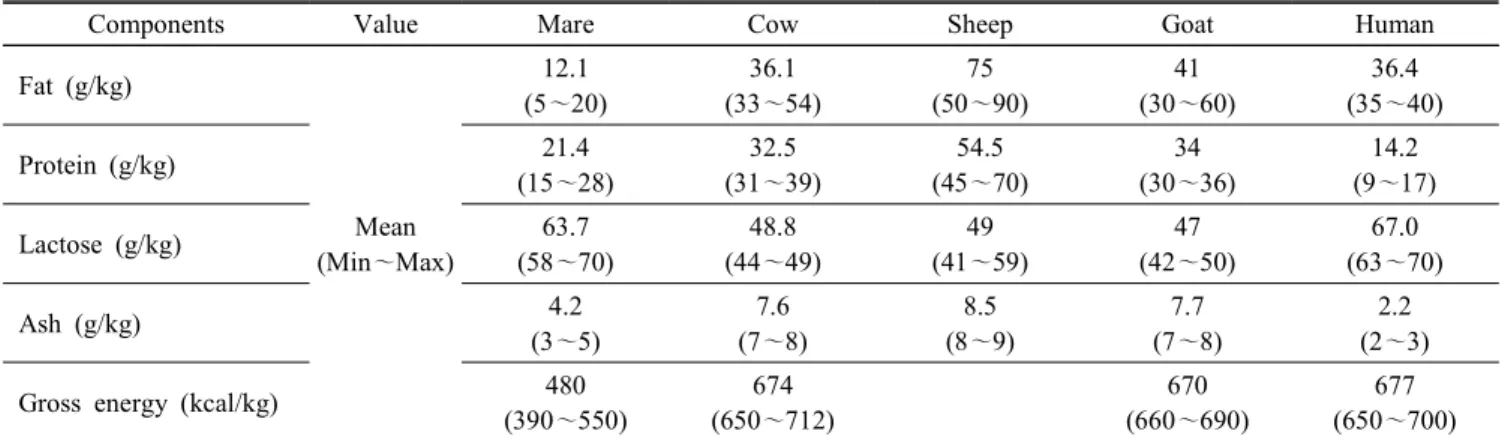
Table 1. Composition of mare, cow, sheep, goat and human milk - mean value, minimum-maximum values reported in literature
Components Value Mare Cow Sheep Goat Human
Fat (g/kg)
Mean (Min~Max)
12.1 (5~20)
36.1 (33~54)
75 (50~90)
41 (30~60)
36.4 (35~40)
Protein (g/kg) 21.4
(15~28)
32.5 (31~39)
54.5 (45~70)
34 (30~36)
14.2 (9~17)
Lactose (g/kg) 63.7
(58~70)
48.8 (44~49)
49 (41~59)
47 (42~50)
67.0 (63~70)
Ash (g/kg) 4.2
(3~5)
7.6 (7~8)
8.5 (8~9)
7.7 (7~8)
2.2 (2~3)
Gross energy (kcal/kg) 480
(390~550)
674 (650~712)
670 (660~690)
677 (650~700) Mitić et al., 1987; Solaroli et al., 1993; Simos et al., 1996; Salimei, 1999; Martuzzi et al., 2000.
어진다. 유성분면에서 포유동물 유선의 분비는 각 동물종 의 새끼동물의 영양적 요구 성분과 관련이 있다. 즉, 유조 성은 동물의 종에 의해 좌우된다고 할 수 있다. 말, 반추 및 인유의 조성 성분 비교가 Table 1에 나타나 있다.
지방 조성과 관련해서는 반추 동물 즉 소, 양, 염소 및 인 유와 비교할 때 마유는 특이하게 낮은 함량의 지방을 가지 고 있다. 반추동물의 유단백질 분획은 아주 높은 유사성을 보이고 있는데 비해, 인유와 마유는 훨씬 적은 단백질 함량 을 보이고 있다. 유당 함량에 관해서는 인유와 아주 유사한 함량을 나타내며, 반추동물의 경우에서는 더 높은 함량을 보인다. 이것은 인유와 마유가 꽤 유사하다는 것을 보여주 며, 이것은 갈락토오스를 함유한다.
마유와 인유는 미네랄 및 염 함량이 다른 반추동물 비교 할 때 그 함량이 적다. 마유의 총 에너지 공급은 뚜렷하게 인유보다 적다(Salimei, 1999). 인유와 마유 사이에 단백질, 유 당, 염 함량에 관련된 유사성은 마유가 다른 반추동물의 유보 다는 인유의 대체자로 더 적합하다는 것을 보여준다(Marconi 와 Panfili, 1998).
2. 마유 단백질
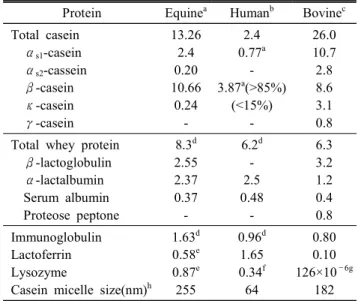
다른 종류의 유(milk)와 비교된 마유 단백질에 관한 자료 는 Table 2에 나타나 있다. 마유가 단백질이 함량이 우유보 다 낮지만 똑같은 단백질로 이루어져 있다. 예를 들면 주요 단백질인 카제인(casein)과 유청 단백질(whey protein)으로 구성되어 있다. 그렇지만 마유와 우유의 조성 차이가 존재 한다. 즉, 우유에서는 단백질 중 카제인이 80%를 차지하고 있어 주요 단백질을 구성하는데 비해, 마유에서는 우유에 비해 카제인은 덜 함유되고, 유청 단백질은 더 많이 함유되 어 있다. 한편, 등전점 pH에 의한 카제인 침전에 관련해서 는 과거에 마유도 우유처럼 pH 4.6에서 산 침전시켜 정량하 는 것이 일반적이었으나, Egito et al.(2002)은 pH 4.2에서 카
Table 2. Concentrations of caseins and whey protein (g/kg) in equine, human, bovine milk
Protein Equinea Humanb Bovinec
Total casein αs1-casein αs2-cassein β-casein κ-casein γ-casein
13.26 2.4 0.20 10.66
0.24 -
2.4 0.77a
- 3.87a(>85%)
(<15%) -
26.0 10.7 2.8 8.6 3.1 0.8 Total whey protein
β-lactoglobulin α-lactalbumin Serum albumin Proteose peptone
8.3d 2.55 2.37 0.37 -
6.2d - 2.5 0.48
-
6.3 3.2 1.2 0.4 0.8 Immunoglobulin
Lactoferrin Lysozyme
Casein micelle size(nm)h 1.63d 0.58e 0.87e 255
0.96d 1.65 0.34f 64
0.80 0.10 126×10-6g
182
a Miranda et al., 2004; b Hambræus, 1984; c Walstra et al., 2006; d Park et al., 2006; e Pagliarini et al., 1993; f Montagne et al., 1998, 2000; g El-Agamy et al., 1996, h Malacarne et al., 2002.
제인의 침전이 최대로 일어난다고 보고하였다.
단백질 함량은 종(species) 간 다양하게 차이가 있으며, 육 종, 비유 시기, 수유, 계절 및 유방의 청결 상태에 따라 영 향을 받는다. 마유, 우유, 양유 및 염소유의 주요 질소 분획 은 Table 3에 나타나 있다. 마유는 다른 종의 유(milk)와는 달리 NPN(non proteic nitrogen)의 수준이 높은 것이 특징이 며, 대신에 카제인 질소(casein nitrogen)는 덜 함유한다. 이 는 앞서 기술한 것처럼 마유 속 카제인의 함량이 반추동물 의 카제인보다 덜 함유되어 있기 때문이다. 유청 단백질의 경우, 우유와는 다르게 마유에서 거의 40%를 차지하는데 비 해 인유에서는 50% 차지한다. 이렇듯 유청 함량이 인유와 비슷하여 마유는 인간의 영양적 측면에서 우유보다는 더 좋 은 원료로 제공되어질 수 있다. 왜냐하면 상대적으로 더 많 은 필수 아미노산을 함유하기 때문이다(Hambræus, 1994).
마유 카제인은 알파에스 카제인(αs-casein)과 베타 카제인 (β-casein)으로 구성되어 있으며(Ochirkhuyag et al., 2000), 알파에스 카제인(αs-casein)에도 두 가지 종류(αs1-casein과 αs2-casein)의 알파에스 카제인이 존재하는데, 아직까지도 연 구 중에 있다. 최근에 카파 카제인(κ-casein)에 관한 연구 가 진행되어 동정 및 특정화 되었다(Egito et al., 2002). 하 지만 그 양은 우유에 비해 월등히 적게 존재한다. 알레르기 를 유발시키는 알파에스-1 카제인(αs1-casein)은 우유에 존재 하지만, 마유의 경우 베타 카제인(β-casein)의 양이 많아 마유 는 알레르기에 덜 민감하다고 볼 수 있다(Clare와 Swaisgood,
2000). 유청 단백질의 경우 알파 락타알부민(α-lactalbumin) 역시 우유에서 알레르기를 유발하는데 원인을 제공한다. 이 것은 아주 심각한 문제를 일으키는데, 특히 영유아에서 더 욱 그렇다. 그러나 산양유에 대해서는 영유아들에게 이러한 알레르기를 유발하지 않아 고통 없이 산양유를 종종 소비 할 수 있다. 이것은 두 단백질(산양유와 우유의 알파 락타 알부민)의 구조의 차이점에서 설명되어질 수 있다. 베타락 토글로불린(β-lactoglobulin)의 경우 염소, 양, 마유에서 유청 단백질 중에서 주요한 단백질이다. 이 단백질 역시 알레르 기를 유발하는데 인유 대체제로 우유를 사용한 경우 영유아 에서 알레르기가 일어났다(Businco와 Bellanti, 1993). Businco
et al.(2000)은 마유로 사용시 이러한 현상들이 덜 일어난다
고 보고하였다. 이렇듯 마유는 우유와 같은 유단백질을 함 유하고 있으나, 그들의 조성은 많은 차이를 보이고 있으며, 인유를 대체할 만한 영양학적 특성을 보이고 있다.3. 마유의 기능성 및 생리활성 성분과 특성
1) 기능성 및 생리활성
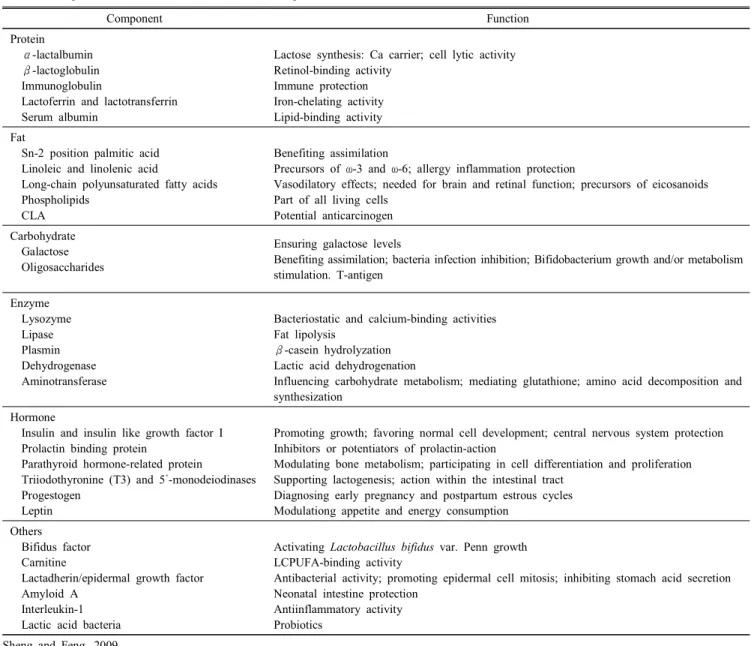
마유는 여러 많은 특수한 기능 즉 감염에 대해 보호할 수 있는 기능들을 가지고 있다. Table 3은 마유 내 존재하는 성분의 특수한 생리활성 기능을 나타낸 것이다. Table 3에 서 보듯이 단백질, 지방, 탄수화물, 효소 호르몬 등 다양한 성분들이 생리활성을 가지는 것을 볼 수 있다(Sheng과 Fang, 2009). 건강 증진 및 질병 예방 차원에서 보충제로서의 이 러한 생리기능성 성분들의 잠재적 역할은 공중위생 분야에 서 중요하다.
말의 유선에서 분비되는 물질 중 human-like leptin이 3.35~
3.52 ng/mL에 해당하는 양이 존재하고(Salimei et al., 2002), insulin like growth factor 1은 9.81~15.5 ng/mL가 차지하 고 있다(Magistrelli et al., 20008). T3(Triiodothyronine)는 4.0 ng/mL가 존재한다(Todini et al., 2010). 인유에 존재하는 이 러한 물질(molecule), 그리고 다른 것들은 조절 음식 섭취, 대사 그리고 영유아 체내조건 등을 조절하는데, 그들의 잠 재적 직접적 역할로 인해 기능성 식품으로 주목이 증가하고 있다(Agostoni, 2005; Dvorak, 2010; Lonnerdal, 2010).
한편, 우유 내 NPN은 여러 가지 물질로 구성되어 있는데, 즉 유레아(urea), 펩타이드, 아미노산 그리고 암모니아 등이 다. 마유에서 NPN의 함량은 10~15%로 그 함량은 우유와 인유 중간에 위치해 있다(Walstra et al., 2006).
단백질의 경우, 카제인 및 유청 단백질은 여러 가지 기전 을 통하여 잠재적 생리학적 활성을 유도하여 인간 건강에 기여한다고 본다. 이러한 생리활성을 나타내는 물질을 생 성하기 위해서 그 단백질 자체로 기능을 나타낼 수도 있으
Table 3. Specific bioactive functions of the components in mare milk
Component Function
Protein α-lactalbumin β-lactoglobulin Immunoglobulin
Lactoferrin and lactotransferrin Serum albumin
Lactose synthesis: Ca carrier; cell lytic activity Retinol-binding activity
Immune protection Iron-chelating activity Lipid-binding activity Fat
Sn-2 position palmitic acid Linoleic and linolenic acid
Long-chain polyunsaturated fatty acids Phospholipids
CLA
Benefiting assimilation
Precursors of ω-3 and ω-6; allergy inflammation protection
Vasodilatory effects; needed for brain and retinal function; precursors of eicosanoids Part of all living cells
Potential anticarcinogen Carbohydrate
Galactose Oligosaccharides
Ensuring galactose levels
Benefiting assimilation; bacteria infection inhibition; Bifidobacterium growth and/or metabolism stimulation. T-antigen
Enzyme Lysozyme Lipase Plasmin Dehydrogenase Aminotransferase
Bacteriostatic and calcium-binding activities Fat lipolysis
β-casein hydrolyzation Lactic acid dehydrogenation
Influencing carbohydrate metabolism; mediating glutathione; amino acid decomposition and synthesization
Hormone
Insulin and insulin like growth factor I Prolactin binding protein
Parathyroid hormone-related protein
Triiodothyronine (T3) and 5΄-monodeiodinases Progestogen
Leptin
Promoting growth; favoring normal cell development; central nervous system protection Inhibitors or potentiators of prolactin-action
Modulating bone metabolism; participating in cell differentiation and proliferation Supporting lactogenesis; action within the intestinal tract
Diagnosing early pregnancy and postpartum estrous cycles Modulationg appetite and energy consumption
Others Bifidus factor Carnitine
Lactadherin/epidermal growth factor Amyloid A
Interleukin-1 Lactic acid bacteria
Activating Lactobacillus bifidus var. Penn growth LCPUFA-binding activity
Antibacterial activity; promoting epidermal cell mitosis; inhibiting stomach acid secretion Neonatal intestine protection
Antiinflammatory activity Probiotics
Sheng and Feng, 2009.
나, 여러 가지 과정 즉 소화효소에 의한 가수분해에 의해, 유 산균 등 미생물에 의한 발효에 의해 혹은 미생물 혹은 식물 유래 단백분해효소에 의해서 생성되어진다(Korhonen, 2009).
생성된 펩타이드들은 특수한 생리적 기능을 조절할 수 있 는데, 그 조절기능은 다음과 같다.
․체중 조절 - 포만감으로 인한 식욕저하인자, 글리코마 크로펩타이드, 진통작용인자
․신경시스템 - 긴장완화작용, 진통작용인자
․면역시스템 - 면역조절
․심장관련 - 항고혈압인자, 항산화제, 항콜레스테롤
․뼈 관련 - 칼슘 흡착제, 항균활성
이런 기능성 펩타이드를 생산할 수 있음에도 불구하고, 마유에 대한 연구는 미흡한 실정이다. 마유나 당나귀유의 기능성 단백질 중 항균효과를 보이는 라이소자임(lysozyme) 및 락토페린(lactoferrin)이 존재하는데, 라이소자임은 그람 양성 박테리아에 대해 더 효과가 있으며, 반대로 음성인 경 우에는 효과가 약하다고 보고되었다(Kato, 2003). 당나귀 유에서 항고혈압 펩타이드를 베타 카제인(β-casein)에서 동정되었고(Bidasolo et al., 2012), 또한 베타 카제인 유래 펩타이드가 인간의 건강에 좋은 효과를 보인다고 보고되었 다(Doreau와 Martin-Rosset, 2002).
또한 프로바이오틱 음료 생산을 위해 마유가 적절한 기 질로 작용되어질 수 있다. 발효된 마유의 사용은 쿠미스
(Koumiss) 혹은 에락(Airag)이 건강 증진 음료로 여겨지는 중앙아시아에서는 고대 전통음료로 사용되어졌다(Uniacke- Lowe, 2011). 마유에서 유래된 젖산-알콜 발효음료인 쿠미스 는 원유의 효과적 조합이며, 주된 미생물 즉 유산균과 효모 다양성에 대한 관심이 증대되고 있다(Watanabe et al., 2008).
새로운 Lactobacillus casei strain, Lb. casei Zhang은 프로바 이오 특성이 연구(Guo et al., 2009) 중에 있는데 비해, 새로 운 Bifidobacterium 종인 Bifidobacterium mongoliense sp. nov.
은 애락(Airag)으로부터 분리되었다(Watanabe et al., 2009).
애락(Airag) 속 유산균에 의해 생성된 박테리오신은 Batdorj
et al.(2006)
에 의해 분리 및 특정화되었다. 쿠미스 또한 ACE(angiotensin-converting enzyme) 억제 펩타이들이 풍부한데, 이는 심혈관 건강에 도움이 된다는 주장에 타당성을 제공 한다(Chen et al., 2010).
마유의 생산량이 소량임에도 불구하고 이렇듯 마유에 대 한 생리기능성 물질이 함유되어 있기 때문에, 이에 관한 연 구는 매우 흥미롭다고 할 수 있다. 특히 마유 단백질로부터 유 래된 펩타이드의 기능성 연구 또한 잠재적 가능성을 보인다.
2) 마유의 소화율 및 알레르기
우유 단백질의 특히 카제인의 소화는 위내의 펩신에 의 해 이루어지는데, 위에서 우유의 침전은 단백질 분해를 더 디게 한다. 이 침전물은 카제인으로 되어 있어 우유 내 카 제인의 함량에 따라 단백분해가 좌우된다고 할 수 있다. 그 렇지만 마유와 인유는 카제인의 함량이 우유보다 적게 함 유되어 있고, 그들의 응고 형태는 부드러우며 빨리 해체되 는 특징이 있다(Oftedal, 1980). 마유와 인유의 단백질 양상 이 비슷하기 때문에 마유는 우유보다 마유가 인간의 영양에 더 적합하다고 할 수 있다. 마유와 인유의 소화율은 Turner(1945) 는 마유의 소화율이 인유보다는 약간 낮으며, 우유보다는 높다고 보고하였으며, 또한 인유와 마유는 위내에서 좀 더 단단한 형태의 우유의 커드보다 부드러운 커드 형태로 되 어 좀 더 빨리 소화관을 통과할 수 있다고 하였다. 마유의 소화율에 관한 또 다른 연구(in vitro) 역시 인유와 마유의 소화율은 매우 비슷하고, 우유와 비교시 소화가 더 쉽게 된 다는 보고도 있다(Kalliala et al.,1951). 인유의 위내 배출시 간은 2~2.5시간인데 비해, 우유는 그 커드의 형태가 단단 하게 되어 있어서 소화시간이 3~5시간이다.
우유 알레르기는 Ig-E 매개가 된 I형 알레르기이다. 이러 한 알레르기를 유발하는 것은 우유 중 존재하는 우유 단백 질이다. 즉, 카제인 및 유청 단백질인데, 특히 유청 단백질 중 베타락토글로불린(β-lactoglobulin)이 우유 알러젠으로 중 요하게 여겨지고 있다. 인유는 이 단백질이 없으며, 마유는 우유보다 낮은 함량을 차지한다. 마유의 알레르기는 지금
까지 아주 극히 드물게 나타난다. 단지 몇 개의 연구가 보 고되었다. Fanta와 Ebner(1998)의 말의 비듬 알러젠에 대한 보고와 Spitzauer(1999)의 호스시럼알부민(horse serum albumin) 이 존재한다. 또한 Gall et al.(1996)은 열에 민감한 유청 단 백질(알파락타알부민 및 베타락토글로불린)에 의해 원인이 된 한 명의 환자에게서 Ig-E 매개 마유알레르기가 있다고 보고하였다. 이 환자의 경우, 우유의 유청 단백질과 교차반 응이 없었기 때문에 마유의 유청 단백질이 원인이 되었다 고 보고하였다. 마유의 단백질이 우유보다 낮으며, 그 구성 성분인 카제인 및 유청 단백질의 함량도 낮다. 또한 카제인 중 낮은 알파에스-1 카제인(αs1-casein) 및 베타락토글로불 린(β-lactoglobulin) 함량으로 알레르기를 덜 유발한다고 할 수 있다. 그래서 우유나 염소유보다 인간의 알레르기 치료 에 이용되어질 수 있다.
4. 마유제품의 가공
최근 수년 동안 마유의 판매가 주목할 만하게 증가되고 있는 것처럼 이에 대한 연구의 초점이 새로운 제품 혹은 새 로운 방법의 개발에 맞춰지고 있다. 상대적으로 높은 가공 온도를 견뎌내는 유의 능력은 기술적 측면에서 아주 중요 하다. 마유의 유청 단백질은 훨씬 더 열에 안정하여 마유 제 조 시 열처리 공정에서 우유보다는 덜 민감하다. 락토페리 신 및 마유 BSA는 가장 민감하게 보여지는데, 130℃에서도 완전히 변성되지 않는다. 베타락토글로불린(β-lactoglobulin) 와 알파락타알부민(α-lactalbumin)은 130℃에서 완전히 변 성되며, 라이소자임(lysozyme)은 110℃ 이상에서 일어난다.
열에 안정한 라이소자임의 높은 함량은 발효제품을 생산하 는데 있어 스타터 컬처의 미생물 활성을 방해할 수도 있다 (Jauregui-Adell, 1975). 그래서 마유 가공에서 있어서 기술 적인 문제를 야기한다. Di Cango et al.(2004)은 라이소자임 을 불활성하기 위해 90℃에서 3분 동안 열처리를 하고, Lb.
delbrueckki subsp. bulgaricus
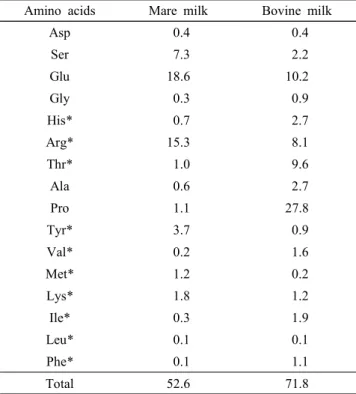
와 Streptococcus thermophilus 의 스타터 컬쳐를 사용하여 만족스러운 발효유를 생산하였 다. 그러나 발효된 마유의 조직 및 향미는 제품의 기호성에 제약이 따를지도 모른다. 소듐 카제네이트(sodium caseinate), 펙틴(pectin), 트레오닌(threonine) 혹은 향미 첨가는 물성 및 관능의 품질을 높일 수 있어 기호성을 증진시킬 수 있다(Di Cagno et al., 2004). 그 결과로 생긴 제품은 4℃에서 45일 후 좋은 세균학적, 물성 및 관능 특성을 지닌다. 그렇지만 이러한 마유를 위에서 기술한 물질들은 첨가하지 않았을 때 발효유의 맛이나 점도 등이 감소되어 그 품질이 만족스 럽지 못하게 된다. 소듐 카제네이트와 설탕의 첨가는 단백 질 구조(protein network)를 단단하게 하여 발효유 제품의 물 성학적 성질에 긍정적인 효과를 준다. 그러나 표준화된 제조 방법에 의한 발효유의 생산은 소비자와 시장의 상황이 중요하게 고려되어야 한다. 또한 발효된 마유의 특성을 보 면 유산균이 시간에 따라 우유에서처럼 잘 성장하지만, 산 성화 정도 즉 pH는 우유에서보다 마유에서 더 내려가는 특 징이 있다(Chang et al., 2011). Table 4에서 보듯이, 우유로 발효된 발효유에서는 유리아미노산 중 글라이신(glycine), 히스티딘(histidine), 트레오닌(threonine), 알라닌(alanine), 프 롤린(proline), 발린(valine), 이조류신(isoleucine) 그리고 페 닐알라닌(phenylalanine)들이 많이 유리되었으며, 마유에서 는 아스파라틱산(aspartic acid), 세린(serine), 글루탐산(glutamic acid), 아르기닌(arginine), 티로신(tyrosine), 메티오닌(methionine), 라이신(lysine) 등이 더 많이 유리되었다. 특히 갓난 신생아 의 성장에 필요한 글루탐산(glutamic acid) 및 세린(serine) 의 함량이 우유보다 많이 유리된다고 보고되었다(Chang et al., 2011). 인유에서 이들 아미노산이 61%를 차지한다고 하였 으며(Carratù et al., 2003), 총 유리아미노산 중 50%가 글루 탐산이라는 보고도 있다(Agostini et al., 2000). 또한 신생아 를 위한 아미노산 예를 들어 히스티딘, 아르기닌, 티로신 등이 발효 중 우유(16.3%)보다 마유(37.5%)에서 더 많이 유 리되어 신생아에게 적합하다고도 할 수 있을 것이다(Chang
Table 4. Concentrations (mg/100 mL) of free amino acid during lactic acid bacteria fermentation
Amino acids Mare milk Bovine milk
Asp 0.4 0.4
Ser 7.3 2.2
Glu 18.6 10.2
Gly 0.3 0.9
His* 0.7 2.7
Arg* 15.3 8.1
Thr* 1.0 9.6
Ala 0.6 2.7
Pro 1.1 27.8
Tyr* 3.7 0.9
Val* 0.2 1.6
Met* 1.2 0.2
Lys* 1.8 1.2
Ile* 0.3 1.9
Leu* 0.1 0.1
Phe* 0.1 1.1
Total 52.6 71.8
Chang et al., 2011.
* Essential amino acids containing His, Arg and Tyr for infant and children.
et al., 2011).
서유럽 건강식품 판매점과 어떤 약국에서 마유는 냉동 혹은 동결 건조된 마유의 캡슐로 판매되고 있다. 다른 형태 는 냉동 혹은 동결 건조된 초유가 포함된다. 마유는 암환자 의 치료에 있어서 하나의 도움을 주는 물질로 추천되어지 며, 그 양은 하루에 250 mL를 마셔야 된다고 하였다. 화장 품 생산에 있어 마유의 이용은 상대적으로 새롭고 그들은 비 누, 크림. 수분 제공 크림을 포함한다(Doreau와 Martin-Rosset, 2002).
결 론
우유의 알레르기에 대한 높은 내성 때문에 마유에 대한 관심이 다시 주목 받고 있다. 가수 분해된 대두로 조제된 것이 이 질병의 치료에 적합하다고 할지라도 마유처럼 대 체 식품이 아주 심한 환자에게는 필요하다. 마유의 단백질 은 알레르기 유발 단백질이 우유에 비해서는 낮은 함량을 지닌다. 인유와 마유의 성분과 기호가 유사하고 마유의 소 화율도 좋기 때문에, 마유가 저 알레르기 조제분유의 좋은 대체제로 사용이 가능하다. 더욱이 마유 내 생리활성 성분 의 존재는 건강 증진 목적으로 고대로부터 소비해온 이들 의 중요성을 말해준다. 또한 발효를 통해 더 많은 생리활성 물질을 생산할 수 있으며, 마유 발효유의 물성 및 관능적 성 질뿐만 아니라 필수아미노산의 유리가 더 많이 일어나 인 유의 대체제로서 이용이 가능하다. 마유는 식이와 치료, 특 히 노인, 회복기 환자, 신생아를 위한 식이에 있어서의 잠 재적으로 이용 가능성이 존재한다. 또한 마유 단백질의 가 수분해를 통한 기능성 펩타이드에 대한 연구도 흥미로울 것이라 보여진다.
감사의 글
본 연구는 2013 농촌진흥청 박사후 연구과제 및 국립축 산과학원 과제(PJ0085852013)에 의해 수행되었다.
참고문헌
1. Agostoni, A. 2005. Ghrelin, leptin and the neurometabolic axis of breast-fed and formula-fed infants. Acta Paediatrica 94:523-525.
2. Agostoni, C., Carratù, B., Boniglia, C., Riva, E. and Sanzini, E. 2000. Free amino acid content in standard infant formulas: comparison with human milk. Journal of the American College of Nutrition 19:434-438.
3. Batdorj, B., Dalgalarrondo, M., Choiset, Y., Pedroche, J., Métro, F., Prévost, H., Chobert, J. M. and Haertlé, T.
2006. Purification and characterization of two bacteriocins produced by lactic acid bacteria isolated from Mongolian airag. Journal of Applied Microbiology 101:837-848.
4. Bidasolo, I. B., Ramos, M. and Gomez-Ruiz, J. A. 2012.
In vitro simulating gastrointestinal digestion of donkeys’
milk. Peptide characterization by high performance liquid chromatography-tandem mass spectrometry. International Dairy Journal 24:146-152.
5. Businco, L. and Bellanti, J. 1993. Food allergy in child- hood. Hypersensitivity to cow’s milk allergens. Clinical and Experimental Allergy 23:481-483.
6. Businco, L., Giampietro, P. G., Lucenti, P., Lucaroni, F., Pini, C., Di Felice, G., Iacovacci, P., Curadi, C. and Orlandi, M. 2000. Allergenicity of mare’s milk in children with cow’s milk allergy. Journal of Allergy and Clinical Immunology 105:1031-1034.
7. Carratù, B., Boniglia, C., Scalise, F., Ambruzzi, A. M.
and Sanzini, E. 2003. Nitrogenous components of human milk: non-protein nitrogen, true protein and free amino acids. Food Chemistry 81:357-362.
8. Chang, O. K., Lee, B. O., Humbert, G. and Saulnier, F.
2011. Nutritional advantage of protein fraction in equine milk as compared to bovine milk. Milchwissenschaft 66:282-285.
9. Chen, Y., Wang, Z., Chen, X., Liu, Y., Zhang, H. and Sun, T. 2010. Identification of angiotensin I-converting enzyme inhibitory peptides from koumiss, a traditional fermented mare’s milk. Journal of Dairy Science 93:
884-892.
10. Clare, D. A. and Swaisgood, H. E. 2000. Bioactive milk peptides: A prospectus. Journal of Dairy Science 83:
1187-1195.
11. Csapó, J., Stefler, J., Martin, T. G., Makray, S. and Csapó- Kiss, Zs. 1995. Composition of mare’s colostrum and milk.
Fat content, fatty acid composition and vitamin content.
International Dairy Journal 5:393-402.
12. Curadi, M. C., Giampietro, P. G., Lucenti, P. and Orlandi, M. 2001. Use of mare milk in ediatric allergology.
Proceedings of the Associazione Scientifica Produzioni Animali. XIV Congress, Firenze, Italy.
13. Di Cagno, R., Tamborrino, A., Gallo, G., Leone, C., De Angelis, M., Faccia, M., Amirante, P. and Gobbetti, M.
2004. Uses of mares’ milk in manufacture of fermented milk. International Dairy Journal 14:767-775.
14. Doreau, M. 1994. Le lait de jument et sa production:
particularités et facteurs de variation. Lait 74:401-418.
15. Doreau, M. and Martin-Rosset, W. 2002. Dairy animals:
horse. In H. Roginski, J. A. Fuquay, and P. F. Fox (Eds.), Encyclopedia of dairy sciences. Academic Press, London, UK. pp. 630-637.
16. Drogoul, C., Prevost, H. and Maubois, J. L. 1992. Le lait de juments un produit, une filiere a developper? Quoi de neuf en matiere d’etudes de recherches sur le cheval?
18éme Journée d’Etude, CEREOPA, Paris, pp. 37-51.
17. Dvorak, B. 2010. Milk epidermal growth factor and gut protection. Journal of Pediatrics 156:S31-S35.
18. Egito, A. S., Miclo, L., López, C., Adam, A., Girardet, J. M. and Gaillard, J. L. 2002. Separation and charac- terization of mare’s milk αs1, β-, κ-caseins, g-casein- like, and proteose peptone components 5-like peptides.
Journal of Dairy Science 85:697-706.
19. El-Agamy, E. I., Ruppanner, R., Ismail, A., Champagne, C. P. and Assaf, R. 1996. Purification and characterization of lactoferrin, lactoperoxidase, lysozyme and immunoglobulins from camel’s milk. International Dairy Journal 6:129-145.
20. Fanta, C. and Ebner, C. 1998. Allergy to mare’s milk.
Allergy 53:539-540.
21. Guo, Z., Wang, J., Yan, L., Liu, X. and Zhang, H. 2009.
In vitro comparison of probiotic properties of Lactobacillus casei Zhang, a potential new probiotic, with selected
probiotic strains. Food Science and Technology 42:1640- 1646.22. Hambræus, L. 1984. Human milk composition. Nutrition Abstracts and Reviews in Clinical Nutrition e Series A 54:219-236.
23. Humbert, G., Chang, O. and Gaillard, J. L. 2005. Plasmin activity and plasminogen activation in equine milk.
Milchwissenschaft 60:134-137.
24. Jauregui-Adell, J. 1975. Heat stability and reactivation of mare milk lysozyme. Journal of Dairy Science 58:
835-838.
25. Kalliala, H., Seleste, E. and Hallman, N. 1951. On the use of mare’s milk in infant feeding. Acta Paediatrica 40:97-117.
26. Kato, A. 2003. Lysozyme. In J. R. Whitaker, A. G. Voragen, and D. W. S. Wong (Eds.), Handbook of food enzy-
mology. Marcel Dekker, New York, USA. pp. 971-978.
27. Korhonen, H. 2009. Milk-derived bioactive peptides: From science to applications. Journal of Functional Foods 1:
177-187.
28. Lonnerdal, B. 2010. Bioactive proteins in human milk:
Mechanisms of action. Journal of Pediatrics 156:S26-S30.
29. Lozovich, S. 1995. Medical uses of whole and fermented mare milk in Russia. Cultured Dairy Products Journal 30:18-21.
30. Magistrelli, D., Rosi, F., Amicone, V., Maglieri, C. and Salimei, E. 2008. Peptidi bioattivi nel latte di asina: primi risultati sperimentali. Atti Convegno Quali Cibi e Cibi di ieri e di domani: qualità e sicurezza tra tradizione e innovazione. Positano, Italy. pp. 28-30.
31. Malacarne, M., Martuzzi, F., Summer, A. and Mariani, P.
2002. Protein and fat composition of mare’s milk: some nutritional remarks with reference to human and cow’s milk. International Dairy Journal 12:869-897.
32. Marconi, E. and Panfili, G. 1998. Chemical composition and nutritional properties of commercial products of mare milk powder. Journal of Food Composition and Analysis 11:178-187.
33. Martuzzi, F., Tirelli, A., Summer, A., Catalano, A. L. and Mariani, P. 2000. Ripartizione delle sieroproteine nel latte dei primi due mesi di lattazione in giumente Sella Italiano. Rivista Societa Italiana di Ippologia 6:21-27.
34. Miranda, G., Mahé, M. F., Leroux, C. and Martin, P. 2004.
Proteomic tools to characterize the protein fraction of Equidae milk. Proteomics 4:2496-2509.
35. Mitić, N., Ferčej, J., Zeremski, D. and Lazarević, L. J.
1987. Govedarstvo. Zavod za udžbenike i nastavna sredstva, Beograd. pp.452-455.
36. Montagne, P., Cuillière, M. L., Molé, C., Béné, M. C.
and Faure, G. 1998. Microparticle enhanced nephelometric immunoassay of lysozyme in milk and other human body fluids. Clinical Chemistry 44:1610-1615.
37. Montagne, P., Cuillière, M. L., Molé, C., Béné, M. C. and Faure, G. 2000. Dynamics of the main immunologically and nutritionally a vailable proteins of human milk during lactation. Journal of Food Composition and Analysis 13:127-137.
38. Ochirkhuyag, B., Chobert, J. M., Dalgalarrondo, M. and Haertlé, T. 2000. Characterization of mare caseins. Identifi- cation of αS1- and αS2-caseins. Lait 80:223-235.
39. Oftedal, O. T. 1980. Milk composition and formula selection for hand-rearing young animals. First annual Dr. Scholl nutrition conference on the nutrition of captive wild animals.
In E. R. Maschgan, M. E. Allen, and L. E. Fisher (Eds.), The nutrition of captive wild animals, Lincoln Park Zoological Gardens, Chicago, Illinois, USA. pp.67-83.
40. Özer, B. 2000. Fermented milk. Products of Eastern Europe and Asia. In R. K. Robinson, C. A. Batt. P. D. Patel (Eds), Encyclopedia of food microbiology, Academic Press, London., UK. pp.803-804.
41. Pagliarini, E., Solaroli, G. and Peri, C. 1993. Chemical and physical characteristics of mare’s milk. Italian Journal of Food Science 4:323-332.
42. Paradis, M. R. 2003. Nutritional support: enteral and pa- renteral. Clinical Techniques in Equine Practice 2:87-95.
43. Park, Y. W., Zhang, H., Zhang, B. and Zhang, L. 2006.
Mare milk. In Y. W. Park, and F. W. Haenlein (Eds.), Handbook ofnon-bovine mammals. Blackwell Publishing.
Oxford, UK. pp.275-296.
44. Salimei, E. and Fantuz, F. 2012. Equid milk for human consumption. International Dairy Journal 24:130-142.
45. Salimei, E. 1999. Latte di equide: dalla storia, una proposta dietetica e terapeutica. 1st Congress Nuove acquisizioni in materia di alimentazione, allevamento e allenamento del cavallo sportivo. Campobasso, Italy, March 26.
46. Salimei, E., Varisco, G. and Rosi, F. 2002. Major con- stituents, leptin, and non-protein nitrogen compounds in mares’ colostrum and milk. Reproduction Nutrition Deve- lopment 42:65-72.
47. Sheng, Q. and Fang, X. 2009. Bioactive components in mare milk bioactive components in milk and dairy products edited by Park, Y. W. Wiley-Blackwell. A John Wiley
& Sons, ltd., Publication. pp. 195-213.
48. Simos, E. N., Nikolaou, E. M. and Zoiopoulos, P. E. 1996.
Yield, composition and certain physicochemical charac- teristics of milk of the Epirus mountain sheep breed.
Small Ruminant Research 20:67-74.
49. Solaroli, G., Pagliarini, E. and Peri, C. 1993. Composition and nutritional quality of mare’s milk. Italian Journal of Food Science 5:3-10.
50. Spitzauer, S. 1999. Allergy to mammalian proteins : at the borderline between foreign and self? International Archives of Allergy and Immunology 120:259-269.
51. Stoyanova, L. G., Abramova, L. A. and Ladoto, K. S.
1988. Freeze-dried mares’ milk and its potential use in infant and dietetic food products. Voprosy Pitaniia. 2:
64-67.
52. Todini, L., Malfatti, A., Salimei, E. and Fantuz, F. 2010.
Measurement of thyroid hormones in donkey (Equus
asinus) blood and milk: validation of ELISA kits and
evaluation of 3 sample collection, handling and storage.Journal of Dairy Research 76:1-6.
53. Turner, A. W. 1945. Digestibility of milk as affected by various types of treatment. Food Research International 10:52-59.
54. Uniacke-Lowe, T. 2011. Koumiss. In J. W. Fuquay, P. F.
Fox, & P. L. H. McSweeney (Eds.) (2nd ed.).. Encyclopedia of dairy sciences, Vol. 2. Academic Press, San Diego, CA, USA. pp.512-517.
55. Walstra, P., Wouters, J. T. M. and Geurts, T. J. 2006.
Dairy science and technology (2nd ed.). CRC Press, Boca Raton, FL, USA.
56. Watanabe, K., Fujimoto, J., Sasamoto, M., Dugersen, J., Tumursuh, K. and Demberel, S. 2008. Diversity of lactic acid bacteria and yeast in Airag and Tarag, traditional fermented milk products of Mongolia. World Journal of Microbiology and Biotechnology 24:1313-1325.
57. Watanabe, K., Makino, H., Sasamoto, M., Kudo, Y., Fujimoto, J. and Demberel, S. 2009. Bifidobactrium
mongoliense sp. Nov., from airag, a traditional fermented
mare’s milk product from Mongolia. International Journal of Systematic and Evolutionary Microbiology 59:1535- 1540.58. Zicker, S. C. and Lönnerdal, B. 1994. Protein and nitrogen composition of equine (Equus caballus) milk during early lactation. Comparative Biochemistry and Physiology 108:
411-421.
(Received: June 5, 2013 / Accepted: June 20, 2013)
![[1] 전공소개[2] 전공능력](data:image/gif;base64,R0lGODlhAQABAIAAAP///wAAACH5BAEAAAAALAAAAAABAAEAAAICRAEAOw==)