EDISON 계산화학 경진대회
S. Nam
Local Structure Study of Liquid Phase Ethylene Glycol and 1,3-propanediol through Density Functional Theory
Seungsoo Nam, Eunji Sim
*Department of Chemistry, Yonsei University, Seoul 03722, Korea
Received Date; Accepted Date (to be inserted by the publisher after your manuscript is accepted) Using density functional Theory, we studied local structure of liquid ethylene glycol and 1,3-propanediol.
For both liquid, making intramolecular hydrogen bonding is not preferred, because relative energy between with and without intramolecular hydrogen bond is only -1.95kcal/mol, which is far less than intermolecular hydrogen bonding energy, about -7.5kcal/mol. Also, hydrogen bond induce polarization of hydroxyl group and make 2
ndhydrogen bond more stronger. This effect was small in intramolecular hydrogen bond of ethylene glycol. When considering energy per hydrogen bond, making only one intermolecular hydrogen bond for ethylene glycol pair is energetically favored, while two intermolecular hydrogen bond can be formed in 1,3-propanediol pair.
Keywords: DFT, Ethylene glycol, 1,3-propanediol, Intramolecular Hydrogen bond, Intermolecular Hydrogen bond
Introduction
Ethylene glycol(EG) is widely used as coolant, antifreeze and 1,3-propanediol(PD) has numerous applications in foods, medicines, cosmetics. And both are used as solvent and precursor of polymers. Also, EG and PD are good model system for intramolecular hydrogen bond(ihb) molecules, and are simplified form of polyhydroxylated molecules, which play important roles in biochemistry. Many studies have done for gas-phase
1–4and hydrated form
5of these molecules, but little is known for liquid phase, and existence of intramolecular hydrogen bond is still on a debate.
6When considering local hydrogen bond balance(that is, the number of hydrogen donor have to be same with hydrogen acceptor), alkanols with only one hydroxyl group can make two hydrogen bond. Therefore, these molecules make linear chain. While diols, can be regarded as two alkanols(simply, methanol) connected by methylene bridge, can make 4 hydrogen bonds per molecule. From molecular dynamics simulations with different force fields, it was found that one EG molecule make little less than 4 hydrogen bonds per molecule regardless of force field used.
7This was supported by experimentally, from raman spectroscopy and Fourier transform IR
8, almost all hydroxyl group participate in hydrogen bond. Less thing was known for PD, but geometrical similarity that hydroxyl groups are exist each end of molecule, similar results are expected. So, EG and PD make about 4 hydrogen bonds per molecule, which is same with water. Other characteristic is that EG and PD can make ihb, and there can be competition between ihb and IHB(intermolecular hydrogen bond). This property is impossible in water, and will be discussed in this paper.
Theory and Computational Method
Geometry optimization of molecules and their dimers and trimers were carried out by the density functional theory(DFT) method, Becke’s hybrid method(B3)
9and the of Lee–Yang–
Parr(LYP) correlation functional
10at the B3LYP level with 6- 311++G** basis set. Grimmes’ empirical dispersion correction
11was used for more accurate long-range interactions. For liquid phase calculations, conductor-like screening model(COSMO) implicit solvent model was used.
12Effective radius of H, O, C and solvent are 1.30, 1.72, 2.00 and 1.30, respectively. Dielectric constant was set 37.0 for EG and 32.0 for PD. Basis set superposition error(BSSE) was corrected with counterpoise(CP) correction
13after geometry was optimized. When calculating binding energy of molecule A and B in supermolecule AB,
E
BSSE corrected=E
CP- E
A(A)-E
B(B)
Where
E
CP=E
AB(AB)+[E
A(A)-E
A(AB)] +[E
B(B)-E
B(AB)]
E
I(J) denotes energy of I calculated with basis set J. All
DFT calculations were performed with TURBOMOLE 6.4
package and Maestro was used for visualization.
EDISON 계산화학 경진대회
Local structure study of ethylene glycol and 1,3-propanediol
tTt
Results and Discussion
For EG, from 10 nonequivalent rotational conformers, tTt and tGg’ were selected(all PD and EG nomenclatures from Radom et al.
14), each representing conformers without ihb and conformers with ihb. Without COSMO, geometry of tTt and tGg’ were optimized and energy was calculated. Relative energy of these 2 conformers was 2.77kcal/mol, showing existence of ihb stabilizes gas-phase EG monomer. Same kind of calculations were performed for PD. From 23 nonequivalent local minimum conformers, tTTt and tGG’g were selected representing without and with ihb, respectively.
In this case, relative energy was 3.71kcal/mol, also showing stabilization through ihb.
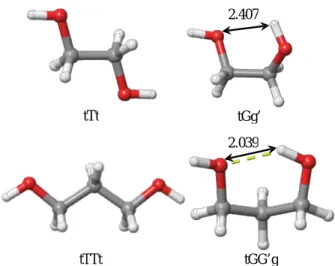
Starting geometry from gas-phase optimized geometry, geometry was re-optimized using COSMO (shown in Figure 1.) and energy was calculated. In this case, relative energies of with/without ihb were 1.95kcal/mol for both EG and PD.
This result seems to show ihbed conformers are more stable structures in liquid phase. However, this result doesn’t guarantee that ihbed conformers are dominant in liquid because H-bond between explicit molecules and implicit molecules are not implemented in COSMO. So for liquid phase study in here, equal or more than two explicit molecules’
binding energy was calculated.
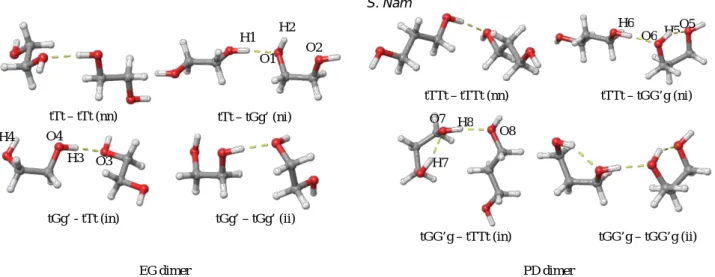
First, binding energies for only one IHB dimer configuration were calculated. Considering H donor and acceptor, 4 configurations (ihb conformer - abbreviate i - as H donor or acceptor, non-ihb – abbreviate n - conformer as H donor or acceptor) with various initial structures were tried and optimized geometry (shown in Figure 2.) binding energies are shown in Table 1. All H-bond length measured are shorter than 1.30+1.72, which is sum of COSMO effective radius of Hydrogen atom and Oxygen atom. So both IHB/ihbs are not interrupted by implicit solvent.
There are two carbon atoms between EG’s two hydroxyl groups. When EG molecule make ihb, and because of relatively short carbon chain(at least shorter than PD),
Figure 1. Optimized geometry of EG(tTt and tGg’) and PD(tTTt and tGG’g) monomers in COSMO implicit solvent. Length of ihb are 2.407 Å in EG tGg’ conformer and 2.039Å in PD tGG’g conformer. Relative energies are 1.95kcal/mol with little difference between EG and PD.
Yellow dashed line in tGG’g represent H-bond when O and H are in certain H-bond criteria in Maestro.
molecule exert geometrical constraint and ihb is weak because of long ihb length. In ni configuration in Figure 2, H1 approaches to O1 to make IHB. Electron density moves from H1 to O1, and O1H2 becomes electron rich. So ihb between H2 and O2 becomes weaker, and ihb length becomes longer(from 2.407 Å to 2.441Å). In in configuration, O3 approaches H3 and electron density moves from O3 to H3, and H3O4 becomes electron poor. So ihb between O4 and H4 becomes weaker , and ihb length becomes also longer(from 2.407Å to 2.430Å). In ii configuration, both ihb length becomes longer(from 2.407Å to 2.428Å and 2.554Å). And because of these weak ihb, IHB work as if there is no ihb. As a result, IHB strength doesn’t vary much with configurations(-7.48, -7.76, -7.64, -7.86 in Table 1.).
However, in case of PD, ihb distance of optimized monomer is 2.039Å, this is much shorter than that of EG, because three carbon chain between two hydroxyl group makes PD more flexible to make ihb. This ihb easily polarize
EG PD
nn ni in ii nn ni in ii
Ebsse corrected -7.48 -7.76 -7.64 -7.86 -7.53 -8.26 -8.87 -8.98
L HB inter 1.819 1.797 1.807 1.796 1.839 1.792 1.789 1.763
L intra donor
HB 2.430 2.428 1.926 1.934
L intra acceptor
HB 2.441 2.554 1.929 1.922
Table 1. Energy and H-bond length of EG and PD dimer with one IHB. n and i in configuration denotes non-ihb monomer and ihb monomer, respectively. H donor is written at the front, H acceptor is at the back. For example, ni denotes monomer n is H donor, monomer i is H acceptor. EBSSE corrected is binding energy of two monomers with BSSE correction. All energies are in units of kcal/mol. LHBinter is H-bond length of IHB, where LHBintra donor is ihb length of H donor monomer and LHBintra acceptor is same for H acceptor monomer. All H-bond length are measured hydrogen bonded H-O distances and are in units of Å.
2.039
tTTt tGG’g
2.407
tGg’
EDISON 계산화학 경진대회
S. Nam H1 H2
O1 O2
tTt – tTt (nn) tTt – tGg’ (ni)
H4 O4
H3 O3
tGg’ - tTt (in) tGg’ – tGg’ (ii)
EG dimer PD dimer
Figure 2. Optimized geometry of EG and PD dimers with only one IHB. Information of H-bond length are in Table 1. Yellow dashed lines represent H-bond. This appears when O and H are in certain H-bond criteria in Maestro.
molecule. In ni configuration of PD, electron density shifts from O5 to H5 to O6. Electron rich O6 then make stronger(- 7.53 to -8.26 in Table 1.) IHB with H6. Similar things happen in in configuration, electron density shifts from H8 to O7 to H7, making H8 electron poor. As a result, stronger IHB formed between H8 and O8. All IHB length becomes shorter (from 1.839Å in nn configuration to 1.792Å, 1.789Å and 1.763Å in ni, in, ii configuration, respectively) with ihb and all ihb length becomes shorter(from 2.039Å in monomer to 1.929 Å, 1.926Å and 1.934Å /1.922Å in ni, in, ii configuration, respectively) with IHB. So in PD, it is clear that ihb and IHB both stabilize dimer. This stabilization effect is far less in EG, because of short carbon chain length.
To figure out effect of hydroxyl group polarization due to hydrogen bond, trimer with two IHB were calculated. In this case, molecule 1, 2 and 3 make consecutive HB and BSSE correction was applied as
E
BSSE corrected=E
CP- E
I(I)-E
2J(2J)
E
CP=E
I2J(I2J)+[E
I(I)-E
I(I2J)] +[E
2J(2J)-E
12J(12J)]
Where I and J can be 1 or 3, but not same. Therefore, two IHB energies calculated separately(between 1 and 2, 2 and 3).
First, H atom in hydroxyl group of molecule 2 make HB with molecule 1, O in same hydroxyl group make HB with molecule 3. Starting geometry was carefully selected that each monomer pair make only one IHB per pair. From binding energy of -7.48kcal/mol and HB length of 1.819Å in nn configuration of EG, HB energies became lower to -8.92 and -8.75kcal/mol, and length became shorter to 1.768 and 1.783 Å in trimer. Same calculation in PD, binding energy was increased from -7.53kcal/mol to -8.89 and -8.54kcal/mol, HB length was decrease from 1.839 Å to 1.792 and 1.816Å.
Next, O atom in hydroxyl group of molecule 2 make HB with molecule 1 and 3. In this case, compare with EG’s nn configuration, binding energy became weaker to - 6.91kcal/mol and HB length was increased to 1.855Å. In PD, binding energy weaken to -7.12kcal/mol length increased to 1.871Å. This implies that HB induces polarization to hydroxyl group, making O atom more negative and H atom more positive. Therefore O atom can make stronger HB with other molecules H atom, H atom can make stronger HB with other molecules O atom, and this effect is about - 1~1.5kcal/mol. Also, If two H atoms from different hydroxyl group make HB with one O atom simultaneously, both HB become weaker because electron density of O atom is shared with two H atoms. Therefore, if HB network is formed, hydroxyl groups will make HB consecutively to induce polarization and 2 HBs on same O atom will not likely to be happen.
Next, dimer system with more than two IHB was considered. There are two situations in this case. First, when two hydroxyl group of one monomer makes H-bond with two hydroxyl group of another monomer separately, we call this
‘cyclic’ dimer. Second, when two hydroxyl group of one monomer makes H-bond with one hydroxyl group of other monomer simultaneously, we call this ‘triangle’ dimer. If dimer can be both cyclic and triangle, it is classified as triangle.
Bulk liquid is stabilized when more number of HB are formed, and their energies are lower. When assuming that maximum number of HB are already formed per each molecule, energy per HB becomes important. In Figure 3, dimers with 2 or 3 IHB are shown. Dimer (d) is most stable EG dimer with binding energy of -15.62kcal/mol. However, it has 3 IHB, and energy per HB is -5.21kcal/mol. This is relatively smaller value than dimer (c)’s energy per HB, which is -6.72kcal/mol. So, if dimer exist in liquid, (c) is preferred than (d). And cyclic dimers are relatively preferred
H6 H5O5 O6
tTTt – tTTt (nn) tTTt – tGG’g (ni) O7 H8
O8
H7
tGG’g – tTTt (in) tGG’g – tGG’g (ii)
EDISON 계산화학 경진대회
Local structure study of ethylene glycol and 1,3-propanediol
-13.11 (2)
EG
(b) tGg’ – tGg’
-12.21 (2)
-11.99 (3)
(i) gTG-g’ - gGTt -14.36 (2)
(m) tGGg’ – g’GG’t -15.76 (2)
(q) gG’Gg - tTTt -13.34 (2)
(f) tGg’ – tGg’
-10.33 (2)
-14.75 (2)
(r) gTTt - tG’Gg -11.46 (2)
PD
(s) gGTg - tTTt -13.67 (2)
(g) tGg’ – tTt -10.50 (2)
-14.05 (2)
(o) tG’Gt - tTTt -13.45 (2)
(t) gG’Gg - gG’Gt -17.89 (3)
-10.64 (2)
(l) tTTg – tGG’g -12.20 (2)
(p) gGG’g - tGG-g’
-10.47 (2)
(u) tG’Gg’ - g’TTt -11.47 (2) Figure 3. Optimized geometry and BSSE corrected binding energy of EG and PD dimer with more than two IHB. Numbers in parenthesis represent the number of IHB. In case of EG, (a), (b), (c) are cycle dimers and from (d) to (h) are triangle dimers. (b) and (c) consist of same conformer, but their H-bond directions are different. Same with (g) and (h). In case of PD, from (i) to (p) are cyclic, (q) to (u) are triangle dimer. Dimer (j), (k), (l), (m), (p) have ihb. All energies are in units of kcal/mol. Some HBs are not represented with yellow dashed lines, which are not in HB criteria in Maestro.
in liquid because they have larger binding energy per HB(- 6.56, -6.11 and -6.72kcal/mol for (a), (b) and (c) respectively) than triangle dimer(-5.21, -4.00, -5.17, -5.25 and -5.32 kcal/mol for (d), (e), (f), (g) and (h) respectively). When consider 1 IHB dimer(in Figure 2), in nn configuration binding energy per HB is -7.48kcal/mol, which is greater than any other configurations.
Similar work was done for PD. Four largest binding energy per IHB are from cyclic dimer, which are -7.18(i), -7.03(k), - 7.88(m), -7.38(n). These values are all comparable with -7.53,
energy from nn configuration in Table 1. Dimer (k) and (m) have ihb. Although these ihb make other HB stronger through polarization, ihb itself is very weak comparable to IHB. Also polarization can be occur from not only ihb but IHB.
Therefore, when thinking about number of HB with neighboring molecules, dimers with ihb are energetically unfavorable in liquid. So if cyclic dimers are formed in liquid, their configuration most likely be (i) or (n).
(j) gTTg’ – gG’Gg (k) tTTg’ – tG’Gg’
-13.36 (2)
(n) tGTt – g’TG’g’
(a) g’Gg’ – g’Gg’ (c) tGg’ – tGg’ (d) g’Gg’ – tGg’
(e) tGg’ – tGg’
-13.43 (2) -15.62 (3)
(h) tG’g – tTt
EDISON 계산화학 경진대회
S. Nam
Conclusion
From DFT calculation data, making ihb is energetically favorable in gas phase monomer of EG and PD. However, in liquid phase, HB with other neighboring molecules also exist.
So, energies per HB were considered in dimer. In EG, making ihb is energetically unfavorable and most HBs are IHBs. Also, dimers that connecting two molecules with 2 or 3 IHBs, like Figure 3, will be rare because energies per HBs are small compared to 1 IHB dimer. Therefore, EGs are expected to be exist in liquid as one IHB per molecule pair. In PD, making ihb is also unfavorable. However, different from EG, cyclic dimers with 2 IHBs from Figure 4 are possible, especially configuration (a) and (f). Also, polarization of hydroxyl group due to HB make O atom more negative and H atom more positive. So 2
ndHB(of same hydroxyl group) become more stronger about 1~1.5kcal/mol, when HBs are in optimal length. Therefore, 2HBs per hydroxyl group will be formed in liquid EG and PD.
Acknowledgments.
This work has been supported by the project EDISON (EDucation-research Integration through Simulation On the Net), Chemistry.References
(1) Oie, T.; Topol, I. A.; Burt, S. K. J. Phys. Chem 1994, No. 98, 1121–1128.
(2) Kollman, P.; Rothenberg, S. Chem. Phys. Lett. 1973, 18 (2), 276–279.
(3) Bultinck, P.; Goeminne, A.; Vondel, D. Van De. J. Mol.
Struct. 1995, 357, 19–32.
(4) Schlenkrich, M.; Bopp, P. A. J. Comput. Chem. 1996, 17 (2), 133–147.
(5) Crittenden, D. L.; Thompson, K. C.; Jordan, M. J. T. J. Phys.
Chem. A 2005, 109, 2971–2977.
(6) Chen, Y.; Czarnecki, M. A. Phys. Chem. Chem. Phys 2013, 15, 18694–18701.
(7) Saiz, L.; Padró, J. A.; Guàrdia, E. 2001, 114, 3187–3199.
(8) Spectra, R.; Glycol, E. 1966, 2, 111–123.
(9) Becke, A. J. Chem. Phys. 1993, 98, 5648–5652.
(10) Lee, C.; Hill, C.; Carolina, N. 1988, 37 (2), 785–789.
(11) Grimme, S. Wiley Interdiscip. Rev. Comput. Mol. Sci. 2011, 1 (2), 211–228.
(12) Klamt, A.; Schuurmann, G. J. Chem. Soc. 1993, 799–805.
(13) Boys, S. F.; Bernardi, F. Mol. Phys. 1970, 19 (4), 553–566.
(14) Anderson, R. A.; Livermore, L.; Radom, L.; Lathan, W. A.;
Hehre, W. J.; Pople, J. A. J. Am. Chem. Soc. 1973, 95 (3), 693–698.
EDISON 계산화학 경진대회
이하 그림 파일 첨부
Local structure study of ethylene glycol and 1,3-propanediol
EDISON 계산화학 경진대회
S. Nam