Vol. 19, No. 9 pp. 348-354, 2018
BIM-BEMS 연계를 위한 M-BDL 기반 BIM 데이터 맵핑
강태욱
한국건설기술연구원
BIM data mapping based on M-BDL for BIM-BEMS connection
Tae-Wook Kang
Korea Institute of Civil Engineering and Building Technology
요 약 최근 BEMS(Building Energy Management System)는 공간정보를 적극 활용하고 있다. 공간정보가 포함된 BIM(Building Information Modeling)을 잘 활용한다면, 사용자는 공간정보와 연계된 직관적 건물 에너지 관리가 가능하다.
이 연구는 BIM-BEMS 연계를 위한 MF(Model Filter)을 활용한 데이터 맵핑 방법인 M-BDL(MF-based BIM Data Linkage)제 안한다. 최근 BEMS은 3차원 공간정보를 적극 활용하고 있다. 이를 통해 사용자는 공간정보가 연계된 직관적인 건물 에너지 관리가 가능하다. BIM 데이터를 에너지 관리 시스템에 활용하기 위해서는, 사용자 요구사항 관점에서 필요한 BIM 데이터만 BEMS과 연계할 필요가 있다. 하지만, Rich dataset인 BIM을 그대로 연계한다면 사용자가 불필요한 정보까지 관리해야 하는 부담을 주게 된다. M-BDL을 통해, 무거운 BIM 데이터에서 BEMS에 필요한 데이터만 맵핑함으로써, BIM데이터를 경량화할 수 있었고, 유지보수에 필요한 데이터량을 줄일 수 있다. 이 기술은 필요한 BIM 데이터만 필터링된 BIM 데이터와 BEMS 데이터베이스 간 연계할 수 있는 M-BDL 맵핑 방법을 제안한다.
Abstract This study proposes MF (Model Filter)-based M-BDL (MF-based BIM Data Linkage), which is a model filter-based data mapping method for BIM (Building Information Modeling)-BEMS linkage. Recently, BEMS (Building Energy Management System) is actively utilizing 3D spatial information. This allows the user to intuitively manage the facility energy linked to spatial information. To use BIM data in energy management systems, it is essential to link BEMS with BIM data only in terms of the user requirements. On the other hand, if the BIM is a rich dataset and is linked as it is, the user will need to manage the unnecessary information. By mapping only the data required for BEMS in heavy BIM data through M-BDL, the BIM data can be lightened and the amount of data required for maintenance can be reduced. This technology proposes a mapping method that can link the BIM data with the filtered BIM data.
Keywords : BIM, BEMS, Linkage, Mapping, MF, M-BDL
This research was supported by a grant(18AUDP-B099686-04) from Architecture & Urban Development Research Program funded by Ministry of Land, Infrastructure and Transport of Korean government.
*Corresponding Author : Tae-Wook Kang(Korea Institute of Civil Engineering and Building Technology) Tel:+82-10-3008-5143 email: [email protected]
Received July 13, 2018 Revised (1st August 20, 2018, 2nd August 23, 2018, 3rd September 3, 2018) Accepted September 7, 2018 Published September 30, 2018
1. 서론
전 세계 에너지 소비량 중 빌딩의 에너지 소모량은 40%에 달한다. 지속 가능한 건물 개발을 위해, 에너지
사용 관리에 대한 효과적인 의사결정 방법은 더욱 중요 해 지고 있다. 최근, BIM기술의 발달로, 효율적인 BIM 기반 에너지 관리가 가능해 졌다. 향후, 시뮬레이션 된 데이터 뿐 아니라, BAS(Building Automation System)
데이터, 현장 IoT(Internet of Things)센서 취득 데이터 및 시설물 관리 시스템에서 생성되는 다양한 빅 데이터 (Big data)를 효과적으로 활용할 수 있게 되었다.
최근 BEMS는 공간정보를 적극 활용하고 있다. 공간 정보가 포함된 BIM을 잘 활용한다면, 사용자는 공간정 보와 연계된 직관적 건물 에너지 관리가 가능하다. 하지만, Rich dataset인 BIM(Building Information Modeling)을 그대로 사용하였을 때, 사용자가 불필요한 정보까지 관 리해야 하는 부담을 주게 된다. 이런 문제를 개선하기 위 해, 사용자 관점에서 필요한 BIM데이터만 BEMS로 맵 핑할 필요가 있다.
이 연구는 BEMS 전문가 자문을 통해 BIM-BEMS 연계 시 고려사항을 확인하고, M-BDL 시스템 구조를 도출한다. MF를 기반으로 필요한 BIM 데이터만 필터링 하여 경량화된 BIM 데이터와 BEMS 데이터베이스 간 연계 방법을 제안한다. 연구 범위는 BIM 형상 정보 연 계를 제외한 다음 같은 부분에 초점을 맞춘다.
1. MF 기반 데이터 맵핑을 위한 시스템 구조 및 프로 세스
2. 맵핑된 BIM-BEMS 간 연계를 위한 데이터 구조
이 연구를 통해, BIM-BEMS 연계 기술을 통한 효과 적인 건축 공간 기반 에너지 관리 시스템을 실현하고자 한다.
2. 연구 방법 및 동향 조사
2.1 연구 방법
본 논문의 연구 방법은 다음과 같다.
우선 제안 기술에 대한 국내외 기술 동향을 조사한다.
이후, 전문가 자문을 통해 BIM-BEMS 연계 시 고려사 항을 도출한다. 도출한 고려사항을 바탕으로 BIM-BEMS 연계를 위한 M-BDL 시스템 구조, MF기술 및 연계 방법을 제안한다.
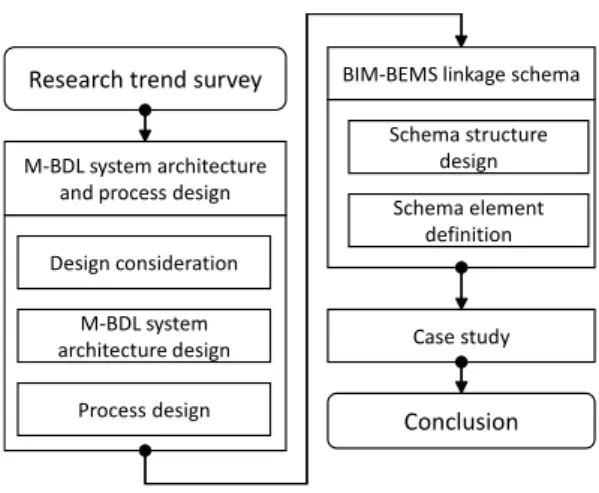
마지막으로, 본 연구의 효과를 확인해 보기 위해 프로 토타입을 개발하고, 제안 기술에 대한 효과에 대해 논의 한다. 본 연구의 흐름은 Fig 1과 같다.
M-BDL system architecture and process design
Design consideration
Research trend survey
M-BDL system architecture design
Process design
BIM-BEMS linkage schema
Schema structure design Schema element
definition
Conclusion
Case studyFig. 1. Research Flow
2.2 연구 동향 조사
BIM-BEMS 데이터 연계와 관련된 연구 동향은 다음 과 같다.
BIM 에너지 시뮬레이션 인터페이스와 관련된 연구가 있었다. 이 연구는 BIM과 에너지 시뮬레이션 시스템을 서로 연계하기 위한 방법에 대한 연구로, 에너지 플러스 에 입력되는 IDF포맷을 IFC에서 어떻게 추출하는 방법 에 초점을 맞추고 있다[1]. 탄소저감을 위한 3D BIM 기 반 건물 에너지 효율화 방안에 대한 연구가 있다. 이 연 구는 소비 에너지 효율화를 목표로 하고 있어, 본 연구와 는 차이가 있다[2]. BIM과 연계된 에너지 분석 시스템 현황을 분석한 연구가 있었다[3]. 이 연구에서는 이기종 에너지 분석 시스템들을 조사하고, 이 시스템과 BIM 연 계를 위해 필요한 데이터를 확인하였다.
BIM 기반 지능형 건축물 에너지 분석 시스템 개발에 관한 연구가 있었다[4]. 이 연구는 IFC에서 데이터를 추 출해 기존 에너지 분석 시스템에 필요한 데이터를 생성 하는 방법에 초점이 맞춰져 있다.
BIM을 이용한 정보 시각화에 관한 연구가 있었다[5].
이 연구는 3차원 웹브라우저로 BEMS 시스템을 구현한 사례를 소개하고 있다. BIM형상 렌더링을 위해 WebGL 을 사용하고 있으며, 형상을 시각화하는 것에만 초점이 맞춰져 있다.
BIM 기반 에너지 시뮬레이션 도구 개발에 관한 연구 가 있었다[6]. 이 연구도 앞서 에너지 분석 시스템 인터 페이스 연구와 유사하며, BIM 저작도구인 Revit의 Addin 개발을 통해 인터페이스된 데이터를 이용하여, 에너지 분석하는 방법을 제안하고 있다. 이외, IFC기반
3차원 형상 모델링 및 변환 방법에 대한 연구가 있었다 [7]. 이 연구는 BIM에서 건설 프로세스에서 필요한 형상 표면 추출 방법을 제안한다.
앞서 조사된 바와 같이 BEMS와 BIM연계에 대한 연 구는 드물며, 대부분 에너지 플러스와 같은 분석 도구에 치중되어 있다. BEMS와 관련된 사례도 BIM 형상 가시 화 등에 초점이 맞춰져 있다.
본 연구는 MF 기반 데이터 경량화를 위한 시스템 구 조 및 프로세스, 경량화된 BIM-BEMS 간 연계를 위한 데이터 구조 연구를 목표로 한다.
3. M-BDL 시스템 구조 및 프로세스
3.1 고려사항 도출
BIM-BEMS 연계를 위해 BIM 및 BEMS 개발 경험 이 있는 5명의 전문가 자문을 수행하였다. 자문에 필요 한 질문은 다음과 같았다.
Q1. 보통 BEMS 관점에서 필요한 BIM 데이터는 무 엇인가?
Q2. BIM-BEMS 연계에 필요한 필수적인 데이터는 무엇인가?
Q3. BIM-BEMS 데이터 연계 시 장애요인은 무엇인 가?
다음은 각 질의에 대한 자문 내용이다.
A1. 사용자 유스케이스에 따라 필요한 데이터는 다르 다. 예를 들어, 공간관리를 위해서는 BIM의 Space 속성 이 필요하다. 설비와 관련된 운영 관리 목적이라면, MEP(Mechanical, electrical and plumbing) 시스템에 대 한 속성정보가 필요하다.
A2. 기본적으로 공간에 대한 속성정보는 필요하다.
공간에 설비나 창호와 같은 건축 부재가 관리되기 때문 이다. 관리자가 인식할 때 개별 건축 부재를 검색하는 것 보다, 공간을 기준으로 관리해야할 정보를 검색하는 것 이 편한 경우가 많다.
A3. BIM, BEMS 모델은 이기종 데이터로 서로 다르 게 발전되어 온 것이다. BEMS 관점에서 BIM을 활용하 기 위해서는, 어떤 BIM 데이터가 유스케이스에 필요한 것인지를 명확히 정의할 수 있는 방법이 필요하다. 그 방
법에 근거해 필요한 BIM데이터만 필터링하고, BEMS 데이터 구조와 연계하는 프로세스를 고려할 필요가 있다.
앞의 A1, A2, A3를 고려해, 사용자 유스케이스 관점 에서 필요한 BIM 데이터를 정의하고, BEMS 데이터와 연계할 수 있는 방법을 고려해 본다. 예를 들어, BEMS 사용자, 관리자 관점에서 필요한 정보만 BIM에서 획득 할 수 있는 문법을 제공할 필요가 있다. M-BDL은 필요 한 데이터를 BEMS 시스템에서 연계 운영할 수 있도록, BIM 데이터를 필터링하고, 유스케이스 관점에서 필요한 데이터만 정의 및 연계할 수 있는 방법을 지원한다.
3.2 구조 및 프로세스 디자인
M-BDL은 MF란 BIM 데이터 필터로 구성된다. MF 는 BIM표준인 IFC(Industry Foundation Classes)를 기 준으로 데이터를 필터링할 수 있다. 참고로, IFC는 BIM 중립파일 포맷으로 표준화되어 있어, 다른 상업용 모델 링 파일에서 IFC로 BIM 데이터를 추출할 수 있다.
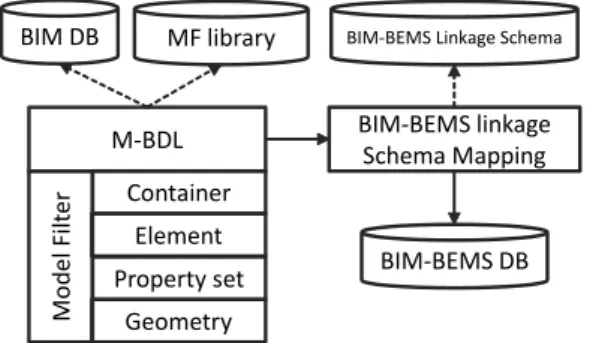
MF는 필터링할 대상을 IFC에서 일반화된 클래스를 구분하여 처리한다. MF는 BIM의 모든 클래스를 container, element, property set로만 일반화시켜 필터링 한다. 다음은 M-BDL 시스템 구조이다.
M-BDL BIM DB
BIM-BEMS DB MF library
BIM-BEMS linkage Schema Mapping
Property set Geometry Container
Mod e l Filt er
Element
BIM-BEMS Linkage Schema
Fig. 2. M-BDL system architecture
동작 흐름은 다음과 같다.
1. BIM 데이터 경량화를 위해, 필요한 데이터만 추출 할 수 있도록 M-BDL 을 정의함. 정의하는 B-BDL 에서 필요한 MF 라이브러리가 MF library DB에 있다면 재활용함
A. M-BDL의 이름, BIM_URL에 정의된 BIM 데이터 소스를 기술함.
Name Role
M-BDL
Defining an operator and a lightweight method for lightening the MF-based BIM data.
M-BDL={name, BIM_URL, BEMS_URL, MF*}
MF={id, filters}
id=identification filters={filter*}
*=multiple
filter={id, type, name, condition*}
id=filter name
type={‘container’ | ‘element’ | ‘property’ | ‘geometry’}
name=instance name of type condition={op, vars, values, [and | or]}
op={‘equal’, ‘not_equal’, ‘less_than’, ‘greater_than’}
vars={var*}
var=variable name values={value*}
value=op operator parameter
and= if A and B boolean are true, return true, else return false
or= if A or B boolean are true, return true, else return false There are four types of MF. Depending on the type, the range of var and value that can be used in MF's filtering op operator is determined.
MF.container=BIM element container. e.g. building, storey, space etc
MF.element=BIM element. e.g. Wall, Door, Window etc MF.property=BIM element property set
MF.geometry=BIM element geometry set MF.contai
ner
var={type, name}
type=container type name=name
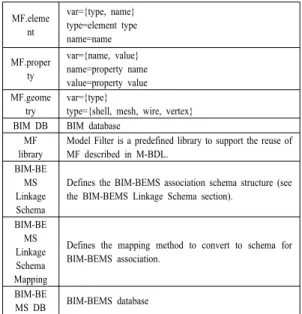
Table 1. M-BDL component role definition
MF.eleme nt
var={type, name}
type=element type name=name MF.proper
ty
var={name, value}
name=property name value=property value MF.geome
try
var={type}
type={shell, mesh, wire, vertex}
BIM DB BIM database MF
library
Model Filter is a predefined library to support the reuse of MF described in M-BDL.
BIM-BE MS Linkage Schema
Defines the BIM-BEMS association schema structure (see the BIM-BEMS Linkage Schema section).
BIM-BE MS Linkage Schema Mapping
Defines the mapping method to convert to schema for BIM-BEMS association.
BIM-BE
MS DB BIM-BEMS database
B. MF의 유일한 id와 filter들을 정의함.
C. filter는 유일 id와 name, condition으로 구성됨.
condition은 BIM_URL에 지정된 대용량 BIM데 이터를 경량화하기 위한 데이터 필터링 조건을 정 의함.
D. condition은 데이터 필터링 규칙을 정의할 수 있도 록 논리 연산자로 구성되며, 사용자 유스케이스에 맞게 정의할 수 있음. 필터링되는 BIM데이터 유 형은 {'container' | 'element' | 'property' | 'geometry'} 로 구분됨. 이와 관련된 자세한 사항 은 표1 참고.
2. 경량화할 BIM DB를 지정함
3. 정의된 M-BDL을 실행해, BIM DB와 BEMS DB 가 연결된 BIM-BEMS DB를 생성함
시스템을 구성하는 각 컴포넌트의 역할은 다음과 같 다.
다음은 M-BDL을 XML로 표현한 예이다.
<M-BDL name="ABC" BIM_URL="192.168.2.7"
BEMS_URL="192.168.10.5">
<MF id="id_pset_filter_01">
<filter id="" type="container" nametype="room"
name="">
<condition op="equal">
<vars>
<var name="A.area"/>
<var name="B.area"/>
</vars>
</condition>
</filter>
</MF>
…
</M-BDL>
4. BIM-BEMS Linkage Schema
4.1 스키마 구조 디자인
BIM-BEMS Linkage Schema는 복잡하고 방대한 BIM 모델에서 표 1의 MF 필터링 op 연산자에 의해 추 출된 BIM 데이터와 BEMS 데이터베이스 연계를 위해, 경량화된 BIM 스키마 정의이다.
Name Requirement
object
BIM object class.
BEMS database GUID PK(Primary Key) {GUID, name}
GUID=Global Unique Identification name=object name
type BIM object’s type. type can be building, storey, space, room, wall, door, window etc.
container BIM element class definition. In example, it can be building, storey, space etc.
element BIM element definition. In example, it can be wall, door, window etc.
property_set
Property set definition.
{property*}
*=multiple
property
Property definition.
{name, type, value}
name=property name
type={integer | real | string | complex}
In case of complex, value can be stored in JSON(JavaScript Object Notation) format.
value=property value
Table 2. BIM-BEMS Linkage Schema Definition(B-LSD)
geometry
LoD geometry definition.
geometry={LoD, shell*, loop*, edge*, vertex*}
LoD=Geometry Level of Detail.
shell=SOLID B-rep(Boundary representation) mode’s geometry surface definition
loop=model geometry surface definition edge=model geometry edge definition around surface
vertex=model geometry vertex definition {x, y, z} coordinate point.
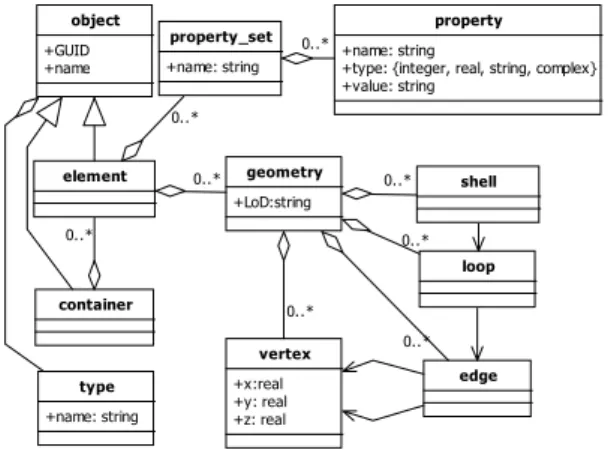
BIM-BEMS Linkage Schema 구조는 object, element, property, geometry, container 클래스를 기준으 로 relationship이 정의되어 있어, MF에 의해 필터링된 BIM데이터가 저장되고 관리될 수 있도록 하였다. 다음 그림은 BIM-BEMS Linkage Schema 구조이다.
object +GUID +name
property_set +name: string
geometry +LoD:string
property +name: string
+type: {integer, real, string, complex}
+value: string
container element
0..*
0..*
type +name: string
0..*
0..*
edge loop shell
vertex +x:real +y: real +z: real
0..*
0..*
0..*
0..*
Fig. 3. BIM-BEMS Linkage Schema
4.2 스키마 요소 정의
그림 3의 스키마 구조는 BEMS 서비스에 필요한 최 소한의 클래스와 데이터 구조를 가져야 한다. 이와 관련 해, 각 클래스에서 필요한 멤버를 요구사항으로 Table 2 에 정의하였다.
다음은 Table 2에 정의된 요구사항을 바탕으로 BIM-BEMS 연계 방법을 xml형식으로 정의한 예이다.
<B-LSD>
<model source='BIM.ifc' target='BEMS/128.34.12.51:2000'/>
<mapping>
<object type='container' source='IfcBuilding' target='building' filter='$name=AEK'>
<object type='storey' source='IfcStorey' target='storey' filter='$name=DK'>
<object type='space' source='IfcSpace' target='space' filter='$name=SP'>
<object type='property_set' filter='*'/>
<link relationship='space.$name, T_Sector.$name from space, T_Sector'/>
</object>
</object>
</object>
</mapping>
</B-LSD>
XML에서 예시한 B-LSD은 데이터베이스와 BIM-BEMS 서비스 간의 미들웨어(middleware) 역할을 할 수 있으며, 무거운 BIM 데이터를 경량화하고, 미리 만들어 놓은 B-LSD는 유사한 맵핑 작업량을 줄여줄 수 있다.
5. 구현 사례
지금까지 제안한 MF기반 BIM-BEMS 데이터맵핑 방 법의 효과를 확인해 보기위해, 이미 구축되어 있는 BEMS 시스템에서 필요한 BIM 데이터를 필터링하기 위하여, B-BDL을 구현해 보았다.
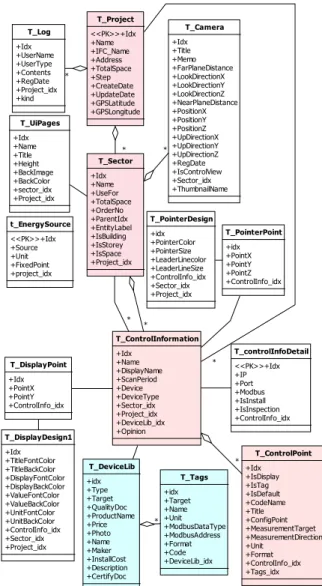
본 사례에서는 K사에서 시험 운용하고 있는 BEMS 데이터베이스와 시스템을 대상으로 B-BDL을 적용해 보 았다. 기존 K사 BEMS 데이터베이스 구조는 그림 4와
같다.
B-BDL 시스템 구현 시 활용한 소프트웨어 프레임웍은 그림 5와 같이 네트워크 기반 어플리케이션 개발에 사용 되는 라이브러리인 Nodejs, MVC 패턴의 적용을 쉽게 해주는 모듈이자 웹 앱 프레임워크인 Express Framework Express Framework을 사용하였다. MVC는 Model, View, Controller 약자로 하나의 모델을 다양한 역할로 구분하여 개발하는 디자인 패턴(Design Pattern)이다.
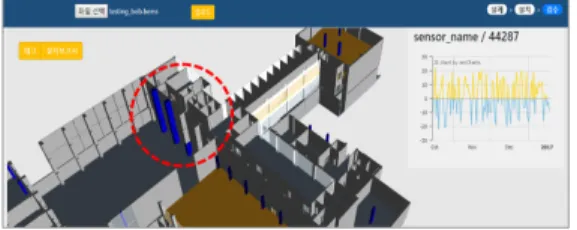
그림 6과 같이 B-BDL기반으로 BIM-BEMS 데이터 연계를 구현하여, BIM 데이터를 맵핑시켰다. 필요한 BIM 데이터만 BEMS에 맵핑되었으므로, BIM 데이터 는 BEMS에 필요한 공간 및 속성 데이터만 관리하면 되 었다. 이로서 BIM데이터가 경량화되어, 모바일 기기에 서도 그림 7과 같이 BIM-BEMS 모델을 확인할 수 있었 다. 아울러, BEMS 서비스에 관련된 BIM 데이터만 유지 하므로, 불필요한 데이터를 관리하는 데 필요한 시간과 노력이 감소될 수 있었다.
6. 결론
이 연구는 효과적인 BIM-BEMS 연계를 위해,MF를 기반으로 필요한 BIM 데이터만 필터링해, 경량화된 BIM 데이터와 BEMS 데이터베이스 간 연계 방법을 제 안하고, 사례 연구를 통해, 그 효과를 논의해 보았다. 사 례 연구를 통해, 제안 방식의 경우, 다음과 같은 이익이 있음을 알 수 있었다.
1. BIM 데이터 경량화: 무거운 BIM 데이터에서 BEMS에 필요한 데이터만 맵핑함으로써, BIM데이터를 경량화할 수 있었다.
2. 데이터 유지보수 노력감소: 유지보수에 필요한 데 이터량을 줄일 수 있어, BEMS에 필요한 공간 및 속성 데이터만 관리하면 되었다. 이는 불필요한 데이터를 관 리하는 데 필요한 시간과 노력이 감소됨을 의미한다.
3. 데이터 맵핑 방식 재활용: 유사한 BIM-BEMS 맵 핑 시 M-BDL을 라이브러리처럼 활용할 수 있어, 맵핑 방법 재활용에 유리하다.
본 연구는 다양한 유형의 샘플을 테스트하지 못한 한 계가 있다. 향후, 본 연구 관련해 다양한 목적의 건물 에 너지 관리 시스템과 유형별 BIM 데이터 샘플 기반으로 적용 효과를 분석할 계획이다.
T_Project
<<PK>>+Idx +Name +IFC_Name +Address +TotalSpace +Step +CreateDate +UpdateDate +GPSLatitude +GPSLongitude T_Log
+Idx+UserName +UserType +Contents +RegDate +Project_idx +kind
*
T_Sector +Idx+Name +UseFor +TotalSpace +OrderNo +ParentIdx +EntityLabel +IsBuilding +IsStorey +IsSpace +Project_idx
* T_UiPages
+Idx+Name +Title +Height +BackImage +BackColor +sector_idx +Project_idx
T_Camera +Idx +Title +Memo +FarPlaneDistance +LookDirectionX +LookDirectionY +LookDirectionZ +NearPlaneDistance +PositionX +PositionY +PositionZ +UpDirectionX +UpDirectionY +UpDirectionZ +RegDate +IsControlView +Sector_idx +ThumbnailName
*
T_controlInfoDetail
<<PK>>+Idx +IP +Port +Modbus +IsInstall +IsInspection +ControlInfo_idx T_ControlInformation
+Idx+Name +DisplayName +ScanPeriod +Device +DeviceType +Sector_idx +Project_idx +DeviceLib_idx +Opinion
*
T_DisplayPoint +Idx+PointX +PointY +ControlInfo_idx
T_ControlPoint +Idx
+IsDisplay +IsTag +IsDefault +CodeName +Title +ConfigPoint +MeasurementTarget +MeasurementDirection +Unit
+Format +ControlInfo_idx +Tags_idx T_DeviceLib *
+idx+Type +Target +QualityDoc +ProductName +Price +Photo +Name +Maker +InstallCost +Description +CertifyDoc
T_Tags +idx +Target +Name +Unit +ModbusDataType +ModbusAddress +Format +Code +DeviceLib_idx
* T_DisplayDesign1
+Idx +TitleFontColor +TitleBackColor +DisplayFontColor +DisplayBackColor +ValueFontColor +ValueBackColor +UnitFontColor +UnitBackColor +ControlInfo_idx +Sector_idx +Project_idx
T_PointerPoint +idx +PointX +PointY +PointZ +ControlInfo_idx T_PointerDesign
+idx+PointerColor +PointerSize +LeaderLinecolor +LeaderLineSize +ControlInfo_idx +Sector_idx +Project_idx
*
* t_EnergySource
<<PK>>+Idx +Source +Unit +FixedPoint +project_idx
Fig. 4. Existed BEMS database schema
Fig. 5. MF-based BIM-BEMS data mapping prototype
software architecture
Fig. 6. Filtered BIM-BEMS Linkage Results
Fig. 7. Lightweight BIM data and viewer
References
[1] K. U. Ahn, S. M. Oh, Y. J. Kim, C. S. Park, I. H. Kim,
“Development of Interface for BIM based Building Energy Simulation”, Architectural Institute of Korea, Vol.31, No.2, pp.457-478, 2011.
UCI: http://uci.or.kr/G704-A00167.2012.28.05.004 [2] D. H. Lee, K. J. Kwon, J. H. Shin, S. H. Park, “3D
BIM-based Building Energy Efficiency Solution for Carbon Emission Reduction”, Journal of the Korean Society of Civil Engineers, Vol.33, No.3, pp.1235-1242, 2013.
DOI:https://dx.doi.org/10.12652/Ksce.2013.33.3.1235 [3] J. H. Yu, K. R, Kim, “The application of energy analysis
system connected with BIM in Korea”, Korea Journal of Construction Engineering and Management, Vol.13, No.3, pp.8-11, 2012.
[4] J. H. Yu, K. R, Kim, “Development of BIM-based intelligent building energy analysis system”, Korea Journal of Construction Engineering and Management, pp.323-324, 2012.
[5] G. C. Cha, S. Park, “A Study on Information Visualization using Building Information Modeling”, Journal of the Korea Academia-Industrial cooperation Society, Vol.16, No.6, pp.4170-4175,2015.
DOI:https://dx.doi.org/10.5762/KAIS.2015.16.6.4170 [6] K. H. Woo, J. M. Kim, “Development of BIM-Based
Building Energy Performance Tool : Samsung Energy Performance(SEP)”, Journal of the Architectural
Institute of Korea Planning & Design, Vol.25, No.12, pp.113-120, 2009
UCI: http://uci.or.kr/G704-A00167.2009.25.12.037 [7] Z. Jianping, Y. Zhang, “Methodology of 3D geometric
modeling and model conversion of IFC-based BIM”, Journal of Information Technology in Civil Engineering and Architecture, Vol.1, No.1, pp.40-50, 2009.
강 태 욱(Tae-Wook Kang) [정회원]
•2005년 2월: 숭실대학교 소프트웨 어공학 (공학석사)
•2009년 3월: 중앙대학교 건설환경 공학 (공학박사)
•2010년 6월 ~ 2011년 5월 : 중앙 대 겸임교수
•2011년 6월 ~ 2012년 6월 : 한길 아이티 BIM본부장
•2012년 7월 ~ 현재 : 한국건설기술연구원 수석연구원
<관심분야>
CAD, BIM, GIS, SW공학, 비전, 역설계, 로보틱스