RESEARCH ARTICLE
Received: August 28, 2018, Revised: October 1, 2018, Accepted: October 1, 2018 ISSN 2233-7679 (Online)
†
Correspondence to: Eunsuk Ahn
Department of Dental Hygiene, Kyungbok University, 154 Sinpyeong-ro, Sinbuk-myeon, Pocheon 11138, Korea
Tel: +82-31-539-5339, Fax: +82-31-539-5339, E-mail: [email protected], ORCID: https://orcid.org/0000-0002-9404-4826 Copyright © 2018 by Journal of Dental Hygiene Science
Relationship between Early Menopause and
Periodontal Disease in Korean Postmenopausal Women
Yun-Hee Lee, Sun-Mi Kim 1 , and Eunsuk Ahn †
Department of Dental Hygiene, Kyungbok University, Pocheon 11138,
1
Department of Dental Hygiene, Wonkwang Health Science University, Iksan 54536, Korea
The purpose of this study was to evaluate the relationship between early menopause and periodontal disease in postmenopausal women using data from the 6th Korean National Health and Nutrition Examination Survey (2013∼2015). A study was conducted with 2,048 postmenopausal women aged 45 to 74 years. Participants were divided into the early menopause group (menopause occurring at age 45 years or before) and normal menopause group (menopause occurring after age 45 years). A community periodontal index greater than or equal to code 3 was used to define periodontal treatment needs. A chi-square test was used to confirm the bivariate relationship between the variables. Multinomial logistic regression analysis was used to adjust for covariates (age, education, family income, body mass index, alcohol drinking, smoking, visiting dentist in the last year, use of oral care products, frequency of tooth brushing per day). The risk of periodontal disease was higher in the early menopause group after adjusting for potential confounders (odds ratio, 1.59). In particular, the relationship between early menopause and periodontal disease was more evident in women with low education and those who did not use oral care products. The findings of this study suggest that early menopause is a significant factor of periodontal disease in Korean women.
Key Words: Menopause, Periodontal diseases, Premature menopause
Introduction
Women have been found to experience periodontal disease related to sex hormones due to menstruation, pregnancy, and menopause as a result of physical changes over their lifetime 1) . Changes in sex hormones are regarded as important factors that can affect the causes of periodontal disease 2) . Changes in estrogen, progesterone, and other female hormones have been reported to have an effect on interleukin-1 (IL-1), interleukin-6 (IL-6), and tumor necrosis factor- (TNF-) secretion, which are proinflammatory cytokines playing a role in bone resorption and periodontal inflammation reactions 3) . Moreover, since there are estrogen, progesterone, and androgen receptors in the gingiva, changes in female
hormones have been reported to have a direct impact on the environment of the oral cavity 4) . Hormonal changes occur across a woman's lifetime, and some are related to menopause, a natural phenomenon where the menstrual cycle discontinues permanently owing to old age. The main cause of menopause is known to be decreases in estrogen and progesterone hormone levels resulting from atrophy of the ovaries 5) . After menopause, xerostomia is a symptoms that can affect women's oral cavity 6) . Estrogen maintains bone mass by accelerating bone production and decreasing bone resorption 7) , and its lack causes gum infections and leads to clinical attachment loss; thus, as the duration of menopause increases, clinical attachment loss and gingivitis also increase 8) .
The age of menopause onset differs for each individual,
and differences between races have also been identified;
however, the average age of menopause is typically around the age of 50 years 9) , and that of Korean women is 49.7 years. Given that women's life expectancy in Korea is 85.2 years as of 2015, Korean women are expected to spend about 35.5 years or 1/3 of their life in menopause 10) . As a result of population aging, the number of women in menopause in the future will rapidly increase, which means the proportion of women in menopause in the entire population will also increase drastically. Middle-aged women in menopause typically have a stronger focus on their family than on themselves, and thus tend to neglect their own health. Due to a lack of knowledge regarding the various physical changes associated with menopause and their oral health needs, many women often fail to focus on their oral health 11,12) . Therefore, improving awareness of the importance of managing oral health for women in menopause is extremely important from a health and social standpoint. While menopause starting around the age of 50 years is considered normal, early menopause starting before the age of 45 years is considered to be a morbid condition 13) . According to previous studies, in primary early menopause (from natural causes) and secondary early menopause (resulting from surgery), bone density starts decreasing at an early age and the body is thus in a state of low bone density for an extended period of time, which increases the risk of osteoporosis and periodontal disease 14,15) . Majority of the previous studies have either evaluated the risk of periodontal disease for women in menopause or analyzed the association between osteoporosis and early menopause. However, no studies to date have analyzed the association between early menopause and periodontal disease using representative data. Hence, this study aimed to verify the relationship between early menopause and the risk of periodontal disease among Korean women in menopause, and provide base data for establishing policies that can prevent periodontal disease and improve oral health for women in early menopause.
Materials and Methods
1. Research participants
Out of 4,503 women in menopause who participated in
the 6th Korean National Health and Nutrition Examination Survey (2013∼2015), after excluding those who experienced artificial menopause due to a hysterectomy, those with a doctor's diagnosis of diabetes with a strong relation to periodontal disease, and those with at least one response missing in the survey, a total of 2,048 participants were selected for analysis. Of these, 294 women whose menopause started at the age of 45 years or younger were assigned to the early menopause group, and 1,754 who started menopause after the age of 45 years constituted the normal menopause group. This study was conducted after receiving approval for exemption from the Institutional Review Board of Wonkwang University (WKIRB- 201803-SB-014).
2. Variables
In this study, the community periodontal index of treatment needs (CPITN), which ranges between 0 and 4, was re-categorized into three levels, namely healthy periodontal tissue (0), gingivitis (1∼2), and periodontitis (3∼4), and was used as the dependent variable.
Menopause status (normal menopause group/early menopause group) was used as the independent variable.
Moreover, this study also included participants’ general characteristics, such as age group (45∼54/55∼64/65∼
74 years), education level (elementary school or lower/
middle school/high school/college degree or higher), household income (lower/lower-middle/upper-middle/
upper), body mass index (BMI) (underweight/normal/
obese), lifestyle habits such as alcohol drinking (non- drinker/drinker in the past/current drinker) and smoking (non-smoker/smoker), and oral health management such visiting the dentist in the last year (yes/no), using oral management products (yes/no), and daily frequency of teeth brushing (less than 3 times a day/3 times a day or more).
3. Analysis method
Considering that the Korean National Health and
Nutrition Examination Survey follows a complex sample
design, a design file was generated prior to the analysis
and the complex sample design was analyzed. The layer
variable was the dispersed estimation layer, the cluster
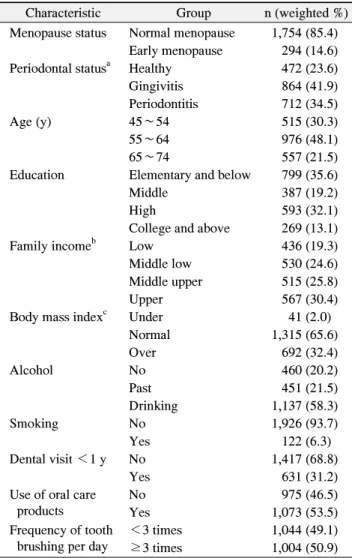
Table 1. General Characteristics of the Study Population (n=2,048)
Characteristic Group n (weighted %)
Menopause status Normal menopause 1,754 (85.4) Early menopause 294 (14.6) Periodontal status
aHealthy 472 (23.6)
Gingivitis 864 (41.9)
Periodontitis 712 (34.5)
Age (y) 45∼54 515 (30.3)
55∼64 976 (48.1)
65∼74 557 (21.5)
Education Elementary and below 799 (35.6)
Middle 387 (19.2)
High 593 (32.1)
College and above 269 (13.1)
Family income
bLow 436 (19.3)
Middle low 530 (24.6)
Middle upper 515 (25.8)
Upper 567 (30.4)
Body mass index
cUnder 41 (2.0)
Normal 1,315 (65.6)
Over 692 (32.4)
Alcohol No 460 (20.2)
Past 451 (21.5)
Drinking 1,137 (58.3)
Smoking No 1,926 (93.7)
Yes 122 (6.3)
Dental visit <1 y No 1,417 (68.8)
Yes 631 (31.2)
Use of oral care products
No 975 (46.5)
Yes 1,073 (53.5)
Frequency of tooth brushing per day
<3 times 1,044 (49.1)
≥3 times 1,004 (50.9)
a
Healthy, community periodontal index of treatment needs (CPITN) 0; gingivitis, CPITN 1∼2; periodontitis, CPITN 3∼4.
b
Income quartile.
c
Asia-Pacific Standard: under, <18.5 kg/m
2; normal, 18.5∼
24.9 kg/m
2; obese, ≥25 kg/m
2. variable was survey district, the weighted values were the
sample extraction framework, household at the point of the current survey, including error according to differences in population, and non-response error according to lack of participation in the survey. In order to adjust these factors, weighted values from a correlation analysis were used to calculate new weighted values. When cases are deleted, since complex sample information included in the deleted materials can be omitted and cause a standard deviation bias in the estimated values, the groups of interested and other groups were generated before the analysis. IBM SPSS statistics (ver. 22.0; IBM Co., Armonk, NY, USA) was used for all analyses. To assess participants’ basic information, frequency analysis and descriptive statistics were performed. A chi-square test was also conducted to verify participants’ menopause and periodontal statuses according to their sociodemographic characteristics, lifestyle habits, and oral health management status. Further, to assess the relationship between menopause status and periodontal disease, a multinomial logistic regression analysis was conducted to obtain the adjusted odds ratio (OR) and 95% confidence interval (CI). The statistical significance level was set to p<0.05.
Results
1. Comparative analysis of general characteristics, lifestyle habits, and oral health management Regarding the periodontal status of all 2,048 participants, 41.9% had gingivitis, 34.5% periodontitis, and 23.6%
healthy periodontal tissue. As for education level, 35.6%
were elementary school graduates or below, 32.1% high school graduates, 19.2% middle school graduates, and 13.1% college graduates or higher. Regarding household income level, 30.4% were considered upper class, and 25.8% middle class. As for BMI, the majority of participants had a normal BMI (65.6%). Regarding drinking and smoking, most participants were drinkers (58.3%) and non-smokers (93.7%), respectively. As for oral health management, 68.8% of participants reported not visiting a dentist in the last year, and 50.9% said they brushed their teeth at least 3 times a day (Table 1).
2. Periodontal status according to general characteristics and menopause status
Upon examining periodontal status according to
menopause status, the number of early menopause with
healthy periodontal tissue were more likely to be
compared to the group with periodontitis, but this was not
statistically significant. Women with periodontitis were
more likely to be 65 to 74 years of age and elementary
school graduates or below, compared to the group with
healthy periodontal tissue (p<0.001). Moreover, women
with periodontitis were more likely to have an average
Table 2. Periodontal Status Based on General Characteristics (n=2,048)
Characteristic Group
Periodontal status
ap-value Healthy
(n=472)
Gingivitis (n=864)
Periodontitis (n=712)
Menopause status Normal menopause 399 (83.9) 738 (84.7) 617 (87.3) 0.315
Early menopause 73 (16.1) 126 (15.3) 95 (12.7)
Age (y) 45∼54 119 (29.7) 266 (36.7) 130 (23.0) 0.000***
55∼64 253 (54.9) 383 (44.0) 340 (48.5)
65∼74 100 (15.3) 215 (19.2) 242 (28.6)
Education Elementary and below 127 (23.2) 339 (35.4) 333 (44.3) 0.000***
Middle 75 (14.2) 166 (19.8) 146 (22.0)
High 179 (43.7) 257 (32.7) 157 (23.4)
College and above 91 (18.9) 102 (12.2) 76 (10.4)
Family income
bLow 76 (13.6) 191 (19.6) 169 (22.8) 0.000***
Middle low 109 (20.4) 227 (25.1) 194 (26.7)
Middle upper 117 (27.2) 219 (25.9) 179 (24.7)
Upper 170 (38.9) 227 (29.3) 170 (25.8)
Body mass index
cUnder 17 (3.2) 13 (1.5) 11 (1.7) 0.000***
Normal 324 (70.9) 570 (67.5) 421 (59.7)
Over 131 (25.9) 281 (31.0) 106 (38.6)
Alcohol No 92 (17.3) 195 (19.9) 173 (22.6) 0.281
Past 113 (23.6) 189 (21.9) 149 (19.6)
Drinking 267 (59.1) 480 (58.2) 390 (57.7)
Smoking No 452 (95.0) 814 (93.8) 660 (92.6) 0.392
Yes 20 (5.0) 50 (6.2) 52 (7.4)
Dental visit <1 y No 284 (61.7) 637 (72.1) 496 (69.8) 0.004**
Yes 188 (38.3) 227 (27.9) 216 (30.2)
Use of oral care products No 160 (32.0) 426 (47.6) 389 (55.2) 0.000***
Yes 312 (68.0) 438 (52.4) 323 (44.8)
Frequency of tooth brushing per day <3 times 218 (44.2) 450 (50.1) 376 (51.1)
≥3 times 254 (55.8) 414 (49.9) 336 (48.9)
Values are presented as n (weighted %).
**p<0.01, ***p<0.001.
a
Healthy, community periodontal index of treatment needs (CPITN) 0; gingivitis, CPITN 1∼2; periodontitis, CPITN 3∼4.
b
Income quartile.
c
Asia-Pacific Standard: under, <18.5 kg/m
2; normal, 18.5∼24.9 kg/m
2; obese, ≥25 kg/m
2. income level than those with healthy periodontal tissue (p
<0.001). Further, in the group with periodontitis, 38.6%
of participants were obese, which was a higher proportion than among those with healthy periodontal tissue or gingivitis (p<0.001). Among those with healthy periodontal tissue, a higher percentage of participants used oral health products at 68.0% (p<0.001) and visited a dentist within the last year at 38.3% (p<0.01) (Table 2).
3. Impact of general characteristics and menopause status on periodontal disease
Table 3 shows the results of the multinomial logistic
regression analysis examining the effects of general characteristics and menopause status on periodontal disease. When all other factors were adjusted, the adjusted OR that a participant in the early menopause group would be afflicted by periodontitis compared to having normal menopause was 1.59 (95% CI, 1.08∼2.35; p<0.05).
With respect to age, the adjusted OR that a woman
between the age of 45 to 54 years would be afflicted by
gingivitis was 1.80 (95% CI, 1.18∼2.75). Regarding
education level, the adjusted OR that a woman who was an
elementary school graduate or below would have gingivitis
was 1.89 (95% CI, 1.19∼3.00; p<0.01), and 2.09 for
Table 3. Periodontal Status Based on Menopause Status, General Characteristics, Lifestyle Habits, and Oral Care (n=2,048)
Characteristic Group Periodontal status
aGingivitis Periodontitis
Menopause status Early menopause 1.27 (0.87∼1.84) 1.59 (1.08∼2.35)*
Normal menopause 1.00 1.00
Age (y) 45∼54 1.80 (1.18∼2.75)** 0.80 (0.51∼1.24)
55∼64 0.88 (0.63∼1.23) 0.65 (0.45∼0.93)*
65∼74 1.00 1.00
Education Elementary and below 1.89 (1.19∼3.00)** 2.09 (1.29∼3.40)*
Middle 1.84 (1.12∼3.02)* 2.25 (1.38∼3.67)*
High 0.99 (0.67∼1.46) 0.83 (0.55∼1.26)
College and above 1.00 1.00
Family income
bLow 1.37 (0.91∼2.07) 1.24 (0.79∼1.94)
Middle low 1.31 (0.90∼1.90) 1.17 (0.78∼1.77)
Middle upper 1.10 (0.78∼1.56) 1.07 (0.73∼1.58)
Upper 1.00 1.00
Body mass index
cUnder 0.47 (0.21∼1.06) 0.49 (0.20∼1.21)
Normal 0.94 (0.69∼1.27) 0.76 (0.56∼1.02)
Over 1.00 1.00
Alcohol No 1.25 (0.89∼1.75) 1.28 (0.90∼1.80)
Past 0.97 (0.70∼1.34) 0.80 (0.56∼1.13)
Drinking 1.00 1.00
Smoking No 0.80 (0.42∼1.51) 0.57 (0.29∼1.13)
Yes 1.00 1.00
Dental visit <1 y No 1.30 (0.96∼1.76) 1.01 (0.74∼1.38)
Yes 1.00 1.00
Use of oral care products No 1.49 (1.13∼1.97)** 1.89 (1.40∼2.56)***
Yes 1.00 1.00
Frequency of tooth brushing per day <3 times 1.06 (0.81∼1.39) 0.97 (0.71∼1.32)
≥3 times 1.00 1.00
Values are presented as adjusted odds ratio (95% confidence interval).
Adjusted for age (y), education, family income, body mass index, alcohol, smoking, dental visit <1 years, use of oral products, frequency of tooth brushing per day.
*p<0.05, **p<0.01, ***p<0.001.
a
Gingivitis, community periodontal index of treatment needs (CPITN) 1∼2; periodontitis, CPITN 3∼4.
b
Income quartile.
c