• 검색 결과가 없습니다.

Cervical Esophageal Hemangioma Combined with Thyroid CancerJong Cheol Lee, M.D.**, Jeong Won Kim, M.D.*, Yong Jik Lee, M.D.*, Seong Rok Lee, M.D.**, Chang-Ryul Park, M.D.*, Jong-Pil Jung, M.D.*

N/A
N/A
Protected

Academic year: 2021

Share "Cervical Esophageal Hemangioma Combined with Thyroid CancerJong Cheol Lee, M.D.**, Jeong Won Kim, M.D.*, Yong Jik Lee, M.D.*, Seong Rok Lee, M.D.**, Chang-Ryul Park, M.D.*, Jong-Pil Jung, M.D.*"

Copied!
3
0
0

로드 중.... (전체 텍스트 보기)

전체 글

(1)

Korean J Thorac Cardiovasc Surg 2011;44:311-313 □ Case Report □ DOI:10.5090/kjtcs.2011.44.4.311 ISSN: 2233-601X (Print) ISSN: 2093-6516 (Online)

− 311 −

*Department of Thoracic and Cardiovascular Surgery, Ulsan University Hospital, University of Ulsan College of Medicine

**Department of Otorhinolaryngology, Ulsan University Hospital, University of Ulsan College of Medicine Received: May 19, 2011, Revised: June 1, 2011, Accepted: June 3, 2011

Corresponding author: Yong Jik Lee, Department of Thoracic and Cardiovascular Surgery, Ulsan University Hospital, University of Ulsan College of Medicine, Jeonha 1-dong, Dong-gu, Ulsan 682-714, Korea

(Tel) 82-52-250-7149 (Fax) 82-52-250-7147 (E-mail) [email protected]

C

The Korean Society for Thoracic and Cardiovascular Surgery. 2011. All right reserved.

CC
This is an open access article distributed under the terms of the Creative Commons Attribution Non-Commercial License (http://creative- commons.org/licenses/by-nc/3.0) which permits unrestricted non-commercial use, distribution, and reproduction in any medium, provided the original work is properly cited.

Cervical Esophageal Hemangioma Combined with Thyroid Cancer

Jong Cheol Lee, M.D.**, Jeong Won Kim, M.D.*, Yong Jik Lee, M.D.*, Seong Rok Lee, M.D.**, Chang-Ryul Park, M.D.*, Jong-Pil Jung, M.D.*

Hemangiomas that arise in cervical esophagus are extremely rare, representing 3.3% of all benign esophageal tumors. Although endoscopic mucosal resection (EMR) and potassium titanyl phosphate/yttrium aluminum garnet (KTP/YAG) laser therapy have been used with success for small tumors, the safety and efficacy in the case of large tumors remains uncertain. We report the successful resection of cervical esophageal hemangioma through a cervical esophagotomy in a patient with thyroid cancer who needed a cervical collar incision.

Key words: 1. Esophageal neoplasms 2. Hemangioma

3. Thyroid neoplasm

CASE REPORT

A 41-year-old woman presented with intermittent phar- yngeal obstruction and repeated vomiting after meals.

Concerning her previous history, she had undergone the re- section of a fibroma in the right side of her neck 7 years ear- lier, and complained of a voice change over the past 3 months. The family history was not contributory. The phys- ical and nutritional status were good. There were no abnor- mal physical findings in the thoracic or abdominal regions.

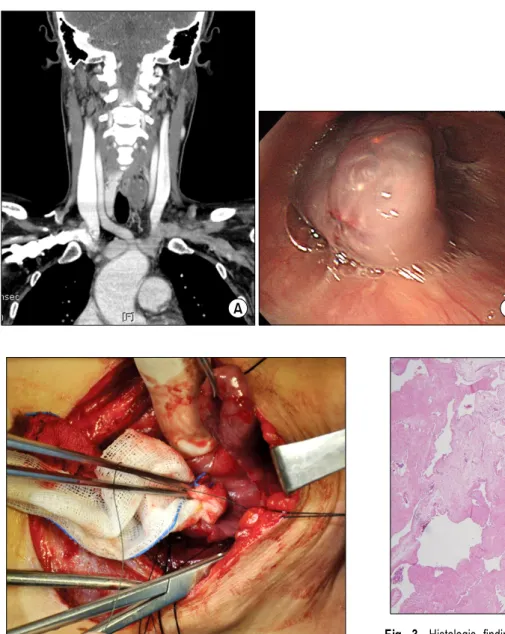
Palpation did not reveal any abnormalities in the superficial lymph nodes or neck. The blood biohistochemistry showed no abnormal findings. Neck and chest computed tomography (CT) revealed an 3.6 cm oval mass with slightly low attenu- ation in the upper esophagus, and a 7 mm nodule in the left lobe of the thyroid gland (Fig. 1A). Esophagogastroscopy showed a 3.5 cm smooth, soft, dark purple, mobile mass which was located just beneath the upper esophageal sphinc-

ter with a possibility of airway obstruction (Fig. 1B). The thyroid nodule was diagnosed as thyroid papillary carcinoma through sonography guided fine-needle aspiration cytology.

We decided to perform a combined operation for total thyroi- dectomy with dissection of the central neck nodes followed by resection of the esophageal tumor through cervical esophagotomy.

Under general anesthesia with a single lumen endotracheal

tube, a 6 cm transverse neck skin incision just above the

clavicle was performed. After meticulous dissection, total thy-

roidectomy with central neck node dissection was completed

by a head and neck surgeon. Esophageal dissection was per-

formed to the level of the hypopharynx. In palpation, there

was no mass in the cervical esophagus even after direct visu-

alization of the intraluminal space through cervical esopha-

gotomy. With a laryngoscope, the mass was seen at the level

of the arytenoid cartilage in the hypopharynx. After a gentle

push of the mass with a long Kelly in the direction of the

(2)

Jong Cheol Lee, et al

− 312 −

Fig. 1. (A) Neck and chest CT. 3.6 cm oval mass with slightly low at- tenuation in the upper esophagus and a 7 mm nodule in the left lobe of the thyroid gland. (B) Esopha- gogastroscopy. 3.5 cm smooth, soft, dark purple, mobile mass, which was located just beneath the upper eso- phageal sphincter.

Fig. 2. Intraoperative finding. The hemangioma was pulled out of the esophagotomy opening with Allis tissue forceps.

Fig. 3. Histologic findings show multiple dilated vascular channels with a focus of organizing thrombi (H&E stain, ×40).

esophagus, it could be extracted through the esophagotomy opening (Fig. 2). Mucosal resection was performed around the stalk, and the mass was removed without any complica- tion such as hemorrhage or perforation. The esophageal mu- cosa and muscle were repaired with 4-0 vicryl interrupted sutures.

The histopathological findings showed irregularly dilated vascular lumens in the submucosa, suggesting cavernous he- mangioma (Fig. 3). On the seventh post-operative day, an esophagogram was performed. There was no leakage or

stricture. After 1 day of oral feeding, the neck drain tube was removed. The patient was discharged on the ninth post-oper- ative day, and underwent follow-up care without incident for 1 month.

DISCUSSION

Hemangiomas are well known to arise from organs such as

the skin, liver, kidney, and brain. However, esophageal he-

mangiomas are extremely rare, representing around 3% of all

benign esophageal tumors [1]. Although the most common lo-

(3)

Esophageal Hemangioma

− 313 − cation of this tumor is the lower esophagus, followed by the middle, then the upper esophagus, it may occur at any level within the esophagus [2]. It occurs in men between the fourth and seventh decades predominantly [3]. Histologically it can be grouped into cavernous, capillary, hamartomatous, and ar- teriovenous malformations (AVM) subtypes. A cavernous he- mangioma is defined by having venous channels that are larger than the capillaries. The differential diagnosis includes leiomyoma, polyp, malignant hemangioma, Kaposi’s sarcoma, benign metastasizing hemangioma, and angiosarcoma [2].

Generally, like other benign esophageal tumors, patients have no clinical symptoms or signs, but the symptoms of ob- struction and hemorrhage, including dysphagia, dyspnea, hem- atemesis, and melena may occur [4,5]. In diagnosing the presence of esophageal hemangioma, esophagography facili- tates visualization in most patients. However, the findings are non-specific, showing either a well-defined lobulated intra- mural mass, pedunculated intraluminal mass, or an infiltrating annular mass [2].

Endoscopic ultrasound is a more helpful method for assess- ing the location, depth, and size of the tumor. It enables vas- cular channels within the hemangioma to be demonstrated precisely, which will help the surgeons to decide whether en- doscopic surgery is feasible or not [2]. Histological diagnosis by biopsy is also useful; however, hemorrhage may occur af- ter biopsy. On a chest CT scan, esophageal hemangioma usu- ally appears as a well-defined soft tissue mass, sometimes containing calcification, within the esophageal wall [6].

Further imaging may be carried out with the use of magnetic resonance imaging (MRI) or fluorodeoxyglucose-positron emission tomography (FDG-PET) [6].

Treatment options include esophagectomy or tumor enu- cleation by thoracotomy or an endoscopic approach. Recently, successful treatment has been reported with endoscopic scle- rotherapy [7], and potassium titanyl phosphate/yttrium alumi- num garnet (KTP/YAG) laser therapy [8]. The number of pa- tients undergoing EMR or endoscopic polypectomy is increas- ing, especially when the tumor is pedunculated and small in size (<25 mm) [2]. A large tumor may predicate the need for surgical resection [6].

In this case, neck incision and central neck dissection were inevitable for the thyroidectomy. Furthermore, the location

and size of the esophageal tumor made the decision to per- form EMR difficult. Therefore, we performed an esoph- agotomy instead of EMR. We could not identify the tumor mass in the esophagus because the redundant stalk caused it to move upward out of the upper esophageal sphincter during external palpation. Laryngoscopic visualization of the phar- yngeal space revealed a mass located the posterior part of the arytenoid cartilage on the hypopharynx. Because of the risk of hemorrhage during instrumental mobilization of the tumor, we gently pushed the mass with a long Kelly, which made it possible to extract the mass out of the esophagotomy opening. After that, the mucosal resection and esophageal re- pair was completed easily.

Although many authors have recently reported the success- ful treatment of esophageal hemangioma with endoscopic mu- cosal resection or KTP/YAG laser therapy, surgical resection through esophagostomy is safe and technically simple, espe- cially when the tumor is large or located in the cervical esophagus.

REFERENCES

1. Plachta A. Benign tumors of the esophagus. Review of liter- ature and report of 99 cases. Am J Gastroenterol 1962;38:

639-52.

2. Rasalkar DD, Chiu PW, Teoh AY, Chu WC. Oesophageal haemangioma: imaging characteristics of this rare condition.

Hong Kong Med J 2010;16:230-1.

3. Hanel K, Talley NA, Hunt DR. Hemangioma of the esoph- agus: an unusual cause of upper gastrointestinal bleeding.

Dig Dis Sci 1981;26:257-63.

4. Lee HJ, Kim YT, Sung SW, Kim JH. A case of long seg- ment myomectomy for the treatment of esophageal heman- gioma. Korean J Thorac Cardiovasc Surg 2003;36:206-10.

5. Mok HK, Shin HS, Hong KW. Cavernous hemangioma of the esophagus: one case report. Korean J Thorac Cardiovasc Surg 1999;32:851-4.

6. Rajoriya N, D’costa H, Gupta P, Ellis AJ. An unusual cause of dyspepsia: oesophageal cavernous haemangioma. QJM 2010;103:791-3.

7. Nagata-Narumiya T, Nagai Y, Kashiwagi H, Hama M, Takifuji K, Tanimura H. Endoscopic sclerotherapy for esophageal hemangioma. Gastrointest Endosc 2000;52:285-7.

8. Shigemitsu K, Naomoto Y, Yamatsuji T, et al. Esophageal

hemangioma successfully treated by fulguration using potas-

sium titanyl phosphate/yttrium aluminum garnet (KTP/YAG)

laser: a case report. Dis Esophagus 2000;13:161-4.

수치

Fig. 1. (A) Neck and chest CT. 3.6  cm oval mass with slightly low  at-tenuation in the upper esophagus  and a 7 mm nodule in the left lobe  of the thyroid gland

참조

관련 문서