• 검색 결과가 없습니다.

Journal of Korean Biological Nursing Science

N/A
N/A
Protected

Academic year: 2021

Share "Journal of Korean Biological Nursing Science"

Copied!
6
0
0

로드 중.... (전체 텍스트 보기)

전체 글

(1)

Introduction

Obesity is a global health problem, In 2016, more than 1.9 billion adults, 18 years and older, were overweight. Of these over 650 million were obese [1]. The obesity is classified as a “disease” in 2013 by the American Medical Association [2]. Obesity and overweight people per-

sist in sub clinical inflammation, leading to of iron deficiency (ID) and iron deficiency anemia (IDA), malignancy, and so forth [3]. Serum ferri- tin is used as a marker of iron deficiency [4]. Serum ferritin levels are present in abnormal conditions because they are acute phase reactants, serum ferritin levels are high in overweight and obesity, which are gener- alized inflammatory conditions [5]. For this reason, the use of serum fer-

한국 성인의 비만과 과체중에 따른 혈청 페리틴과 백혈구의 차이

이혜순

한남대학교 간호학과

The Difference in Serum Ferritin and Leukocyte Regarding Overweight and Obese South Korean Adults

Lee, Hea Shoon

Department of Nursing, College of Life Science and Nano Technology, Hannam University, Daejeon, Korea

Purpose: The purpose of this study was to investigate the difference in serum ferritin and leukocyte regarding overweight and obese South Korean adults. Methods: This study was conducted on 5,281 subjects older than 19, according to data from the Fifth Korea Na- tional Health and Nutrition Examination Survey (KNHANES V-3), 2015. Data were analyzed using descriptive statistics, t-test, ANOVA, Scheffe’s test, Pearson’s correlation coefficient, and stepwise multiple regression analysis (SPSS 24.0). Results: First, serum ferritin and leukocyte were higher regardubg obesity, followed by being overweight and within normal weight. Second, body mass index (BMI) was positively correlated with serum ferritin and leukocyte. Third, factors affecting serum ferritin were gender, and being obese and overweight. Explanatory power of the model was 26.2%. Factors affecting leukocyte were gender, obesity, being overweight, and weight change over the past year (weight gain). Explanatory power of the model was 10.2%. Conclusion: Obesity and being over- weight were factors affecting serum ferritin and leukocyte, and obesity was more affected than being overweight in Koreans older than 19. In conclusion, serum ferritin was a marker of inflammation, rather than iron status, in overweight and obese Korean adults.

Key Words: Adult; Body mass index; Ferritin; Leukocytes 국문주요어: 성인, 체질량지수, 페리틴, 백혈구

Corresponding author: Lee, Hea Shoon

Department of Nursing, College of Life Science and Nano Technology, Hannam University 70, Hannam-ro, Daedeok-gu, Daejeon 34430, Republic of Korea Tel: +82-42-629-8474 Fax: +82-42-629-8883 E-mail: [email protected]

* 이 연구는 2019년 한남대학교 연구 기금에서 지원받았습니다. * This work was supported by 2019 Hannam University Research Fund.

Received: December 30, 2018 Revised: February 26, 2019 Accepted: February 27, 2019

This is an Open Access article distributed under the terms of the Creative Commons Attribution Non-Commercial License (http://creativecommons.org/licenses/by-nc/4.0) which permits unrestricted non-commercial use, distribution, and reproduction in any medium, provided the original work is properly cited.

www.bionursingjournal.or.kr

https://doi.org/10.7586/jkbns.2019.21.2.108

Journal of Korean Biological Nursing Science 2019;21(2):108-113

(2)

ritin as a marker of ID or IDA in overweight or obese is controversial [6].

The inflammation caused by the increase of the adiposity will be sug- gested as a link between iron status and obesity [7]. Among the many metabolic activities of obesity, high Body mass index (BMI) is associated with incompatibility of iron parameters [8]. Chronic inflammation caused by obesity led to low iron status and showed low iron status in 38.8% of obesity and 12.1% of overweight [9]. Physical activity and weight gain are inversely related, thus, physical activity may reduce body iron deficiency in obesity [10].

When ID/IDA and obesity coexist, they double the adverse health ef- fects of obesity itself. Chronic inflammation caused by excessive fat tis- sue, rather than diet, provides an explanation for obesity’s ID/IDA, but the presence of acute and chronic infections should also be considered and inflammatory diseases should be considered [11]. As a result, ferritin is an indicator of inflammation in overweight and obesity than iron sta- tus. Higher ferritin levels secondary to asymptomatic inflammation of overweight and obese people can conceal iron deficiency because they are acute-phase responders [12].

In a study of Korean adults, serum ferritin is a positive associated with metabolically obese normal weight [6], and serum ferritin is the highest in obesity and lowest in normal weight [12]. Serum ferritin levels are as- sociated with incidence of obesity in Korean men [13] and had a positive correlation with BMI and negative correlation with iron [12].

On the other hand, obesity is associated with decreased anemia, high hemoglobin and platelets [14,15]. Platelets are correlated with body fat mass and body fat percentage, and chronic inflammation is the cause of platelet activation [15].

The leukocyte is a hematological parameter that could provide useful information about health condition, leukocyte is needed to protect against invading organisms and the immune system [16]. There is strong evidence for a link between obesity and increased leukocyte [17]. Also, serum ferritin is positive correlated with C-reactive protein (CRP) as an indicator of inflammation [12].

In previous studies, there is a difference in serum ferritin and leuko- cyte according to obesity level of foreigners [10,17], but there are few studies of obesity in Korea. In particular, studies investigating the differ- ence in serum ferritin and leukocyte in overweight and obese groups are rare. Also, the effects of obesity have shown contradictory results for iron reduction [3,7-9] or iron gain [14,15]. Serum ferritin, which reflects iron status, is used as a variable in this study.

The Fifth Korea National Health and Nutrition Examination Survey is representative of nationwide survey data. Therefore, it is appropriate sample data to construct domestic reference value. In this study, we sug- gested a fundamental data of adult obesity prevention and management program by identifying the difference in serum ferritin and leukocyte according to overweight and obesity in Korean adults. We suggested a fundamental data of Korean adult obesity prevention and management program.

Methods

1. Research design

This study is a descriptive survey study which attends a secondary analysis of The Fifth Korea National Health and Nutrition Examination Survey’s raw data to investigate the difference in serum ferritin and leu- kocyte according to overweight and obesity in South Korean adults.

2. Samples and setting

Subject of this study is adult (over 19 years) and data was based on

‘The Fifth Korea National Health and Nutrition Examination Survey (KNHANES V-3), 2015’ which Ministry of Health and Welfare and Ko- rea Centers for Disease Control and Prevention conducted.

According to classification standard of BMI groups were divided in normal weight 2,303 (43.6%), overweight 1,282 (24.3%) and obesity 1,696 (32.1%). The total 5,281 subjects were analyzed as the data of this study.

3. Instruments 1) BMI

The subject’s height and weight were measured after overnight fasting with participants shoe less and wearing a lightweight gown. World Health Organization (WHO) classified BMI over 25 kg/m 2 as over- weight and over 30 kg/m 2 as obesity [1]. However, it was not appropriate to apply it to Asians because it was developed based on the results of re- search on westerner [18]. In the World Health Organization Western Pa- cific region [19], classified BMI as normal weight less than 23 kg/m 2 , overweight as 23-24.9 kg/m 2 and obesity as 25 kg/m 2 or more. This crite- rion was applied in this study as well.

2) Blood measurement

Blood sampling was collected in the morning after fasting for 8 hours

(3)

or more, and median cubital vein was punctured using a vacutainer needle and blood was drawn into a vacuum tube.

Serum ferritin was measured by immuno-radiometric assay using a 1470 Wizard Gamma Counter (Perkin-Elmer, Finland). Leukocyte was mea- sured by laserflow cytometry using a Sysmex XE2100D (Sysmex, Japan).

4. Ethical consideration

The Korea National Health and Nutrition Examination Survey which was used in this study was reviewed from Korea Centers for Disease Control and Prevention Institutional Review Boards (IRB)(2012-01EXP- 01-2C), and subject’s anonymity and confidentiality were guaranteed by collecting their private information in serial number which was unable to distinguish, and we conducted an annual survey. In this study, ac- cording to the raw data open and care regulation of Korea Centers for Disease Control and Prevention, after the researcher got confirmation for using data (Dec 7th, 2017), the data was provided, and we used them.

5. Data analysis

The data was analyzed by SPSS WIN 24.0 program (SPSS Inc. Chica- go, IL, USA). The general characteristic of subject was analyzed by de- scriptive statistics. Difference of serum ferritin and leukocyte depends on subject’s obesity degree was analyzed by t-test, ANOVA, Scheffe’s test, Correlation among subject’s BMI, serum ferritin and leukocyte were an- alyzed by Pearson correlation coefficient. The predictive variables for se- rum ferritin and leukocyte were analyzed by stepwise multiple regres-

sion. All significance were analyzed using a 2-tailed method, and a P- value<0.05 was considered statistically significant.

Results

1. General characteristics of subject

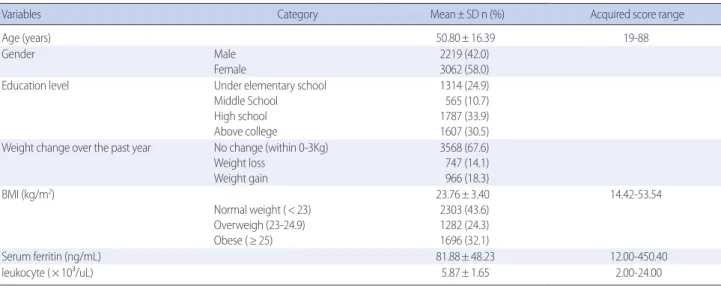
The average age of the subjects were 50.80 years old. The average BMI was 23.76 kg/m 2 , specifically, normal weight was 43.6%, overweight was 24.3%, and obesity was 32.1%. The average serum ferritin was 81.88 (ng/

mL) and the average leukocyte was 5.87 (x10 3 /uL) (Table 1).

2. Differences of serum ferritin and leukocyte according to subject’s BMI.

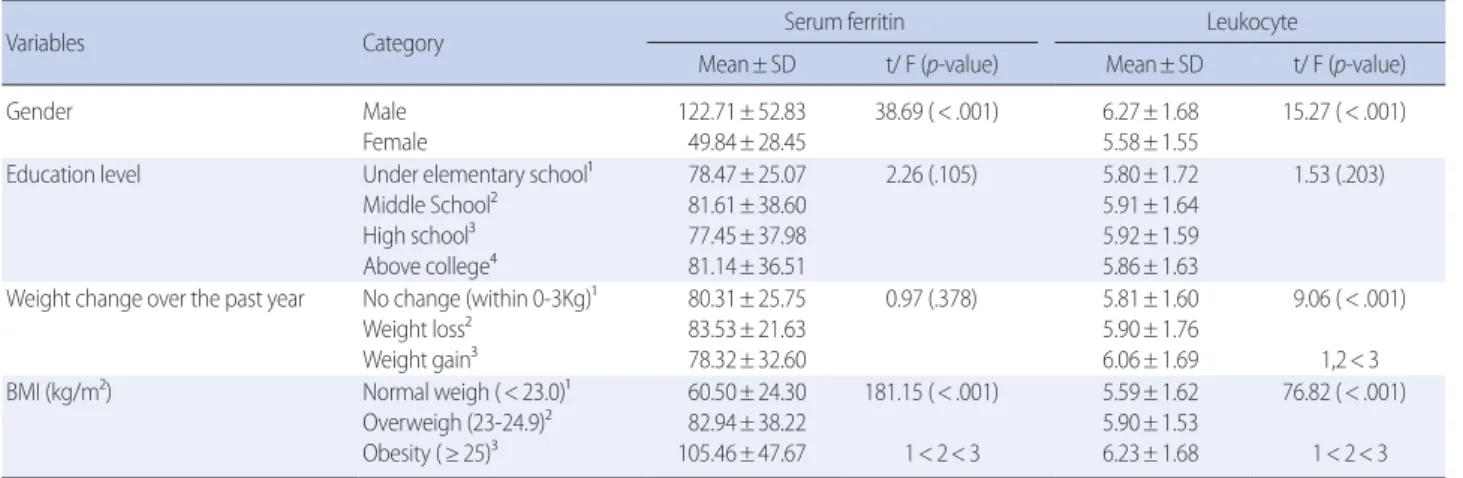
The serum ferritin was higher in males than females (t=38.69, p<.001).

According to BMI classification, serum ferritin was highest in obesity, followed by overweight and normal weight (F=181.15, p<.001). The leu- kocyte was higher in males than in females (t=15.27, p<.001). In weight change over the past year, weight gain was higher than no change (with- in 0-3 kg) and weight loss (F=9.06, p<.001). According to the BMI clas- sification, leukocyte was the highest in obesity, followed by overweight and normal weight (F=76.82, p<.001) (Table 2).

3. Correlation among subject’s BMI, serum ferritin and leukocyte

The subject’s BMI was positively correlated with serum ferritin

Table 1. General Characteristics of Subject (N=5,281)

Variables Category Mean± SD n (%) Acquired score range

Age (years) 50.80± 16.39 19-88

Gender Male

Female

2219 (42.0) 3062 (58.0)

Education level Under elementary school

Middle School High school Above college

1314 (24.9) 565 (10.7) 1787 (33.9) 1607 (30.5) Weight change over the past year No change (within 0-3Kg)

Weight loss Weight gain

3568 (67.6) 747 (14.1) 966 (18.3) BMI (kg/m

2

)

Normal weight (< 23) Overweigh (23-24.9) Obese (≥ 25)

23.76± 3.40 2303 (43.6) 1282 (24.3) 1696 (32.1)

14.42-53.54

Serum ferritin (ng/mL) 81.88± 48.23 12.00-450.40

leukocyte (× 10³/uL) 5.87± 1.65 2.00-24.00

SD= Standard deviation; BMI= Body mass index.

(4)

(r= 0.20, p<.001) and leukocyte (r= 0.17, p<.001) (Table 3).

4. Predictive variables for serum ferritin and leukocyte To determine the factors affecting serum ferritin and leukocyte, gen- der, weight change over the past year and BMI (obesity, overweight, nor- mal weight), which showed significant differences in serum ferritin and leukocyte were regarded as independent variables. A stepwise multiple regression analysis was performed and the nominal scale was converted to a dummy variable.

Serum ferritin regression model was significant (F= 468.55, p<.001) and the explanatory power of the model was 26.2%. Factors affecting se- rum ferritin were gender (female) (β=-.455, p<.001), obesity (β=.209, p<.001), and overweight (ß=.075, p<.001).

The leukocyte regression model was significant (F=36.42, p<.001) and the explanatory power of the model was 10.2%. Factors affecting leukocyte was gender (female) (β =-.191, p <.001), obesity (β =.149, p<.001), overweight (β=.060, p<.001), and weight change over the past

year (weight gain) (β=.047, p=.001) (Table 4).

Discussion

The study is performed to investigate the difference in serum ferritin and leukocyte according to overweight and obesity in South Korean adults. In this study, BMI and serum ferritin are positive correlation, and serum ferritin is the highest in obesity, followed by overweight and nor- mal weight. In addition, factors affecting serum ferritin is gender, obesi- Table 2. Differences of Serum ferritin and Leukocyte according to Subject's BMI (N=5,281)

Variables Category Serum ferritin Leukocyte

Mean± SD t/ F (p-value) Mean± SD t/ F (p-value)

Gender Male

Female

122.71± 52.83 49.84± 28.45

38.69 (< .001) 6.27± 1.68 5.58± 1.55

15.27 (< .001)

Education level Under elementary school¹

Middle School² High school³ Above college⁴

78.47± 25.07 81.61± 38.60 77.45± 37.98 81.14± 36.51

2.26 (.105) 5.80± 1.72

5.91± 1.64 5.92± 1.59 5.86± 1.63

1.53 (.203)

Weight change over the past year No change (within 0-3Kg)¹ Weight loss²

Weight gain³

80.31± 25.75 83.53± 21.63 78.32± 32.60

0.97 (.378) 5.81± 1.60

5.90± 1.76 6.06± 1.69

9.06 (< .001) 1,2< 3

BMI (kg/m²) Normal weigh (< 23.0)¹

Overweigh (23-24.9)² Obesity (≥ 25)³

60.50± 24.30 82.94± 38.22 105.46± 47.67

181.15 (< .001) 1< 2< 3

5.59± 1.62 5.90± 1.53 6.23± 1.68

76.82 (< .001)

1< 2< 3 SD= Standard deviation; BMI= Body mass index.

Table 4. Predictive Variables for Serum ferritin and Leukocyte (N=5,281)

Variables Serum ferritin Leukocyte

β t p β t p

Gender (female) -.455 -37.55 < .001 -.191 -14.19 < .001

BMI (kg/m²) Obesity (≥ 25) Overweigh (23-24.9)

  .209 .075

  16.01

5.78


< .001

< .001

  .149 .06

  1.12 4.15


< .001

< .001

Weight change over the past year (weight gain)       .047 3.46 .001

Constant   42.242 < .001   73.587 < .001

Adjusted R² .262 .102

F (p) 468.55 (< .001) 36.42 (< .001)

BMI= Body mass index.

Table 3. Correlation among Subject's BMI, Serum ferritin and Leukocyte (N=5,281)

Variables BMI Serum ferritin Leukocyte

r (p value)

BMI 1

Serum ferritin 0.20 (< .001) 1

Leukocyte 0.17 (< .001) 0.14 (< .001) 1

BMI= Body mass index.

(5)

ty, and overweight.

The study second, third and fourth quartiles of serum ferritin levels are incident obesity 1.08 times, 1.14 times, and 1.24 times as compared with the first quartile, also there is a consistent association with severe obesity (BMI≥30 kg/m2) [13]. Serum ferritin is a marker of inflamma- tion in obese subjects, the high BMI is to have a high level of serum ferri- tin, which can be caused because of the dominant inflammatory condi- tions, in the presence of an increased adipose tissue [12]. Increased body fat tissue appears to be associated with an increased risk of iron deficien- cy that can be masked by elevated serum ferritin levels, perhaps the in- creased cytokines results in increased acute phase reactant synthesis leading to a decrease in macrophages sequestration and / or intestinal iron uptake [20].

The expression of serum ferritin, a prime indicator of iron status, is stimulated by a number of factors, including cytokines released during inflammation and liver disease. Inflammation in turn leads to hepatic synthesis of acute-phase proteins and obesity is one of the most com- mon and prevalent conditions promoting low-level inflammation [21].

ID commonly observed in overweight and obese people is most likely due to inflammatory mechanisms [22].

IDA occurs most often due to malnutrition. Obesity, on the other hand, is often caused by excessive nutrition. Therefore, the coexistence of IDA and obesity in the same person indicates malnutrition and hyper nutrition. Among the factors responsible for mutual co-existence, such as diluted hypoferremia, lack of dietary iron intake, increased iron de- mand, and/or iron absorption disorder, hepcidin has recently been iden- tified as a major cause of obesity ID or IDA [23].

In this study, BMI and leukocyte were positive correlation, and leuko- cyte was the highest in obesity, followed by overweight and normal weight. In addition, factors affecting leukocyte were gender, obesity, overweight and weight change over the past year (weight gain). The study found a positive correlation between BMI and leukocyte in the obese group [24] and cross-sectional studies reported a positive association be- tween obesity and leukocyte count [17]. The number of leukocyte in overweight and obesity was 1.06 times (95% CI= 0.9-1.2) and 1.11 times (95% CI= 0.9-1.3), respectively [14]. A previous study showed some fac- tors that cause continuous increase in leukocyte in obese patients [25].

Obesity is the only identified cause in patients with leukopenia. In an- other study, people with central fat had higher levels of some inflamma- tory markers, including leukocyte counts, 17% higher than those with

normal body fat distribution [26]. Leukocytes increased with increasing waist circumference(WC), and the number of leukocytes are the most consistent between BMI and WC [25].

It has been shown that there is some association between increased numbers of immune cells and obesity as a result of chronic inflammato- ry conditions resulting from increased cytokines production by adipose tissue, obesity has also been demonstrated to be associated with low- grade sub clinical and smoldering inflammation [27], supporting the re- sults of this study. The previous findings are positive correlation between cell number and obesity have been reported in cross-over study [16].

Measurements of central fat accumulation have been found to be more closely related to the various diseases and health conditions of BMI in both gender [25]. It is necessary to study the difference of serum ferritin and leukocyte including WC and BMI.

The sampling framework of the National Health and Nutrition Sur- vey used in this study was designed to extract representative samples. So, the results of this study, it was meaningful that it can represent the char- acteristics of Korean adults.

As a limitation of this study, the increase of leukocyte in obesity may be due to hypervolemic in obese people, resulting in a naturally increas- ing number of blood cells. In addition, the correlation between obesity and chronic inflammation requires implementation of not only leuko- cyte but also inflammatory markers (for example, CRP).

Conclusions

In this study, obesity and overweight is a factor affecting serum ferri- tin and leukocyte, and obesity is more affected than overweight in Kore- an aged over 19 years. In conclusion, Serum ferritin is a marker of in- flammation rather than iron status in overweight and obese Korean adults. Because of acute-phase reactions, high ferritin levels secondary to asymptomatic inflammation of both overweight and obesity can mask underlying iron deficiency. It is recommended to request an iron studies including transferrin saturation, total iron binding capacity, and the like.

CONFLICT OF INTEREST

The authors declared no conflict of interest.

(6)

REFERENCES

1. World Health Organization. Obesity and Overweight [Internet]. Geneva:

World Health Organization; 2017, [cited 2019 March 5]. Available from: https://

www.who.int/news-room/fact-sheets/detail/obesity-and-overweight 2. Kelly F. Obesity Is Now A Disease, American Medical Association

Decides[internet]. Brighton: Healthline Media UK Ltd;2013 [cited 2018 May 10]. Available from: https://www.medicalnewstoday.com/articles/262226.php.

3. Kohlgruber AL, Lynch L. Adipose tissue inflammation in the pathogenesis of type 2 diabetes. Current Diabetes Reports. 2015;15(11):92. https://doi.org/10.1007/

s11892-015-0670-x.

4. Bansal PG, Toteja GS, Bhatia N, Vikram NK, Siddhu A, Garg AK, et al. Defi- ciencies of serum ferritin and vitamin B12, but not folate, are common in ado- lescent girls residing in a slum in Delhi. International Journal for Vitamin and Nutrition Research 2015;85(1-2):14-22. https://doi.org/10.1024/0300-9831/

a000219

5. O’Brien HT, Blanchet R, Gagn´e D, Lauzi`ere J, V´ezina C. Using soluble trans- ferrin receptor and taking inflammation into account when defining serum ferritin cutoffs improved the diagnosis of iron deficiency in a group of Canadi- an preschool Inuit children from Nunavik. Anemia. 2016; Article ID 6430214.

https://doi.org/10.1155/2016/6430214

6. Kim JW, Kim DH, Roh YK, Ju SY, Nam HY, Nam GE, et al. Serum ferritin levels are positively associated with metabolically obese normal weight: a nationwide population-based study. Medicine. 2015; 94(52): Article ID e2335. https://doi.

org/10.1097/MD.0000000000002335

7. McClung JP, Andersen NE, Tarr TN, Stahl CH, Young AJ. Physical activity pre- vents augmented body fat accretion in moderately iron-deficient rats. The Jour- nal of Nutrition. 2008;138(7):1293-1297. https://doi.org/10.1093/jn/138.7.1293 8. Cheng HL, Bryant C, Cook R, O’Connor H, Rooney K, Steinbeck K. The rela- tionship between obesity and hypoferraemia in adults: A systematic review.

Obesity Reviews. 2012;13(2):150-161. https://doi.org/10.1111/j.1467- 789X.2011.00938.x.

9. Pinhas-Hamiel O, Newfield RS, Koren I, Agmon A, Lilos P, Phillip M. Greater prevalence of iron deficiency in overweight and obese children and adolescents.

International Journal of Obesity. 2003;27(3):416-418. https://doi.org/10.1038/

sj.ijo.0802224

10. Lecube A, Carrera A, Losada E, Hernández C, Simó R, Mesa J. Iron deficiency in obese postmenopausal women. Obesity. 2006;14(10):1724-1730. https://doi.

org/10.1038/oby.2006.198

11. Jericó C, Bretón I, García Ruiz de GA, de Oliveira AC, Rubio MÁ, Tinahones FJ, et al. Diagnosis and treatment of iron deficiency, with or without anemia, be- fore and after bariatric surgery. Endocrinologíay nutrición. 2016; 63(1):32-42.

https://doi.org/10.1016/j.endonu.2015.09.003

12. Khan A, Khan WM, Ayub M, Humayun M, Haroon M. Ferritin Is a Marker of Inflammation rather than Iron Deficiency in Overweight and Obese People. Jour- nal of Obesity. 2016; Article ID 1937320. https://doi.org/10.1155/2016/1937320 13. Park SK, Choi WJ, Oh CM, Kim JE, Shin HH, Ryoo JH. Association between

serum ferritin levels and the incidence of obesity in Korean men: A prospective

cohort study. Endocrine Journal. 2014; 61(3):215-224. https://doi.org/10.1507/

endocrj.EJ13-0173

14. Abdelmageed E, Duria AR, Renda E, Abdelmageed IA, Gasim IG. High level of hemoglobin, white blood cells and obesity among Sudanese women in early pregnancy: a cross-sectional study. Future science OA. 2017; 3(2): FSO182.

https://doi.org /10.4155/fsoa-2016-0096.

15. Zhang SZ, Jin YP, Qin GM, Association of platelet-monocyte aggregates with platelet activation, systemic inflammation, and myocardial injury in patients with non-ST elevation acute coronary syndromes. Clinical cardiology.

2007;30(1):26-31. https://doi.org/10.1002/clc.2

16. Imano H, Sato S, Kitamura A, Kiyama M, Ohira T, Shimamoto T, et al. Leuko- cyte count is an independent predictor for risk of acute myocardial infarction in middle-aged Japanese men. Atherosclerosis. 2007;195(1):147-152. https://doi.

org/10.1016/j.atherosclerosis.2006.09.002

17. Dixon JB, O’Brien PE. Obesity and the white blood cell count: changes with sustained weight loss. Obesity Surgery. 2006;16(3):251-257. https://doi.

org/10.1381/096089206776116453

18. Sim KW, Lee SH, Lee HS. The relationship body mass index and morbidity in Korea. Journal of Korean Society for the Study of Obesity. 2001;10(2):147-155.

19. World Health Organization Western Pacific Region. The Asia-pacific perspec- tive: Redefining obesity and its Treatment. Australia: WHO Western Pacific Re- gion, 2000.

20. Cepeda-Lopez AC, Aeberli I, Zimmermann MB. Does obesity increase risk for iron deficiency? a review of the literature and the potential mechanisms. Inter- national Journal for Vitamin and Nutrition Research. 2010;80(45):263-270.

https://doi.org/10.1024/0300-9831/a000033

21. Shiwaku K, Anuurad E, Enkhmaa B, Kitajima K, Yamane Y. Appropriate BMI for Asian populations. The Lancet. 2004;363(1077):157-163. https://doi.

org/10.1016/S0140-6736(04)15856-X

22. Lecube A, Hern´andez C, Pelegr´ı D, Sim´o R. Factors accounting for high fer- ritin levels in obesity. International Journal of Obesity. 2008;32(11):1665-1669.

https://doi.org/10.1038/ijo.2008.154

23. Villarroel HP, Arredondo OM, Olivares GM. Hepcidin as a central mediator of anemia of chronic diseases associated with obesity. Revista Medica de Chile.

2013;141(7):887-894. https://doi.org/10.4067/S0034-98872013000700008 24. Jamshidi L, Sief A. Association Between Obesity, White Blood Cell and Platelet

Count. Zahedan Journal of Research in Medical Sciences.2017;9(2):e4955.

https://doi.org/10.5812/zjrms.4955.

25. Herishanu Y, Rogowski O, Polliack A. Leukocytosis in obese individuals: possible link in patients with unexplained persistent neutrophilia. European Journal of Hae- matology. 2006;76(6):516-520. https://doi.org/10.1111/j.1600-0609.2006.00658.x 26. Panagiotakos DB, Pitsavos C, Yannakoulia M, Chrysohoou C, Stefanadis C. The

implication of obesity and central fat on markers of chronic inflammation: the ATTICA study. Atherosclerosis. 2005;183(2):308-315. https://doi.org/10.1016/

j.atherosclerosis.2005.03.010

27. Samocha-Bonet D, Justo D, Rogowski O, Saar N, Abu-Abeid S, Shenkerman G,

et al. Platelet counts and platelet activation markers in obese subjects. Mediators

Inflammation. 2008; Article ID 834153: 6. https://doi.org/10.1155/2008/834153

수치

Table 1. General Characteristics of Subject  (N=5,281)
Table 4. Predictive Variables for Serum ferritin and Leukocyte       (N=5,281)

참조

관련 문서

Study of diabetes and the nutrition education and awareness of nutrition labels in Korean adults: Using data from the fifth Korea National Health and Nutrition Examination

In the past year, it is obvious that this cooperation development has also promoted in Vietnam the formation and development of a Korean studies training

In this Thesis, an empirical study on the Influence of Consumer's Preferences and Satisfaction on Purchase Intention of Korean Automobile in Vietnamese Consumers

Factors associated with hypertension control in Korean adults: The fifth Korea National Health and Nutrition Examination Survey (KNHANES V-2).. Association of stress

The Relationship between Physical Activities and Health-related Quality of Life in Korean Adults with Diabetes

‹ The science of Geophysics is the application of physics to investigations of the Earth, Moon and Planets3. × In

A stress component is positive when it acts in the positive direction of the coordinate axes, and on a plane whose outer normal points in one of the positive coordinate

The safe ship operation of Korean coastal shipping, compared with that of ocean going shipping, is threatened by difficulties in replacement of a