Research Article Open Access
Effects of Isometric Upper Limb Contraction on Trunk and Leg Muscles During Sit-to-stand Activity in Healthy Elderly Females
Eun-Mi Jang, PhD, PT⋅Jae-Seop Oh, PhD, PT
1⋅Mi-Hyun Kim, PhD, PT
1†Dept. of Rehabilitation Science, Graduate School, Inje University
1
Dept. of Physical Therapy, Inje University
Received: October 21, 2016 / Revised: October 31, 2016 / Accepted: November 26, 2016
ⓒ 2017 J Korean Soc Phys Med
| Abstract |
1)PURPOSE: The purpose of this study was to investigate the effects of isometric upper limb contraction on the trunk and lower extremity muscles during the sit-to-stand activity in elderly females.
METHODS: Eighteen healthy elderly females performed three directional isometric upper extremity contractions (flexion, extension, and horizontal abduction movements) using an elastic band during sit-to-stand activity. Electromy- ography signals were collected from the internal oblique, erector spinae, rectus femoris, and biceps femoris muscles.
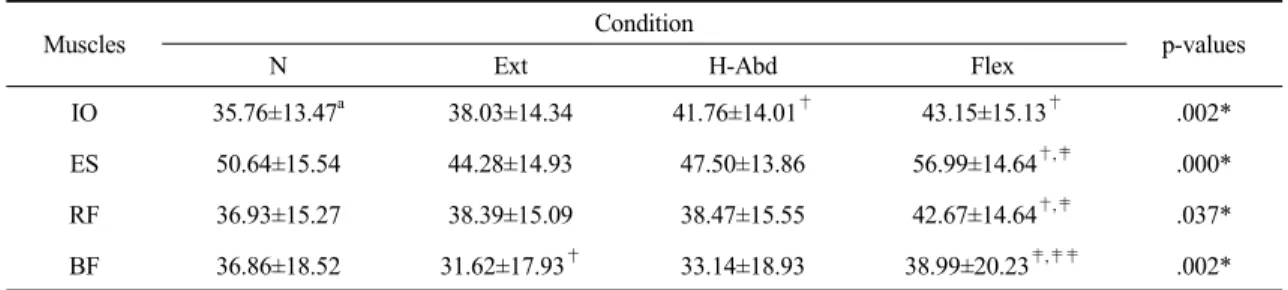
RESULTS: Internal oblique activity was greater in bilateral shoulder flexion and bilateral shoulder horizontal abduction than in neutral position (p<.05). Erector spinae and rectus femoris muscle activities in bilateral shoulder flexion was greater than in neutral position and bilateral shoulder extension (p<.05). Biceps femoris activity was significantly greater in bilateral shoulder flexion than in bilateral shoulder extension and horizontal abduction, and in neutral position compared to bilateral shoulder extension (p<.05).
†Corresponding Author : [email protected]
This is an Open Access article distributed under the terms of the Creative Commons Attribution Non-Commercial License (http://creativecommons.org/licenses/by-nc/3.0) which permits unrestricted non-commercial use, distribution, and reproduction in any medium, provided the original work is properly cited.
CONCLUSION: These results suggest that incorporating isometric upper limb contraction may be beneficial for enhancing the contribution of trunk and lower extremity muscle activities to trunk stabilization during sit-to-stand activity.
Therefore, isometric upper limb contraction during sit-to-stand tasks, especially in flexion, may be used to elicit contraction of the lumbopelvic region muscles within a tolerable range, for developing endurance and strength in the elderly.
Key Words: Isometric contraction, Leg muscle, Sit-to-stand, Trunk muscle, Upper extremity
Ⅰ. Introduction
The ability to rise from a seated position, otherwise known as sit-to-stand activity (STS), is essential for postural maintenance and controlled and coordinated movement (Park, 2002). Safe execution of STS is a prerequisite for activities such as walking and stair climbing (Papa and Cappozzo, 2000).
Age-related declines in lower limb strength and balance
and sensory systems have independently been shown to
impair safe and efficient execution of STS in older adults
(Lord et al., 2002; Schenkman et al., 1996). In elderly
women in particular, decreased muscle strength of the lower
extremities occurs more quickly than in elderly men,
reducing balance and gait ability (Park and Yoon, 2009).
Standing up require greater muscle strength, range of motion and a peak joint moment than walking and stair climbing. It also requires the balance ability to translate the body mass forward and upward from a relatively stable sitting position to the feet. Because of these mechanical demands, elderly people may experience difficulty when standing from a chair (Carr and Shepherd, 2011; Yoshioka et al., 2009). It was found that older adults exhibited a longer execution time than younger adults for executing STS possibly due to the poorer leg muscle strength in elderly adults (Yamada and Demura, 2009).
Thus the balance training and muscle strengthening exercise may be required to successful STS performance in elderly people (Kim et al., 2010). Previous studies have been suggested that trunk and hip muscles may be affected by loading induced from upper- and lower-limb movement (Arokoski et al., 2001; Park and Yoon, 2009; Tarnanen et al., 2008). Arokoski et al. (2001) found that the activation patterns of the abdominal muscles were affected by the direction of restricted upper-limb movements. Other researchers have shown that the direction of resistance on the upper limb could affect the activation patterns of the abdominal muscles (Lee et al., 2012). However, these exercises were performed in a static posture only, such as a standing or sitting position. There are no studies on effects of the resistance direction of upper extremity on trunk and leg muscles during a dynamic movement such as STS. Therefore, the purpose of this study was to quantify and compare how isometric contractions of upper extremity affect trunk and lower extremity electromyography activity during STS in healthy old adults.
Ⅱ. Methods
1. Subjects
We recruited 18 healthy elderly women volunteers from a community dwelling in Gimhae city. The mean age of
the subjects was 68 ± 1.97 years (mean ± SD), mean height was 154.72 ± 4.21 cm, and mean body weigh was 54.61
± 6.84 kg. The Inje University Faculty of Health Science Human Ethics Committee granted approval for this study, and all subjects provided written informed consent prior to participation.
2. Instrumentation
Surface EMG signals were recorded using four pre-amplified (gain: 1,000) active surface electrodes (Model DE-2.3, Delsys Inc., Wellesley, MA, USA) with surface electrodes fixed at an inter-electrode distance of 10 mm.
The sampling rate was 1,000 Hz; the band-pass filter was 20–450 Hz. Raw data for the four muscles were processed into root-means square (RMS) data.
The electrodes were positioned on four sites on the right side of the subjects’ bodies: internal oblique (IO), erector spinae (ES), rectus femoris (RF), and biceps femoris (BF) muscles. For normalization of the EMG signal, subjects were asked to perform a maximum voluntary isometric contraction (MVIC) maneuver for 5s. The EMG data expressed the entire STS task as a percentage of maximum voluntary isometric contraction (%MVIC). One infrared-retro reflective marker was placed on the superior aspects of the scapular acromion process to define the start and end positions of the STS (Vicon 512, Oxford Metrics Group, UK).
3. Procedures
Subjects were instructed to sit with an upright trunk
posture on a height-adjustable bed without back support
and with feet flat on the floor. The hip, knee, and ankle
joints were positioned at 90∘ flexion, and the feet were
positioned shoulder-width apart with the toes pointing
directly forward. The poles were placed directly in front
of (extension condition) or behind (flexion condition) the
trunk bilaterally at a distance of 1m, and the subject’s
shoulder height was measured to determine the fixed axis
for the elastic band. A blue elastic therapeutic band
Muscles Condition
p-values
N Ext H-Abd Flex
IO 35.76±13.47
a38.03±14.34 41.76±14.01
†43.15±15.13
†.002*
ES 50.64±15.54 44.28±14.93 47.50±13.86 56.99±14.64
†,‡.000*
RF 36.93±15.27 38.39±15.09 38.47±15.55 42.67±14.64
†,‡.037*
BF 36.86±18.52 31.62±17.93
†33.14±18.93 38.99±20.23
‡,‡‡.002*
Abbreviations: MVIC, maximum voluntary isometric contraction; N, neutral; Ext, extension; H-Abd, horizontal abduction;
Flex, flexion; IO, internal oblique; ES, erector spinae; RF, rectus femoris; BF, biceps femoris.
a