• 검색 결과가 없습니다.

Therapeutic Effects of Coptidis Rhizoma and Berberine in Streptozotocin-induced Diabetic Rats

N/A
N/A
Protected

Academic year: 2021

Share "Therapeutic Effects of Coptidis Rhizoma and Berberine in Streptozotocin-induced Diabetic Rats"

Copied!
9
0
0

로드 중.... (전체 텍스트 보기)

전체 글

(1)

Therapeutic Effects of Coptidis Rhizoma and Berberine in Streptozotocin-induced Diabetic Rats

Kee-Tae Kweon

1

, Sang-young Ahn

2

, In-hye Ham

3

, Kyung-jin Lee

3

, Ho-Young Choi

3

1Division of Traditional Korean Medicine Industry, Office for Healthcare Policy, Ministry of Health & Welfare

2Korea Institute of Oriental Medicine

3Department of Herbology, College of Oriental Medicine, Kyung Hee University Original Article

⋅Received:7 November 2011 ⋅Revised:9 November 2011 ⋅Accepted:9 November 2011

⋅Correspondence to:Ho-Young Choi

Department of Herbology, College of Oriental Medicine, Kyung Hee University 1 Hoegi-dong, Dongdaemun-gu, Seoul130-701, Republic of Korea.

Tel:+82-2-961-9372, Fax:+82-2-965-9372, Email:[email protected]

Objectives: We performed this study to compare the antidiabetic effects of Coptidis Rhizoma (CR) and its major component berberine with gliclazide.

Materials and Methods: Diabetic rats induced by injection of streptozotocin (STZ) 55mg/kg were treated with CR 100, 200, 400mg/kg and berberine 100mg/kg. After rats were treated for 5 days, serum glucose, total cholesterol, triglyceride, BUN, creatinine and antioxidant levels were determined.

Results: The cytotoxic effects of CR (0.1, 0.01, and 0.001mg/mL), berberine and gliclazide (0.1µM, 1µM, and 10µM) were tested in rat insulinoma (RIN) cells induced with 5mM STZ. The levels of fasting blood glucose, total cholesterol, triglyceride, BUN and creatinine of CR and berberine treated groups were reduced as much as that of gliclazide group in comparison to control groups, whereas total antioxidant levels increased. In vitro experiments showed that CR and berberine have a cytoprotective effect on RIN cells.

Key Words : Coptidis rhizome; berberine; streptozotocin; gliclazide; diabetes.

Introduction

Diabetes mellitus is a metabolic disorder of the endocrine system. The disease is found in all parts of the world and is rapidly increasing in most parts of the world

1)

. While there is much variation within the Asia-Pacific region, there is a rising prevalence of diabetes throughout the region. This is strongly associated with the lifestyle changes that follow large- scale industrialization, mechanization and urbanization.

The current epidemic of diabetes is principally due to rises in Type 2 diabetes, although Type 1 diabetes prevalence rates are also increasing

2)

.

According to its clinical manifestation, diabetes mellitus is categorized as So-gal or So-dang in traditional Korean medicine (TKM). From a TKM perspective, the cause of disease is classified into fluid consumption due to lung heat, excessive fire in the stomach, deficiency of kidney yin, deficiency of both qi and

yin, and deficiency of both yin and yang. The

treatment is based on the principle of eliminating heat by nourishing yin, moistening dryness and pro- moting fluid production

1)

.

Coptidis Rhizoma (CR) is cited in Dongeuibogam

(‘Treasured Mirrors of Eastern Medicine’) as a

useful herbal medicine in the treatment of diabetes

(2)

mellitus

3)

. It has been reported that CR possesses hypocholesterolemic action

4)

and antioxidant pro- perties

5)

, which may play a important protective role against diabetes mellitus in the onset, complications and insulin resistance

6,7)

. Also berberine, one of the main constituents of CR, is a type of isoquinoline alkaloid. It is suggested that berberine might be one of the principal antidiabetic constituents of CR.

Berberine increases glucose uptake through a mechanism distinct from insulin, and activated adenosine mono- phosphate-activated protein kinase seems to be involved in the metabolic effect of berberine

8)

.

In this study, we treated rats with streptozotocin (STZ) and investigated the effects of CR and berberine on serum glucose, total cholesterol, triglyceride, BUN, creatinine, total antioxidant and cytotoxicity on RIN cells in comparison with gliclazide.

Materials and Methods 1. Preparation of H

2

O Extracts from Coptidis

Rhizoma (CR)

For extraction, 100g of CR was ground and extracted with boiling water for 4h. After centrifugation at 3000g for 20min, the supernatant was concentrated under reduced pressure to 100mL and freeze dried to 17.2g. The sterile extract was stored at -70℃.

2. Animal Preparation

Male Sprague-Dawley rats (200g) from Samtaco (Samtaco Co., Republic of Korea) were used. They were kept in a wire-bottomed cage under a conventional lighting regime with a dark condition.

The room temperature (about 25℃) and humidity (about 60%) were controlled automatically. The rats were allowed access to laboratory pellet chow (Samyang Co., Republic of Korea) and water ad

libitum. After 7 days of adaptation, STZ (Sigma

Chemical Co, USA) dissolved in citrate buffer (pH 4.5) was injected intraperitoneally at a dose of 55

mg/kg following overnight fasting. Five days after injection, blood was taken from the tale vein. Rats with glucose levels above 180mg/dL were used as streptozotocin-induced diabetic rats. The animals were divided into 7 groups (n=5 per group), avoiding any intergroup differences in blood glucose levels.

The control group received physiological saline (vehicle), while the other groups received the water extracted CR at a dose of 100, 200, or 400mg/kg, berberine (Sigma Chemical Co., USA) 100mg/kg, and gliclazide 40mg/kg body weight/day, respectively. After admini- stration for 5 consecutive days, rats were killed by decapitation, blood samples were collected and serum was separated immediately by centrifugation.

3. Cell culture

The RIN cells were a generous gift from the Kyung Hee University Endocrinology Center, Republic of Korea. The cells was grown at 37℃ under a humidified, 5% CO

2

atmosphere in RPMI 1640 medium supplemented with 10% fetal bovine serum and 2nM glutamine, 10,000units/mL of penicillin, 50ug/mL of streptomycin, and 2.5ug/mL of amphotericin B. Cells from passages 5-9 were used.

4. Serum Analysis 1) Glucose assay

Glucose levels were measured using a commercial kit OneTouch Ultra (Inverness Medical Ltd., UK).

2) Total cholesterol assay

Total cholesterol levels were measured by using Enzymatic and colorimetry methods. ADVIA 1650 (Bayer, Japan) apparatus and cholesterol reagent (Bayer, Japan) were used.

3) Triglyceride assay

Triglyceride levels were measured using lipase,

GK, GPD, and colorimetry methods. ADVIA 1650

(Bayer, Japan) apparatus and triglyceride reagent

(3)

(Bayer, USA) were used.

4) BUN assay

BUN levels were measured using the urease with GLDH method. ADVIA 1650 (Bayer, Japan) apparatus and urea nitrogen reagents (Bayer, USA) were used.

5) Creatinine assay

Creatinine levels were measured using the Jaffe method. ADVIA 1650 (Bayer, Japan) apparatus and creatine reagents (Bayer, USA) were used.

6) Total antioxidant assay

Total antioxidant levels were measured using the Total Antioxidant Status kit (RANDOX, USA) and calculated by the following equation:

Factor  A Bland  A Standard Concentration of standard

A1: Mix well, incubate to bring to temperature and read initial absorbance.

A2: Mix and start timer simultaneously. Read absorbance after exactly 3 minutes.

A2-A1 = ΔA of sample/standard/blank mmol/L = Factor× (ΔA Blank-ΔA Sample)

5. MTT assay

An MTT assay was carried out to assess the cytotoxicity of STZ 5mM, CR 01, 10, and 100µg/mL, berberine and gliclazide 10

-5

, 10

-6

, 10

-7

M, respectively.

Cells were placed in a 24-well plate Cell Counting Kit-8 (Dojindo, USA). After 48h of incubation at 37℃, MTT assay was performed according to the manu- facturer's instructions and measured by an ELISA reader at 460 nm wavelength. The value was con- sidered to reflect the activity of cell metabolism and the cytotoxicity index was calculated according to the following equation.

CI 

  Control OD

Sample OD

× 

6. Statistical Analysis

Data were presented as means ± S.D. Differences among the groups were analyzed by Student's t-test and those at p<0.05 were considered significant.

Results

1. Effect of Coptidis Rhizoma (CR) and berberine on fasting blood glucose levels

Fasting blood glucose levels were measured after rats were fasted for 12h on day 5. In the diabetic control group, the fasting blood glucose increased significantly. As with the gliclazide treatment, fasting blood glucose at every dose of CR and berberine decreased significantly (Fig. 1).

2. Effect of CR and berberine on lipid metabolic parameters, BUN and creatinine

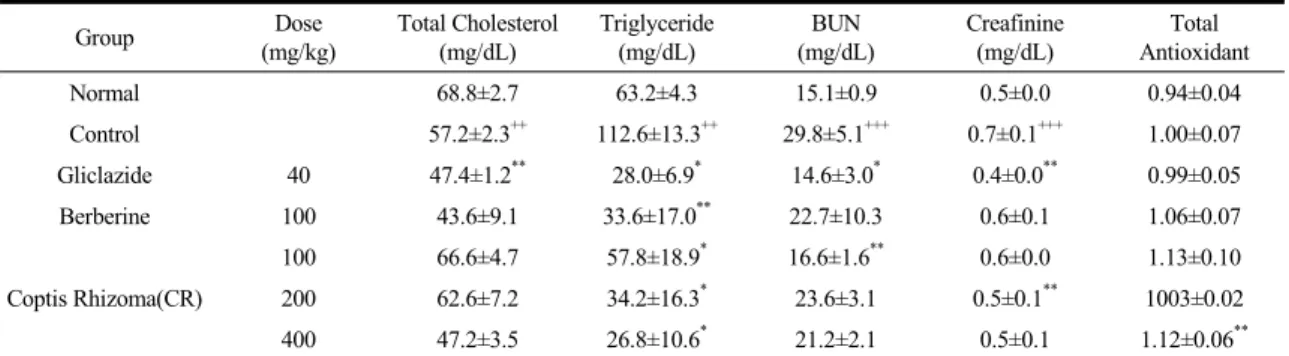
The cholesterol levels decreased slightly but to a non-significant degree while triglyceride levels showed a statistically significant lowering effect. BUN and creatinine levels were effective at the doses of CR 100mg/kg and 200mg/kg. Overall effects were similar to that of gliclazide (Table 1).

3. Effect of CR and berberine on total antioxidant level

Total antioxidant levels generally increased on CR and berberine treatment, in CR 400mmol/L with a statistically significant increase while gliclazide had no such property (Table 1).

4. Prevention of STZ-induced cell death by CR The RIN cells were cultured to near confluence.

Using 5 mM STZ, RIN cells were treated with CR

at doses of 1, 10, and 100 µg/mL and berberine,

gliclazide at doses of 0.1µM, 1 µM, and 10 µM for

24 h, at which time the cells were harvested and

their viability was analyzed. A single treatment of

RIN cells with 5 mM STZ decreased the percentage

(4)

600 500 400 300 200 100

0 Gliclazide Berberine 100 200 400

CR (mg/kg) Control

Normal

Glucose(mg/dL)

Fig. 1. Effect of CR, berberine and gliclazide on serum glucose level in streptozotocin-induced diabetic rats.

Data are represented as mean ± S.D. (n=5). +++ p < 0.001 compared with normal group, * p < 0.001 compared with the diabetic control group.

Group Dose

(mg/kg)

Total Cholesterol (mg/dL)

Triglyceride (mg/dL)

BUN (mg/dL)

Creafinine (mg/dL)

Total Antioxidant

Normal 68.8±2.7 63.2±4.3 15.1±0.9 0.5±0.0 0.94±0.04

Control 57.2±2.3++ 112.6±13.3++ 29.8±5.1+++ 0.7±0.1+++ 1.00±0.07

Gliclazide 40 47.4±1.2** 28.0±6.9* 14.6±3.0* 0.4±0.0** 0.99±0.05

Berberine 100 43.6±9.1 33.6±17.0** 22.7±10.3 0.6±0.1 1.06±0.07

100 66.6±4.7 57.8±18.9* 16.6±1.6** 0.6±0.0 1.13±0.10

Coptis Rhizoma(CR) 200 62.6±7.2 34.2±16.3* 23.6±3.1 0.5±0.1** 1003±0.02

400 47.2±3.5 26.8±10.6* 21.2±2.1 0.5±0.1 1.12±0.06**

Data are represented as mean ± S.D. (n=5). +++p < 0.001 and ++p < 0.05 compared with normal group, *p < 0.001 and **p < 0.05 compared with the diabetic control group.

Table 1. Effect of CR and berberine on lipid metabolic parameters, BUN, creatinine and antioxidant

of live cells. Treatment of 5 mM STZ treated RIN cells along with CR, berberine and gliclazide, especially CR 10µg/mL, showed significantly increased cell viability (Fig. 2). On the other hand, berberine and gliclazide at higher concentration 10 µM, by itself, was cytotoxic to RIN cells (Fig. 3).

Discussion

As in other countries that have undergone indust- rialization in recent years, the prevalence of diabetes has increased dramatically in Korea. While the prevalence of diabetes in Korean adults was estimated to be less

than 0.5% in the 1960's, a recent study showed a dramatic increase to 7.2%

9)

.

Coptidis Rhizoma has traditionally been used in oriental medicine because it is said to drain fire and relieve toxicity, clear heat and drain dampness, clear heart fire, clear heat and stop bleeding, drain stomach fire and clear heat topically

10)

. It also has been cited in Dongeuibogam as a useful herbal medicine in the treatment of diabetes mellitus

3)

.

Recent research on CR demonstrated inhibition of

human esophageal cancer cell lines

11)

, potentiation of

nerve growth in PC12 cells

12)

, and protective effects

on pancreatic RINm5F cells

13)

by a mechanism which

(5)

Cytotoxic Index

STZ(5mM) Control

Normal 1 10 100

CR(μg/mL) 1.2

1.0 0.8 0.6 0.4 0.2 0.0

**

+++

Fig. 2. Effect of CR on cytotoxicity assay. Cytotoxic index level in RIN cells treated with STZ 5 mM was reduced significantly.

Treatment of CR 100µg/mL had a significant cytoprotective effect against STZ 5 mM. Data are represented as mean ± S.D.

(n=6). +++ p<0.001 compared with normal group, ** p < 0.05 compared with control group.

Gliclazide

Cytotoxic Index

0.8

0.6

0.4

0.2

0.0

**

STZ(5mM) Control

Normal 0.1 1 10

Dose(μg)

+++

+++

Berberine

Fig. 3. Effect of berberine and gliclazide on cytotoxicity assay. Cytotoxic index level in RIN cells treated with STZ 5 mM was reduced significantly.

Treatment of berberine 10 uM produced RIN cell destruction which led to significant decrease. Data are represented as mean

± S.D. (n=6). +++ p<0.001 compared with normal control group, ** p<0.05 compared with control group.
involves the inhibition of NF-κβ activation

14)

. Its major component berberine has been reported to inhibit arylamine N-acetyltransferase activity and gene expression in mouse leukemia L1210 cells

15)

, have an inhibitory effect on the mediastinal lymph node metastasis

16)

, inhibit cyclooxygenase-2 transcriptional activity in human colon cancer cells

17)

, have anti- inflammatory effects in vitro and in vivo

18)

and inhibit

the progression of diabetes induced by alloxan

19)

. As diabetes mellitus is breaking out like a pandemic, much research about effective use of herbal medicine in its treatment is taking place all over the world

1,20,21)

. We performed this study in order to compare the antidiabetic effect of CR and berberine in comparison with gliclazide.

In the present study CR and berberine showed a

(6)

clear antihyperglycemic effect, as much as that of gliclazide. In a previous study, berberine 1-10umol/L promoted insulin secretion in HIT-T15 cells incubated in the presence of glucose (0, 5, or 10mmol/L)

22)

, while in the present study CR did not show this insulin increasing effect (data not shown). This can be explained according to recent studies

23,24)

. Berberine exerted a glucose-lowering effect in hepatocytes in an insulin-independent way

23)

. As is well known, glucose is powerful in stimulating insulin release.

If blood glucose level is lowered through a hepatocyte metabolic pathway, in feedback the insulin release from pancreatic β-cell is reduced, as a result which counteracts' the insulin promoting action of berberine. Pan et al

24)

. had another hypothesis.

The fact that berberine has low bioavailability and shows poor absorption through the gut wall suggested that it may exert its antihyperglycemic effect in the intestinal tract before absorption and concluded that its effect is partly due to its ability to inhibit α- glucosidase and decrease glucose transport through the intestinal epithelium.

The typical secondary dyslipidemia of DM is characterized by increased concentration of total triglycerides (TG), very low density lipoproteins (VLDL) and decreased levels of high lipoprotein (HDL)

25)

. Numerous studies have demonstrated that the risk and incidence of coronary heart disease (CHD) and vascular disease in patients with diabetes mellitus are higher than in non-diabetics. In fact, vascular disease accounts for more than 60% of the morbidity and mortality of diabetes

26)

. CR is effective in reducing the pathological damage caused by hypercholesterolemia, through lowering serum cholesterol levels

27)

. In addition, CR reduced the levels of liver cholesterol, but it did not reduce that of fecal cholesterol, suggesting that the cholesterol level-lowering effect resulted from the reduction of cholesterol synthesis, not the enhancement of its excretion. Our study did not show the same result as the research described above and a possible reason for this could be due to using a different rat

feed.

The murine model induced by streptozotocin injection plus high fat chow feeding has been recognized as a type 2 diabetes models

22)

. However, because patients with diabetes mellitus often have high blood lipid and cholesterol, the activity of CR blood vessel scavengers would contribute to the cure of diabetes mellitus.

Skeletal muscle contains large amounts of intracellular triglyceride (TG), which provides an important and readily available energy source with an overall caloric value exceeding that of glycogen stores. However, recent evidence suggests that if muscle contains abnormally high TG stores its sensitivity to insulin may be reduced

28)

. An explanation for the delayed onset of insulin resistance may be that FFAs need to accumulate first as triglycerides inside muscle fiber.

In support of this notion, several studies in animals and humans have demonstrated a close relationship between muscle fat content and insulin resistance

24,28,29)

. The lowering triglyceride effects observed in CR and berberine were similar to that of gliclazide and also compatible with results of a previous study

4)

.

CR has a protective effect against the renal dys- function caused by ischemia and the reperfusion process, and renal DNA of rats given CR extract orally showed a significantly lower DNA fragmentation rate

30)

. Urea nitrogen, creatinine and free radicals affect renal tissue directly or secondarily, leading to a deterioration of renal function, and producing a vicious cycle which results in renal failure. Though the mechanism is not clear, our study and that of Cho et al

30)

. suggest that CR and berberine can not only inhibit the production of uremic toxins but can also scavenge the reactive oxygen.

Histological analyses of the pancreases revealed

that the β-cell mass was significantly larger in the

diabetic mice treated with the antioxidant. As a

possible cause, the antioxidant treatment suppressed

apoptosis in β-cells without changing the rate of β-

cell proliferation, supporting the hypothesis that in

(7)

chronic hyperglycemia, apoptosis induced by oxidative stress caused reduction of β-cell mass

31)

. Hyperglycemia and characteristic dyslipidemia of DM along with increased oxidative stress leading to endothelial dys- function have been implicated as early events in the pathogenesis of atherothrombotic macrovascular diseases

32)

. Increased lipid peroxidation in tissues such as the liver and kidney implies that the tissues are susceptible to diabetic oxidative stress, leading to diabetic com- plications. Therefore, prevention of lipid peroxidation resulting from oxidative stress is considered to play a crucial role in protection against diabetes-induced disorders

33)

. In general, oxidative injury occurs when endogenous antioxidant mechanism are unable to balance the rate of production of free radicals

34)

. The result of our study compliments that of Kim et al

5)

. showing that CR and berberine have effective anti-oxidative properties and could well scavenge excess free radicals with are not demonstrated in gliclazide.

In the present study, 5mM STZ caused destruction in RIN cells and was prevented only in CR. NO is an indispensable component of STZ-induced toxicity in RIN cells, and these findings indicate that the protective effect of CR against STZ-mediated killing is due to the inhibition of NO generation. Berberine in high doses was found to cause toxicity in RIN cells in our study. However, the hepatotoxicity or pancreotoxicity induced by berberine has never been observed clinically. Latha et al

35)

. reported similar toxicity in high dose with Scoparia dulcis.

Our data suggest that CR and berberine have a beneficial effect in diabetic rats, which is exerted through its antihyperglycaemic, lipid modulation, and cytoprotective action with an extent of gliclazide also showing some properties that in gliclazide does not, like antioxidant properties.

Berberine and related isoquinoline alkaloids are quite different from sulfonylureas, biguanides and thiazolidinediones. Hence, berberine is a candidate agent in the treatment of diabetes. Thus, our study strongly supports the notion that supplementation of

CR and berberine to diabetic patients would help in achieving good glycemic and metabolic control due to its antidiabetic effect.

References

1. Li WL, Zheng HC, Bukuru J, Kimpe ND. Natural medicines used in the traditional Chinese medical system for therapy of diabetes mellitus. J Ethno- pharmacol. 2004; 92(1):1-21.

2 Cockram CS. Diabetes mellitus: perspective from the Asia-Pacific region. Diabetes Res Clin Pract.

2000; 50(2):S3-S7.

3 Heo J. Dongeuibogam. Seoul:Bubin publisher co.

1999:1341.

4 Choi YS, Lee YI, Lee SY. Effects of extracts of Coptis japonica on lipid metabolism in rats.

Kor J Pharmacogn. 1996; 27(3):246-253.

5 Kim YJ, Lee MJ, Park JW, Kim JK, Choi DY, Kim CH. Antioxidant activity of water-extract from Coptidis chinensis Franch. Journal of Life Science. 2000; 10(3):241-246.

6 Saltiel AR. New Perspectives into the Molecular Pathogenesis and Treatment of Type 2 Diabetes.

Cell. 2001; 104:517-529.

7 Taskinen M. LDL-cholesterol, HDL-cholesterol or triglycerides which is the culprit? Diabetes Res Clin Pract. 2003; 61:S19-S26.

8 Zhou L, Yang Y, Wang X, Liu S, Shang W, Yuan G, et al. Berberine stimulates glucose transport through a mechanism distinct from insulin. Meta- bolism. 2007; 56(3):405-412.

9 Park JY, Lee KU, Kim CH, Kim HK, Hong SK, Park KS, et al. Past and current obesity in Koreans with non-insulin-dependent diabetes mellitus.

Diabetes Res Clin Pract.1997; 35:49-56.

10. Bensky D, Gamble A. Chinese herbal medicine:

Materia Medica. Revised Edition. Seattle:

Eastland Press, Inc., 1993; 77-80.

(8)

11. Iizuka N, Miyamoto K, Okita K, Tangoku A, Hayashi H, Yosino Y, et al. Inhibitory effect of Coptidis Rhizoma and berberine on the proliferation of human esophageal cancer cell lines. Cancer Lett. 2000; 148:19-25.

12. Shigeta K, Ootaki K, Tatemoto H, Nakanishi K, Inada A, Muto N. Potentiation of Nerve Growth Factor-Induced Neurite Outgrowth in PC12 Cells by a Coptidis Rhizoma Extract and Protoberberine Alkaloids. Biosci Biotechnol Biochem. 2002;

66(11):2491-2492.

13. Kwon KB, Kim EK, Lim JG, Shin BC, Han SC, Song BK, et al. Protective effect of Coptidis Rhizoma on S-nitroso-N-acetylpenicillamine (SNAP)- induced apoptosis and necrosis in pancreatic RINm5F cells. Life Sciences. 2005; 76:917-929.

14. Kim EK, Kwon KB, Han MJ, Song MY, Lee JH, Lv N, et al. Coptidis rhizoma extract protects against cytokine-induced death of pancreatic β- cells through suppression of NF-κβ activation.

Exp and Mol Med. 2007; 39(2):149-159.

15. Lin SS, Chung JG, Lin JP, Chuang JY, Chang WC, Wu JY, et al. Berberine inhibits arylamine N-acetyltransferase activity and gene expression in mouse leukemia L1210 cell. Phytomedicine.

2005; 12:351-358.

16. Mitani N, Murakami K, Yamamura T, Ikeda T, Saiki I. Inhibitory effect of berberine on the mediastinal lymph node metastasis produced by orthotopic implantation of Lewis lung carcinoma.

Cancer Lett. 2001; 65:35-42.

17. Fukuda K, Hibiya Y, Mutoh M, Koshiji M, Akao S, Fujiwara H. Inhibition by berberine of cycloo- xygenase-2 transcriptional activity in human colon cancer cells. J Ethnopharmacol. 1999; 66:227-233.

18. Kuo CL, Chi CW, Liu TY. The anti-inflammatory potential of berberine in vitro and in vivo. Cancer Lett. 2004; 203:127-137.

19. Tang LQ, Wei W, Chen LM, Liu S. Effects of

berberine on diabetes induced by alloxan and a high-fat/high-cholesterol diet in rats. J Ethnophar- macol. 2006; 108:109-115.

20 Jia W, Gao W, Tang L. Antidiabetic herbal drugs officially approved in China. Phytother Res. 2003;

17:1127-1134.

21. Kar A, Choudhary BK, Bandyopadhyay NG.

Comparative evaluation of hypoglycemic activity of some Indian medicinal plants in alloxan diabetic rats. J Ethnopharmacol. 2003; 84(1):

105-108.

22. Leng SH, Lu FE, Xu LJ. Therapeutic effects of berberine in impaired glucose tolerance rats and its influence on insulin secretion. Acta Pharma- cologica Sinica. 2004; 25(4):496-502.

23. Yin J, Hu R, Chen M, Tang J, Li F, Yang Y,

et al. Effects of Berberine on Glucose Metabolism in vitro. Metabolism. 2002; 51(11):1439-1443.

24. Pan GY, Huang ZJ, Wang GJ, Fawcett JP, Liu XD, Zhao XC, et al. The antihyperglycaemic activity of berberine arises from a decrease of glucose absorption. Planta Med. 2003; 69(7):

632-636.

25. Saxena R, Madhu SV, Shukla R, Prabhu KM Gambhir JK. Postprandial hypertriglyceridemia and oxidative stress in patients of type 2 diabetes mellitus with macrovascular complication. Clinica Chimica Acta. 2006; 368(1-2):101-108.

26. Barakat HA, Vadlamudi S, MacLean PS, MacDonald KG, Pories WJ. Lipoprotein metabolism in non- insulin-dependent diabetes mellitus. Nutritional Biochemistry. 1996; 7:586-598.

27. Yokozawa T, Ishida A, Cho EJ, Nakagawa T.

The effects of Coptidis Rhizoma extract on a hypercholesterolemic animal model. Phytomedicine.

2003; 1(10):17-22.

28. Phillips DI, Caddy S, Ilic V, Fielding BA, Frayn

KN, Borthwick AC, et al. Intramuscular triglyceride

and muscle insulin sensitivity: Evidence for a

(9)

relationship in nondiabetic subjects. Metabolism.

1996; 45(8):947-950.

29. Koyama K, Chen G, Lee Y, Unger UH. Tissue triglycerides, insulin resistance, and insulin pro- duction: implication for hyperinsulinemia of obesity.

Am j Physiol. 1997; 273:708-713.

30. Cho EJ, Yokozawa T, Rhee SH, Park KY. The role of Coptidis Rhizoma extract in a renal ischemia-reperfusion model. Phytomedicine. 2004;

11:576-584.

31. Kaneto H, Kajimoto Y, Miyagawa J, Matsuoka T, Fujitani Y, Umayahara Y, et al. Beneficial effects of antioxidants in diabetes: possible pro- tection of pancreatic beta-cells against glucose toxicity. Diabetes. 1999; 48:2398-2406.

32. Anderson RA, Evans ML, Ellis GR, Graham J, Morris K, Jackson SK, et al. The relationship

between pots-prandial lipaemia, endothelial function and oxidative stress in healthy individuals and patients with type 2 diabetes. Atherosclerosis.

2001; 154:475-483.

33. Cho EJ, Yokozawa T, Kim HY, Shibahara N, Park C. Rosa rugosa attenuates diabetic oxidative stress in rats with streptozotocin-induced diabetes.

Am J Chin Med. 2004; 32(4):487-496.

34. Baynes JW, Thorpe SR. Role of oxidative stress in diabetic complication, a new perspective on an old paradigm. Diabetes. 1999; 45:1-9.

35. Latha M, Pari L, Sitasawad S, Bhonde R.

Insulin-secretagogue activity and cytoprotective role of the traditional antidiabetic plant Scoparia- dulcis (Sweet Broom weed). Life Sciences. 2004;

75:2003-2014.

수치

Table  1.  Effect  of  CR  and  berberine  on  lipid  metabolic  parameters,  BUN,  creatinine  and  antioxidant
Fig.  2.  Effect  of  CR  on  cytotoxicity  assay.  Cytotoxic  index  level  in  RIN  cells  treated  with  STZ  5  mM  was  reduced  significantly

참조

관련 문서

Normal, normal group; STZ-con, streptozotocin-induced diabetic rats; LRC, Lycii Radicis Cortex; CF, Corni Fructus; BB, Bombyx Batryticatus; LF, Lycii Fructus;

Diabetic rats were treated orally with AK (100 mg/kg and 200 mg/kg body weight) once a day orally for 9 weeks. In vehicle-treated diabetic rats, lens opacity was increased,

Objectives : For evaluation of preventive and anti-diabetic activities of Cinnamomi ramulus(CR) herbal acupuncture on pancreatic islet damage

The rats were treated orally with KIOM-79 (500 mg/kg/day) 1) for 3 days prior to streptozotocin (60 mg/kg, intraperitoneal) injection or 2) for 9 weeks after

Effect of the administration of medicinal herbal plants extract on oral glucose tolerance test (OGTT) in STZ induced diabetic rats.. Treated groups com- pared

Antidiabetic effect of Korean red ginseng (RG) processed by puffing in streptozotocin (STZ)-induced diabetic (DM) rats was investigated.. NC group received saline

latisecta on blood glucose, lipids, and diabetes-related changes in the liver and kidney of streptozotocin-induced diabetic rats.. Methods: Male Wistar rats were

Lee, Alternation of Hepatic Antioxidant Enzyme Activities and Lipid Profile in Streptozotocin Induced Diabetic Rats by Supplementation of Andelion Water