218
Effect of Hydrodynamic Condition on the Electrochemical Behavior of Various Metals in 3.5 wt% NaCl Solution
Szu-Jung Pan1, Samuel-Sudibyo Hadinata2, Ruey-Chy Kao3, and Wen-Ta Tsai1,2,†
1Ocean Energy Research Center, Tainan Hydraulics Laboratory, National Cheng Kung University, Tainan, Taiwan
2Department of Materials Science and Engineering, National Cheng Kung University, Tainan, Taiwan
3Tainan Hydraulics Laboratory, National Cheng Kung University, Tainan, Taiwan (Received July 23, 2015; Revised September 24, 2015; Accepted September 25, 2015)
The electrochemical behaviors of various metals with and without diamond-like-carbon (DLC) coating in 3.5 wt% NaCl solution were investigated. The effect of hydrodynamic conditions was focused by employing a rotating disc electrode (RDE). The experimental results showed that each bare metal had a more positive corrosion potential and a higher corrosion rate due to enhanced oxygen transport at the higher rotating speed of the RDE. DLC coating caused a substantial increase in the corrosion resistance of all metals studied.
However, localized corrosion was still found in the DLC-coated metal at sites where deposition defects existed. Surface morphology examination was performed after the electrochemical test to confirm the roles of hydrodynamic conditions and DLC coating.
Keywords : diamond-like-carbon (DLC), hydrodynamic, rotating disc electrode (RDE), electrochemical behavior
†Corresponding author: [email protected]
1. Introduction
Diamond-like carbon (DLC) films exhibiting high hard- ness1,2), low friction coefficient3,4) and high corrosion resist- ance5-10) have found wide applications and become im- portant materials for surface modification. Owing to their chemical inertness and high electrical resistivity, DLC coat- ing makes itself as a potential candidate of corrosion barrier for metals11). Although there were some studies6,12) dealt with the electrochemical performance of DLC-coated met- als in stagnant aqueous solution, rare information is avail- able on their corrosion behavior in flowing environments.
In this work, the effect of hydrodynamic condition on the electrochemical behavior of DLC-coated specimens em- ploying rotating disk electrode (RDE) was investigated and discussed.
2. Experimental Procedure
The as-received carbon steel, 316 stainless steel (316SS), titanium, and brass, all with and without DLC coating, were used in this investigation. The condition for DLC coating (about 1.7 um thick) was described in a previous study13). In electrochemical tests, each coupon with a di-
mension of 10 mm × 15 mm × 2 mm was used. The open circuit potential (OCP) and potentiodynamic polar- ization curve (measured at a scan rate of 1 mV/s) of each specimen were determined in 3.5 wt% NaCl solution at 25 oC (pH = 6.5). The counter electrode and reference electrode were a platinum sheet and a saturated calomel electrode (SCE), respectively. The electrochemical im- pedance spectroscopy (EIS) was also performed in the same environment at open circuit potential under a sinus- oidal wave form at an amplitude of 10 mV over a fre- quency between 100 kHz and 10 mHz. In the test employ- ing RDE, a cylindrical specimen with a diameter of 1.2 cm and a height of 0.2 cm was used. Each cylinder with or without DLC coating was mounted leaving an exposed surface area of 1.13 cm2. The rotating speed was con- trolled in the range of 0 ~ 2500 rpm. After electrochemical test, the surface morphologies of some specimens were examined using a scanning electron microscope.
3. Resutls and Discussion
3.1 Effect of dissolved oxygen
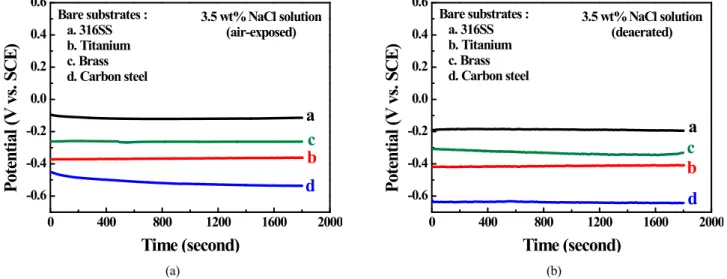
The OCP values of the bare substrates measured in air-exposed 3.5 wt% NaCl solutions are shown in Fig.
1(a). Carbon steel was the most active and exhibited the lowest value of OCP (about -0.531 V) in 3.5 wt% NaCl
0 400 800 1200 1600 2000 -0.6
-0.4 -0.2 0.0 0.2 0.4 0.6
3.5 wt% NaCl solution (air-exposed)
d c b a
P o te n ti a l (V v s. S C E )
Time (second)
Bare substrates : a. 316SS b. Titanium c. Brass d. Carbon steel
(a)
0 400 800 1200 1600 2000
-0.6 -0.4 -0.2 0.0 0.2 0.4 0.6
3.5 wt% NaCl solution (deaerated)
d c b a
P o te n ti a l (V v s. S C E )
Time (second)
Bare substrates : a. 316SS b. Titanium c. Brass d. Carbon steel
(b)
Fig. 1. Open Circuit potentials of 316SS, titanium, brass, and carbon steel in (a) air-exposed, and (b) deaerated 3.5 wt% NaCl aqueous solution.
1E-9 1E-8 1E-7 1E-6 1E-5 1E-4 1E-3 0.01 0.1 -1.0
-0.5 0.0 0.5 1.0
1.5 3.5 wt% NaCl solution
(air-exposed)
d c b
a
P ot en ti al ( V v s. S C E )
Current Density (A/cm2)
Bare substrates : a. 316SS b. Titanium c. Brass d. Carbon steel
(a)
1E-9 1E-8 1E-7 1E-6 1E-5 1E-4 1E-3 0.01 0.1 -1.0
-0.5 0.0 0.5 1.0
1.5 3.5 wt% NaCl solution
(deaerated) Bare substrates :
a. 316SS b. Titanium c. Brass d. Carbon steel
c a b
d
P o te n ti a l (V v s. S C E )
Current Density (A/cm
2)
(b)
Fig. 2. Potentiodynamic polarization curve of 316SS, titanium, brass, and carbon steel in (a) air-exposed, and (b) deaerated 3.5 wt% NaCl aqueous solution.
solution, while titanium (about -0.356 V) had an OCP about 0.175 V higher than carbon steel. 316SS had the highest value of OCP about -0.115 V, nobler than titanium and carbon steel. The OCP of brass fell in the region be- tween titanium and stainless steels. Fig. 1(b) shows the OCP values of the bare substrates in deaerated 3.5 wt%
NaCl solution. The absence of oxygen shifted the OCP to more negative value for each substrate.
Potentiodynamic polarization curves for all metallic substrates in air-exposed 3.5 wt% NaCl are shown in Fig.
2(a). The relative magnitudes of corrosion potential (Ecorr) of the four metals tested were consistent with and close to their OCPs. As shown in this figure, the anodic polar- ization curve of carbon steel only exhibited active dis- solution characteristic, while titanium had a very wide pas-
sive region with a low passive current density of 5×10⁻⁶ A/cm2. Both brass and 316 SS could also be passivated in this solution but with rather narrow passive region. In deaerated solution, as shown in Fig. 2(b), the features of the four polarization curves were similar to those depicted in Fig. 2, except the shift of corrosion potential to more active direction.
3.2 Effect of rotating speed of RDE
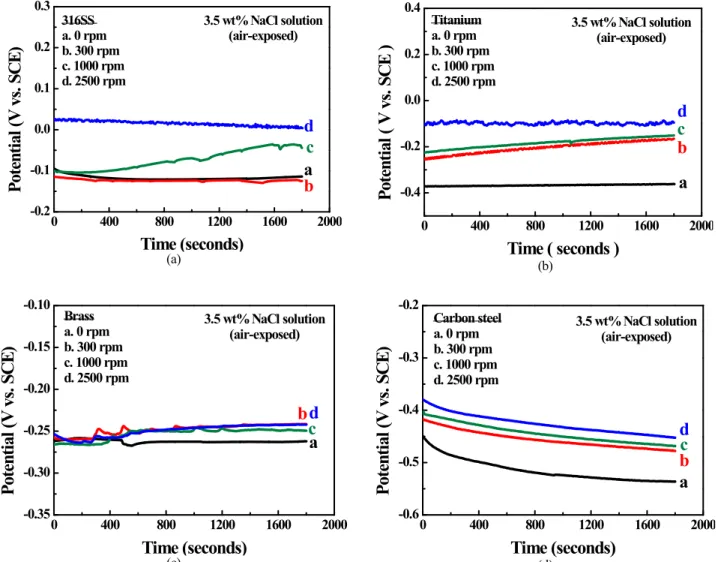
The open circuit potentials of the four different metals measured in air-exposed 3.5 wt% NaCl aqueous solution, using RDEs at different rotation speeds were presented in Fig. 3. The results showed that the open circuit potential generally increased with increasing rotating speed of the RDE. The accelerated transfer of oxygen to the electrode
0 400 800 1200 1600 2000 -0.2
-0.1 0.0 0.1 0.2 0.3
3.5 wt% NaCl solution (air-exposed)
d c b a
Potential (V vs. SCE)
Time (seconds)
316SS a. 0 rpm b. 300 rpm c. 1000 rpm d. 2500 rpm
(a)
0 400 800 1200 1600 2000
-0.4 -0.2 0.0 0.2 0.4
3.5 wt% NaCl solution (air-exposed)
d c b Potential ( V vs. SCE ) a
Time ( seconds )
Titanium a. 0 rpm b. 300 rpm c. 1000 rpm d. 2500 rpm
(b)
0 400 800 1200 1600 2000
-0.35 -0.30 -0.25 -0.20 -0.15 -0.10
3.5 wt% NaCl solution (air-exposed)
d b c
a
P o te n ti a l (V v s. S C E )
Time (seconds)
Brass a. 0 rpm b. 300 rpm c. 1000 rpm d. 2500 rpm
(c)
0 400 800 1200 1600 2000
-0.6 -0.5 -0.4 -0.3 -0.2
3.5 wt% NaCl solution (air-exposed)
d c b P o te n ti a l (V v s. S C E ) a
Time (seconds)
Carbon steel a. 0 rpm b. 300 rpm c. 1000 rpm d. 2500 rpm
(d)
Fig. 3. Open circuit potential of (a) 316SS, (b) titanium, (c) brass, and (d) carbon steel in air-exposed 3.5 wt% NaCl aqueous solution at different rotation speed.
surface under high rotating speed caused the move of OCP to positive direction, which was more pronounced for car- bon steel, 316 SS and titanium due to enhanced passivation.
However, the rotating speed or oxygen mass transfer had little effect on the OCP of brass, as revealed in Fig. 3.
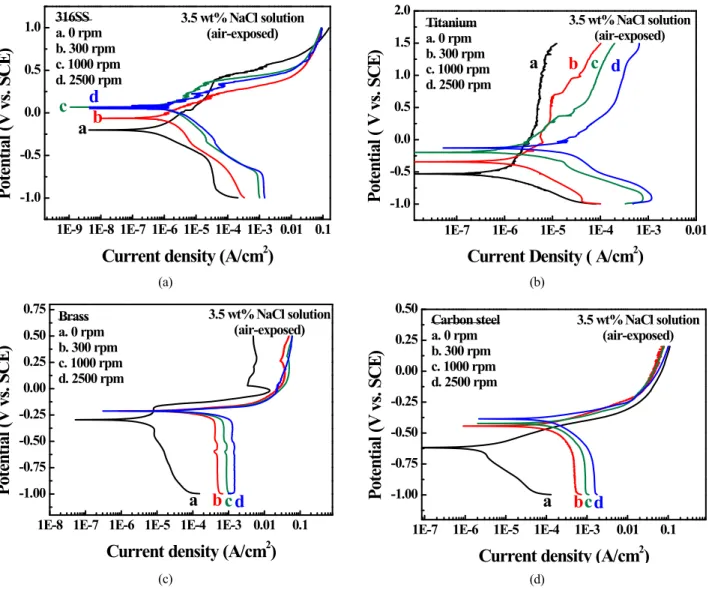
The effect of rotating speed on the potentiodynamic po- larization curves of the four different substrates is demon- strated in Fig. 4. Increasing the rotating speed caused an increase in the cathodic current density of each metal, comparing with the stagnant condition. Again, the easy access of oxygen to the electrode surface promoted the cathodic reaction and resulted in an increase in cathodic current density. The increase in cathodic current density with increasing rotating speed was more pronounced for brass and carbon steel as revealed in Fig. 4. Moreover, at a rotating speed greater than 300 rpm, the cathodic re- action was enhanced to such a high rate that a limiting
current density was observed for both brass and carbon steel. The effect of rotating speed seemed have less effect of the anodic polarization curves of 316 SS, brass and carbon steel. But due to the enhanced cathodic reaction, the corrosion current density (icorr) increased with increas- ing rotating speed for each of these three metals. Similar observation had been found for carbon steel in un-buffered NaCl solution14). For titanium, however, a significant ef- fect of rotating speed on the anodic polarization behavior was found. As shown in Fig. 4(b), the passive current density increased with increasing rotating speed. The pas- sive region was almost disappeared when the rotating speed was raised to 2500 rpm. Obviously, at such high rotating speed, the dissolved titanium ions could be easily removed away from the electrode surface, hindering the formation of TiO2 passive film. As a result, titanium ex- hibited active dissolution characteristic similar to that ob-
1E-9 1E-8 1E-7 1E-6 1E-5 1E-4 1E-3 0.01 0.1 -1.0
-0.5 0.0 0.5
1.0 3.5 wt% NaCl solution
(air-exposed)
c d a b
P o te n ti a l (V v s. S C E )
Current density (A/cm
2)
316SS a. 0 rpm b. 300 rpm c. 1000 rpm d. 2500 rpm
(a)
1E-7 1E-6 1E-5 1E-4 1E-3 0.01
-1.0 -0.5 0.0 0.5 1.0 1.5
2.0 3.5 wt% NaCl solution
(air-exposed)
c d b a
P o te n ti a l ( V v s. S C E )
Current Density ( A/cm
2)
Titanium a. 0 rpm b. 300 rpm c. 1000 rpm d. 2500 rpm
(b)
1E-8 1E-7 1E-6 1E-5 1E-4 1E-3 0.01 0.1 -1.00
-0.75 -0.50 -0.25 0.00 0.25 0.50
0.75 3.5 wt% NaCl solution
(air-exposed)
d b c P o te n ti a l (V v s. S C E ) a
Current density (A/cm
2)
Brass a. 0 rpm b. 300 rpm c. 1000 rpm d. 2500 rpm
(c)
1E-7 1E-6 1E-5 1E-4 1E-3 0.01 0.1 -1.00
-0.75 -0.50 -0.25 0.00 0.25
0.50 3.5 wt% NaCl solution
(air-exposed)
d c a b
P o te n ti a l (V v s. S C E )
Current density (A/cm
2)
Carbon steel a. 0 rpm b. 300 rpm c. 1000 rpm d. 2500 rpm
(d)
Fig. 4. Potentiodynamic polarization curve of (a) 316SS, (b) titanium, (c) brass, and (d) carbon steel in air-exposed 3.5 wt% NaCl aqueous solution at different rotation speed.
served in brass and carbon steel. The enhanced anodic current density of titanium in recirculating 3.5 wt% NaCl containing SiC particles, as compared with that in a stag- nant solution was reported by Neville and McDougall15). Furthermore, the mechanical degradation of the passive film, induced by turbulent flow and/or impinging particles, would cause a decrease in corrosion resistance of most met- allic materials but in different forms and extents, even all exhibiting passivating characteristics. In a comparison study in a 10% HCl solution with the presence of fine alumina particles and stirring at 1000 rpm, Burmudez et al. found that 304L exhibited different corrosion morphol- ogy from that of a commercially pure titanium16). They found 304L SS suffered pitting corrosion while titanium was attacked to form uniform corrosion surface appearance.
The surface morphologies of the RDEs after potentiody-
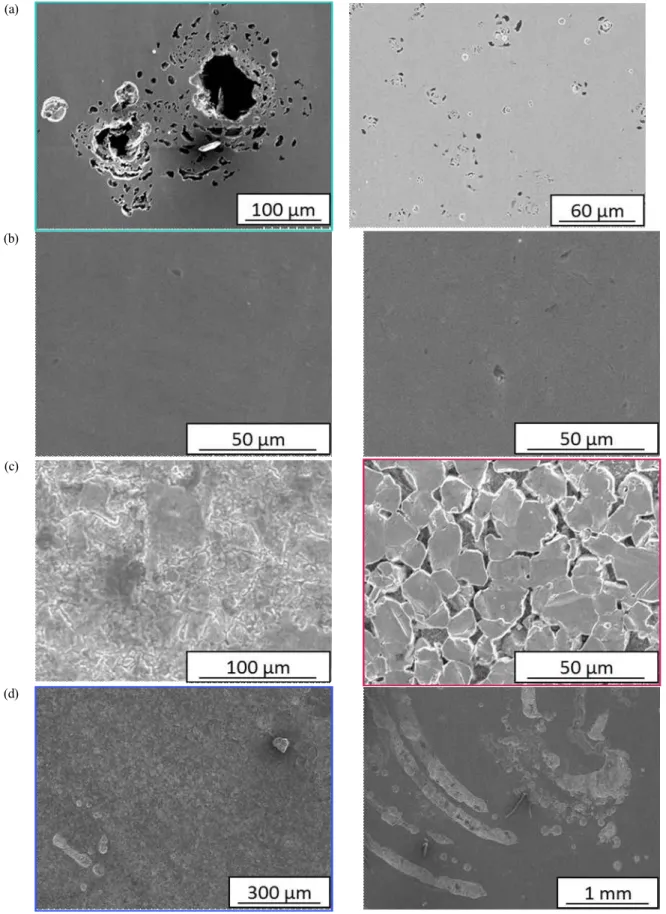
namic polarization test are examined by SEM. The SEM images of each metal after polarization test in stagnant solution and that under 2500 rpm are compared in Fig.
5. The results showed that 316 SS was more susceptible to pitting corrosion in stagnant 3.5 wt% NaCl solution.
Under hydrodynamic condition at 2500 rpm, however, the size of the corrosion pit became smaller with much shallow in depth as shown in Fig. 5(a). Titanium exhibited the superior corrosion resistance, showing no obvious corro- sion attack (Fig. 5(b)) after polarization test in stagnant solution and in the condition of 2500 rpm. A significant effect of rotating speed on the corrosion morphology was observed for brass. As shown in Fig. 5(c), brass suffered uniform corrosion in 3.5 wt% NaCl solution in stagnant solution. Under a rotating speed of 2500, severe corrosion (in the form of selective dissolution) was seen. The effect
(a)
(b)
(c)
(d)
Fig. 5. SEM micrographs of various metals after potentiodynamic polarization test at 0 rpm (left), and 2500 rpm (right) rotation rates in air-exposed 3.5 wt% NaCl aqueous solution. (a) 316SS, (b) titanium, (c) brass, and (d) carbon steel.
1E-101E-9 1E-8 1E-7 1E-6 1E-5 1E-4 1E-3 0.01 0.1 -1.0
-0.5 0.0 0.5 1.0 1.5 2.0
3.5 wt% NaCl solution (air-exposed)
d c
b
Potential (V vs. SCE)
a
Current Density (A/cm
2)
Bare 316SS a. Static condition b. 2500 rpm DLC-coated c. Static condition d. 2500 rpm
(a)
1E-10 1E-9 1E-8 1E-7 1E-6 1E-5 1E-4 1E-3 0.01 -1.0
-0.5 0.0 0.5 1.0 1.5
2.0 3.5 wt% NaCl solution
(air-exposed) Bare titanium
a. Static condition b. 2500 rpm DLC-coated c. Static condition d. 2500 rpm
d
c b
a
Potential (V vs. SCE)
Current Density (A/cm
2)
(b)
1E-10 1E-9 1E-8 1E-7 1E-6 1E-5 1E-4 1E-3 0.01 0.1 -1.0
-0.5 0.0 0.5
1.0 3.5 wt% NaCl solution
(air-exposed)
d
c a b
Potential (V vs. SCE)
Current Density (A/cm
2)
Bare brass a. Static condition b. 2500 rpm DLC-coated c. Static condition d. 2500 rpm
(c)
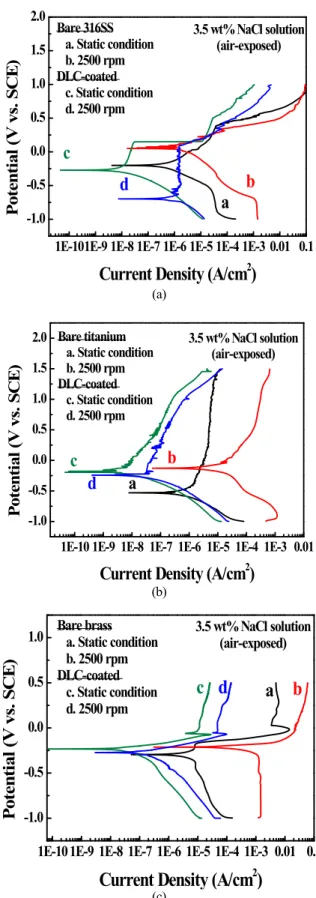
Fig. 7. Potentiodynamic polarization curves of DLC-coated metals in air-exposed 3.5 wt% NaCl aqueous solution at static and hydro hydrodynamic condition: (a) 316SS, (b) titanium, and (c) brass.
0.0 5.0x10⁴ 1.0x10⁵ 1.5x10⁵ 2.0x10⁵ 2.5x10⁵ 0.0
5.0x10⁴ 1.0x10⁵ 1.5x10⁵ 2.0x10⁵ 2.5x10⁵
-Z'' (ohm.cm2 )
Z' (ohm.cm2)
316SS 0 rpm 300 rpm 1000 rpm 2500 rpm
(a)
0 1x10⁵ 2x10⁵ 3x10⁵ 4x10⁵ 5x10⁵ 6x10⁵ 0
1x10⁵ 2x10⁵ 3x10⁵ 4x10⁵ 5x10⁵ 6x10⁵
-Z''( ohm.cm2 )
Z' ( ohm.cm2)
Titanium
0 rpm 1000 rpm 300 rpm 2500 rpm
(b)
0.0 5.0x10² 1.0x10³ 1.5x10³ 2.0x10³ 2.5x10³ 3.0x10³ 0.0
5.0x10² 1.0x10³ 1.5x10³ 2.0x10³ 2.5x10³ 3.0x10³
-Z'' (ohm.cm2 )
Z' (ohm.cm2)
Brass 0 rpm 300 rpm 1000 rpm 2500 rpm
(c)
0.0 5.0x10² 1.0x10³ 1.5x10³ 0.0
5.0x10² 1.0x10³ 1.5x10³
-Z'' (ohm.cm2 )
Z' (ohm.cm2)
Carbon steel 0 rpm 300 rpm 1000 rpm 2500 rpm
(d)
Fig. 6. Impedance diagrams Nyquist plots for (a) 316SS, (b) tita- nium, (c) brass, and (d) carbon steel in air-exposed 3.5 wt% NaCl aqueous solution at different rotation rates.
(a)
(b)
(c)
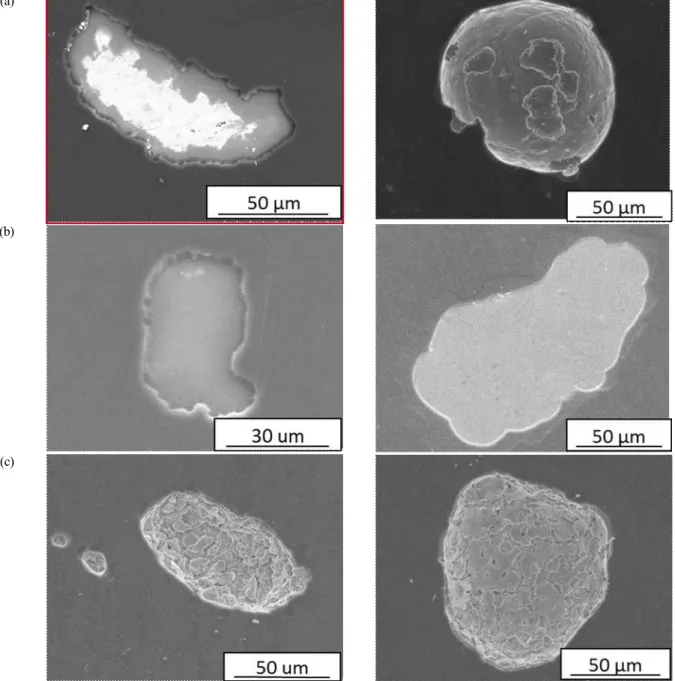
Fig. 8. SEM images of DLC-coated specimens, (a) 316SS, (b) titanium, and (c) brass after polarization test in air-exposed 3.5 wt% NaCl aqueous solution under static (left) and hydrodynamic condition (right).
of hydrodynamic condition on the corrosion morphology of carbon steel is demonstrated in Fig. 5(d). In stagnant solution, carbon steel corroded in uniform manner, while s spiral eroded tracks were seen on the surface under a rotating speed of 2500 rpm. The results might suggest that carbon steel was more susceptible to erosion corrosion.
Fig. 6 shows the Nyquist plots determined from EIS measurements for 316SS, titanium, brass, and carbon steel in air-exposed 3.5 wt% NaCl aqueous solution at different rotation speeds. The impedance results showed a strong influence of the hydrodynamic condition on the electro-
chemical behavior of each metal in 3.5 wt% NaCl solution. The magnitude of impedance decreased with in- creasing rotating speed for all metals. The decrease in po- larization resistance, more obvious for brass, indicated that the electrode surface became more active due to easy re- moval of the corrosion product under high rotating speed.
The results were consistent with those of potentiodynamic polarization measurements.
3.3 Effect of DLC coating
The polarization and corrosion performance of DLC
-coated 316SS, titanium, and brass were investigated. The role of DLC coating and the effect RDE rotating condition on the potentiodynamic polarization behavior are man- ifested in Fig. 7. In each case, the DLC-coated specimen exhibited a lower anodic current density. With or without DLC coating, a higher current density was observed under a rotating speed of 2500 rpm for all metals. Since DLC coating was rather inert in 3.5 wt% NaCl solution, the observation of rotating speed dependent anodic polar- ization behavior indicated that the coating applied in this investigation might contain defects. Post SEM surface morphology examination, as shown in Fig. 8, confirmed the existence of surface defects in the coating, which acted as the active sites for anodic dissolution. Since 316 SS and titanium are passive materials, the exposed substrates in the defected regions can be passivated easily. As a re- sult, these two DLC-coated metals still exhibited a passive region in the anodic polarization curve. This was not the case for brass which could not readily be passivated in 3.5 wt% NaCl solution. Thus, the anodic polarization curve still exhibited active dissolution characteristic with the absence of passive region.
4. Conclusions
Enhanced cathodic polarization current density was ob- served under hydrodynamic condition, which increased with increasing rotating speed of RDE. The rotating speed of RDE had less effect on the anodic polarization behavior of 316 SS, brass and carbon steel, but was sensitive for titanium. In general, the corrosion current density in- creased with enhanced hydrodynamic condition. The DLC coating applied to 316 SS, brass and titanium gave rise to a lower anodic current density. However, these coatings contained defects where localized corrosion could still occur.
Acknowledgments
The authors would like to thank Bureau of Energy, Ministry of Economic Affairs of the Republic of China for supporting this study under contract no. 102-D0618.
References
1. A. L. Baia Neto, R. A. Santos, F. L. Freire Jr., S. S.
Camargo, R. Carius, F. Finger, and W. Beyer, Thin Solid Films, 293, 206 (1997).
2. J. F. Zhao, P. Lemoine, Z. H. Liu, J. P. Quinn, P. Maguire, and J. A. McLaughlin, Diam. Relat. Mater., 10, 1070 (2001).
3. A. K. Gangopadhyay, P. A. Willermet, M. A. Tamor, W.
C. Vassell, Tribol. Int., 30, 9 (1997).
4. W. J. Wu, T. M. Pai, and M. H. Hon, Diam. Relat. Mater., 7, 1478 (1998).
5. J. Choi, S. Nakao, J. Kim, M. Ikeyama, and T. Kato, Diam.
Relat. Mater., 16, 1361 (2007).
6. H. G. Kim, S. H. Ahn, J. G. Kim, S. J. Park, and K.
R. Lee, Diam. Relat. Mater., 14, 35 (2005).
7. A. Dorner-Reisel, C. Schürer, G. Irmer, and E. Müller, Surf. Coat. Technol., 177-178, 830 (2004).
8. M. Azzi, P. Amirault, M. Paquette, J. E. Klemberg- Sapieha, and L. Martinu, Surf. Coat. Technol., 204, 3986 (2010).
9. B. Tomcik, T. Osipowicz, and J. Y. Lee, Thin Solid Films, 360, 173 (2000).
10. A. Dorner, B. Wielage, and C. Schürer, Thin Solid Films, 355-356, 214 (1999).
11. J. Robertson, Mat. Sci. Eng. R, 37, 129 (2002).
12. M. S. Jellesen, T. L. Christiansen, L. R. Hilbert, and P.
Møller, Wear, 267, 1709 (2009).
13. S. S. Hadinata, M. T. Lee, S. J. Pan, W. T. Tsai, C. Y.
Tai, and C. F. Shih, Thin Solid Films, 529, 412 (2013).
14. L. Cáceres, T. Vargas, and L. Herrera, Corros. Sci., 49, 3168 (2007).
15. A. Neville, and B.A.B. McDougall, Wear, 250, 726 (2001).
16. M. D. Bermudez, F. J. Carrion, G. Martinez-Nicolas, and R. Lopez, Wear, 258, 693 (2005).