Effects of Laughter Therapy on Depression and Sleep among Patients at Long-term Care Hospitals
Han, Ji Hyoung MSN, RN
1· Park, Kyung Min Ph.D., RN
2· Park, Heeok Ph.D., RN
21Department of Nursing Hosan University, Gyeongsan
2College of Nursing Keimyung University, Daegu, Korea
Purpose: The purpose of the study was to investigate the effects of laughter therapy on depression and sleep among patients at two long-term care (LTC) hospitals. Methods: Forty-two residents from two LTC hospitals participated in this study. Twenty-one residents at one LTC hospital received the laugher therapy treatment and 21 at the other LTC hospital received no treatment as a comparison group. The laugher therapy protocol consisted of singing funny songs, laughing for diversion, stretching, playing with hands and dance routines, laughing exercises, healthy clap- ping, and laughing aloud. The participants engaged in the protocol 40 minutes twice a week (Monday/Thursday) for a total of eight sessions held in the patients’ lounge. Results: Findings showed that depression and sleep im- proved in the treatment group compared to the comparison group (t=-7.12, p<.001; Z=-4.16, p<.001). Conclusion:
To improve depression and sleep among patients at LTC hospitals, offering laughter therapy strengthening physical activities might be beneficial to patients.
Key Words: Laughter, Depression, Sleep, Long-term care
Corresponding author: Park, Heeok
College of Nursing Keimyung University, 1095 Dalgubeol-daero, Dalseo-gu, Daegu 42601, Korea.
Tel: +82-53-580-3924, Fax: +82-53-580-3916, E-mail: [email protected] - This manuscript is extracted from JiHyoung Han's master's thesis.
Received: Jun 5, 2017 / Revised: Oct 7, 2017 / Accepted: Oct 23, 2017
This is an open access article distributed under the terms of the Creative Commons Attribution Non-Commercial License (http://creativecommons.org/licenses/
by-nc/3.0), which permits unrestricted non-commercial use, distribution, and reproduction in any medium, provided the original work is properly cited.
INTRODUCTION
The number of older adults in the need of long term care (LTC) has led to the increase number of LTC hospitals which increased from 819 in 2010 to 1,342 in 2015[1].
Almost 80% of patients at LTC hospitals remain in treat- ment for more than two years. Patients at LTC hospitals re- port having problems with self-control, loneliness, social isolation, and anxiety leading to depression [2]. For in- stance, almost 50% of patients at LTC hospitals exhibit more than three symptoms of depression [1]. Often de- pression occurs among older adults with physical disease.
It is difficult to recognize symptoms of depression; thus, early detection and intervention in older adults is im- portant [3].
Depression is related to the delay of sleep latency, sleep deficiency, and reduced sleep quality. Older adults with
sleep problems exhibit more depressive symptoms than those without sleep problems.[4]. Patients at LTC hospi- tals already have a compromised physical status, thus leading to a low level of physical activities and, thus a de- lay in sleep latency. Participating in health promotion pro- grams including physical activities decreases depressive symptoms and improves sleep quality [5]. Almost 36~61%
of older adults in hospitals complained of sleep problems [6]. Older adults in LTC hospitals report that the quality of their sleep is compromised compared to the home-dwell- ing older adults [7]. At times, the low quality of sleep among older adults is misunderstood as a normal aging process rather than sleep problems [3].
At LTC hospitals, medications are used to improve de- pression and the quality of sleep among older adults.
However, the side effects of drowsiness during the day, re- duced cognition, a high risk of falls, and medication toler-
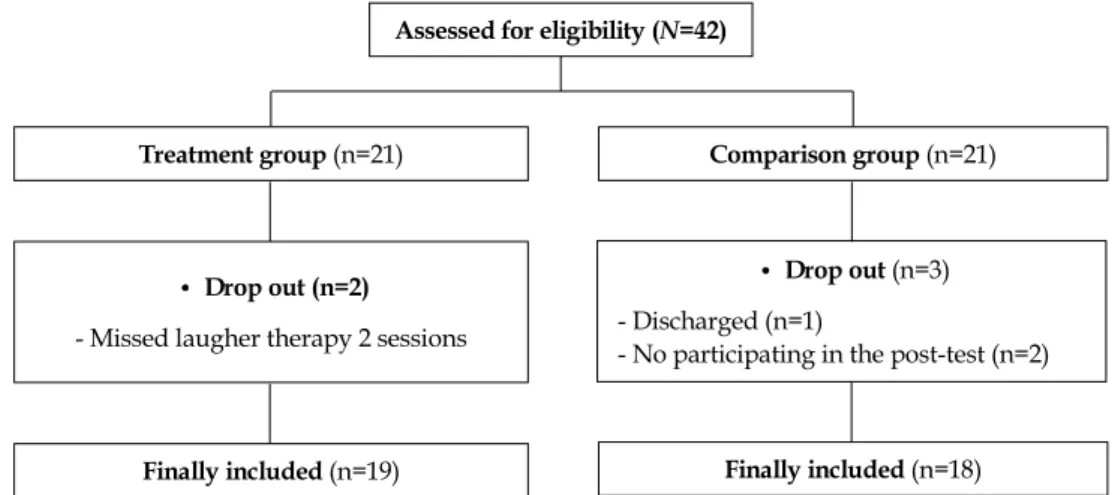
Assessed for eligibility (N=42)
Finally included (n=18)
• Drop out (n=3) - Discharged (n=1)
- No participating in the post-test (n=2) Comparison group (n=21) Treatment group (n=21)
• Drop out (n=2) - Missed laugher therapy 2 sessions
Finally included (n=19)
Figure 1. Flowchart of participants included for data analysis.
ance suggest that other interventions should be consid- ered [8]. For example, non-pharmacological interventions including aromatherapy, music intervention, art therapy, laughter therapy may be introduced. The advantages of laughter therapy are that it is cost-effective, does not re- quire high technology, and is not limited to a specific time and place [9]. While laughing, endorphins and serotonin, which control anxiety and depression, are secreted [10,11].
Especially, laughing aloud with whole body movements improves blood circulation. There is evidence to support that emotional relaxation and the quality of sleep will be improved [12].
Previous studies of laughter therapy investigate the ef- fects of the therapy on vital signs, anxiety, depression, sleep and quality of life [12-15]. These reported studies were limited to community-dwelling older adults [12-15]. Pre- vious studies reported consistent positive effects on de- pression, but not on sleep [16]. Previous studies showing the lack of a consistent effect on sleep suggested that inter- ventions improving sleep require more active movements to enhance the upper and lower extremities and torso movements and increased physical activity time. In this study, the research design took into account the recommen- dations from the reviewed studies. That is, there was an ef- fort to utilize physical movement including stretching, dance routines, and activities to express the pleasure and laugh is reinforced. Specifically, the purpose of this study was to investigate the effects of laughter therapy on de- pression and quality of sleep among older adults living in LTC hospitals. The hypotheses in this study are as follows:
1. Hypotheses
Patients at LTC hospitals who participate in the laugh-
ter therapy(the treatment group) will report lower de- pression scores than those who do not receive it(the comparison group).
Patients at LTC hospitals who participate in the treat- ment group will report better sleep quality than the comparison group.
METHODS 1. Study Design
A nonequivalent design was utilized in this study. The purpose of the study was to identify the effects of laughter therapy on reported depression and quality of sleep among older adults living in a LTC hospital.
2. Setting and Samples
A non-probability convenience sample was used. A to- tal of 42 individuals from two different LTC hospitals were used. Specifically, the treatment group was from Hangeul Hospital located in Daegu city and the compar- ison group was drawn from Suseong hospital located in Daegu city in Korea. The power calculation based on Cohen’s effect size formula [17], t-test, using power .80, ef- fect size .50, and ⍺=.05, group=2, showed a total of 34 par- ticipants (17 for each group). The rationale for setting the effect size as .50 was that differences in means and stand- ard deviations between the treatment and comparison groups were high in the previous study [18]. Considering a 20% dropout rate, a total of 42 participants (21 in the treatment group and 21 in the comparison group) were re- cruited for the study. During the study, five participants withdrew (2 for personal reasons in the treatment group;
one discharge and two with no measurement data in the comparison group). Finally, 37 participants were included in the analysis (Figure 1).
The participants that met the following inclusion cri- teria were included in the study. Those who are aged 65 and older; staying at a LTC hospital; able to communicate (scoring >18 on the Mini-Mental State Examination for Koreans [MMSE-K])[19]; exhibiting light depression (scor- ing > 5 on the Geriatric Depression Scale Short Form―
Korea [GDSSF-K])[20]; and having sleep problems (scor- ing > 5 on the Pittsburgh Sleep Quality Index―Korea [PSQI-K])[21] were recruited.
3. Development of the Intervention (Treatment Group)
The initial design of the protocol was developed based on Han’s laughter therapy [22]. In the initial protocol sev- en activities were included: 1) singing funny songs, 2) laughing for diversion, 3) stretching, 4) playing with hands and dance routines, 5) laughing exercise, 6) healthy clap- ping, and 7) laughing aloud. The initial design consisted of therapy for 60 minutes per session. The protocol was reviewed by six health professionals familiar with laugh- ter therapy to improve the validity of the protocol. Includ- ed among the six health professionals were one nursing faculty, three nurses from nursing homes, and two instruc- tors skilled in laughter therapy. The recommended mod- ifications were: 1) simplifying fast movements and in- creasing the physical movements in the ‘laughing for di- version’ area and 2) adding exercises of the upper and lower extremities to the ‘laughing exercise’ area. The ra- tionale for simplifying the fast movements was the resi- dents’ physical health status. Additionally, the exercises for upper and lower extremities were added because in- creased physical activities are supposed to improve sleep.The second revision of the protocol was based on the findings of the pilot study. Ten patients participated in the pilot study. Based on the results of the pilot study, the therapy protocol was modified as follows: 1) stretching, healthy clapping, and laughing out loud were repeated without any change every session and were easy to follow;
2) the length of each therapy session was reduced from 60 minutes to 40 minutes because a length of 60 minutes made it difficult for residents to participate; and 3) lecture time without any activity was added as break time in the middle of each session to prevent fatigue. Finally, the final form of laughter therapy simplified the fast movements and added exercises of upper and lower extremities.
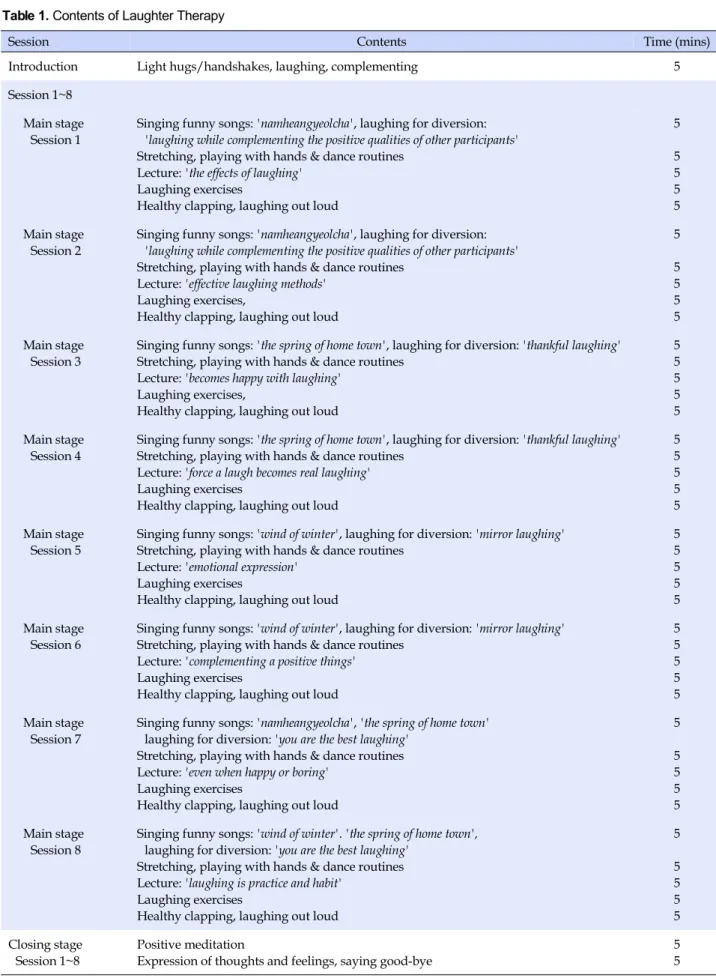
The structure of the final laughter therapy is presented in Table 1. The laughter therapy included introduction,
main, and closing stages. The introduction stage was in- tended to increase the sense of closeness and motivation to participate and lasted for five minutes. A sense of close- ness was fostered with light hugs/handshakes and com- pliments. The main stage of the laughter therapy lasted for 25 minutes and included singing funny songs, laughing for diversion, stretching, playing with hands and dance routines, lecture, laughing exercises, healthy clapping, and laughing aloud. “Singing funny songs” consisted of sing- ing songs such as Namheangyeolcha (a south-bound train), spring of hometown, and wind of winter. “Laughing for diversion” consisted of laughing while complimenting the positive qualities of other participants, thankful laughing, mirror laughing and you are the best laughing. The lecture topic was related to laughing and consisted of the effects of laughing, effective laughing methods, thankful laughing, emotional expression, laughing practice, and habits. The closing stage was for relaxation and the maintenance of a positive mood for 10 minutes and included positive medi- tation, expression of thoughts and feelings, and saying goodbye.
Each session occurred at 2 pm for 40 minutes twice a week (Monday/Thursday) with a total of eight sessions in the lounge of the LTC hospital provided by four research assistants (1 laugher therapist, 1 nurse, 1 social worker, and 1 nurse aid). The laughter therapist is certified by the Inter- national Association of Laughter Therapy Inc.
4. Measurements
The demographic data collected included age, gender, education, medical diagnosis, medication types, and du- ration of hospitalization. The levels of cognition, activ- ities of daily living, depression, and sleep quality were measured.
1) Cognition
Cognition level was measured using the MMSE-K [19]. The MMSE-K was modified from Folstein and col- league’s MMSE [23]. The MMSE-K includes six areas:
time and place orientation, memory registration, atten- tion and calculation, memory recall, language, and under- standing/comprehension. Possible scores on the MMSE-K range from 0 to 30 and are classified into three groups by score: normal (≥24), inadequate (20~23), and poor (≤
19). The Cronbach’s ⍺ for the original MMSE was .99, and the Cronbach’s ⍺ for the MMSE-K in this study was .80.
2) Activities of daily living
Activities of daily living were measured using the Kore-
Table 1. Contents of Laughter Therapy
Session Contents Time (mins)
Introduction Light hugs/handshakes, laughing, complementing 5
Session 1~8 Main stage
Session 1
Singing funny songs: 'namheangyeolcha', laughing for diversion:
'laughing while complementing the positive qualities of other participants' Stretching, playing with hands & dance routines
Lecture: 'the effects of laughing' Laughing exercises
Healthy clapping, laughing out loud
5 5 5 5 5 Main stage
Session 2
Singing funny songs: 'namheangyeolcha', laughing for diversion:
'laughing while complementing the positive qualities of other participants' Stretching, playing with hands & dance routines
Lecture: 'effective laughing methods' Laughing exercises,
Healthy clapping, laughing out loud
5 5 5 5 5 Main stage
Session 3
Singing funny songs: 'the spring of home town', laughing for diversion: 'thankful laughing' Stretching, playing with hands & dance routines
Lecture: 'becomes happy with laughing' Laughing exercises,
Healthy clapping, laughing out loud
5 5 5 5 5 Main stage
Session 4
Singing funny songs: 'the spring of home town', laughing for diversion: 'thankful laughing' Stretching, playing with hands & dance routines
Lecture: 'force a laugh becomes real laughing' Laughing exercises
Healthy clapping, laughing out loud
5 5 5 5 5 Main stage
Session 5
Singing funny songs: 'wind of winter', laughing for diversion: 'mirror laughing' Stretching, playing with hands & dance routines
Lecture: 'emotional expression' Laughing exercises
Healthy clapping, laughing out loud
5 5 5 5 5 Main stage
Session 6
Singing funny songs: 'wind of winter', laughing for diversion: 'mirror laughing' Stretching, playing with hands & dance routines
Lecture: 'complementing a positive things' Laughing exercises
Healthy clapping, laughing out loud
5 5 5 5 5 Main stage
Session 7
Singing funny songs: 'namheangyeolcha', 'the spring of home town' laughing for diversion: 'you are the best laughing'
Stretching, playing with hands & dance routines Lecture: 'even when happy or boring'
Laughing exercises
Healthy clapping, laughing out loud
5 5 5 5 5 Main stage
Session 8
Singing funny songs: 'wind of winter'. 'the spring of home town', laughing for diversion: 'you are the best laughing'
Stretching, playing with hands & dance routines Lecture: 'laughing is practice and habit'
Laughing exercises
Healthy clapping, laughing out loud
5 5 5 5 5 Closing stage
Session 1~8
Positive meditation
Expression of thoughts and feelings, saying good-bye
5 5
an Activities of Daily Living (K-ADL) [24]. The K-ADL consists of seven items and ranges from 1 (without any difficulty) to 3 (unable to do). Lower scores indicated higher ADL. The Cronbach’s ⍺ for the original K-ADL was .93, and the Cronbach’s ⍺ for this study was .86.
3) Depression
Depression was measured using the GDSSF-K [20]. The original GDSSF was developed by Yesavage and Sheikh [25] and was translated into Korean (GDSSF-K) by Kee [20]. The GDSSF-K includes 15 items. Possible scores on the GDSSF-K range from 0 to 15 and are classified into three groups by score: normal (≤4), mild (5~9), and severe (≥10). Higher scores indicate higher levels of depression.
The Cronbach’s ⍺ for the original GDSSF-K was .88, and the Cronbach’s ⍺ for the GDSSF-K in the current study was .75.
4) Sleep
Sleep was measured using the PSQI-K [21]. The origi- nal PSQI was developed by Buysse and colleagues [20]
and was translated into Korean (PSQI-K) by Choi and colleagues [21]. The PSQI-K is composed of 18 questions and assesses seven categories: subjective sleep quality, sleep latency, sleep duration, habitual sleep efficiency, sleep disturbance, use of sleep medication, and daytime dysfunction. The PSQI-K ranges from 0 to 21, and scoring more than five indicates sleep problems. Higher scores in- dicate lower sleep quality. The Cronbach’s ⍺ of the origi- nal PSQI was .83, and the Cronbach’s ⍺ of the PSQI-K in the current study was .73.
5. Data collection
The participants were recruited at two LTC hospitals in Daegu city, Korea. The first LTC hospital was allocated to the treatment group and the second LTC hospital was allo- cated to the comparison group based on each LTC hospi- tals’ choice. The two LTC hospitals with similar sizes of 150 beds, were built within two years, and did not provide any other programs related to depression and sleep. Un- der the cooperation with the LTC directors, primary inves- tigator (PI) was able to contact the patients and explained about study purpose, contents and procedures, and bene- fits and risks of this study participation. A written consent was obtained from each participant if they agreed to par- ticipate in this study.
After the written consent was obtained, demographic data, cognition, ADL, depression, and sleep were meas- ured by the PI prior to the laughter therapy in the treat-
ment and comparison groups. Cognition was the MMSE-K scores obtained from the electronic medical record data.
Depression and sleep were measured by the PI immedi- ately following the eighth session of laughter therapy. The residents in the comparison group received standard care without laughter therapy and a CD of laughter therapy was provided after the study is completed.
6. Ethical Considerations
This study was reviewed and approved by Keimyung University Institutional Review Board (No. 40525-201505- HR-38-02). Data collection began after obtaining the ap- proval. Participants were informed that they could with- draw anytime during the study participation without any consequences. All data and consent forms were stored in a locked file cabinet in the PI’s office.
7. Data Analysis
The data analysis was performed using the SPSS Statis- tics 22.0 program. Descriptive statistics were used to de- scribe participants’ demographic characteristics. To test the homogeneity of participants’ characteristics, cognition, ADL, depression, and sleep between the two groups, t-test, x2 test, and Mann-Whitey U test were used. Kolmogrov- Smirnov was used to check the normal distribution of de- pression and sleep level. To compare the effects of laugher therapy on depression between the two groups paired t-test, independent t-test was used. To compare the effects of laugher therapy on sleep between the two groups, Wilcoxon matched pairs signed ranks test, and Mann- Whitney U test were used because the sleep level did not follow the normal distribution.
RESULTS 1. Participant Characteristics
The findings of the participant characteristics are pre- sented in Table 2. In the treatment group, 57.9% of them were male and 63.2% were under the age of 80. Those par- ticipants who had less than an elementary school educa- tion were 57.9%, had a cerebrocardiovascular disease were 47.4%. 26.3% of them were taking sleeping pills and 26.3%
were taking antidepressants. 57.9% of them had been at the LTC hospital for less than 1 year. Cognition and ADL lev- els were 26.47±2.86 and 12.00±3.63, respectively. In the comparison group, 55.6% of the participants were female and 55.6% were under age 80. Those participants who had
Table 2. Characteristics of Participants at the Long-term Care Hospitals (N=37) Characteristics Categories
Treatment group (n=19)
Comparison group
(n=18) x2 or t or Z p
n (%)/M±SD n (%)/M±SD
Gender Male
Female
11 (57.9) 8 (42.1)
8 (44.4) 10 (55.6)
0.67 .313
Age (year) 65~79
≥80
12 (63.2) 7 (36.8)
10 (55.6) 8 (44.4)
0.22 .446
Education ≤Elementary school
≥Middle school
11 (57.9) 8 (42.1)
13 (72.2) 5 (27.8)
0.83 .286
Medical diagnosis CVD MCI Others†
9 (47.4) 4 (21.0) 6 (31.6)
8 (44.4) 3 (16.7) 7 (38.9)
0.25 .882
Sleeping pills‡ Yes No
5 (26.3) 14 (73.7)
6 (33.3) 12 (66.7)
0.22 .457
Antidepressants Yes No
5 (26.3) 14 (73.7)
5 (27.8) 13 (72.2)
0.01 .605
Hospitalization ≤1 year
>1 year
11 (57.9) 8 (42.1)
11 (61.1) 7 (38.9)
0.04 .554
Cognition 26.47±2.86 25.94±2.62 -0.59 .562
ADL 12.00±3.63 10.83±2.68 -1.35 .179
Depression 8.37±1.54 8.17±1.98 -0.35 .730
Sleep 8.98±3.08 9.22±3.39 -0.28§ .783
CVD=cerebrocardiovascular disease; MCI=mild cognitive impairment; ADL=activity of daily living; †Parkinson's disease, cancer, arthritis, fracture, diabetes mellitus, Sjogren's syndrome; ‡Lunapam, Stilnox; §Mann-Whitney U test.
less than an elementary school education were 72.2% and had cerebrocardiovascular disease were 44.4%. 33.3% of them were taking sleeping pills and 27.8% were taking antidepressants. 61.1% of them had been at the LTC hospi- tal for less than 1 year. Cognition and ADL levels were 25.94±2.62 and 10.89±2.68, respectively. There were no significant differences in the participants’ characteristics, cognition, ADL, depression, and sleep between the two groups prior to therapy. In both groups, prescribed medi- cations were not changed throughout the study period.
2. Depression
Changes in depression in both groups are presented in Table 3. In the treatment group, the depression level was 8.37 prior to the laughter therapy and decreased to 5.32, in- dicating light depression, when the therapy ended. The depression decreased significantly at posttest compared to the baseline in the treatment group (t=8.96, p<.001). In the comparison group, the depression level was 8.17 and de- creased to 7.94, indicating light depression. The depres- sion did not decrease significantly at posttest compared to
the baseline in the comparison group (t=0.81, p=.429).
There was a significant difference in depression between the two groups (t=-7.12, p<.001).
3. Sleep
The changes in sleep in both groups are also presented in Table 3. In the treatment group, sleep level was 8.68 pri- or to the therapy and decreased to 6.53 after the therapy.
Sleep decreased significantly at posttest compared to the baseline in the treatment group (z=-3.62, p<.001). In the comparison group, sleep level was 9.22 and decreased to 8.83. There was a significant difference in sleep between the two groups (z=-4.16, p<.001). Sleep had not decreased significantly at posttest compared to the baseline in the comparison group (z=-0.88, p=.378). There was a signifi- cant difference in sleep between the two groups (z=-4.16, p<.001).
DISCUSSION
This study investigated the effects of laughter therapy
Table 3. Difference in Depression and Sleep between the Two Groups (N=37)
Variables Groups Pretest Posttest Difference
Paired t or Z p t or Z p
M±SD M±SD M±SD
Depression Treatment (n=19) Comparison (n=18)
8.37±1.54 8.17±1.98
5.32±1.20 7.94±2.49
-3.05±1.31 -0.22±1.17
8.96 0.81
<.001 .429
7.12 <.001
Sleep Treatment (n=19) Comparison (n=18)
8.68±3.38 9.22±3.39
6.53±2.34 8.83±3.13
-2.42±1.22 -0.39±0.92
-3.62† -0.88†
<.001 .378
4.16‡ <.001
†Wilcoxon matched pairs signed ranks test; ‡Mann-Whitney U test.
on depression and sleep quality for residents at LTC hos- pitals, and the results showed that depression and sleep quality were improved. Previous studies involving laugh- ter therapy were performed among older adults living in the community and showed similar effects on depression [12,14]. Laughing affects the secretion of physiological stress hormones and of serotonin and endorphins and al- so reduces depression [10,11]. Laughing increases the ability to control negative situations such as stress and to convert negative emotions such as depression into pos- itive emotions.
However, some previous studies showed no significant effect from laughter therapy on depression [13,26]. In those studies, the therapy was provided only once a week, and the they suggested the importance of providing the therapy more than once a week to improve depression.
Therefore, this study provided the therapy twice a week for a total of eight sessions. The pilot study was originally offered for 60 minutes, and the older adults complained that 60 minutes of operation time is strenuous to older adults and suggested 40 minutes as appropriate for the laughter therapy in this study. In further studies involving laughter therapy, the residents’ physical status and atten- tion should be taken into consideration.
In this study, participants were screened using GDSSF-K and evaluated as having or not having mild depression.
Prior to the therapy, the residents showed mild-moderate levels of depression, but the level decreased to a mild level when the therapy was completed. Therefore, the laughter therapy could be considered an important therapy to im- prove depression in LTC hospitals.
This study showed positive effects of laughter therapy on sleep for patients at LTC hospitals whereas previous studies did not show consistent results. While some stud- ies on laughter therapy showed positive effects on sleep for home-dwelling patients or vulnerable populations, other studies showed no significant effect on sleep in pa- tients with dialysis or hospitalized patients [16,27]. Lee and colleagues [16,27] assumed that the lack of a signifi- cant effect from laughter therapy on sleep was because the
therapy was more focused on laughing. Because sleep has a significant correlation with physical activity, adding ex- ercises of upper and lower extremities to the therapy ap- peared to improve sleep in this study. In the sub-catego- ries of sleep, subjective sleep quality, sleep latency, sleep duration, habitual sleep efficiency and daytime dysfunc- tion were significantly improved with laughter therapy, but sleep disturbance and medication use were not. Sleep disturbance is a serious problem in LTC hospitals [28]. The amount of medication used to improve sleep in the treat- ment group was lower than in the comparison group, though the difference was not significant. For better sleep with less taking sleeping medications, the contents of laughter therapy need to be reviewed and modified for patients at LTC hospitals.
It is meaningful that the results of this study supported the value of laughter therapy on depression and sleep. The therapy included more intense physical activities to in- crease the effect of laughter therapy on sleep. Laughter therapy is originally defined as “expressing the pleasure to laughing using the physical body, make physical, psy- chological and social relationship with others healthy and help improving quality of life”[29]. Physical activity is of- ten defined as “the movement of the body by the skeletal muscle following energy consumption”[5]. Thus, the laughter therapy is similar with physical activity in terms of using physical body, but it is distinguished from the physical activity in terms of using physical body to ex- press the pleasure to laugh. Based on the findings, laugh- ter therapy strengthening physical activities must be pro- vided more than two times a week to improve depression and sleep among patients in LTC hospitals.
The limitations of this study were as follows. First, this study was conducted at two LTC hospitals. Therefore, it requires careful generalization of the study results. Fur- ther, the two groups of participants were drawn from separ- ate hospitals and there may be differences in the two groups that may account for the findings. The PSQI-K to measure sleep used in this study was based on the participants’ mem- ory and self-reporting during the past month; hence, the in-
strument must be changed to consider the short-term me- mory of older adults and to increase the validity and reli- ability of the study findings. In the past, laughter therapy was mostly provided to reduce depression among older adults. However, in this study, the laughter therapy en- hanced physical activities (from exercise with upper and lower extremities) in the “laughing exercise” area; there- fore, the laughter therapy improved sleep as well as de- pression. Therefore, for the older adults with depression and sleep problems at LTC hospitals, laughter therapy re- inforcing physical activities can be considered to decrease depression and sleep problems.
CONCLUSION
This study showed that laughter therapy with more in- tense physical activities reduced depression and improved sleep among the participants in the LTC hospitals. To im- prove depression and sleep quality in older adults, laugh- ter therapy strengthening physical activities might be ben- eficial if it can be offered more than two times a week. The findings of this study suggest that laughter therapy must enhance more physical activities to improve depression and sleep.
REFERENCES
1. Health Insurance Review & Assessment Service. Status of me- dicalinstitutions [Internet]. Seoul: Health Insurance Review &
Assessment Service; 2015 [cited 2015 Oct 15]. Available from:
http://opendata.hira.or.kr/op/opc/yadmOpCloPrsnt.do?se archType=&dateType=&frYear=2015&frMonth=09&ykihoPl cTpCd=&ykihoPlcTpCdNm=&clCd=28&shwSbjtCd=
2. Eun Y, Ko SH, Kim MJ, Kim JS, Park MH. Introduction to ger- ontological nursing. Seoul: Hyeonmunsa; 2010.
3. Park EO. Effects of visiting laughter therapy on depression and insomnia among the vulnerable elderly. Journal of Korean Academy of Community Health Nursing. 2013;24(2):205-13.
https://doi.org/10.12799/jkachn.2013.24.2.205
4. Almeida OP, Pfaff JJ. Sleep complaints among older general practice patients: association with depression. British Journal of General Practice. 2005;55(520):864-6.
5. Park YH. Physical activity and sleep patterns in elderly who visited a community senior center. Journal of Korean Acad- emy of Nursing. 2007;37(1):5-13.
6. Redeker NS. Sleep in acute care settings: an integrative review.
Journal of Nursing Scholarship. 2000;32(1):31-8.
7. Jang HY, Kim TI. Sleep patterns and it's influencing factors of hospitalized elderly in long-term care hospital. Journal of the Korean Data & Information Science Society. 2016;27(3):773-89.
8. Won WY, Lee CU. Pharmacological treatment of psychiatric disorders of the elderly. The Journal of the Korean Medical Association. 2010;53(11):972-83.
https://doi.org/10.5124/jkma.2010.53.11.972
9. Takeda M, Hashimoto R, Kudo T, Okochi M, Tagami S, Mori- hara T, et al. Laughter and humor as complementary and alter- native medicines for dementia patients. BMC Complement and Alternative Medicine. 2010;10(1):28.
https://doi.org/10.1186/1472-6882-10-28
10. Berk LS, Felten DL, Tan SA, Bittman BB, Westengard J. Mo- dulation of neuroimmune parameters during the eustress of humor-associated mirthful laughter. Alternative Therapies in Health Medicine. 2001;7(2):62-76.
11. Cha MY, Hong HS. Effect and path analysis of laughter ther- apy on serotonin, depression and quality of life in middle- aged women. Journal of Korean Academy of Nursing. 2015;45 (2):221-30. https://doi.org/10.4040/jkan.2015.45.2.221 12. Jung HW, Yoon CH, Cho NR, Lee MK, Lee JB. The effect of
laughter therapy on sleep in the community-dwelling elderly.
Korean Journal of Family Medicine. 2009;30(7):511-8.
https://doi.org/10.4082/kjfm.2009.30.7.511
13. Kim YS, Jeon SS. The influence of one-time laughter therapy on stress response in the elderly. Journal of Korean Academy of Psychiatric and Mental Health Nursing. 2009;18(3):269-77.
14. Ko HJ, Youn CH. Effects of laughter therapy on depression, cognition and sleep among the community-dwelling elderly.
Geriatrics and Gerontology International. 2011;11(3):267-74.
https://doi.org/10.1111/j.1447-0594.2010.00680.x
15. Lee HK, Byeon DH, Park YS, Kim JS, Gil JH. Effects of the laugh- ter therapy on blood pressure, depression and quality of life in rural elderly women. Journal of the Korea Academia-Industrial cooperation Society. 2013;14(4):1810-9.
https://doi.org/10.5762/kais.2013.14.4.1810
16. Lee KI, Eun Y. Effect of laugher therapy on pain, depression and sleep with elderly patients in long term care facility. Jour- nal of Muscle and Joint Health. 2011;18(1):28-38.
https://doi.org/10.5953/JMJH.2011.18.1.028
17. Cohen J. Statistical power analysis for the behavioral sciences.
2nd ed. Hillsdale, New Jersey: L. Erlbaum; 1988.
18. Seo SY, Chang SY. Effect of laughing therapy on sleep, depres- sion and self-esteem of elderly women in senior home. Journal of Regional Studies. 2011;19(4):211-25.
19. Kwon YC, Park JH. Korean version of Mini-Mental State Examination (MMSE-K). Part I: development of the test for the elderly. Journal of Korean Neuropsychiatr Association. 1989;
28(1):125-35.
20. Kee BS. A preliminary study for the standardization of geri- atric depression scale short form-Korea version. Journal of Korean Neuropsychiatr Association. 1996;35(2):298-307.
21. Choi HJ, Kim SJ, Kim BJ, Kim IJ. Korean versions of self-re-
ported sleep questionnaires for research and practice on sleep disturbance. The Korean Journal of Rehabilitation Nursing.
2012;15(1):1-10. https://doi.org/10.7587/kjrehn.2012.1 22. Han GI. Laughter therapy. Seoul: Samho MEDIA; 2014.
23. Folstein MF, Folstein SE, McHugh PR. "Mini-mental state": a practical method for grading the cognitive state of patients for the clinician. Journal of Psychiatric Research. 1975;12(3):189- 98.
24. Won CW, Yang KY, Rho YG, Kim SY, Lee EJ, Yoon JL, et al. The development of Korean activities of daily living (K-ADL) and Korean instrumental activities of daily living (K-IADL) scale.
Journal of the Korean Geriatrics Society. 2002;6(2):107-20.
25. Yesavage JA, Sheikh JI. 9/Geriatric Depression Scale (GDS) re- cent evidence and development of a shorter violence. Clinical Gerontologist. 1986;5(1-2):165-73.
https://doi.org/10.1300/J018v05n01_09
26. Chae KS. Effects of the laughing and music therapy on the de- pression and activities of autonomic nervous system for eld- erly with dementia. Journal of Korean Biological Nursing Sci- ence. 2015;17(3):245-52.
https://doi.org/10.7586/jkbns.2015.17.3.245
27. Lee JS, Kim KS, Kim MY, Oh SM, Oh SH, Lee HS. The effects of laughter therapy on sleep disturbance and depression among hemodialysis patient. Journal of Clinical Nursing Research.
2006;9:107-50.
28. Ersser S, Wiles A, Taylor H, Wade S, Walsh R, Bentley T. The sleep of older people in hospital and nursing homes. Journal of Clinical Nursing. 1999;8(4):360-8.
https://doi.rog/10.1046/j.1365-2702.1999.00267.x
29. Lee IS, Bae GH, Baek JS. Laughter therapy introduction. Seoul:
Changjisa; 2009.