http://www.ecevr.org/ 175
A Bordetella pertussis
proteoliposome induces protection in mice without affecting the
immunogenicity of diphtheria
and tetanus toxoids in a trivalent formulation
CLINICAL
EXPERIMENTAL VACCINE
RESEARCH
Brief communication
Whooping cough, an acute respiratory disease caused by Bordetella pertussis, still is an important cause of public health concern worldwide even in countries with high vac- cination coverage [1]. Various reasons could explain this phenomenon, among them, waning of vaccine-induced immunity has shift the incidence peak from young chil- dren to adolescents and adults, which become source of infection for unvaccinated newborns [2].
Improvement of existing vaccines or the development of new and better ones, ca- pable of conferring a long-lasting protection against disease has been recommended by some experts [3,4]. Bacterial-derived proteoliposomes (PL) are nanoparticulate ve- sicular structures that contain proteins, lipids, and native lipopolysaccharide (LPS) [5,6]. Their immune-stimulatory and adjuvant properties made them attractive for vaccine development against several diseases [5]. A previous work described the ob- taining of a PL derived from B. pertussis (PLBp). Preliminary characterization of PLBp revealed the presence of LPS and some important proteins such as pertussis toxin, pertactin, and fimbriae; also, Limulus amoebocyte lysate assay showed that PLBp has lower endotoxin level than those reported for traditional whole cell pertussis licensed vaccines. In addition, immunization with PLBp protected mice in the intracranial and
© Korean Vaccine Society.
This is an Open Access article distributed under the terms of the Creative Commons Attribution Non-Com- mercial License (http://creativecommons.org/licenses/
by-nc/4.0) which permits unrestricted non-commercial use, distribution, and reproduction in any medium, pro- vided the original work is properly cited.
K O R E A N V A C C I N E S O C I E T Y
K O R E A N V A C C I N E S O C I E T Y K O R E A N
A C C I N E O C I E T Y V
S
Clin Exp Vaccine Res 2016;5:175-178 http://dx.doi.org/10.7774/cevr.2016.5.2.175 pISSN 2287-3651 • eISSN 2287-366X
Sonsire Fernández Castillo1, Mario Landys Chovel1, Niurka Gutiérrez Hernández1, Lorena Corcho González1, Amaya Blanco2,
Daily Serrano Hernández1, Mildrey Fariñas Medina1, Maydelis Álvarez Tito1, José Luis Pérez Quiñoy1
1Finlay Institute, Havana; 2Medical Faculty and Institute of Basic and Preclinical Science “Victoria de Girón”, University of Medical Sciences of Havana, Havana, Cuba
Received: December 29, 2015 Revised: February 15, 2016 Accepted: March 25, 2016 Corresponding author:
Sonsire Fernández Castillo, MS
Finlay Institute, 27 Street, No. 19805, La Lisa, Havana, Cuba
Tel: +53-7-2717911 Fax: +53-7-2086075
E-mail: [email protected]
No potential conflict of interest relevant to this article was reported.
In this study, a formulation of Bordetella pertussis proteoliposome (PLBp), diphtheria, and tetanus toxoids and alum (DT-PLBp) was evaluated as a trivalent vaccine candidate in BALB/c mice. Vaccine-induced protection was estimated using the intranasal challenge for pertussis and enzyme-linked immunosorbent assay to assess serological responses for diphtheria or tetanus. Both, diphtheria-tetanus-whole cell pertussis (DTP) and diphtheria-tetanus vaccines (DT) were used as controls. Animals immunized with DT-PLBp, PLBp alone, and DTP showed total reduction of CFU in lungs 7 days after intranasal challenge. Likewise, formulations DT- PLBp, DTP, and DT elicited antibody levels ≥2 IU/mL against tetanus and diphtheria, consid- ered protective when neutralization tests are used. Overall, results showed that combination of PLBp with tetanus and diphtheria toxoids did not affect the immunogenicity of each antigen alone.
Keywords: Bordetella pertussis, Proteoliposome, Whooping cough, Vaccines
Sonsire Fernández Castillo, et al • DT-PLBp formulation induces protection in mice
176 http://www.ecevr.org/ http://dx.doi.org/10.7774/cevr.2016.5.2.175
intranasal challenge models [7].
Since 1947, pertussis vaccines are administered with diph- theria and tetanus toxoids first, and later with other antigens to form combined vaccines [8]. In this work, we evaluated the protection conferred by a combined formulation of PLBp with diphtheria and tetanus toxoids in BALB/c mice.
PLBp was obtained as described previously [7] and formu- lated at 120 μg/mL with 50 Lf/mL of diphtheria toxoid and 20 Lf/mL of tetanus toxoid using aluminum hydroxide (2 mg/
mL) as adjuvant (diphtheria-tetanus and B. pertussis proteo- liposome [DT-PLBp]). Vaccines DTP-vax (diphtheria 50 Lf/
mL, tetanus 20 Lf/mL, and whole cell pertussis 32 OU/mL) and VA-DIFTET (diphtheria 50 Lf/mL and tetanus 20 Lf/mL) produced at Finlay Institute, Cuba, were also used in this study as controls. In-house diphtheria and tetanus reference sera were obtained and supplied by the Reference Material De- partment from Finlay Institute.
Female BALB/c mice, 3-4 weeks old, were supplied by the National Center for Laboratory Animals Breeding (CENPAL- AB) from Havana, Cuba with their health certificates. Animals were housed at the Finlay Institute animal facility and kept following the Canadian Council directions for laboratory ani- mal experiments. All experiments were performed with ap- proval from the Finlay Institute Ethical Committee.
Groups of 18 mice were immunized subcutaneously with two doses of 125 μL of each vaccine, separated by a 3-week interval. Two weeks after the second dose, serum samples of
10 mice were obtained for the assessment of diphtheria and anti-tetanus immune response by enzyme-linked immuno- sorbent assay (ELISA). Briefly, microplates were coated with diphtheria and tetanus toxoids (2Lf/mL) in carbonate-bicar- bonate buffer (pH 9.6) and incubated overnight, at 2-8°C. Af- ter washing, 2-fold dilutions of the references and samples sera in phosphate buffered saline (PBS)-Milk 3%-Tween 20 0.05%, starting in 1/400 and 1/800, respectively, were pre- pared and added to the plates. One-hour later, a working di- lution of an anti-mouse IgG conjugated to horseradish per- oxidase was applied. After 1-hour incubation, a substrate so- lution (ortho-phenylendiamine in citrate buffer) was added and the plates were incubated in darkness, for 30 minutes, at room temperature. Reaction was stopped with sulphuric acid 1 M and absorbances were read at 492 nm. Results were ex- pressed in International Units (IU/mL) as the arithmetic means±standard deviation. An antibody level equal or high- er than 2 IU/mL was considered as protective for both anti- gens as was seen in correlation studies made between these ELISA and the in vivo toxin neutralization test [9].
The intranasal challenge was performed 2 weeks after the last immunization. Each mouse was slightly anaesthetized with ether and then 50 μL (25 μL per nostril) of PBS contain- ing approximately 5×10⁶-107 CFU of B. pertussis strain 18323 were administrated intranasally. Lung extraction for CFU coun- ting were done two hours and 7 days post-challenge (4 mice per time) as described by Guiso et al. [10]. Results were ex-
50
40
30
20
10
0
DTP DT PLBp DT-PLBp
IgG anti-tetanus (IU/mL)
a
c
b
d
Fig. 1. Immune response anti-tetanus toxoid by enzyme-linked immu- nosorbent assay. Groups were immunized with two doses (3 weeks apart) and 2 weeks after the second dose, blood samples were taken from 10 mice per group. DTP, diphtheria-tetanus-whole cell pertussis vaccine; DT, diphtheria-tetanus vaccine; PLBp, B. pertussis proteolipo- some; DT-PLBp, diphtheria-tetanus and B. pertussis proteoliposome.
Comparison of arithmetic means was carried out by simple ANOVA and confidence levels (p<0.05) by Tukey’s multiple comparison test.
Fig. 2. Immune response anti-diphtheria toxoid by enzyme-linked im- munosorbent assay. Groups were immunized with two doses (3 weeks apart) and 2 weeks after the second dose blood samples were taken from 10 mice per group. DTP, diphtheria-tetanus-whole cell pertussis vaccine; DT, diphtheria-tetanus vaccine; PLBp, B. pertussis proteolipo- some; DT-PLBp, diphtheria-tetanus and B. pertussis proteoliposome.
Comparison of arithmetic means was carried out by simple ANOVA and confidence levels (p<0.05) by Tukey’s multiple comparison test.
16 14 12 10 8 6 4 2 0
DTP DT PLBp DT-PLBp
IgG anti-diphtheria (IU/mL)
a
b c
d
Sonsire Fernández Castillo, et al • DT-PLBp formulation induces protection in mice
http://www.ecevr.org/ 177
http://dx.doi.org/10.7774/cevr.2016.5.2.175
pressed as the arithmetic means±standard deviation of log10 of the CFU/g of lung for each group of mice at each extraction time after challenge.
The comparison of arithmetic means of the groups was car- ried out by an analysis of simple variance and Tukey’s multi- ple comparison test was used to compare groups with a con- fidence level of 95% (p<0.05) (GraphPad Prisma 5, La Jolla, CA, USA).
Immune response against tetanus and diphtheria elicited by each group is showed in Figs. 1 and 2, respectively. Groups immunized with diphtheria-tetanus vaccine (DT), DTP, and DT-PLBp elicited antibody levels higher to 2 IU/mL for both antigens. These antibody levels are related to their ability to neutralize the tetanus and diphtheria toxins, as shown by the correlation studies performed between the serological meth- ods and the toxin neutralization assays [9]. Thus, it was dem- onstrated that the immunized vaccines generated protective antibodies and the PLBp did not affected the immunogenici- ty of the toxoids.
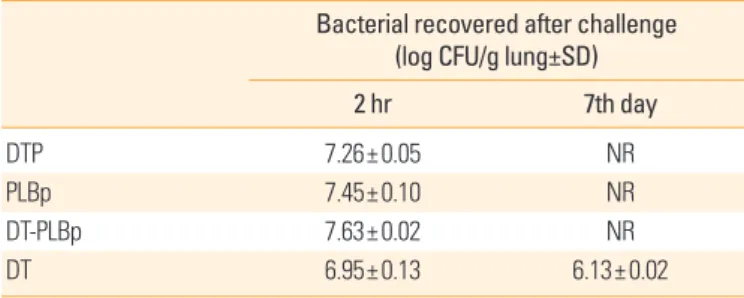
As observed in Table 1, seven days after intranasal chal- lenge, no CFU were recovered in lungs from mice of groups immunized with PLBp, DT-PLBp, and DTP vaccine. On the other hand, in the group immunized with the DT, the num- ber of CFU recovered from lungs was not significantly differ- ent (p>0.05) from CFU recovered 2 hours after challenge.
Same results were observed by our group previously, using PLBp and DTP vaccine [7].
Triple combination of diphtheria-tetanus toxoids and per- tussis component (whole cell or acellular) is one of the most used vaccines worldwide (131 countries with ≥90% coverage in 2012) in a 3-dose primary series and booster in the second year of live [11]. In addition, the use of reduced diphtheria/
acellular pertussis and tetanus vaccines has been recommend- ed for additional boosters in adolescents and adults in order
to decrease incidence in these age groups [12]. On the other hand, there is now convincing evidence available that the current acellular pertussis vaccines does not provide an ade- quate protective immunity and, the bacteria is adapting in order to evade the vaccines pressure [13]. This calls for the development of new and improved pertussis vaccines as a long-term control measure. Ideally, this new vaccine should have to (1) induce a pattern of immune response similar to natural infection, (2) elicit a long-lasting immunity, (3) show a reactogenic profile better than traditional whole cell pertus- sis vaccines, (4) be multi-antigenic in order to elude the vac- cine pressure, and (5) be affordable for both developed and developing countries. In that matter, a Bordetella pertussis derived proteoliposome may represent a good approach [5,7].
Results obtained here indicated that combination of these antigens did not affect the protective capacity of PLBp and the immune response elicited by diphtheria-tetanus toxoids, showing its potential use in a trivalent formulation. Further studies are needed in order to elucidate duration of protec- tion and the immune response pattern induced by PLBp as well as deepen in its antigenic composition, but these results encourage us to continue in that direction.
ORCID
Sonsire Fernández Castillo http://orcid.org/0000-0001-5329- 5971
Mario Landys Chovel http://orcid.org/0000-0002-6991-7007 Niurka Gutiérrez Hernández http://orcid.org/0000-0002-
3896-9648
Lorena Corcho González http://orcid.org/0000-0002-0084- 281X
Amaya Blanco http://orcid.org/0000-0002-5049-4024 Daily Serrano Hernández http://orcid.org/0000-0001-9233-
2376
Mildrey Fariñas Medina http://orcid.org/0000-0001-6530- 9904
Maydelis Álvarez Tito http://orcid.org/0000-0002-7507-6013 José Luis Pérez Quiñoy http://orcid.org/0000-0001-8325-2120
References
1. Pertussis vaccines: WHO position paper. Wkly Epidemiol Rec 2010;85:385-400.
2. Cherry JD. Why do pertussis vaccines fail? Pediatrics 2012;
129:968-70.
Table 1. Intranasal challenge experiments in BALB/c mice using Bor- detella pertussis strain 18323
Bacterial recovered after challenge (log CFU/g lung±SD) 2 hr 7th day
DTP 7.26±0.05 NR
PLBp 7.45±0.10 NR
DT-PLBp 7.63±0.02 NR
DT 6.95±0.13 6.13±0.02
DTP, diphtheria-tetanus-whole cell pertussis vaccine; PLBp, B. pertussis proteolipo- some; DT-PLBp, diphtheria-tetanus and B. pertussis proteoliposome; DT, diphtheria- tetanus vaccine; NR, not recovered.
Sonsire Fernández Castillo, et al • DT-PLBp formulation induces protection in mice
178 http://www.ecevr.org/ http://dx.doi.org/10.7774/cevr.2016.5.2.175
3. Storsaeter J, Wolter J. Is there a need for a new generation of vaccines against pertussis? Expert Opin Emerg Drugs 2006;11:195-205.
4. Meade BD, Plotkin SA, Locht C. Possible options for new pertussis vaccines. J Infect Dis 2014;209 Suppl 1:S24-7.
5. Acevedo R, Fernandez S, Zayas C, et al. Bacterial outer membrane vesicles and vaccine applications. Front Im- munol 2014;5:121.
6. Sierra GV, Campa HC, Varcacel NM, et al. Vaccine against group B Neisseria meningitidis: protection trial and mass vaccination results in Cuba. NIPH Ann 1991;14:195-207.
7. Fernandez S, Fajardo EM, Mandiarote A, et al. A proteoli- posome formulation derived from Bordetella pertussis induces protection in two murine challenge models. BMC Immunol 2013;14 Suppl 1:S8.
8. Mattoo S, Cherry JD. Molecular pathogenesis, epidemiol- ogy, and clinical manifestations of respiratory infections due to Bordetella pertussis and other Bordetella subspe- cies. Clin Microbiol Rev 2005;18:326-82.
9. Chovel ML, Mandiarote A, Ontivero I, et al. Development
of 3Rs alternatives for determining potency and toxicity of vaccines in Cuba: current challenges and research proj- ects in progress. ALTEX 2012;29:71-6.
10. Guiso N, Capiau C, Carletti G, Poolman J, Hauser P. Intra- nasal murine model of Bordetella pertussis infection. I.
Prediction of protection in human infants by acellular vac- cines. Vaccine 1999;17:2366-76.
11. WHO/UNICEF coverage estimates 2012 revision, July 2013.
194 WHO Member States. Map production: immuniza- tion vaccines and biologicals (IVB). Geneva: World Health Organization; 2013.
12. Forsyth KD, Wirsing von Konig CH, Tan T, Caro J, Plotkin S.
Prevention of pertussis: recommendations derived from the second Global Pertussis Initiative roundtable meet- ing. Vaccine 2007;25:2634-42.
13. Mooi FR, Van Der Maas NA, De Melker HE. Pertussis re- surgence: waning immunity and pathogen adaptation:
two sides of the same coin. Epidemiol Infect 2014;142:685- 94.