CORROSION SCIENCE AND TECHNOLOGY, Vol.7, No.4(2008), pp.233~236
233
Development and Oxidation Resistance of B-doped Silicide Coatings on Nb-based Alloy
Xiaoxia Li and Chungen Zhou†
School of Materials Science and Engineering, Beijing University of Aeronautics and Astronautics, Beijing 100083, PR China
Halide-activated pack cementation was utilized to deposit B-doped silicide coating. The pack powders were consisted of 3 Wt.℅NH4Cl, 7 Wt.℅Si, 90 Wt.℅Al2O3+TiB2. B-doped silicide coating was consisted of two layers, an outer layer of NbSi2 and an inner layer of Nb5Si3. Isothermal oxidation resistance of B-doped silicide coating was tested at 1250℃ in static air. B-doped silicide coating had excellent oxidation resistance, because continuous SiO2 scale which serves as obstacle of oxygen diffusion was formed after oxidation.
Keywords : Nb-based alloy; B-doped silicide coating; Oxidation resistance
†Corresponding author: [email protected]
1. Introduction
Niobium-based alloy is regarded as a new material used for aeroengine because of its high melting point, relatively low density and excellent high-temperature strength, but practical application at high temperature is limited by its poor oxidation resistance.1)-6) A satisfactory balance of me- chanical properties and oxidation resistance at high tem- perature has not been achieved by alloying.1)-3) Therefore, protective coatings are required for their successful appli- cation at high temperature in oxidizing environments.7)-11) Different silicide coatings produced by various methods have been investigated. However, the coatings applied in industry during present time remain the alloyed silicide coatings developed by Priceman and Sama in 1965.12) There is a long way to go to find new protective coatings for Nb and Nb-base alloy to improve its oxidation resis- tance. Brain V.Cockeram4) has investigated B-modified silicide diffusion coatings on Ti-20Al-22Nb, Ti-22Al-27Nb and Nb-40Ti-15Al, the results showed that the cyclic oxi- dation resistance of these coated substrate was excellent.
In this paper, B-doped silicide coating would be produced on Nb-24Ti-6Cr-6Al-2Hf substrate.
The purpose of this work is to develop a protective coat- ing to improve oxidation resistance of Nb-base alloy and to study the mechanism of oxidation resistance. Halide-ac- tivated pack cementation was utilized to deposit B-doped silicide coating. Because the pack cementation method to convert a substrate surface to an oxidation-resistant dif-
fusion coating has the advantages of low cost, good coat- ing adhesion and wide versatility, as compared with other surface modification methods such as metalliding, hot dip- ping, ion implantation and laser surface alloying.13),14)
2. Experimental procedures
The specimen alloys Nb-24Ti-16Si-6Cr-6Al-2Hf (in atomic percent) were prepared by arc melting of propor- tional amounts of high purity niobium, titanium, chro- mium, aluminum, silicon and hafnium in a vacuum arc furnace. The ingots were inverted and remelted 5 times to ensure complete mixing. The coupons of Ф10 mm×2 mm were cut from these ingots by means of linear cutting.
The samples were prepared for coating by grinding their surface to a 600-grit finish, and ultrasonically cleaning with acetone.
Then halide-activated pack cementation (HAPC) proc- ess was utilized to codeposit boron and silicon onto the samples. Pack powders for B-doped silicide coating as fol- lows: 3 Wt.℅NH4Cl, 7 Wt.℅Si, 90 Wt.℅Al2O3+TiB2
(The contents of TiB2 were 5 ℅, 6 ℅, 7.33 ℅, 8 ℅, 8.33 ℅, 10 ℅, which meant that the contents of B were 1.5 ℅, 1.8 ℅, 2.2 ℅, 2.4 ℅, 2.5 ℅, 3.0 ℅). The pack chemistries were weighed and then mixed by tumbling in an alumina mortar. The substrate sample(s) and pack mate- rials were placed in an aluminide crucible closed with an aluminide lid using aluminide-base cement. The sealed crucible was positioned in the uniform heating zone of a horizontal heat-resistant tube furnace, then was heated at the rate of 7℃/min to 1100℃ and held at this temper-
XIAOXIA LI AND CHUNGEN ZHOU
234 CORROSION SCIENCE AND TECHNOLOGY Vol.7, No.4, 2008
ature for 10 hours. Prepurified Ar gas flowed through the furnace tube to protect the pack from oxidation. After holding at the coating temperature for a given time, the crucible was allowed to furnace cool. The couple was re- trieved from the pack and then cleaned in an ultrasonic cleaner.
Oxidation experiment was performed in air in a vertical tube furnace at 1250℃. The samples were placed in an alumina crucible preheated to constant weight. The weight gains were measured after oxidation for 24 h, 48 h, 72 h, 96 h and 100 h.
The structure, compositions and phase distribution of the as-deposited coatings and the coatings after oxidation were studied by scanning electron microscopy (SEM) and X-ray diffraction (XRD).
3. Results
3.1 Coating morphologies and composition
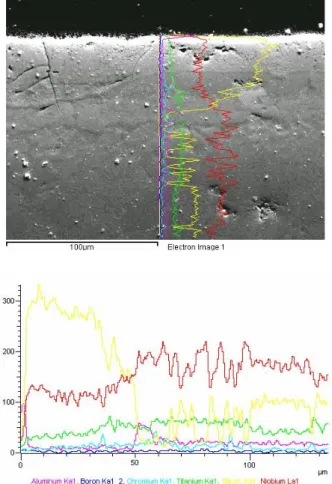
Fig. 1 showed the XRD patterns of B-doped silicide coatings produced from the pack powders with different TiB2 contents. The results demonstrated that only one phase of NbSi2 was detected on the surfaces of different B-doped silicide coatings. The morphology of cross-sec- tion and the elements distribution on the line of B-doped silicide coating investigated from pack powder with 6 Wt.% TiB2 contents (as B-1.8) were showed in Fig. 2.
It is evident that the B-1.8 coating was consisted of two layers. The ratio of intensity of Si to that of Nb is similar to 2:1 in the outer layer and 3:5 in the inner layer, which means that the outer layer is mainly composed of NbSi2, and the inner is Nb5Si3. The same results were learnt in the other B-doped silicide coatings.
Fig. 1. XRD patterns of B-doped silicide coatings
Fig. 2. The morphology of cross-section ans line scanning results of B-doped silicide coating investigated from the pack powder with 6 Wt.% TiB2
3.2 Isothermal oxidation
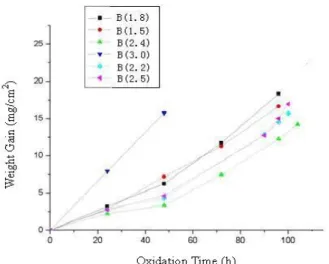
Oxidation tests were performed to evaluate the oxidation resistance of B-doped silicide coatings formed on Nb-base alloy. Fig. 3 shows a plot of weight change per unit area vs. oxidation time for the test performed at 1250℃ in air.
The weight gains were different with the change of TiB2
contents in the pack powder. When the content of TiB2
is 8 Wt.% (B-2.4), B-doped silicide coating has the small- est weight gain of 15.38 mg/cm2 compared with other B-doped silicide coatings after oxidation at 1250℃ for 100 h. B-2.2 and B-2.5 coatings have the same weight gain, while the weight gains of B-1.5 and B-1.8 coatings are the same. When the content of TiB2 was increased to 10 Wt.% (B-3.0), the coating oxidized at an extremely high rate, the specimens deteriorated quickly and failed cata- strophically after oxidation for 48 h, separating into pieces.
The surface morphology of B-2.4 coating oxidized at 125 0℃ for 100 h was shown in Fig. 4. It is evident that the surface of B-2.4 coating after oxidation for 100 h was covered with the bar shape phases, and the dark glass
DEVELOPMENT AND OXIDATION RESISTANCE OF B-DOPED SILICIDE COATINGS ON NB-BASED ALLOY
CORROSION SCIENCE AND TECHNOLOGY Vol.7, No.4, 2008 235 Fig. 3. Plot of weight gain per unit area vs. oxidation time for the test at 1250℃
Fig. 4. Surface morphology of B-2.4 coating oxidized at 1250℃for 100 h (A: TiO2, B: SiO2, C: TiO2+SiO2)
phase filled in the gap between the bar shape phases. Small globular phases also existed. EDS analysis for the dark glass phase showed profiles with strong Si and O peaks, while for the bar shape phases revealed profiles with strong Ti and O peaks. XRD results for B-doped coatings oxidized at 1250℃ for 100 h showed in Fig. 5 indicated the existence of TiO2 and small amount of Nb2O5 for B-1.8 coating, but no SiO2.
Fig. 6 shows cross-section of B-2.4 coating oxidized at 1250℃ for100h and magnified oxide layer. As shown in Fig. 6 (b), the oxide layer was consisted of two layers.
The outer layer contained a dark phase of SiO2 and a gray phase of TiO2+Nb2O5, while the inner layer dark in color has the composition 66.84O, 22.11Si (at.%), suggesting the formation of SiO2. The SiO2 scale which serves as oxygen diffusion obstacle is continuous.
Fig. 5. XRD patterns for B-doped silicide coatings after oxidation at 1250℃ for100 h
(a)
(b)
Fig. 6. (a) Morphology of B-2.4 coatings oxidized at 1250℃
for 100 h and (b)magnified oxide layer
XIAOXIA LI AND CHUNGEN ZHOU
236 CORROSION SCIENCE AND TECHNOLOGY Vol.7, No.4, 2008
4. Discussions
4.1 Effect of boron on oxidation resistance of silicide coating on Nb-based alloy
B which dissolves into silicide could improve the SiO2
scale that forms during high temperature oxidation. And the addition of B2O3 solute into SiO2 results in a glass with higher fluidity at low temperature to heal cracks.15),16) The coefficient of thermal expansion for B2O3-SiO2 is also significantly higher than that for pure SiO2 to minimize spalling of the scale during thermal cycling.17) In this pa- per, although no boron or boride were detected by SEM and XRD, the oxidation resistance of B-doped silicide coatings produced under the same conditions except the content of TiB2 in pack powder is different, which means that the content of TiB2 (which affects the B content in silicide coating) has significant effect on the oxidation re- sistance of silicide coatings. Cracks were also were ob- served in the coatings. Oxidation attack occurs preferen- tially along these pre-existing cracks, but they are stopped in the interface of coating and substrate and normally sealed by protective glass formation which prevents oxy- gen penetration.
4.2 Oxidation resistance of B-doped silicide coatings B dissolved into silicide improve SiO2 scale, however, the content of B dissolved into silicide must be controlled, if it is higher enough, boride which reduces the oxidation resistance of silicide coatings would form. The B-doped silicide coating was also produced by molten salt siliconiz- ing followed by pack boriding, and the results showed that the formation of boride deteriorated the oxidation resist- ance of silicide coatings (these results will be reported in other papers). And in this paper, the oxidation results also showed that, when the content of TiB2 was higher to 10 Wt.%, the B-doped silicide coating has very poor oxidation resistance. The oxidation resistance of B-doped silicide coatings needs further investigation.
5. Conclusions
B-doped silicide coatings formed on Nb-base alloy shows a twe-layer structure, an outer layer of NbSi2 and an inner layer of Nb5Si3.
B-doped silicide coating has excellent oxidation resist- ance when the content of TiB2 in pack powder is 8 Wt.%, having a weight gain of 15.38 mg․cm-2 after oxidation at 1250℃ for 100 h due to the formation of continuous SiO2 which serve as obstacle of oxygen diffusion.
References
1. R. A. Perkins and G. H. Meier, J. Mater., 42, 17 (1990).
2. P. J. Bania, J. Mater., 46, 16 (1994).
3. L. Gauer, S. Alperine, P. Steinmetz, and A. Vassel, Oxid.
Met., 42, 49 (1994).
4. B. V. Cockeram, Surf. Coat. Technol., 76, 20 (1995).
5. M. Vilasi, M. Francois, R. Podor, and J. Steinmetz, J.
Alloys Comp., 264, 244 (1998).
6. J. F. Stringer, High Temperature Corrosion of Aerospace Alloys, AGARD-AG 200, NATO (1975).
7. C. M. Packer in T. Grobstein, J. Doychak, editors.
Oxidation of high temperature intermetallics. p. 235, Warrendale (1988).
8. B. P. Bewlay, M. R. Jackson, and H. A. Lipsitt, Metall Trans A, 27A, 3801 (1996).
9. M. Vilasi, M. Francois, R. Podor, and J. Steinmetz, J.
Alloys Comp, 264, 244 (1998).
10. A. Mueller, G. Wang, R. A. Rapp, and E. L. Courtright, J. Electrochem Soc., 139, 1266 (1992).
11. S. J. Balsone, B. P. Bewlay, M. R. Jackson, P. R.
Subramanian, J. C. Zhao, A. Chatterjee, T. M. Heffernan, in K. J. Hemker, et al., editors. Structural intermetallics., p. 99, Warrendale (2001).
12. S. Priceman and L. Sama, Electrochem. Tech., 6(9-10) 315 (1968).
13. Yi-Rong He, R. A. Rapp, and P. F. Tortorelli, Mater.
Sci. Eng., A222, 109 (1997).
14. P. G. Cappelli, Coating Processes, in D. Coutsouradis, P. Felix, H. Fischmeister, L. Habraken, Y. Lindblom and M. O. Speidel (eds.), High Temperature Alloys for Gas Turbines, p. 177, Applied Science, London, 1978.
15. W. D. Kingery, H. K. Bowen, and D. R. Uhlmann, Introduction to Ceramics, pp. 92, 257, Wiler, New York, 1975.
16. H. Scholze, Glass Nature, Structure, & properties, pp.
162, 197, 340, Springer, New York, 1990.
17. Y. S. Touloukian, R. K. Kirby, R. E. Taylor, and T.
Y. R. Lee, Thermophysical Properties of Matter, Vol.
13, p. 1354, IFI-Plenum, New York, 1977.