170
J. Appl. Biol. Chem. 53(3), 170-173 (2010)
Article
거제 맹종죽엽 물 추출물과 에탄올 추출물의 항산화 활성 및 항혈전 활성
조은아1·김소영1,2·나인호1·김동청3·인만진3·채희정1,2*
1호서대학교 식품생물공학과 및 기초과학연구소, 2내추럴초이스(주) 3청운대학교 식품영양학과
Antioxidant and Anticoagulant Activities of Water and Ethanol Extracts of Phyllostachys pubescence Leaf Produced in Geoje
Eunah Cho1, Soyoung Kim1,2, Inho Na1, Dong Chung Kim3, Man-Jin In3, and Hee Jeong Chae1,2*
1Department of Food and Biotechnology, and Institute of Basic Science, Hoseo University, Asan 336-795, Korea
2Natural Choice Co., Ltd, Asan 336-795, Korea
3Department of Human Nutrition and Food Science, Chungwoon University, Hongseong 350-701, Korea Received July 21, 2010; Accepted August 4, 2010
Antioxidant and anticoagulant activities of water extract and 70% ethanol extract of Phyllostachys pubescence leaf (PPL) produced in Geoje were investigated. Total polyphenol contents of PPL- water extract and PPL-70% EtOH extract were measured as 80.6±3.2 and 71.3±2.7 mg/g, respectively. DPPH radical scavenging activity of PPL-water extract and PPL-70% EtOH extract were 50% and 90%, respectively. The anticoagulant activity, in intrinsic pathway of activated partial thromboplastin time (APTT) showed a concentration-dependency. This results showed that PPL-water extract and PPL-70% EtOH extract have high antioxidant and anticoagulant activities.
Key words: Phyllostachys pubescence, water extract, ethanol extract, antioxidant activity, anticoagulant activities
현대인의 식생활과 생활방식의 변화에 따라 비만, 고혈압, 동 맥경화 등의 질병이 증가하고 있는 추세이다[Kwon 과 Kang, 1993]. 특히 최근에는 건강의 유지와 증진에 유익한 효과를 갖 는 기능성 식품 및 대체의학에 대한 관심이 급증하고 있다. 따 라서 생리활성 물질을 함유하고 있는 천연소재의 식품을 비롯한 생물들에 대한 연구가 활발히 이루어지고 있다[Merete, 2002;
Millen 등, 2002; Penny 등, 2002; Sacks과 Katan, 2002].
동의보감, 본초강목 및 신농본초경에 따르면 대나무는 예로 부터 중풍과 발한 및 고혈압을 치료하는 민간요법으로 사용되 어 왔고, 노화방지에 좋은 식물로 소개되고 있다[Lee 와 Moon, 2003]. 특히 대나무 잎은 해열, 거담, 청량 등의 목적으로 폐렴, 기관지염 등의 구갈에 사용되었다고 기록되어 있다[Kwoon 과 Hwang, 2001]. 또한 현재 대나무 잎을 이용한 죽엽차, 죽엽주, 죽엽 냉면 및 대나무 통을 이용한 대나무밥, 대통주 등이 식용 으로 이용되고 있고, 죽력, 죽력고, 죽엽 및 대나무 수액 등은 민간약으로 활용되고 있다[Chung과 Yu, 1995; Zang 등, 2002].
최근 연구에서는 대나무 추출물의 항산화 활성, 항돌연변이
효과, 간독성 억제효과 및 항균 활성 등의 다양한 생리활성이 보고되었다[Sin과 Han, 2002; Lee 등, 2004; Ju 등, 2005]. 우 리나라에 분포하고 있는 대나무 중 경제수종으로는 왕대 (Phyllostachys bambusoides S. st), 솜대(Phyllostachys bambusoides nigra var. henonis Stapf), 맹종죽(Phyllostachys pubescence Mael)이 주를 이루고 있으며 전라남도와 경상남도에 주로 서식 하고 있다.
우리나라의 대나무가 외국산에 비해 품질이 매우 뛰어나다고 보고된 바 있다[Park, 2006]. 그 중 맹종죽은 중국이 원산으로 주로 죽순을 먹는다고 하여 식용죽 또는 죽순대라고도 하며, 굵 은 죽순이 식용으로 쓰인다. 반면, 죽질이 매우 연하여 죽세공 에는 이용되지 않는다. 맹종죽은 죽재와 죽순을 함께 수취할 수 있기 때문에 왕대나 솜대보다도 경제성이 매우 높다고 보고된 바 있다[Kim 등, 1982; Jeong 등, 1983; Ahn 등, 2003].
경남 진주산 왕대 및 맹종죽 추출물은 in vitro에서 강력한 항 산화 효과 및 low density lipoprotein(LDL) 산화 억제효과가 있음 이 보고되었다[Lee 와 Moon, 2003]. 또한 진주산 왕대와 솜대, 맹 종죽, 조릿대 추출물을 대상으로 1,1-diphenyl-2-picryl-hydra-zyl (DPPH)법에 의한 항산화 활성을 측정한 결과, 맹종죽 열수 추 출물과 70% 에탄올 추출물이 다른 시료들에 비해 높은 항산화 활성을 나타내었으며 조릿대, 솜대, 왕대의 순으로 항산화 효과 가 높게 나타났다고 보고된 바 있다[Lee 와 Moon, 2003].
*Corresponding author
Phone: +82-41-540-5642; Fax: +82-41-532-5640 E-mail: [email protected]
doi:10.3839/jabc.2010.030
맹종죽엽 추출물의 항산화 활성 및 항혈전 활성 171 2007년 산림청 임산물 통계에 의하면 경남 거제도는 우리나
라 맹종죽림의 80% 이상이 분포하고 있고, 전국 맹종죽순 생 산량의 90%를 차지하고 있다. 그러나 대부분 요리용으로 소비 되는 실정이다. 따라서 가공식품이나 화장품의 원료로서 다양 한 용도개발이 요구된다[In 등, 2010].
현재까지 맹종죽엽(Phyllostachys pubescence leaf, PPL)의 생 리활성에 대한 보고는 주로 항산화 및 항균활성에 대한 보고가 대부분이고 항혈전에 대한 보고는 전무하다. 본 연구에서는 맹 종죽엽의 활용성을 높이고자 맹종죽의 물과 에탄올 추출물의 항산화, 항혈전 활성 및 총 폴리페놀 함량에 대한 분석을 실시 하였다.
맹종죽엽은 거제(경남)에서 재배된 것을 사용하였으며, 맹종 죽엽의 추출을 위해 물과 에탄올(Pretanol A, Duksan Pure Chemical, Korea)을 사용하였다. Folin-ciocalteu reagent와 1,1- diphenyl-2-picrylhydrazyl(DPPH)는 Sigma사(MO, USA)의 제품 을 구입하여 사용하였고, 항혈액응고 활성 분석을 위해 plasma(TEControl N, TECO, Neufahrn, Germany)를 사용하였 다. 그 밖의 사용한 시약은 모두 일급시약을 사용하였고, 실험 에 사용된 모든 증류수는 1차 증류수를 사용하였다.
맹종죽잎을 깨끗한 물로 수세하고 열풍건조기(T2AL, Taeyang, Korea)를 사용하여 50oC에서 열풍건조하였다. 건조 후 맹종죽 엽을 제분기(Chyun Tech Industrial Co., 1-Phase Induction Motor, Korea)를 사용하여 100 mesh로 분쇄한 후 120 mesh sieve로 맹종죽엽 분말의 입도를 균일하게 하였다. 맹종죽엽 분 말을 진탕항온수조(Jeio Tech, Model BS-31, Korea)에서 각각 물과 70%(v/v) 에탄올을 추출용매로 70oC, 125 rpm에서 4시간 동안 추출한 후 여과지(filter paper, No. 42, Toyo Roshi Kaisha, Ltd., Japan)를 이용하여 여제를 분리하였다. 여과한 추 출액을 동결건조기(Ilshin Lab Co. Ltd., Model No. FD8512, Korea)를 이용하여 분말화하여 기능성 평가 시료로 사용하였다.
총 폴리페놀 함량은 Folin-Denis assay법[Folin과 Denis, 1915]
으로 측정하였다. 건조된 맹종죽엽(Phyllostachys pubescence leaf, PPL)을 건조 중량 대비 5% 농도로 물과 70% 에탄올에 현탁한 후 70oC에서 4시간동안 추출하여 맹종죽엽의 추출물을 조제하 였다. 추출물을 농도별로 희석하여 시료 희석액 0.1 mL에 folin- ciocalteu reagent 50µL를 첨가하여 혼합한 후 4분간 실온에서 반응시킨 다음, 20% sodium carbonate anhydrous 포화용액 1.5 mL를 첨가하여 2분간 반응시키고 microplate reader(VERSA max, Molecular Device, USA)를 이용하여 760 nm에서 흡광도를 측정하였다. 총 폴리페놀 함량은 chlorogenic acid를 이용하여 작 성한 표준곡선으로부터 산출하였다. 실험결과는 3회 반복 측정 한 후 평균±표준오차로 나타내었다. 맹종죽의 70% 에탄올 추출 물과 물 추출물은 각각 80.6±3.2 mg/g과 71.3±2.7 mg/g의 총 폴 리페놀 함량을 나타내었다. 70% 에탄올 추출물이 물 추출물보 다 높은 폴리페놀 함량을 나타내었다. 오죽의 물 추출물의 경우 0.02 mg/g으로 보고된 바 있는데[Kim 등, 2010], 맹종죽엽(PPL) 추출물의 총 폴리페놀함량은 이보다 약 3500배 높은 값을 나타 냈으며, 물 추출물보다 에탄올 추출물에서 더 높은 총 폴리페놀 함량을 갖는 것도 위의 실험결과와 유사한 결과이다. 이것은 페 놀성 물질이 대부분 물보다는 에탄올에 더 많이 용해되는 성질 을 띄는 것으로 판단된다.
항산화 활성으로는 DPPH radical 소거 활성법을 이용하여 측 정하였다[Heo 등, 2006]. DPPH 용액 160 µL와 시료 40 µL를 첨가하여 암소(dark site)에서 30분간 방치하여 반응시킨 다음 microplate reader를 이용하여 515 nm에서 흡광도를 측정하였다.
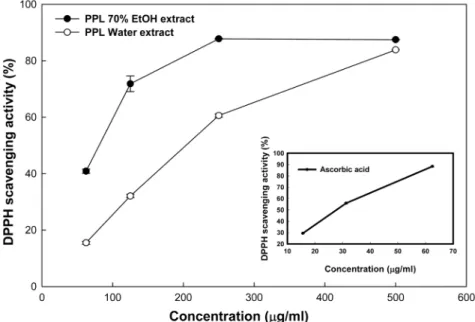
DPPH radical 소거활성(%)은 1-[(시료첨가구의 흡광도/무시료첨 가구의 흡광도)100]으로 나타내었다. 양성대조군으로는 항산화 효과가 알려진 ascorbic acid(vitamin C)를 이용하였으며 65 µg/
mL의 농도에서 90% 이상의 높은 항산화 활성을 보였다. Fig.
1은 물과 70% 에탄올로 추출한 맹종죽엽 추출물의 DPPH 라 디칼 소거능을 비교한 것이다. Fig. 1에서 보는 바와 같이 맹 종죽엽의 물 추출물과 70% 에탄올 추출물은 250 µg/mL 농도
Fig. 1. DPPH radical-scavenging activity of Phyllostachys pubescence leaf extracts.
172 조은아·김소영·나인호·김동청·인만진·채희정
에서 각각 50%와 90%의 항산화 활성을 보였다. 한국산(생산 지역 미상) 맹종죽엽 물 추출물의 경우 30 mg/mL에서 라디칼 소거활성이 작용하지 않는 것으로 보고된 바 있다[Kim 등, 2001]. 맹종죽엽 물 추출물의 항산화 효과는 기존에 보고된 맹 종죽엽 물 추출물[Kim 등, 2001]과 비교하여 높은 활성을 나 타낸 것임을 확인할 수 있었으며, 물보다는 에탄올 추출물에서 더 높은 항산화 활성을 나타내었다.
맹종죽엽 추출물의 항혈전 활성 중 내인성경로(intrinsic pathway)에서의 활성을 확인하고자 activated partial throm- boplastin time(APTT) assay로 측정하였다[Irving 등, 1993; Kim 등, 1998]. 각각 맹종죽엽의 물 추출물과 70% 에탄올 추출물을 coagulometer(Coatron M1, TECO, Neufahrn, Germany)를 사
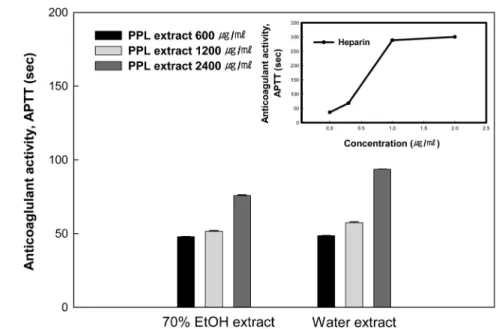
용하여 응고될 때까지의 시간을 측정하였다. 맹종죽엽의 물 추 출물과 70% 에탄올 추출물로 내인성 경로인 APTT 항혈전 활 성을 측정한 결과, 70% 에탄올 추출물의 경우 2.4 mg/mL 처 리군에서는 대조군 대비 209.4%로, 물 추출물의 경우 2.4 mg/
mL 처리군에서 대조군 대비 260%로 항혈액응고활성이 매우 높음을 확인하였다(Fig. 2). 흑삼 추출물의 경우 3.33 mg/mL에 서 대조군 대비 118.8%의 APTT를 나타내었다고 보고된 바 있 다[Roh와 Park, 2008]. 이것으로부터 맹종죽엽 물과 에탄올 추 출물의 항혈액응고활성은 혈액응고기전에서 내인성 경로인자에 대해 조절 작용을 갖는 것으로 볼 수 있다.
맹종죽엽 추출물의 항혈전 활성 중 외인성 경로(extrinsic pathway)에서의 활성을 확인하고자 prothrombin time(PT) assay Fig. 2. Effect of Phyllostachys pubescence leaf extracts on anticoagulant activity expressed as activated partial thromboplastin time (APTT).
Fig. 3. Effect of Phyllostachys pubescence leaf extracts on anticoagulant activity expressed as prothrombin time (PT).
맹종죽엽 추출물의 항산화 활성 및 항혈전 활성 173 로 측정하였다[Irving 등, 1993; Kim 등, 1998]. 맹종죽엽의 물
추출물과 70% 에탄올 추출물로 외인성 경로인 PT의 항혈전 활 성을 측정한 결과, 외인성 경로인 PT에서 70% 에탄올 추출물 과 물 추출물은 각각 대조군 대비 119.7%와 114.9%로서 항혈 액응고 활성이 크게 높지 않음을 확인하였다(Fig. 3). 호이초 추 출물의 경우에도 1.5 µg/mL의 농도에서 대조군 대비 110.8%의 수준으로 미약하게 항혈액응고 활성이 증가하였다고 보고된 바 있는데[Sohn 등, 2008], 맹종죽엽 추출물의 경우도 이와 유사한 결과를 보였다. 이것으로부터 맹종죽엽 추출물의 항혈액응고활 성은 혈액응고기전에서 외인성 경로인자에 대해서는 낮은 조절 작용을 갖는 것으로 볼 수 있다.
결론적으로, 맹종죽엽을 각각 물과 70% 에탄올로 추출하여 제조한 추출물에 대한 총 폴리페놀함량, 항산화활성 및 항혈액 응고활성을 검토한 결과 총 폴리페놀 함량과 연관되는 항산화 활성의 일종인 DPPH 라디칼 소거능이 높게 분석되었으며, 70%
에탄올 추출물에서 물 추출물보다 더 높은 항산화 활성이 있음 을 확인하였다. 또한 항혈액응고활성의 내인성 경로인 APTT를 검토한 결과, 농도 의존적으로 항혈액응고 활성이 보임을 확인 하였다.
참고문헌
Ahn SY, Shin HJ, Byeon HS, Park SB, and Kong YT (2003) Physical and mechanical properties of Phyllostachys pubescens according to growth age or felling time. J Kor For En 22, 8- 16.
Chung DK and Yu RN (1995) Antimicrobial activity of bamboo leaves extract on microorganisms related to kimchi fermenta- tion. Korean J Food Sci Technol 27, 1035-1038.
Folin O and Denis W (1915) A colorimetric method for the determination of phenols (and phenol derivatives) in urine. J Biol Chem 22, 305-308.
Heo JC, Park JY, An SM, Lee JM, Yun CY, Shin HM, Kwon TK, and Lee SH (2006) Anti-oxidant and anti-tumor activities of crude extracts by Gastrodia elata Blume. Korean J Food Preserv 13, 83-87.
In MJ, Park MK, Kim SY, Chae HJ, Chae MW, Sone J, Ji HS, Han KS, and Kim DC (2010) Composition analysis and antioxidative activity of maengjong-juk (Phyllostachys pubescence) leaves tea.
J Appl Biol Chem 53, 116-119.
Irving F, Adrian D, Peter L, Jane E, Kathleen F, Elizabeth L, Don H, Tim M, John W, and John M (1993) Anticoagulant activity of HirulogTM, a direct thrombin inhibitor, in humans. Thromb Haemost 69, 157.
Jeong JS, Kim SI, Hong HP, Oh SW, and Won JS (1983) Effect of silicic acid on the sprout of Phyllostachys edulis Makino.
The Research Reports of the Forest Research Institute No. 30, Seoul, Korea.
Ju IO, Jung GT, Ryu J, Choi JS, and Choi YG (2005) Chemical components and physiological activities of bamboo (Phyllostachys bambusoides Starf) extracts prepared with different methods. Kor J Food Sci Technol 37, 542-548.
Kim KI, Seo HD, Lee HS, Jo HY, and Yang HC (1998) Studies
on the blood anticoagulant polysaccharide isolated from hot water extracts of Hizikia fusiforme. J Korean Soc Food Sci Nutr 27, 1204-1210.
Kim NK, Cho SH, Lee SD, Ryu JS, and Shim KH (2001) Functional properties and antimicrobial activity of bamboo (Phyllostachys sp.) extracts. Korean J Postharvest Sci Technol 8, 475-480.
Kim SI, Jeong JS, and Won JS (1982) Effects of culm-cutting on the sprouting in Phyllostachys edulis. The Research Reports of the Forest Research Institute No. 29, Seoul, Korea.
Kim YS, Cho KA, and Choi DB (2010) Effect of solvents of extraction on the viological activities of Phyllostachys nigra Munro. Appl Chem Eng 21, 6-10.
Kwon TY and Kang SK (1993) Development of food industry and our dietary life. Korean J Food Culture 8, 351-358.
Kwoon M and Hwang HJ (2001) Identification and antioxidant activity of novel chlorogenic and derivatives from bamboo (Phyllostachys edulis). J Agric Food Chem 49, 4646-4655.
Lee MJ and Moon GS (2003) Antioxidative effects of Korean bamboo trees, wand-dae, som-dae, maengjong-juk, jolit-dae and o-juk. Kor J Food Sci Technol 35, 1226-1232.
Lee MJ, Kim EY, Jung KO, Park KY, and Moon GS (2004) Antimutagenic effects of Korean bamboo trees and inhibitory effect of hepatic toxicity of bamboo extracts coated rice. J Korean Soc Food Sci Nutr 33, 1279-1285.
Merete O (2002) Nutritional modification of cardiovascular disease risk. Int Congress Series 1229, 109-114.
Millen BE, Quatromoni PA, Nam BH, O'Horo CE, Polak JF, and D'Agostino RB (2002) Dietary patterns and the odds of carotid atherosclerosis in women: the framingham nutrition studies.
Prev Med 35, 540-547.
Park EJ (2006) A study on the health functionalities and food development of bamboo shoot. Ph. D. Thesis, Chonnam University, Gwangju, Korea.
Penny ME Kris, Kari DH, Andrea B, Stacie MC, Amy EB, Kirsten FH, Amy EG, and Terry DE (2002) Bioactive compounds in foods: their role in the prevention of cardiovascular disease and cancer. Am J Med 113, 71-88.
Roh SS and Park JH (2008) The effects of ginseng radix preparata extract on anti-thrombotic activity. J East-West Med 33, 47-61.
Sacks FM and Katan M (2002) Randomized clinical trials on the effects of dietary fat and carbohydrate on plasma lipoproteins and cardiovascular disease. Am J Med 113, 13-24.
Sin MK and Han SH (2002) Effects of methanol extracts from bamboo (Pseudosasa japonica Makino) leaves extracts on lipid metabolism in rats fed high fat and high cholesterol diet. Kor J Food Culture 17, 30-36.
Sohn HY, Ryu HY, Jang Y, Jang HS, Park YM, and Kim SY (2008) Evaluation of antimicrobial, antithrombin, and antioxidant activity of aerial part of Saxifraga stolonifera. Kor J Microbiol Biotechnol 36, 195-200.
Zang Y, Wu X, and Yu ZY (2002) Comparison study on total flavonoid content and anti-free radical activity of leaves of bamboo, Phyllostachys nigra and Ginko biloba. Zhongguo Zhong Yao Za Zhi 27, 254-257.