INTRODUCTION
1. Background
Based on the statistical report, from 1999 to 2017, Korea had 1.86 million cancer patients, accounting for 3.6% of the total population in 2017.1) The 5-year relative survival rate of cancer patients in Korea from 2013 to 2017 was 70.4%, an increase of 16.4% compared to 12 years ago, when the 5-year relative survival rate was 54%(2001 to 2005). After a cancer diagnosis, it is estimated that more than 2 out of 3 people sur- vive for 5 years or more.2) This increased number of cancer survivors need to secure economic stability to support their continuous health maintenance and management, and so the need for them to engage in economic activities such as returning to work or employment is also increasing.3,4)
In fact, economic activity means more than economic power for
cancer survivors, because it implies a return to a life which was tempo- rarily cut off due to cancer treatment, and has an important impact on the overall quality of their life through social relations and social status recovery.4) However, cancer survivors experience various physical and physiological symptoms and changes after cancer treatment,5) and have difficulties performing daily life activities as well as in maintaining in- terpersonal relationships and social functions due to fatigue, pain, and limited physical functions and activities.6) In addition to physical symp- toms, cancer survivors continue to experience mental health symptoms such as depression, anxiety, stress, uncertainty, and fear of recurrence,7,8) which affects their work ability, leading to difficulties in re-adaptation to work life, job duties, and interpersonal relationships. They face a range of difficulties, such as performance and interpersonal prob- lems.8,9) The difficulty in returning to social role functions prior to can- cer diagnosis eventually negatively affects their quality of life,10) so their changed health status and mental health are important factors that should be considered to improve their new life adaptation and quality of life. Therefore, an approach to managing the quality of life of work- ing cancer survivors should be studied.
Looking at the previous studies on working cancer survivors, many have been conducted on specific occupational groups, such as nurses,11) dental hygienists,12) and port stevedores,13) etc. and there have been many studies on physical and psychological symptoms,9) the develop-
Factors Affecting the Quality of Life of Working Cancer Survivors: Based on the 6
thand 7
th(2014, 2016, 2018) Korean National Health and Nutrition Examination Survey (KNHANES)
Choi, Jahyun1 · Kim, Sanghee2
1College of Nursing, Yonsei University, Seoul; 2Yonsei University, College of Nursing, Mo-Im Kim Nursing Research Institute, Seoul, Korea
Purpose: The purpose of the study was to compare the relationship between subjective health status, mental health, and quality of life among cancer survivors, who are workers, and to identify the factors affecting the quality of life. Methods: This study conducted a second data analysis using data from the 6th (2014, 2016) and 7th (2018) Korea National Health and Nutrition Examination Survey.
Retrospective data searching was performed and finally a sample of 205 cancer survivors, who are workers was included. The data were analyzed by descriptive statistics, t-tests, ANOVA, Pearson correlation, and multiple regression analysis. Results: The regression model explained 33.3% of the quality of life, and the influencing factors were depression (β=-.309, p<.001), age (β=-.288, p<.001), subjective health status (β=-.183, p=.005), and gender (β=-.135, p=.024). Conclusion: In order to improve the quality of life of can- cer survivors, who are workers, mental health such as depression must be assessed and actively managed. To promote mental health, an intervention program that can improve aspects of health such as physical and spiritual health has been developed to improve the overall quality of life.
Key Words: Neoplasm, Survivorship, Quality of life
* This research did not receive any specific grants from funding agencies in the public, commercial, or not-for-profit sectors.
Address reprint requests to: Kim, Sanghee Yonsei University, College of Nursing, 50-1 Yonsei-ro, Seodaemun-gu, Seoul 03722, Korea.
Tel: +82-2-2228-3388 Fax: +82-2- 2227-8303 E-mail: [email protected] Received: Sep 29, 2020 Revised: Nov 29, 2020 Accepted: Dec 14, 2020
This is an Open Access article distributed under the terms of the Creative Commons Attribution NoDerivs License. (http://creativecommons.org/licenses/by-nd/4.0/) If the original work is properly cited and retained without any modification or reproduction, it can be used and re-distributed in any format and medium.
ment of measuring tools for quality of life at work,3) and literature re- view of intervention programs related to quality of life,14) However, considering the high incidence and survival rate of cancer in Korea and the need for cancer survivors to engage in economic activities, it is necessary to support research that examines the overall life of working cancer survivors from various perspectives.
Therefore, in this study, by identifying the relationship between the subjective health status, mental health and quality of life experienced by cancer survivors who are workers, it is intended to derive findings that can be utilized to develop effective interventions to improve their quality of life in hospitals and industrial sites based on this.
2. Purpose of study
The purpose of this study was to compare the relationship between subjective health status, mental health, and quality of life of working cancer survivors, and to identify factors that affect their quality of life.
The specific objectives are as follows. First, identify the demographic and sociological characteristics of working cancer survivors. Second, identify the subjective health status, mental health, and quality of life of working cancer survivors. Third, identify the level of quality of life of working cancer survivors according to the demographic and sociologi- cal characteristics. Fourth, identify the correlation between the subjec- tive health status, mental health, and quality of life of working cancer survivors. Fifth, identify factors that affect the quality of life of working cancer survivors.
METHODS
1. Study design
This study was designed as a secondary data analysis derived from the 6th (2014, 2016) and 7th (2018) Korean National Health and Nutri- tion Examination Survey. It was a descriptive correlation study that would compare the relationship between the subjective health status, mental health, and quality of life of working cancer survivors, and identify factors affecting the quality of life.
2. Study subjects
In this study, data from the 6th (2014, 2016) and 7th (2018) Korean National Health and Nutrition Survey were used, and the raw data were requested and received upon approval from the Korean National Health and Nutrition Survey website. The received data includes 23,692
people aged 1 or older, extracted through a two-stage stratified sam- pling method, and the subjects of this study who were selected met the following selection criteria.
1) Selection criteria (1) Cancer survivors
The definition of cancer survivor broadly includes those who are di- agnosed with cancer and are in all stages reaching to life balance,15) but in this study, was limited to people who were diagnosed with cancer and answered ‘No’ to a question asking whether they have cancer now.
The cancers included gastric cancer, liver cancer, colon cancer, breast cancer, cervical cancer, lung cancer, thyroid cancer and all other can- cers.
(2) Workers
In this study, this was defined as people who answered ‘Yes’ to a ques- tion on whether they are currently engaged in an economic activity.
2) Calculation of the number of subjects
Of the 23,692 subjects collected in the 6th (2014, 2016) and 7th (2018) Korean National Health and Nutrition Survey, 209 who met the selec- tion criteria were selected, and 205 people were ultimately analyzed retrospectively after people who did not answer for some key variables were excluded.
The G power 3.1.9.7 program was used to confirm the appropriate- ness of the sample size of this study. When the effective size of multiple regression analysis (f 2) was .15, significance level (α) was .05, the num- ber of predictors was 11, and the number of subjects was 205 people, the power (1-β) was calculated as .97, so it was considered that the pur- pose of this study could be achieved using the sample size in this study.
3. Instruments
1) Demographic and sociological characteristics
The demographic and sociological characteristics included gender, age, marital status, income level, elapsed time since cancer diagnosis, the presence of a chronic disease (hypertension, diabetes, dyslipidemia), whether or not the subject was a waged worker, working hours, and work type.
2) Subjective health status
Subjective health status was measured using the single question:
“What do you think your health is like?”. In terms of score, 1 is ‘very good,’ 2 is ‘good,’ 3 is ‘normal,’ 4 is ‘bad,’ and 5 is ‘very bad.’ A higher score indicates a lower subjective health status.
3) Mental health
Mental health was measured using stress perception and depression.
Regarding the stress perception score, 1 is ‘feeling very much stress,’ 2 is ‘feeling a lot of stress,’ 3 is ‘feeling some stress,’ and 4 is ‘feeling little stress.’ A higher score means a lower stress perception. Depression was measured using the depression screening tool (Patient Questionnaire-9:
PHQ-9),16) based on the question “In the last 2 weeks, how often did you suffer from the symptoms listed below?” A score of 0 is ‘not at all,’
1 is ‘on multiple days,’ 2 is ‘for more than a week,’ and 3 is ‘almost every day.’ As the score increases, the depression is higher.
4) Quality of life
Quality of life was measured using a tool developed by EuroQol (http://euroqol.org/). This tool covers 5 sub areas: athletic ability, self- management, daily life, pain/discomfort, and anxiety/depression. Re- garding the score of each area, 1 is ‘No problem at all,’ 2 is ‘Some prob- lems,’ and 3 is ‘there is a very serious problem.’ As the score increases, the quality of life is lower. Based on this information, the score of over- all quality of life (EQ-5D) was calculated by applying a weighting for- mula17) to convert the score from -0.171, which the lowest quality of life, to 1, which means a completely healthy status. Therefore, as the score for overall quality of life increases, the quality of life becomes higher.
4. Data collection
In this study, the raw data used was obtained from the 6th (2014, 2016) and 7th (2018) Korean National Health and Nutrition Survey, which has been conducted by the Korea Disease Control and Preven- tion Agency since 1999 to identify the health and nutritional level of the people and also to establish related policies. The 2-stage stratified sampling method was used for the target population of people age 1 or older residing in Korea, and the data about 23,692 people were col- lected. The data was processed in a manner that prevented the identifi- cation of subjects, and was intended to be used only for public pur- poses such as statistical analysis and academic research.
5. Data analysis
The collected data were analyzed as follows using the SPSS/WIN
25.0 software package.
1) The demographic and sociological characteristics of the subjects were analyzed using frequency and percentage, which are descriptive statistics.
2) The subjective health status, mental health, and quality of life were analyzed using the mean and standard deviation, which are descriptive statistics.
3) The quality of life according to the demographic and sociological characteristics of the subjects was analyzed using t-test and variance analysis, and post-hoc test was verified using the Scheffé method.
4) The correlation among subjective health status, mental health, and quality of life was analyzed using Pearson’s correlation coefficient.
5) The factors influencing the subject’s quality of life were analyzed using multiple regression analysis.
6. Ethical considerations
After approval was granted by the Institutional Review Board (IRB) of Yonsei University Medical Center, this study was carried out. As a secondary analysis study based on public data, IRB exempted the study from review (Y-2020-0038).
RESULTS
1. General Characteristics of Subjects
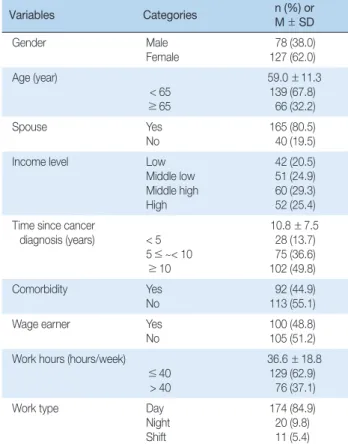
In terms of the demographic and sociological characteristics of the subjects, the number of males was 78 (38.0%) and the number of fe- males was 127 (62.0%), i.e. there were more females than males. The av- erage age was 59.0±11.3, with 139 (67.8%) under the age of 65 in the group and 66 (32.2%) age 65 or more. 165 (80.5%) had a spouse, i.e. the majority were married, and by income quartile (household) there were 42 (20.5%) in low, 51 (24.9%) in medium low, 60 (29.3%) in medium high, and 52 (25.4%) in high.
In terms of the disease-related characteristics of the subjects, the aver- age duration since the cancer diagnosis was 10.8±7.5 years; for 28 pa- tients (13.7%) in the group it was less than 5 years, for 75 patients (36.6%) it was 5 years or more and less than 10 years, and for 102 patients (49.8%) it was 10 years or more. 92 (44.9%) patients had chronic diseases.
Regarding the vocational characteristics of the subjects, 100 (48.8%) were waged workers and the average working hours per week was 36.6
±18.8 hours, with 129 people (62.9%) in the group working less than 40 hours, and 76 people (37.1%) working over 40 hours. Regarding work
type, the majority worked during daytime, 174 people (84.9%) (Table 1).
2. Subjective health status, mental health and quality of life The average of subjects’ subjective health status score was 3.13± 0.80 in the range of 1 to 5 points. In addition, the average stress perception score was 2.91± 0.75 in the range of 1 to 4 points and the average de- pression score was 2.59±3.58 in the range of 0 to 27 points. In addition, the average subjects’ quality of life (EQ-5D) score was 0.94± 0.10 in the range of -0.171 to 1 point and in the self-management category, the qual- ity of life was the highest among the sub-categories (Table 2).
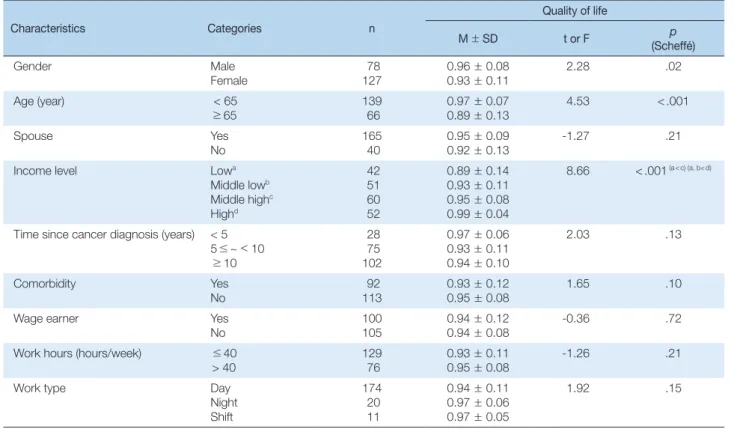
3. Difference in quality of life depending on subjects’characteristics There were significant differences in quality of life based on gender (t=2.28, p =.02), age (t= 4.53, p<.001), and income level (F = 8.66, p<.001). Males (0.96± 0.08) had a higher quality of life than females (0.93± 0.11) and the group under 65 years old (0.97± 0.07) had a higher quality of life than the group 65 years or older (0.89± 0.13). The group in the medium high income quartile (0.95± 0.08) had a higher quality of life than the low group (0.89± 0.14), and the group in the high in- come quartile (0.99± 0.04) had a higher quality of life than the low
group (0.89± 0.14) and the medium low group (0.93± 0.11) (Table 3).
4. Relationship between subject’s subjective health status, mental health and quality of life
Subjects’ quality of life had a significant correlation with subjective health status (r=-.37, p<.001), stress perception (r=.17, p=.013), and depression (r=-.42, p<.001). In other words, as the subjective health status was higher, the stress perception was lower; as the depression level was lower, the quality of life was higher (Table 4).
5. Factors affecting subjects’quality of life
To identify factors affecting subjects’quality of life, the gender, age, and income level, which showed a significant difference in terms of quality of life among the general characteristics, and the subjective health status, stress perception, and depression, which showed a signifi- cant correlation with quality of life, were entered to perform a multiple regression analysis. Of these, the categorical variables, i.e., gender and age, were treated as a dummy variable; the gender was male and the age was under 65.
When the Durbin-Watson correlation coefficient was checked to verify the basic assumptions of the regression analysis on the quality of life, there was no autocorrelation with the coefficient 1.83. When the tolerance limit and the variance inflation factor (VIF) for the multicol- linearity test were measured, the tolerance limit was 0.70~0.93, which was higher than 0.1, and the dispersion expansion factor was 1.08~1.42, which was less than 10, confirming that there was no problem in terms of multicollinearity.
Through a multiple regression analysis, it was determined that the model was significant (F=17.94, p= <.001) and showed 33.3% of vari- ance. The depression (β =-.309, p<.001) was the strongest predictor, Table 1. General Characteristics of Working Cancer Survivors (N= 205)
Variables Categories n (%) or
M±SD
Gender Male
Female
78 (38.0) 127 (62.0) Age (year)
< 65
≥65
59.0±11.3 139 (67.8)
66 (32.2)
Spouse Yes
No 165 (80.5)
40 (19.5)
Income level Low
Middle low Middle high High
42 (20.5) 51 (24.9) 60 (29.3) 52 (25.4) Time since cancer
diagnosis (years) < 5 5≤ ~< 10
≥10
10.8±7.5 28 (13.7) 75 (36.6) 102 (49.8)
Comorbidity Yes
No 92 (44.9)
113 (55.1)
Wage earner Yes
No 100 (48.8)
105 (51.2) Work hours (hours/week)
≤40 > 40
36.6±18.8 129 (62.9)
76 (37.1)
Work type Day
Night Shift
174 (84.9) 20 (9.8) 11 (5.4)
Table 2. Subjective Health Status, Stress Perception, Depres- sion and Quality of Life of Working Cancer Survivors (N= 205)
Variables Categories Total score
M±SD
Subjective health status 3.13±0.80
Stress perception 2.91±0.75
Depression 2.59±3.58
Quality of life Total Motor ability Self-management Daily activities Pain/discomfort Anxiety/depress
0.94±0.10 1.19±0.40 1.03±0.18 1.07±0.28 1.24±0.46 1.11±0.33
followed by age (β=-.288, p<.001), subjective health status (β=-.183, p =.005), and gender (β =-.135, p =.024). These had an effect on the quality of life, in the order listed (Table 5).
DISCUSSION
This study analyzed the factors affecting the quality of life of work- ing cancer survivors using the data from the 6th (2014, 2016) and 7th (2018) Korean National Health and Nutrition Survey. This study found that the quality of life of working cancer survivors was 0.94 ± 0.10 points, which is higher than 0.92± 0.01 and 0.916± 0.007, the results of prior studies18,19) that examined the factors affecting the quality of life of adult cancer patients. The result was lower than the quality of life in a prior study20) for general workers. From this, it can be understood
that working cancer survivors have a higher quality of life than cancer patients under treatment, but their quality of life is lower than that of ordinary workers. It is likely that the working cancer survivors have gone through the process cancer patients should go through, with many physical, psychological, and social difficulties during the treat- ment process, but the discomfort persists even after the treatment and is affecting their daily and social life.8) Therefore, the quality of life of working cancer survivors should be improved and maintained even after the treatment period is over, through continuous interest and ob- servation.
In this study, the factors affecting the quality of life of working can- cer survivors include depression, gender, subjective health status, and age. Depression was the first influencing factor affecting the quality of life of working cancer survivors. Cancer survivors experience different Table 3. Quality of Life according to Sociodemographic Characteristics of Working Cancer Survivors (N= 205)
Characteristics Categories n
Quality of life
M±SD t or F p
(Scheffé)
Gender Male
Female 78
127 0.96±0.08
0.93±0.11 2.28 .02
Age (year) < 65
≥65
139 66
0.97±0.07 0.89±0.13
4.53 < .001
Spouse Yes
No
165 40
0.95±0.09 0.92±0.13
-1.27 .21
Income level Lowa
Middle lowb Middle highc Highd
42 51 60 52
0.89±0.14 0.93±0.11 0.95±0.08 0.99±0.04
8.66 < .001 (a < c) (a, b< d)
Time since cancer diagnosis (years) < 5 5 ≤ ~ < 10
≥10
28 75 102
0.97±0.06 0.93±0.11 0.94±0.10
2.03 .13
Comorbidity Yes
No
92 113
0.93±0.12 0.95±0.08
1.65 .10
Wage earner Yes
No
100 105
0.94±0.12 0.94±0.08
-0.36 .72
Work hours (hours/week) ≤40
> 40 129
76 0.93±0.11
0.95±0.08 -1.26 .21
Work type Day
Night Shift
174 20 11
0.94±0.11 0.97±0.06 0.97±0.05
1.92 .15
Table 4. Correlations among Subjective Health Status, Stress Perception, Depression and Quality of Life of Working Cancer Survivors (N= 205)
Variables Subjective health status Stress perception Depression
r (p) r (p) r (p)
Stress perception -.29 (< .001)
Depression .37 (< .001) -.47 (< .001)
Quality of life -.37 (< .001) .17 (.013) -.42 (< .001)
physical, social, and functional changes compared to their life prior to their cancer diagnosis, and also experience mental health symptoms such as depression.5,6,8) When they experience these depressive symp- toms, quality of life may deteriorate.18) In addition, a problem such as subjective health status and stress perception occurs to a worker in a working environment, it will affect depression, which can ultimately affect the quality of life.21,22) In this way, working cancer survivors may experience mental symptoms such as depression in the process of try- ing to maintain their former role as a worker after they experienced a cancer. Therefore, hospitals and work sites should pay attention to the mental health of working cancer survivors to ensure their proper ex- amination and handling in order to help them maintain and improve their health.
Next, regarding the general characteristics of subjects, gender was found to be an important factor affecting quality of life. In this study, women were found to have a lower quality of life than men. According to a prior study that confirmed the quality of life of workers depending on gender, women experience discrimination in the workplace more often than men in terms of working environment or conditions.23,24) Therefore, women may experience more stress in social life compared to men.20) In addition, it is likely that the physical and mental health status of female workers are affected by the burden they must take on both at work and at home, which ultimately affects their quality of life.21,24) However, this study does not include all the variables that would explain the working environment in detail, so it is difficult to provide a more accurate description of this phenomenon. As such, it is something to consider in future studies.
In addition, in this study, subjective health status was also found to be a factor influencing the quality of life of working cancer survivors.
In many studies involving the general public, cancer patients, and
workers, subjective health status was found to be a major factor affect- ing quality of life.18,20,25,26) It is likely that physical and mental health as- pects can be a constraint in daily and social life, and in particular is likely that they will have a great influence in the working environment to the working cancer survivors, i.e. the subjects of this study, who are returning to work after cancer treatment. But as health is a broad con- cept that includes many aspects, it is necessary to accurately define the meaning of health perceived by individuals through future studies. In addition, 44.9% of subjects in this study had chronic diseases. It will be also necessary to assess the manner in which such chronic diseases af- fect the subjective health status of working cancer survivors.
Lastly, age was found to be a factor affecting the quality of life of working cancer survivors. In this study, it was found that quality of life was lower among subjects 65 or higher compared to subjects under 65.
This is because there is biological aging as people get older and experi- ences limitations in the working environment,27) and instability in the working environment, such as working as a non-regular worker, may affect quality of life.25,28,29) As the number of elderly cancer survivors will gradually increase due to the aging of the productive manpower through the continuous increase in the relative survival rate of cancer patients and the increase in the average life expectancy,30) it is necessary to take an active interest in their quality of life and to provide interven- tion.
Therefore, if a nursing intervention program in terms of compre- hensive health care including depression and subjective health status, which are factors influencing the quality of life of working cancer sur- vivors, identified through this study, is developed and applied, it will be effective in improving their quality of life. In addition, it will be likely that more effective programs can be developed if women and elderly workers, who are more vulnerable to quality of life issues in terms of
Table 5. Factors Influencing Quality of Life of Working Cancer Survivors (N= 205)
Variables Categories B SE β t p 95% CI
(Constant) 1.076 .043 24.996 < .001 0.99~1.16
Depression -0.009 .002 -.309 -4.530 < .001 -0.02~-0.01
Age (ref: < 65) ≥65 -0.064 .013 -.288 -4.825 < .001 -0.09~-0.04
Subjective health status -0.023 .008 -.183 -2.872 .005 -0.04~-0.01
Gender (ref: Male) Female -0.028 .012 -.135 -2.277 .024 -0.05~-0.01
Income level 0.010 .006 .112 1.769 .078 -0.01~0.02
Stress perception -0.006 .009 -.048 -0.732 .465 -0.02~0.01
R2=.352, Adjusted R2=.333, F=17.944, p< .001 B=Unstandardized beta; SE=Standard error; CI=Confidence interval.
gender and age, are also considered.
CONCLUSION
This study uses data from the 6th (2014, 2016) and 7th (2018) Korean National Health and Nutrition Survey to identify factors that affect the quality of life of working cancer survivors and to provide basic data to develop programs to support working cancer survivors. Factors influ- encing the quality of life of working cancer survivors include depres- sion, age, subjective health status, and gender. The explanatory power was 33.3%. Therefore, to improve the quality of life of working cancer survivors, it is necessary to check and actively manage mental health factors such as depression. In addition to mental health, a program in- cluding physical and mental health should be developed to compre- hensively improve their quality of life.
As this study was designed as a cross-sectional study, it is difficult to interpret causal relations. In addition, it was not possible to analyze all of the various aspects of health, as this is a secondary analysis study.
Since wage workers, the self-employed, employers, and unpaid family workers are all included in this study, the differences between them are not adequately considered. Therefore, follow-up research should con- sider this point. In addition, since the characteristics of each cancer type were not reflected, a follow-up study that considers this is also suggested.
ORCID
Choi, Jahyun orcid.org/0000-0001-9192-3668 Kim, Sanghee orcid.org/0000-0002-9806-2757
REFERENCES
1. National Cancer Information Center. Status of cancer prevalence [In- ternet]. Available from:
https://www.cancer.go.kr/lay1/S1T654C655/contents.do [Accessed June 20, 2020]
2. National Cancer Information Center. 5 year cancer survival rate [Inter- net]. Available from:
https://www.cancer.go.kr/lay1/S1T648C650/contents.do [Accessed June 20, 2020]
3. de Jong M, Tamminga SJ, van Es RJJ, Frings-Dresen MHW, de Boer AGEM. The quality of working life questionnaire for cancer survivors (QWLQ-CS): factorial structure, internal consistency, construct valid- ity and reproducibility. BMC Cancer. 2018;18:66.
4. Son MR, Lee JS. Concept analysis on returning to work for cancer sur-
vivors. J Mil Nurs Res. 2014;32:119-33.
5. Seo HK, Park JH, Kwon SS. Evidence-Based Management of Cancer Survivor. Goyang: National Cancer Center; 2013.
6. Numico G, Longo V, Courthod G, Silvestris N. Cancer survivorship:
long-term side-effects of anticancer treatments of gastrointestinal can- cer. Curr Opin Oncol. 2015;27:351-7.
7. Mitchell AJ, Ferguson DW, Gill J, Paul J, Symonds P. Depression and anxiety in long-term cancer survivors compared with spouses and healthy controls: a systematic review and meta-analysis. Lancet Oncol.
2013;14:721-32.
8. Kim MH, Kim JS, Kim HN. Return-to-work experiences among nurses after receiving cancer treatment. J Korea Acad Ind Coop Soc.
2016;17:215-25.
9. Duijts SF, van Egmond MP, Spelten E, van Muijen P, Anema JR, van der Beek AJ. Physical and psychosocial problems in cancer survivors be- yond return to work: a systematic review. Psychooncology. 2014;23:
481-92.
10. Mehnert A. Employment and work-related issues in cancer survivors.
Crit Rev Oncol Hematol. 2011;77:109-30.
11.Kim M, Ryu E. Structural equation modeling of quality of work life in clinical nurses based on the culture-work-health model. J Korean Acad Nurs. 2015;45:879-89.
12. Park JH, Cho YS, Lim SR. Analysis of factors affecting the quality of work Life of dental hygienists based on the culture-work-health model.
J Dent Hyg Sci. 2018;18:32-41.
13. Choi EK. The structural equation model among the variables related to the quality of work life of container terminal workers [dissertation].
Busan: Kosin Univ.; 2017.
14. Bae KR, Cho JH, Jun SH. A literature review of return-to-work inter- vention for cancer survivors. Korean J Occup Health Nurs. 2019;28:83- 93.
15. National Cancer Institute. Survivorship definitions [Internet]. Available from:
https://cancercontrol.cancer.gov/ocs/statistics#definitions [Accessed November 20, 2020]
16. Han C, Jo SA, Kwak JH, Pae CU, Steffens D, Jo I, et al. Validation of the patient health questionnaire-9 Korean version in the elderly popula- tion: the Ansan Geriatric study. Compr Psychiatry. 2008;49:218-23.
17. Nam HS. A Study on Estimation of Quality Weights of the EQ-5D Questionnaire. Cheongju: Korea Centers for Disease Control & Pre- vention; 2007.
18. Park JA, Hong JY. Factors influencing quality of life in adult cancer pa- tients: the sixth Korea National Health and Nutrition Examination Survey (KNHANES VI-2), 2014.J Korea Acad Ind Coop Soc. 2017;18:
382-90.
19. An KY, Kang DW, Min JH. The association between resistance exercise frequency, muscular strength, and health-related quality of life in Ko- rean cancer patients: the Korea National Health and Nutrition Exami- nation Survey (KNHANES) 2014-2016. Korean J Sports Stud. 2018;57:
269-79.
20. Kwon M. Factors affecting quality of life of worker by gender. Asia Pac J Multimed Serv Converg Art Humanit Sociol. 2019;9:747-59.
21. Park EH, Kim HS. A study on the factors affecting on worker’s quality of life. J Digit Converg. 2017;15:581-9.
22. Kim DJ, Lee JS. Factors associated with depression among wage earners by subjective health and stress perception. J Korean Soc Occup Envi- ron Hyg. 2016;26:99-108.
23. Cho HS, Kim YW, Park HW, Lee KH, Jeong BG, Kang YS, et al. The re- lationship between depressive symptoms among female workers and job stress and sleep quality. Ann Occup Environ Med. 2013;25:12.
24. Jeong YR, Jeong SH, Han SS. Factors influencing health-related quality of life among women workers. J Korean Soc Occup Environ Hyg. 2018;
28:117-23.
25. Kim SE, Yoon YS, Yang YJ, Lee ES, Lee JH, Kim DJ, et al. The effect of non-regular employment on the health behaviors, mental health and quality of life: data from the Korea National Health and Nutrition Ex- amination Survey 2013.Korean J Stress Res. 2016;24:127-36.
26. Kang SJ. Factors influencing quality of life among cancer survivors: Us- ing KNHANES 2010-2014. J Korea Contents Assoc. 2016;16:628-37.
27. Lim KH. An analysis of factors influencing the mid-old aged wage workers’ life satisfaction [dissertation]. Seoul: Ewha Womans Univ.;
2018.
28. Choi HJ, Jung ES. Impacts of precarious labor on quality of life of older workers. Soc Sci Stud. 2018;25:217-37.
29. Sun YH, Park JW, Noh MS, Chung HW. Comparison of health related quality of life between standard and non-standard workers in Korea.
Korean J Fam Pract. 2015;5:935-42.
30. Lee BI. Effects on working environment and socioeconomic status on health status in elderly workers: a comparison with non-elderly work- ers. J Korean Acad Community Health Nurs. 2017;28:472-81.