1. Introduction
One of the most popular techniques used in oil well stimulation is the acidification. It seeks to increase well productivity by dissolving rocks which limit, hinder or prevent the flow of oil during operation of the well [1].
An alternative to the acid treatment is the use of chelating agents such as ethylenediaminetetraacetic acid (EDTA) or nitrilotriacetic acid (NTA) [2]. Chelating solutions are used in cleaning formations and well stimulation, partic- ularly in the formations that can be damaged by strong acids [3].
EDTA is a chelating or complexing compound used in various processes such as the recovery of heavy metals in catalytic processes because it is capable of solubilizing radioactive metals and increasing their mobility. It is used as a chemical agent that helps clean or remove iron oxide and some flakes or buildup on the steam plant systems
and hot water circulation [4]. In the stimulation of oil wells, it is used as a sequestering agent of cation present in the formations. When EDTA based fluids are working at low pH, the net effect is the stimulation of the well by dissolving the matrix, increasing the effect of hydro- gen during the protonation and chelation processes [2].
Furthermore, EDTA compounds found to be corrosive and can increase the rate of corrosion of steel [5], generating an adverse situation in oil production facilities by increas- ing the steel deterioration of the installed infrastructure.
The EDTA from the well stimulation fluid can to act as ferrous ion chelating agent [4,6] by stabilization of Fe2+
ions in solution. Additionally, EDTA can act as a cathode depolarizer [5] in the electrochemical dissolution of the metal. Both mechanisms increase the steel corrosion.
With the aim of to design corrosion inhibitors and other alternatives to corrosion control it is necessary to under- stand the behavior of the system under operating con- ditions, likewise understand the kinetics of the electro- chemical reactions occurring during the corrosion process.
Corrosion in Oil well Stimulation Processes Caused by Different Chelating Agents Based on EDTA Compounds
J. A. Calderón1,†, F. A. Vásquez1, L. Arbeláez1, and J. A. Carreño2
1Centro de Investigación, Innovación y Desarrollo de Materiales –CIDEMAT, Universidad de Antioquia UdeA; Calle 70 No. 52-21, Medellín, Colombia
2Laboratório de H2S, CO2 e Corrosividade - Instituto Nacional De Tecnologia (INT). Av. Venezuela, 82 – Térreo, Anexo 01, Sala 101A – Saúde. Rio de Janeiro – RJ – Brasil
(Received December 02, 2016; Revised December 02, 2016; Accepted April 06, 2017)
Chelating solutions can be damaged by strong acids during oil production. To design effective corrosion inhibitors and other alternatives for corrosion control, it is important to understand not only the behavior of the system under operating condition but also the kinetics of electrochemical reactions during the corrosion process. In this study, the electrochemical behaviors of P-110 steel in aqueous fluids based on ethylenediaminetetraacetic acid (EDTA) compounds under various temperatures and hydrodynamic regime conditions were assessed. Electrochemical measurements were conducted using rotating disc electrodes manufactured. Electrolytes were prepared using aqueous compounds of EDTA like diammonium salt, disodium salt, and tetrasodium salt. Potentiodynamic polarization, electrochemical impedance, and mass loss tests were performed in order to assess the corrosion kinetic in electrolytes. Hydrodynamic effects were observed only in the cathodic polarization curve. This proves that hydrodynamic regime plays an important role in the corrosion of steel mainly in disodium and diammonium EDTA solutions. Two cathodic reactions controlled the corrosion process. However, oxygen level and pH of the electrolyte played the most important role in metal corrosion. Corrosion rates in those fluids were decreased drastically when oxygen concentration was reduced.
Keywords: EDTA, chelating agents, electrochemical techniques, steel, corrosion, oil production
†Corresponding author: [email protected]
This work looks for to assess the behavior of a P-110 steel in aqueous fluids based on EDTA compounds under different temperature and hydrodynamic regime con- ditions, in order to understand the corrosion kinetics of carbon steel in these fluids.
2. Experimental Procedure
Electrochemical measurements were conducted with electrodes manufactured from a P-110 steel bar with nomi- nal composition (wt%): C 0.29, Mn 0.55, Si 0.3, P 0.016, Cr 0.002, Mo 1.01, Al 0.56, Nb 0.026, Cu 0.035, and Fe balance. The electrodes were manufactured in order to obtain a rotating disc electrode (RDE) with an area of 0.28 cm2. The lateral surface of the metal bar was in- sulated with epoxy resin. The RDE were manually pol- ished with sandpaper grade 600. Then, they were washed and degreased in water and ethanol prior to the completion of the measures. Electrochemical measurements were per- formed in a three electrode cell, using the working elec- trode (RDE) steel P-110. A saturated calomel electrode (SCE) was used as a reference electrode and a platinum mesh of large area was used as an auxiliary electrode.
The electrolytes were prepared with ethylenediaminetetra- acetic acid disodium salt (EDTA-Na2) 10% w/w, ethyl- enediaminetetraacetic acid diammonium salt (EDTA-(NH4)2) 10% w/w and ethylenediaminetetraacetic acid tetrasodium salt (EDTA-Na4) at 20% w/w. The natural pH values of the EDTA-Na2, EDTA-(NH4)2, and EDTA-Na4 solutions were 4.5, 4.6, and 11.5, respectively. The electrochemical measurements such as potentiodynamic polarization curves were made at scan rate of 1 mV∙s-1, starting from a cathodic overpotential of -300 mV to an anodic over- potential of +300 mV with respect to the open circuit po- tential (OCP). All polarization curves were repeated at least three times in order to verify the reproducibility of the curves. Before starting the polarization measurements, the OCP was monitored for 45 min to reach its stationary state. Tafel plots were performed at different rotation rates of the electrode (100, 225, 400, 900 and 1600 rpm) and at different temperatures (25, 40 and 80 °C). Electrochemical impedance spectroscopy (EIS) measurements were carried out at an OCP and at low anodic overpotentials in a fre- quency range of 40 kHz to 5 mHz with a sinusoidal pertur- bation amplitude of 10 mV (RMS) and at 6 points per frequency decade. EIS measurements were carried out in
Na4 Na2
EDTA-(NH4)2
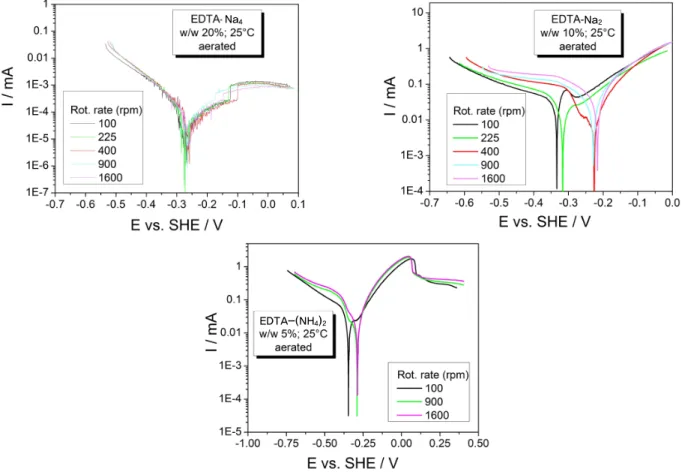
Fig. 1 Polarization curves of the P-110 steel in EDTA solution at 25 °C and different rotation rates.
separated experiments. EIS measurements at the OCP were made taking a fresh metal surface. Similarly, for each EIS measurement made at overpotential different to the OCP, fresh metal surface was the initial state of the working electrode. After verification of the OCP, the corresponding overpotential was applied and the steady state of current was guaranteed before starting the EIS measurement. All electrochemical measurements were made using an Autolab PGSTAT 30 potentiostat.
The mass loss tests and corrosion rate determination were carried out in an autoclave of 2500 ml with 80%
of liquid phase and 20% vapor phase; at a pressure of 30 bars, temperatures of 80 and 160 °C and a run time of 24 hours (measured from the time the system reaches the test conditions). All samples are hand polished to 400 grit, degreased with ketone, and superficially characterized by optical microscopy with 4X and 100X magnification to identify the surface state before and after trial.
3. Resutls and Discussion
The effect of the hydrodynamic on the system under study was verified by plotting the polarization curves at different rotational rates of the RDE steel electrode. Fig.
1 show polarization curves performed on EDTA solutions.
No significant effect of the hydrodynamic condition was observed on polarization curves in solution of EDTA-Na4. This means that the electrochemical parameters of metal corrosion as corrosion current and OCP do not change with variation of rotation rate of the electrode. The hydro- dynamic forces do not affect the corrosion process in this electrolyte because the kinetic of metal dissolution is con- trolled essentially by the electrochemical of metal dis- solution reaction.
Moreover, in the EDTA-Na2 and EDTA-(NH4)2 sol- utions a significant effect of the hydrodynamics was ob- served on the polarization curves and on the electro- chemical parameters of the system. In these solutions the polarization curves are shifted to more anodic potentials, ie OCP is more positive as increasing the rotation rates of the electrode. Also, corrosion current and corrosion rates increase
The corrosiveness of EDTA base fluid can be ordered from less to more corrosive as EDTA-Na4 < EDTA-Na2
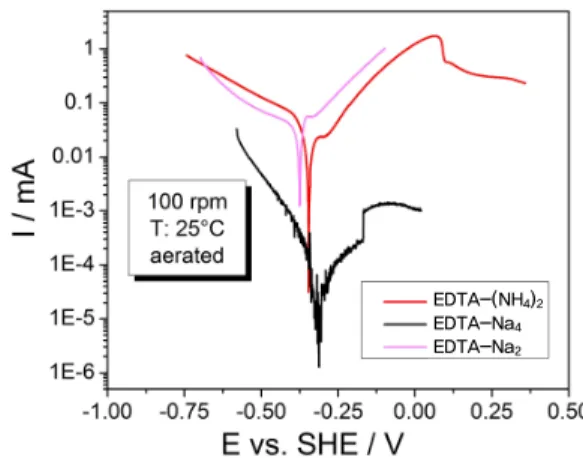
< EDTA-(NH4)2 in all temperatures and hydrodynamic conditions evaluated. Fig. 2, for instance, presents the po- larization curves carried on P-110 steel at 100 rpm and 25 °C in all electrolytes. It can be seen that the polarization curve in EDTA-(NH4)2 moves towards more negative po- tentials than the other electrolytes, indicating stronger acti- vation of anodic reactions occurring during the electro- chemical dissolution. This is corroborated by comparing the corrosion rates values obtained at these conditions in the EDTA-Na2 and EDTA-(NH4)2 solutions. In EDTA-(NA4)2
solutions it was observed higher corrosion rates than in EDTA-Na2 electrolyte, even when the EDTA disodium was in lower concentration than the EDTA-(NA4)2 sol- ution, see Fig. 3. Corrosion rates of P-110 steel in EDTA-Na4 was lowest than the other ones and it is not showed in the Figure. The difference in fluid corrosiveness of both EDTA electrolytes could be explained by the dif- ference of chelation power of EDTA on the Fe2+ ions at different pH values [7]. Conditional formation constant Kf' for EDTA solutions depends on pH value and on the electrolyte concentration. Kf' establishes the ratio,
in EDTA solutions. It has been found that that ratio is 5 and 6 order of magnitude higher in EDTA-Na2 and EDTA-(NH4)2 solutions than in EDTA-Na4 [8]. According to that, the concentration of free uncomplexed Fe2+ ion
EDTA-(NH4)2
EDTA-Na4
EDTA-Na2
Fig. 2 Polarization curves of the P-110 steel in EDTA solutions at 25 °C. w/w 5% EDTA-(NH4)2, w/w 10% EDTA-Na2, w/w 20%
EDTA-Na4.
Na2
Fig. 3 Corrosion rates of P-110 steel in w/w 5% EDTA-(NH4)2, w/w 10% EDTA-Na2 electrolytes. Date extracted from potentiody- namic polarization curves.
is much higher in the solution of EDTA-(NH4)2 and -(NH4)2 than in the EDTA-NH4 electrolyte, which could explain their high corrosivity.
By a carefully observation of the polarization curves it can be stablished that cathodic currents are inferior to the anodic ones. It means that corrosion process at EDTA elec- trolytes is controlled by cathodic reactions. Furthermore, in the cathodic branch of the polarization curves per- formed in EDTA-(NH4)2 and EDTA-Na2 solutions there are two cathodic slopes. The first one, being more accen- tuated, is probably associated to oxygen reduction re-
action, since this would be the preferred cathodic reaction at low cathodic overpotentials [10]. A second cathodic slope is observed at higher cathodic overpotential, most likely associated with hydrogen evolution reaction.
However, the EDTA specie can also be reduced in the cathodic branch of the polarization curve, since it has been found that EDTA may act differently to chelation of Fe2+
ions in the solution [5]. The importance of the cathodic reactions, specially the oxygen reduction reaction, on the corrosion process of the P-110 steel in EDTA solutions is evidenced in electrochemical test made at deaerated condition, where corrosion rates fall drastically when oxy- gen is not present in the electrolyte, see Fig. 4.
Fig. 5 shows the EIS of P-110 steel in EDTA-Na4 and EDTA-(NH4)2 at +100 mV of anodic overpotential. It can be seen different features of the EIS plots depending on the nature of the EDTA electrolyte, which means different kinetic mechanism of the metal dissolution process. For instance, no inductive loop is observed at the EIS diagram on the EDTA-Na4 solution, conversely two capacitive loop appear at that anodic polarization. The existence of an inductive loop at OCP is normally related with the active metal dissolution in the corrosion phenomena [9]. The val- ues of the charge transfer resistance and the capacitance, extracted from the capacitive loop at high frequencies, of the metal in EDTA disodium salt are lower than those exhibited in EDTA-Na4, being values of 160 Ohm∙cm2
Na2
Fig. 4 Corrosion rates of P-110 steel in EDTA.Na2 solution at different exposition conditions.
Na4
Na2
Fig. 5 Electrochemical Impedance Spectroscopy of P-110 steel in EDTA-Na4 and EDTA-(NH4)2 solutions at 25 °C, 100 rpm and +100 mV anodic overpotentials.
Tabla 1 Corrosion rate by mass loss test made in Autoclave of the P-110 steel. 20% EDTA-Na4, 10% EDTA-(NH4)2, 10% EDTA-Na2. 30 bars of pressure and oxygen presence, 80% of liquid phase
Electrolyte T (°C) pH Volume/area (ml cm-2) Corr. rate (mm y-1)
EDTA-Na4
80 12.70 14.71 0.12
160 12.70 14.65 50.25
EDTA-(NH4)2
80 5.14 14.65 30.90
160 5.14 15.05 110.97
EDTA-Na2
80 4.30 14.50 17.08
160 4.38 14.52 96.51
and 450 µF∙cm-2, respectively. The impedance results con- firm that increasing of metal dissolution and superior cor- rosion rates are expected in the disodium salt.
Table 1 presents the corrosion rate of P-110 steel ex- posed at different EDTA solutions at high pressure and temperature. It was confirmed that the more corrosive elec- trolyte is the EDTA-(Na4)2 following by the EDTA-Na2. Temperature increasing enhances the corrosion process in all EDTA solutions.
4. Conclusions
The hydrodynamic plays an important role in the corrosion of P-110 steel, meanly in EDTA-(NH4) and EDTA-Na2 solutions. With the increasing of rotation rate of the electrode, current densities and corrosion rates also went up. The corrosiveness of EDTA base fluid can be ordered from less to more corrosive as EDTA-Na4 <
EDTA-Na2 < EDTA-(NH4). Corrosion process at EDTA electrolytes is controlled by cathodic reactions. In the cathodic branch of the polarization curves two cathodic slopes were observed. The importance of the cathodic re- actions, specially the oxygen reduction reaction, on the corrosion process of the P-110 steel in EDTA solutions is evidenced in electrochemical test made at deaerated condition, where corrosion rates fall drastically when oxy- gen is not present in the electrolyte. The kinetic of the dissolution process of steel in EDTA solutions is quite
different; it depends on the EDTA solution nature.
Acknowledgments
The authors thank Colciencias (Contract 0381-2013 Diáspora 2011) and Universidad de Antioquia (CODI Project N° MDC10-1-03) for the support received for this work.
References
1. H. A. Nasr-El-Din, A. M. Al-Othman, K. C. Taylor, and A. H. Al-Ghamdi, J. Petrol. Sci. Eng., 43, 57 (2004).
2. C. N. Fredd and H. S. Fogler, J. Colloid Interf. Sci., 204, 187 (1998).
3. W. W. Frenier, C. N. Fredd, F. Chang, Proc. SPE 71696 Annual Technical Conf. and Exhibition, ID No. 71696, New Orleans, LA (2001).
4. D. A. Frey, Mater. Performance, 20, 49 (1981).
5. J. W. Palmer and P. J. Boden, Br. Corros. J., 27, 305 (1992).
6. J. Liu and D. D. Macdonald, J. Electrochem. Soc., 148, B425 (2001).
7. A. R. Barashev, S. W. Karelov, O. S. Anisimova, and S. V. Manyachenkov, Metallurgist, 55, 381 (2011).
8. J. A. Calderón, G.-F. Bonilla, and J. A. Carreño. C. T.F Cienc., Tecnol. Futuro, 5, 35 (2014).
9. M. Keddam, O. R. Mattos and H. Takenouti, J.
Electrochem. Soc., 128, 257 (1981).
10. H. J. Flitt and D. P. Schweinsberg, Corros. Sci., 47, 2125 (2005).