Key words: Caron fiber, PAN copolymer, Melt spinning, Stabilization, Carbonization
Carbon fiber is prepared from various carbonizable pre- cursors of polyacrylonitrile (PAN), pitch, rayon. The carbon fibers have very strong mechanical properties because of the bond strength of carbon atoms.1−5 Their properties are lower density of 20% than iron, 70% than aluminum, 10 times higher strength than steel. Carbon fiber is mainly used as a reinforced composite and functionality materi- als. The composite material has been widely used over the industries, such as break disk of an aircraft, the nose cone of space shuttle, sporting goods, blades of wind mill etc.
Though the excellent properties of the carbon fiber rein- forced composite (CFRP) give strong potential to be applied to automobile, building materials, concrete structures, wind power generation blades, high-speed vehicles, marine struc- tures, the applications are very limited due to the high price of the carbon fiber.6−10 Currently, the price of carbon fiber is $30/kg and it is good to be half of the price for automobile applicattion.8 PAN fiber is used to be manu- factured by wet spinning, dry spinning or dry-jet wet. The production method is costive due to the use of large amounts of environmentally undesirable solvents and relatively low spinning speed in comparison with melt spinning. One of the choices of reducing the production cost is to use melt spinning technology in production of the precursor fiber.9−11 Microwave is a form of electromagnetic energy in a lower frequency range of 300−300000 MHz which causes only molecular rotation rather than breaking molecular bonds. In general, heating by thermal conduction is slow, energy consuming process, and difficult in controlling of the reaction due to the non-selectivity of the energy level.
In contrast, microwave energy can heat material at selec- tive energy by frictions from the molecular rotation and/or ionic conduction.10−13 Microwave synthesis have been
reported, such as zeolitic imidazolate framework (ZIF), NaY zeolites, subphthalocyanine (SubPc), Poly(ε-capro- lactone), etc.14−17 On the basis of the discussions, the micro- wave heating would be cost effective process. However, the fiber from melt spinning normally shows difficulties in stabilization for carbonization due to the fusible prop- erty in the process of heat treatment for carbonization.
Therefore oxidizing agent such as O2, N2O, CO2, H2O, KMnO4, HNO3, KClO3 is applied to the melt spun fibers to get infusible fibers.18−22 In this study, melt spinnable polyacrylonitrile (PAN) copolymers were synthesized by using microwave energy, and the precursor fibers was chem- ically modified with KMnO4 to provide the condition for easier stabilization process.
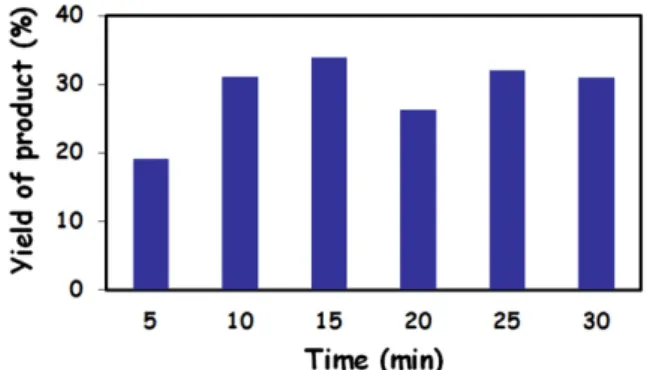
Fig. 1 shows the yield of the copolymer after micro- wave irradiation at various times. The yield was around 30% from the monomer composition of 90/10(AN/MA) in the presence of 0.1wt% initiator (AIBN) in 200% DMSO solvent to applied monomer in 30 min. It was recognized that 30 min is enough reaction time to maximize the prod-
Fig. 1. Yields of AN90MA10(0.1)200% copolymer with various reaction time.
uct yield and get the melt spinnable PAN copolymers.
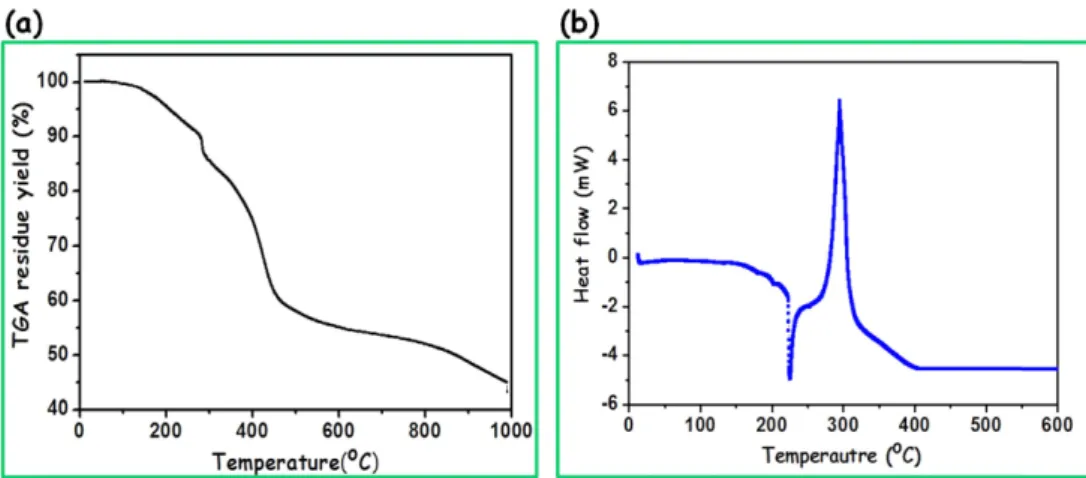
The thermal behaviors of AN90MA10(0.1)200% copol- ymer were analyzed by TGA and DSC under nitrogen atmo- sphere at a heating rate of 10oC/min. TGA curve shows that the main mass loss from 280 to 450oC, attributed to the pyrolysis of the fibers, is in agreement with the peak on the DSC curve of as-spun fibers. The loss slows down above 450oC to give a yield of 52% at 800oC. It appeared an endothermic melting peak at 220oC and exothermic peak at 290oC (Fig. 2).23 Endothermic reaction is a melt- ing point that copolymer is molten. In addition, exothermic reaction is temperature of dehydrogenation and cycliza- tion reactions of the PAN. The actual maximum temper- ature was setup up to 190oC in the melt spinning because AN90MA10(0.1)200% copolymer is molten at higher than the melting temperature.
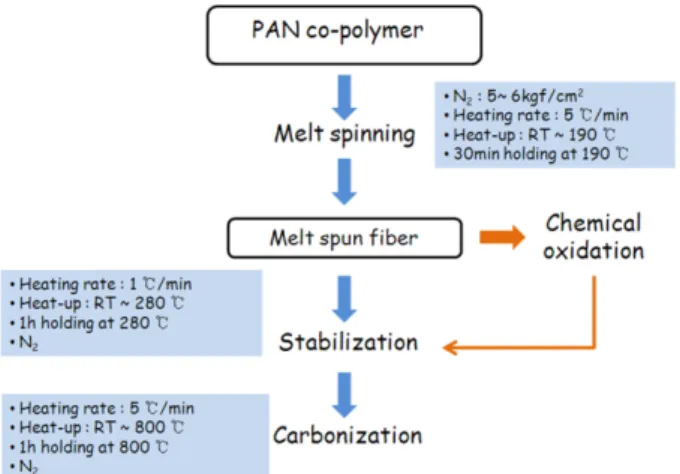
The AN90MA10(0.1)200% copolymer were heated up to 190oC at 5oC/min in nitrogen atmosphere and hold for 30 min which is enough for fluidity. The spinning tem- perature for all runs was 190oC, followed by stabilization and carbonization under nitrogen pressure. Pyrolysis is used for the conversion process from spun fibers into CFs.
The chemistry of the stabilization process of PAN consists of cyclization, dehydrogenation, and crosslinking. As a result of the conversion of C≡N bonds to C=N bonds, a fully aromatic cyclized ladder type structure forms.24,25 There- fore, thermo-stabilization involves cyclization of the PAN component, enabling the spun fibers to be thermally stable (infusible) for the subsequent carbonization. A variety of physical changes take place during the thermo-stabiliza- tion process, which cause the initial changes in color of spun fibers from pale yellow to dark brown, as shown in Fig. 3.
The AN90MA10(0.1)200% copolymer synthesized by microwave energy is successfully melt spun. On the other
hand, the fibers were stick together with brittle physical properties in the stabilizing process as shown in Fig. 3(b).
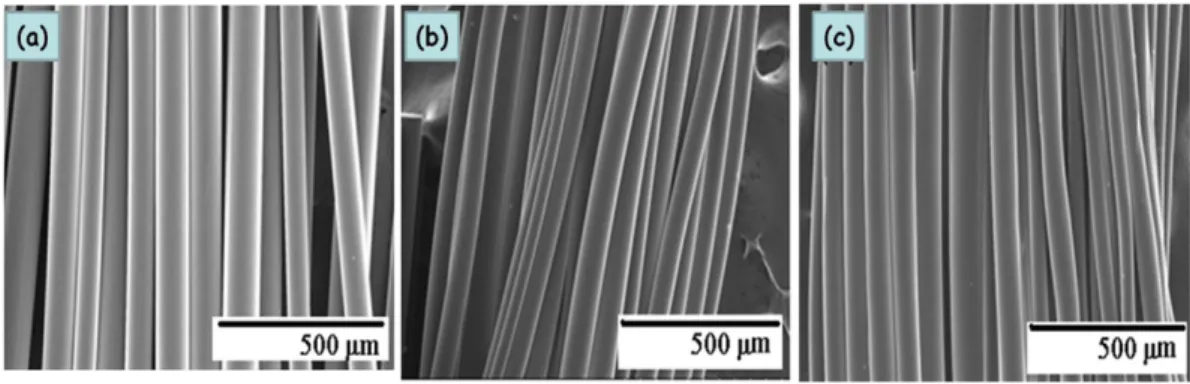
Fig. 4 show the SEM images of the melt-spun, stabilized, and carbonized fibers obtained from PAN90MA10(0.1) 200% copolymer. The average diameter of the fibers was thick and decreases from 188 to 154 to 136 mm with increas- ing heat treatment by numerous evolution gasses during the pyrolysis, such as H2O, NH3, HCN, CO, CO2, N2, H2, and CH4.
Furthermore, the composition of AN/MA was varied by adding another component itaconic acid(IA) and increased the initiator concentration to 2 wt%, then resulted an increase of the PAN co-polymer yield of higher than 80%
from the composition AN83/IA1/MA16(2)50%, as shown in Fig. 5. The IA addition gives advantages of reduction of onset temperature of stabilization and lowering heat of reaction avoiding the introduction of hot spots.26,27 The yield increase would be resulted from enhanced reactivity by more frequent collision at higher monomer concen- tration and reduced activation energy at higher initiator concentration.
As shown in Fig. 6, the diameter of AN83IA1MA16(2) 50% copolymer based melt-spun fiber was reduced aver- age diameter to 90−100 µm with uniform and homoge- Fig. 2. Thermal properties of the AN90MA10(0.1)200% copolymer; (a) TGA and (b) DSC curve.
Fig. 3. Photographs of AN90MA10(0.1)200% copolymer based (a) melt-spun and (b) stabilized fiber.
neous surface, compare with the AN90MA10(0.1)200%
copolymer. The spinnability can be evaluated by the fiber diameter from spinning. Therefore, the spinnability was improved by increases in concentrations of MA and ini- tiator, represented by the increase in the wind up speed to 60 mmin−1.
However, AN83IA1MA16(2)50% copolymer based melt- spun fibers were also partially molten and fragile through the stabilization process. The precursor fibers were oxi- dized in aqueous KMnO4 solution before stabilization to avoid the melt down of the spun at the stabilizing process.
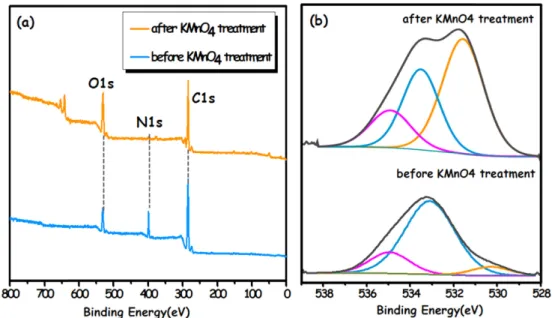
The wide-scan XPS spectra in Fig. 7a imply that the surface of unmodified and KMnO4-modified AN83IA1MA16(2)50%
copolymer based melt-spun fibers contain only the expected
three elements (e.g., C, O, N). The deconvolution of the O1s XPS spectra (Fig. 7b) revealed three Gaussian curves centered at 530.2, 532.1 and 533.5 eV, which can be assigned to COO−/O=CO and C−OH/O=C and O=C−OH/R−O−R, respectively.28
Quantitative peak analyses were also carried out to determine the concentrations of the surface elements by XPS. It was found that the KMnO4-modified melt-spun fiber has higher content in a spun fiber, as shown in Table 1.
The carbon content of a modified melt-spun fiber have no great difference as compared to those in a unmodified melt-spun fiber, whereas the oxygen content increased from 10.42% in pristine to 24.08% in KMO4 modified fiber.
The higher oxygen content was involved in the functional groups of C=O, HO –C=O, etc. In particular, the C=O and COOH intensities increased significantly after the modi- fication, compare with the C−OH group, as summarized in Table 1. It suggests that the oxygen functional groups increased on the melt-spun fiber surface by the KMnO4 modification, then, the activated C−O and −OH groups by the KMnO4 modification would be oxidized further to form ketone (C=O) and carboxylic acid groups (COOH).
We suppose that the dissociated K+ and MnO4−
ion in water can diffuse into the fibers. The interaction between K+ and a fiber is mainly in the nature of physical absor- bance, while the MnO4−has a strong trend to attack the macromolecule of a PAN fiber through the interaction between MnO4−
and a fiber, as following eq. (1).29 There- fore, the oxygen content increased in the modified spun fibers (Table 1), which might promote the cyclization and thermal oxidation rate as an active site.30
(1) Fig. 5. The production yield of various copolymer.
Fig. 6. SEM images of AN83IA1MA16(2)50% copolymer based melt-spun fiber at (a) low and (b) high magnification.
For this reason, in the case of the modified melt-spun fiber, the stabilization process under oxidative conditions can be omitted in the conversion process from precursor fibers into CFs under inert condition.31 The carbonyl and carboxyl functionalities of the chemical oxidized spun fiber lead to ester and anhydride linkages through dehy- dration reactions, condensation, crosslinking, and elimi- nation reactions in the heat treatment process. Therefore, it did not show melting behavior any longer through the heat treatment in the carbonization process in N2 atmo- sphere, as shown in Fig. 8a−b. The average fiber diameter is also reduced to 30 mm when carbonized at 800oC. The SEM images (Fig. 8b) show the deposition of uniform particles on carbon fibers surface after 800oC pyrolysis.
They represent that the particles are spherical shape and uniformly dispersed on the surface of the carbon fiber.
The elemental mapping of EDX shows the presences of K, Mn, C, and O atoms in the fiber (Fig. 8c). In the future, the carbonized fibers can be developed for activated car- bon fibers with controlled pore size depending not only on the activity but also the size of the particle of the metals with catalyst functions. The mechanism of the activation
of the carbon fiber stabilized by KMnO4 needs to be stud- ied further.
In conclusion, low cost production of the carbon fibers would be approached by adoption of economic process, such as melt spinning of the precursor and microwave energy application for the polymerization. The PAN copol- ymer synthesized by microwave energy showed good Fig. 7. XPS spectra of (a) a wide-scan XPS spectrum, (b) the deconvolution of O1s of unmodified and KMnO4-modified AN83IA1MA16(2)50%
copolymer based melt-spun fibers.
Table 1. Chemical composition and oxygen-containing functional groups for unmodified and KMnO4-modified AN83IA1MA16(2)50%
copolymer based melt-spun fibers
Sample Chemical composition Functional groupsa
carbon oxygen O1s/C1s −C=O R−OH −COOH
Pristine 77.81 10.42 0.13 0.77 8.04 1.89
KMnO4 modified 74.29 24.08 0.32 13.03 8.11 4.22
aAnalyzed from O1s core-level scan spectra
Fig. 8. SEM images of (a) stabilized, (b) carbonized fiber, (c) the elemental mapping of carbonized fiber developed from modified spun fiber.
Materials and Characterizations
The monomers, acrylonitrile (AN), methyl acrylate (MA), itaconic acid (IA), initiator AIBN (2,2’-azo-bis-isobuty- ronitrile) were obtained from Aldrich Co. The dimetyl- sulfoxide (DMSO) purchased from Yakuri Pure Chemical was used as solvent in this reaction. AN and MA were washed with aqueous NaCl (to remove inhibitor), washed twice with distilled water, and distilled at reduced pres- sure before use. Samples for differential scanning calo- rimeter (DSC) experiments were heated to 500oC under nitrogen atmosphere at a heating rate of 10oC/min. Ther- mogravimetric analysis (TGA) was performed using a Shimadzu TGA 50 (Shimadzu, Inc.). The samples were heated to 800oC in nitrogen in an electric furnace at a rate of 10oC/min. Viscosity measurements were performed at 25oC using a BROOKFIELD viscometer (LVDVII+). Sur- face layer morphologies were analyzed using a scanning electron microscope (SEM) with Energy-dispersive X-ray (EDX) spectroscopy model Hitachi, S-4700. As-spun and stabilized fibers were sputter-coated with a platinum layer before being subjected to a SEM analysis. The surface functionalities of the copolymer were examined by Fourier transforms infrared spectroscopy (FT-IR, Nicolet 200 instru- ment). All the samples were analyzed using the KBr pel- let technique and scanned in the range from 4000 to 400 cm−1. The yield of the copolymer was determined by the weight % of copolymer on the basis of the total amount of monomer used. Microwave irradiation of the samples was studied by microwave oven (KR-A202B).
Synthesis of PAN Copolymer
Monomer AN, MA, IA put together in a given weight fraction in DMSO solvent in cover tight Teflon bottle, and then the sample was polymerized under microwave irra- diation of 100 Watt (KR-A202B, Dae Woo, Korea) for var- ious times. After cooling down to room temperature, the polymers washed with methanol until no remaining of
solvent and unreacted monomers and finally dried it under vacuum at 70oC for 24h. The copolymer produced from the monomer composition of 90/10(AN/MA) in the pres- ence of 0.1 wt% initiator (AIBN) in DMSO solvent (ratio of total monomer and solvent is 1:2) was identified as AN90MA10(0.1)200%.
Carbon Fiber Preparation
The PAN copolymer was spun into fiber through the using a melt spinning apparatus at melting temperature (DAQS- TATION DX1000, YOKOGAWA, Tokyo, Japan). PAN co- polymer were heated up to 190oC (5oC/min) in nitrogen atmosphere and hold for 30 min. Fibers were initially spun through a round single-hole spinneret having 0.5 mm diameter, and then collected on a aluminum drum located down 52 cm from the spinneret at with average speed at 50 mmin−1. In addition, the melt spun PAN copolymer fibers were dipped in 3 wt% KMnO4 aqueous solution for 4 hours, which is followed by washing with distilled water and dried at room temperature. It was additionally heated up to 280oC in a tubular furnace under nitrogen atmo- sphere and carbonized at 800oC in nitrogen atmosphere.
The overall process of carbon fibers from PAN copoly- mer is presented in Fig. 9.
Acknowledgments. This study was supported by a grant from the Fundamental R&D Program for Core Technol- ogy of Materials funded by the Ministry of Knowledge Economy, Republic of Korea.
REFERENCES
1. Donnet, J. B.; Bansal, R. C. Carbon Fibers; Marcel Dek- ker: 1984.
Fig. 9. Schematic of preparation process of carbon fiber.
2007.
9. Daumit, G. P.; Ko, Y. S.; Slater, C. R.; Venner, J. G.;
Young, C. C. U.S. Patent 4935180, 1990.
10. Furuta, S.; Katsuki, H.; Komarneni, S. J. Porous Mate- rials 2001, 8, 43.
11. Uguina, M. A.; Serrano, D. P.; Sanz, R.; Castillo, E. Proc.
12th Intern.: Zeolite Conference 1998.
12. Perreux, L.; Loupy, A. Tetrahedron 2001, 57, 9199.
13. Lidström, P.; Tirney, J.; Wathey, B.; Westman, J. Tetra- hedron 2001, 57, 9225.
14. Park, J. H.; Park, S. H.; Jhung, S. H. J. Korean Chem.
Soc. 2009, 53, 553.
15. Choi, K. Y.; Conner, W. C. J. Korean Ind.: Eng. Chem.
2007, 18, 344.
16. Kim, J. H.; Heo, J.; Kang, B. M.; Son, D. H.; Lee, G. D.;
Hong, S. S.; Park, S. S. J. Korean Ind.: Eng. Chem. 2009,
22. Hwang, K. C.; J. Chem. Soc.: Chem. Comm. 1995, 2, 173.
23. Gupta, A.; Harrison, I. R. Carbon 1996, 34, 1427.
24. Esrafilzadeh, D.; Morshed, M.; Tavanai, H. Synth. Met.
2009, 159, 267.
25. Maradura, S. P.; Kim, C. H.; Kim, S. Y.; Kim, B. H.;
Kim, W. C.; Yang, K. S. Synth. Met. 2012, 162, 453.
26. Fitzer, E.; Muller, D. J. Carbon 1975, 13, 63.
27. Bhat, G. S.; Abhiraman, A. S.; Cook, F. L.; Peebles Jr., L.
H. J. Appl. Polym. Sci. 1993, 49, 2207.
28. Shimoda, K.; Park, J.-S.; Hinoki, T.; Kohyama, A. Appl.
Surf. Sci. 2007, 253, 9450.
29. Mathur, R. B.; Mittal, J.; Bahl, O. P. J. Appl. Polym. Sci.
1993, 49, 469.
30. Wangxi, Z.; Jie, L. Journal of Wuhan University of Tech- nology - Mater. Sci. Ed. 2006, 21, 44.
31. Kubo, S.; Uraki, Y.; Sano, Y. Carbon 1998, 36, 1119.