• 검색 결과가 없습니다.

Alizarin Red S modified electrochemical sensors for the detection of aluminum ion

N/A
N/A
Protected

Academic year: 2021

Share "Alizarin Red S modified electrochemical sensors for the detection of aluminum ion"

Copied!
7
0
0

로드 중.... (전체 텍스트 보기)

전체 글

(1)

DOI : 10.5369/JSST.2010.19.6.421 pISSN 1225-5475/eISSN 2093-7563

Alizarin Red S modified electrochemical sensors for the detection of aluminum ion

Seung-Cheol Chang Abstract

Alizarin Red S modified screen printed carbon electrodes were developed for the electrochemical detection of aluminum ion. The electrodes developed use screen-printed carbon electrodes(SPCEs) coupled with chemical modification with an organic chelator, Alizarin Red S(ARS), for aluminum ion detection in aqueous solution. For sensor fabrication ARS was directly immobilized on the surface of SPCEs using PVA-SbQ(The poly(vinyl alcohol) bearing stryrylpyridinium groups).

Aluminum concentrations were indirectly estimated by amperometric determination of the non-complexed ARS immobilized on the electrodes, after its complexation with aluminum. The sensitivity of the sensor developed was 3.8 nA µ M

-1

cm

-2

and the detection limit for aluminum was 25 µ M.

Key Words : screen printed electrode, electrochemical, alizarin red S, aluminum ion

1. Introduction

Direct determination of aluminum(Al(III)) ions by voltammetric and amperometric methods using solid electrodes is limited for application to real samples because of a low signal-to-noise ratio [1] and high reduc- tion potential of Al(III) [2] . These limitations could be overcome by using indirect methods based on the elec- trodes modified with metal chelators such as Alizarin Red S [3-6] . These methods are based upon the measure- ment of changes in the electrochemical behavior of the chelator upon complexation with the Al(III).

Chemically modified electrodes(CMEs) [10] have been widely used for the electrochemical determination of metals in water resources [7] . CMEs, generally, have been used in voltammetric methods especially in anodic stripping voltammetry(ASV) with an analyte accumu- lation step. The modifiers, chelators, are physically or chemically modified onto the working electrode and used to accumulate the analyte followed by the indirect determination of the analyte. The reagents used for chemical modification of the electrode surface therefore fall into two main categories; accumulating reagents

and electro-active reagents. The use of CMEs in elec- trochemical analysis has led to the development of sen- sors exhibiting high selectivity and sensitivity for Al(III) ion in environmental water samples.

The work reported in this study is aimed at develop- ing a rapid, sensitive and specific technique for the measurement of Al(III). The technique involved the use of an organic chelator, Alizarin Red S(ARS), modified disposable screen-printed carbon electrodes for the elec- trochemical determination of Al(III) ion in aqueous samples.

To achieve the aim proposed, this study was focused in two major areas. Firstly, the differences in electro- chemical behavior between modified ARS and its com- plexed form with Al(III) was characterized and optimized using voltammetric and amperometric tech- niques. Secondly, disposable printed electrodes modi- fied with immobilized ARS using the photo-polymer, PVA-SbQ [8,9] , for amperometric Al(III) detection was fabricated and tested.

2. Experimental

2.1. Materials

The basic disposable screen-printed carbon electrodes (SPCEs) were constructed as reported by author previ- ously [8] . Alizarin Red S(ARS, 3.4-dihydroxy-9,10-

Institute for Bio·Physio Sensor Technology(IBST), Pusan National University

Corresponding author: [email protected]

(Received : October 20, 2010, Revised : November 5, 2010,

Accepted : November 10, 2010)

(2)

dioxo-2-anthracensulfonic acid, sodium salt), aluminum nitrate(Al(NO 3 ) 3 ), potassium chloride(KCl), and potas- sium phosphates(KH 2 PO 4 , K 2 HPO 4 ) were obtained from Sigma. The poly(vinyl alcohol) bearing stryrylpy- ridinium groups(PVA-SbQ) matrix(SPP-H-13) was from Toyo Gosei Kogyo Co.(Tokyo, Japan).

2.2. Apparatus

Cyclic voltammetry and amperometric measurements were performed using an Autolab analyzer supplied by Eco Chemie B.V.(Utrecht, Netherlands). A Perspex 10- well template for accommodation of the screen-printed electrodes was built by the Workshop at Pusan National University. A Spectroline ® UV lamp was obtained from Spectronics Co.(New York, USA) and was used for PVA-SbQ photo-polymerisation. pH measurement was performed using an Orion pH meter model 310 in con- junction with a PerpHecT ® Ag/AgCl pH electrode model 9202 supplied by Orion ® Research Inc.(Beverly, USA).

2.3. Alizarin Red S(ARS) Solution

55 mM Alizarin Red S(ARS) solution was prepared by dissolving 20 mg of ARS in 20 ml of 50 mM potas- sium phosphate buffer(PPB, pH 7.0, 100 mM KCl). 2 ml aliquots of ARS solutions were also prepared in the same buffer, over the concentration range of 0.5 mM~

55 mM.

2.4. Assessment of ARS Modified SPCEs(PVA- SbQ(ARS)-SPCEs)

ARS was modified in the photo-polymer(PVA-SbQ) layer on the surface of the working electrodes. A 200 µl aliquot of 55 mM ARS solution was thoroughly mixed with 300 µl of PVA-SbQ prepolymer for 5 minutes. A 5 µl aliquot of the mixture was placed on the surface of the working electrode of the SPCEs. The electrodes were then exposed to long wave UV light(365 nm, at 10 cm) for 2 h to allow polymerization, and dried in a dark place for 12 h at room temperature. 40 µmol of ARS was modified on each SPCE. In order to investi- gate the voltammetric behavior of ARS in PPB, PVA- SbQ(ARS)-SPCEs were also prepared using the 2 ml aliquots of ARS solutions as described in Section 2.3.

2.5. Measurement Procedure

An electrochemical cell for voltammetric and amper-

ometric measurements was set up and Cyclic voltam- metry was carried out using polymer coated bare SPCEs and PVA-SbQ(ARS)-SPCEs and were used according to the procedure outlined in previous studies by author [8,9] . Experimental protocols were identical except for the following conditions; 50 mM PPB was used as background electrolyte and the potential sweeping range was between -0.1 mV to +1.0 mV vs. Ag/AgCl at a scan rate of 50 mVs -1 . Amperometric measurements were performed using PVA-SbQ(ARS)-SPCEs as described in previous studies by author [8,9] . Electrodes were polarized at a potential of +480 mV vs. Ag/AgCl in PPB. This was repeated to construct aluminum cal- ibration curves for a range of Al(III) concentrations from 0 to 5 mM using a fresh PVA-SbQ(ARS)-SPCE for each measurement.

3. Results and Discussion

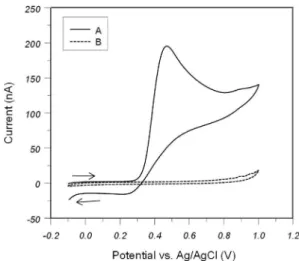
3.1. Cyclic Voltammetry of Alizarin Red S Cyclic voltammograms with bare(PVA-SbQ-SPCEs) and ARS modified electrodes(PVA-SbQ(ARS)-SPCEs) were obtained in 50 mM PPB(pH6.0, 100 mM KCl) and a representative example is shown in Fig. 1. Poten- tial sweeping was initiated in an anodic direction from -0.1 V in all experiments.

As can be seen in curve B in Fig. 1, no specific oxi-

Fig. 1. Cyclic voltammograms for PVA-SbQ(ARS)-SPCEs

(A) and PVA-SbQ-SPCEs (B) in 50 mM PPB

(pH6.0, 100 mM KCl).

(3)

dation and reduction current peaks were observed in the absence of modified ARS over the total sweep range of -0.1 V to +1.0 V. In the case of cyclic voltammograms for PVA-SbQ(ARS)-SPCEs, a clear anodic peak was apparent at a potential of +0.48 V with an anodic peak current of 190 nA and is shown in curve A in Fig. 1.

After sweeping 5 times at potentials between -0.1 and +1.0 V, the peak current remained practically constant, which indicated the strong and stable modification of ARS on the surface of the electrodes.

Fig. 2 shows examples of cyclic voltammograms for PVA-SbQ(ARS)-SPCEs that were modified with a series of ARS concentrations. The final amounts of ARS modified at each electrode ranged from 20 to 40 µmol. As can be seen, the peak heights produced were proportional to the amount of ARS on the modi- fied surface.

The voltammetric behavior of ARS is known to be quasi-reversible, showing redox peaks at potentials over the range -0.6 to -0.8 V vs. SCE when graphite working electrodes were used [2] . In this range of potentials, how- ever, the voltammograms obtained using the electrodes under investigation in this study showed a large cathodic peak and high noise. Although ARS could pro- duce redox peaks at negative potentials, the electro-

chemical behavior would be subject to interference from the reduction of dissolved oxygen [11] . This would lead to major irreproducibility problems. As a result of these considerations, therefore, the potential range from -0.1 to +1.0 V was used for all cyclic voltammetric experiments.

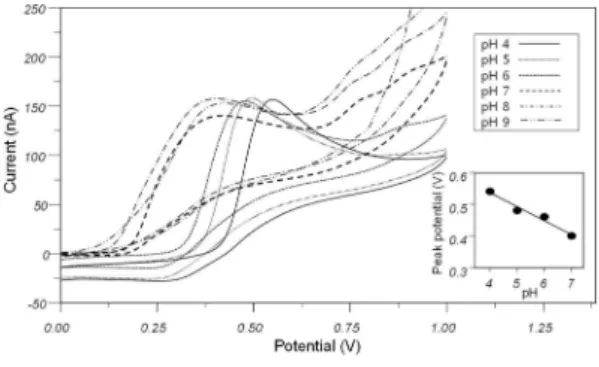
The cyclic voltammograms for PVA-SbQ(ARS)- SPCEs were sensitively dependent on the change of pH.

As can be seen in Fig. 3, peak potentials shifted as a function of pH. At higher pH over 6, however, the quasi-reversible behavior of ARS was deformed compared with the voltammograms obtained at lower pH. At pH 7 to 9, the large cathodic picks were produced at potentials higher than 800 mV vs. Ag/AgCl and the peaks were broadened. It was, consequently, difficult to determined reproducible peak potentials.

Therefore, pH 6 was used as an operating pH for further voltammetric experiments. The inset in Fig. 3 shows a linear relationship between the peak potentials and pH from 4 to 7. The slope for the line was calculated to be;

∆ E p / ∆ pH = -44 mV/pH.

3.2. Voltammetric Detection of Al(III)

In the presence of Al(III), the change in cyclic vol- tammograms of PVA-SbQ(ARS)-SPCEs is shown in Fig. 4. As can be seen, the peak potentials are nearly constant while the magnitude of anodic peak current is decreased as a function of the increase in aluminum concentration in solution. The responses of ARS mod- ified electrodes showed a similar peak current decrease with a series of Al(III) samples measured over the pH range from 5 to 8. In recent studies, however, it was

Fig. 2. A: Cyclic voltammograms for PVA-SbQ(ARS)- SPCEs in 50 mM PPB(pH 6.0, 100 mM KCl,).

Experimental conditions; Scan range was from - 0.1 V to +1.0 V at a scan rate of 50 mVs

-1

and scan started at -0.1 V. Amounts of modified ARS at each electrode were 20, 25, 30 and 40 µmol. B:

Plot of peak current vs. amount of modified ARS from voltammograms in A.

Fig. 3. Cyclic voltammograms for PVA-SbQ(ARS)-SPCEs

in 50 mM PPB(pH 4.0, 5.0, 6.0, 7.0, 8.0 and 9.0,

100 mM KCl). Inset: linear relationship between

peak potential and pH.

(4)

demonstrated that ARS modified electrodes could be used for the detection of copper in water at pH 8.0- 9.0 [3,4] . Furthermore, at pH 6.0, it was apparent that the

anodic peak from the voltammogram had a much smaller peak width compared with the peak at pH 7.0.

Therefore, pH 6.0 was chosen as the operating pH in all further experiments

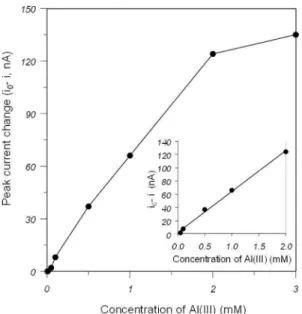
In order to obtain data for calibration curves for Al(III), cyclic voltammograms were obtained with Al(III) concentrations over the range from 0 to 3 mM.

Peak currents were determined from the first scan of each voltammogram. Calibration curves for Al(III) were constructed using the data from the cyclic voltammo- grams obtained and are shown in Fig. 5. The peak cur- rent change(i o -i) in Fig. 5, represents the differences between peak currents determined by using Al(III) sam- ples and the peak current obtained from the blank.

Although the calibration curve showed a wide range of linearity, approximately from 0.05 mM to 2.0 mM Al(III) and the sensitivity of the electrodes for Al(III) was determined to be 0.63 µA mM cm -2 .

3.3. Amperometric Detection of Al(III)

Amperometric measurements were performed with Alizarin Red S modified screen-printed carbon elec- trodes(PVA-SbQ(ARS)-SPCEs) as described Steady baseline currents were observed after 5 minutes

~10 minutes when the PVA-SbQ(ARS)-SPCEs were polarized at a potential of +480 mV. The steady state current observed was produced by oxidation of ARS, which was modified in the polymer layer on the surface of the electrodes. After addition of a 10 µl aliquot of an Al(III) sample into the cell, the color of the PVA- SbQ(ARS) polymer layer instantly changed from pale yellow to reddish yellow indicating the formation of an ARS-Al(III) complex on the surface of the electrodes.

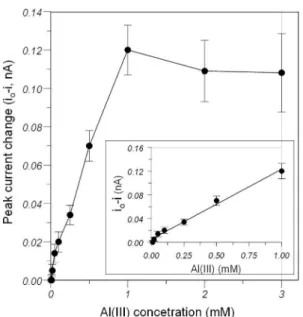
Because of the strong chelating ability of Alizarin Red S to Al(III), the ARS-Al(III) complex formed was irreversible [12] . Therefore, the decrease in current response was recorded and the current changes obtained were used to construct a calibration curve. An unused fresh PVA-SbQ(ARS)-SPCEs was used for each individual measurement. PVA-SbQ(ARS)-SPCEs were calibrated using Al(III) standard solution and calibration curves for Al(III) are shown in Fig. 6. Each point represents the mean value of 5 measurements and the error bars rep- resent one standard deviation. The peak current change (i o -i) in Fig. 6, represents the difference between the current response obtained after addition of an Al(III) sample and the response of the blank. The detection

Fig. 4. Cyclic voltammograms for PVA-SbQ(ARS)-SPCEs in 50 mM PPB(pH 6.0, 100 mM KCl) with blank, 1.0, 2.0, and 3.0 mM Al(III).

Fig. 5. Calibration curve of anodic peak currents from

voltammograms obtained using PVA-SbQ(ARS)-

SPCEs vs. Al(III) concentration in 50 mM PPB

(pH6.0, 100 mM KCl). Inset: linear relationship

between peak current and Al(III) concentration

over the range of 0.05-2.0 mM.

(5)

limit(25 µM), sensitivity(3.8 nAµM -1 cm -2 ) and linear range(25 µM to 1mM) of the method were determined using the results obtained. Intra-electrode reproducibil- ity was determined as a coefficient of variation(CV) of less than 14.5 % over the Al(III) concentration range of 0.1 mM~0.5 mM.

3.2. Comparison with Alternative Electrochemical Al(III) Detection Methods

The suitability of PVA-SbQ(ARS)-SPCEs for Al(III) detection in water samples was investigated in compar- ison with other methods using CMEs. The results are summarized in Table 1.

It was noted that the anodic peak currents obtained using the methods based on ASV(adsorption stripping voltammetry) in Table 1, were obtained by the reduction or oxidation of chelator-metal complexes that were accumulated on the surface of electrodes prior to appli- cation of the stripping potential. However, the system under investigation in this study detects the change in oxidation current produced not from the metallic com- plexes but from the modified chelator, ARS. Although all the methods summarized in Table 1 based on ASV show a lower detection limit compared with the present

sensor based system, they usually need a longer detec- tion time and a repeatable electrode polishing step at each measurement. Therefore, these differences indicate that the present system is a simpler system because it does not involve an analyte accumulation and an elec- trode polishing step and the use of the disposable elec- trodes. Furthermore, because of the additional steps of the ASV based methods, they may not be suitable for the incorporation into a hand held device.

Overall, in order to develop highly sensitive screen printed disposable sensor system for Al(III), the follow- ing approaches would be suggested; SPCEs could be modified using PVA-SbQ with chelators that have highly specific and strong chelating abilities to Al(III) such as N,N’-Bis(salicylidene)-1,2-phenylenediamine [5] . Another approach would be to incorporate chelators into the screen-printed carbon ink electrode in a manner similar to that described reported previously [13,14] . This may be easily achieved by mixing the chelator with the carbon ink prior to printing.

4. Conclusion

The work carried out in this study has demonstrated the use of a chelator for the on-site electrochemical determination of aluminum in water resources. Unlike traditional electrochemical detection methods such as ASV, the methods carried out in this work were based upon the measurement of changes in the electrochemi- cal behavior of the chelator upon complexation with Al(III). The sensor developed in this study showed a detection limit for Al(III) of 25 µM(167 ppm), with a short turnaround time(15 min for each measurement).

Fig. 6. Calibration curve for Al(III) using PVA-SbQ (ARS)-SPCEs. Inset: linear relationship between peak current and Al(III) concentration over the range of 0.05-1.0 mM.

Table 1. Comparison of present sensor system and other electrochemical Al(III) detection methods

Chelators used

Chelator Modification

Method

Method based on

Detection limit (ppm) Ref.

Alizarin

Red Polymerization

with PVA-SbQ Ampero-

metry 167 Present system Alizarin

Red Drop coating ASV 60 [2]

Pyrocatech

ol violet Adsorption ASV 6 [11]

8-hydroxy-

quinoline Adsorption ASV 4 [12]

(6)

The simple screen-printing technique and the effective chelator modification procedure using direct polymeri- zation on electrodes allows inexpensive and disposable amperometric Al(III) sensor fabrication.

Acknowledgements

This work was supported by the Korea Research Foundation Grant funded by the Korean Government (MOEHRD, Basic Research Promotion Fund)(KRF- 2007-331- C00184).

References

[1] D. Compagnone et al. , “Electrochemical sensors for determination of metal ions”, Sensors and Actuators B-Chemical , vol. 7, pp. 549-552, 1992.

[2] A. Downard et al., “Voltammetric determination of aluminium(III) using chemically modified elec- trodes”, Analytica Chimica Acta , vol. 251, pp. 157- 163, 1991.

[3] K.-K. Shiu and F.-Y. Song, “Preconcentration and electroanalysis of copper species at electrochemi- cally activated glassy carbon electrodes adsorbed with Alizarin Red S”, Electroanalysis , vol. 10, pp.

256-261, 1998.

[4] V. Filho et al. , “Surface complexation of copper(II) with alizarin red s adsorbed on a graphite electrode and its possible application in electroanalysis”, Electroanaysis , vol. 11, pp. 1130-1136, 1999.

[5] M. Gholivand et al ., “A novel Al(III)-selective elec- trochemical sensor based on N,N’-Bis(salicylidene)- 1,2-phenylenediamine complexes”, Electroanalysis,

vol. 18, No. 16, pp. pp. 1620-1626, 2006.

[6] D. Junwei, “Voltammetric determination of alumi- num(III) using a reagentless sensor fabricated by sol–gel process”, Sensors and Actuators B , vol. 99.

pp. 468-473, 2004.

[7] D. Arrigan, “Voltammetric determination of trace- metals and organics after accumulation at modified electrodes”, Analyst , vol. 119, pp. 1953-1966, 1996.

[8] S. Chang and D. Park, “Disposable in-field electro- chemical potable sensor system for free available chlorine(FAC) detection”, J. Kor. Sensors Soc. , vol.

16, no. 6, pp. 449-456, 2007.

[9] D. Park et al., “Tri-enzyme modified electrochemi- cal biosensor for paracetamol detection”, J. Kor.

Sensors Soc. , vol.17, no.1, pp. 29-34, 2008.

[10] D. Lee, “Chemical sensor technology”, J. Kor. Sen- sors Soc. , vol. 18, no. 1, pp. 1-21, 2009.

[11] D. Vukomanovic et al., “Voltammetric determina- tion of Al(III) with adsorptive preconcentration of the pyrocatechol violet complex”, Canadian Jour- nal of Chemistry , vol. 69, pp. 1418-1426, 1991.

[12] E. Stryjewska and S. Rubel, “Adsorptive stripping voltammetry for determination of trace amounts of aluminium with calmagite”, Electroanalysis , vol. 3, pp. 995-998, 1991.

[13] R. Keay et al ., “Separation-free electrochemical immunosensors for rapid determination of atrazine”, Biosensors and Bioelectronics , vol. 13, pp. 963-970, 1998.

[14] S. Chang et. Al. , “Disposable tyrosinase-peroxidase

bi-enzyme sensor for amperometric detection of

phenols”, Biosens. Bioelectr , vol. 17, pp. 1015-

1023, 2002.

(7)

Seung-Cheol Chang

• Seung-Cheol Chang earned a B.Sc. in

Chemistry in 1994 from Dongguk

University and received a Ph.D. in

Clinical Biochemistry from the

University of Newcastle upon Tyne,

UK in 2000. From 1999 to 2005, he

worked as a Researcher in the

Medical School and Institute for

Nanoscale Science&Technology(INSAT)

at the University of Newcastle upon

Tyne. From Jan. 2006 to Feb. 2007,

he worked as a Principle Researcher

in the Medical School at Newcastle

University. Since Mar. 2007, he has

been an Assistant Professor in the

Institute for Bio·Physio Sensor

Technology(IBST), Pusan National

University. His research interests are

biosensors and diagnostic devices such

as cell-based(bio) sensor systems and

functionalized microfabricated sensors

and arrays based on bioMEMS.

수치

Fig. 1. Cyclic voltammograms for PVA-SbQ(ARS)-SPCEs (A) and PVA-SbQ-SPCEs (B) in 50 mM PPB (pH6.0, 100 mM KCl)
Fig. 2 shows examples of cyclic voltammograms for PVA-SbQ(ARS)-SPCEs that were modified with a series of ARS concentrations
Fig. 5. Calibration curve of anodic peak currents from voltammograms obtained using  PVA-SbQ(ARS)-SPCEs vs
Fig. 6. Calibration curve for Al(III) using PVA-SbQ (ARS)-SPCEs. Inset: linear relationship between peak current and Al(III) concentration over the range of 0.05-1.0 mM

참조

관련 문서