1 Corresponding Author: Department of Electronics and Communications Engineering, Korea Maritime and Ocean University, 727 Taejong-ro, Yeongdo-Gu, Busan 606-791, Korea, E-mail: [email protected], Tel: 051-410-4312 2 Department of Electronics and Communications Engineering, Korea Maritime and Ocean University, E-mail:
[email protected], Tel: 051-410-4908
LED transceivers with beehive-shaped reflector for visible light communication
Kyung-Rak Sohn†․ Min-Soo Kim1
(Received October 24, 2013; Revised December 16, 2013;Accepted December 19, 2013)
Abstract: This paper proposes a novel beehive-shaped reflector for application to light-emitting diode (LED) transceivers for illumination and bi-directional visible light communication (VLC). By using a diffuse prop- agation model extended to line-of-sight and direct signals, the distribution of illuminance and the path loss of the transceiver are investigated to evaluate the performance of the beehive-shaped reflector. To verify bi-direc- tional communication, a VLC-based image capture system, comprising a complementary metal-oxide semi- conductor (CMOS) image sensor and video processor unit, is demonstrated. Real-time images captured by the CMOS camera are successfully transmitted to the monitoring system via a free-space channel at a rate of 115.2 kbps.
Keywords: Visible light communications, Optical wireless communications, Bi-directional communications, Reflector, White LED lightings
1. Introduction
The characteristics of free-space optical communica- tion depend on the optical waves used to transfer information. The wavelengths of these waves range from infrared (IR) and visible light (VL) to ultraviolet (UV). IR technology has been applied to outdoor and indoor communication using intensity modulation in line-of-sight (LOS) or diffusion conditions [1]. IR can use low-power emitters because the receiver can be fo- cused on the emitter or reflector to increase the col- lected optical power. However, the outdoor solar back- ground or indoor florescence noise may significantly limit the performance of IR detectors. UV is mainly used for outdoor communication because of solar-blind non-line-of-sight (NLOS) conditions and abundant at- mospheric scattering of the UV radiation by molecules and aerosols [2]. UV technology is attractive for wire-
less sensor networks and military applications.
However, white light-emitting diodes (WLEDs) are gradually replacing traditional incandescent and fluorescent lamps because WLEDs offer very favorable characteristics such as durability and low power consumption. Furthermore their radiant intensity can be rapidly varied by the driving current and their comparably low driving voltage enables the use of WLEDs for both illumination and visible light communication (VLC) [3][4]. Every home is supplied with electricity by means of the power grid, which is distributed to each power outlet in every room in a house. With the emergence of WLEDs in the market, LED lighting systems may be used as powerline-based transceivers [5].
However, potential issues of the VLC technology include the reliance on intensity modulation, which results in a pronounced dependence of the attainable signal-to-noise ratio on the transmitted power.
Additionally light sources require sufficient illuminance for high-data-rate optical transmission.
This paper proposes a novel beehive- shaped reflector for application to LED lighting transceivers for illumination and bi-directional VLC. Each light source is equipped with multiple LEDs and photodiodes (PDs). The beehive-shaped reflectors are added to the lighting system to improve the link budget for LOS. The distribution of illuminance is simulated and analyzed in terms of the luminous intensity at the transmitter and the link loss at the receiver according to the presence or absence of the reflector. A bidirectional communication system is demonstrated using a reflector-mounted transceiver and the results are described in detail.
2. Transceiver design
Since the lighting of indoor workspaces can be considered as the primary purpose for an LED source, we need to ensure sufficient horizontal bright- ness in the area intended for the viewing task.
According to the European standard EN 12464-1, an illuminance of 500 lx is recommended for workspace lighting [6]. In order to satisfy this minimum in- tensity, many LEDs are integrated into lighting systems. Komine et al. considered more 14,000 chips in an area of × [7]. In comparison, J. Grubor et al. used less than 1,000 LED chips for the very same room dimensions with a major portion of the plane receiving at least 400 lx [4].
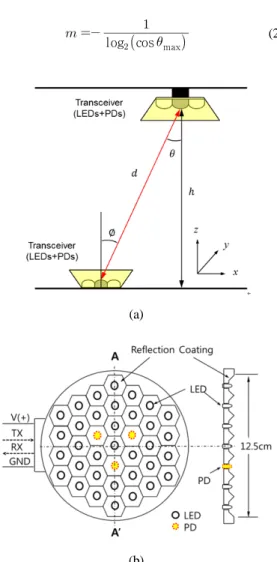
In VLC systems as shown in Figure 1 (a), optical intensity is often constrained by the available in- tensity of the light source and receiver sensitivity.
Since the basic source consists of WLED chips, the angular distribution of radiant output power is mod- eled with a generalized Lambert law [8]:
cos
(1)
where is luminous intensity at the transmitter in
radiation angle and is the maximum luminous intensity. The Lambertian index m depends on the source radiation semi-angle max as:
logcos max
(2)
(a)
(b)
Figure 1: (a) Configuration of VLC, (b) schematic of lighting transceiver with beehive-shaped reflector.
Relevant optical source parameters for data trans- mission are the radiant power and modulation bandwidth. If we restrict our considerations to small distances, the transmission medium of air can be con- sidered to be totally lossless. However, the signal strength decreases for un-collimated light beams due to spatial divergence. For isotropic emitters, the in-
tensity decreases as the square of the distance [9].
However, if the light source consists of n LEDs and they have their own reflectors as shown in Figure 1 (b), a total horizontal illuminance in a LOS channel should be considered as the optical gain by the reflection beam. Since the illuminance increases when the reflectance is higher, it can be written as:
cos
(3)
where is the angle of incidence, is the distance from the source, and is the reflectance of the reflector.
Basically, 34 LEDs, 3 PDs, and a beehive-shaped reflector are included in the transceiver. Each LEDs has its own hexagonal reflector for concentrating the light into the opposite receiving area. Since the trans- mitter beam is larger than the receiver collection aperture, the power collected will generally be pro- portional to the detector area. However, increasing the detector area reduces the available bandwidth. In this work, 3 Si-pin PDs (SHF213, Osram) were selected and placed near the center of the transceiver. They were connected in parallel to increase the effective physical area of a detector. The PDs are isolated among the LEDs, and crosstalk, which is caused by the adjacent LED lights, is inherently blocked.
The relevant parameters are listed in Table 1. The horizontal distribution of illuminance in the LOS channel can be calculated using these parameters.
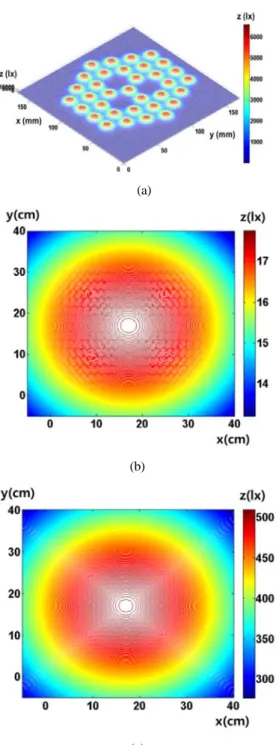
Figure 2 (a) shows the beam profile generated by an array of 34 LEDs. The locations of the 3 PDs are clearly outlined near the center. Figure 2 (b) and (c) show the calculated illuminance distributions at a dis- tance of 2 m. For a no-reflector emitter, maximum il- luminance of less than 20 lx is shown in Figure 2 (b).
This level is not sufficient to support the dual func- tion as an illuminant and transceiver. According to the lighting standards set up by the International Standard
Organization (ISO), the illuminance of the work area and the immediate surrounding areas in the office or workplace is recommended to be at least 500 lx and 300 lx, respectively [3]. In areas where continuous work is carried out, illuminance shall not be less than 200 lx. In order to satisfy the recommend illumination under the same system conditions, most lights should be focused on the work area. Because of the chrome coating on the surface of the hexagonal reflectors, the reflection coefficient is assumed to be 0.7. The dis- tribution of illuminance for reflector-mounted-type emitter is shown in Figure 2 (c). The maximum illu- minance would be around 500 lx.
Figure 3 shows the calculated and measured max- imum illuminance in terms of a distance. Illuminance was measured using a light meter (HD450, Extech).
Each pair of data shows good agreement. This means that the reflectivity of the reflector considered in Eq.
3 is reasonable. For the no-reflector-type emitter, illu- minance is exponentially related to the distance. The peak illuminance is around 500 lx at a distance of less than 0.2 m. However, when the reflector is mounted on the transceiver, the peak illuminance is maintained up to 2 m.
Table 1: Transceiver parameters used in the simulation.
Parameters Without reflector
With hexagonal
reflector Maximal luminous
intensity, 5000 mcd at 20mA Source radiation
semi- angle, max 15° 7°
Reflectance, R 0 0.48
Field of view of the
hemispherical lens, 90°
Physical area of the
detector, 0.3
Height, 2 m
(a)
(b)
(c)
Figure 2: (a) Analytic model of the transceiver.
Horizontal distribution of illuminance in the LOS channel at a distance of 2 m, (b) no reflector, (c) with reflector.
Figure 3: Maximum illuminance as a function of distance from the LEDs to the illuminated point.
The distribution of received optical power on the surfaces of desks in the room is a key concern for a communication. Since the optical receivers mainly consist of a detector and a concentrator, the received optical power is calculated as:
cos
sin
(4)where is the physical area of the detector, is the refractive index and is the field of view of the hemispherical lens of the detector.
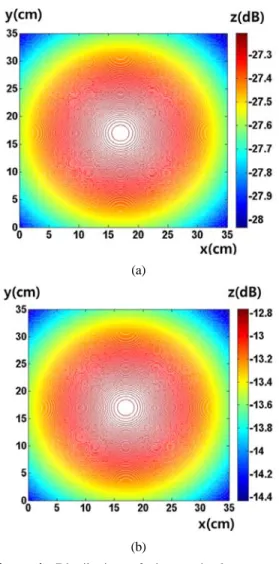
The distribution of the received power at a distance of 2 m is shown in Figure 4. In Figure 4 (a) without a reflector, the link loss is more than -27 dB. By mounting the reflector, the loss can be reduced to less than half of that shown in Figure 4 (a). As shown in Figure 4 (b), the minimum loss is around – 13 dB.
The calculated and measured link losses are com- pared in Figure 5. The loss is measured using an op- tical power meter (ML9001A, Anritsu). The measured values are in good agreement with the calculated ones. We can expect the signal-to-noise ratio (SNR) to be improved by using a reflector.
(a)
(b)
Figure 4: Distribution of the received power at d=2 m: (a) no reflector, (b) with reflector.
Figure 5: Link loss with and without reflector.
3. VLC experiment and results
(a)
(b)
Figure 6: Demonstration system: (a) Block diagram of the bi-directional VLC system, (b) photograph of experimental setup.
Figure 6 (a) shows a bidirectional communication system comprising two lighting transceivers. The pow- er-line communication (PLC) modem is connected to the monitoring PC and then plugged into an outlet. A digital camera module (DCM) is comprised of a 0.3 mega-pixel CMOS image sensor and a digital video
processor (DVP) is used to get a digital image data.
The experimental setup is shown in Figure 6 (b). The distance between the two transceivers was 2 m, and the serial communication rate was set to 115.2 kbps.
A LabVIEW®-based monitoring system on the PC was developed to reproduce the received image file.
Figure 7 shows the monitoring screen. The original image data captured by the CMOS sensor is com- pletely reconstructed at the monitoring program.
Figure 7: Monitoring screen for showing the received image.
4. Conclusion
In this paper, a reflector-mounted transceiver was demonstrated to improve the performance of the indoor lighting system and VLC. By using a diffuse prop- agation model of the LED light, the analytic modeling of the transceiver was executed. As a result, we know that the reflector-mounted lighting system can increase the illuminance and expand the coverage of VLC.
Image capture at the remote camera and its transfer to the monitoring system was also successfully carried out. From the result, we found that a well-designed re- flector contributes to producing a cost-effective visible light transceiver as well as an indoor illuminant.
Acknowledgement
This research was supported by LINC through the National Research Foundation of Korea (NRF) funded by the Ministry of Education
Reference
[1] F. R. Gfeller and U. Bapst, “Wireless in-house data communication via diffuse infrared radia- tion,” Proceedings of the IEEE, no. 67, pp.
1474-1486, 1979.
[2] R. Wang, Y. Yuan, C. Li, Y. Zhang, and X.
Li, “A compact signal transmitter for UV com- munication system,” Journal of Physisc.:
Conference Series, vol. 276, pp. 1-6, 2011.
[3] V. Jungnickel, V. Pohl, S. Nönnig, and C.
Helmolt, “A physical model of the wireless in- frared communication channel,” IEEE Journal on Selected Areas in Communications, vol. 20, no.
3, pp. 631-640, 2002.
[4] J. Grubor, S. Randel, K-D. Langer, and J.
Walewski, “Broadband information broadcasting using LED-based interior lighting,” Journal of Lightwave Technology, vol. 26, pp. 3883-3892, 2008.
[5] T. Komine, S. Haruyama, and M. Nakagawa,
“Performance evaluation of narrowband OFDM on integrated system of power line communica- tion and visible light wireless communication,”
Proceedings of IEEE Wireless Pervasive Computing, pp. 6-11, 2006.
[6] European standard EN 12464-1: Lighting of in- door work places, 2003.
[7] T. Komine and M. Nakagawa, “Fundamental analysis for visible-light communication system using LED lightings,” IEEE Transactions on Consumer Electronics, vol. 50, no. 1, pp.
100-107, 2004.
[8] J. B. Carruthers and J. M. Kahn, “Angle diver- sity for nondirected wireless infrared communi- cation,” IEEE Transactions on Communications.
vol. 48, no. 6, pp. 960-969, 2000.
[9] R. Wang, J. Duan, A, Shi, Y. Wang, and Y. Liu,
“Indoor optical wireless communication system uti- lizing white LED lights,” Asia-Pacific Conference on Communications, pp. 617-621, 2009.