*Corresponding Author :Young-Sik Kang (Chung-Nam National Univ.) Tel: +82-10-5433-4050 email: [email protected]
Received October 18, 2017 Revised November 14, 2017 Accepted December 8, 2017 Published December 31, 2017
누리연계 유아의 숲 체험 미술 활동이 환경 감수성에 미치는 효과
강영식
충남대학교 교육학과 교육대학원 유아교육
The Effects of Children's Art Activities through Forest Experience in Relation with Nuri Curriculum on Their Environmental Sensitivity
Young-Sik Kang
Dept of Early Childhood Education, Chung-Nam National University
요 약 연구목적: 본 연구는 누리 연계 유아의 숲 체험 미술 활동이 환경 감수성에 미치는 영향력을 밝히는 데 목적을 갖고 실증조사 하였다. 연구방법: 어린이집 만 4세 유아 대상 숲체험 미술활동을 16차시 50일간 수행후 실험집단 20명과 통제집단 20명을 대상으로 설문지에 의한 평가 조사후 통계분석 방법을 통해 분석하였다. 연구결과: 유아들의 숲 체험 미술 활동이 환경 감수성에 긍정적인 영향을 미치는 것으로 나타났으며 특히 실험집단에서의 자기인지, 자기조절, 감정이입, 동기부여에 긍정적인 결과를 나타내 발달기 유아들의 누리 과정 연계 숲 체험 미술 활동 교육의 교육적 효과와 유용성을 뒷받침해 준 것으로 평가할 수 있다. 이는 숲 체험 미술 활동이 관찰과 탐색을 이끌어내 유아들에게 미술에 대한 흥미를 발현하는 창의적 인 표현활동과 동시 환경에 대한 긍정적인 태도와 감성적 사고를 갖게 하는 교육적 경험을 제공한다는 측면에서 유용성을 갖는다. 연구결론: 이상의 결과를 볼 때, 유아들의 숲 체험 미술 활동이 유아의 환경감수성에 긍정적인 효과를 미친다는 사실 과 함께 현장의 유아교사들에게 유아 교수학습방법에 보다 유용한 정보를 제공해 줄 수 있을 것으로 생각된다. 따라서 유아 의 숲 체험 미술 활동은 자연을 익히고 환경 친화적인 감성 지능의 증진을 위한 하나의 대안으로 유아 교육 현장에 적극 도입할 필요가 있다.
Abstract Objective: This study examines the effects of children's art activities through forest experience in relation with Nuri curriculum on environmental sensitivity. Method: A survey was administered to an experimental group of 20 children as well as a control group of 20 children for statistical analysis. after 16-class art activities through forest experience were performed to children aged 4 at a daycare center for 50 days. Result: Children's art activities through forest experience in relation with Nuri curriculum had a positive effect on their environmental sensitivity. In particular, their art activities had a positive effect on their self-awareness, self-regulation, empathy and motivation in the experimental group, supporting the educational effects and benefits of developmental children's art activities through forest experience in relation with Nuri curriculum. In other words, art activities through forest experience are useful in terms of providing children with creative expression activities in art by leading to observation and exploration, as well as educational experiences that have positive attitudes toward the environment. Conclusion: As children's art activities through forest experience have a positive effect on their environmental sensitivity, more useful information on teaching-learning methods will be able to be provided to early childhood teachers in the field. Consequently, children's art activities through forest experience need to be actively introduced in the field of early childhood education as an alternative for learning nature and improving environment-friendly emotional intelligence.
Keywords : Art Activities through Forest Experience, Children's Representation Ability, Environmental Sensitivity,
Emotional Intelligence, sensibility
1. 서론
유아교육기관에서 자연을 만나는 방법 중 특히 숲 체 험 미술 활동은 유아들에게 훌륭한 자연학습장이 될 수 있다. 유아들이 숲을 이해하고 탐구하는 미술 활동 속에 서 계절과 날씨의 변화, 식물의 생장, 자연에 대한 책임, 흙의 생명력 등 많은 것을 배울 수 있다. 숲을 통한 자연 체험 미술 활동은 다양성, 소재의 생명성, 활동성뿐만 아 니라 다양한 감각 기관을 자극하고, 반복적인 연중 프로 그램 구상이 가능하며, 활동의 결과물들을 통하여 성취 감을 맛볼 수 있는 특징이 있다. 따라서 유아는 직접 숲 체험 미술 활동을 통해 스스로 사고하고 행동할 수 있는 독립적인 자기 학습과정이 이루어진다[1]. 이러한 과정 에서 유아는 미술 활동에 대해 관찰해 놓은 것을 학습하 는 것이 아니고 사물 자체를 직접 알고 체험함으로써 유 아는 일상생활 속에서 호기심과 궁금증에 의해 자유롭게 경험한 활동들을 자신이 이해한 것으로 정리할 수 있으 며 자신이 작성한 미술 활동지를 또래에게 들려줌으로서 서로의 경험을 나눌 수 있다. 이 같은 표상 활동을 포함 한 재생산적인 미술 활동에 대해 유아들이 자료를 잘 조 직하도록 하게 함으로써 여러 가지 환경적 감수성과 태 도를 긍정적으로 증진하는데 돕는다[2,3].
이 같은 장점으로 인해 최근 숲 체험을 통한 미술 활 동의 가치를 조명하고 이를 교육과정에 적용하기 위한 다양한 접근이 시도되고 있다[4].
이 같은 체험 미술 활동은 재료, 크기, 모양, 형태 질 감 등이 모두 다르고 모든 재료가 자연물이라는 장점을 가지고 있기 때문에 이는 유아들에게 쌓인 에너지를 방 출시키는데 도움을 주고 유아의 부정적일 수 있는 심리 를 긍정적인 방향으로 전환시키는데 유용한 교육적 소재 이다. 이런 점에서 유아들이 교실에서 만족하지 못한 부 분을 숲 체험 미술활동을 통해 유아의 몸과 마음을 조화 롭게 심리적 감수성을 성장 발달시킬 수 있다[5,6,7].
현재 숲체험 활동에 포함된 누리과정의 기본교육 방 향은 기본생활 습관과 질서, 배려, 협력 등 바른 인성을 기르는데 중점을 두어 사람과 자연을 존중하는 5개 영역 을 중심으로 주도적인 경험과 놀이 중심의 통합과정으로 운영할것을 강조하고 있다[4]. 이러한 시대의 흐름에 맞 춰 나약해진 유아들의 몸과 마음을 치유할 수 있는 숲 체험 미술 활동 교육에 바탕을 둔 숲 유치원 교육이 최 근 부각되고 있는 것이다.
이로 인해 최근 숲 유치원을 표방하는 유아교육기관 이 늘어나고 있다. 지자체, 산림청, 수목원 등 공공기관 이 주관하는 숲 체험 교실, 숲 체험 프로그램, 숲 체험 캠프, 가족 숲 행사 등 여러 가지 다양한 프로그램이 운 영되고 있다[8]. 이 같은 숲 체험 활동의 중요성이 부각 되면서 여러 가지 형태의 숲 관련 프로그램이 진행되고 있다. 이들 유치원은 정기적으로 숲으로 가서 숲 체험 활 동을 유아들에게 제공하고 있으며 숲에서의 미술활동 또 한 활발하게 진행하고 있다. 그러나 이 같이 자연체험 교 육이 부각되면서 숲 유치원교육의 근간이 되는 숲 체험 과 미술 활동에 관한 연구들 또한 활발하게 이루어지고 는 있으나 유아의 숲 체험 미술 활동에 따른 환경적 감 수성에 나타나는 감성지능에 어느 정도 영향력을 갖는지 그 결과를 발표한 연구는 아직 미흡한 실정이다. 즉 기존 선행된 연구를 보면 유아의 정서지능에 미치는 영향[9], 창의성과 미술 표현력에 미치는 영향[10], 창의적 사고 와 표현에 미치는 영향[11], 조형미술활동에 미치는 영 향[12], 창의성 발달에 미치는 영향[13], 창의성과 자연 친화적 태도에 미치는 영향[3]등의 연구를 볼 때, 숲 체 험 미술활동을 중심으로 한 양적 연구들이 대부분이나 자연 체험활동을 통한 유아들에게 나타나는 효과 및 현 상을 검증하는 연구에 치중돼 환경감수성에 대한 연구가 부족한 실정이다[17,18].
이에 본 연구에서는 누리연계 숲 체험 미술 활동이 유 아의 환경감수성에 어느 정도 영향력을 미치는지 이를 검증하여 학제적, 실무적 시사점을 제안하는데 본 연구 의 목적을 둔다.
따라서 위의 연구목적을 바탕으로 최근 어린이집 교 육이 자연의 중요성을 인식하고 숲 체험을 표방하고 있 는 숲 유치원이 증가하고 있는 현실에서 숲 체험에서 누 리과정을 연계한 미술활동이 환경감수성에 어느 정도 영 향력을 미치는지 감성 발달과의 연관성을 증명하기 위해 다음과 같이 연구문제를 선정하였다.
1-1. 숲 체험 활동과 연계한 미술 활동이 자기인식(자 아인지) 능력에 영향을 미치는가?
1-2. 숲 체험 활동과 연계한 미술활동이 자기조절(감 정조절) 능력에 영향을 미치는가?
1-3. 숲 체험 활동과 연계한 미술 활동이 타인인식(감 정이입) 능력에 영향을 미치는가?
1-4. 숲 체험 활동과 연계한 미술 활동이 낙관성(긍정 성) 능력에 영향을 미치는가?
2. 연구방법
2.1 연구대상
본 연구는 S시 소재 어린이집 만 4세 유아를 대상으 로 감성지능의 차이를 알아보기 위한 것이다. 이 연구를 수행하기 위해 2017년 7월 3일부터 8월 25일까지 총 50 일간 16차시 활동으로 실험집단 20명과 통제집단 20명 을 대상으로 실험처치를 하였다.
2.2 연구도구
2.2.1 감성지능 평가도구
감성지능검사를 위한 연구도구로는 Daniel Goleman[14]
의 EI(Emotional Intelligency)에 관한 검사지를 기반으 로 하여 다시 유아의 수준에 맞게 신뢰도 및 타당성을 검증한 교사용 감성지능척도가 사용되었다. 감성지능검 사도구의 하위요인은 ‘자기인식 자기조절 타인인식 낙관 성’의 4개로 구분 하였고 각각의 하위요인은 6개의 문항 으로 구성되어 있다. 교사의 평정방식은 5점 Likert 척도 로써 ‘전혀 아니다’에 1점을 배점하고 ‘아주 그렇다’에 5 점을 배점하도록 되어있다. 총점의 범위는 24점에서 120 점이고 채점된 점수의 합이 유아의 감성지능에 대한 점 수이다. 점수의 총점이 높을수록 감성지능이 높은 것을 의미한다. 검사 및 채점은 교사와 유아 간 1:1 개인면접 및 실험 처치 기간 동안 교사가 관찰한 결과를 종합하여 실시하였다
Test Item Content Item
Number Self-Emotion
Awareness Ability to be aware of my emotions 6 Self-Emotion
Regulation
Ability to process and change my perceived emotions appropriately 6 Other
People's Emotion Awareness
Ability to feel other people's emotions as if they is my own and read their
emotions
6
Self- Motivation
A positive/optimistic view of life A measure of happiness that satisfies
life
6 Table 1. Operational Concept and Item Number in
Sub-factors of Emotional Intelligence
본 연구에서 사용된 척도는 자기 인식, 자기조절, 타 인인식, 낙관성으로 4가지 하위요인을 가지며 각 요인별 문항 수는 6개이다.
각 요인별 Cronbach ɑ계수는 Table 2.에서 나타나듯 모두 0.7이상으로 충분히 신뢰할 수 있는 척도라고 할 수 있으며 전체문항에 대한 Cronbach‘ɑ는 0.908로 매우 높은 신뢰도를 가지는 것으로 나타났다.
Component Item
Number
Reliability (Cronbach ɑ) Self-Awareness(Self-Cognition)
Ability 6 .712
Self-Regulation(Emotion
Regulation) Ability 6 .754
Other-Awareness(Empathy)
Ability 6 .860
Optimism(Positive) 6 .709
Reliability .890
Table 2. Reliability by Factors
2.3 연구 절차
본 연구의 전체 진행과정은 예비 연구, 본 연구(사전 검사, 실험 처치, 사후 검사)순으로 이루어졌다.
2.3.1 실험 설계
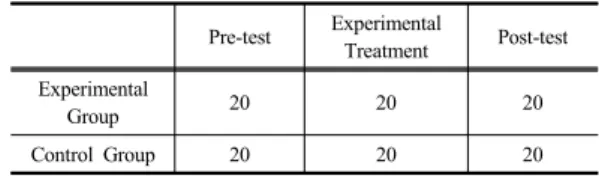
본 연구에서 사용한 연구 방법은 실험 연구 방법으로 기본 실험 설계는 통제집단 실험집단 설계를 이용하였 다. 실험집단과 통제집단의 두 집단으로 나누어 실험처 치 전에 사전검사를 실시하였다. 실험설계는 Table 3.과 같다.
Pre-test Experimental
Treatment Post-test Experimental
Group 20 20 20
Control Group 20 20 20
Table 3. Experimental Design
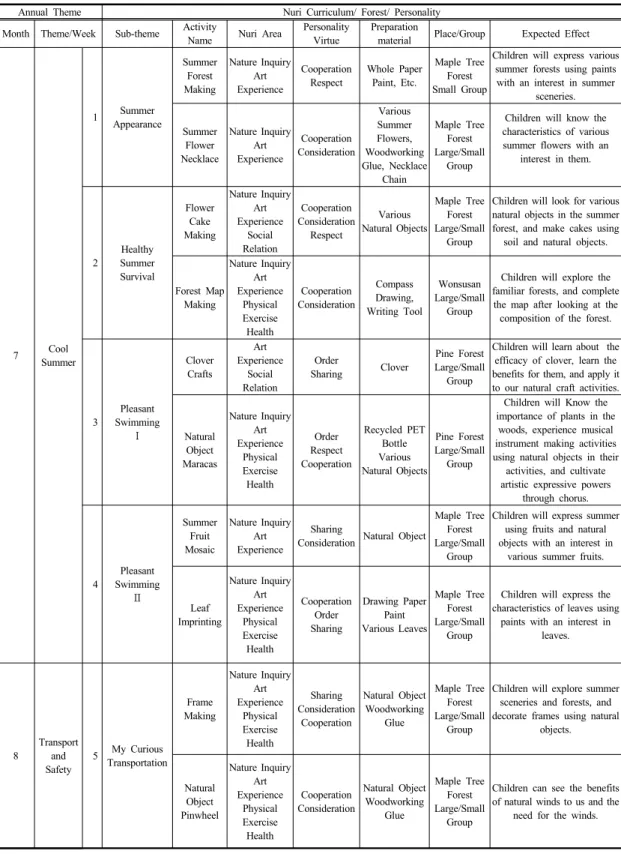
실험 처치 전에 실험집단과 통제집단 유아들에게 검 사 도구를 활용하여 예비검사를 거쳐 사전 검사를 실시 하였다. 실험 기간 동안 실험집단에는 누리연계 숲 체험 미술활동을 일주일에 2회 화요일과 목요일 16차시에 걸 쳐 누리연계 숲 체험 미술활동을 실시하였고 미술활동 후 실내 자유선택놀이시간에 미술확장 활동을 준비하여 실시하였다, 통제집단에는 누리과정에 의한 생활 주제 중심의 미술활동을 실시하였다.
Annual Theme Nuri Curriculum/ Forest/ Personality Month Theme/Week Sub-theme Activity
Name Nuri Area Personality Virtue
Preparation
material Place/Group Expected Effect
7 Cool
Summer
1 Summer
Appearance
Summer Forest Making
Nature Inquiry Art Experience
Cooperation Respect
Whole Paper Paint, Etc.
Maple Tree Forest Small Group
Children will express various summer forests using paints with an interest in summer
sceneries.
Summer Flower Necklace
Nature Inquiry Art Experience
Cooperation Consideration
Various Summer Flowers, Woodworking Glue, Necklace
Chain
Maple Tree Forest Large/Small
Group
Children will know the characteristics of various summer flowers with an
interest in them.
2
Healthy Summer Survival
Flower Cake Making
Nature Inquiry Art Experience
Social Relation
Cooperation Consideration Respect
Various Natural Objects
Maple Tree Forest Large/Small
Group
Children will look for various natural objects in the summer forest, and make cakes using soil and natural objects.
Forest Map Making
Nature Inquiry Art Experience
Physical Exercise Health
Cooperation Consideration
Compass Drawing, Writing Tool
Wonsusan Large/Small
Group
Children will explore the familiar forests, and complete the map after looking at the composition of the forest.
3
Pleasant Swimming
Ⅰ
Clover Crafts
Art Experience
Social Relation
Order
Sharing Clover
Pine Forest Large/Small
Group
Children will learn about the efficacy of clover, learn the benefits for them, and apply it to our natural craft activities.
Natural Object Maracas
Nature Inquiry Art Experience
Physical Exercise Health
Order Respect Cooperation
Recycled PET Bottle Various Natural Objects
Pine Forest Large/Small
Group
Children will Know the importance of plants in the
woods, experience musical instrument making activities using natural objects in their activities, and cultivate artistic expressive powers
through chorus.
4
Pleasant Swimming
Ⅱ
Summer Fruit Mosaic
Nature Inquiry Art Experience
Sharing
Consideration Natural Object
Maple Tree Forest Large/Small
Group
Children will express summer using fruits and natural objects with an interest in
various summer fruits.
Leaf Imprinting
Nature Inquiry Art Experience
Physical Exercise Health
Cooperation Order Sharing
Drawing Paper Paint Various Leaves
Maple Tree Forest Large/Small
Group
Children will express the characteristics of leaves using
paints with an interest in leaves.
8
Transport and Safety
5 My Curious Transportation
Frame Making
Nature Inquiry Art Experience
Physical Exercise Health
Sharing Consideration
Cooperation
Natural Object Woodworking
Glue
Maple Tree Forest Large/Small
Group
Children will explore summer sceneries and forests, and decorate frames using natural
objects.
Natural Object Pinwheel
Nature Inquiry Art Experience
Physical Exercise Health
Cooperation Consideration
Natural Object Woodworking
Glue
Maple Tree Forest Large/Small
Group
Children can see the benefits of natural winds to us and the
need for the winds.
Table 4. Examples of Art Activities through Forest Experience in Relation with Nuri Curriculum(16-Class)
6
Convenient Transportation
Facilities
Summer Pendant Making
Nature Inquiry Art Experience
Physical Exercise Health
Sharing
Consideration Natural Object
Maple Tree Forest Large/Small
Group
Children will make pendants using various natural objects(wooden materials), and look at the points when
using activity materials.
I draw with Insect's
Eyes
Nature Inquiry Art Experience
Physical Exercise Health
Sharing Consideration
Insect Mirror Echo Mirror Drawing Tool
Pine Forest Large/Small
Group
Children will become the eyes of the animals who see
different viewpoints of the animals living in the forest to
see their lives, and find out why they are seeing nature.
7 Future Transportation
I am a fashion designer
Nature Inquiry Art Experience
Social Relation
Cooperation Order Sharing
Whole Paper Woodworking
Glue Natural Object
Maple Tree Forest Large/Small
Group
Children will do natural fashion show activities with
various natural objects in collaboration with their peers.
What color is it?
Nature Inquiry Art Experience
Physical Exercise Health
Cooperation Order Sharing
Cotton Cloth Wooden Hammer Natural Object
Maple Tree Forest Large/Small
Group
Children will experience dyeing using natural objects, explore the process of change, and participate happily with
an interest in dyeing activities.
8 Safe Traffic Culture
Leaf Mask
Nature Inquiry Art Experience
Physical Exercise Health
Consideration Order Cooperation
Various Leaves
Maple Tree Forest Large/Small
Group
Children can make masks using leaves, and express them creatively using natural
objects.
Mandala
Nature Inquiry Art Experience
Physical Exercise Health
Cooperation Consideration
Sharing
Various Natural Objects
Maple Tree Forest Large/Small
Group
Children will participate actively in decorating activities using various natural objects, and resolve
conflicts with other peers through negotiation.
2.3.1.1 예비연구
이 연구를 위한 예비 검사도구의 적절성과 내용 및 소 요시간 등을 파악하기 위해 이 연구를 실시하기 전 2017 년 6월 12일에서 6월 17일 까지 이 연구의 참여하지 않 는 만 4세 여아 5명, 남아 5명 총 10명의 유아를 대상으 로 예비검사를 실시하였으며 이때 나타나는 유아들의 흥 미, 수준, 반응, 적절한 시간을 관찰 및 기록하여 활동 진 행을 분석함으로써 실험처치 과정에서 발생할 수 있는 부족한 점의 재검토 하여 숲 체험 활동과 미술 활동을 계획하는데 참고하였다. 예비연구 결과를 통해 유아의 숲 체험 활동은 50분 정도로 계획하여 진행하고 미술 활 동 시간은 도입과 준비를 마무리 평가를 마치고 50분으 로 계획된 활동내용에 따라 확장 활동을 융통성 있게 조 절하여 실시하였다.
2.3.1.2 검사를 위한 교사훈련
이 연구는 2017년 6월 19일에서 6월 23일까지 첫째, 실험집단과 비 실험 집단 유아교사 2인에게 숲 체험 놀
이를 연계한 누리과정 조형 활동에 대한 이연구의 목적 과 필요성, 감성지능의 개념에 대해 설명해 주었다.
둘째, 숲 체험 활동에 대한 프로그램 운영에 대한 앞 으로의 전반적인 활동 내용에 대한 계획 및 활동 시 유 의점 등에 대해 설명해 주고 안내하였다.
셋째, 감성지능에 대한 유아들의 상호작용과 실험진 행절차를 바탕으로 숲 체험 활동 놀이와 미술활동이 원 만하게 운영될 수 있도록 지원하였다.
넷째, 검사도구의 내용과 목적, 평정척도 방법, 항목 별 문항에 내한 질문내용의 이해, 검사요령 등에 대해 설 명해주고 체크리스트 방법을 말해 주었다. 이 연구에서 참여한 검사자는 실험집단 교사 1인, 통제집단 교사 1인, 각각의 교실에 누리보조교사 1인과 연구자 이다. 3인의 검사자간의 평정 일치도를 위하여 실험집단 및 통제집단 의 유아를 대상으로 자유선택활동 시간에 유아 1인당 1 시간 동안 촬영한 영상을 보면서 연구자와 검사자 2인이 감성지능검사를 실시하는 것을 확인하고 분석해 본 결과 별 무리가 없는 것을 확인하고 이 연구의 도구로 확정하
Experimental Group Comparative Group
Frequency
Art Activities through Forest Experience in Relation with Nuri Curriculum:
A Total of 16 Times
(Plan-Practice-Retrospection-Appraisal-Extension)
Total: 16
(Art Activity in Relation with Nuri Curriculum)
Experiment Time Morning Free Choice Play Time Morning Free Choice Play Time
Group Composition Individual, Small Group, Large Group Individual, Small Group, Large Group Life Theme-Based
Nuri Curriculum July: Cool Summer August: Transport and Safety
Activity Method
Linkage with secondary extension activities by expressing artistic sensitivity through cooperative art activities in the prepared forest by group
in preparation for art activity play related to theme of Nuri curriculum
Combination of art activities with life theme of Nuri curriculum
Activity
ActivityⅠ Preparation of required materials and tools in forest art activities linked with Nuri curriculum
Combination of art activities with life theme of Nuri curriculum
ActivityⅡ
Practice of activities in the forest with prepared materials or tools:
Introduction→Development→Finish→Appraisal→Exten sion Activities
Practice of art activities in class Table 5. Experimental Design
여 사용하였다.
2.3.1.3 사전검사
숲 체험 활동 후 누리연계 조형 활동을 실시하기 전에 실험집단과 통제집단의 동질성 여부를 알아보기 위하여 유아 40명을 대상으로 2017년 6월 26일부터 6월 30일까 지 감성지능 사전검사를 실시하였다.
2.3.1.4 실험처치
이 연구에서는 누리연계 숲 체험 활동이 감성지능에 미치는 영향을 알아보기 위해 2017년 7월 3일~ 2017년 8월 25일까지 일주일에 2회씩 화요일과 목요일 모두 16 회기에 걸쳐 실험이 실시되었다. 이때 실험집단에서는 계획된 주제로 이야기 나누기를 한 후 누리 연계 숲 체 험 미술 활동을 기관 가까운 근처 숲 공원에서 다양한 방법으로 표상하기를 통하여 표현해보기, 자연물 그리 기, 조형 활동 만들기, 퍼포먼스 등을 실시하였다 물감, 크레파스, 사인펜, 재활용품, 생활용품, 사인펜, 색종이, 자연물 등의 다양한 재료를 통하여 자유롭게 표현할 수 있는 환경을 제공 해 주고, 활동시간 외에 확장 활동을 돕기 위해 자유 선택 활동 시간에도 활동이 지속되고 확 장될 수 있도록 영역별로 숲에서 활동한 주제와 관련된 워크북과 관련 자료들을 배치해 주었다. 비 실험 집단 활 동은 누리과정 미술 활동과 관련된 활동 후 자유선택 놀 이를 하도록 하였다.
진행은 같은 시간 오전 10:30∼11:30 사이 화요일과 목요일에 실시하였다.
실험집단의 진행방법과 참고는 이예슬[15]의 실외놀
이 활동과 연계한 조형 활동이 만3세 유아의 감성지능에 미치는 영향이라는 연구를 토대로 수정·보완하여 참고하 였다.
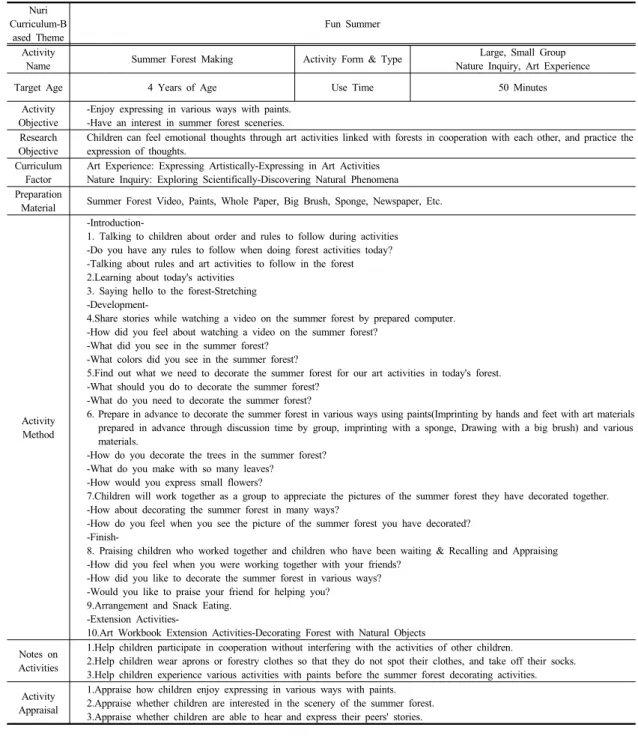
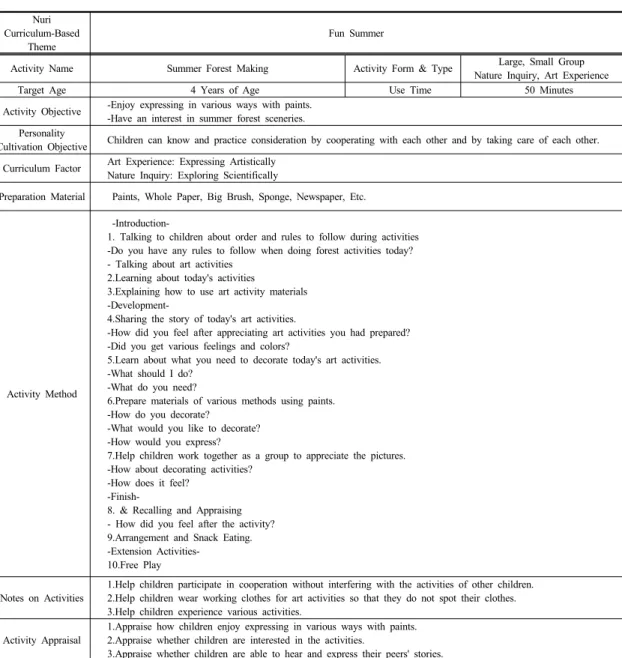
실험집단의 비 실험 집단 미술활동 연구의 과정과 실 험집단의 1차∼16차시 활동계획안 예시는 계획안은 다 음과 같다.
2.3.1.5 사후검사
실험처치가 끝난 후 실험처치의 효과를 검증하기 위 하여 실험집단과 통제집단을 대상으로 사전검사와 동일 한 방법으로 2017년 8월 28일에서 2017년 8월 31일까 지 사후검사를 사전검사와 동일한 방법으로 실시하였다.
2.4 분석방법
연구 자료 분석을 위하여 Windows SPSS 18.0 통계 프로그램을 활용하였다. 연구 대상자의 빈도분석과, 실 험집단과 통제집단의 평균 차이를 알아보기 위하여 t-test와 비모수검정 Wilcoxon Signed rank test를 실시 하였다.
3. 연구결과
3.1 감성지능의 그룹 간 동질성
실험집단과 통제집단의 동질성 여부를 파악하기 위해 감성지능의 ‘자기인지’, ‘자기조절’, ‘감정이입’, ‘자기동 기부여’ 4가지 요인에 대하여 독립표본 t-test를 통하여 사전검사에 대한 두 집단이 동질적인 집단임을 확인하기
Nuri Curriculum-B
ased Theme
Fun Summer
Activity
Name Summer Forest Making Activity Form & Type Large, Small Group
Nature Inquiry, Art Experience
Target Age 4 Years of Age Use Time 50 Minutes
Activity Objective
-Enjoy expressing in various ways with paints.
-Have an interest in summer forest sceneries.
Research Objective
Children can feel emotional thoughts through art activities linked with forests in cooperation with each other, and practice the expression of thoughts.
Curriculum Factor
Art Experience: Expressing Artistically-Expressing in Art Activities Nature Inquiry: Exploring Scientifically-Discovering Natural Phenomena Preparation
Material Summer Forest Video, Paints, Whole Paper, Big Brush, Sponge, Newspaper, Etc.
Activity Method
-Introduction-
1. Talking to children about order and rules to follow during activities -Do you have any rules to follow when doing forest activities today?
-Talking about rules and art activities to follow in the forest 2.Learning about today's activities
3. Saying hello to the forest-Stretching -Development-
4.Share stories while watching a video on the summer forest by prepared computer.
-How did you feel about watching a video on the summer forest?
-What did you see in the summer forest?
-What colors did you see in the summer forest?
5.Find out what we need to decorate the summer forest for our art activities in today's forest.
-What should you do to decorate the summer forest?
-What do you need to decorate the summer forest?
6. Prepare in advance to decorate the summer forest in various ways using paints(Imprinting by hands and feet with art materials prepared in advance through discussion time by group, imprinting with a sponge, Drawing with a big brush) and various materials.
-How do you decorate the trees in the summer forest?
-What do you make with so many leaves?
-How would you express small flowers?
7.Children will work together as a group to appreciate the pictures of the summer forest they have decorated together.
-How about decorating the summer forest in many ways?
-How do you feel when you see the picture of the summer forest you have decorated?
-Finish-
8. Praising children who worked together and children who have been waiting & Recalling and Appraising -How did you feel when you were working together with your friends?
-How did you like to decorate the summer forest in various ways?
-Would you like to praise your friend for helping you?
9.Arrangement and Snack Eating.
-Extension Activities-
10.Art Workbook Extension Activities-Decorating Forest with Natural Objects Notes on
Activities
1.Help children participate in cooperation without interfering with the activities of other children.
2.Help children wear aprons or forestry clothes so that they do not spot their clothes, and take off their socks.
3.Help children experience various activities with paints before the summer forest decorating activities.
Activity Appraisal
1.Appraise how children enjoy expressing in various ways with paints.
2.Appraise whether children are interested in the scenery of the summer forest.
3.Appraise whether children are able to hear and express their peers' stories.
Table 6. Primary Art Activities of Experimental Group in Nuri Curriculum(Example) 위함이다. 통제집단과 실험집단의 두 집단 간 동질성 검
증의 결과를 살펴보면 아래 Table 1.과 같다. ‘자기인지’
에 대하여 통제집단이 실험집단의 차이는 t=.188 p=.852,
‘자기조절’은 t=1.525 p=.134, ‘감정이입’ t=.1.292 p=.204, ‘자기동기부여’ t=.475 p=.638로 나타났으며, 전 체적으로 통제집단과 실험집단도 t=1.484 p=.146으로
하위요인과 더불어 유의한 차이가 있다고 할 수 없다. 두 집단은 감성지능에 있어서 동질적인 집단으로 판단되었다.
3.2 감성지능의 효과 검증
실험집단과 통제집단에서 사전검사와 사후검사를 통 해 본 연구의 감성지능의 향상여부와 그에 대한 프로그
Nuri Curriculum-Based
Theme
Fun Summer
Activity Name Summer Forest Making Activity Form & Type Large, Small Group
Nature Inquiry, Art Experience
Target Age 4 Years of Age Use Time 50 Minutes
Activity Objective -Enjoy expressing in various ways with paints.
-Have an interest in summer forest sceneries.
Personality
Cultivation Objective Children can know and practice consideration by cooperating with each other and by taking care of each other.
Curriculum Factor Art Experience: Expressing Artistically Nature Inquiry: Exploring Scientifically
Preparation Material Paints, Whole Paper, Big Brush, Sponge, Newspaper, Etc.
Activity Method
-Introduction-
1. Talking to children about order and rules to follow during activities -Do you have any rules to follow when doing forest activities today?
- Talking about art activities 2.Learning about today's activities 3.Explaining how to use art activity materials -Development-
4.Sharing the story of today's art activities.
-How did you feel after appreciating art activities you had prepared?
-Did you get various feelings and colors?
5.Learn about what you need to decorate today's art activities.
-What should I do?
-What do you need?
6.Prepare materials of various methods using paints.
-How do you decorate?
-What would you like to decorate?
-How would you express?
7.Help children work together as a group to appreciate the pictures.
-How about decorating activities?
-How does it feel?
-Finish-
8. & Recalling and Appraising - How did you feel after the activity?
9.Arrangement and Snack Eating.
-Extension Activities- 10.Free Play
Notes on Activities
1.Help children participate in cooperation without interfering with the activities of other children.
2.Help children wear working clothes for art activities so that they do not spot their clothes.
3.Help children experience various activities.
Activity Appraisal
1.Appraise how children enjoy expressing in various ways with paints.
2.Appraise whether children are interested in the activities.
3.Appraise whether children are able to hear and express their peers' stories.
Table 7. Primary Art Activities of Non-experimental Group in Nuri Curriculum(Example) 램에 대한 효과를 알아보기 위해 각각 대응 표본t-test를
실시하였다. 대응 표본 t-test에 앞서 먼저 정규성검토를 실시한 후 정규성을 따를 때 대응표본 t-test를 실행하고, 정규성을 따르지 않을 때 비모수적 방법인 윌콕슨 부호 순위 검정(Wilcoxon signed rank test)을 통해 대응 표본 의 차이를 알아본다. Table 9.는 통제집단과 실험집단의 정규성 검정을 한 결과이다. Shapiro-Wilk 통계량 W를 따르면 ‘자기인식’에 대한 통제집단은 유의확률 .001로 귀무가설을 기각하여 사전, 사후 정규성을 따르지 않는
것으로 나타났으며, 이에 대하여 윌콕슨 부호 순위 검정 을 통해 사전-사후 차이가 유의한지 확인하며, 이를 제외 한 정규성을 보인 항목에서는 대응표본 t-test를 진행하 였다.
3.2.1 통제집단의 자기인식요인의 사전 사후 차이 통제집단의 자기인식 사전, 사후에 대한차이를 확인 한기 위하여 윌콕슨 부호 순위 검정을 실시하였다. 결과 는 다음 Table 10.과 같이 볼 수 있다. 검정결과 통계량
Z값은 –3.785, 유의확률 p<.001로 유의수준 .05에서 유 의하다 할 수 있으며, 즉 통제집단의 자기인지요인에 대 하여 사전, 사후 차이가 있음을 확인 하였다.
Variable Pre-test
Control Experiment
Self-Awareness
N 19 20
M(SD) 1.523(.195) 1.517(.120)
t(p) .188(.852)
Self-Regulation
N 19 20
M(SD) 1.728(.209) 1.633(.176)
t(p) 1.525(.134)
Empathy
N 19 20
M(SD) 1.570(.160) 1.505(.155)
t(p) 1.292(.204)
Self-Motivation
N 19 20
M(SD) 1.658(.203) 163(.229)
t(p) .475(.638)
Total
N 19 20
M(SD) 1.621(.113) 1.570(.099)
t(p) 1.484(.146)
Table 8. Homogeneity Verification of Emotional
Table 9. Normality Test Experimental
Group
Kolmogorov- Smirnova
Shapiro-Wilk
Statistics df p W df p
Self- Awareness
Control .289 18 .000 .795 18 .001 Experiment .181 19 .103 .942 19 .283 Self-
Regulation
Control .150 18 .200* .959 18 .580 Experiment .166 19 .175 .934 19 .202 Empathy Control .230 18 .013 .932 18 .209 Experiment .241 19 .005 .907 19 .064 Self-
Motivation
Control .203 18 .048 .935 18 .242 Experiment .163 19 .200* .925 19 .138
*. This is a value for the lower limit of significance probability of being true.
a. Lilliefors Modification of significance probability
Variable Control Group
Pre Post
Self-Awareness
N 20 20
M(SD) 1.517(.194) 1.867(.245)
Z(p) -3.785***
*** p<.001
Table 10. The Result of Wilcoxson Signed-Rank Test
of Self-Awareness
3.2.2 정규성을 따르는 통제집단의 감성지능 효과 검증
통제집단의 ‘자기조절’, ‘감정이입’, ‘자기동기부여’
요인에 대한 사전-사후 차이에 대한 t-test결과는 아래의 Table 11.과 같다. 자기조절은 사전 평균 1.725점에서 사 후 2.108점으로 상승하였으며, 감정이입은 1.676에서 1.982, 자기동기부여는 1.512에서 1.982로 모두 평균 약 .3 ~ .4의 상승한 것을 확인 할 수 있었고, 이에 대한 유 의확률은 자기조절 p<.001, 감정이입 p<.001, 자기동기 부여 p=.001로 유의수준 .05에서 유의한 차이가 있음을 알 수 있다.
Variable Control Group
Pre-test Post-test
Self-Awareness
N 18 18
M(SD) 1.725(.204) 2.108(.231)
t(p) -6.204***
Empathy
N 18 18
M(SD) 1.676(.194) 1.982(.228)
t(p) -6.756***
Self- Motivation
N 18 18
M(SD) 1.512(.194) 1.982(.228)
t(p) -4.267(.001)
*** p<.001
Table 11. Comparison between Pre and Post of Control
실험집단의 사전-사후에 대한 차이 비교 결과 다음의 Table 12.와 같다. 자기인지는 사전 평균 1.509에서 사후 4.233으로 증가하였으며, 자기조절은 1.640에서 4.333으 로 감정이입은 1.500에서 4.301로, 자기동기부여는 1.632에서 4.316으로 모든 항목에서 큰 폭으로 상승한 것을 확인 할 수 있으며, 이에 대한 유의확률은 p<.001 로 자기인지, 자기조절, 감정이입, 자기동기부여 모두 유 의수준 .05에서 유의한 차이가 있음을 알 수 있다.
Variable Experimental Group
Pre Post
Self-Awareness
N 19 19
M(SD) 1.509(.118) 4.233(.209)
t(p) -45.039***
Self-Regulation
N 19 19
M(SD) 1.640(.178) 4.333(.289)
t(p) -39.059***
Empathy
N 19 19
M(SD) 1.500(.157) 4.301(.231)
t(p) -56.373***
Self-Motivation
N 19 19
M(SD) 1.632(.233) 4.316(.235)
t(p) -36.174***
*** p<.001
Table 12. Comparison between Pre and Post of
Experiment Group
3.3 통제집단과 실험집단의 사후 차이
앞서 통제집단과 실험집단의 사전-사후에 대한 차이 가 있음을 확인하였으며, 본 연구의 집단별 사후효과에 대한 차이가 나는지 확인하기 위하여 독립표본 t-test를 통하여 통제집단과 실험집단의 사후 차이를 검증하기 위 함이다. 집단별 사후실험에 대한 차이는 자기인지 통제 군 평균 1.867, 실험군 평균 4.232로 실험군 평균이 2.366점 더 높게 측정이 되었으며, 자기조절은 통제집단 2.108 실험집단 4.333으로 실험집단이 2.225점 높으며, 감정이입은 통제집단 1.921 실험집단 4.307점으로 실험 집단이 2.386 더 높은 것을 확인 할 수 있다. 마찬가지로 자기동기부여에 대하여 통제집단 1.973, 실험집단 4.297 로 실험집단이 2.333점 더 높았으며, 전체 감성지능 평 균 통제군은 1.973, 실험집단 4.271로 실험집단이 2.324 점 높게 나타났고, 이에 대한 차이의 유의성은 모든 항목 에서 유의확률 p<.001로 유의수준 .05에서 통제집단과 실험집단의 사후실험에 대하여 유의한 차이가 있다고 할 수 있다.
Variable After Effect
Control Experiment
Self-Awareness
N 20 19
M(SD) 1.867(.245) 4.232(.209)
t(p) -32.332***
Self-Regulation
N 20 19
M(SD) 2.108(.231) 4.333(.288)
t(p) -26.638***
Empathy
N 19 19
M(SD) 1.921(.238) 4.307(.231)
t(p) -31.361***
Self-Motivation
N 19 19
M(SD) 1.983(.221) 4.316(.235)
t(p) -31.495***
Total
N 20 19
M(SD) 1.973(.146) 4.297(.107)
t(p) -56.495***
*** p <.001
Table 13. Difference in Post by Group
3.4 가설 검증 결과
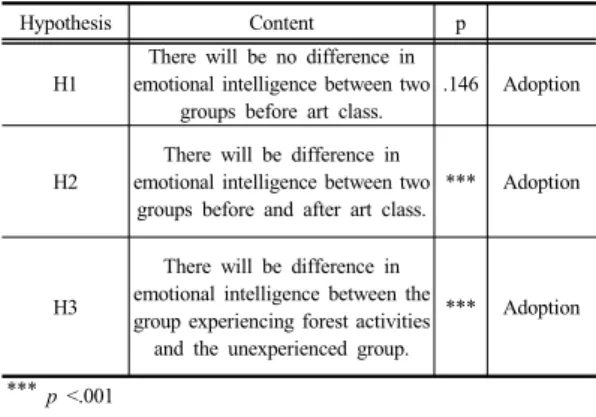
본 연구 가설1은 ‘조형, 미술 수업 이전의 두 집단 간 의 감성지능 차이는 없을 것이다.’에 대하여 유의확률 p=.146으로 귀무가설을 기각하지 못하여 두 그룹간의 차이가 없음을 확인 할 수 있었다. 가설 2는 ‘조형, 미술 수업의 이전과 이후의 차이가 두 집단 모두 있을 것이
다.’에 대한 가설 검증 결과 유의확률 p< .001로 두 집단 모두 조형, 미술 수업의 이전 이후의 차이가 있음을 확인 할 수 있었다. 가설3은 ‘숲 체험활동을 경험한 그룹과 미 체험 그룹의 감성지능의 차이가 있을 것이다.’에 대하여 유의확률 p<.001로 숲 체험활동이후 유아들의 조형, 미 술 수업 이후 감성지능의 차이가 비실험집단 체험 유아 들보다 높게 나타났으며 유의수준 .05에서 유의미한 차 이임을 확인 하였다.
Hypothesis Content p
H1
There will be no difference in emotional intelligence between two
groups before art class.
.146 Adoption
H2
There will be difference in emotional intelligence between two
groups before and after art class.
*** Adoption
H3
There will be difference in emotional intelligence between the group experiencing forest activities
and the unexperienced group.
*** Adoption
*** p <.001
Table 14. The Result of Hypothesis Test
4. 결론
전체적으로 유아들의 숲 체험 미술 활동이 환경 감수 성에 긍정적인 영향을 미치는 것으로 나타났으며 특히 실험집단에서의 자기인지, 자기조절, 감정이입, 동기부 여에 긍정적인 결과를 나타내 성장기 유아들의 누리 과 정 연계 숲 체험 미술 활동 교육의 교육적 효과와 유용 성을 뒷받침해 준 것으로 평가할 수 있다.
이는 숲 체험 미술 활동이 관찰과 탐색을 이끌어내 유 아들에게 미술에 대한 흥미를 발현하는 창의적인 표현활 동과 동시 환경에 대한 긍정적인 태도와 감성적 사고를 갖게 하는 교육적 경험을 제공한다는 관점에서 학제적 시사점을 갖는다. 즉 숲은 하루하루 모든 생명체, 사계절 변화 등 매일같이 다르게 변화하고 있는 자연 속에서 유 아들이 숲 체험 미술활동을 통해 다양한 종류의 자연 재 료를 탐색하고 만지고 놀이하고 작품화하면서 자연스럽 게 경험과 탐색을 통해 학습이 이루어짐과 동시 미술 활 동을 통한 유아의 창의적 표현이 유아들에게 기쁨과 만 족을 주고 이를 통한 자유로운 표현활동은 유아들의 감
수성을 함양시켜 종국적으로 조형적 능력의 개발과 사물 을 인지하는 감성적 사고 능력을 배울 수 있는 기초ㄹ르 쌓게 함으로써 이는 결국 긍정적인 환경감수성을 갖게됨 을 의미한다.
이 같은 결과는 숲 체험 미술 활동이 유아들 자신의 생각과 느낌을 의사소통으로 전달하기 위한 표현방법으 로 적합함을 시사한다. 즉 숲체험형 활동이 만들고 그리 고 꾸밈을 통해 표출하는 수단에 있어 언어보다 보다 효 과적인 매개체로서 유아가 자신의 내면세계를 표출하는 소통의 수단으로 유아가 끊임없이 자연 속에서 탐색하고 경험하는 과정을 통해 자신의 욕구를 만족시키고 사회 적·정서적인 면에서 인격을 형성하는데 좋은 소재이기 때문이다. 이는 이규선 외[16]가 밝힌 유아의 숲활동 미 술활동이 표현, 이해, 감상 등을 통해 감성적 지능을 더 욱 풍부하게 해준다는 선행 연구를 뒷받침해 줄 결과로 해석할 수 있어 본 연구의 유용성을 뒷받침해 준다. 이와 같이 유아들의 숲 체험 미술 활동이 유아의 환경감수성 에 긍정적인 효과를 미친다는 실험적 사실과 함께 현장 의 유아교사들에게 유아들의 숲체험 미술활동이 교수학 습방법에 보다 유용한 정보를 제공해 줄 수 있을 것으로 생각된다. 따라서 유아의 숲 체험 미술 활동은 자연의 체 험을 통해 학습하고 환경 친화적인 감성 지능의 증진을 통한 하나의 대안으로 유아 교육 현장에 적극 도입할 필 요가 있다.
숲 체험 미술활동은 유아들의 탐구활동 차원의 미술 의 단순 놀이기능이 아닌 미술 활동에 대한 이해와 감성 적 활동도 함께 이루어지는 교육이다. 따라서 유아들의 미술활동은 예술적인 감성을 자연스럽게 표현할 수 있는 바탕으로서 신체적, 창의적, 정서적, 심미적, 사회성까지 의 발달을 고려하여 특히 오감을 활용한 미술활동을 통 해 환경에 대한 긍정적인 태도와 감수성을 깨워주는 바 탕으로 자기인식과 자기조절, 감정이입, 동기부여에 긍 정적인 교육적 효과를 기대할 수 있을 것이다.
마지막으로 본 연구에 참여한 유아는 S시에 소재한 T 어린이집의 만 4세 실험집단 유아 20명과 B어린이집 만 4세 통제집단 20명으로 임의 선정한 연구로서 모든 유 아들에게 일반화하기에는 제한점이 있을 것으로 보인다.
따라서 추후 연구에 전국적 표준에 의한 표본의 선정을 통한 후속적 연구가 요구된다.
References
[1] E. H. Yang, “Art of Dislocation, Exile, and Diaspora : Korean Artists in New York in the 1960s and 1970s”, The Journal of Art Theory & Practice, vol. 16, pp.
107-137, 2013.
[2] N. E. Kwak, “A Study on the Play and Personality Education in Forest Kindergarten”, Korean Society for Holistic Convergence Education, vol. 15, no. 3, pp.
1-23, 2011.
[3] S. Y. Lee., J. T. Im., E. J. Kim., J. E. Song., “A study on a developmental plan for korean-style forest kindergarten by analyzing the present status and the actual condition of operational forest kindergarten in early childhood education institutions nationwide”, The Korean Society For Eco-Early Childhood Education, vol. 14 no. 1, pp. 239-267, 2015.
[4] The department of Education, Kindergarten education course commentary(1), 2011.
[5] H. A. Lee., Early Childhood Art Education. Chang-Ji Publishers, 2009.
[6] J. T. Im., J. Y. Ha., J. Y. Sin, Kindergarten operation manual for kindergarten and day care center, Gong Dong Che Publisher, 2013.
[7] S. S. Bae., Walk through the forest of hearts. Good Thinking People Publisher, 2011.
[8] E. S. Kim. A Study on the First Forest Preschool Education in Korea - Focused on Forest Preschool in Incheon University. Master’s Thesis from Graduate School at Incheon University, 2010.
[9] K. J. Yang. (The) effects of ecological art education on the personality development of children in the preschematic stage. Master’s Thesis from Graduate School at Hanyang University, 2009.
[10] D. Y. Kim., W. S. Choi. Children's Art Therapy, Jungmun Publisher, 2001.
[11] K. H. Kim. Development of the model integrated fine arts education program for young children centered on aesthetic elements. Master’s Thesis from Graduate School at Kyungsung University, 2011.
[12] Y. A. Lee. The Aesthetic Basis in the Theory and Practice of the Art Education for Young Children.
Journal of philosophy, vol. 47, pp. 247-276, 2007.
[13] M. H. Lee. (The)Development and Effects of the Nature-Friendly Art Education Program for Young Children. Master’s Thesis from Graduate School at Junnam University, 2009.
[14] Daniel Goleman, Emotional Intelligence, NLP WORLD.
vol. 5 no. 2, pp. 59-60, 1998.
[15] Y. S. Lee. The influence of formative activities in outdoor play activities on emotional intelligence of 3 years old infants. Master’s Thesis from Graduate School at Dongkuk University, 2016.
[16] K. S. Lee., D. Y. Jung., S. S. Jeon, Introduction to Art Education. Education Science History Publisher,1994.
[17] Woo-Young Kim, Hyeyoung Jung, “Perception of Early Childhood Teachers on Aesthetic Approach by Q
Methodology”, Asia-pacific Journal of Multimedia Services Convergent with Art, Humanities, and Sociology, vol. 7, no. 5, pp. 395-407, May 2017.
DOI: http://dx.doi.org/10.14257/ajmahs.2017.05.83 [18] Hyoun-Kyoung Moon, “A Study on the Experience of
Early Childhood Teachers for Art Education and Visual Culture”, Asia-pacific Journal of Multimedia Services Convergent with Art, Humanities, and Sociology, vol. 7, no. 7, pp. 17-25, July 2017.
DOI: http://dx.doi.org/10.14257/ajmahs.2017.07.09
강 영 식(Young-Sik Kang) [정회원]
•2004년 2월 : 원광대학교 유아교육 전공 (문학박사)
•2006년 8월 : 원광대학교 사회복지 학과 전공 (사회복지학박사)
•2012년 1월 ~ 현재 : 충남대학교 교육학과 교육대학원
(유아교육 전공교수)
<관심분야>
부모교육, 유아교육, 숲교육