Comparison of Motor Skill Acquisition according to Types of Sensory- Stimuli Cue in Serial Reaction Time Task
Purpose: The purpose of this study is to investigate whether types of sensory-stimuli cues in terms of visual, auditory, and visuoauditory cues can be affected to motor sequential learning in healthy adults, using serial reaction time task.
Methods: Twenty four healthy subjects participated in this study, who were randomly allocated into three groups, in terms of visual-stimuli (VS) group, auditory-stimuli (AS) group, and visuoauditory-stimuli (VAS) group. In SRT task, eight Arabic numbers were adopted as presentational stimulus, which were composed of three different types of presentational modules, in terms of visual, auditory, and visuoauditory stimuli. On an experiment, all subjects performed total 3 sessions relevant to each stimulus module with a pause of 10 minutes for training and pre-/post-tests. At the pre- and post-tests, reaction time and accuracy were calculated.
Results: In reaction time, significant differences were founded in terms of between-subjects, within-subjects, and interaction effect for group x repeated factor. In accuracy, no significant differences were observed in between-group and interaction effect for groups x repeated factor. However, a significant main effect of within-subjects was observed. In addition, a significant difference was showed in comparison of differences of changes between the pre- and post-test only in the reaction time among three groups.
Conclusion: This study suggest that short-term sequential motor training on one day induced behavioral modification, such as speed and accuracy of motor response. In addition, we found that motor training using visual-stimuli cue showed better effect of motor skill acquisition, compared to auditory and visuoauditory-stimuli cues.
Key Words:Motor sequential learning, Sensory-stimuli cues, Serial reaction time task Yong Hyun Kwon1, Myoung Hee Lee2
1Department of Physical Therapy, Yeungnam University College, 2Department of Physical Therapy, College of Science, Kyungsung University
The Journal of Korean Society of Physical Therapy Original articles
I. Introduction
Motor sequential learning lead to relatively permanent changes in the capability for skilled behavioral modification, through a set of processes associated with repetitive practice and experience.1,2 It is a truly critical part of our life to successfully perform physical activities, and operates from interaction with the task and the environment.3 Numerous
Copylight ⓒ 2014 The Korea Society of Physical Therapy
This is an Open Access article distribute under the terms of the Creative Commons Attribution Non-commercial License (Http:// creativecommons.org/license/by-nc/3.0.) which permits unrestricted non-commercial use, distribution,and reproduction in any medium, provided the original work is properly cited.
Received May 19, 2014 Revised Jun 11, 2014 Accepted Jun 13, 2014
Corresponding author Myoung Hee Lee, [email protected]
attempts have been tried to describe more exactly the factors and mechanisms that influence modification or acquisition of movement, because of its own significance in daily life of human. Motor skill learning can be inferred from behavioral changes, although it is impossible to directly measure movement modification. Therefore, in order to assess the degree of the motor skill learning, various kinetic and kinematic measurements have been used, in terms of tracking task, movement aiming task, serial reaction time (SRT) task, and so forth.4-7 In particular, SRT task is one of the most popular measurement tools for evaluation of motor sequential learning over two decades,8 on account of convenient composition of task paradigm and obvious detection of movement modification. Many previous studies reported that
SRT task reflected behavioral changes through decrease of reaction time and increase of correct responses.5,9-14
It is well-known that amount of practice and internal/
external feedback are critically affected to enhancement of the motor skill acquisition.3,15 So, academic interests of many previous researcher had focused on types and application methods of the feedback to efficiently improve motor skill learning.16-19 The feedback is generally composed of visual, auditory, tactile, visuoauditory cues, and so forth.18 According to Lee et al’s study,20 choice of motor response was influenced by types of stimulated cue, in terms of visual, auditory, and visuoauditory cues. In addition, types of stimulated sensory cue induced motor output have widely used as therapeutic tool for patients with neurological injury in field of rehabilitation.
Therapeutic frame of proprioceptive neuromuscular facilitation emphasized that visual and auditory cues were essential components for giving rise to desired motor output.21
A few studies regarding which type of sensory-stimuli cues more strongly affected to changes of movement speed and accuracy following motor skill acquisition were rare, although sensory-stimuli types such as visual or auditory cues were evident. Therefore, in the current study, we aimed to investigate the question of whether types of sensory- stimuli cues in terms of visual, auditory, and visuoauditory cues influenced efficiency of sequential motor skill acquisition, and to provide results that can be used by clinicians in consideration of this factor in training of motor learning.
II. Methods
1. Subjects
Twenty four healthy subjects were enrolled in this experiment.
Inclusive criterions were as followings; (1) healthy volunteer over 20 years old with no previous history of neurological and psychiatric illness, (2) no history of musculoskeletal injury of their dominant upper limb within the past 3 years, (3) no exposure of motor sequential learning experiment such as serial reaction time SRT task, (4) right handed individual who was verified by the modified Edinburgh Handedness Inventory.22 All subjects were randomly divided into the three groups, i.e., visual stimulated (VS) group (n=8), auditory
stimulated (AS) group (n=8), and visuoauditory stimulated (VAS) group (n=8). Alcohol intake was restricted and enough sleep was encouraged in the previous day of the experiment.
They understood the purpose of the purpose of this study, and gave written informed consent prior to the experiment.
2. Experimental procedures 1) Equipment and protocols of SRT task
Paradigm of serial reaction time SRT task was designed using a stimulation program (SuperLab pro 4.0, Cedrus Co., USA) software installed a laptop computer. Eight Arabic numbers (i.e., one, two, three, four, five, six, seven, eight) was adopted as presentational stimulus, which were composed of three different types of presentational modules, in terms of visual, auditory, and visuoauditory stimuli. Each English word of Arabic numbers were presented on the center of computer monitor as visual stimuli. As for auditory stimuli, each English word of eight Arabic number was acoustically presented through auditory file. In visuoauditory stimuli, two presentational stimulus of the same as the visual and auditory cues were concurrently presented.
In each of three different types of presentational modules, one block consisted of total 40 stimulus, which were randomly presented with equal probabilities of 12.5% for each eight stimulus. Accordingly, one stimuli was presented five times in one block, which consisted of presentation period for 2,000 (㎳) with inter-stimuli interval for 500 (㎳). One session included total 5 blocks with resting time for 30 seconds between each block. On an experimental day, the subject who belonged to each groups performed total 3 sessions relevant to each stimulus module with a pause of 10 minutes for training and pre-/post-tests.
2) Procedures of SRT task
Subjects were seated on a chair and in front of the laptop computer with elbow flexed at approximately 90°. Their three fingers (i.e., index, middle, and ring fingers) were positioned on four arrow keys (i.e., ←, →, ↑, and↓) on keyboard. The left, right, and up/down arrow keys were controlled by the index finger, the ring finger, and the middle finger at the time of presentation of each three different types of stimulus.
The middle finger controlled up and down arrow keys.
Subjects were instructed to repeatedly press the corresponding arrow key as accurately and quickly as possible using the dominant right hand, when the stimuli was presented (i.e., the left arrow key was corresponding to “one” and “eight”, the up arrow key was “two” and “seven”, the down arrow key was “four” and “five”, and the right arrow key was “three”
and “six”).
On an experimental day, the subject who belonged to each group performed total 3 sessions relevant to each stimulus module with a pause of 10 minutes. Of these blocks, the first and the last blocks were acquired as the pre-test and the post-tests, respectively, and the rested blocked was used as training for motor sequential learning. At the pre- and post- tests, reaction time and accuracy were calculated. Prior to the actual experiment, subjects was given one demonstration and three practical blocks, in order to adapt paradigm of SRT task.
3. Statistic analysis
The effect of motor skill acquisition according to stimulus modules was determined using a two-way ANOVA (between- subjects effect: VS, AS, and VAS groups, within-subjects effect: pre-test and post-test) with repeated measurements on the two dependent variables (reaction time and accuracy).
In addition, difference of changes between the pre-test and post-test in each group was compared using one-way ANOVA, and post-hoc test was performed by Bonferroni method. All statistical analyses were completed using SPSS, version 18.0, and a probability level for statistical significance was set up at p<0.05.
III. Results
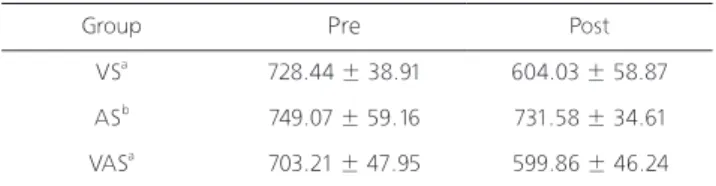
VS group showed 8 men, and their mean ages were 21.63±2.26. AS group consisted of 8 men, their mean ages were 23.63±2.88. VAS group was 8 men, their mean ages were 22.13±3.04. Among three groups, no significant differences were founded in terms of age (p=0.337). Table 1, 2 shows scores of reaction time and accuracy at the pre-test and post-test in three groups. No significant difference was
showed in comparison of the reaction time (F=1.731, p=0.201) and accuracy (F=0.537, p=0.592) at the pre-test among three groups. In variable of the reaction time, univariate analysis showed significant difference of a main group effect (F=13.564, p=0.000), a repeated factor effect (F=39.444, p=0.00), and an interaction effect for group x repeated factor (F=6.311, p=0.007). Post-hoc analysis for group difference indicated that AS group was significant different from VS group and VAS group. In variable of the accuracy, univariate analysis showed no significant differences of a main group effect (F=1.364, p=0.277) and an interaction effect for groups x repeated factor (F=0.616, p=0.550). However, a significant main effect of repeated factor (F=81.072, p=0.000) was observed. In addition, a significant difference was showed in comparison of differences of changes between the pre- and post-test only in the reaction time (F=6.311, 0.007) among three groups. Post-hoc analysis indicated that AS group had slower reaction time and lower accuracy than VS (=0.009) and VAS groups (p=0.041) did.
IV. Discussion
In the current study, we found out that short-term sequential motor training reduced the time of motor response and increase the accuracy of movement choice in respect of visual, auditory, and visuoauditory-stimuli cues. These results
Group Pre Post
VSa 728.44 ± 38.91 604.03 ± 58.87
ASb 749.07 ± 59.16 731.58 ± 34.61
VASa 703.21 ± 47.95 599.86 ± 46.24
Group Pre Post
VSa 49.69 ± 21.57 85.00 ± 9.64
ASb 50.70 ± 15.77 76.80 ± 18.31
VASa 58.75 ± 19.69 91.25 ± 8.24
Table 1. Changes of reaction at the pre- and post-tests in three groups
Table 2. Changes of accuracy at the pre- and post-tests in three groups VS: visual-stimuli, AS: auditory-stimuli, VAS: visuoauditory-stimuli
*p<0.05
VS: visual-stimuli, AS: auditory-stimuli, VAS: visuoauditory-stimuli
*p<0.05
indicated that short-term training for one day induced behavioral modification, which is inferred as motor program formation, or change of error-detection sensitivity. The same findings has been reported many previous studies regarding effectiveness of short-term motor skill acquisition.13,23,24
In the variable of reaction time, significant difference in comparison of change between the pre- and post-tests among three groups was observed. Motor sequential training using visual-stimuli cue gave rise to the highest improvement of movement speed, and motor training using visuoauditory- stimuli cue also showed a prominent reduce of motor response time. However, movement speed was slightly reduced following by motor training using auditory-stimuli cue. In the variable of movement accuracy, no significant difference in comparison of change between the pre- and post-tests among three groups was observed. However, the highest improvement of movement accuracy was found in motor training group using visual-stimuli cue, and the next higher increase of accuracy was occurred in training group using visuoauditory-stimuli cue. Motor training group using auditory-stimuli cue showed only slight improvement of movement accuracy.
Our first main finding was that motor training using visual-stimuli and visuoauditory-stimuli cues showed better effect of motor skill acquisition, compared to auditory- stimuliother stimulus cues. These result was concordance with previous findings, which investigated the effect of motor learning using various types of feedback.18,25,26 Akmatsu et al.27 reported that visual cue was most affected to motor response, compared to auditory and visuoauditory cues in normal healthy subjects and patients with Parkinson disease, and suggested that these findings could be influence motor skill learning. In addition, according to Camachon et al.
and Huet et al.’s studies,28,29 visual feedback was effectively operated to access internal processing fast in complex motor task. Moreover, visual cue showed the best effectiveness in early stage of motor learning, due to decrease of cognitive load.30 Consequentially, visual cue was better influenced factor to improve motor skill learning, compared to auditory cue. In addition visuoauditoryl-stimuli cue was not better effective than visual-stimuli. The possibility might be that multiple sensory stimulations mixed by the auditory and
visual sensations could disturb choice of motor response, internal neural process, motor skill acquisition, and so forth.
We speculated that it could lead to reduce motor accuracy and to delay motor response. This result was supported by previous study, indicating that gait training using only visual cue showed better improvement of the performance in terms of cadence and stride length, compared to auditory cues.31 The second finding was that visuoauditory-stimuli cue was not better effective than visual-stimuli and visuoauditory- stimuli cuesvisual cue. In comparison with visual feedback, auditory feedback may hinder processing of other sensory afferences to a lesser extent. Thereby, it could still be used to calibrate the motor program using visual information.18
Motor skill learning is modification of the behavior by experience, which lead to changes of neural circuits as well as brain cell activity. Its process of motor learning involves sensory interaction, motor control, motor skill acquisition, the ability to perform the skill during various condition, and retention/memory of the acquired skill.32 Moreover, learning of motor skill is an essential components to conduct physical activity in our daily life. Numerous investigators have been interested in knowing the most efficient and effective way to improve motor skill in many different scientific realms. We identified that motor skill training using visual-stimuli and visuoauditory-stimuli cues could induce to better learning effect of sequential motor skill, compared to auditory-stimuli cue. These findings is expected to be valuable information for effective motor skill learning in sports and medical sciences.
In addition, based on these findings, considering the effect of sensory-stimuli cue for motor learning will be helpful to physical therapists in selecting type of feedback. However, limitation of this study is a small sample size, and difficult to be generalization. Further study considering such factorsthe subjects, for example patients, and the various sensory stimuli will be needed in future.
References
1. Schmidt RA. Motor control and learning. Champaign, IL:
Human Kinetis Publishers; 2005.
2. Wolpert DM, Ghahramani Z, Flanagan JR. Perspectives and problems in motor learning. Trends Cogn Sci. 2001;5(11):487-94.
3. Schmidt RA, Lee TD. Motor learning and performance; from principle to application. Human Kinetics; 2014.
4. Connelly DM, Carnahan H, Vandervoort AA. Motor skill learning of concentric and eccentric isokinetic movements in older adults. Exp Aging Res. 2000;26(3):209-28.
5. Robertson EM. The serial reaction time task: Implicit motor skill learning? J Neurosci. 2007;27(38):10073-5.
6. Shemmell J, Forner M, Tathem B et al. Neuromuscular-skeletal constraints on the acquisition of skill in a discrete torque production task. Exp Brain Res. 2006;175(3):400-10.
7. Kim SH, Pohl PS, Luchies CW et al. Ipsilateral deficits of targeted movements after stroke. Arch Phys Med Rehabil.
2003;84(5):719-24.
8. Nissen MJ, Bullemer P. Attentional requirements of learning:
Evidence from performance measures. Cognit Psychol. 1987;
19(1):191-32.
9. Moisello C, Crupi D, Tunik E et al. The serial reaction time task revisited: A study on motor sequence learning with an arm- reaching task. Exp Brain Res. 2009;194(1):143-55.
10. Song S, Howard JH Jr, Howard DV. Perceptual sequence learning in a serial reaction time task. Exp Brain Res.
2008;189(2):145-58.
11. Kwon YH, Chang JS, Kim CS. Changes of cortical activation pattern induced by motor learning with serial reaction time task. The Korean Society of Physcial Therapy. 2009;21(1):65-72.
12. Kwon YH, Chang JS, Lee MH et al. The evidence of neuromuscular adaptation according to motor sequential learning in the serial reaction time task. J Phys Ther Sci. 2010
;22(2):117-21.
13. Kwon YH, Nam KS, Park JW. Identification of cortical activation and white matter architecture according to short-term motor learning in the human brain: Functional mri and diffusion tensor tractography study. Neurosci Lett. 2012;520(1):11-5.
14. Park MC, Bae SS, Lee MY. Change of activation of the supplementary motor area in motor learning: An fmri case study. The Journal of Korean Society of Physical Therapy.
2011;23(2):85-90.
15. Jonsdottir J, Cattaneo D, Recalcati M et al. Task-oriented biofeedback to improve gait in individuals with chronic stroke: Motor learning approach. Neurorehabil Neural Repair.
2010;24(5):478-85.
16. Fairbrother JT, Laughlin DD, Nguyen TV. Self-controlled feedback facilitates motor learning in both high and low activity individuals. Front Psychol. 2012;3:323-30.
17. Lauber B, Keller M. Improving motor performance: Selected aspects of augmented feedback in exercise and health. Eur J
Sport Sci. 2014;14(1):36-43.
18. Sigrist R, Rauter G, Riener R et al. Augmented visual, auditory, haptic, and multimodal feedback in motor learning: A review.
Psychon Bull Rev. 2013;20(1):21-53.
19. Yen SC, Landry JM, Wu M. Augmented multisensory feedback enhances locomotor adaptation in humans with incomplete spinal cord injury. Hum Mov Sci. 2014
20. Lee MH, Kim MC, Park JT. Analysis of motor performance and p300 during serial task performance according to the type of cue. Journal of the Korean Society of Physical Medine.
2013;8(2):281-7.
21. Adler S, Beckers D, Buck M. Pnf in practice: An illustrated guide. Springer; 2013.
22. Oldfield RC. The assessment and analysis of handedness: The edinburgh inventory. Neuropsychologia. 1971;9(1):97-113.
23. Labeye E, Oker A, Badard G et al. Activation and integration of motor components in a short-term priming paradigm. Acta Psychol (Amst). 2008;129(1):108-11.
24. Tang K, Staines WR, Black SE et al. Novel vibrotactile discrimination task for investigating the neural correlates of short-term learning with fmri. J Neurosci Methods.
2009;178(1):65-74.
25. Todorov E, Shadmehr R, Bizzi E. Augmented feedback presented in a virtual environment accelerates learning of a difficult motor task. J Mot Behav. 1997;29(2):147-58.
26. Wulf G, Horger M, Shea CH. Benefits of blocked over serial feedback on complex motor skill learning. J Mot Behav.
1999;31(1):95-103.
27. Akamatsu T, Fukuyama H, Kawamata T. The effects of visual, auditory, and mixed cues on choice reaction in parkinson's disease. J Neurol Sci. 2008;269(1-2):118-25.
28. Camachon C, Jacobs DM, Huet M et al. The role of concurrent feedback in learning to walk through sliding doors. Ecological psychology. Ecological Psychology. 2007;19(4):367-82.
29. Huet M, Camachon C, Fernandez L et al. Self-controlled concurrent feedback and the education of attention towards perceptual invariants. Hum Mov Sci. 2009;28(4):450-67.
30. Wulf G, Shea CH. Principles derived from the study of simple skills do not generalize to complex skill learning. Psychon Bull Rev. 2002;9(2):185-211.
31. Suteerawattananon M, Morris GS, Etnyre BR et al. Effects of visual and auditory cues on gait in individuals with parkinson's disease. J Neurol Sci. 2004;219(1-2):63-9.
32. Leonard CT. The neuroscience of human movement. Mosby;
1998.