cluding water, soil, and feces, and can cause respiratory, surgical, and urinary tract infections, as well as sepsis and other diseases in newborns [1-4]. Moreover, this strain is commonly detected in nosocomial infections of the urinary tract, wounds, and blood [5].
Multidrug-resistant E. cloacae has been detected in clinical spec- imens and is associated with the high production of extended spectrum β lactamase (ESBL) and AmpC [6]. Although various re- sistant strains capable of producing ESBL and AmpC have been identified in recent hospital-acquired infections in Korea, few studies have investigated multidrug-resistant E. cloacae isolates producing ESBL and AmpC.
In this study, we investigated the biological and genetic charac- teristics of multidrug-resistant E. cloacae collected from two gen- eral hospitals located in the central region of Korea.
INTRODUCTION
Enterobacter cloacae is a gram-negative bacterium that can cause pathogenic infections in patients in the intensive care unit.
This bacterium is widely distributed in human environments, in-
최근 임상에서 분리된 다제 내성 Enterobacter cloacae의 생물학적 유전학적 특성
Biological and Genetic Characteristics of Clinically Isolated Enterobacter cloacae with Multidrug Resistance
김재중1·구선회2
Jae-Jung Kim, M.T.1, Sun Hoe Koo, M.D.2
가톨릭대학교 대전성모병원 진단검사의학과1, 충남대학교병원 진단검사의학과2
Department of Laboratory Medicine1, St. Mary’s Hospital, Daejeon Catholic University, Daejeon; Department of Laboratory Medicine2, Chungnam National University Hospital, Daejeon, Korea
Vol. 8, No. 3: 99-106, July 2018
https://doi.org/10.3343/lmo.2018.8.3.99 임상미생물학
Corresponding author: Sun Hoe Koo
Department of Laboratory Medicine, Chungnam National University Hospital, 282 Munhwa-ro, Joong-gu, Daejeon 35015, Korea
Tel: +82-42-280-7798, Fax: +82-42-257-5365, E-mail: [email protected] Received: November 22, 2017
Revision received: November 27, 2017 Accepted: November 27, 2017
This article is available from http://www.labmedonline.org 2018, Laboratory Medicine Online
This is an Open Access article distributed under the terms of the Creative Commons Attribution Non-Commercial License (http://creativecommons.org/licenses/by-nc/4.0/) which permits unrestricted non-commercial use, distribution, and reproduction in any medium, provided the original work is properly cited.
Background: From January 2014 to December 2015, 69 clones of Enterobacter cloacae showing multidrug resistance to six classes of antimi- crobial agents were collected from two medical centers in Korea.
Methods: Minimum inhibitory concentrations were determined using the E-test method, and 17 genes were detected using polymerase chain reaction (PCR). The epidemiological relatedness of the strains was identified using repetitive element sequence-based PCR and multilocus se- quence typing.
Results: The 69 E. cloacae clones produced extended spectrum β lactamase (ESBL) and AmpC and showed multidrug resistance to cefotaxime, ceftazidime, and aztreonam. We identified the following sequence types: ST56 of type VI for ESBL SHV (N=12, 17.4%); ST53, ST114, ST113, and ST550 of types I, IV, VI, and VII, respectively, for CTX-M (N=11, 15.9%); and ST668 of type III for the carbapenemase NDM gene (N=1, 1.5%).
The AmpC DHA gene (N=2, 2.89%) was confirmed as ST134, although its type was not identified, whereas EBC (MIR/ACT; N=18, 26.1%) was identified as ST53, ST24, ST41, ST114, ST442, ST446, ST484, and ST550 of types V, I, III, IV, VII, and VI, respectively. The formed subclasses were blaCTX-M-3 and blaCTX-M-22 by CTX-M-1, blaCTX-M-9 and blaCTX-M-125 by CTX-M-9, blaDHA-1 by DHA, and blaMIR-7 and blaACT-15,17,18,25,27,28 by EBC (MIR/ACT).
Conclusions: There were no epidemiological relationships between the gene products and the occurrence of resistance among the strains.
Key Words: Enterobacter cloacae, Extended spectrum β lactamase, AmpC, Repetitive element sequence-based polymerase chain reaction, Multilocus sequence typing, Multidrug resistance
2017-03-16 https://crossmark-cdn.crossref.org/widget/v2.0/logos/CROSSMARK_Color_square.svg
MATERIALS AND METHODS
1. Enterobacter cloacae collection
From January 2014 to December 2015, a total of 69 E. cloacae clones that were resistant to gentamicin, ertapenem, cefotaxime, ceftazidime, cefepime, ciprofloxacin, aztreonam, and cotrimoxa- zole (TMP/SMX) were collected without overlap from two medi- cal centers in the central region of Korea using a Vitek 2 Compact 60 instrument (SYSMEX BioMerieux Co., Ltd., Lyon, France) and a Microscan WalkAway 96SI instrument (Siemens Healthcare Diag- nostic. Inc., West Sacramento, CA, USA).
2. Antimicrobial susceptibility test
Using Mueller-Hinton agar (ASAN, Daejeon, Korea), the mini- mum inhibitory concentrations (MICs) were determined by Epsi- lometer tests (E-tests) based on the Clinical Laboratory Standards Institute guideline [33]. Escherichia coli ATCC 25922 was tested at the same time as a control group, and eight types of antibiotic discs were used: gentamicin (BioMerieux SA), ertapenem, cefotaxime, ceftazidime, cefepime, ciprofloxacin, aztreonam, and cotrimoxa- zole (TMP/SMX).
3. DNA extraction
Single colonies of each E. cloacae strain were cultured in steril- ized MacConkey agar medium at 37˚C for 18–20 hours, and DNA was extracted using a GeneAll Ribospin extraction kit (GeneAll Biotechnology, Daejeon, Korea) following the manufacturer’s in- structions. After storage at 20˚C, isolated genomic DNA was used as a DNA template for the amplification of ESBL and AmpC resis- tance genes and for repetitive element sequence-based polymerase chain reaction (REP-PCR) and multilocus sequence typing (MLST) analysis.
4. Detection of ESBL and AmpC by PCR
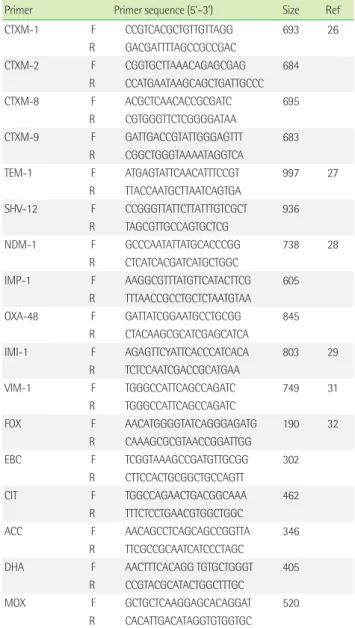
Using an ABI 3730XL system (Applied Biosystems, Foster City, CA, USA), we detected the expression of CTX-M-1, CTX-M-2, CTX-M-8, CTX-M-9, TEM, SHV, NDM, IMP, OXA, IMI, VIM, FOX, EBC, CIT, ACC, DHA, and MOX [24-29]. PCR was carried out in a final volume of 25 μL containing 0.5 μL SP Taq (Cosmoge- netech, Daejeon, Korea), 2.5 μL of 10× SP Taq buffer, 2.0 μL dNTPs, 5.0 μL Tuning Buffer, 1.0 μL DNA template, 1 μL of each forward and reverse primer (5 µmol), and 12 μL distilled water.
ESBL was amplified under the following conditions: pre-denatur- ation at 95˚C for 5 minutes; 35 cycles of denaturation at 95˚C for 1 minute, annealing at 55˚C for 30 seconds, and extension at 72˚C for 1 minute; and a final extension at 72˚C for 7 minutes. For AmpC, the PCR conditions were as follows: pre-denaturation at 94˚C for 3 minutes; 35 cycles of denaturation at 94˚C for 30 seconds, anneal- ing at 64˚C for 30 seconds, and extension at 72˚C for 1 minute; and a final extension at 72˚C for 7 minutes. The PCR products were verified by electrophoresis on 2% agarose gels containing ethid- ium bromide and then purified using a PCR purification kit (Cos- mogenetech). From the purified DNA, CTX-M-1, CTX-M-2, and
Table 1. Sequences of primers for the amplification of the β-lactamase and AmpC genes of Enterobacter cloacae
Primer Primer sequence (5’–3’) Size Ref
CTXM-1 F CCGTCACGCTGTTGTTAGG 693 26
R GACGATTTTAGCCGCCGAC
CTXM-2 F CGGTGCTTAAACAGAGCGAG 684
R CCATGAATAAGCAGCTGATTGCCC
CTXM-8 F ACGCTCAACACCGCGATC 695
R CGTGGGTTCTCGGGGATAA
CTXM-9 F GATTGACCGTATTGGGAGTTT 683
R CGGCTGGGTAAAATAGGTCA
TEM-1 F ATGAGTATTCAACATTTCCGT 997 27
R TTACCAATGCTTAATCAGTGA
SHV-12 F CCGGGTTATTCTTATTTGTCGCT 936
R TAGCGTTGCCAGTGCTCG
NDM-1 F GCCCAATATTATGCACCCGG 738 28
R CTCATCACGATCATGCTGGC
IMP-1 F AAGGCGTTTATGTTCATACTTCG 605
R TTTAACCGCCTGCTCTAATGTAA
OXA-48 F GATTATCGGAATGCCTGCGG 845
R CTACAAGCGCATCGAGCATCA
IMI-1 F AGAGTTCYATTCACCCATCACA 803 29
R TCTCCAATCGACCGCATGAA
VIM-1 F TGGGCCATTCAGCCAGATC 749 31
R TGGGCCATTCAGCCAGATC
FOX F AACATGGGGTATCAGGGAGATG 190 32
R CAAAGCGCGTAACCGGATTGG
EBC F TCGGTAAAGCCGATGTTGCGG 302
R CTTCCACTGCGGCTGCCAGTT
CIT F TGGCCAGAACTGACGGCAAA 462
R TTTCTCCTGAACGTGGCTGGC
ACC F AACAGCCTCAGCAGCCGGTTA 346
R TTCGCCGCAATCATCCCTAGC
DHA F AACTTTCACAGG TGTGCTGGGT 405
R CCGTACGCATACTGGCTTTGC
MOX F GCTGCTCAAGGAGCACAGGAT 520
R CACATTGACATAGGTGTGGTGC Abbreviations: F, forward; R, reverse.
CTX-M-9 were sequenced using a BigDye Terminator v3.1 Cycle Sequencing Kit (Applied Biosystems) with sequencing primers and then confirmed by Basic Local Alignment Search Tool (BLAST) [7]
software (Table 1).
5. REP-PCR and MLST analysis to examine epidemiological relationships
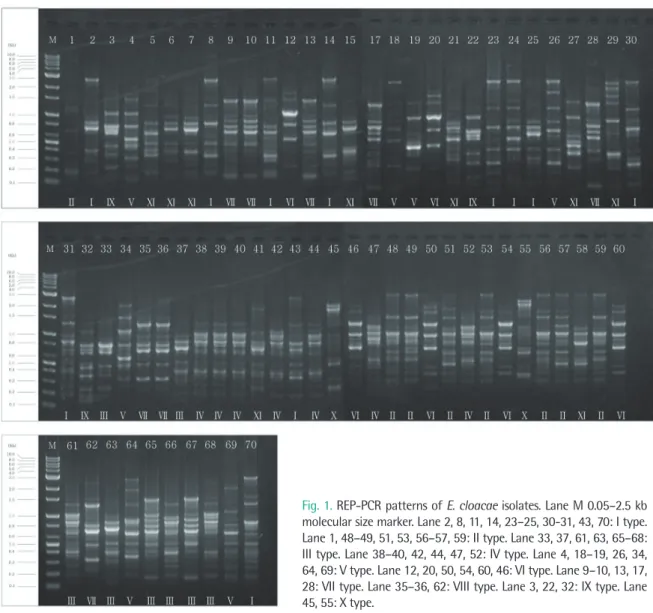
The epidemiological relationships of the strains were investi- gated by REP-PCR and MLST. For REP-PCR, the conditions were as follows: pre-denaturation at 94˚C for 15 minutes; 40 cycles of denaturation at 94˚C for 30 seconds, annealing at 60˚C for 1.5 min- utes, and extension at 72˚C for 1.5 minutes; and a final extension at 72˚C for 10 minutes. The PCR products were electrophoresed on 2% agarose gels with ethidium bromide and then compared by fingerprints with the naked eye; if at least three bands were differ- ent, they were categorized into different types. For MLST, the con- ditions were as follows: pre-denaturation at 95˚C for 5 minutes; 35 cycles of denaturation at 95˚C for 1 minute, annealing at 55˚C for 30 seconds, and extension at 72˚C for 1 minute; and a final exten- sion at 72˚C for 7 minutes, followed by electrophoresis on 2% aga- rose gels with ethidium bromide. DNA sequences were analyzed using a BigDye Terminator v3.1 Cycle Sequencing Kit (Applied Bio- systems). Finally, the sequencing results of seven housekeeping
genes were compared against the MLST database [8], and the al- lele number and sequence types (STs) were determined (Table 2).
6. Statistical analysis
Chi-square or Fisher’s exact tests were performed to determine resistance according to the occurrence of resistant genes. A P value of less than 0.05 was considered statistically significant. SPSS version 18.0 (SPSS Inc., Chicago, IL, USA) was used for statistical analysis.
RESULTS AND DISCUSSION
E. cloacae clones collected from two medical centers in the central region of Korea exhibited multidrug resistance because of the production of ESBL (N=19, 27.5%) and AmpC (N=20, 29.0%).
In general, the amounts of ESBL detected from urine and sputum specimens were higher than those reported by Park et al. [9] and Courdon et al. [10], and more AmpC was generated than what was previously reported by Souna et al. [11]. The resistance rates were higher than the 27.6% for cefotaxime, 21.8% for ceftazidime, and 21.1% for aztreonam reported by the Centers for Disease Control and Prevention of Korea (KARMS) in 2014. The collected E. cloa- cae clones also showed various levels of resistance against genta- micin, ertapenem, cefepime, ciprofloxacin, and cotrimoxazole.
The most common mechanism through which Enterobacteria acquires resistance involves the production of AmpC and ESBL.
Similar to E. coli, E. cloacae also obtains resistance through AmpC β-lactamase [12], and resistance against third-generation cephalo- sporins is caused by ESBL [13]. In this study, EBC (MIR/ACT; N=18, 26.1%), SHV (N=12, 17.4%), and CTX-M (N=11, 15.9%) were pro- duced, and the carbapenemases OXA (N=1, 1.5%), NDM (N=1, 1.5%), and DHA (N=1, 1.5%) were generated in some strains (Ta- ble 3). These results are similar to those of a report by Harada et al. [14] showing that levels of SHV and CTX-M had increased glob- ally. The results of this study were also consistent with a report in 2007 showing that the amounts produced were highest for CTX- M in the intestinal bacteria E. coli and for SHV-12 in K. pneumoniae found in Daejeon city [15]. There were no correlations among the occurrence of genes, resistance due to mismatch, and occurrence of resistance (P=0.653, 0.759, and 0.419, respectively). The pro- duced subclasses were blaCTX-M-9 and blaCTX-M-125 for CTX-M-1, and blaMIR-7 and blaACT-15,17,18,25,27,28 for DHA. These results differ from those in E. coli, which carries CTX-M-14 and CTX-M-15 genes Table 2. Primers for the multilocus sequence typing analysis of En-
terobacter cloacae
Primer Sequence (5’–3’) Position in the target gene Ref A dnaA F AYAACCCGCTGTTCCTBTATGGCGGCAC 500–527* 33
R KGCCAGCGCCATCGCCATCTGACGCGG 1222–1248*
fusA F TCGCGTTCGTTAACAAAATGGACCGTAT 413–440*
R TCGCCAGACGGCCCAGAGCCAGACCCAT 1291–1318 gyrB F TCGACGAAGCGCTCGCGGGTCACTGTAA 143–170
R GCAGAACCGCCCGCGGAGTCCCCTTCCA 1268–1295 leuS F GATCARCTSCCGGTKATCCTGCCGGAAG 1342–1369*
R ATAGCCGCAATTGCGGTATTGAAGGTCT 2159–2186*
pyrG F AYCCBGAYGTBATTGCRCAYMAGGCGAT 56–83*
R GCRCGRATYTCVCCCTSHTCGTCCCAGC 563–590*
rplB F GTAAACCGACATCTCCGGGTCGTCGCCA 17–44*
R ACCTTTGGTCTGAACGCCCCACGGAGTT 735–762*
rpoB F CCGAACCGTTCCGCGAACATCGCGCTGG 252–280*
R CCAGCAGATCCAGGCTCAGCTCCATGTT 973–1000*
S gyrB F AAAACCGGTACYATGGTGCGTTTCTGG 484–510*
R GCAGAACCGCCCGCGGAGTCCCCTTCC 1269–1295*
fusA R ATCTCTTCACGYTTGTTAGCGTGCATCT 1094–1121*
*These primers were used for sequencing respective amplicons.
Abbreviations: A, amplification; F, forward; R, reverse; S, sequencing.
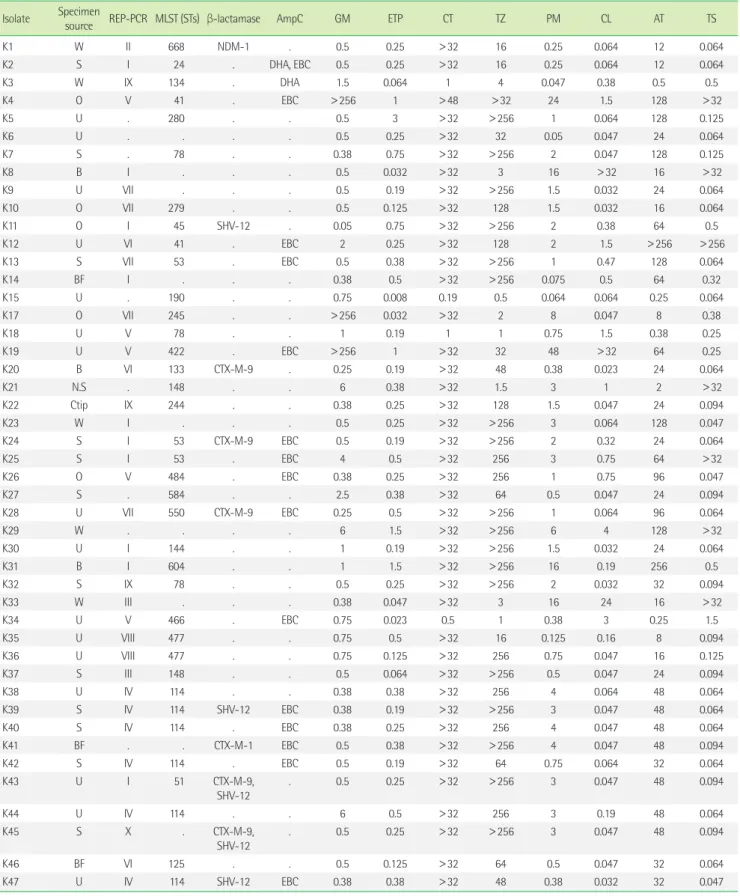
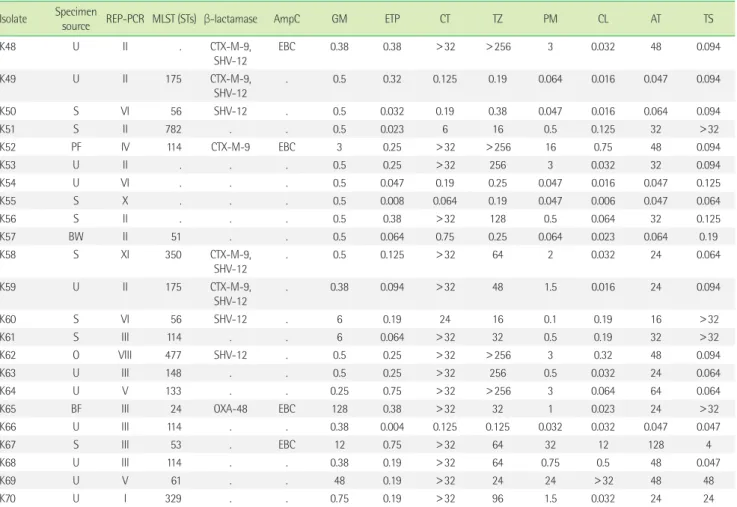
Table 3. Characteristics of multidrug-resistant Enterobacter cloacae isolates based on repetitive element sequence-based polymerase chain reac- tion and multilocus sequence typing
Isolate Specimen
source REP-PCR MLST (STs) β-lactamase AmpC GM ETP CT TZ PM CL AT TS
K1 W II 668 NDM-1 . 0.5 0.25 >32 16 0.25 0.064 12 0.064
K2 S I 24 . DHA, EBC 0.5 0.25 >32 16 0.25 0.064 12 0.064
K3 W IX 134 . DHA 1.5 0.064 1 4 0.047 0.38 0.5 0.5
K4 O V 41 . EBC >256 1 >48 >32 24 1.5 128 >32
K5 U . 280 . . 0.5 3 >32 >256 1 0.064 128 0.125
K6 U . . . . 0.5 0.25 >32 32 0.05 0.047 24 0.064
K7 S . 78 . . 0.38 0.75 >32 >256 2 0.047 128 0.125
K8 B I . . . 0.5 0.032 >32 3 16 >32 16 >32
K9 U VII . . . 0.5 0.19 >32 >256 1.5 0.032 24 0.064
K10 O VII 279 . . 0.5 0.125 >32 128 1.5 0.032 16 0.064
K11 O I 45 SHV-12 . 0.05 0.75 >32 >256 2 0.38 64 0.5
K12 U VI 41 . EBC 2 0.25 >32 128 2 1.5 >256 >256
K13 S VII 53 . EBC 0.5 0.38 >32 >256 1 0.47 128 0.064
K14 BF I . . . 0.38 0.5 >32 >256 0.075 0.5 64 0.32
K15 U . 190 . . 0.75 0.008 0.19 0.5 0.064 0.064 0.25 0.064
K17 O VII 245 . . >256 0.032 >32 2 8 0.047 8 0.38
K18 U V 78 . . 1 0.19 1 1 0.75 1.5 0.38 0.25
K19 U V 422 . EBC >256 1 >32 32 48 >32 64 0.25
K20 B VI 133 CTX-M-9 . 0.25 0.19 >32 48 0.38 0.023 24 0.064
K21 N.S . 148 . . 6 0.38 >32 1.5 3 1 2 >32
K22 Ctip IX 244 . . 0.38 0.25 >32 128 1.5 0.047 24 0.094
K23 W I . . . 0.5 0.25 >32 >256 3 0.064 128 0.047
K24 S I 53 CTX-M-9 EBC 0.5 0.19 >32 >256 2 0.32 24 0.064
K25 S I 53 . EBC 4 0.5 >32 256 3 0.75 64 >32
K26 O V 484 . EBC 0.38 0.25 >32 256 1 0.75 96 0.047
K27 S . 584 . . 2.5 0.38 >32 64 0.5 0.047 24 0.094
K28 U VII 550 CTX-M-9 EBC 0.25 0.5 >32 >256 1 0.064 96 0.064
K29 W . . . . 6 1.5 >32 >256 6 4 128 >32
K30 U I 144 . . 1 0.19 >32 >256 1.5 0.032 24 0.064
K31 B I 604 . . 1 1.5 >32 >256 16 0.19 256 0.5
K32 S IX 78 . . 0.5 0.25 >32 >256 2 0.032 32 0.094
K33 W III . . . 0.38 0.047 >32 3 16 24 16 >32
K34 U V 466 . EBC 0.75 0.023 0.5 1 0.38 3 0.25 1.5
K35 U VIII 477 . . 0.75 0.5 >32 16 0.125 0.16 8 0.094
K36 U VIII 477 . . 0.75 0.125 >32 256 0.75 0.047 16 0.125
K37 S III 148 . . 0.5 0.064 >32 >256 0.5 0.047 24 0.094
K38 U IV 114 . . 0.38 0.38 >32 256 4 0.064 48 0.064
K39 S IV 114 SHV-12 EBC 0.38 0.19 >32 >256 3 0.047 48 0.064
K40 S IV 114 . EBC 0.38 0.25 >32 256 4 0.047 48 0.064
K41 BF . . CTX-M-1 EBC 0.5 0.38 >32 >256 4 0.047 48 0.094
K42 S IV 114 . EBC 0.5 0.19 >32 64 0.75 0.064 32 0.064
K43 U I 51 CTX-M-9,
SHV-12
. 0.5 0.25 >32 >256 3 0.047 48 0.094
K44 U IV 114 . . 6 0.5 >32 256 3 0.19 48 0.064
K45 S X . CTX-M-9,
SHV-12 . 0.5 0.25 >32 >256 3 0.047 48 0.094
K46 BF VI 125 . . 0.5 0.125 >32 64 0.5 0.047 32 0.064
K47 U IV 114 SHV-12 EBC 0.38 0.38 >32 48 0.38 0.032 32 0.047
(Continued to the next page)
Isolate Specimen
source REP-PCR MLST (STs) β-lactamase AmpC GM ETP CT TZ PM CL AT TS
K48 U II . CTX-M-9,
SHV-12 EBC 0.38 0.38 >32 >256 3 0.032 48 0.094
K49 U II 175 CTX-M-9,
SHV-12
. 0.5 0.32 0.125 0.19 0.064 0.016 0.047 0.094
K50 S VI 56 SHV-12 . 0.5 0.032 0.19 0.38 0.047 0.016 0.064 0.094
K51 S II 782 . . 0.5 0.023 6 16 0.5 0.125 32 >32
K52 PF IV 114 CTX-M-9 EBC 3 0.25 >32 >256 16 0.75 48 0.094
K53 U II . . . 0.5 0.25 >32 256 3 0.032 32 0.094
K54 U VI . . . 0.5 0.047 0.19 0.25 0.047 0.016 0.047 0.125
K55 S X . . . 0.5 0.008 0.064 0.19 0.047 0.006 0.047 0.064
K56 S II . . . 0.5 0.38 >32 128 0.5 0.064 32 0.125
K57 BW II 51 . . 0.5 0.064 0.75 0.25 0.064 0.023 0.064 0.19
K58 S XI 350 CTX-M-9,
SHV-12
. 0.5 0.125 >32 64 2 0.032 24 0.064
K59 U II 175 CTX-M-9,
SHV-12 . 0.38 0.094 >32 48 1.5 0.016 24 0.094
K60 S VI 56 SHV-12 . 6 0.19 24 16 0.1 0.19 16 >32
K61 S III 114 . . 6 0.064 >32 32 0.5 0.19 32 >32
K62 O VIII 477 SHV-12 . 0.5 0.25 >32 >256 3 0.32 48 0.094
K63 U III 148 . . 0.5 0.25 >32 256 0.5 0.032 24 0.064
K64 U V 133 . . 0.25 0.75 >32 >256 3 0.064 64 0.064
K65 BF III 24 OXA-48 EBC 128 0.38 >32 32 1 0.023 24 >32
K66 U III 114 . . 0.38 0.004 0.125 0.125 0.032 0.032 0.047 0.047
K67 S III 53 . EBC 12 0.75 >32 64 32 12 128 4
K68 U III 114 . . 0.38 0.19 >32 64 0.75 0.5 48 0.047
K69 U V 61 . . 48 0.19 >32 24 24 >32 48 48
K70 U I 329 . . 0.75 0.19 >32 96 1.5 0.032 24 24
Abbreviations: ATM, aztreonam; B, blood; BF, bile fluid; BW, bronchial wash; CIP, ciprofloxacin; CTX, cefotaxime; Ctip, catheter tip; ETP, ertapenem; GM, gentamicin; NS, nasal swab; O, other; PF, pleural fluid; FEP, cefepime; S, sputum; TS, cotrimoxazole; CAZ, ceftazidime; U, urine; W, wound; “.”, Not detected.
Table 3. Continued
with high frequency, and from those in K. pneumoniae, in which the CTX-M-14 and CTX-M-3 genes are more prevalent. Furthur- more, blaCTX-M-3 was isolated from plasmids of E. coli and K. pneu- moniae by Liu et al. [16] in 2007 and was also reported by Kim et al. [17] in Korea in 2008. Unlike reports showing that blaCTX-M-3-pro- ducing strains were repeatedly found in the same hospital [18, 19], this gene was detected in only one strain, and we concluded that the resistance by blaCTX-M-3 had not yet spread. Despite the first re- port of blaCTX-M-22 from E. coli and K. pneumoniae in China in 2002 [20], this gene has not been reported in Korea until now.
Moreover, the carbapenemase gene NDM was found in four cases in Korea in 2011 [21], and OXA was found among intestinal bacte- ria in Korea [22]; thus, resistance genes in plasmids were thought to have been transferred horizontally from bacteria such as E. coli and K. pneumoniae. The DHA and EBC (MIR/ACT) genes, which have been shown to cause inductive resistance to AmpR [23, 24], were also shown to cause inductive resistance in this study, alth-
ough there were no epidemiological relationships among strains, as types and clone classes were different (Fig. 1, Table 3).
As previously reported by Girlich et al. [25], ST114, which was frequently identified, was highly correlated with EBC (MIR/ACT) AmpC, along with ST53 and ST41. There were also correlations between ST175 and CTXM-9, ST175 and SHV ESBL, and ST477 and SHV ESBL. However, as no resistance genes were detected, a correlation was not identified for ST78.
In summary, multidrug-resistant E. cloacae clones collected from two medical centers in the central region of Korea exhibited no epidemiological relationships and showed multidrug resistance through the generation of ESBL and AmpC.
요 약
배경: 2014년 1월부터 2015년 12월까지 중부지방 2곳의 종합병원 에서 6개 계열 8종 항균제에 다제 내성을 나타내는 Enterobacter
Fig. 1. REP-PCR patterns of E. cloacae isolates. Lane M 0.05–2.5 kb molecular size marker. Lane 2, 8, 11, 14, 23–25, 30-31, 43, 70: I type.
Lane 1, 48–49, 51, 53, 56–57, 59: II type. Lane 33, 37, 61, 63, 65–68:
III type. Lane 38–40, 42, 44, 47, 52: IV type. Lane 4, 18–19, 26, 34, 64, 69: V type. Lane 12, 20, 50, 54, 60, 46: VI type. Lane 9–10, 13, 17, 28: VII type. Lane 35–36, 62: VIII type. Lane 3, 22, 32: IX type. Lane 45, 55: X type.
cloacae 69주를 수집하였다.
방법: E-test법으로 최소억제농도(MIC)를 구하였고, TEM, SHV, CTX-M-1, CTX-M-2, CTX-M-8, CTX-M-9, NDM, OXA, IMI, IMP, VIM, FOX, EBC, CIT, ACC, DHA, MOX 등 17개 유전자를 PCR 증 폭 후 검출하였다. 균주 간 역학적 연관성은 REP-PCR과 multilo- cus sequence typing (MLST)법으로 확인하였다.
결과: E. cloacae 69주는 ESBL과 AmpC를 생성하며 cefotaxime, ceftazidime, aztreonam에 다제 내성을 나타냈다. ESBL SHV (N=12, 17.4%)는 VI type의 ST56로, CTX-M (N=11, 15.9%)은 I, IV, VI, VII type의 ST53, ST114, ST133, ST550로, carbapenemase NDM (N=1, 1.5%)은 II type의 ST24, OXA (N=1, 1.5%)는 III type의 ST668로 확 인되었다. AmpC DHA (N=2, 2.89%)는 type이 동정되지 않은 ST134, EBC (MIR/ACT) (N=18, 26.1%)는 V, I, III, IV, VII, VI type의 ST53, ST24, ST41, ST114, ST422, ST466, ST484, ST550로 확인되었다. CTX- M-1은 blaCTX-M-3, blaCTX-M-22, CTX-M-9은 blaCTX-M-9, blaCTX-M-125, DHA
는 blaDHA-1, EBC (MIR/ACT)는 blaMIR-7, blaACT-15,17,18,25,27,28 아형을 생 성하였다.
결론: 유전자 생성과 내성발생 균주 간 역학적 연관성은 없었다.
AUTHORS’ DISCLOSURES OF POTENTIAL CONFLICTS OF INTEREST
No potential conflicts of interest relevant to this article were re- ported.
ACKNOWLEDGMENTS
This work was supported by a research fund from Chungnam National University (2016-1635-01).
REFERENCES
1. Sanders WE Jr and Sanders CC. Enterobacter spp.: pathogens poised to flourish at the turn of the century. Clin Microbiol Rev 1997;10:220-41.
2. Dalben M, Varkulja G, Basso M, Krebs VL, Gibelli MA, van der Hei- jden I, et al. Investigation of an outbreak of Enterobacter cloacae in a neonatal unit and review of the literature. J Hosp Infect 2008;70:7-14.
3. Fernandez A, Pereira MJ, Suarez JM, Poza M, Trevino M, Villalón P, et al. Emergence in Spain of a multidrug-resistant Enterobacter cloacae clinical isolate producing SFO-1 extended-spectrum beta-lactamase. J Clin Microbiol 2011;49:822-8.
4. Hamada Y, Watanabe K, Tatsuya T, Mezaki K, Takeuchi S, Shimizu T, et al. Three cases of IMP-type metallo-β-lactamase-producing Entero- bacter cloacae bloodstream infection in Japan. J Infect Chemother 2013;19:956-8.
5. Schaberg DR, Culver DH, Gaynes RP. Major trends in the microbial eti- ology of nosocomial infection. Am J Med 1991;91:S72-S75.
6. Sirot D, Sirot J, Labia R, Morand A, Courvalin P, Darfeuille-Michaud A, et al. Transferable resistance to third-generation cephalosporins in clin- ical isolates of Klebsiella pneumoniae: identification of CTX-1, a novel β-lactamase. J Antimicrob Chemother 1987;20:323-34.
7. Altschul SF, Gish W, Miller W, Myers EW, Lipman DJ. Basic local align- ment search tool. Available from http://www.ncbi.nlm.nih.gov/BLAST.
Accessed.
8. Jolley K. Enterobacter cloacae MLST Databases. Available from http://
pubmlst.org/ecloacae/. Accessed.
9. Park YJ, Park SY, Oh EJ, Park JJ, Lee KY, Woo GJ, et al. Occurrence of extended-spectrum β-lactamases among chromosomal AmpC-pro- ducing Enterobacter cloacae, Citrobacter freundii, and Serratia marc- escens in Korea and investigation of screening criteria. Diagn Micro- biol Infect Dis 2005;51:265-9.
10. Coudron PE, Moland ES, Sanders CC. Occurrence and detection of ex- tended-spectrum β-lactamases in members of the family Enterobac- teriaceae at a veterans medical center: seek and you may find. J Clin Microbiol 1997;35:2593-7.
11. Souna D, Amir AS, Bekhoucha SN, Berrazeg M, Drissi M. Molecular typing and characterization of TEM, SHV, CTX-M, and CMY-2 β-lac- tamases in Enterobacter cloacae strains isolated in patients and their hospital environment in the west of Algeria. Med Mal Infect 2014;44:
146-52.
12. Livermore DM. β-lactamases in laboratory and clinical resistance. Clin Microbiol Rev 1995;8:557-84.
13. Jeong SH. Extended-spectrum beta-lactams-resistant gram-negative bacilli. Asian Conf Clin Pathol 2000;6:S61-S62.
14. Harada S, Ishii Y, Yamaguchi K. Extended-spectrum beta-lactamases:
implications for the clinical laboratory and therapy. Korean J Lab Med 2008;28:401-12.
15. Ko CS, Sung JY, Koo SH, Kwon GC, Shin SY, Park JW. Prevalence of extended-spectrum beta-lactamase in Escherichia coli and Klebsiella pneumoniae from Daejeon. Korean J Lab Med 2007;27:344-50.
16. Liu, SY, Su LH, Yeh YL, Chu C, Lai JC, Chiu CH. Characterization of plasmids encoding CTX-M-3 extened-spectrum β-lactamase from En- terobacteriaceae isolated at a university hospital in Taiwan. Int J Anti- microb Agents 2007;29:440-5.
17. Kim CK, Yum JH, Yong D, Jeong SH, Lee K, Chong Y. Detection of CTX- M-type extended-spectrum β-lactamase in clinical isolates of chromo- somal AmpC beta-lactamase-producing Enterobacteriaceae from Ko- rea and their molecular characteristics. Korean J Clin Microbiol 2008;
11:90-7.
18. Baraniak A, Sadowy E, Hryniewicz W, Gniadkowski M. Two different extended-spectrum β-lactamase (ESBLs) in one of the first ESBL-pro- ducing Salmonella isolates in Poland. J Clin Microbiol 2002;40:1095-7.
19. Baraniak A, Fiett J, Sulikowska A, Hryniewicz W, Gniadkowski M. Coun- trywide spread of CTX-M-3 extended-spectrum β-lactamaseproducing microorganisms of the family Enterobacteriaceae in Poland. Antimi- crob Agents Chemother 2002;46:151-9.
20. Yu Y, Ji S, Chen Y, Zhou W, Wei Z, Li L, et al. Resistance of strains pro- ducing extended-spectrum β-lactamases and genotype distribution in China. J Infect 2007;54:53-7.
21. Author XX. First cases of NDM-1 (New Delhi Metallo-beta-lactamase)- producing carbapenem resistant Enterobacteriaceae in Korea. Avail- able from http://cdc.go.kr/CDC/cms/content/mobile/52/12552_view.
html. Accessed.
22. Jeong SH, Lee KM, Lee J, Bae IK, Kim JS, Kim HS, et al. Clonal and hor- izontal spread of the blaOXA-232 gene among Enterobacteriaceae in a Korean hospital. Diagn Microbiol Infect Dis 2015;82:70-2.
23. Barnaud G, Arlet G, Danglot C, Philippon A. Cloning and sequencing of the gene encoding the AmpC β-lactamase of Morganella morga- nii. FEMS Microbiol Lett 1997;148:15-20.
24. Poirel L, Guibert M, Girlich D, Naas T, Nordmann P. Cloning, sequence analyses, expression, and distribution of ampC-ampR from Morganella morganii clinical isolates. Antimicrob Agents Chemother 1999;43:769- 76.
25. Girlich D, Poirel L, Nordmann P. Clonal distribution of multidrug-resis-
tant Enterobacter cloacae. Diagn Microbiol Infect Dis 2015;81:264-8.
26. Ryoo NH, Kim EC, Hong SG, Park YJ, Lee K, Bae IK, et al. Dissemina- tion of SHV-12 and CTX-M-type extended-spectrum β-lactamases among clinical isolates of Escherichia coli and Klebsiella pneumoniae and emergence of GES-3 in Korea. J Antimicrob Chemother 2005;56:698- 702.
27. Chang FY, Siu LK, Fung CP, Huang MH, Ho M. Diversity of SHV and TEM β-lactamases in Klebsiella pneumoniae: gene evolution in North- ern Taiwan and two novel β-lactamases, SHV-25 and SHV-26. Antimi- crob Agents Chemother 2001;45:2407-13.
28. Bae IK, Kang HK, Jang IH, Lee W, Kim K, Kim JO. Detection of carba- penemase in clinical Enterobactereriaceae isolates using the VITEK AST-N202 card. Infect Chemother 2015;47:167-74.
29. Huang L, Wang X, Feng Y, Xie Y, Xie L, Zong Z. First identification of an IMI-1 carbapenemase-producing colistin-resistant Enterobacter
cloacae in China. Ann Clin Microbiol Antimicrob 2015;14:51.
30. Tato M, Coque TM, Ruíz-Garbajosa P, Pintado V, Cobo J, Sader HS. Com- plex clonal and plasmid epidemiology in the first outbreak of Entero- bacteriaceae infection involving VIM-1 metallo-β-lactamase in Spain:
toward endemicity? Clin Infect Dis 2007;45:1171-8.
31. Perez-Perez FJ and Hanson ND. Detection of plasmid-mediated AmpC beta-lactamase genes in clinical isolates by using multiplex PCR. J Clin Microbiol 2002;40:2153-62.
32. Miyoshi-Akiyama T, Hayakawa K, Ohmagari N, Shimojima M, Kirikae T. Multilocus sequence typing (MLST) for characterization of Entero- bacter cloacae. PLoS One 2013;8:e66358.
33. Clinical and Laboratory Standards Institute. Performance standards for antimicrobial susceptibility testing; Document M100-S28. Wayne, PA:
Clinical and Laboratory Standards Institute, 2018.