• 검색 결과가 없습니다.

Fontan Revision with Y-Graft in a Patient with Unilateral Pulmonary Arteriovenous Malformation

N/A
N/A
Protected

Academic year: 2021

Share "Fontan Revision with Y-Graft in a Patient with Unilateral Pulmonary Arteriovenous Malformation"

Copied!
4
0
0

로드 중.... (전체 텍스트 보기)

전체 글

(1)

ISSN: 2233-601X (Print) ISSN: 2093-6516 (Online)

− 207 −

This study was presented at the 275 monthly conference of Seoul and Gyeonggi-do.

Received: August 29, 2016, Revised: October 27, 2016, Accepted: October 28, 2016, Published online: June 5, 2017

Corresponding author: Jeong-Jun Park, Department of Thoracic and Cardiovascular Surgery, Asan Medical Center, University of Ulsan College of Medicine, 88 Olympic-ro 43-gil, Songpa-gu, Seoul 05505, Korea

(Tel) 82-2-3010-3575 (Fax) 82-2-3010-6811 (E-mail) [email protected]

© The Korean Society for Thoracic and Cardiovascular Surgery. 2017. All right reserved.

This is an open access article distributed under the terms of the Creative Commons Attribution Non-Commercial License (http://creativecommons.org/

licenses/by-nc/4.0) which permits unrestricted non-commercial use, distribution, and reproduction in any medium, provided the original work is properly cited.

Fontan Revision with Y-Graft in a Patient with Unilateral Pulmonary Arteriovenous Malformation

Jeong-woo Lee, M.D. 1 , Jeong-Jun Park, M.D., Ph.D. 1 , Hyun Woo Goo, M.D., Ph.D. 2 , Jae Kon Ko, M.D., Ph.D. 3

Departments of

1

Thoracic and Cardiovascular Surgery,

2

Radiology, and

3

Pediatric Cardiology, Asan Medical Center, University of Ulsan College of Medicine

The extracardiac conduit Fontan procedure is the last surgical step in the treatment of patients with a func- tional single ventricle. An acquired pulmonary arteriovenous malformation may appear perioperatively or postoperatively due to an uneven hepatic flow distribution. Here we report a case of a bifurcated Y-graft Fontan operation in a 15-year-old male patient with a unilateral pulmonary arteriovenous malformation after an extracardiac conduit Fontan operation.

Key words: 1. Congenital heart defects 2. Fontan

3. Conduits 4. Vascular disease 5. Y-graft

Case report

A 15-year-old male patient with a history of com- plete atrioventricular septal defect, pulmonary atre- sia, right isomerism, asplenia, and separate hepatic venous drainage was treated with a left modified Blalock -Taussig shunt at 50 days after birth, a bidir- ectional cavopulmonary shunt at 21 months, and an external cardiac conduit Fontan operation at 5 years of age. His oxygen saturation was maintained at ap- proximately 93%–95% after the Fontan procedure.

During follow-up, mild desaturation at about 90%–

93% was observed. In the cardiac catheterization, there were no anomalous findings regarding ven- tricular function or systemic venous pressure; how- ever, preferential flow was observed. Blood from the

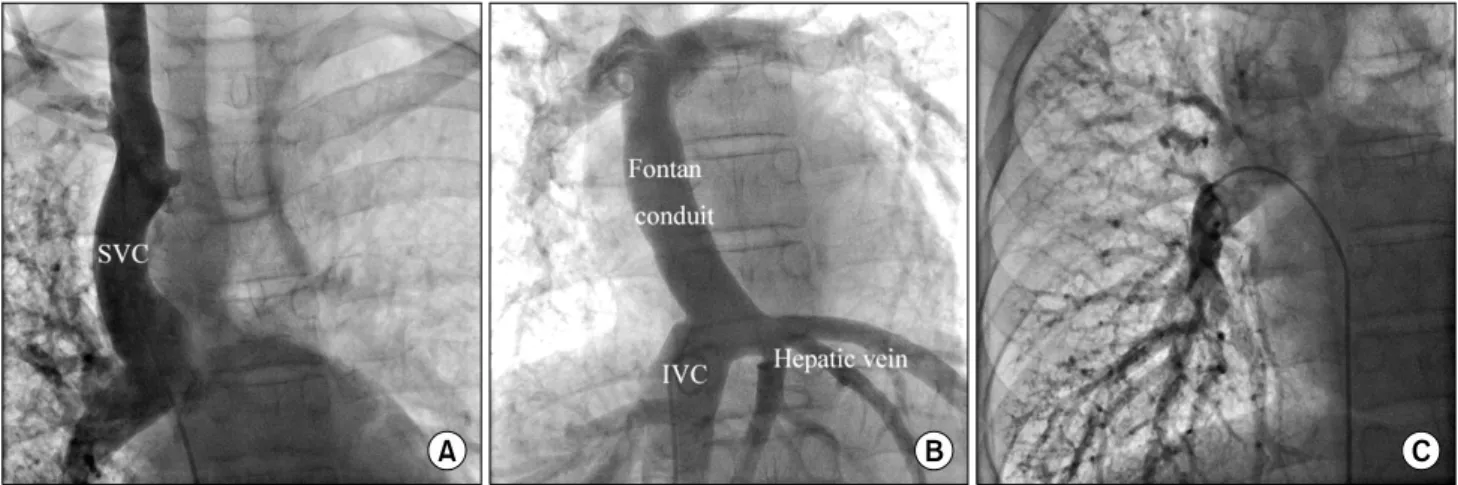
superior vena cava showed a tendency to flow to- ward the right lung, while blood from the inferior vena cava (IVC) showed a tendency to flow toward the left lung. The right lung had a diffuse pulmonary arteriovenous malformation (pAVM) (Fig. 1). A lung perfusion scan (LPS) was performed by a 99mTc al- bumin-aggregated (99mTc-MAA) injection in the low- er limb and the shunt fraction was reported as 15%.

Given the diagnosis of a unilateral pAVM, a Fontan revision was planned. A bifurcated Y-graft was used for the redistribution of the hepatic blood flow.

Under general anesthesia, a redo median sternotomy and adhesiolysis were performed. After aortic/bicaval cannulation, the operation was performed under car- diopulmonary bypass. In the operative findings, the previous Fontan graft was offset to the left side, and

Korean J Thorac Cardiovasc Surg 2017;50:207-210 □ CASE REPORT □

https://doi.org/10.5090/kjtcs.2017.50.3.207

(2)

Jeong-woo Lee, et al

− 208 −

Fig. 1. A selective angiogram showing that (A) the right lung received almost all blood flow from the SVC, (B) while the blood from the IVC mainly flowed to the left lung. (C) The right lung displays a reticulonodular density representing a diffuse pulmonary arteriovenous malformation. SVC, superior vena cava; IVC, inferior vena cava.

Fig. 2. The Y-graft conduit connected to the left pulmonary ar- tery and the lower branch of the RPA (arrow). SVC, superior vena cava; RPA, right pulmonary artery.

the previous bidirectional cavopulmonary shunt site was very wide. The previous Fontan conduit was re- moved, and a 22×11×11-mm Y-graft conduit was connected to the left pulmonary artery and the right pulmonary artery lower branch. The IVC side was connected to the previous remnant graft. At the pre- vious anastomosis site of the graft to the pulmonary artery, a direct closure and angioplasty using GORE- TEX Vascular Grafts (W. L. Gore & Associates Inc., Newark , NJ, USA) had been performed (Fig. 2). The total cardiopulmonary bypass time was 100 minutes.

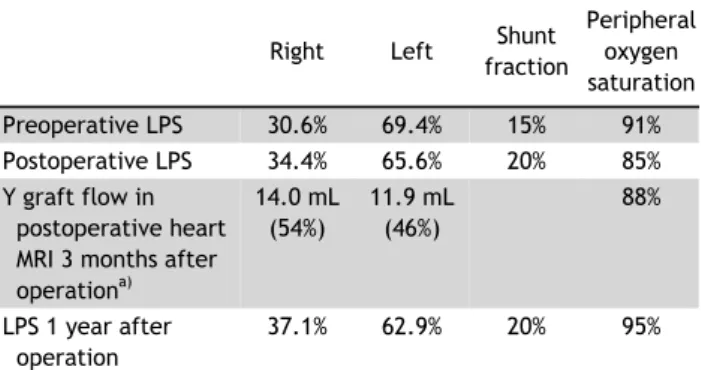
The patient was transferred to the general ward on postoperative day 1 and discharged on post- operative day 8 without any complications. In the postoperative LPS, performed by using a right foot vein, the shunt fraction was found to have increased by 20% as compared to the preoperative LPS. Three months after surgery, the patient underwent a mag- netic resonance imaging (MRI) scan of the heart, and oxygen saturation was still 88%. In the MRI quantifi- cation, the total blood flow per strok e volume of the Y-graft was 25.9 mL. The blood flow volumes in the right and left limbs of the Y-graft were 14.0 mL (54%) and 11.9 mL (46%), respectively. Considering that this patient had a preoperative preferential flow of the Fontan graft to the left lung, greater IVC flow, including hepatic venous return, was directed to the right lung postoperatively. One year after the Fontan revision, LPS was performed again. It showed an in- creased blood flow to the right lung and oxygen sat- uration amounting to 95%, considerably greater than

the results of the previous test (Table 1).

Discussion

There are various factors that cause pAVMs, but

these do not account for the details of how pAVMs

are formed. A congenital heart defect, such as a left

isomerism or exclusion of the hepatic vein blood

flow to the pulmonary circulation, could be a risk

factor for a pAVM. Even after the completion of the

Fontan operation in patients with a functional single

ventricle (FSV), an unbalanced distribution of the

hepatic flow might result in a pAVM.

(3)

Fontan Revision with Y-Graft

− 209 −

Table 1. Changes in preoperative and postoperative blood flow, shunt fraction, and oxygen saturation

Right Left Shunt fraction

Peripheral oxygen saturation

Preoperative LPS 30.6% 69.4% 15% 91%

Postoperative LPS 34.4% 65.6% 20% 85%

Y graft flow in postoperative heart MRI 3 months after operation

a)

14.0 mL (54%)

11.9 mL (46%)

88%

LPS 1 year after operation

37.1% 62.9% 20% 95%

LPS, lung perfusion scan, using Technetium 99mTc albumin aggregated injection to the lower limb; MRI, magnetic resonance imaging.

a)
Blood flow per stroke volume.

It has not been clearly established how lung angio- genesis is inhibited. The precursors of angiotensin II, an agonist of angiogenesis, and endostatin, an antag- onist of angiogenesis, are known to be produced pri- marily in the liver. For instance, in a review of the occurrence and mechanisms of pAVMs, Hoffman [1]

showed that, in the heart systems of FSV patients, unlike in the normal heart system, the lungs are ex- posed to a high concentration of angiotensin II.

Furthermore, Field-Ridley et al. [2] found that colla- gen XVIII, a precursor of endostatin, is degraded in the lungs. In FSV patients, the collagen XVIII levels increase and the endostatin levels decrease, resulting in angiogenesis, since the pulmonary circulatory sys- tem inhibits endostatin production from collagen XVIII.

It is essential to plan a surgical strategy to achieve a better distribution of the hepatic flow. When a pAVM is diagnosed in the pre-Fontan state, most cas- es of pAVMs regress after Fontan completion with hepatic vein inclusion [3]. In this case, to avoid com- plications, we performed the first Fontan procedure with a separate drainage of the hepatic vein connect- ing to the IVC stump. Nevertheless, a pAVM occurred and it was necessary for us to devise ways to pro- vide a more even and effectively distributed hepatic flow. Imoto et al. [4] reported good results from treating a pAVM by changing the position of the Fontan conduit. In addition, McElhinney et al. [5] re- ported that only a direct hepatic vein–azygous vein connection may provide the most reliable mixing and

bilateral distribution of hepatic venous blood in pa- tients with heterotaxy.

The case reported here was somewhat different;

thus, we considered using a Y-graft conduit to rede- sign the Fontan pathway. Kanter et al. [6] reported largely successful results from the Fontan operation using a Y-graft. Likewise, some patients who under- went a Y-graft Fontan revision showed increased oxygen saturation at discharge. For example, Haggerty et al. [7] reported positive hemodynamic results in patients who underwent a Y-graft Fontan operation using computed tomography and MRI in a quantita- tive simulation. Yang et al. [8] also found that asym- metric blood flow distribution was reduced after the Y-graft Fontan operation.

In the reported case, oxygen saturation, in terms of clinical improvement, did not increase immediately after the surgery. Rather, the shunt fraction increased to 20% in the postoperative LPS. However, this may have reflected the increased flow from the IVC to the right lung after the Y-graft Fontan operation. Con- sidering that pAVMs will gradually disappear, it is evident that this reflects the increasing flow into the right pulmonary artery, which increases flow via the pAVM and causes a consequent increase in the shunt ratio.

In this case, all of the preoperative and post-

operative LPSs used a lower extremity vein to inject

the radionuclide (99mTc-MAA), thus showing the re-

gional uptak e ratio in each lung from the Fontan

graft flow. The serial uptake ratio of radionuclide in

the right lung increased over time from 30.6% pre-

operatively and 34.4% immediately postoperatively

to 37.1% at 1 year after the operation. In the pres-

ence of a unilateral pAVM, this ratio represents not

the perfusion ratio, but the captured radionuclide in

the pulmonary capillaries of each lung. Therefore, the

serial uptake ratio in the right lung was below 50%,

but gradually increased, even though, in the post-

operative MRI flow measurement, flow in the right

limb of the Y-graft (14.0 mL, 54%) was greater than

in the left limb (11.9 mL, 46%). This means that the

captured radionuclide in the right lung increased

over time and the pAVM started to gradually dis-

appear. However, a residual pAVM in the right lung

still needs to be considered. This is the reason why

the oxygen saturation improved to 95% while the

shunt fraction was 20% at 1 year postoperatively.

(4)

Jeong-woo Lee, et al

− 210 − Therefore, much more time is needed to show radio-

nuclide uptake over 50% in the right lung.

As in other reported cases, oxygen saturation im- proved over time in our patient. Thus, the Y-graft Fontan operation may be a promising option for re- ducing the risk of pAVMs by solving the problem of unbalanced distribution in the hepatic flow.

Conflict of interest

No potential conflict of interest relevant to this ar- ticle was reported.

References

1. Hoffman JI. Normal and abnormal pulmonary arterio- venous shunting: occurrence and mechanisms. Cardiol Young 2013;23:629-41.

2. Field-Ridley A, Heljasvaara R, Pihlajaniemi T, et al.

Endostatin, an inhibitor of angiogenesis, decreases after bidirectional superior cavopulmonary anastamosis. Pediatr Cardiol 2013;34:291-5.

3. Kim SJ, Bae EJ, Lee JY, Lim HG, Lee C, Lee CH. Inclusion of hepatic venous drainage in patients with pulmonary arte- riovenous fistulas. Ann Thorac Surg 2009;87:548-53.

4. Imoto Y, Sese A, Joh K. Redirection of the hepatic venous flow for the treatment of pulmonary arteriovenous mal- formations after Fontan operation. Pediatr Cardiol 2006;

27:490-2.

5. McElhinney DB, Marx GR, Marshall AC, Mayer JE, Del Nido PJ. Cavopulmonary pathway modification in patients with heterotaxy and newly diagnosed or persistent pulmonary arteriovenous malformations after a modified Fontan operation. J Thorac Cardiovasc Surg 2011;141:1362-70.e1.

6. Kanter KR, Haggerty CM, Restrepo M, et al. Preliminary clinical experience with a bifurcated Y-graft Fontan pro- cedure: a feasibility study. J Thorac Cardiovasc Surg 2012;

144:383-9.

7. Haggerty CM, Kanter KR, Restrepo M, et al. Simulating he- modynamics of the Fontan Y-graft based on patient-spe- cific in vivo connections. J Thorac Cardiovasc Surg 2013;

145:663-70.

8. Yang W, Chan FP, Reddy VM, Marsden AL, Feinstein JA.

Flow simulations and validation for the first cohort of pa-

tients undergoing the Y-graft Fontan procedure. J Thorac

Cardiovasc Surg 2015;149:247-55.

수치

Fig. 1. A selective angiogram showing that (A) the right lung received almost all blood flow from the SVC, (B) while the blood from the  IVC mainly flowed to the left lung
Table 1. Changes in preoperative and postoperative blood flow,  shunt fraction, and oxygen saturation

참조

관련 문서