• 검색 결과가 없습니다.

Chronic Prostatitis Category IIIa와 IIIb 환자에서 Polymerase Chain Reaction을 이용한 의 유병률

N/A
N/A
Protected

Academic year: 2021

Share "Chronic Prostatitis Category IIIa와 IIIb 환자에서 Polymerase Chain Reaction을 이용한 의 유병률"

Copied!
7
0
0

로드 중.... (전체 텍스트 보기)

전체 글

(1)

Chronic Prostatitis Category IIIa와 IIIb 환자에서 Polymerase Chain Reaction을 이용한 Chlamydia trachomatis, Neisseria gonorrhoeae, Mycoplasma genitalium, Ureaplasma

urealyticum 의 유병률

조인창, 김유석, 김성빈, 김순기, 이경인 1 , 민승기

국립경찰병원 비뇨기과, 1진단검사의학과

Prevalence of Chlamydia trachomatis, Neisseria gonorrhoeae, Mycoplasma genitalium, Ureaplasma urealyticum in Chronic Prostatitis Category IIIa and IIIb Patients Using Polymerase Chain Reaction

In-Chang Cho, Yoo Seok Kim, Sung Bin Kim, Soon Ki Kim, Gyeong In Lee

1

, Seung Ki Min Departments of Urology and

1

Laboratory Medicine, National Police Hospital, Seoul, Korea

Purpose: The aim of this study was to report on the prevalence of Chlamydia trachomatis (CT), Neisseria gonorrhoeae (NG), Mycoplasma genitalium (MG), and Ureaplasma urealyticum (UU) in patients with chronic prostatitis (CP) IIIa and CP IIIb using PCR and correlations between four microorganisms and other clinical parameters.

Materials and Methods: The medical charts of 206 Patients who visited National Police Hospital and were diagnosed with CP IIIa and CP IIIb between January 2011 and December 2012 were reviewed. We investigated white blood cell (WBC) counts on expressed prostatic secretion (EPS) samples and the frequency of four possible causative microorganisms of prostatitis, CT, NG, MG, and UU, using PCR techniques on first voided urine samples (VB1).

Results: Of 206 patients, 88 patients were CP IIIa and 118 were CP IIIb, with a mean age of 33.8±12.9 and 34.6±11.3, respectively. CT, NG, MG, and UU were detected in 13.6%, 0%, 4.5%, and 14.8% of CP IIIa patients and in 0.8%, 0%, 3.4%, and 11.9%

of CP IIIb patients, respectively. Among men aged 19-30, detection of CT was significantly greater in the CP IIIa group than in the CP IIIb group (p=0.002). CT showed a positive association with EPS or the third voided urine (VB3) WBC count grade (p<0.01), however, MG and UU did not. The relationship between numbers of detected microorganisms and WBC counts was statistically insignificant.

Conclusions: In subgroup analyses, microorganisms were detected in by PCR in 29 CP IIIa patients (32.9%) and 19 CP IIIb patients (16.1%). Young aged men in the CP IIIa group showed high prevalence of CT, and patients in whom CT was detected in urine PCR had high EPS WBC counts.

Keywords: Polymerase chain reaction; Prevalence; Chlamydia

Copyright 2013, Korean Association of Urogenital Tract Infection and Inflammation. All rights reserved.

This is an open access article distributed under the terms of the Creative Commons Attribution Non - Commercial License (http://creativecommons.org/licenses/by - nc/3.0) which permits unrestricted non - commercial use, distribution, and reproduction in any medium, provided the original work is properly cited.

Received: 30 September , 2013 Revised: 14 October, 2013 Accepted: 14 October, 2013

Correspondence to: Seung Ki Min

Department of Urology, National Police Hospital, 123, Songi-ro, Songpa-gu, Seoul 138-708, Korea Tel: +82-2-3400-1264, Fax: +82-2-3400-1259 E-mail: [email protected]

No potential conflict of interest relevant to this

article was reported.

(2)

서 론

만성 전립선염(chronic prostatitis, CP)은 성인 남성의 약 50%가 일생에 한 번 정도는 그 증상을 경험할 정도로 흔한 질환이며,

1

그 특징적 증상인 비뇨생식기의 통증 및 사정 시 통증은 생활할 때의 불편감, 성욕감소, 발기부전을 유발하여 삶의 질 저하를 초래하는 것으로 알려졌다.

2

현재까지의 보고 에 의하면 만성 전립선염은 세균성에 비해 비세균성 원인이 월등히 많으며

3

이로 인해 아직까지 병리학적 기전은 거의 알려지지 않은 상태로 이전의 감염 병력, 골반저 고혈압, 국소 적 화학변화, 관류장애 등이 가설로 등장하였지만 여전히 논의 중이며

4

또한 싸이토카인 레벨의 증가 및 염증, 배뇨 시 신경근 부조화와 관계된 비정상적 방광기능, 호르몬의 불균형, 전립선 내 역류, 정신적 문제 등이 영향을 미치는 것으로 알려졌다.

5

그래서 만성 전립선염은 대부분 만성 골반통 증후군(chronic pelvic pain syndrome, CPPS)의 증상군에 포함되는 경우가 많으며 실제 임상에서는 환자의 증상에 의존하여 진단과 치료 효과를 판정하는 경향이 많고 증후군의 개념에서 치료의 목적 은 증상의 개선에 초점이 맞추어져 있다.

전립선염은 미국국립보건원(National Institutes of Health, NIH) 분류에 따라 크게 네 가지 유형으로 분류되는데, category I은 급성 세균성 전립선염, II는 만성 세균성 전립선염 이며 이 두 category는 전체의 5-10%에 지나지 않는다.

Category IV는 무증상 염증성 전립선염을 일컫는데 전립선비 대증, 전립선암, 불임 등 다른 비뇨기과 질병에 대해 경직장전 립선 침생검, 전립선적출술 후 조직, 또는 정액검사 시 우연히 발견되는 소견이다.

6

Category III의 전립선염은 만성 전립선 염/만성 골반통 증후군(CP/CPPS)이라는 용어로도 사용되는 데, 지난 6개월간 3개월 이상의 요로생식기계 통증을 호소하며 정액과 전립선염 검사에서 원인균의 검출이 되지 않는 경우이 며 해외의 보고에 의하면 전립선염의 90% 이상이 이 category 에 속한다.

7,8

Category III, 즉 CP/CPPS는 IIIa와 IIIb로 다시 분류되는데 IIIa는 현미경 고배율 하에 정액, 전립선액 (expressed prostatic secretion, EPS)에서 백혈구가 10배 이상 으로 관찰되거나, 전립선 마사지 후 채취한 소변(third voided urine, VB3)에서 고배율 하에서 4개 이상의 백혈구가 관찰되는 경우이다. 이를 염증성 만성골반통증 증후군(inflammatory CPPS)이라 말하며, 그 이하의 백혈구가 관찰될 때를 IIIb, 비염증성 만성골반통증 증후군(non-inflammatory CPPS)라 부른다.

9

만성 전립선염의 대부분을 차지하는 CP/CPPS의 병인이 불명확한 이유는 이전 연구에 의하면 약 8%에서의 환자에서만 감염의 원인이 밝혀지고 나머지에서는 확고한 요로계 병원균 이 배양되지 않기 때문이다.

10

하지만 몇몇 연구들에서 hidden bacterial infection이 전립선염의 병인임을 시사하는 증거들이

제시되고 있고

11

많은 임상의들이 배양검사에서 발견되지 않 는 감염이 CP/CPPS의 병인에 중요한 역할을 할 것이라 생각하 고 있다. 네덜란드의 일반의(63%)와 위스콘신의 일차진료의 (78%)는 세균의 감염을 만성 전립선염의 가장 중요한 병인으 로 보고 있고,

12,13

한국에서는 약 반수(52%)의 비뇨기과 전문의 가 만성 비세균성 전립선염의 병인을 hidden bacterial infection으로 꼽았다.

14

최근 CPPS의 병인을 밝혀내려는 노력 의 일환으로 분자생물학적인 진단방법들이 상용화되고 특히 요로감염분야에 중합효소 연쇄반응(polymerase chain reaction, PCR) 검사법이 적용되면서 높은 민감도 및 양성 예측률을 바탕으로 원인균의 진단에 많은 도움을 주고 있다.

PCR 검사법은 핵산증폭검사법(nucleic acid amplification tests, NAATs) 중 한가지로 높은 민감도 때문에 일반적인 배양검사로는 검출하기 힘든 cryptic microorganism의 검출에 이용되며, 성매개감염(sexually transmitted infection, STI) 원인균 검사에서는 이미 표준적인 검사방법으로 인정되고 있다.

15

국내에서도 Chlamydia trachomatis (CT), Ureaplasma urealyticum (UU), Mycoplasma genitalium (MG), Mycoplas- ma hominis , Trichomonas vaginalis 등의 잠복 미생물이 CPPS 환자에서 검출된 바 있다.

16,17

특히 CT, Neisseria gonorrhoeae (NG), MG, UU 등은 전립선염의 원인균으로 생각되는 cryptic microorganism이며 통상적인 배양검사에서 잘 자라지 않아 PCR 검사를 통해야 보다 정확한 검출률을 확인할 수 있는 균주들이다.

본 연구는 본원을 방문한 만성 비세균성 전립선염 환자들을 CP/CPPS IIIa와 CP/CPPS IIIb 환자군으로 나누어 EPS 및 VB3를 PCR을 이용하여 흔한 cryptic microorganism인 CT, NG, UU, MG의 검출률을 조사하여 이들간의 상관관계를 연구 하고자 하였다.

대상 및 방법

20011년 1월에서 2012년 12월까지 본원에서 chronic non-bacterial prostatitis로 진단받은 206명의 환자를 후향적 으로 조사하였다. 환자군은 3개월 이상의 하복부, 회음부 통증 이나 불쾌감 등의 전립선염 증상을 호소하였던 환자들로 병력 청취, 신체검사, 소변검사, EPS, VB3를 시행하였다.

NIH Chronic Prostatitis Work Shop의 분류

18

에 따라 EPS 및 VB3 내의 백혈구 수가 현미경 400배의 시야당 10개 이상인 경우를 CP IIIa로, 10개 미만인 경우를 CP IIIb로 분류하였으며 이들은 각각 88명, 118명이었다.

모든 환자를 대상으로 소변검체를 채취하여 상온에서 안정

화한 후 15분간 5,000 g 로 원심분리한 뒤 상층액을 제거하고

재부유시킨 후 DNA를 추출하였다. DNA 검출은 real-time

(3)

Table 1. Baseline characteristics of CPIIIa and CP IIIb patients (n=206) CP IIIa (n=88) CP IIIb (n=118) Age (year)

CT positivity NG positivity MG positivity UU positivity

33.8±12.9 12 (13.6)

0 (0) 4 (4.5) 13 (14.8)

34.6±11.3 1 (0.8)

0 (0) 4 (3.4) 14 (11.9) Values are presented as mean±standard deviation or number (%).

CP: chronic prostatitis, CT: Chlamydia trachomatis, NG: Neisseria gonorrhoeae, MG: Mycoplasma genitalium, UU: Ureaplasma urealyticum. Positivity for microorganisms was detected using polymerase chain reaction methods in urine samples.

PCR DNA detection method를 이용하였으며 검체로부터 자 동화 핵산추출기기인 ExiPrep 16 Dx (Cat. No. A-5050, Bioneer Co., Daejeon, Korea)와 ExiPrep Dx Bacteria Demonic DNA Kit (Cat. No. K-4414, Bioneer Co.)를 이용하 여 장비 및 시약 제조사 지침에 따라 추출한 후 실험에 이용하였 다.

PCR 이전에 준비된 원심분리액 튜브에 44 μl의 PCR-grade water와 1 μl의 internal positive control을 혼합하고 5 μl의 핵산 추출물은 대조군 튜브에 추가하였다. 튜브를 막은 후 DNA extracts에 premix pellet을 녹이기 위해 ExiSpin (Cat.

No. A-7040, Bioneer Co.)을 사용하였다.

PCR을 이용한 균주 확인 과정은 Exicycler 96 Real-Time Quantitative Thermal Block (Cat. No. A-2060M, Bioneer Co.)과 AccuPower CT & NG Real-Time PCR Kit (Cat. No.

STD2A-1111, Bioneer Co.), AccuPower MG Real-Time PCR Kit (Cat. No. MPG-1111, Bioneer Co.), AccuPower UU Real-Time PCR Kit (Cat. No. UUU11, Bioneer Co.)를 사용하 여 chromosome을 증폭시키고 확인하였다.

PCR 진행과정의 평가는 tabocco mosaic virus genome을 증폭하여 internal positive control을 측정하였다. Positive control은 microorganism이 명확히 확인된 배양배지에서 추 출한 DNA를 사용하였고 negative control은 건강한 환자의 정상 소변을 증류수에 희석하여 추출한 DNA를 사용하였다.

교차오염 및 위양성 결과를 막기 위해 모든 검사 시마다 환자에 게 검체의 정확한 채취에 대한 설명을 고지하였다.

만성전립선염 IIIa와 IIIb 환자의 PCR 결과를 나이와 EPS 또는 VB3에서의 백혈구 개수 등에 따라 Student’s t-test와 chi-square test 및 fisher’s exact test를 이용하여 비교하였다.

통계 분석은 PASW Statistics 18.0 (IBM Co., Armonk, NY, USA)을 이용하여 수행하였으며 p-value가 0.05 미만일 경우를 통계적으로 유의성이 있다고 판정하였다.

결 과

총 206명의 환자 중 CP IIIa 환자군은 88명, IIIb 환자군은 118명이었으며 각 군의 평균연령은 각각 33.8±12.9세, 34.6±11.3세였다. CP IIIa 환자군에서 CT 검출수는 12 (13.6%), NG 0 (0%), MG 4 (4.5%), UU 13 (14.8%)였고 CP IIIb 환자군에서의 각 균주의 검출수는 각각 CT 1 (0.8%), NG 0 (0%), MG 4 (3.4%), UU 14 (11.9%)였다(p=0.677, Table 1).

연령에 따른 각 균주의 검출률을 비교해 보았을 때 19-30세 의 연령대의 CT의 검출률에서 CP IIIa 환자군은 23.8%

(10/42), CP IIIb 환자군은 2.1% (1/48)로 유의한 차이를 보였 으나(p=0.002), 다른 세 가지 균주에서는 각각 NG 0%

(0/42)/0% (0/48), MG 7.1% (3/42)/2.1% (1/48), UU 19%

(8/42)/12.5% (6/48)로 유의한 차이를 보이지 않았다. 30대에 서는 UU만이 CP IIIb군에서만 16% (4/24) 검출되었고, 40대에 서는 CT 7.1% (2/28)/0% (0/40), NG 0% (0/28)/0% (0/40), MG 3.6% (1/28)/5.0% (2/40), UU 17.9% (5/28)/7.5% (3/40) 의 검출률을, 50대에서는 MG 0% (0/7), 16.7% (1/6)/UU 0% (0/7)/16.7% (1/6)의 검출률을 보여, 30대, 40대, 50대에서 는 각 균주의 검출률에 대한 CP IIIa 환자군과 CP IIIb 환자군의 유의한 차이를 발견할 수 없었다(Fig. 1).

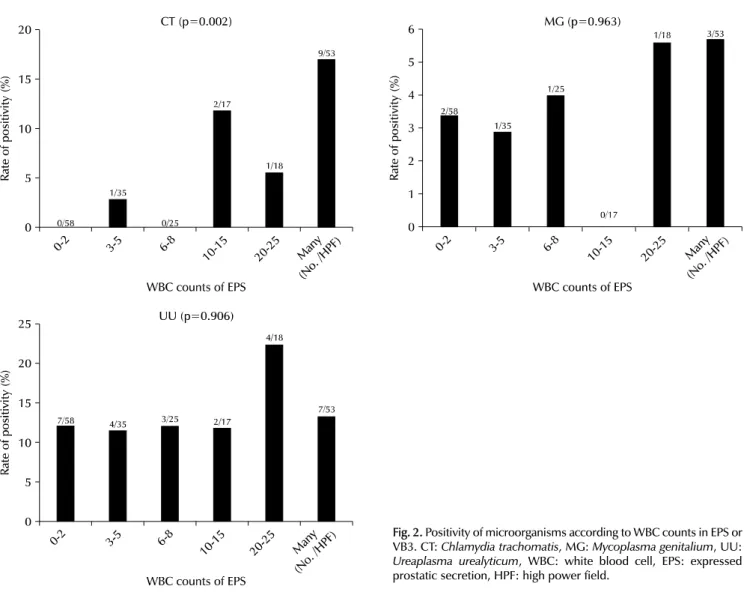
EPS 또는 VB3에서 검출된 white blood cell (WBC) counts 에 따른 각 균주의 검출률을 비교해본 결과 WBC counts 0-2개가 0% (0/58), 3-5개 2.9% (1/35), 6-8개 0% (0/25), 10-15개 11.8% (2/17), 20-25개 5.6% (1/18), 다수 개 17%

(9/53)으로 WBC counts와 CT의 검출률이 통계적으로 유의하 게 양의 상관관계를 보였으며(p=0.002) 다른 균주에 대해서는 NG는 전혀 검출되지 않았고 MG는 WBC counts 0-2개가 3.4% (2/58), 3-5개 2.9% (1/35), 6-8개 4% (1/25), 10-15개 0% (0/17), 20-25개 5.6% (1/18), 다수 개 5.7% (3/53)였으며 UU는 0-2개가 12.1% (7/58), 3-5개 11.4% (4/35), 6-8개 12.0%

(3/25), 10-15개 11.8% (2/17), 20-25개 22.2% (4/18), 다수 개 13.2% (7/53)의 결과를 보여 WBC counts와 균주의 검출률 과의 상관관계가 통계적으로 유의하지 않는 것으로 나타났다 (Fig. 2).

그리고 EPS 또는 VB3에서 검출된 WBC counts와 PCR을 통해 검출된 균주의 총 개수와의 상관관계를 조사한 결과로는 최대 2개까지의 균주가 검출되었으며, 균주가 전혀 검출되지 않은 경우는 WBC counts 0-2개가 84.5% (49/58), 3-5개 82.9%

(29/35), 6-8개 88.0% (22/25), 10-15개 76.5% (13/17), 20-25

개 66.7% (12/18), 다수 개 71.7% (38/53)였다. 균주가 1개만

검출된 경우는 WBC counts 0-2개가 15.5% (9/58), 3-5개

17.1% (6/35), 6-8개 8.0% (2/25), 10-15개 23.5% (4/17),

20-25개 33.3% (6/18), 다수 개 20.8% (11/53)였으며, 균주가

2개 검출된 경우는 WBC counts 0-2개가 0% (0/58), 3-5개

0% (0/35), 6-8개 4.0% (1/25), 10-15개 0% (0/17), 20-25개

(4)

Fig. 1. (A) Detected microorganisms according to age subgroup in CP IIIa and CP IIIb patients (age 19-30 years). (B) Detected microorganisms according to age subgroup in CP IIIa and CP IIIb patients (age 31-40 years). (C) Detected microorganisms according to age subgroup in CP IIIa and CP IIIb patients (age 41-50 years). (D) Detected microorganisms according to age subgroup in CP IIIa and CP IIIb patients (age 51-60 years). CT:

Chlamydia trachomatis, MG: Mycoplasma genitalium, UU: Ureaplasma urealyticum.

0% (0/18), 다수 개 7.5% (4/53)의 결과를 보였으며 통계적으 로 유의하지는 않았다(Table 2).

고 찰

만성 전립선염은 다양한 임상경과를 나타내는 비뇨기계 질환으로 최근 증가 추세이며 연구마다 차이는 있지만 성인남 성에서의 4-16%의 유병률을 나타내는 질환이다. 만성 전립선 염의 category III에 해당하는 만성 전립선염/만성 골반통 증후 군(CP/CPPS)은 만성전립선염의 대부분을 차지하며 현미경 고배율 하에 EPS 또는 VB3에서 백혈구가 일정 수 이상 관찰되 느냐에 따라 IIIa와 IIIb로 분류된다. 만성 전립선염의 병인은 아직까지 많은 논란이 있지만 몇몇 병원균과 관련이 있는데 이중 특정 병원균은 다른 균에 비해서 수정능력에 더 큰 영향을 미치는 것으로 알려졌다. 기존의 국내외 보고에서 국내외 투약되어 온 항생제의 영향, 전립선 마사지 기술에 있어서의 개인차, 그리고 전립선의 국소 염증 시 전립선 배출관 폐쇄 등으로 인해 병소의 내용물이나 미생물의 검출이 어려워 세균 성 전립선염이 CPPS로 오인될 수 있는 가능성이 있으며 일부

균주는 일반 배지에서 균이 자라지 않는 관계로 비세균성 전립선염에서 보이지 않는 감염을 찾기 위해 PCR과 같은 분자생물학적 검사방법이 시도되었으며, 여러 연구에서 CT, MG, NG, UU 같은 STI의 원인균이 되며 일반배양검사로 관찰 하기 힘든 cryptic microorganism의 존재가 증명된 바 있 다.

16-22

본 연구에서는 총 206명의 CP/CPPS 환자 중 PCR에 의해 원인균주가 확인된 경우가 category IIIa에서는 29명(32.9%), category IIIb에서는 19명(16.1%)으로 국내에서 Ha 등

20

이 5종류의 균주(CT, MG, NG, UU, Mycoplasma hominis , Trichomonas vaginalis )에 대한 단독 PCR을 각각 시행하여 category IIIa에서 16.8%, category IIIb에서 8.1%의 검출률을 보인 것과 Kim 등

16

이 6종류의 균주(CT, MG, M . hominis , NG, T . vaginalis , UU)에서 category IIIa에서 39.1%, category IIIb에서 17.4%의 검출률을 보인 것과 유사하게 category IIIb 에 비해 IIIa에서 2배 정도 많은 균주가 검출되었다.

Category IIIa와 category IIIb의 환자군을 연령대로 나누어

분석한 결과 19-30세의 연령대에서 CT 검출률에서 CP IIIa

환자군은 23.8% (10/42), CP IIIb 환자군은 2.1% (1/48)로

(5)

Fig. 2. Positivity of microorganisms according to WBC counts in EPS or VB3. CT: Chlamydia trachomatis, MG: Mycoplasma genitalium, UU:

Ureaplasma urealyticum, WBC: white blood cell, EPS: expressed prostatic secretion, HPF: high power field.

Table 2. Number of detected microorganism according to WBC counts in EPS or VB3 Number of

microorganisms

WBC counts

p-value

0-2 3-5 6-8 10-15 20-25 Many

0 1 2 3 4

49/58 (84.5) 9/58 (15.5) 0/58 (0.0) 0/58 (0.0) 0/58 (0.0)

29/35 (82.9) 6/35 (17.1) 0/35 (0.0) 0/35 (0.0) 0/35 (0.0)

22/25 (88.0) 2/25 (8.0) 1/25 (4.0) 0/25 (0.0) 0/25 (0.0)

13/17 (76.5) 4/17 (23.5) 0/17 (0.0) 0/17 (0.0) 0/17 (0.0)

12/18 (66.7) 6/18 (33.3) 0/18 (0.0) 0/18 (0.0) 0/18 (0.0)

38/53 (71.7) 11/53 (20.8) 4/53 (7.5) 0/53 (0.0) 0/53 (0.0)

0.205

Values are presented as number/HPF (%).

WBC: white blood cell, EPS: expressed prostatic secretion, HPF: high power field.

유의한 차이를 보였는데(p=0.002) 이는 이 연령대의 환자군이 성적으로 활발한 시기이므로 성매개감염균의 검출빈도가 높 게 나온 것으로 생각된다. 또한 MG, UU도 CP IIIa 환자군에서 검출률이 높게 나왔으나 통계적으로 유의하지는 않았다. 특히 Chlamydia 는 성매개감염에서 가장 흔한 박테리아 감염으로 아직 논란의 여지가 있지만 만성 전립선염의 원인이 되는 것으로 생각되고 있으며 남성에서는 요도, 부고환, 전립선 질환을, 여성에서는 질, 요도 및 상부 요로의 질환과 더불어

자궁 경부염, 요도염, 난관염, 자궁내막염 등을 일으키는 중요

한 원인균으로 여성의 경우 자궁외 임신 및 불임과 남성불임의

원인이 되기도 한다.

23

Chlamydia 는 약 75%의 여성과 절반

이상의 남성에 있어 감염되어 있어도 증상이 없고 정액이나

전립선액에서 감염의 증거가 있어도 일반 배양검사로는 배양

되지 않기 때문에 특수배양이나 PCR을 통해서만 균주를 확인

할 수 있는 특성을 가지고 있다.

24

따라서 성적으로 활발한

연령대의 만성 전립선염 환자군에서 PCR 검사와 함께

(6)

Clamydia 에 대한 경험적 항생제로 azithromycin과 doxy- cycline의 투여 및 파트너에 대해서도 PCR 등의 정밀검사 시행과 항생제 사용을 고려해 볼 필요가 있다고 생각된다.

또한 EPS 또는 VB3에서 현미경 고배율로 관찰한 WBC counts와 각 균주의 검출률을 비교해 보았을 때 CT의 검출률이 통계적으로 유의하게 양의 상관관계(p=0.002)를 보였으며 이는 Clamydia 감염 환자의 절반 이상은 무증상인 경우가 많기 때문에 Kim 등

25

이 제시하였듯이 증상이 드러나지 않은 환자에서도 WBC counts가 높은 의심되는 환자군에 대해 적극 적인 PCR 검사를 시행하고 항생제 치료후 원인균의 박멸여부 를 추적관찰하기 위한 도구로서 PCR 검사가 의미를 가진다고 본다. 또한 Lee와 Lee

24

는 항생제 치료 후 최소 3-5주 후 핵산증 폭검사법(NAATs)을 권장하고 있다는 점도 이를 뒷받침하는 부분이라 하겠다.

WBC conuts와 multi-organism infection은 관련성이 없었 고 총 206명의 환자 가운데 CP IIIa 환자 118명 중에서 4명, CP IIIb 환자 88명 중 1명에서 multi-organism infection이 관찰되어 CP IIIb 환자군에서는 multi-organism infection을 무시할 만하다고 생각된다. Multi-organism이 관찰된 5명은 CT-UU가 4명, MG-UU 1명으로 대체로 CT와 UU가 동시 감염 될 가능성이 높은 결과를 보였다.

본 연구는 국내에서 PCR을 통한 cryptic microorganism의 검출결과 및 임상적 의의를 기술한 기존 자료들이 많지 않아 CPPS 환자군의 cryptic microorganism의 연령별 특징 및 치료 에 도움이 되리라 생각되며 특정 연령대의 EPS 및 VB3의 WBC counts가 낮은 환자에게서는 CT나 MG의 검출이 되지 않아 불필요한 PCR 검사의 생략도 고려해 볼 만하다고 생각한 다.

본 연구의 제한점으로는 총 환자군의 수가 많지 않아 PCR에 서 균주가 검출된 환자수가 적은 관계로 통계상의 근거가 약한 점이 있다. 또한 CPPS의 진단에 정액검사 및 정액배양검 사를 포함하지 않아 category II와 category IIIa 환자가 category IIIb로 분류되었을 가능성이 있다. 다음 연구에서는 EPS나 정액의 culture, PCR 등의 검사를 동반하여 비교분석하 면 좀 더 세부적인 연관성을 찾을 수 있을 것이며, 또한 CPSI 등의 설문지를 통해 증상점수와 비교하였으면 임상적으로 더 밀접한 연관이 있는 연구가 될 수 있었다고 생각한다.

마지막으로 만성 전립선염의 전통적인 분류인 NIH classifi- cation외에 새로이 고안된 UPOINT (Urinary, Psychosocial, Organ specific infection, Neurologic/systemic, Tenderness of skeletal muscles)의 도메인을 이용한 치료효과 분석에 대해 서는 다른 추가연구가 필요하다고 생각된다.

결 론

만성 전립선염/만성 골반통 증후군 환자에서 PCR을 통해 cryptic microorganism을 검출한 결과 19-30대 나이의 연령군 에서 category IIIa이 category IIIb에 비해 CT 검출이 유의하게 높았고 MG, UU도 통계적으로 유의하지는 않지만 높은 빈도수 로 검출되었으며, EPS 또는 VB3에서 관찰된 WBC counts와 CT가 양의 상관관계를 나타내었다. 이를 통해 연령대 및 ESP, VB3를 통해 관찰된 WBC counts에 따라 Chlamydia 등의 hidden cryptic microorganism을 예측하여 검사 및 치료여부 결정에 도움을 줄 수 있을 것이라 생각하며, category III prostatitis에서 PCR을 통해 균이 배출되는 경우가 적지 않으므 로 특히 젊은 연령에서는 PCR 검사 시행이 필요할 것으로 생각된다.

REFERENCES

1. Ku JH, Lee SH, Jeon YS, Kim ME, Lee NK, Park YH.

Epidemiologic study of chronic prostatitis-like symptoms surveyed among young men in the area of Taejeon and Chung-nam: prevalence and influence of weather. Korean J Urol 2002;43:318-21.

2. Shoskes DA, Landis JR, Wang Y, Nickel JC, Zeitlin SI, Nadler R;

Chronic Prostatitis Collaborative Research Network Study Group. Impact of post-ejaculatory pain in men with category III chronic prostatitis/chronic pelvic pain syndrome. J Urol 2004;172:542-7.

3. Krieger JN, Egan KJ, Ross SO, Jacobs R, Berger RE. Chronic pelvic pains represent the most prominent urogenital symptoms of “chronic prostatitis”. Urology 1996;48:715-21.

4. Pontari MA. Chronic prostatitis/chronic pelvic pain syndrome.

Urol Clin North Am 2008;35:81-9.

5. Schaeffer AJ. Epidemiology and evaluation of chronic pelvic pain syndrome in men. Int J Antimicrob Agents 2008;31(Suppl 1):S108-11.

6. Cho IC, Min SK. Asymptomatic prostatitis: clinical signifi- cances and management. Korean J Urogenit Tract Infect Inflamm 2013;8:13-9.

7. Nickel JC, Nyberg LM, Hennenfent M. Research guidelines for chronic prostatitis: consensus report from the first National Institutes of Health International Prostatitis Collaborative Network. Urology 1999;54:229-33.

8. Nickel JC, Downey J, Hunter D, Clark J. Prevalence of prostatitis-like symptoms in a population based study using the National Institutes of Health chronic prostatitis symptom index. J Urol 2001;165:842-5.

9. Nadler RB, Schaeffer AJ. Lower urinary tract cultures. In: Nickel

JC, ed. Textbook of prostatitis. 1st ed. Oxford, England: Isis

(7)

Medical Media, 1999:201-6.

10. Schaeffer AJ, Landis JR, Knauss JS, Propert KJ, Alexander RB, Litwin MS, et al; Chronic Prostatitis Collaborative Research Network Group. Demographic and clinical characteristics of men with chronic prostatitis: the national institutes of health chronic prostatitis cohort study. J Urol 2002;168:593-8.

11. Krieger JN, Riley DE. Chronic prostatitis: charlottesville to Seattle. J Urol 2004;172:2557-60.

12. de la Rosette JJ, Hubregtse MR, Karthaus HF, Debruyne FM.

Results of a questionnaire among Dutch urologists and general practitioners concerning diagnostics and treatment of patients with prostatitis syndromes. Eur Urol 1992;22:14-9.

13. Moon TD. Questionnaire survey of urologists and primary care physicians' diagnostic and treatment practices for prostatitis.

Urology 1997;50:543-7.

14. Lee KS, Choi JD. Chronic prostatitis: approaches for best management. Korean J Urol 2012;53:69-77.

15. Johnson RE, Green TA, Schachter J, Jones RB, Hook EW 3rd, Black CM, et al. Evaluation of nucleic acid amplification tests as reference tests for Chlamydia trachomatis infections in asymptomatic men. J Clin Microbiol 2000;38:4382-6.

16. Kim TH, Kim TH, Kim HR, Lee MK, Myung SC, Kim YS.

Detection of cryptic microorganisms in patients with chronic prostatitis by multiplex polymerase chain reaction. Korean J Urol 2007;48:304-9.

17. Seo KI, Hwang JC, Kim TW, Lee SH, Park SY, Roh SH. Results of microorganism detection by multiplex polymerase chain

reaction in patients with chronic pelvic pain syndrome. Korean J Urol 2009;50:1120-4.

18. Krieger JN, Nyberg L Jr, Nickel JC. NIH consensus definition and classification of prostatitis. JAMA 1999;282:236-7.

19. Kim SW, Lee JY, Park WJ, Cho YH, Yoon MS. The diagnostic values of the polymerase chain reaction in prostatitis. Korean J Infect Dis 2000;32:265-73.

20. Ha JS, Kim SW, Cho YH. Detection of cryptic microorganisms by polymerase chain reaction assay in chronic pelvic pain syndrome. Korean J Urol 2002;43:396-401.

21. Krieger JN, Riley DE, Roberts MC, Berger RE. Prokaryotic DNA sequences in patients with chronic idiopathic prostatitis. J Clin Microbiol 1996;34:3120-8.

22. Brookings C, Goldmeier D, Sadeghi-Nejad H. Sexually trans- mitted infections and sexual function in relation to male fertility. Korean J Urol 2013;54:149-56.

23. Mouton JW, Verkooyen R, van der Meijden WI, van Rijsoort-Vos TH, Goessens WH, Kluytmans JA, et al. Detection of Chlamydia trachomatis in male and female urine specimens by using the amplified Chlamydia trachomatis test. J Clin Microbiol 1997;

35:1369-72.

24. Lee YS, Lee KS. Chlamydia and male lower urinary tract diseases. Korean J Urol 2013;54:73-7.

25. Kim SJ, Lee DS, Lee SJ. The prevalence and clinical significance of urethritis and cervicitis in asymptomatic people by use of multiplex polymerase chain reaction. Korean J Urol 2011;

52:703-8.

수치

Table 1. Baseline characteristics of CPIIIa and CP IIIb patients (n=206) CP IIIa (n=88) CP IIIb (n=118) Age (year) CT positivity NG positivity MG positivity UU positivity  33.8±12.9   12 (13.6)0 (0)   4 (4.5)   13 (14.8)  34.6±11.3   1 (0.8)0 (0)   4 (3.4)
Fig. 1.  (A) Detected microorganisms according to age subgroup in CP IIIa and CP IIIb patients (age 19-30 years)
Fig. 2. Positivity of microorganisms according to WBC counts in EPS or  VB3. CT: Chlamydia trachomatis, MG: Mycoplasma genitalium, UU:

참조

관련 문서

1) Kim JH, Lee CS, Moon C, Kwak YG, Kim BN, Kim ES, et al. Co-Infection of Scrub Typhus and Human Granulocytic Anaplasmosis in Korea, 2006. Korean Med Sci. Case Report:

Purpose: This study was performed to identify the association between family support, ADL and depression among hospitalized older patients with chronic

As a result, the number of vasopressin and oxytocin-containing neurons was decreased in the paraventricular and supraoptic nucleus in chronic alcohol group..

Full genome cloning and nucleotide sequence analysis of hepatitis C virus from sera of chronic hepatitis patients in Korea. Detection of hepatitis C virus RNA

19) Yu Y, Kang J., Clinical studies on treatment of chronic prostatitis with acupuncture

Baseline characteristics of genotype 1b chronic hepatitis C patients who treated with daclatasvir and asunaprevir (n=231)... Characteristics of genotype 1b

Chronic kidney disease (partial update): Early identification and management of chronic kidney disease in adults in primary and secondary care (Clinical

Specifically, the prevalence and incidence rates of cancer among chronic diseases are continuously increasing, while early diagnosis and treatment of cancer