Comparison of Immune Response by Virus Infection and Vaccination to 2009 Pandemic Influenza A/H1N1 in Children
We aimed to compare the immune response induced by natural infection with 2009 pandemic influenza A/H1N1 (pH1N1) virus and by monovalent pH1N1 vaccination in children and adolescents. This cross-sectional clinical study was conducted at 3 hospitals in Korea from February to May 2010. A total of 266 healthy subjects aged from 6 months to 18 yr were tested for the presence of the antibody against pH1N1 using hemagglutination inhibition (HI) test. Information about pH1N1 vaccination and laboratory-confirmed pH1N1 infection history was obtained. The overall rate of HI titers of ≥ 1:40 against pH1N1 was 38.7%, and the geometric mean titer (GMT) was 20.5. Immunogenicity of pH1N1 vaccination only was reflected by a 41.1% of seroprotection rate and a GMT of 22.5. Immunogenicity of natural infection only was reflected by a 61.0% of seroprotection rate and a GMT of 40.0. GMT was significantly higher in the subjects of natural infection group than in the subjects of pH1N1 vaccination group (P < 0.001). The immune responses induced by natural pH1N1 infection exceed those induced by pH1N1 vaccinations.
Key Words: Pandemic Influenza A; Child; Immune Response; Natural Infection;
Vaccination Eun Kyeong Kang,1 Jung Sub Lim,2
Jun Ah Lee,2 and Dong Ho Kim2
1Department of Pediatrics, Dongguk University Ilsan Hospital, Goyang; 2Department of Pediatrics, Korea Cancer Center Hospital, Seoul, Korea
Received: 22 August 2012 Accepted: 26 November 2012 Address for Correspondence:
Dong Ho Kim, MD
Department of Pediatrics, Korea Cancer Center Hospital, 75 Nowon-ro, Nowon-gu, Seoul 139-706, Korea Tel: +82.2-970-1298, Fax: +82.2-6008-5748 E-mail: [email protected]
This study was supported by grant of the Korean Food and Drug Administration (KFDA10172322).
http://dx.doi.org/10.3346/jkms.2013.28.2.274 • J Korean Med Sci 2013; 28: 274-279 Pediatrics
INTRODUCTION
Novel swine-origin influenza A/H1N1 virus infection originat- ed in Mexico in April 2009 and was determined to be the cause of febrile respiratory illness (1, 2). The World Health Organiza- tion declared a pandemic in June 2009. Novel swine-origin in- fluenza A/H1N1 virus rapidly spread to many countries, caus- ing a worldwide pandemic. The active use of oseltamivir and large-scale vaccination with the pandemic influenza vaccine during the pandemic period controlled the spread of infection.
The 2009 pandemic influenza A/H1N1 (pH1N1) virus infection was also present in Korea. At that time, oseltamivir was provid- ed to treat the suspicious influenza-like illness at nearly all hos- pitals and clinics nationwide. Under government direction, the monovalent 2009 pH1N1 vaccine (Green Cross Corporation, Yongin, Korea) was developed and national vaccination was started in late October 2009. With these efforts, pH1N1 was re- solved in the early part of 2010.
The most probable reason for the end of pandemic was the acquisition of immunity against the pH1N1 virus by most peo- ple. Vaccination-acquired immunity might account for a great part of this immunity, but the proportion of immunity acquired by natural infection may be also considerable. It is important to characterize the immunogenicity induced by natural infections to evaluate herd immunity, especially against pH1N1 infection.
Immune responses that are induced by wild-type infection are generally superior to those induced by inactivated vaccination.
Live-attenuated vaccines can induce mucosal immune and cel- lular immune responses in a manner similar to those in infec- tion (3). The immunogenicity induced by natural infection may also be dependent on several factors including personal immune status, age, and concurrent use of medications (4).
Seroprevalence studies in children are rare (5) but significant owing to their important role in the transmission of influenza (6, 7). Few studies have compared the antibody titers against pH1N1 after natural infection and vaccination (8). The aim of this cross-sectional study was to compare the immune response induced by natural infection with pH1N1 to that induced by monovalent pH1N1 vaccination in children.
MATERIALS AND METHODS Study subjects and questionnaire
Enrollment was conducted at 3 hospitals from February to May 2010 (Department of Pediatrics, Korea Cancer Center Hospital, 2 pediatric practices located in Seoul and Gyeonggi-do). Healthy children aged 6 months to 18 yr who were free of illnesses im- peding immune response were enrolled in the study.
After written informed consent was obtained, 3-4 mL of ve- nous blood was obtained from all subjects. Serum was centri-
fuged and stored at -70°C until analysis. A questionnaire per- taining to the child’s age and sex, history of pandemic or sea- sonal influenza vaccination, and history of laboratory-confirmed influenza infection was completed by the parents. According to the questionnaire responses, the subjects were classified into the following 4 groups: subjects who had monovalent pH1N1 vaccination and no history of pH1N1 infection, subjects who had no monovalent pH1N1 vaccination and a history of pH1N1 infection, subjects reporting neither monovalent pH1N1 vacci- nation nor pH1N1 infection, and subjects who were infected with pH1N1 after monovalent pH1N1 vaccination. The primary outcome of the present study was comparison of the immuno- genicity among the 4 groups. We also compared the immune response against pH1N1 in 3 different age groups (< 3 yr, 3-8 yr, 9-18 yr) to evaluate the differential effect of immunogenicity with respect to age. Virological confirmation of pH1N1 infection at that time period was performed using pH1N1-specific real-time reverse transcriptase-polymerase chain reaction (RT-PCR) in most hospitals. An influenza A-positive result from the rapid antigen test was also included because > 95% of influenza iso- lates were pH1N1 viruses (9). The monovalent pH1N1vaccine administered to the participants was inactivated and unadju- vanted vaccine (Greenflu-S®, Green Cross Corporation, Yongin, Korea) containing 7.5 µg (subjects < 3 yr of age) or 15 µg (sub- jects ≥ 3 yr of age) of the recommended pH1N1 antigen A/Cal- ifornia/7/2009 (H1N1). Two doses of the vaccine were admin- istered to the subjects aged < 9 yr-old and one dose was admin- istered to the aged ≥ 9 yr old.
Hemagglutination inhibition (HI) test
Antihemagglutinin antibody titers were determined using the HI test according to the “WHO Manual on Animal Influenza Diagnosis and Surveillance” (10), which is the most commonly used reference. All assays were performed in duplicate and the mean value of each was taken. The pH1N1 vaccine seed virus was used for the HI tests. An HI titer of < 10 was assigned a val- ue of 5 for computation of the geometric mean titer (GMT).
Immunogenicity assessment
Immunogenicity was assessed according to the seroprotection rate and GMT of HI. Seroprotection rate was defined as the pro- portion of subjects with HI titers of ≥ 1:40 (11).
Statistical analysis
Descriptive data are reported as numbers of subjects and as percentages or GMT, with 95% confidence intervals (95% CI).
Comparisons of immunogenicity (seroprotection rate) among groups were performed using the chi-squared test. P values of
< 0.05 were considered significant (2-tailed test). SPSS software version 12.0 (SPSS Inc., Chicago, IL, USA) was used for the sta- tistical analyses.
Ethics statement
The study protocol was reviewed and approved by the institu- tional review board of Korea Cancer Center Hospital (K-1001- 001-013). Written informed consent was obtained from all par- ticipants or their parents before study participation.
RESULTS
A total of 266 healthy children and adolescents with nearly equal gender distribution were enrolled in the present study (Table 1).
The mean participant age was 5.8 yr (0.5-18.7 yr). For pH1N1, the overall seroprotection rate (HI ≥ 1:40) was 38.7% and the GMT was 20.5 (95% CI, 18.5-22.4). Of the children aged < 3 yr, the seroprotection rate and GMT was 28.1% and 16.5 (95% CI, 13.2-19.7), respectively. Of the children aged 3-8 yr, the seropro- tection rate and GMT was 50.0% and 18.2 (95% CI, 15.3-21.1), respectively. Of the children aged 9-18 yr, the seroprotection rate and GMT was 51.1% and 33.4 (95% CI, 28.3-38.6), respec- tively.
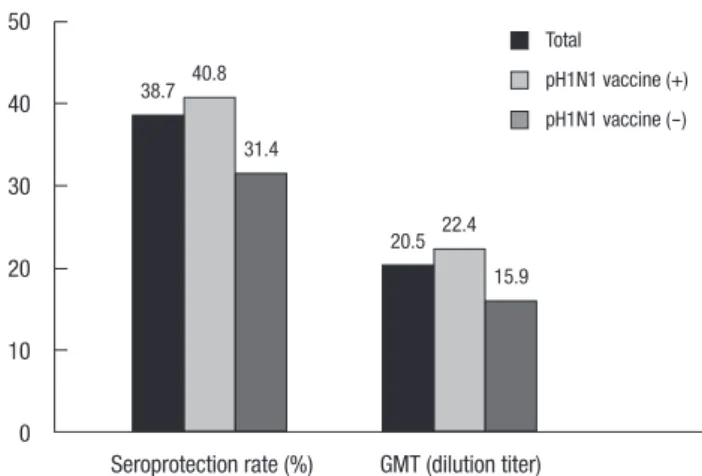
Immunogenicity of the monovalent pH1N1 vaccine Of the 266 subjects, 196 were vaccinated with the pH1N1 vac- cine. The mean age of 196 vaccinated subjects was 6.2 yr and 100 subjects were male. The mean duration from pandemic in- fluenza vaccination to the HI test was 58 days (21-148 days). The overall seroprotection rate and GMT among the subjects who received the pH1N1 vaccination was 40.8% and 22.4, respective-
Table 1. Characteristics of the study population
Characteristics No. of subjects
Mean age ± SD (5.8 ± 4.2) 266
< 3 yr (1.9 ± 0.7) 82 (30.8%)
3-8 yr (5.7 ± 1.7) 126 (47.4%)
9-18 yr (12.4 ± 2.9) 58 (21.8%)
Sex ratio (M:F) 132:134
The vaccinated:Unvaccinated subjects 196:70 Fig. 1. Immune response of the study subjects against pH1N1.
Seroprotection rate (%) GMT (dilution titer) 50
40 30 20 10 0
38.7
20.5 40.8
22.4 31.4
15.9 Total
pH1N1 vaccine (+) pH1N1 vaccine (-)
ly (Fig. 1). Of the 196 children who received the pH1N1 vaccine, 57 were aged < 3 yr, 87 were aged 3-8 yr, and 52 were aged 9-18 yr. The immunogenicity induced by each vaccine was stratified by age. Of the children aged < 3 yr, the seroprotection rate and GMT was 28.1% and 17.9 (95% CI, 14.5-21.4), respectively (Fig.
2). Of the children aged 3-8 yr, the seroprotection rate and GMT was 43.7% and 21.3 (95% CI, 16.7-25.9), respectively. Of the chil- dren aged 9-18 yr, the seroprotection rate and GMT was 51.9%
and 31.1 (95% CI, 22.9-39.2), respectively.
Immunogenicity by natural infection with pH1N1 virus Of the 266 subjects, 27 (15 male, 12 female) had confirmed pH1N1 virus infection. The mean duration of the pH1N1 diag- nosis to the sampling was 94.7 days (52-177 days). The mean age of the infected subjects was 5.5 yr; 21 (77.8%) were aged 3-8 yr.
The rate of infection by age was 4.9% in the group of aged < 3 yr (4/82), 16.7% (21/126) in the group of aged 3-8 yr, and 3.4% (2/
58) in the group of aged 9-18 yr. The seroprotection rate and GMT by pH1N1 virus infection was 59.3% and 36.1 (95% CI, 24.8-37.0), respectively.
Comparison of immunogenicity by monovalent pH1N1 vaccination and pH1N1 natural infection
Of the 196 children who received the monovalent pH1N1 vac- cine, 192 had no history of clinical infection with the pH1N1 vi- rus and 4 had a history of laboratory-confirmed pH1N1 virus infection. Of the 70 children who did not receive the monova- lent pH1N1 vaccine, 23 had laboratory-confirmed pH1N1 virus infection, and 47 had no history of clinical infection with pH1N1 virus (Table 2). In the subjects who received the monovalent pH1N1 vaccination but did not have a history of pH1N1 virus infection, the seroprotection rate was 41.1% and the GMT was 22.5 (group A). The immunogenicity induced by vaccine in- creased with age.
On the other hand, the immunogenicity induced by pH1N1 natural infection without monovalent pH1N1 vaccination was reflected by a 61.0% seroprotection rate and a GMT of 40.0 (group B). GMT of group B was significantly higher than that of group A (P < 0.001). When we compared GMT between the vaccina- tion and infection groups including the 18 subjects who had HI titers > 10 (presumed as asymptomatic infection) from group C, GMT was still significantly different (22.5 vs 36.1, 95% CI, 28.2- 44.1, P < 0.001). The mean duration from the day of vaccination/
infection to sampling day was significantly different (58 vs 95 days, P < 0.05). To reduce the influence by this different dura- tion of the vaccination/infection to sampling between group A and B, we limited the duration from 50 to 150 days. The age of subjects was also limited as between 6 months and 10 yr old.
After matching the age within the limited duration, the difference
Table 2. Immune response against pH1N1 among 4 groups
Immune response Total (n = 266) A* (n = 192) B* (n = 23) C (n = 47) D (n = 4)
Seroprotection rate (%) < 3 yr
3-8 yr 9-18 yr
38.7 29.1(57) 44.1 (84) 51.0 (51)
41.1 50.0 (4) 61.1 (18)
100.0 (1)
61.0 31.4 50.0
GMT (95% CI) < 3 yr 3-8 yr 9-18 yr
20.5 (18.5-22.4) 18.3 (57) 21.7 (84) 30.5 (51)
22.5 (19.5-25.5) 47.6 (4) 33.0 (18)
640 (1)
40.0 (33.0-47.0) 10.2 (8.7-11.6) 20.0 (9.4-49.4)
*GMT of group B was significantly higher than that of group A (P < 0.001). A, monovalent pH1N1 vaccination (+)/pH1N1 infection (-) group; B, monovalent pH1N1 vaccination (-)/pH1N1 infection (+) group; C, monovalent pH1N1 vaccination (-)/pH1N1 infection (-) group; D, monovalent pH1N1 vaccination (+)/pH1N1 infection (+) group.
Fig. 2. Immune response of the monovalent pH1N1 vaccine among the 3 age groups.
Seroprotection rate (%) GMT (dilution titer) 60
50 40 30 20 10 0
28.1
17.9 43.7
21.3 51.9
31.1
< 3 yr 3-8 yr 9-18 yr
Table 3. Comparison of immune response against pH1N1 between A and B groups after matching the age
Characteristics A (n = 34) B (n = 18) P value
Range of age, yr (mean) 0.50-9.84 (6.6) 0.80-9.12 (5.1) 0.054
Range of duration between vaccination/infection and sampling, days (mean) 51-148 (82.2) 52-121 (88.7) 0.37
Seroprotection rate (%) 35.3 61.0 0.11
GMT (95% CI) 17.0 (10.4-23.6) 42.1 (30.2-52.9) < 0.001
A, monovalent pH1N1 vaccination (+)/pH1N1 infection (-) group; B, monovalent pH1N1 vaccination (-)/pH1N1 infection (+) group.
of GMT between group A and B was more prominent (Table 3).
A total of 31.4% of the subjects who had neither pH1N1 vaccina- tion nor pH1N1 virus infection (group C) had HI titers of ≥ 1:40.
The effect of 2009-2010 seasonal influenza vaccination on the immunogenicity of monovalent pH1N1 vaccination Among the 196 monovalent pH1N1-vaccinated subjects, 191 subjects answered questions about their history of previous seasonal influenza vaccination (2009-2010 season). A total of 131 of 191 (68.6%) children were vaccinated with seasonal in- fluenza vaccine. Of the children vaccinated with monovalent pH1N1 vaccine after seasonal influenza vaccination, the sero- protection rate was 37.1% and the GMT was 20.7 (95% CI, 17.7- 23.8). Of the subjects vaccinated with monovalent pH1N1 vac- cine alone, 49.2% achieved HI titers ≥ 1:40 and the GMT was 30.2 (95% CI, 21.8-38.6). There was a significant difference be- tween the 2 groups (P < 0.05, Fig. 3).
DISCUSSION
The overall seroprotection rate provided by the monovalent pH1N1 vaccine was 40.8%. This rate is lower than those report- ed by most studies on immunogenicity among children (12, 13).
In a clinical trial on immunogenicity against the same pH1N1 vaccine with our study, which has been carried out in Korea in 2009, seroprotection rate in subjects 6 months to < 9 yr of age were lower than the previous results. HI titers ≥ 1:40 were ob- served in 55.9% of subjects < 3 yr, 69.5% of subjects 3-8 yr, and 90.5% of subjects 9-18 yr of age by day 21 after the second dose (14). Relatively low seroprotection rate against the vaccine might be applied similarly to our study subjects. This may be the main reason for the weak immune response in our study. The second reason for the weak response is delayed post-vaccination sam- pling (mean 58 days after vaccination) to evaluate the immuno- genicity. Antihemagglutinin antibody titers of inactivated influ- enza vaccination peak at 3-4 weeks after vaccination. Therefore,
most of the studies that evaluate vaccine immunogenicity show the antibody titers at that time point. Low antibody titers of chil- dren aged < 3 yr, which comprised 29% of our study subjects, also contribute to the weak immunogenicity. The seroprotec- tion rate of this age group was 28.1% compared with 50% in the older age groups. The immune response in infants and young children by vaccination is lower than that in older children and adults (8, 13-15). Even at an age of < 2 yr, the antibody respons- es increase with age (16).
There have been a few studies focusing on pH1N1-induced immunogenicity. One seroprevalence study of pandemic influ- enza among children demonstrated that subjects vaccinated against the pH1N1 virus exhibited lower titers than subjects with laboratory-confirmed pH1N1 virus infection (8). We also dem- onstrated that natural infection-induced immunogenicity was higher than that induced by inactivated vaccine. However, only 61% of the subjects with natural influenza infection had protec- tive antibody titers against pH1N1. This result is short of the ex- pected natural infection-induced immunogenicity. Except for the obviously delayed sampling, after confirmation of the infec- tion (mean 95 days), one possible reason for the weak immune response is the aggressive use of oseltamivir by the infected sub- jects during the pandemic period. Medication with oseltamivir was the most different point in coping with the influenza pan- demic wave compared with previous seasonal influenza sea- sons. All infected subjects were treated with oseltamivir for 5 days in the present study. This might have influenced the natural H1N1 infection-induced immunogenicity in this study.
Since influenza viruses invade the respiratory mucosal sur- face, mucosally produced secretory immunoglobulin A (IgA) antibodies are thought to be the most effective and immediate defense (17). One recent study about the effect of oseltamivir on the immune response showed that oseltamivir significantly suppressed respiratory mucosal secretory IgA responses and decreased the neutralizing activities of the airway fluids (18).
Oseltamivir treatment reduces the viral load of patients with pH1N1 virus infection (19). Consequently, the decrease of viral load and suppression of mucosal immune system by oseltami- vir treatment might negatively influence immune responses to the influenza virus.
It was notable in our study that 31% of the subjects who nei- ther received pH1N1 vaccination nor had a history of pH1N1 virus infection had HI titers of ≥ 1:40 against pH1N1 virus. Older adults born before 1950 had HI titers of ≥ 1:80 at a rate of 34%
against pH1N1 virus via previous natural infection with season- al H1N1 viruses (20). On the other hand, children had little evi- dence of cross-reactive antibodies to pH1N1. Therefore, our re- sult suggests subclinical or asymptomatic infection with pH1N1 virus. Studies have described a 25%-30% rate of subclinical or asymptomatic pH1N1 infection (8, 21). Subjects with milder symptoms or non-symptoms might not consider themselves Fig. 3. The effect of seasonal influenza vaccination on the immunogenicity of pH1N1
vaccination.
Seroprotection rate (%) GMT (dilution titer) 60
50 40 30 20 10 0
37.1
20.7 49.2
30.2
Seasonal + pandemic vaccine Pandemic vaccine only
infected with influenza and not visit the hospital for laboratory test confirmation. Further, the inclusion of only laboratory-con- firmed cases as the infected subjects in this study might have underestimated the proportion of infected subjects. Underesti- mation of the rate of asymptomatic infection may contribute to the spread of infections and make it difficult to measure the ex- act incidence of influenza infection. Serological diagnosis of subclinical infections could be performed by the identification of 4-fold or greater increases in antibody titer after infection, compared with baseline titers.
We found that the rate of HI titers of ≥ 1:40 against pH1N1 in subjects vaccinated with both the seasonal and the pH1N1 vac- cine (37.1%) was lower than in those who received the pH1N1 vaccine only (49.2%). Several studies have suggested a possible suppressive impact of the seasonal influenza vaccine on the im- mune response to pH1N1 (12, 22-24). An association between prior receipt of the 2008-2009 trivalent inactivated seasonal in- fluenza vaccine and pH1N1 illness was suggested in 1 study performed in Canada (24). One of the hypotheses suggested by that study is that repeat immunization blocks the more com- plex and cross-protective immunity afforded by prior infection.
Similarly, other studies found a diminution of antibody response in patients with higher baseline titers of pH1N1 and prior sea- sonal vaccine exposure (12, 22). We obtained similar results in this study in spite of not evaluating the baseline pH1N1 titers.
Further, research is needed to confirm the findings about this effect.
The main limitation of this study was that we could not eval- uate the baseline antibody titers before vaccination and could not rule out the asymptomatic infection in the vaccinated group.
Another limitation was the small number of subjects in the in- fected group (n = 23, group B).
In summary, this study demonstrated that the immune re- sponse to wild-type pH1N1 virus infection exceeds that to vac- cination and that aggressive use of antiviral agents may influ- ence natural infection-induced immunogenicity. Subclinical pH1N1 infections were assumed in approximately 30% of the children with neither pH1N1 vaccination nor a history of lab- confirmed pH1N1 virus infection. In addition, previous season- al influenza vaccination seems to have a negative impact on the immune response to pH1N1 vaccination. Evaluation of the in- fluence of natural infection and vaccination on herd immunity is important and necessary. Several factors including age, prior influenza exposure, and the type of prior vaccination should be considered to evaluate vaccine efficacy and develop an ideal vaccine.
ACKNOWLEDGMENTS
We acknowledge pediatricians Drs. Jang HO and Park KW (Star Pediatrics Clinic, Gyeonggi-do and Love for Neighbor Pediat-
rics Clinic, Seoul, Korea, respectively) for enrolling the healthy volunteers in this study. The authors have no conflicts of inter- est to disclose.
REFERENCES
1. CDC. Swine influenza A (H1N1) infection in two children-Southern California, March-April 2009. MMWR Morb Mortal Wkly Rep 2009; 58:
400-2.
2. CDC. Outbreak of swine origin influenza A (H1N1) virus infection-Mex- ico, March-April 2009. MMWR Morb Mortal Wkly Rep 2009; 58: 467-70.
3. Kreijtz JH, Fouchier RA, Rimmelzwaan GF. Immune responses to influ- enza virus infection. Virus Res 2011; 162: 19-30.
4. Demicheli V, Jefferson T, Rivetti D, Deeks J. Prevention and early treat- ment of influenza in healthy adults. Vaccine 2000; 18: 957-1030.
5. Broberg E, Nicoll A, Amato-Gauci A. Seroprevalence to influenza A (H1N1) 2009 virus: where are we? Clin Vaccine Immunol 2011; 18: 1205-12.
6. Miller E, Hoschler K, Hardelid P, Stanford E, Andrews N, Zambon M.
Incidence of 2009 pandemic influenza A H1N1 infection in England: a cross-sectional serological study. Lancet 2010; 375: 1100-8.
7. Kim JH, Yoo HS, Lee JS, Lee EG, Park HK, Sung YH, Kim S, Kim HS, Shin SY, Lee JK. The spread of pandemic H1N1 2009 by age and region and the comparison among monitoring tools. J Korean Med Sci 2010;
25: 1109-12.
8. Von Kries R, Weiss S, Falkenhorst G, Wirth S, Kaiser P, Huppertz HI, Tenenbaum T, Schroten H, Streng A, Liese J, et al. Post-pandemic serop- revalence of pandemic influenza A (H1N1) 2009 infection (Swine flu) among children <18 years in Germany. PLoS One 2011; 6: e23955.
9. Korea Centers for Disease Control and Prevention. Current status of se- lected infectious diseases. Public Health Wkly Rep 2009; 2: 886.
10. WHO. WHO manual on animal influenza diagnosis and surveillance.
Available at: www.who.int/csr/resources/publications/influenza/whocd- scsrncs20025rev.pdf. [accessed on 27 Nov 2011]
11. Potter CW, Oxford JS. Determinants of immunity to influenza infection in man. Br Med Bull 1979; 35: 69-75.
12. Nolan T, McVernon J, Skeljo M, Richmond P, Wadia U, Lambert S, Nis- sen M, Marshall H, Booy R, Heron L, et al. Immunogenicity of a mon- ovalent 2009 influenza A (H1N1) vaccine in infants and children: a ran- domized trial. JAMA 2010; 303: 37-46.
13. Plennevaux E, Sheldon E, Blatter M, Reeves-Hoché MK, Denis M. Im- mune response after a single vaccination against 2009 influenza A H1N1 in USA: a preliminary report of two randomised controlled phase 2 tri- als. Lancet 2010; 375: 41-8.
14. Oh CE, Lee J, Kang JH, Hong YJ, Kim YK, Cheong HJ, Ahn YJ, Kim SH, Lee HJ. Safety and immunogenicity of an inactivated split-virus influenza A/H1N1 vaccine in healthy children from 6 months to <18 years of age: a prospective, open-label, multi-center trial. Vaccine 2010; 28: 5857-63.
15. Fiore AE, Neuzil KM. 2009 influenza A (H1N1) monovalent vaccines for children. JAMA 2010; 303: 73-4.
16. Walter EB, Rajagopal S, Zhu Y, Neuzil KM, Fairchok MP, Englund JA.
Trivalent inactivated influenza vaccine (TIV) immunogenicity in chil- dren 6 through 23 months of age: do children of all ages respond equally?
Vaccine 2010; 28: 4376-83.
17. Wright P. Influenza viruses. In: Kliegman RM, Behrman RE, Jenson HB,
Stanton BF, editors. Nelson textbook of pediatrics. 18th ed. Philadelphia, PA: Saunders, 2007, p1384-6.
18. Takahashi E, Kataoka K, Fujii K, Chida J, Mizuno D, Fukui M, Hiro-O Ito, Fujihashi K, Kido H. Attenuation of inducible respiratory immune re- sponses by oseltamivir treatment in mice infected with influenza A virus.
Microbes Infect 2010; 12: 778-83.
19. Li IW, Hung IF, To KK, Chan KH, Wong SS, Chan JF, Cheng VC, Tsang OT, Lai ST, Lau YL, et al. The natural viral load profile of patients with pandemic 2009 influenza A(H1N1) and the effect of oseltamivir treat- ment. Chest 2010; 137: 759-68.
20. Hancock K, Veguilla V, Lu X, Zhong W, Butler EN, Sun H, Liu F, Dong L, DeVos JR, Gargiullo PM, et al. Cross-reactive antibody responses to the 2009 pandemic H1N1 influenza virus. N Engl J Med 2009; 361: 1945-52.
21. Jackson ML, France AM, Hancock K, Lu X, Veguilla V, Sun H, Liu F, Hadler J, Harcourt BH, Esposito DH, et al. Serologically confirmed house- hold transmission of 2009 pandemic influenza A (H1N1) virus during
the first pandemic wave-New York City, April-May 2009. Clin Infect Dis 2011; 53: 455-62.
22. Chao DY, Cheng KF, Hsieh YH, Li TC, Wu TN, Chen CY, Tsai CA, Chen JH, Chiu HT, Lu JJ, et al. Serological response and persistence in school- children with high baseline seropositive rate after receiving 2009 pan- demic influenza A (H1N1) vaccine. Vaccine 2011; 29: 617-23.
23. Choi YS, Baek YH, Kang W, Nam SJ, Lee J, You S, Chang DY, Youn JC, Choi YK, Shin EC. Reduced antibody responses to the pandemic (H1N1) 2009 vaccine after recent seasonal influenza vaccination. Clin Vaccine Immunol 2011; 18: 1519-23.
24. Skowronski DM, De Serres G, Crowcroft NS, Janjua NZ, Boulianne N, Hottes TS, Rosella LC, Dickinson JA, Gilca R, Sethi P, et al. Association between the 2008-09 seasonal influenza vaccine and pandemic H1N1 illness during Spring-Summer 2009: four observational studies from Canada. PLoS Med 2010; 7: e1000258.