국우(菊芋) 증자가 혈당강하작용에 미치는 영향
김진우1#, 하미애2, 신용욱2*
1 : 경남과학기술대학교 식물자원학과, 2 : 농학·한약자원학부
The Effects of steam heat processing of Helianthus tuberosi Rhizoma on Blood glucose lowering
Jin-Woo Kim
#1, Mi-Ae Ha
2, Yong-Wook Shin
2*1 : Dept. of Plant Resources, Gyeongnam National University of Science and Technology, Jinju 52725, Korea 2 : Department of Agronomy & Medicinal Plant Resources, Gyeongnam national University of Science and
Technology, Jinju 52725, Republic of Korea
ABSTRACT
Objective : This study was designed to evaluate the hypoglycemic effects of Helianthus tuberosi Rhizoma extracts and its optimum Heat processing conditions
Methods : We investigated the Salivary α -amylase, pancreas α -amylase and α -glucosidase inhibitory activities of extracts from Steam Heated Helianthus tuberosi Rhizoma Ext. The inhibitory activities of a 50% EtOH extract of Steam Heated Helianthus tuberosi Rhizoma Ext against α -glucosidases were evaluated in this study. Inhibiting these enzymes involved in the absorption of disaccharides significantly decreases the postprandial increase in blood glucose level after a mixed carbohydrate diet. Furthermore, the postprandial blood glucose lowering effect of Steam Heated Helianthus tuberosi Rhizoma Ext. was compared to a known type 2 diabetes drug(Acarbose®) in a mice model. Steam Heated
Helianthus tuberosusL. Ext significantly reduced the blood glucose increase after glucose loading.
Results : The results were confirmed by real-time PCR that after treated with Streptozotocin in L6 cells, induced expression of GLUT4, after the steamed
Helianthus tuberosusL. Ext. treated, observed its expression was increased.
Steam Heated
Helianthus tuberosusL Ext treated 4 hours in L6 cells, cytotoxicity was measured in MTT assay. Its toxicity were 5.7%, 9% and 11.3% at the treatment concentration 12.5㎍/㎖, 25㎍/㎖, the 50㎍/㎖ respectively Conclusions : Overall, the results of this study indicate that Hypoglycemic effect of Helianthus tuberosi Rhizoma caused by the Steam heat treatment, the optimum Heat processing condition is steamming at 121℃ for 30 min, and it will provide the basis for developing a useful dietary supplement for controlling postprandial hyperglycemia.
1)
Key words : Steam heat treatment,
Helianthus tuberosusL, GLUT4, Hypoglycemic effect
Ⅰ. 서 론
돼지감자(
Helianthus tuberosusLinne)는 국화과 다년생 식물로 뚱딴지로 불리며 약재명으로는 국우(菊芋), 영문명으 로는 Jerusalem artichoke 로 불린다
1). 냉해와 수분스트레
스에 대한 저항성이 커서 척박한 토양에서도 생육이 가능하여 재배가 용이
2)하여 최근 재배량이 증가하고 있다. 주요성분인 Inulin은 사람의 위액과 소화효소에 의해서 분해되지 않고 장 내 미생물에 의하여 발효되어 정장작용 및 배변 촉진에 기여 한다. 또한 분해되더라도 fructose형태이므로 혈당치를 상승
*Corresponding author : Yong-Wook Shin,Department of Agronomy & Medicinal Plant Resources, Gyeongnam national University of Science and Technology, Jinju 52725, Republic of Korea.
·Tel : +82-55-751-3226 ·Fax : +82-55-751-3229 ·E-mail : [email protected]
#First author : Jin-woo Kim, Dept. of Plant Resources, Gyeongnam National University of Science and Technology, Jinju 52725, Korea.
·Tel : +82-55-751-3694 ·Fax : +82-55-751-3229 ·E-mail : [email protected] ·Received : 11 August 2017 ·Revised : 2 September 2017 ·Accepted : 15 September 2017
시키지 않으며, 열량이 낮아 비만개선효과, 중성지질의 감소 효과 등의 효과가 있다고 보고
3)되고 있다. 돼지감자는 수확 후 저장성이 짧아 건조된 상태로 유통, 보관된다. 건조된 돼지감 자는 분말화하거나 환 형태
1)로 빈번하게 이용된다. 특히 저 장을 위해서 열처리 후에 보관하기도 하는데 돼지감자 열처리의 온도가 증가함에 따라 폴리페놀 화합물이 열에 의해 추출율이 높아지고 α-Glucosidase 저해 효과가 증가함을 보고
4)한 바 있다. 실제로 민간에서 돼지감자 추출물은 당뇨증상개선에 빈용 되어지는데 이와 관련해서 췌장 β -세포인 HIT-T15 cell을 이용하여 돼지감자추출물의 췌장 β-세포의 생존율을 높이고, 세포보호 효과를 가짐으로써 인슐린 분비능 정상화 및 NAD+
함량을 증가시켜 혈당 조절에 기여한다고 보고
5)된 바 있다.
한편, 한약재의 경우 괴경은 쪄서 말려야 건조가 용이하여 물에 넣고 찌는 증법(蒸法)을 활용하여 포제하는 경우가 많다.
이럴 경우 빈번하게 고려해야하는 사항이 바로 벤조피렌 검출 이다. 증법의 경우 체반 밑의 수분이 부족할 경우 불이 닿는 용기에 직접 약재가 닿아 벤조피렌이 검출되는 예가 빈번히 발생하기 때문이다. 벤조피렌은 다환 방향족탄화수소 (Polycyclic aromatic hydrocarbons, PAHs)화합물 중 하나로 내분비장 애를 일으키는 물질로써, 주로 식품을 가공할 때 식품의 주성 분인 탄수화물, 단백질, 지방 등이 불완전연소 과정에서 생성 되는 것으로 알려져 있다
6)생약은 지황과 숙지황에 대해 벤조 피렌은 5 ㎍/㎏이하 (식품의약품안전청 고시 제2009-13호)로 기준이 설정되어 있다.
민간약재 혹은 식품으로 자주 활용되는 국우(菊芋, 돼지감 자)는 증법(蒸法)의 표준화된 공정이 아직 설정되지 않은 채 시중에서 다양한 방법으로 제조되고 있어 특히 benzo[α ] pyrene으로 인한 안전성의 문제가 대두되고 있다. 그러므로 benzo[α]pyrene 으로부터의 안전성을 고려한 돼지감자 제조 공정의 표준화가 필요한 것으로 생각된다. 이에 본 연구에서는 혈당강하에 관여하는 약효와 benzo[α ]pyrene 함량 등을 조사 하여 농가에서 안전하게 돼지감자를 이용하여 제조할 수 있는 제조 공정 표준화를 위한 기초적 자료를 얻고자 본 연구를 수 행하였다.
Ⅱ. 재료 및 방법
1. 재료
1) 시약 및 동물본 연구에 사용된 돼지감자(Helianthi Tuberosi Rhizoma.
;HT)는 경남생약농업협동조합에서 제공한 것으로 돼지감자 (菊芋) 100g을 가압가열기(Autoclave)에 넣고 121℃에서 시 간을 달리한 가열가압한 후 70℃ dryoven에서 24시간 건조 하였다. 이후 색상 및 무게변화를 관찰하여 기록한 뒤 쪄서 말린 돼지감자(蒸菊芋) 100g에 10배의 증류수를 가하여 2 시간 동안 환류추출하고 전액을 여과지로 여과한 후 여과액을 Rotary evaporator로 감압농축한 뒤 동결건조를 통하여 추출물 건조 분말을 제조하였다. 제조된 분말은 냉장보관하면서 실험에 사 용하였다. 즉, 121℃에서 10분, 30분, 1시간, 2시간 동안 찐 돼지감자(蒸菊芋;Steamed HT)를 각각 SHT10M, SHT30M,
SHT60M, SHT120M 로 표기하여 실험에 사용하였다. 나머지 시약은 Sigma-aldrich (St. Louis, MO, USA) 제품을 사용 하였다. 기타 시약 및 기기는 별도 표기하였다. 본 실험에서는 체중 18±2g의 ICR mouse 4주령을 주식회사 코아텍 (Gyeonggi-do,Korea)에서 제공받아 항온(22℃±1℃), 항습 (55%±3%)과 12시간 명암주기(오전 8시 점등, 오후 8시 소등) 가 유지되는 사육장 환경에서 5마리씩 polycarbonate 마우스 케이지에 수용하여 7일 동안 적응시킨 후 실험에 사용하였다.
2. 실험방법
1) 벤조피렌 측정증국우(蒸菊芋)의 벤조피렌 측정을 위해서 식품의약품안전 청고시 제 2009-13호의 생약의 벤조피렌 시험법에 따라 전처 리를 시행하였다. 벤조피렌 정량은 이 등
7)의 방법에 준하여 형광 검출기가 내장된 HPLC (shiseido,Japan)를 이용하여 분석하였다. 이 때 칼럼은 LC-PAH column (25 ㎝ × 4.6 ㎜, 5 ㎛)를, 분석파장 즉, 여기파장, 형광파장은 각각 294와 404 nm에서, 이동상은 아세토니트릴과 물의 혼합액 (8:2)을, 시험용액은 10 ㎕ 그리고 유속은 1.0 ㎖/min으로 측정하였다.
2) Free radical 소거활성측정
증국우 추출물의 항산화력은 Blois
8)의 방법을 변형하여 측 정하였다. Methanol 4 ㎖에 농도별로 시료를 첨가한 후 0.15 mM 1,1-diphenyl-2-picrylhydrazyl (DPPH) 1 ㎖를 혼합하여 실온에서 30분간 안정화시킨 다음 UV-vis spectrophotometer 로 517㎚에서 흡광도를 측정하였다.
Sample 첨가구와 무첨가구의 흡광도 차이를 백분율 (%)로 표 시하였다.
· Free radical scarvenging effects(%)
= (1−ABSsample / ABScontrol) × 100 - ABSsample : Absorbance of the experimental sample - ABScontrol : Absorbance of the control
3) 탄수화물 소화관련 효소작용 저해능 측정
Salivary α -amylase(SAA)와 pancreas α -amylase (PAA) 의 활성저해 실험은 Shin 효소액(0.5unit)과 증국우 추출물이나 SAA, PAA 및 대조약물로서 acarbose (Bayer, Leverkusen, German)을 50 mM-phosphatel buffer(pH 6.8)에 넣고, 37℃에서 20분간 혼합, 반응시킨 후 0.5%
starch를 가하여 37℃에서 5분간 반응시키고, DNS발색시약을 넣어 반응을 정지시켰다. 이를 100℃에서 10분간 가열하여 발색을 시키고, 냉각 후 540 nm에서 흡광도를 측정하였다.
4) α-Glucosidase(AG):
효모기원의 0.75 unit의 AG(Sigma)와 증국우 추출물과
대조약물로서 acarbose를 기질인 5mM p-nitrophenyl α -
D-glucopyranoside (Sigma)와 50mM phosphatel buffer
(pH 6.8)에 혼합하여, 37℃에서 20분간 반응 후, 0.1 M
Na
2CO
3를 가하여 반응을 정지시켰다. 405 ㎚ 에서 흡광도를 측정하여 아래의 식에 의해 저해율을 계산하였다.
· Inhibition rate(%)
= [1-(ABSsample) / (ABScontrol)] × 100 - ABSsample : Absorbance of the experimental sample - ABScontrol : Absorbance of the control
5) 내당능측정
정상인 ICR mouse를 난괴법으로 세 군으로 나눈 뒤, 동물을 24시간 동안 절식시킨 후, 꼬리정맥에서 채혈하여 혈당을 개 인용 혈당측정기 (Roche, Germany)를 사용하여 측정하였다.
대조군(n=3)은 soluble starch(1 g/㎏, Sigma Co.)를, 실험 군은 soluble starch(1 g/㎏)와 50% EtOH 국우 및 증국우 추출물(100, 200 ㎎/㎏)을 경구투여 하였다. 투여 후 30, 60, 90, 120분에 꼬리 정맥에서 채혈하여 혈당을 측정하였다. 각 시점의 혈당 증가치를 계산하여 혈당증가곡선을 구하였다.
6) 세포배양
본 실험에 사용한 세포주는 ATCC,(Rockville, MD, USA) 에서 구입한 백서 근육세포(rat myoblast 미분화 근원 세포) L6을 사용하였다. 세포는 DMEM 배지 (10% fetal bovine serum(FBS, Thermo Scientific, USA), 1% penicillin- streptomycin (P/S) 포함)를 처리하여 37℃, 5% CO
2배양 기(MCO-170AIC, Panasonic, Japan)에서 배양한 후, 세포가 약 70% 증식되어졌을 때 배양액을 근관세포 분화유도 배양액 (0.5 mM 3-isobutyl–1-me thylxanthine (IBMX, Sigma Aldrich, USA), 2 ㎛ Dexametasone (DEX, Sigma Aldrich, USA), 2 ㎍/㎖ insulin (Sigma Aldrich, USA) / 10% FBS) 으로 바꾸어 증국우 추출물을 처리하여 2일간 배양한다. 2일 후 2 ㎍/㎖ insulin/10% FBS 배지로 교환하며, 약물을 이틀에 한 번씩 5번 처리하였다
7) 세포독성 시험
국우(菊芋)에 대한 세포독성은 MTT assay로 시험하였다.
96 well plate에 well당 L6 세포(1.8×10
4cells)를 접종하여 5% CO
2, 37℃에서 18시간 배양하여 세포단층을 얻은 후, 세포접종용 배지로 희석한 증국우 추출물을 100 ㎕ 접종한 후 4시간 동안 배양하였다. 5 ㎎/㎖ MTT 용액을 10 ㎕ 가하여 2시간 더 배양한다. 상등액을 완전히 제거하고 DMSO와 EtOH의 혼합액(1:1)을 각 well에 100 ㎕ 가하고 rotomix 로 15분간 혼합하여 생성된 formazan 결정체를 용해하여 ELISA plate reader로 570 ㎚에서 흡광도를 측정하였다. 세포 독성 비율은 정상세포와 증국우 추출물을 처리한 군의 비율로 아래의 식에 따라 계산하였다.
· Cytotoxicity (%)
= [(정상세포군의 흡광도-시료처리군의 흡광도) /정상세포군의 흡광도] × 100
8) RT-PCR을 이용한 STZ에 노출된 L6세포의 GLUT4 측정
신
9 )의 방법에 준하여, 6 well plate에 well당 L6 세포 (2.3×10
4cells)를 접종하여 5% CO
2, 37℃에서 18시간 배양 한 후 Streptozotocin을 2 ㎍/㎖을 처리한다. 6시간 배양한 후 배지를 교체하고 30분 가열처리된 증국우 추출물을 50 ㎍/㎖의 농도로 접종한다. 72시간 배양한 후 세포를 회수하여 추출된 RNA를 대상으로 Mx3000 qPCR system(Agilent Tech.
CA, USA)을 이용하여 qRT-PCR을 수행하였다. 추출되어진 RNA를 cDNA로 합성한 후 200ng의 cDNA를 Template으로 하여 10pmole의 Primer와 함께 iTag™Universal SYBRⓇ
Green Supermix(Bio Rad, CA, USA)를 사용하여 최종 반 응물은 20 ㎕ 맞추었으며, 반응 조건은 다음과 같다. 모든 유 전자의 증폭을 위한 프라이머 정보는 아래와 같다.
Initialdenaturation ; 95℃, 10분, denaturation ; 95℃, 30초, annealing ; 55℃, 1분으로 40 cycle한 다음, Extension ; 72℃, 1분하여 , postelongation bromide (EtBr ; Sigma Chemical Co, St,Louis, MO, USA) 가 포함된 1% agarose gel을 사용하여 75 volt에서 40분간 전기영동하여 UV에서 관찰하였다. β-actin 의 유전자 증폭을 위하여 Forward primer : 5' CTGTATTCCCCTCCATCGT-3', Reverse primer : 5'-CCATGTTCAATGGGGTACTT-3'를 사용하였고 Glut4 의 증폭을 위하여 5'-GCTTCTTCATCTTCACCTTCC-3' (Reverse) 와 5'- CTGTACTGGGTTTCACCTCCT-3' (Forward)를 사용 하였다.
9) 통계학적 분석
통계처리(Student's t-test)는 GraphPad Prism 5 program (GraphPad Software, Inc., La Jolla, CA, USA)을 사용하 였고, 대조세포에 대한 유의성 검증은 p < 0.05 수준에서 실 시하였다.
Ⅲ. 결 과
1. 증자 후 벤조피렌 및 물리적 특성
채취 후 상법에 의해 건조된 돼지감자(菊芋; HT)는 다시
찌는 시간을 달리하여 121℃로 가압가열 처리하였다. 증자에
의해 생성될지 모르는 Benzo(a)pyrene을 정량하고 증자후
항량으로 건조한 뒤 건조감량을 측정하였다. 채취 후 관행적
으로 건조기에 건조된 菊芋(HT)는 Benzo(a)pyrene이 1.22
인데 비해 121℃에서 약재가 열기구에 닿지 않고 오직 수증
기로만 가열한 증법을 거치면서 오히려 Benzo(a)pyrene이
감소된 것을 확인할 수 있었다 (Table 1). Benzo(a)pyrene 의
양은 식약처 기준에 모두 부합하였으며 가압가열 하지 않은
무처리구에서는 1.22 ㎍/㎏, 가압가열 10분 처리구에서는
0.19 ㎍/㎏, 30분 처리구에서는 0.12 ㎍/㎏, 1시간 처리구
에서는 0.21㎍/㎏으로 식약처 고시 기준인 5 ㎍/㎏보다 낮게
측정된 것으로 나타나 121℃ 에서 30분간 찐 시험구(SHT30M)
에서 가장 적게 검출된 것을 확인 할 수 있었다. 건조감량에
서는 121℃ 에서 30분간 찐 시험구(SHT30M)와 60분간 찐
시험구(SHT60M)간의 차이가 없음을 확인 할 수 있었다.
Benzo(a)pyrene 의 검출량으로 볼 때 121℃ 에서 30분간 증자 하는 것이 적합한 것으로 여겨진다.
Sample Steam Heat Conditions Benzo(a)pyrene (㎍/㎏)
Dry weight loss(%) Temp(℃) Time(min)
HT - - 1.22 0
SHT10M 121 10 0.19 3
SHT30M 121 30 0.12 4
SHT60M 121 60 0.21 4
HT : Helianthus tuberosus not steamed,
SHT10M : Helianthus tuberosus steamed on 121℃ in 10min, SHT30M : Helianthus tuberosus steamed on 121℃ in 30min, SHT60M : Helianthus tuberosus steamed on 121℃ in 60min.
Dry weight loss : Weight reduced rate after steaming HT Table 1. Contents of Benzo(a)pyrene and Dry weight loss of Helianthus tuberosus with steam heat processing
2. Free radical 소거활성
국우(菊芋)의 가압가열 전후 에탄올 추출물의 항산화효과를 DPPH radical 제거 정도를 측정하여 증자 전후의 항산화력을 비교하였다. 증자 무 처리구에 비해 가압가열 처리구의 항산 화력이 높은 것으로 나타났다. 50~100 ㎍/㎖의 낮은 농도 처리구에서는 가압가열 처리 시간에 따른 항산화력의 차이가 미비한 것으로 나타났으나, 100 ㎍/㎖의 농도에서 무처리구 10.3%, 10분 처리구 12.5%, 30분 처리구 15.8%, 1시간 처 리구에서 18.4%로 가압가열 처리시간에 비례하여 항산화력도 증가하는 것으로 나타났다. 200 ㎍/㎖에서도 100 ㎍/㎖때와 비슷한 패턴이었으며 500 ㎍/㎖ 농도에서는 그 차이가 더 현격 하게 드러났다. 즉, 가압가열 처리시간이 증가할수록 항산화 력도 증가하는 것으로 나타났다.
Fig. 1. DPPH radical scavenging ability of 50% EtOH extract of Helianthus tuberosus.
HT(◆) : 50% ethanol extract of Helianthus tuberosus;
SHT10M (■) : 50% ethanol extract of Steamed Helianthus tuberosus on 121℃ in 10min;
SHT30M (▲) : 50% ethanol extract of Steamed Helianthus tuberosus on 121℃ in 30min;
SHT60M (●) : 50% ethanol extract of Steamed Helianthus tuberosus on 121℃ in 60min.
3. 증자조건별 국우(菊芋)의 탄수화물 소화관련 효소저해효과
식이 중의 전분은 소장에서 α -Glucosidase는 α -amylase에 의해 당질을 최종적으로 단당류로 전환시켜 소장을 통해 흡수 되어 식후 혈당치를 증가시킨다. 이에 본 실험에서는
in vitro에서 α-Glucosidase 저해실험을 통하여 증자조건별 국우(菊 芋)의 50% EtOH 추출물의 혈당강하작용을 비교하였다. 각각 췌장 및 타액에서 분비되는 Pancreas α -amylase (PAA)와 Salivary α -amylase(SAA)에 대한 국우(菊芋)의 50% EtOH 추출물의 저해능을 측정한 결과, 가압가열 처리 10분에서 76.1%, 52.5%의 저해효과를 나타내어 시판되고 있는 대표적인 혈당강하제인 Acarbose 61.6%, 47.2% 보다 높은 저해능을 보이는 것으로 나타났다. 무처리, 30분 및 1시간 처리구에서는 Acarbose와 비슷하거나 낮은 저해능을 보이는 것으로 나타났다.
Fig. 2 α-Amylase inhibitory activies of 50% EtOH extract of Helianthus tuberosus.
(a) Pancrease α-amylase(PAA) (b) salivary α-amylase(SAA) inhibiory activities of Helianthus tuberosus.
HT : Helianthus tuberosus not steamed,
SHT10M : Helianthus tuberosus steamed on 121℃ in 10min, SHT30M : Helianthus tuberosus steamed on 121℃ in 30min, SHT60M : Helianthus tuberosus steamed on 121℃ in 60min.
The data was expressed as the mean ± SD. (n=3) from three independent experiements. *Concentration of acarbose and 50%
EtOH extract of Helianthus tuberosus. 2.5 ㎍/㎖.
4. α -Glucosidase(AG) 저해효능
국우(菊芋)의 50% EtOH 추출물의 α -Glucosidase(AG)
저해효능을 측정한 결과, 처리 30분의 경우 99.7%로 가장 높은
AG저해효능을 보이는 것으로 나타났다. 또한 무처리구, 10분
및 1시간의 경우 AG저해효능이 모두 99%이상으로 시판되고
있는 대표적인 혈당강하제인 Acarbose 98.6% 보다 높은 AG
저해효능을 보이는 것으로 나타났다.
Fig. 3. α-glucosidase inhibiory activities of 50% EtOH extract of Helianthus tuberosus. Concentration of acarbose and Helianthus tuberosus Ext. 2.5 ㎍/㎖.
HT : Helianthus tuberosus not steamed,
SHT10M : Helianthus tuberosus steamed on 121℃ in 10min, SHT30M : Helianthus tuberosus steamed on 121℃ in 30min, SHT60M : Helianthus tuberosus steamed on 121℃ in 60min.
The data were expressed as the mean ± SD. (n=3) from three independent experiements.
5. 내당능 측정
가압가열 처리 시간에 따른 국우(菊芋)의 50% EtOH 추출 물의 경구포도당 내당검사를 실시 한 결과, 공복 시 대조군과 실험군 모두 정상범위(50~100 ㎎/㎗)로 시작하여 포도당 투여 후 30분일 때 대조군 205 ㎎/㎗, 실험군은 116~156 ㎎/㎗로, 대조군과 실험군 모두 120분 이후 다시 감소하는 것으로 나타 났다(Fig 4). 경구투여 30분 후에서 경구투여 120분 사이의 혈당 감소율을 확인한 결과, 가압가열 30분 처리구 200 ㎎/㎏
농도에서 가장 높은 36.1%의 혈당 감소율을 보였다. 국우(菊芋) 처리구 모두 경구투여 하지 않은 대조군에 비해 혈당 감소율이 다소 높은 것으로 나타났다(Fig 5).
Fig. 4. Incremental blood glucose after administration of 50% EtOH extract of Helianthus tuberosus.
CTR (◆) : Starch (1 g/㎏) was administered orally to a rat after an overnight-fast.
HT 100 ㎎ (■) : Starch (1 g/㎏) with the 50% ethanol extract of Helianthus tuberosus (100 ㎎/㎏) was administered orally to a mouse after an overnight-fast.
HT 200 ㎎ (▲) : Starch (1 g/㎏) with the 50% ethanol extract of Helianthus tuberosus (200 ㎎/㎏) was administered orally to a mouse after an overnight-fast.
SHT10M 100 ㎎ (-■-) : Starch (1 g/㎏) with the 50% ethanol extract of Steamed Helianthus tuberosus on 121℃ in 10min (100 ㎎/㎏) was administered orally to a mouse after an overnight-fast.
SHT10M 200 ㎎ (-▲-) : Starch (1 g/㎏) with the 50% ethanol extract of Steamed Helianthus tuberosus on 121℃ in 10min (200 ㎎/㎏) was administered orally to a mouse after an overnightfast.
SHT30M 100 ㎎ (-□-): Starch (1 g/㎏) with the 50% ethanol extract of Steamed Helianthus tuberosus on 121℃ in 30min (100 ㎎/㎏) was administered orally to a mouse after an overnight-fast
SHT30M 200 ㎎ (-△-) : Starch (1 g/㎏) with the 50% ethanol extract of Steamed Helianthus tuberosus on 121℃ in 30min (200 ㎎/㎏) was administered orally to a mouse after an overnightfast.
SHT60M 100 ㎎ (■) : Starch (1 g/㎏) with the 50% ethanol extract of Steamed Helianthus tuberosus on 121℃ in 60min (100 ㎎/㎏) was administered orally to a mouse after an overnight-fast.
SHT60M 200 ㎎ (▲) : Starch (1 g/㎏) with the 50% ethanol extract of Steamed Helianthus tuberosus on 121℃ in 60min (200 ㎎/㎏) was administered orally to a mouse after an overnight-fast.
Each value represents the means±SE of three independent experiments and is expressed relative to a control.
*p<0.05, significant between the control.
Fig. 5. Blood glucose decreasing rate after administration of 50% EtOH extract of Helianthus tuberosus.
CTR : Starch (1 g/㎏) was administered orally to a rat after an overnight-fast.
HT 100 ㎎ : Starch (1 g/㎏) with the 50% ethanol extract of Helianthus tuberosus (100 ㎎/㎏) was administered orally to a mouse after an overnight-fast.
HT 200 ㎎ : Starch (1 g/㎏) with the 50% ethanol extract of Helianthus tuberosus (200 ㎎/㎏) was administered orally to a mouse after an overnight-fast.
SHT10M 100 ㎎ : Starch (1 g/㎏) with the 50% ethanol extract of Steamed Helianthus tuberosus on 121℃ in 10min (100 ㎎/㎏) was administered orally to a mouse after an overnight-fast.
SHT10M 200 ㎎ : Starch (1 g/㎏) with the 50% ethanol extract of Steamed Helianthus tuberosus on 121℃ in 10min (200 ㎎/㎏) was administered orally to a mouse after an overnight-fast.
SHT30M 100 ㎎ : Starch (1 g/㎏) with the 50% ethanol extract of Steamed Helianthus tuberosus on 121℃ in 30min (100 ㎎/㎏) was administered orally to a mouse after an overnight-fast.
SHT30M 200 ㎎ : Starch (1 g/㎏) with the 50% ethanol extract of Steamed Helianthus tuberosus on 121℃ in 30min (200 ㎎/㎏) was administered orally to a mouse after an overnight-fast.
SHT60M 100 ㎎ : Starch (1 g/㎏) with the 50% ethanol extract of Steamed Helianthus tuberosus on 121℃ in 60min (100 ㎎/㎏) was administered orally to a mouse after an overnight-fast.
SHT60M 200 ㎎ : Starch (1 g/㎏) with the 50% ethanol extract of Steamed Helianthus tuberosus on 121℃ in 60min (200 ㎎/㎏) was administered orally to a mouse after an overnight-fast.
Each value represents the means±SE of three independent experiments and is expressed relative to a control.
*p<0.05, significant between the control.
6. 세포독성
MTT 분석법을 이용하여 세포독성을 측정하였다. 국우(菊 芋)의 121℃ 가압가열 30분 증자 처리구 50% 에탄올 추출물의 세포 독성을 알아보기 위해 L6 근육세포에 0.0125∼0.05 ㎎/㎖
농도의 추출물을 각각 처리하고 MTT 분석법을 이용하여 세포 독성을 측정하였다. 세포 수준의 연구에 많이 이용되고 있는 MTT assay는 세포 생존 측정의
in vitro분석에 전통적으로 유용하게 사용되고 있다
12), 이에 L6 세포를 이용한 추출물을 농도별로 처리하여 일정시간 배양하였을 때 농도 0.025 ㎎/㎖
까지 88.7~94.3%의 높은 생존률이 나타났다(Fig. 6). 따라서 본 실험에서는 세포 생존율에 영향을 미치지 않는 농도로 판단 되는 0.025 ㎎/㎖ 농도에서 이후 실험들을 진행하였다.
Fig. 6 Effect of 50% ethanol extract of Steamed Helianthus tuberosus on 121℃ in 30min on cell cytotoxicity in L6 cells. The data were expressed as the mean ± SD. (n=3) from three independent experiements. *p<0.05, significant between the control.
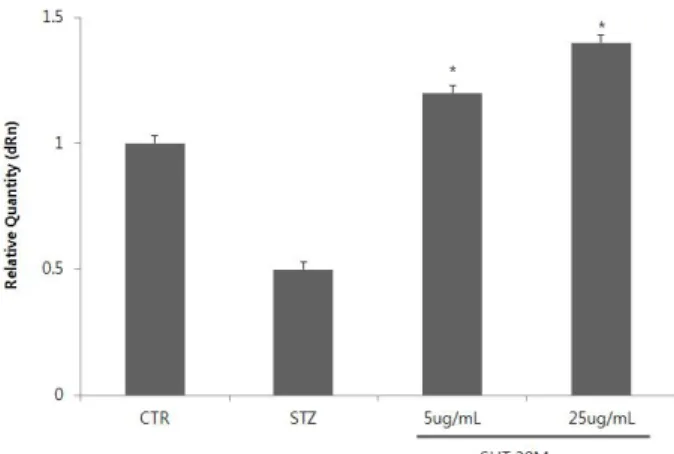
7. 인슐린 저항성 관련 유전자 발현
혈액 내 포도당을 세포 내로 이동시키는 glucose transporter 4 (GLUT-4)의 발현은 인슐린 저항성관련에 중요한 역할
13)을 한다. 국우(菊芋)의 121℃ 가압가열 30분 증자 처리구 50%
에탄올 추출물의 GLUT-4의 발현에 미치는 영향을 비교하기 위해 농도별로 시험하여 그 결과를 Fig. 7에 제시하였다. 국우 (菊芋)의 121℃ 가압가열 30분 증자 처리구 50% 에탄올 추출 물 5 ㎍/㎖ 투여군과 25 ㎍/㎖에서 농도의존적으로 GLUT-4 의 발현을 유의적으로 증가시킴을 확인할 수 있었다.
Fig. 7 Effect of 50% ethanol extract of Steamed Helianthus tuberosus on 121℃ in 30min on glucose transporter 4 (Glut-4) expression in L6 cells. The data were expressed as the mean
± SD. (n=3) from three independent experiements.
*p<0.05, significant between the control.
Ⅳ. 고 찰
당뇨는 혈당조절에 관여하는 인슐린의 결핍에 의해 발생된 대사성질환
12)으로 인슐린 생성 및 작용의 문제로 인하여 인슐 린저항성이 생겨나고 내당능장애의 상태를 거친 후에 발병하게 된다
13). 우리나라의 경우 운동부족 및 비만 인구의 증가로 인해 당뇨의 유병률은 2001년의 8.6% 이던 것이 2013년에는 11.0%로 증가하였다. 2015년의 통계에 따르면 고혈압처방을 받는 당뇨병의 환자비율은 2006년 56.0%에서 2013년에는 62.5%로 증가하였으며 고지혈처방을 받는 당뇨병환자의 비 율은 2006년 대비 2013년에는 1.8배 증가하였다
14). 체중과 당뇨병이 밀접하게 관련 있음이 밝혀진 것 중 대표적인 예로 비만 마우스에서 체중감소를 겪으면서 인슐린 저항성과 혈당 조절 효과에 영향을 미치는 것
15)이 있다. 앞서 살펴본 바와 같이 당뇨와 비만, 당뇨와 고지혈, 당뇨와 고혈압이 밀접한 관련을 맺고 있다. 이러한 복합적인 병증에는 한약과 같은 천 연물을 이용하여 다방면에서 혈압, 콜레스테롤 개선, 체중조절과 함께 당뇨를 치료하는 접근방법이 필요하다. 이러한 내용을 방증하듯이 최근 혈당강하를 주된 목표로 보고된 본초관련 논 문들은 당뇨와 다른 질환을 동시에 개선하는 논문들이 주류를 이루고 있다. 상지(桑枝)의 70% MeOH 추출물과 그의 분획 물인 H
2O층과 CHCl
3추출물을 STZ으로 당뇨가 유도된 마우 스에 투여하여 항당뇨 효과와 고혈당으로 인한 신장 기능의 저하에 대한 억제효과를 보고
16)한 바 있다. 상지와 마찬가지로
상엽(桑葉) 추출물에서도제2 형 당뇨병에 있어서 혈중 인슐린과 렙틴 농도를 저하시킴으로써 인슐린 저항성과 렙틴 저항성을 감소시키고, 혈당조절과 비만개선에 효과
17)가 있음이 보고된 바 있고 고혈압 등의 증상 해소에 빈용되는 갈근(葛根)의 경우 지방·고탄수화물 식이와 저용량 STZ단회 투여에 의해 당뇨 병이 유발된 마우스에서의 갈근 추출물의 당뇨병 개선효과
18)가 보고된 바 있다.
지골피와 산수유 물추출물은 흰쥐 STZ로 유발시킨 당뇨모 델에서 혈당 강하는 물론이고 혈청 내 총콜레스테롤과 중성지방 수치 증가를 유의적으로 감소시키고, BUN과 Creatinine의 증가를 다소 감소시킴으로써 신장 및 간과 폐 조직의 구조적 손상을 막는데 기여한다고 보고
19)하였다. 광나무 잎인 여정엽 (女貞葉)의 물추출물을 급여한 제 2형 당뇨병모델인 db/db 마우스에서 혈당과 고혈압을 감소시키며 세포 유착분자의 발현 감소 및 혈관 내피세포의 기능 개선을 통해 초기 죽상경화증에 효과를 나타내었으며 인슐린 발현을 증가시켜 췌장 기능부진을 개선시키는데 효과가 있었다고 보고
20)한 바 있다. 또한 산양 산삼의 경우 혈중 인슐린 농도를 높여 혈당을 내려서 당뇨증 상을 완화하고, 지질대사를 개선시켜 당뇨병으로 인한 이상지 질혈증에 효과가 있는 것으로 보고
21)되는 등 앞으로 본초(本 草)를 이용한 당뇨병을 비롯한 당뇨병을 둘러싼 합병증의 개 선을 목표로 하는 연구는 지속적으로 확대될 것으로 예상된다.
이러한 관점에서 본초(本草)의 외연을 넓히는 차원에서 민간 약에 대한 혈당강하작용의 검토는 더욱 필요하며 민간약에 대한 포제(炮製)방안의 확립 또한 절실히 요구되는 실정이다.
국우(菊芋)는 재배가 용이하고 민간에서 당뇨증상을 개선 한다고 알려져 그 수요가 많음으로 인해 민간약으로 널리 알 려져 있다. 국우라는 한약재명과 약성, 약효를 가지고 있음에도 불구하고 이에 대한 연구가 부족한 상태이며 또한 이 약재는 관행적으로 보관기간을 늘리기 위해 쪄서 말린 뒤 사용하고 있으나 대한민국 약전외 생약규격집에 수재되어있지 않고 포제 방법에 대해 표준화 되어있지 않아서 본 연구에서는 증자 시 간별로 조제한 국우(菊芋)의 벤조피렌을 정량하고 경구포도당 내당검사와 탄수화물 소화관련 효소작용 저해능을 비교하였다.
항산화력은 증자시간에 비례하여 증가하였으나 증자시간이 일정한도를 넘어서면서 Benzo(a)pyrene 의 양이 증가함으로 유해물질의 최소화와 효능의 극대화를 적정선에서 조정하여 포제조건을 확립하고자 하였다.
Ⅴ. 결 론
본 연구에서는 최근 재배량이 증가되고 있는 돼지감자(菊 芋)의 포제방법 중 증자 시간별 조건에 따라 벤조피렌을 정량 하고 물리성과 항산화력 비교하며 혈당강하작용을 비교한 것을 바탕으로 菊芋의 고온고압 증자방법의 가능성을 확인하였다.
1. 국우(菊芋)는 증자시간에 비례하게 중량이 감소하였다.
2. 국우(菊芋)의 증자시간별 Benzo(a)pyrene의 양을 정량한
결과 121℃ 30분간 증자하는 것이 Benzo(a)pyrene을
최소화 할 수 있었다.
3. Pancreas α-amylase (PAA)와 Salivary α -amylase (SAA)에 대한 국우(菊芋)의 50% EtOH 추출물의 저해 능을 측정한 결과, 가압가열 처리 10분에서 76.1%, 52.5%의 저해효과를 나타내어 탄수화물 소화관련 효소 작용 저해능은 121℃ 10분간 증자하는 것이 가장 우수 하였다.
4. 국우(菊芋) 50% EtOH추출물의 경구포도당 내당검사에서 경구투여 30분 후에서 경구투여 120분 사이의 혈당 감 소율을 확인한 결과, 가압가열 30분 처리구 200 ㎎/㎏
농도에서 36.1%의 감소효과를 나타내어 121℃ 30분간 증자하는 것이 가장 최적이었다.
따라서 이상의 결과를 통해서 혈당강하를 위한 국우(菊芋)의 고온고압 증자시간은 약재 100g 기준 30분간 증자하는 것이 가장 효과적임을 확인 할 수 있었다.
감사의 글
본 연구는 2016년도 중소기업청에서 시행한 산학연협력 기술개발사업 (과제번호 : C0442718)의 지원에 의해 진행된 결과 입니다.
References