289
<원례보저>
The anti-parasitic efficacy of ivermectin and pyrantel pamoate compound against canine Toxocara canis and Trichuris vulpis
Heejeong Youn
1,*, Jeong Chan Ra
2, Byung Ki Kim
2, Bokyoung Bae
1, Yong Suk Lim
1, Kyong Hee Kim
1, Kyong-Eun Lee
11Department of Veterinary Parasitology, College of Veterinary Medicine, Seoul National University, Seoul 151-742, Korea
2RNL-Bio, Seoul 138-840, Korea
(Received: February 18, 2011; Revised: November 11, 2011; Accepted: November 12, 2011)
Abstract :Toxocara (T.) canis and Trichuris (T.) vulpis are very important canine parasitic nematodes. T.
canis parasitize in small intestine and T. vulpis parasitize in large intestine. In order to control of these nematodes, ivermectin and pyrantel pamoate compound was applied to the dogs infected with these parasites naturally and artificially. This drug was composed of 68.0 µg of ivermectin and 57.0 mg of pyrantel pamoate for small animal, 136.0 µg of ivermectin and 114.0 mg of pyrantel pamoate for middle animal, and 272.0 µg of ivermectin and 227.0 mg of pyrantel pamoate for large animal. Ivermectin in this drug is activity to nematodes and ectoparisites. Pyrantel pamoate in this drug is also activity to nematodes. In this experiment, this drug had a good efficacy against T. canis and T. vulpis in the infected dogs.
Keywords : ivermectin, ivermectin and pyrantel pamoate compound, pyrantel pamoate, Toxocara canis, Tri- churis vulpis
Introduction
Companion animals are very important to human and families, because they give many comfortable, commu- nications, and human-relationship between their families.
If they are infected with parasites and zoonotic parasites, their parasites can infect to human. Military dogs and police dogs are frequently infected with parasites. The major parasites in dogs are T. canis, T. vulpis, and Dirofilaria (D.) immitis in helminth, Isospora (I.) canis and Giardia (G.) canis in protozoa, and sarcoptic mite [20].
Ivermectin is a kind of good anti-parasitic drug against nematodes, such as Toxocara (T.) canis, Trichuris (T.) vulpis, ect and ectoparasites in dogs [1, 7]. Pyrantel pamoate is also very good anti-parasitic drug against canine nematodes, such as Ancylostoma caninum, T.
canis, T. vulpis, and so on [10, 12, 14, 18]. This is the research on the anti-parasitic efficacy and safety of ivermectin and pyrantel pamoate compound (IPPC) against T. canis and T. vulpis of companion animals.
After the anti-parasitic activities of the IPPC were
evaluated in the center of strayed dogs and private animal clinics, its were re-evaluated in the private animal clinics.
Materials and Methods
Experimental Animals and feed
Experimental animals are companion animals (dogs) and deserted dogs infected with T. canis and T. vulpis.
They were investigated eggs of parasites. In the field trial, the experimental dogs from the private animal clinics in Seoul were used in this experiment. Feed and water were supplied ad libitum.
Drugs and parasites
The components and dosages of IPPC were as follows. This experiment was used drug for middle animal and other ivermectin drug. For small animals, the effective components of IPPC were 68.0 µg of ivermectin and 57.0 mg of pyrantel pamoate in 1 tablet.
And for large animals, those were 272.0 µg of ivermectin and 227.0 mg of pyrantel pamoate in 1 tablet.
*Corresponding author
Tel: +82-2-880-1267, Fax: +82-2-888-0659
E-mail: [email protected]
These drugs were evaluated the anti-parasitic activity against T. canis and T. vulpis in the center of stray dogs and private clinics.
IPPC was used in this experiment. The dogs infected with T. canis and T. vulpis were used in this experiment.
Methods
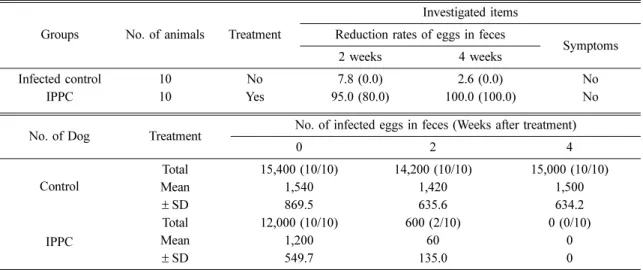
T. canis and T. vulpis was investigated in the center of stray dogs and private animal clinics. After investigation of parasites infection in the stray dogs, the infected dogs were used this experiment. Experimental groups and investigated items were as follow Tables 1 and 2. The dogs were raised by use of in the center of stray dogs and private animal owners. After the parasitic infections of the dogs were diagnosed by use of feces in animal clinics, IPPC were administered orally to the dogs infected with T. canis and T. vulpis. In the private animal clinics trials, the experimental groups and investigated items were as follow Tables 3 and 4. The drugs also
were administered per oral. The dogs were raised by use of in the private animal owners.
Experimental groups
Forty five dogs infected with T. canis and T. vulpis were divided three groups, each group was 3 dogs, such as IPPC (1, 2 and 4 doses) treated group, other ivermectin drug group and infected control group. These experiments were replied 3 times, respectively. In the field trial, twenty dogs in the private animal clinics were selected and were experimented. One group was control group and other group was IPPC treated group.
Investigated items
Eggs of T. canis and T. vulpis were investigated in the feces at 0, 2, and 4 weeks before and after treatment.
Egg reduction rates were calculated each week after treatment. To evaluate drug safety, the side-effects of 2- and 4-fold treated groups were investigated at 0, 2, and
Table 1. The anti-parasitic efficacies of ivermectin and pyrantel pamoate compound (IPPC) against Toxocara (T.) canis in the center of stray dogs
Groups No. of
animals Replication Treatment
Investigated items Reduction rates of eggs (Infected rates)
Symptoms
2 weeks 4 weeks
Infected control 3 3 No –7.1 (0.0) 13.1 (0.0) No
IPPC 3 3 Yes 94.4 (66.7) 100.0 (100.0) No
Ivermectin 3 3 Yes 88.6 (44.4) 100.0 (100.0) No
IPPC (2D) 3 3 Yes 97.4 (77.8) 100.0 (100.0) No
IPPC (4D) 3 3 Yes 100.0 (100.0) 100.0 (100.0) No
No. of Dog Treatment Weeks after treatment
0 2 4
Control
Total 16,800 (9/9) 18,000 (9/9) 14,600 (9/9)
Mean 1,867 2,000 1,622
± SD 1,330 1,661 891
IPPC 1D
Total 18,000 (9/9) 1,000 (3/9) 0 (0/9)
Mean 2,000 111 0
± SD 1,723 176 0
Ivermectin
Total 14,000 (9/9) 1,600 (5/9) 0 (0/9)
Mean 1,556 178 0
± SD 646 211 0
IPPC 2D
Total 15,400 (9/9) 400 (2/9) 0 (0/9)
Mean 1,711 44 0
± SD 813 88 0
IPPC 4D
Total 14,400 (9/9) 0 (0/9) 0 (0/9)
Mean 1,600 0 0
± SD 447 0 0
4 weeks before and after treatment.
Statistic analysis
Statistic analysis were accompanied by student’s t test by use of SigmaPlot (ver. 5.0; Jandel, USA).
Results
The anti-parasitic efficacies of IPPC against T.
canis and T. vulpis in the center of stray dogs In the results of Anti-parasitic efficacy of IPPC against T. canis, the egg reduction rate of IPPC treated group was 94.4% and other Ivermectin treated group was 88.6% after 2 weeks post treatment. Those of 2- and 4- doses groups were 97.4% and 100%, respectively. The individual egg reduction rates of IPPC treated group and other ivermectin treated group were 66.7% and 44.4%, respectively. The egg reduction rates of all treated groups were 100% after 4 weeks post treatment (Table 1).
In the results of Anti-parasitic efficacy of IPPC against
T. vulpis, the egg reduction rate of IPPC treated group was 84.4% and other ivermectin group was 85.7% after 2 weeks post treatment. Those of 2- and 4-doses groups were 93.5% and 97.2%, respectively. The individual egg reduction rates of IPPC treated group and other ivermectin group were 44.4%, respectively. Those of 2- and 4-doses groups were 55.6% and 77.8%, respectively.
The egg reduction rate of IPPC treated group was 96.7%
and other ivermectin group was 97.1% after 4 weeks post treatment. Those of 2- and 4-doses groups were 98.7% and 100.0%, respectively. The individual egg reduction rates of IPPC treated group and other ivermectin group were 77.8%, respectively. Those of 2- and 4-doses groups were 88.9% and 100.0%, respectively (Table 2).
The anti-parasitic efficacies of IPPC to T. canis and T. vulpis in the private clinics
Egg reduction rate of T. canis in blood was 95.0%
in the group treated with IPPC. Individual egg reduction Table 2. The anti-parasitic efficacies of IPPC against Trichuris (T.) vulpis in the center of stray dogs
Groups No. of
animals Replication Treatment
Investigated items Reduction rates of eggs (Infected rates)
Symptoms
2 weeks 4 weeks
Infected control 3 3 No –8.0 (11.1) 14.7 (0.0) No
IPPC 3 3 Yes 84.4 (44.4) 96.7 (77.8) No
Ivermectin 3 3 Yes 85.7 (44.4) 97.1 (77.8) No
IPPC (2D) 3 3 Yes 93.5 (55.6) 98.7 (88.9) No
IPPC (4D) 3 3 Yes 97.2 (77.8) 100.0 (100.0) No
No. of Dog Treatment Weeks after treatment
0 2 4
Control
Total 15,000 (9/9) 16,200 (8/9) 12,800 (9/9)
Mean 1,667 1,800 1,422
± SD 1,330 1,661 891
IPPC 1D
Total 18,000 (9/9) 2,800 (5/9) 600 (2/9)
Mean 2,000 311.1 66.7
± SD 1,723 401.4 141.4
Ivermectin
Total 14,000 (9/9) 2,000 (5/9) 400 (2/9)
Mean 1,556 222.2 44.4
±SD 646 253.9 88.2
IPPC 2D
Total 15,400 (9/9) 1,000 (4/9) 200 (1/9)
Mean 1,711 111.1 22.2
± SD 813 145.3 66.6
IPPC 4D
Total 14,400 (9/9) 400 (2/9) 0.0 (0/9)
Mean 1,600 44.4 0.0
± SD 447 88.2 0.0
rate of T. canis in blood was 80.0% in the group treated with IPPC at 2 weeks after treatment. Egg reduction rate of T. canis in blood was 100% in the group treated with IPPC (Table 3).
Egg reduction rate of T. vulpis in blood was 84.7%
in the group treated with IPPC. Individual egg reduction rate of T. vulpis in blood was 60.0% in the group treated with IPPC at 2 weeks after treatment. Egg reduction rate of T. vulpis in blood was 95.7% in the group treated with IPPC. Individual egg reduction rate of T. vulpis in blood was 80.0% in the group treated with IPPC at 4 weeks after treatment (Table 4).
Discussion
The major canine parasites are round-worm, whip- worm and heart-worm in nematodes, Isospora canis and Giardia canis, in protozoa, and mite in arthropods. In the results of anti-parasitic activity of IPPC against T.
canis in this experiment, the egg reduction rate of IPPC treated and other ivermectin groups were 94.4% and 88.6% at 2 weeks after treatment, respectively. Those of 2 and 4 doses of IPPC group were 97.4% and 100%, at 2 weeks after treatment, respectively. Otherwise, the individual egg reduction rate of IPPC treated and other ivermectin groups were 66.7% and 44.4% at 2 weeks Table 3. The anti-parasitic efficacies of IPPC against T. canis in the private clinics
Groups No. of animals Treatment
Investigated items Reduction rates of eggs in feces
Symptoms
2 weeks 4 weeks
Infected control 10 No 7.8 (0.0) 2.6 (0.0) No
IPPC 10 Yes 95.0 (80.0) 100.0 (100.0) No
No. of Dog Treatment No. of infected eggs in feces (Weeks after treatment)
0 2 4
Control
Total 15,400 (10/10) 14,200 (10/10) 15,000 (10/10)
Mean 1,540 1,420 1,500
± SD 869.5 635.6 634.2
IPPC
Total 12,000 (10/10) 600 (2/10) 0 (0/10)
Mean 1,200 60 0
± SD 549.7 135.0 0
Table 4. The anti-parasitic efficacies of IPPC against T. vulpis in the private clinics Groups No. of animals Treatment
Investigated items Reduction rates of eggs in feces
Symptoms
2 weeks 4 weeks
Infected control 10 No 9.0 (0.0) 3.0 (0.0) No
IPPC 10 Yes 84.8 (60.0) 95.7 (80.0) No
No. of Dog Treatment Weeks after treatment
0 2 4
Control
Total 13,400 (10/10) 12,200 (10/10) 13,000 (10/10)
Mean 1,340 1,220 1,300
± SD 869.5 635.6 634.2
IPPC
Total 9,200 (10/10) 1,400 (4/10) 400 (2/10)
Mean 920 140 40
± SD 413.1 211.9 84.3
after treatment, respectively. Those of 2 and 4 doses of IPPC group were 77.8% and 100%, at 2 weeks after treatment, respectively. T. canis were treated in the all of the medicated groups at 4 weeks after treatment. In the field trials, the results of anti-parasitic activity of IPPC against T. canis, the egg reduction rate of IPPC treated group was 95.0% at 2 weeks after treatment. The individual egg reduction rate of IPPC treated group were 80.0% at 2 weeks after treatment. All of T. canis were entirely treated in the medicated groups at 4 weeks after treatment. Some researchers published the anti-parasitic efficacies of pyrantel parmoate and ivermectin against T. canis and T. vulpis. Miró et al. [16] reported that in the dogs, the anti-parasitic activities of pyrantel, fenbendazole, and febantel-pyrantel-praziquantel were 100%, 80~100% and 97~100% against T. canis, respectively. Grandemange et al. [8] reported that in the dogs, the anti-parasitic activities of oxantel/pyrantel/
praziquantel against T. canis were 99.1%, 98.8% and 98.9% at 7, 14 and 21 after medication. McTier et al.
[15] reported that in the dogs, the results of anti-parasitic activity of selamectin and pyrantel against T. canis were 84.6~100.0%. Dryden and Ridley [6] reported that in the dogs, the anti-parasitic activities of egg reduction rates of fenbendazole and pyrantel pamoate suspension against T. canis were 95.8%, 99.8% and 96.8~99.8%, 85.8%, 88.3% and 71.4~98.3% at 10, 31 and 31~128 days after treatment, respectively. Lloyd and Gemmell [13] reported that in the dogs, the anti-parasitic activities of a compound of praziquantel, pyrantel embonate, and febantel were 100% in the artificial infection and 97~98% in the field trial. Clark et al. [3] reported that in the dogs, the anti-parasitic activity of beef-based chewable formulation of Ivermectin and pyrantel pamoate against T. canis was 90.1%, respectively. Clark et al. [2]
reported that in the dogs, the anti-parasitic activities of pyrantel pamoate with 2.5, 5 or 10 mg/kg of weight against T. canis adult worms were 76.1, 94.2, 91.2%, respectively. Jacobs [11] reported that in the dogs, the anti-parasitic activities of pyrantel pamoate and piperazine against T. canis adult worms were 83.5 and 82.5%, respectively. Sharp and McCurdy [19] reported that in the dogs, the anti-parasitic activities of 10 and 1 mg/
kg of body weight of febantel and praziquantel against T. canis adult worms were 100%, respectively. Corwin et al. [5] reported that the anti-parasitic activities of a compound of 3.40% febantel and 0.34% praziquantel against T. vulpis (10), T. canis (2), D. immitis (3) in the
dogs and Toxocara cati (10/11) in the cats at 1 time per day during 3 days were 100%, respectively. Corwin et al. [4] reported that febantel were good efficacy against nematodes, such as Ancylostoma caninum, T. vulpis, Uncinaria stenocephala, T. canis, Toxascaris leonina and cestodes, such as Taenia sp and Dipylidium caninum. In these experiments, the results of anti-parasitic activities of IPPC against T. canis were like as those of previous researchers.
The egg reduction rates of IPPC in the dogs artificially infected with T. vulpis were 84.4% in 1 dose, 93.5% in 2 doses, 97.2% in 4 doses and 85.7% in control drug treated group at 2 weeks after treatment. The individual egg reduction rates of IPPC against T. vulpis were 44.4%
in 1 dose, 55.6% in 2 doses, 77.8% in 4 doses and 44.4% in control drug treated group at 2 weeks after treatment. The egg reduction rates of IPPC against T.
vulpis were 96.7% in 1 dose, 98.7% in 2 doses, 100.0%
in 4 doses and 97.1% in control drug treated group at 4 weeks after treatment. The individual egg reduction rates of IPPC against T. vulpis were 77.8% in 1 dose, 88.9% in 2 doses, 100.0% in 4 doses and 77.8% in control drug treated group at 4 weeks after treatment.
In the field trials, the egg reduction rates of IPPC in the dogs infected with T. vulpis were 84.7% and 95.7% at 2 and 4 weeks after treatment. The individual egg reduction rates of IPPC in the dogs infected with T.
vulpis were 60.0% and 80.0% at 2 and 4 weeks after treatment. Grandemange et al. [8] reported that the egg reduction rates of a compound of oxantel/pyrantel/
praziquantel against T. vulpis were 97.3%, 97.2% and 98.4% at 7, 14 and 21 days after treatment, respectively.
Prelezov and Bauer [17] reported that the worm reduction rates of Flubenol and Drontal Plus against T.
vulpis were 99.4%, respectively. Lloyd and Gemmell [13] reported that the anti-parasitic activities of a compound of praziquantel, pyrantel embonate and febantel were over 92% in the dogs naturally infected with T. vulpis. Greiner et al. [9] reported that the anti- parasitic activities of febantel/praziquantel paste and febantel tablet were 95.8% and 99.7% in the dogs naturally infected with T. vulpis, respectively. Sharp and McCurdy [19] reported that the anti-parasitic activities of a compound of 10 mg/kg febantel and 1 mg/kg praziquantel was 99.5% in the dogs infected with T.
vulpis at 1 time per day during 3 days. Corwin et al.
[5] reported that the anti-parasitic activities of a compound of 3.40% febantel and 0.34% praziquantel
against T. vulpis were 99.9% at 1 time per day during 3 days. The results of anti-parasitic activities of IPPC against T. vulpis also were like as those of previous researchers.
So that IPPC is a good drug for control of intestinal nematode parasites.
Aknowledgments
This work was supported by Korean Research Foundation Grant (KRF-2006-005-J02902).
References
1. Anderson DL, Roberson EL. Activity of ivermectin against canine intestinal helminths. Am J Vet Res 1982, 43, 1681-1683.
2. Clark JN, Daurio CP, Barth DW, Batty AF.
Evaluation of a beef-based chewable formulation of pyrantel pamoate against induced and natural infections of hookworms and ascarids in dogs. Vet Parasitol 1991, 40, 127-133.
3. Clark JN, Daurio CP, Plue RE, Wallace DH, Longhofer SL. Efficacy of ivermectin and pyrantel pamoate combined in a chewable formulation against heartworm, hookworm, and ascarid infections in dogs.
Am J Vet Res 1992, 53,517-520.
4. Corwin RM, McCurdy HD, Pratt SE. Effect of febantel against Ancylostoma caninum and Trichuris vulpis infections in dogs. Am J Vet Res 1982, 43, 1100- 1102.
5. Corwin RM, Pratt SE, McCurdy HD. Anthelmintic effect of febantel/praziquantel paste in dogs and cats.
Am J Vet Res 1984, 45, 154-155.
6. Dryden MW, Ridley RK. Efficacy of fenbendazole granules and pyrantel pamoate suspension against Toxocara canis in greyhounds housed in contaminated runs. Vet Parasitol 1999, 82, 311-315.
7. Epe C, Pankow WR, Hackbarth H, Schnieder T, Stoye M. A study on the prevention of prenatal and galactogenic Toxocara canis infections in pups by treatment of infected bitches with ivermectin or doramectin. Appl Parasitol 1995, 36, 115-123.
8. Grandemange E, Claerebout E, Genchi C, Franc M.
Field evaluation of the efficacy and the safety of a combination of oxantel/pyrantel/praziquantel in the treatment of naturally acquired gastrointestinal nematode
and/or cestode infestations in dogs in Europe. Vet Parasitol 2007, 145, 94-99.
9. Greiner EC, Brenner DG, Cox DD, Heaton-Jones DL. Comparison of febantel tablets and Vercom paste against gastrointestinal nematodes of dogs. Vet Parasitol 1992, 41, 151-156.
10. Hopkins TJ. Efficacy of a tablet containing pyrantel embonate, febantel and praziquantel against T canis in dogs. Vet Rec 1991, 128, 331.
11. Jacobs DE. Control of Toxocara canis in puppies: a comparison of screening techniques and evaluation of a dosing programme. J Vet Pharmacol Ther 1987, 10, 23-29.
12. Klein JB, Bradley RE Sr, Conway DP. Anthelmintic efficacy of pyrantel pamoate against the roundworm, Toxocara canis, and the hookworm, ancylostoma caninum, in dogs. Vet Med Small Anim Clin 1978, 73, 1011-1013.
13. Lloyd S, Gemmell MA. Efficacy of a drug combination of praziquantel, pyrantel embonate, and febantel against helminth infections in dogs. Am J Vet Res 1992, 53, 2272-2273.
14. Mackenstedt U, Schmidt S, Mehlhorn H, Stoye M, Traeder W. Effects of pyrantel pamoate on adult and preadult Toxocara canis worms: an electron microscope and autoradiography study. Parasitol Res 1993, 79, 567- 578.
15. McTier TL, Siedek EM, Clemence RG, Wren JA, Bowman DD, Hellmann K, Holbert MS, Murphy MG, Young DR, Cruthers LR, Smith DG, Shanks DJ, Rowan TG, Jernigan AD. Efficacy of selamectin against experimentally induced and naturally acquired ascarid (Toxocara canis and Toxascaris leonina) infections in dogs. Vet Parasitol 2000, 91, 333-345.
16. Miró G, Mateo M, Montoya A, Vela E, Calonge R.
Survey of intestinal parasites in stray dogs in the Madrid area and comparison of the efficacy of three anthelmintics in naturally infected dogs. Parasitol Res 2007, 100, 317-320.
17. Prelezov PN, Bauer C. Comparative efficacy of flubendazole chewable tablets and a tablet combination of febantel, pyrantel embonate and praziquantel against Trichuris vulpis in experimentally infected dogs. Dtsch Tierarztl Wochenschr 2003, 110, 419-421.
18. Reinemeyer CR, Faulkner CT, Assadi-Rad AM, Burr JH, Patton S. Comparison of the efficacies of three heartworm preventives against experimentally
induced infections with Ancylostoma caninum and Toxocara canis in pups. J Am Vet Med Assoc 1995, 206, 1710-1715.
19. Sharp ML, McCurdy HD. Anthelmintic efficacy of febantel combined with praziquantel in dogs. J Am Vet
Med Assoc 1985, 187, 254-255.
20. Youn HJ, Hong KO, Lee BC and Oh HG. Prevalence of intestinal parasites in dogs and its control in Korea.
Korean J Vet Public Health 1995, 19, 257-261.