Copyright ⓒ 2013, The Microbiological Society of Korea
멧돼지 대장으로부터 Bacillus atrophaeus MPL-01의 분리 및 항진균 활성의 특성
윤성조1․노재영2*
1엠피엘, 2단국대학교 생명과학부
Isolation of Bacillus atrophaeus MPL-01 from A Wild Boar and Characterization of Its Antifungal Activity
Sung-Jo Yun1 and Jae-Young Rho2*
1MPL, Cheonan 331-831, Republic of Korea
2School of Bio-science, Dankook University, Cheonan 330-714, Republic of Korea
(Received May 31, 2013 / Accepted June 19, 2013)
A bacterial strain MPL-01 was isolated from the large intestine of a wild boar. The strain was shown to have morphological, physiological and biochemical characteristics, fatty acids composition typical of Bacillus. The 16S rRNA gene sequence showed that the isolate formed distinct phyletic line that was most closely related to this of Bacillus atrophaeus (99.99%). It was proposed that the strain is classified as B. atrophaeus MPL-01. The strain MPL-01 exhibited the strongest antifungal activity against Colletotrichum acutatum, the pathogen of anthracnose of chili peppers. The ethyl acetate extract of culture filtrate possessed not only the antifungal activity but also the bio-surfactant activity. Therefore, the strain MPL-01 could be a useful bacterium in the development of bio-control process against the pathogenic fungi.
Keywords: Bacillus atrophaeus, 16S rRNA, antifungal activity, biocontrol, wild boar
*For correspondence. E-mail: [email protected]; Tel.: +82-41-550- 3475; Fax: +82-41-558-3861
친환경 농산물 생산 증가에 따라서 농작물에 대한 생물학적 방제 또한 증가하였고, 천연물이나 미생물을 이용한 다양한 연 구가 진행되고 있다(Tuleva et al., 2002; Jang and Kim, 2011).
미생물에 의한 생물학적 방제는 환경 친화성, 낮은 독성, 저렴한 비용, 높은 선별성 및 특이성 등 여러 가지 장점을 가지고 있다 (Tuleva et al., 2002). 식물 병은 주로 바이러스, 세균, 진균에 의 해 발병되며, 이 중 진균에 의한 피해가 가장 심각하고 작물의 생 산성에 직접 영향을 주었다. 1960년대 이후 환경오염을 줄이고 식물병원성 진균에 의한 피해를 줄일 수 있는 화학 농약 대체 생물 학적 제제를 개발하려는 시도가 이루어져 blasticidin, kasugamycin 등이 실제 방제에 적용되었다. 몇몇의 이차대사물질은 독성 등의 이유로 실용화하지 못하고 있는 실정이다(Larsen et al., 1989;
Hotta, 1996). 이러한 문제점 때문에 방선균 이외의 균을 이용한 식물병 방제제 개발이 시도되었다. 특히 Bacillus 속은 가장 많이 연구된 근권 세균으로 내생포자를 형성 보존성이 우수하고 제형 화가 용이하여 화학 농약을 대체할 수 있는 주요한 미생물이며, 식물 병원균과 영양적 경쟁을 하거나, 항생물질을 생산하여 저 항성을 유도한다(Punja and Utkhede, 2003). 이들이 생산하는
항진균 물질들이 다양하게 있으며 iturin (Besson et al., 1990;
Maget-Dana and Peypoux, 1994), bacillomycin (Tenoux et al., 1991; Eshita et al., 1995), mycosubtilin (Peypoux et al., 1986;
Besson and Michel, 1990), surfactin 등 약 10여 종류가 보고 되고 있다. 주요 생산균들로는 B. subtilis, B. cereus, B. polymixa, B.
amyloliquefaciens, B. thuringiensis 등이 있다. 이들은 생물계면 활성제(biosurfactant)로 양친매성 물질이며 농업, 화장품, 의약 품, 세제, 식품, 환경복원 등에 많이 이용되고 있다. 생물계면활 성제의 장점은 독성이 없고, 생분해성이 강하여 친환경적이며, 선택성이 높으며 극한적인 조건에서도 효과적으로 작용한다는 것이다. 예를 들면, 생물계면활성제로 알려진 iturin A에 의한 효 과적인 Rhizoctonia solani 억제 결과는 식물병 방제에 큰 잠재 력을 같고 있다고 할 수 있다(Yu et al., 2002).
본 연구는 식물 병원성 진균에 항균 활성을 나타내는 Bacillus 속을 야생멧돼지에서 분리 ․ 동정하고 식물병원균에 대한 생물농 약으로서의 가능성을 알아보고자 하였다. 먼저 야생멧돼지 장내 에서 세균을 순수 분리한 후, 여러 식물 병원성 진균을 대상으로 길 항력을 확인하였다. 주사전자현미경(Hitachi S4300 FESEM, Japan)으로 분리균의 형태와 크기를 관찰하였고 16S rRNA 염 기서열을 분석하였다. 이와 함께 균체의 지방산분석 및 생리화 학적 분석을 통하여 균을 동정하였으며, 여러 식물병원 진균 중
Fig. 1. Scanning electron micrograph of B. atrophaeus MPL-01.
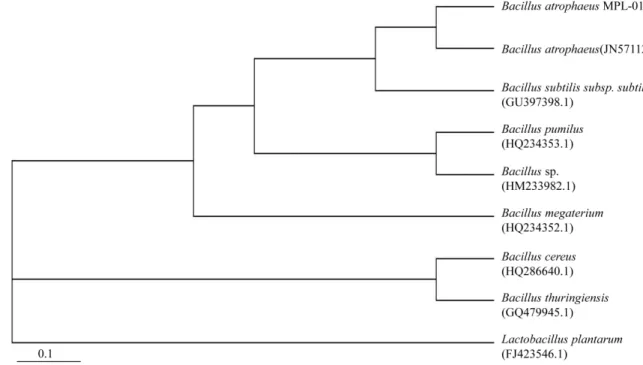
Fig. 2. Phylogenetic tree derived from 16S rRNA gene sequence, indicating the position of B. atrophaeus MPL-01.
Strains Fatty acids composition (%)
15:0 iso 15:0 anteiso 16:0 iso 17:0 iso 17:0 anteiso
B. atrophaeus MPL-01 18.00 45.72 3.76 7.83 14.68
B. atrophaeus KCCM 11495 18.54 45.79 3.20 8.06 16.84
Table 1. Fatty acids composition of B. atrophaeus MPL-01 by MIDI Sherlock System
에서 특히 고추 탄저균에 대한 뛰어난 길항력을 확인하였고, 이와 관련된 물질 중의 하나인 생물계면활성제 생산을 확인하였다.
2008년 12월 경남 거창의 야산에서 포획된 수컷의 대장 내부 에서 채취된 시료를 생리식염수(0.85%)에 희석한 다음 80℃ 항 온기에서 10분간 중탕 한 후 희석하여 nutrient agar (NA)에 도 말, 30℃에서 24시간 배양 후 자란 단일 집락에서 식물병원성 진 균에 대해 길항력을 보이는 균을 분리하였다. 분리균의 형태와
크기를 조사하기 위해 주사전자현미경 관찰 결과, 균은 전형적 인 간균이었으며 그 크기는 0.8 µm × 3.2 µm로 확인되었다(Fig.
1). 분리균의 균체 지방산 조성 분석을 위하여 비교균주인 B.
atrophaeus KCCM 11495와 함께 TSA 배지에서 30℃, 48시간 배양한 대수기의 균체를 회수하여 비누화 과정과 메틸화 시킨 후 추출하여 기체크로마토그라피(Agilent technologies 5890, USA), Microbial Identification System (MIDI; Microbial ID, Inc., USA)을 이용하여 분석하였다. 지방산 분석결과 15:0 iso는 18.0%, 15:0 anteiso는 45.72%, 16:0 iso는 3.76%, 17:0 iso는 7.83% 그리고 17:0 anteiso는 14.68%로 구성되어 표준 균주인 B. atrophaeus KCCM 11495와 유사한 양상을 나타내었다 (Table 1). 이와 함께 분리균주를 TSA에 배양·희석 후 API 50CH와 API 20E 검사키트를 이용하여 생화학적 동정을 완료 하였다. 그 결과 분리균주 MPL-01은 B. subtilis로 분류되었고 (99.9%), 비교 균주인 B. atrophaeus KCCM 11495 역시 B.
subtilis에 속하는 것으로 분류되었다(99%)(Table 2). 이러한 생 리, 화학적 분류와 함께 계통분류를 위해 16S rRNA 유전자 염 기서열 분석을 수행하였다. 분리균의 genomic DNA 추출은 DNeasy blood and tissue kit (Qiagen, USA)를 사용하여 수행되 었다. 16S rRNA 유전자는 universal primer로써 27F (5′-AGAG TTTGATCCTG GCTCAG)와, 1492R (5′-GGTTACCTTGTT ACGACTT-3′)를 사용한 PCR을 통하여 증폭하여 1,448 bp 산물
Biochemical tests MPL-01 KCCM
11495 Biochemical tests MPL-01 KCCM
11495 Control
Glycerol Erythritol D-Arabinose L-Arabinose D-Ribose D-Xylose L-Xylose D-Adonitol
Methyl-β-D-Xylopyranoside D-Galactose
D-Glucose Fructose D-Mannose L-Sorbose L-Rhamnose Dulcitol Inositol D-Mannitol D-Sorbitol
Methyl-α-D-mannopyranoside Methyl-α-D-glucopyranoside N-Acetylglucosamine Amygdalin
Arbutin Esculin Salicin D-Cellobiose D-Maltose
D-Lactose (bovine origin) D-Melibiose
D-Saccharose (sucrose) D-Trehalose
Inulin D-Melezitose D-Raffinose
- + - - + + - - - - - + + + - - - + + + - + - + + + + + + - - + + - - -
- + - - + + + - - - - + + + - - - + + + - + - + + + + + + - - + + - - -
Starch Glycogen Xylitol Gentiobiose D-Turanose D-Lyxose D-Tagatose D-Fucose L-Fucose D-Arabitol L-Arabitol Gluconate 2-Keto-gluconate 5-Keto-gluconate Beta-galactosidase Arginine dihydrolase Lysine decarboxylase Ornithine decarboxylase Citrate
Hydrogen sulfide Urease
Trytophane deaminase Indole
VP Gelatinase Nitrate reduction Oxidation-Fermentation Catalase
Caseinase Amylase Lipase Range of growth Temperature 20-45℃
pH 5-8
NaCl >0.1-8% (w/v)
- - - - - - - - - - - - - - + - - - + - - - - + + + + + + + + + + +
- - - - - - - - - - - - - - + - - - + - - - - + + - + + + + + + + + Table 2. Biochemical characterization of B. autropaus-MPl-01 using API 20E and API 50 CHB kits
을 얻었다. Genotech (Korea)에 의뢰하여 이에 대한 염기서열을 결정하고 GenBank BlastN 결과 분리균주 MPL-01은 B.
atrophaeus KCCM 11495와 99.99%의 상동성을 보였다. 또한 neighbor-joining method에 의하여 계통수(phylogenetic tree)를 작성한 결과 B. subtilis과는 분리된 독립적인 B. atrophaeus taxon에 속하는 것으로 나타났다(Fig. 2). 따라서 분리균주 MPL-01를 B. atrophaeus MPL-01로 명명하고 한국생명공학연 구원에 국제특허 균주기탁하였다(KCTC 12329BP). B. atrophaeus MPL-01은 그람 양성, 호기성, 포자형성, 막대모양이고 운동성 을 나타내며, 집락은 불투명하고, 부드러우며, 불규칙하다(자료 미제시). 특히 질소원을 함유하는 배지에서 배양 2–5일에 검정색 소를 생성하는 B. atrophaeus 특유의 특성을 나타내었다(자료 미제시). B. atrophaeus는 이전에 검정갈색(brownish black) 색 소를 생산하는 B. subtilis로써 "B. subtilis var. niger" 라고 불리 기도 했으나 DNA relatedness group을 이용한 재분류에서 B.
subtilis와는 다른 새로운 종으로 분류되어 명명되었다(Nakamura, 1989). 이후에 수행된 B. subtilis 근연 종들에 대한 분류에서도 B.
atrophaeus는 B. subtilis와 공유하는 많은 특성에도 불구하고 분 명하게 다른 clade에 속한다고 보고되었다(Chun and Bae, 2000). 본 실험에서도 생리 ․ 생화학적 분류방법에 따르면 B.
atrophaeus MPL-01와 B. atrophaeus KCCM 11495 모두 B.
subtilis로 분류되었으나 16S rRNA 유전자 서열과 특유의 검정 색소 생산을 고려하면 B. atrophaeus로 명명하는 것이 적절하다 고 생각된다.
이어서 분리균주 MPL-01의 항균활성을 측정하였다. PDA 한 천배지(potato dextrose agar, Difco)에 3일간 배양된 식물 병원 균 한천 블록(0.5 cm × 0.5 cm)을 올려 놓은 다음, B. atrophaeus MPL-01를 TSB (tryptic soy broth, Merck) 배지에서 30℃ 72시 간 배양 후 배양액 40 μl를 직경 6 mm의 여과지 위에 점적, 25℃
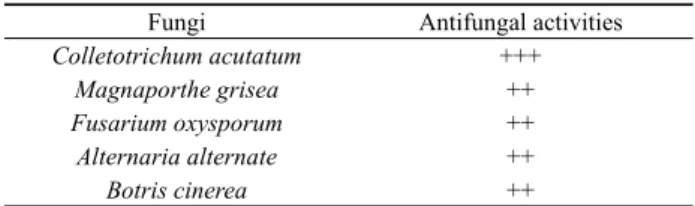
6일간 배양하여 형성된 생장억제환을 기준으로 항진균 활성을 측정하였다. 고추 탄저병(Colletotrichum acutatum)에 대하여 15 mm의 가장 높은 항진균 활성을 보였고, 벼 도열병(Magnaporthe grisea), 배추 시들음병(Fusarium oxysporum), 밤나무 검은무늬 병(Alternaria alternate), 딸기 잿빛곰팡이병(Botris cinerea) 순
(A) (B) (C)
Fig. 5. Oil drop collapse test in the 96 well plate using the ethyl acetate extract. (A) undiluted ethyl acetate extract, (B) 1000X diluted ethyl acetate extract, (C) distilled water drop on the oily surface.
Fungi Antifungal activities
Colletotrichum acutatum +++
Magnaporthe grisea ++
Fusarium oxysporum ++
Alternaria alternate ++
Botris cinerea ++
(+++: 10–20 mm, ++: 5–10 mm, +: bellow 5 mm)
Table 3. Antifungal activities against plant pathogenic fungi of B.
atrophaeus MPL-01
Fig. 3. Antifungal activity of the ethyl acetate extract of culture
supernatant against C. acutatum and C. gloeosporioides . Fig. 4. Hemolytic activity of B. atrophaeus MPL-01.
으로 항진균 활성을 나타내었다(Table 3).
고추탄저병의 주요 원인균은 C. acutatum, C. coccodes, C.
gloeosporiodes, C. dematinum 등인데 이들 중에 C. acutatum, C. gloeosporiodes가 풋고추와 홍고추에 직접적으로 피해를 주는 것으로 알려져 있다. 이들을 대상으로 항진균 활성을 측정하고 자 배양액으로부터 항생물질을 부분 정제하였다. B. atrophaeus MPL-01을 TSB에 1% (v/v)가 되도록 접종하고 30℃에서 3일간 진탕 배양한 뒤, 원심분리(6,000 × g, 20분) 후 상층을 회수하였 다. 회수된 상층 배양액을 같은 양의 ethyl acetate와 혼합하여 항 진균 물질을 추출한 다음 감압 농축하여 methanol에 녹여서 실 험에 사용하였다. Ethyl acetate 추출물에 의해서 C. acutatum과 C. gloeosporiodes의 생장이 억제된 것을 확인하였다(Fig. 3).
한편 B. subtilis 균주들은 생물계면활성제를 생산하고 이것에 의한 항진균활성이 보고된 바 있으므로(Besson et al., 1990), 분
리균주 MPL-01의 생물계면활성제 생산 여부를 확인하였다. 5%
(v/v)의 양적혈구가 첨가된 blood agar에 접종 후 30℃, 24시간 배양한 다음 분리균 집락 주변에 투명환이 형성됨을 확인하였다 (Fig. 4). 이것은 생물계면활성제에 의한 적혈구 용혈활성 (hemolytic activity)으로 이전의 결과들과 일치한다(Zaragoza et al., 2010).
그리고 추출액의 생물계면활성를 확인하기 위하여 oil drop collapse 방법을 변형하여 시행하였다(Bodour and Miller-Maier, 1998; Kermanshahi and Peymanfar, 2012). 96 well microtiter plate에 미네랄오일을 100 μl를 넣은 다음 시료10 μl를 처리하고 2분 후 해부 현미경에서 증류수 처리한 것과 drop의 크기를 비교 하여 생물계면활성제 양성으로 판별하였다. Ethyl acetate 추출 원액은 오일전체에 유화되었으며 1000배 희석한 시료에서도 대 조군인 물보다 drop 크기가 커져있어 많이 유화되었음을 보였다 (Fig. 5). 이것은 이전에 보고된 유산균 배양액의 계면활성 보다 높은 것으로서 분리균주 MPL-01은 우수한 계면활성제 생산균으 로 여겨진다(Kermanshahi and Peymanfar, 2012).
그러므로 본 실험에서 분리된 B. atrophaeus MPL-01는 고추 탄저병 진균을 비롯한 여러 식물병원균에 대하여 항진균 활성을 나타내며 동시에 생물계면활성제를 생산하므로 친환경적 미생 물 농약으로 개발될 가능성이 크다고 할 수 있다. 앞으로 이 균주 가 생산하는 항진균 물질을 분리 정제하고, 구조 분석 등의 추가 적인 연구를 수행하며, 항진균 물질과 계면활성제가 동일 물질 임을 밝혀야 할 것이다.
적 요
멧돼지 대장에서 MPL-01 균주를 분리하여 균주의 형태학적, 생리 ․ 생화적 특성 및 지방산 조성을 분석하여 Bacillus임을 확 인하였다. 16S rRNA 유전자 서열 분석 결과 MPL-01 균주는 Bacillus atrophaeus와 거의 일치하므로(99.99%) B. atrophaeus MPL-01로 명명하였다. MPL-01 균주는 고추 탄저병을 일으키 는 Colletotrichum acutatum에 대하여 가장 강한 항진균 활성을 나타내었다. 배양액의 ethyl acetate 추출액에서 항진균 활성은 물론이고 계면활성도 확인하였다. 그러므로 B. atrophaeus MPL-01 은 농작물 병원성 곰팡이 제어를 위한 bio-control 개발에서 유용 하게 사용될 것이다.
참고문헌
Besson, F., Hourdou, M.L., and Michel, G. 1990. Studies on the biosynthesis of iturin, an antibiotic of Bacillus subtilis, and a lipopeptide containing beta-hydroxy fatty acids. Biochim. Biophys.
Acta. 1036, 101–106.
Besson, F. and Michel, G. 1990. Mycosubtilins B and C: minor antibiotics from mycosubtilin producer Bacillus subtilis. Microbios 62, 93–99.
Bodour, A.A. and Miller-Maier, R.M. 1998. Application of a modified drop-collapse technique for surfactant quantitation and screening of biosurfactant producing microorganisms. J. Microbiol. Methods 32, 273–280.
Chun, J. and Bae, K.S. 2000. Phylogenetic analysis of Bacillus subtilis and related taxa based on partial gyrA gene sequences. Antonie van Leeuwenhoek 78, 123–127.
Eshita, S.M., Roberto, N.H., Beale, J.M., Mamiya, B.M., and Workman, R.F. 1995. Bacillomycin Lc, a new antibiotic of the iturin group:
isolations, structures, and antifungal activities of the congeners. J.
Antibiot. 48, 1240–1247.
Hotta, K. 1996. Mechanism of multiple aminoglycoside resistance of kasugamycin-producing Streptomyces kasugaensis MB273 :
involvement of two types of acetyltransferases in resistance to astromicin group antibiotics. J. Antibiot. (Tokyo) 49, 682–688.
Jang, Y.L. and Kim, Y.H. 2011. Biocontrol efficacies of Bacillus species against Cylindrocarpon destructans causing ginseng root rot. Plant Pathol. J. 27, 333–341.
Kermanshahi, R.K. and Peymanfar, S. 2012. Isolation and identification of Lactobacilli from cheese, yoghurt and silage by 16S rDNA gene and study of bacteriocin and biosurfactant production. Jundishapur J. Microbiol. 5, 528–532.
Larsen, S.H., Berry, D.M., Paschal, J.W., and Gilliam, J.M. 1989.
5-Hydroxymethyl blasticidin S and blasticidin S from Streptomyces setonii culture A 83094. J. Antibiot. 42, 470–471.
Maget-Dana, R. and Peypoux, F. 1994. Iturins, a special class of pore-forming lipopeptides: biological and physicochemical properties.
Toxicology 87, 151–174.
Nakamura. L.K. 1989.Toxonomic relationship of black-pigmented Bacillus subtilis strains and a proposal for Bacillus atrophaeus sp.
nov.. Int. J. Syst. Bacteriol. 39, 295–300.
Peypoux, F., Pommier, M.T., Marion, D., Ptak, M., Das, B.C., and Michel, G. 1986. Revised structure of mycosubtilin, a peptidolipid antibiotic from Bacillus subtilis. J. Antibiot. 39, 636–641.
Tenoux, I., Besson, F., and Michel, G. 1991. Studies on the antifungal antibiotics: bacillomycin D and bacillomycin D methylester.
Microbios 67, 187–193.
Tuleva, B.K., Ivanov, G.R., and Christovam N.E. 2002. Biosurfactant production by new Pseudomonas putida strain. Z. Naturforsch. 57, 356–360.
Yu, G., Sinclair, J.B., Hartman, G.L., and Bertagnolli, B.L. 2002.
Production of iturin A by Bacillus amyloliquefaciens suppressing Rhizoctonia solani. Soil Biol. Biochem. 34, 955–963.
Punja, Z.K. and Utkhede, R. 2003. Using fungi and yeasts to manage vegetable crop disease. Trends Biotechnol. 21, 400–407.
Zaragoza, A., Aranda, F.J., Espuny, M.J., Teruel, J.A., Marqués, A., Manresa, A., and Ortiz, A. 2010. Hemolytic activity of a bacterial trehalose lipid biosurfactant produced by Rhodococcus sp.:
evidence for a colloid-osmotic mechanism. Langmuir 26, 8567–
8572.