• 검색 결과가 없습니다.

A Study on the Effect on UV Exposure in Coastal Buildings

N/A
N/A
Protected

Academic year: 2021

Share "A Study on the Effect on UV Exposure in Coastal Buildings"

Copied!
11
0
0

로드 중.... (전체 텍스트 보기)

전체 글

(1)

Received |

12 October, 2020

Revised |

23 June, 2021

Accepted |

23 June, 2021

OPEN ACCESS

This is an Open-Access article distributed under the terms of the Creative Commons Attribution Non-Commercial License (http://creativecommons.

org/licenses/by-nc/4.0) which permits unrestricted noncommercial use, distribution, and reproduction

ABSTRACT

Purpose: The ultraviolet reflectance and transmittance of coastal building materials are one of the important factors of ultraviolet radiation in and out of coastal building. In this research, the ultraviolet spectral reflectance of many kinds of building materials was measured. Also, the relationships with the lightness, roughness, and chromaticity, which are surface characteristics, were reviewed and suggested. Method: In this study, according to the CIE classification, the ultraviolet region was defined as short-wavelength region UV-C(10nm~280nm), medium-wavelength region UV-B (280-315 nm), and long-wavelength region UV-A (315-400nm), and the visible light region was defined as (400nm

~780nm). Spectrophotometer was used to continuously measure the reflectance from the ultraviolet region to the visible light region. Results: From the measurement results, the ultraviolet reflectance on Wood was shown to be about Visible 55-68%, UV-A* 7-12%, and UV-B 4-5%. Wall tiles are about Visible18-40%, UV-A* 8-20%, and UV-B* 7-8%. That on concrete was shown to be about Visible 37%, UV-A* 28%, and UV-B*19%. Conclusion: The ultraviolet reflectance can be estimated by visible reflectance. Also, it is important to select a variety of materials according to the application when blocking UV.

Keywords: Ultraviolet, Radiation, Coast, Exposure, Building, Beach

요 약

연구목적: 연안건축 재료의 자외선 반사율과 투과율은 건물의 자외선 방출 및 방출의 주요 요인 중 하나 이다. 이 연구에서는 건축 자재의 여러 종류의 자외선 스펙트럼 반사율이 측정되었으며 또한 표면 특성 중에 하나인 명도, 거칠기 및 색도와의 관계에 대해서도 검토 및 제안했다. 연구방법: 본 연구에서는 CIE 분류에 의거하여 자외선영역은 단파장 UV-C (10nm~280nm), 중파장 영역 UV-B (280-315 nm), 장 파장 영역 UV-A (315-400nm), 가시광선 영역 (400nm ~780nm)으로 정했으며, 연속적으로 측정하기 위 하여 분광 광도계를 사용했다. 연구결과: 나무의 경우 반사율은 가시광선역 55-68 %, UV-A * 7-12 %, UV-B* 4-5 %로 나타났다. 벽타일은 가시광선역 18-40 %, UV-A* 8-20 %, UV-B* 7-8 % 로 나타났으며, 콘크리트는 가사광선역 37 %, UV-A* 28 %, UV-B* 19 %로 나타났다. 결론: 가시광선 반사율에 의해 자 외선 반사율을 추정 할 수 있으며, 또한 자외선 차단을 할 때에는 용도에 따라 다양한 재료를 선택하는 것이 중요하다.

핵심용어: 자외선, 방사선, 해안, 노출, 건물, 해변

KOSDI www.sodi.or.kr https://doi.org/10.15683/kosdi.2021.6.30.195

Original Article

연안건축물의 자외선 노출에 따른 안전성 연구

A Study on the Effect on UV Exposure in Coastal Buildings

김태환

1

ㆍ어재선

2

*

Taehwan Kim

1

, Jesun Uh

2

*

1

Professor, Department of Security Service, Yongin University, Yongin, Republic of Korea

2

Professor, Department of Deep Ocean Water, Kyungdong University, Goseong, Republic of Korea

*Corresponding author: Jesun Uh, [email protected]

(2)

Introduction

The increase in ultraviolet radiation resulting from the destruction of the ozone layer causes various health problems such as skin cancer and cataracts in the human body. Therefore, there is a need for stability and improvement. As shown in Fig. 1, when considering ultraviolet radiation, what should be considered in addition to direct ultraviolet radiation and perforation ultraviolet radiation is ultraviolet reflection depending on materials. Studies on UV reflectance have been conducted by Buttner(1935), Kor et al.(1986), Fukuda(1987), Blumthaler et al.(1988), Takeda(1998), Kawanishi et al.

(1997), Uh et al.(1998), etc. However, since ultraviolet reflectance is measured according to the spectral characteristics of the ultraviolet radiation system, it is not yet known what kinds of changes are made in individual wavelength regions. In addition, few studies have dealt with the relationship with the UV wavelength or the relationship with the surface properties of building materials. As various studies on the ultraviolet region are in progress, the average ultraviolet reflectance levels for various phenomena and discoloration occurring in each wavelength region are required. In this research, the ultraviolet spectral reflectance of many kinds of building material is measured. Also, the relationships with the lightness, roughness, and chromaticity, which are surface characteristics, are discussed.

Fig. 1. Ultraviolet radiation on coastal building material(location:1129, Seorak-ro, Nam-myeon, Inje-gun)

Coastal building materials

Types of building materials

The materials are building materials 4 types of wood, 1 type of marble, 2 types of aluminum, 103 types of colored paper,

2 types of carpet, 24 types of indoor tiles, 24 types of outdoor wall tiles, 1 type of vinyl tile, 1 type of roof tile plate, 3 types

of sand, asphalt it is 1 type , road paving stone 17 types , waterproofing material 13 types , curtain 5 types, sandpaper 23

types , plaster 1 type , concrete 1 type , and 16 types of glass. The powder used on sandpaper (23 types of abrasives) was

mainly composed of aluminum oxide (Ai203), alumina-based WA (5 types), and silicon carbide (Sio), silicon carbide-

(3)

based abrasives 2C (18 types). The sandpaper was used to investigate the relationship between roughness and reflectance.

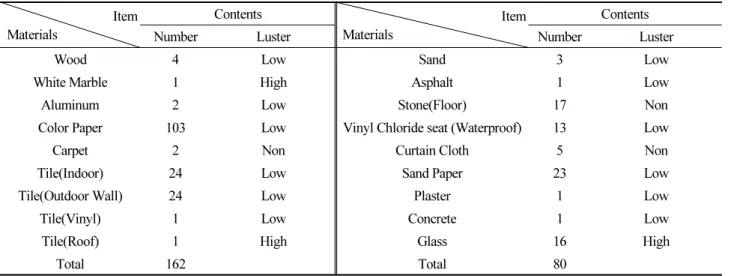
Table 1 shows the 242 types of building materials. The contents of the table indicate whether the material has a high or low luster.

Table 1. Costal building materials data Item

Materials

Contents Item

Materials

Contents

Number Luster Number Luster

Wood 4 Low Sand 3 Low

White Marble 1 High Asphalt 1 Low

Aluminum 2 Low Stone(Floor) 17 Non

Color Paper 103 Low Vinyl Chloride seat (Waterproof) 13 Low

Carpet 2 Non Curtain Cloth 5 Non

Tile(Indoor) 24 Low Sand Paper 23 Low

Tile(Outdoor Wall) 24 Low Plaster 1 Low

Tile(Vinyl) 1 Low Concrete 1 Low

Tile(Roof) 1 High Glass 16 High

Total 162 Total 80

Surface characteristics of coastal building materials

Measurement of lightness, chromaticity, and roughness of materials

The equipment used includes a daylight bulb type fluorescent lamp EFT15EDG close to the standard lightness C for measurement of lightness, and a color difference meter (Yxy colorimeter) for measurement of chromaticity. The roughness was measured with SURFCOM, a surface roughness shape measuring apparatus, and the measurement principle was a stylus method to measure the average roughness of the center line (Ra).

Measurement results

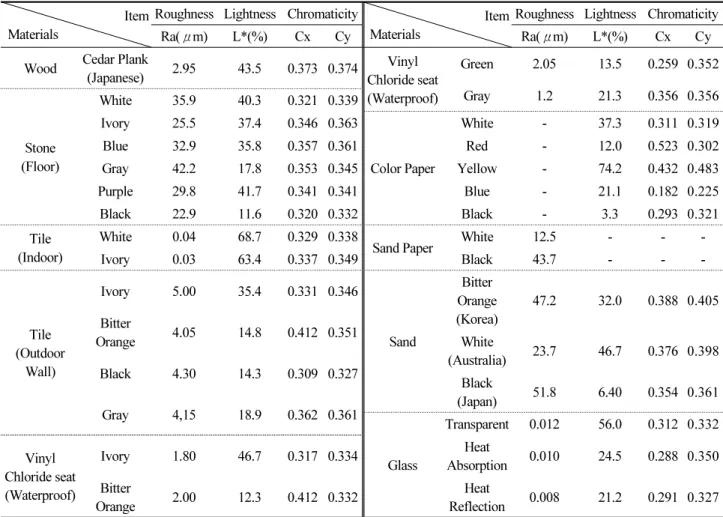
Table 2 shows the results of measurement of the surface roughness (Ra), lightness (L*) and chromaticity of the CIE

standard color system’s x and y axes, Cx and Cy respectively, of coastal building materials. The surface roughness (Ra)

was shown to be 22.9~42. 2 on road paving stones, 0. 03~5.0 on tiles, 1.15~2.05 on waterproofing materials, and

23.7~51.8 on sand. The ratios of materials with high lightness (L*) were high in yellow colored paper and white and ivory

interior tiles while materials with the ratios of materials with low lightness (L*) were high in black sand and black paving

stones. The values of chromaticity (Cx) were shown to be 0.182 to 0.523, and the values of chromaticity (Cy) were shown

to be 0.225 to 0.483.

(4)

Table 2. Surface characteristics of coastal building material Item

Materials

Roughness Lightness Chromaticity Item Materials

Roughness Lightness Chromaticity

Ra(μm) L*(%) Cx Cy Ra(μm) L*(%) Cx Cy

Wood Cedar Plank

(Japanese) 2.95 43.5 0.373 0.374 Vinyl Chloride seat (Waterproof)

Green 2.05 13.5 0.259 0.352 Gray 1.2 21.3 0.356 0.356

Stone (Floor)

White 35.9 40.3 0.321 0.339 Ivory 25.5 37.4 0.346 0.363

Color Paper

White - 37.3 0.311 0.319

Blue 32.9 35.8 0.357 0.361 Red - 12.0 0.523 0.302

Gray 42.2 17.8 0.353 0.345 Yellow - 74.2 0.432 0.483

Purple 29.8 41.7 0.341 0.341 Blue - 21.1 0.182 0.225

Black 22.9 11.6 0.320 0.332 Black - 3.3 0.293 0.321

Tile (Indoor)

White 0.04 68.7 0.329 0.338

Sand Paper White 12.5 - - -

Ivory 0.03 63.4 0.337 0.349 Black 43.7 - - -

Tile (Outdoor

Wall)

Ivory 5.00 35.4 0.331 0.346

Sand

Bitter Orange

(Korea) 47.2 32.0 0.388 0.405 Bitter

Orange 4.05 14.8 0.412 0.351 White

(Australia) 23.7 46.7 0.376 0.398

Black 4.30 14.3 0.309 0.327 Black

(Japan) 51.8 6.40 0.354 0.361 Gray 4,15 18.9 0.362 0.361

Glass

Transparent 0.012 56.0 0.312 0.332 Vinyl

Chloride seat (Waterproof)

Ivory 1.80 46.7 0.317 0.334 Heat

Absorption 0.010 24.5 0.288 0.350 Bitter

Orange 2.00 12.3 0.412 0.332 Heat

Reflection 0.008 21.2 0.291 0.327

Measurement of UV reflectance and transmittance

Measuring principle

There is a method of measuring ultraviolet reflectance by measuring the amounts of radiation coming in the upward and downward directions using an ultraviolet irradiance meter, and obtaining the ultraviolet reflectance from the two amounts.

However, this method has a disadvantage in that it cannot measure the levels of reflectance by wavelength. Here, a spectrophotometer was used to continuously measure the reflectance from the ultraviolet region to the visible light region.

In this study, according to the CIE classification, the ultraviolet region was defined as short-wavelength region UV-C

(10nm~280nm), medium-wavelength region UV-B (280~315 nm), and long-wavelength region UV-A (315~400nm), and

the visible light region was defined as (400nm) ~780nm). As for the performance of the equipment, the reflectance UV-C

was set to 240~280nm, and the transmittance UV-C was set to 200~280nm. The integrating sphere’s inner diameter of the

spectrophotometer used in this measurement is 150mm ϕ, so it is possible to measure the spectral reflection of solid

samples.

(5)

Measurement of reflectance

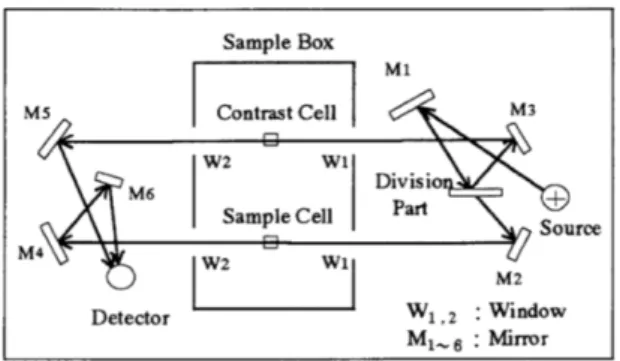
Figs. 2, 3 shows the conceptual diagram of the optical system for reflection. As for the method of measuring reflectance, before measuring the samples, the standard white plates (BaSO4) of Kodak's Eastman reagent were set on the sample side and the control side at the position of reflective samples on the integrating sphere and 100% calibration was carried out.

Thereafter, the standard white plate on the sample side was exchanged with the sample to be measured, and the reflection spectrum with wavelengths of 240 to 780 nm was recorded. The wavelength was measured at every 5 nm and the reflectance was obtained by multiplying the value of reflection spectrum at each recorded wavelength by the reflectance of barium sulfate. The values of the spectral reflectance included in the wavelength region were averaged to obtain the reflectance of the wavelength region.

Measurement of transmittance

Figs. 2, 3 shows the conceptual diagram of the optical system for transmittance. As for the method of measuring transmittance, before measuring the samples, filter holders for transmittance are set on the sample side and the control side at the transmittance sample position, and 100% is set on the air flank. Then, as with the reflectance measuring method, the standard is exchanged with the sample to be measured, and the reflection spectrum with wavelengths of 200~780nm is recorded.

Fig. 2. Measurement of reflectance Fig. 3. Measurement of transmittance

Results and Discussion

Analysis Results of the Spectral reflectance and discussion

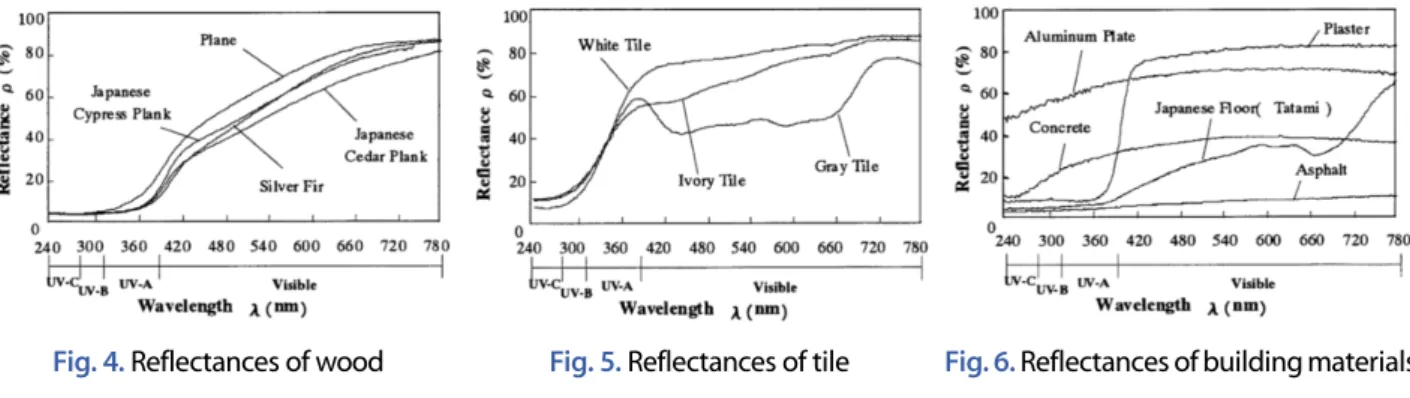
Fig. 4 shows the spectral reflectance of ultraviolet and visible lights. The four types of trees show high reflectance in the

visible light region, and the reflectance drops sharply from 380nm in the ultraviolet light region. The reflectance in the

visible light region of the trees is in a range of 55-68%, while the UV reflectance is in a range of 4-12%. Therefore, the

trees can be said to be suitable as a material that blocks UV reflection. Fig. 5 shows the UV spectral reflectance of tiles.

(6)

The UV spectral reflectance changes according to colors in the visible light region, but the rates of changes are low in the ultraviolet light region. Fig. 6 shows aluminum plates, which are widely used as building materials. The levels of reflec- tance of aluminum plates are high in both the visible and ultraviolet light regions, and the reflectance levels at all wavelengths are in a range of 50~70%. Also, the UV reflectance levels of concrete are high, in a range of 20~30% across UV-A and B. The reflectance levels of plaster and tatami are high in the visible light region and sharply drop in the ultraviolet light range. Therefore, as with wood, plaster and tatami can be said to be suitable as materials for lowering ultraviolet reflection. Asphalt has very low reflectance levels of 4~9% at all wavelengths.

Fig. 4. Reflectances of wood Fig. 5. Reflectances of tile Fig. 6. Reflectances of building materials

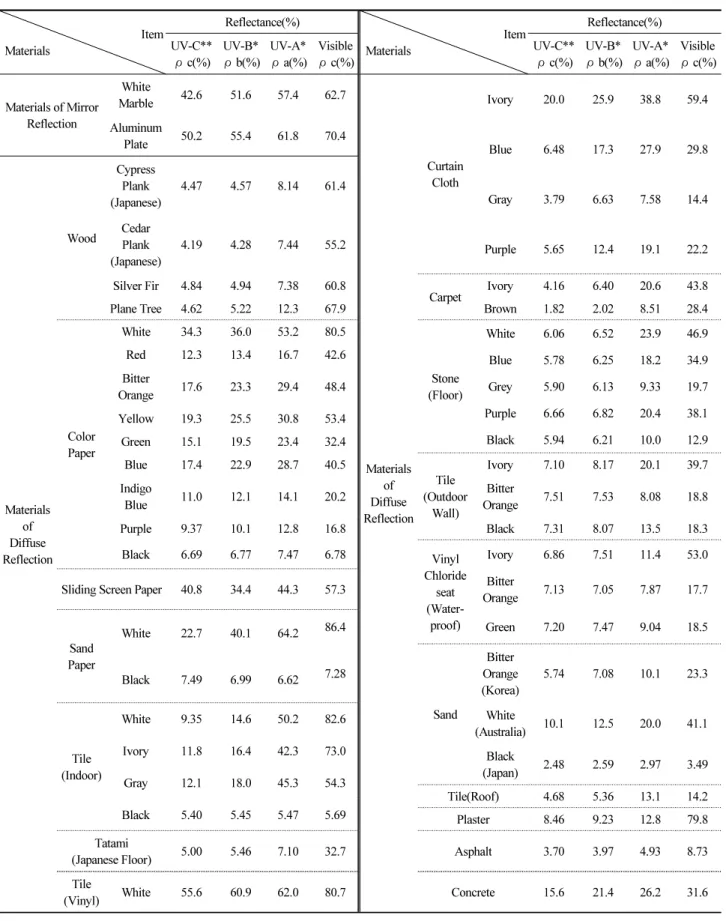
In Table 3, the range of wavelengths was divided into UV short wavelength region UV-C**, UV medium wavelength region UV-B*, UV long wavelength region UV-A*, and visible light region and the average UV reflectance levels by region were indicated as ρc, ρb, ρa, and ρv, respectively.

In addition, the materials can also be divided into mirror reflective materials and diffuse reflective materials according to the reflective properties of the materials. Among mirror reflective materials, marbles and aluminum plates show high reflectance levels in both visible ultraviolet light regions. In the case of mables, the UV-C** reflectance ρc was 43%, UV-B* reflectance ρb was 52%, UV-A* reflectance ρa was 57%, and visible light reflectance ρv was 63% Among diffuse reflective materials, the material with the highest UV-B* reflectance was white vinyl tile with a ρb level of 61%, and the material with the highest UV-A* reflectance was white sandpaper with a ρa level of 64%. Therefore, it can be seen that reflectance levels of the materials were much different in the UV region.

In addition, among materials with low UV - B* reflectance levels, brown carpet had the lowest reflectance level followed by black sand, asphalt, and wood in order of precedence, and the pb values were shown to be 2~ 5 %.

In the case of paving stones, UV-C** reflectance ρc was shown to be in a range of 5.7%~6, 7%, UV-B* reflectance ρb

was shown to be in a range of 6.1%~6. 8%, UV-A* reflectance ρa was shown to be in a range of 9. 3 %~24%, visible light

reflectance ρv was shown to be in a range of 13%~47%. The reason why the fluctuations in UV-C** reflectance ρc and

UV-B* reflectance ρb were found to be not so large is thought to be the fact that the surface properties of the material

affect the reflectance.

(7)

Table 3. Visible and UV reflectance

Materials Item

Reflectance(%)

Materials Item

Reflectance(%) UV-C**

ρ c(%) UV-B*

ρ b(%) UV-A*

ρ a(%) Visible

ρ c(%) UV-C**

ρ c(%) UV-B*

ρ b(%) UV-A*

ρ a(%) Visible ρ c(%)

Materials of Mirror Reflection

White

Marble 42.6 51.6 57.4 62.7

Materials of Diffuse Reflection

Curtain Cloth

Ivory 20.0 25.9 38.8 59.4 Aluminum

Plate 50.2 55.4 61.8 70.4

Blue 6.48 17.3 27.9 29.8

Materials of Diffuse Reflection

Wood

Cypress Plank

(Japanese) 4.47 4.57 8.14 61.4

Gray 3.79 6.63 7.58 14.4 Cedar

Plank

(Japanese) 4.19 4.28 7.44 55.2 Purple 5.65 12.4 19.1 22.2

Silver Fir 4.84 4.94 7.38 60.8

Carpet Ivory 4.16 6.40 20.6 43.8

Plane Tree 4.62 5.22 12.3 67.9 Brown 1.82 2.02 8.51 28.4

Color Paper

White 34.3 36.0 53.2 80.5

Stone (Floor)

White 6.06 6.52 23.9 46.9

Red 12.3 13.4 16.7 42.6 Blue 5.78 6.25 18.2 34.9

Bitter

Orange 17.6 23.3 29.4 48.4 Grey 5.90 6.13 9.33 19.7

Purple 6.66 6.82 20.4 38.1 Yellow 19.3 25.5 30.8 53.4

Black 5.94 6.21 10.0 12.9 Green 15.1 19.5 23.4 32.4

Blue 17.4 22.9 28.7 40.5

Tile (Outdoor

Wall)

Ivory 7.10 8.17 20.1 39.7 Indigo

Blue 11.0 12.1 14.1 20.2 Bitter

Orange 7.51 7.53 8.08 18.8

Purple 9.37 10.1 12.8 16.8 Black 7.31 8.07 13.5 18.3

Black 6.69 6.77 7.47 6.78 Vinyl

Chloride seat (Water-

proof)

Ivory 6.86 7.51 11.4 53.0

Sliding Screen Paper 40.8 34.4 44.3 57.3 Bitter

Orange 7.13 7.05 7.87 17.7

Sand Paper

White 22.7 40.1 64.2 86.4 Green 7.20 7.47 9.04 18.5

7.28

Sand

Bitter Orange

(Korea) 5.74 7.08 10.1 23.3 Black 7.49 6.99 6.62

(Indoor) Tile

White 9.35 14.6 50.2 82.6 White

(Australia) 10.1 12.5 20.0 41.1

Ivory 11.8 16.4 42.3 73.0 Black

(Japan) 2.48 2.59 2.97 3.49 Gray 12.1 18.0 45.3 54.3

Tile(Roof) 4.68 5.36 13.1 14.2

Black 5.40 5.45 5.47 5.69 Plaster 8.46 9.23 12.8 79.8

Tatami

(Japanese Floor) 5.00 5.46 7.10 32.7 Asphalt 3.70 3.97 4.93 8.73

Tile

(Vinyl) White 55.6 60.9 62.0 80.7 Concrete 15.6 21.4 26.2 31.6

(8)

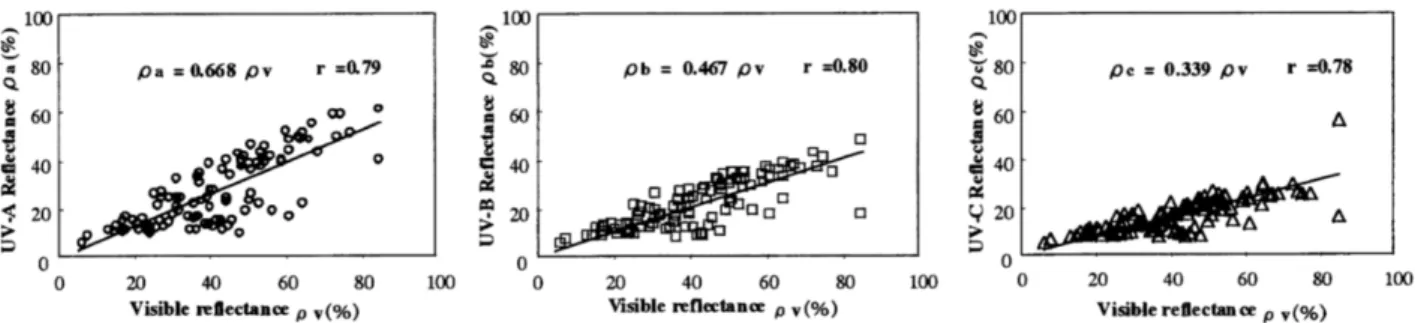
Fig. 7 shows the correlation between the visible light reflectance and the UV reflectance of colored paper. It was found that correlation coefficient r of UV-A* reflectance ρa is 0.793, that of UV-B* reflectance pb is 0.795, and that of UV-C**

reflectance ρc is 0.777. In addition, the slopes of the regression line of the UV-A* reflectance, UV-B * reflectance, and UV-C** reflectance are about 0.67 times, 0.47 times, and 0.34 times those of the visible light reflectance, respectively. ρa

=0.668 ρv (r =0.79),ρb =0.467 ρv (r =0.80),ρc =0.339 ρv (r =0.78). Therefore, when the visible light reflectance is known, an approximate values of the ultraviolet reflectance can be estimated by multiplying by one third to two thirds by wavelength region. The shorter the wavelength, the larger the absorption and the smaller the reflectance.

Fig. 7. Relation between visible and UV reflectance of colorpaper(Visible and UV reflectance)

UV spectral reflectance and surface properties UV spectral reflectance and lightness

Fig. 8 shows the relationship between the UV reflectance and the lightness (L*) of colored paper. The UV reflectance is between 10~50% in many samples, and in the regression line, stable value can be seen when the UV reflectance exceeds 60%. In the UV-A*, UV-B*, and UV-C** regions, when the lightness (L*) is high, the UV reflectance is also shown to be high. The regression equation is as follows. L* is the lightness. ρa =-0.0080 (L*)

2

+ 1.1733 L* (r =0.84), ρb =-0.0078 (L*)

2

+ 1.0026 L* (r =0.89),ρc =-0.0063 (L*)

2

+ 0.7801 L* (r =0.85). The correlation coefficient r is 0.84~0.89, indicating that the correlations are high. In this equation, if the lightness is known, the UV reflectance and visible light reflectance of the building materials can be estimated.

Fig. 8. Relation between visible and UV reflectance of colorpaper(Lightness and UV reflectance)

(9)

UV spectral reflectance, roughness and chromaticity

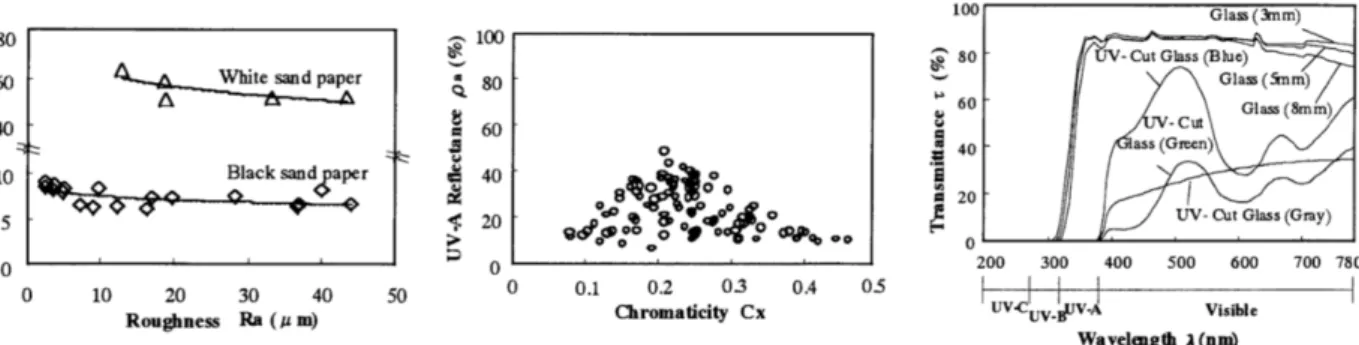
Fig. 9 shows the relationship between the UV reflectance and roughness (Ra) of sandpaper. The sandpaper materials used in this study were abrasive alumina WA (5 types) and silicon-based abrasive 2C (18 types). The white abrasives have UV reflectance levels of 50%~60%. The UV reflectance increases as the roughness (Ra) decreases. In addition, the UV reflectance of the black abrasives are low at 5%~9%, and when the roughness (Ra) is 7 or less, the UV reflectance is increasing, but other properties are much different. Fig. 10 shows the relationship between the UV reflectance and chromaticity (Cx) of colored paper. The chromaticity (Cx) values are in a range of 0. 2~0. 3 in many samples and the UV reflectance is also increasing. Since the center of chromaticity of the color difference meter (Yxy color specification system) is around 0.3, it was shown the UV reflectance increased as the chromaticity decreased.

Analysis Results of the Spectral transmittance and discussion

Fig. 11 shows the ultraviolet and visible light spectral transmittance levels of ordinary glass and UV blocking glass. In the case of ordinary glass, transmittance is rapidly decreasing as the wavelenth decreases from 350nm to 320nm. Also, the transmittance decreases as the thickness increases in ordinary glass of 3, 5, and 8 mm thicknesses. UV blocking glass has a transmittance of 0 up to 380nm, but in the wavelength region exceeding 380nm, the transmittance changes according to colors. The maximum transmittance of the blue UV blocking glass is 500nm, while the transmittance of brown UV blocking glass decreases slowly as the wavelength decreases.

Fig. 9. Relation between visible and UV reflectance of sandpaper

Fig. 10. Relation between UV reflectance and chromaticity of colorpaper

Fig. 11. Transmittance of UV-Cut, glass materials

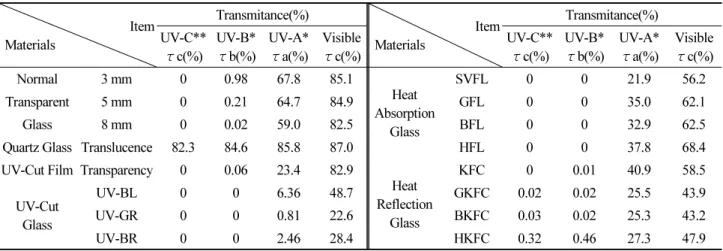
Table 4 shows the average ultraviolet transmittance levels by wavelength region wheen the range of wavelengths was

divided into the ultraviolet short wavelength region UV-C***, the ultraviolet medium wavelength region UV-B*, the

ultraviolet long wavelength region UV-A*, and the visible light region. Usually, in the case ordinary glass, the

transmittance levels are 0% in the UV-C*** area, 0.02%~0.98% in the UV-B* area, 59%~68% in the UV-A* area, and

83% or more in the visible light area. In addition, it can be seen that the transmittance is decrteasing as the thickness

increases. The UV blocking glass showed low transmittance levels; 0% in the UV-B*, UV-C*** regions, and

(10)

0.81%~6.36% in the UV-A* region. In the case of heat absorbing glass, the transmittance levels were shown to be 0% in the UV-B*, UV-C*** regions, and 22% or higher in the UV-A* region.

Heat-reflecting glass exhibited a transmittance of 0.3% even in the ultraviolet short wavelength region UV-C***

indicating that transmittance levels differ depending on the characteristics of glass. In addition, quartz glass showed the highest transmittance levels, over 82% in all wavelengths in the ultraviolet and visible light regions.

Table 4. Visible and UV transmittance Item

Materials

Transmitance(%)

Item Materials

Transmitance(%) UV-C**

τc(%)

UV-B*

τb(%)

UV-A*

τa(%)

Visible τc(%)

UV-C**

τc(%)

UV-B*

τb(%)

UV-A*

τa(%)

Visible τc(%)

Normal 3 mm 0 0.98 67.8 85.1

Heat Absorption

Glass

SVFL 0 0 21.9 56.2

Transparent 5 mm 0 0.21 64.7 84.9 GFL 0 0 35.0 62.1

Glass 8 mm 0 0.02 59.0 82.5 BFL 0 0 32.9 62.5

Quartz Glass Translucence 82.3 84.6 85.8 87.0 HFL 0 0 37.8 68.4

UV-Cut Film Transparency 0 0.06 23.4 82.9

Heat Reflection

Glass

KFC 0 0.01 40.9 58.5

UV-Cut Glass

UV-BL 0 0 6.36 48.7 GKFC 0.02 0.02 25.5 43.9

UV-GR 0 0 0.81 22.6 BKFC 0.03 0.02 25.3 43.2

UV-BR 0 0 2.46 28.4 HKFC 0.32 0.46 27.3 47.9

Conclusions

The purpose of this study was to measure the spectral transmittance and reflectance of coastal buildings in the wavelength range including visible light other than ultraviolet rays, and to understand the wavelength characteristics of building materials indoors and outdoors.

The results of measurement of various materials are summarized as follows.

1) The reflectance levels of marbles and aluminum, which are a mirror reflective material, are little different between the visible light region and the ultraviolet region, and are shown to be high. The reflectance levels of the diffuse reflective materials in the ultraviolet region were 4 %~12 % for wood, 8 %~13 % for gypsum, 5 %~7 % for tatami mats, 5 %~50 % for indoor tiles, 7 %~20 % for outdoor tiles, and 6 %~24% for paving stones, 7%~11% for waterproofing materials, 2%~21% for carpets, 4%~39% for curtains, and 12%~28% for concrete. Among them, tatami mats, gypsum, and wood are materials suitable for UV reduction measures because they showed high reflectance in the visible light region, but showed rapidly decreasing reflectance in the ultraviolet region .

UV blocking glass has a transmittance of 0 up to 380 nm, but shows changes in the transmittance according to color in the wavelength region exceeding 380 nm. Also, in the case of ordinary glass, the transmittance decresases as the thickness increases.

2) The reflectance in the visible light region has a high correlation with the reflectance in the ultraviolet region. The

(11)

slopes of the regression line of the UV –A* reflectance, UV -B * reflectance, and UV –C** reflectance are about 0.67 times, 0.47 times, and 0.34 times those of the visible light reflectance, respectively.

3) The ultraviolet light region reflectance is correlated with the lightness of the surfaces of material surfaces, and the higher the lightness, the higher the ultraviolet reflectance. From the above measurement results, the following can be considered when designing ultraviolet rays.

When blocking ultraviolet radiation, a material with a low UV transmittance level should be selected for the window side and a material with a low UV reflectance level for the wall. Thick glass and UV-blocking glass are selected as the transmissive material, and materials with black-colored and rough surfaces are good as reflective materials. Based on the results of measurement results, tatami mats, gypsum, and wood can be used as materials with low reflectance.

On the other hand, in order to introduce ultraviolet rays, materials with high ultraviolet transmittance should be selected for the window side and mirror reflective materials should be selected for the wall. A thin ordinary glass should be selected as the transmissivew material, and a white materials having a fine surface is preferable as the reflective material.

Based on the results of measurement, marbles and aluminum can be selected. As such, it is thought important to select diverse materials according to the purposes when blocking ultraviolet radiation in an oceanic building space.

References

[1] Blumthaler, M., Ambach, W. (1988). “Solar UVB-albedo of various surfaces.” Journal of Photochemistry and photobiology, Vol. 48, No.1, pp. 85-88.

[2] Buttner, K. (1935). “Die abkublungsgrobe in den duen.” Sttalentherapie, Vol. 54, pp. 167-173.

[3] Fukuda, H. (1987). “The amount of ultraviolet radiation of sunlight in Japan, Dermatology Bulletin.” Shiseido Institute for Basic Science, pp. 8.

[4] Kawanishi, T., Uh, J.S. (1997). “Basic study on medium wavelength UV reflectance of beach and building materials.” Japan Architectural Institute Annual Conference Lecture Summary, pp. 311-312.

[5] Kor, C.J., Monard, L.A.G. (1986). “The ultraviolet and visible reflectance of building materials.” CIE-Journal, Vol.

5, No. 1, pp. 1-7.

[6] Takeda, Y. (1998). “Understanding the outline of UV reflection characteristics of building materials, Study on extraordinary reflection of environment forming materials, Part 1.” Japanese Association for Coastal Zone Studies, No. 505, pp. 31-36.

[7] Uh, J.S., Kawanishi, T. (1998). “A study ultraviolet spectral reflectancet of coastal sands.” Journal of Japan Institute,

Architectural Institute of Japan, No. 516, pp. 167-172.

수치

Fig. 1. Ultraviolet radiation on coastal building material(location:1129, Seorak-ro, Nam-myeon, Inje-gun)
Table 1 shows the 242 types of building materials. The contents of the table indicate whether the material has a high or low  luster.
Table 2. Surface characteristics of coastal building material Item
Fig. 2. Measurement of reflectance Fig. 3. Measurement of transmittance
+6

참조

관련 문서