54
SiO 기판에 이온빔 조사를 통해서 제조한 IPS Cell의 특성에 관한 연구
한정민*, 서대식**
IPS property using ion beam irradiation on SiOF surfaces
Jeong-Min, Han*, Dae-Shik, Seo**
요 약
최근 비접촉식 액정배향방법에 대한 요구가 산업계 전반으로 확산되면서, 기존의 UV 광배향을 비롯하여, 여러 가지 비접촉식 액정 배향방법이 활발히 연구되고 있다. 본 연구에서는 이러한 비접촉식 액정배향방법 중에서 SiOF 무기막에 이온빔을 정량적으로 조사 하는 방법을 사용하여 액정을 배향하고, 이 기술을 사용하여, 상용화 수준의 IPS(In-Plane Switching) 방식의 액정 셀을 제작함으로 써 전기광학 특성을 평가하였다. 특히 이러한 무기막 배향의 경우 배향안정성에 많은 문제를 가지고 있는 것이 보통이나, 본 연구에 서 제안한 방법으로 제조된 평가셀은 200℃의 높은 온도로 열처리를 하여도 배향성을 잃지 않고 균일한 배향을 지속하는 것을 관찰 할 수 있었다.
Key Words : SiOF Thin Film, LC (Liquid Crystal) Alignment, Nematic LC, Ion Beam
ABSTRACT
Nematic liquid crystal (NLC) alignment effects on SiOF layers via ion-beam (IB) irradiation for four types of incident energy were successfully studied. The effect of fluorine addition on silicon oxide film properties as a function of SiOF4/O2 gas flow ration was investigated. The SiOF thin film exhibits good chemical and the thermal stability of the SiOF thin film were sustained as function of the NLC alignment until 200℃ Also, the response-time characteristics of aligned LCD based on SiOF film were studied.
※본 논문은 2011년도 서일대학 학술연구비에 의해 연구되었음
*서일대학교 전기과([email protected]), **연세대학교 공과대학 전기전자공학부
접수일자 : 2012년 11월 9일, 수정완료일자 : 2012년 11월 23일, 최종게재확정일자 : 2012년 12월 3일
I. Introduction
Liquid crystal displays (LCDs) are widely used as information display devices such as the monitors in notebook and desktop computers and in televisions. The liquid crystal (LC) alignment layers play an important role in the effectiveness of LCDs regarding their display uniformity and contrast ratio [1-3]. To date, numerous alignment technologies have been developed to generate anisotropic surfaces and to align LC molecules in a specific direction. Currently, the rubbing method [4-8], which rubs the PI surface to align liquid crystals, is being used to mass produce wide LCD panels. However, the rubbing method has some drawbacks, such as the generation of electrostatic charges and the creation of contaminating
particles. To eliminate these defects, the rubbing method requires a cleaning process that slows the manufacturing process and reduces cost effectiveness. Thus, we strongly recommend a non-contact alignment technique for future generations of large high-resolution LCDs [9]. The ion beam (IB) induced alignment method, which provides controllability, nonstop processing, and high resolution display, has been intensively investigated with inorganic materials so far. Insulating films such as SiC, SiNx, ZrO2, DLC, and Al2O3have also been investigated as potential candidates for inorganic alignment materials [10-12]. We examined the possibilities of the IB induced alignment of the LC on SiOF for the first time [13-15]. SiOF, which has generated great interest has excellent low dielectric properties and stable optical characteristics. A homogeneously 통신위성우주산업연구회논문지 제7권 제3호 (K7-3-10)
SiO 기판에 이온빔 조사를 통해서 제조한 IPS Cell의 특성에 관한 연구
55 aligned LCD with SiOF was fabricated and characterized to evaluate the application potential for the inorganic material as the LC alignment layer. In this paper, we report on LC alignment effects and pretilt angle generation on SiOF thin film treated by ion-beam irradiation.
Ⅱ. Experimental
SiOF thin film layers were deposited on indium-tin-oxide (ITO)-coated Corning 1737 glass substrates by a plasma chemical vapor deposition (CVD) system (SiOF4 : O2= 5 sccm : 5 sccm). Before deposition, the ITO-coated glass was cleaned with a supersonic wave in a trichloroethyl-acetone-methanol-deionized water solution for 10 min and was then dried with N2gas. The 15 Å SiOF thin films, which were measured using a surface profiler alpha step and a field emission-scanning electron microscope (FE-SEM), were exposed to the IB for irradiation times ranging from 60 to 62 sec, 45 degrees at an exposure angle, and intensity energies ranging from 500 to 2000 eV using a DuoPIGatron-type IB system, as illustrated in Figure 1. The IB chamber was initially evacuated to a base pressure of about 10-6 Torr, and the working pressure was maintained at about 10-4Torr with an Ar gas flow of 1.4 SCCM. (SCCM denotes cubic centimeters per minute at STP.) The dosages of Ar+ IB plasma were 1014-1015ions/cm2 energy. The ITO-coated glass substrates with SiOF layers on the ITO surfaces were assembled in an antiparallel configuration with a cell gap of 60 ㎛in order to measure the tilt angles using the crystal rotation method (TBA 107 tilt-bias angle evaluation device; Autronic). The LCDs were assembled with a cell gap of 5㎛in order to examine the EO characteristics. Commercial Negative LCs (Tc=75℃ Δε=8.2 MJ001929, Merck Corp.) were used for LCD fabrication.
Fig 1. The ion beam irradiation system used (DuoPIGatron-type IB).
Ⅲ. Results and Discussion
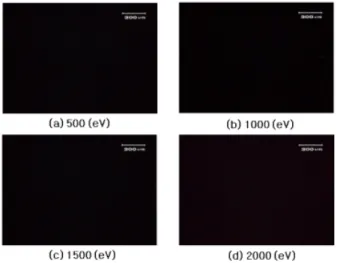
The LC alignment property and pretilt angle for the SiOF thin films described above were observed to verify the practical application potential. Uniform alignment with a regular pretilt angle of the LC is very important to avoid the creation of disclination in LCDs. As shown in Figure 2, microphotographs of the LC cells aligned on the SiOF thin film layer by the density of IB irradiation (in crossed Nicols) : (a) 500 eV, (b) 1000 eV, (c) 1500 eV, (d) 2000 eV, showed LC molecules in the states as uniformly aligned at irradiation energies at or above 500 eV. As can be seen, uniform switching behavior was achieved without deviated alignment and local defects.
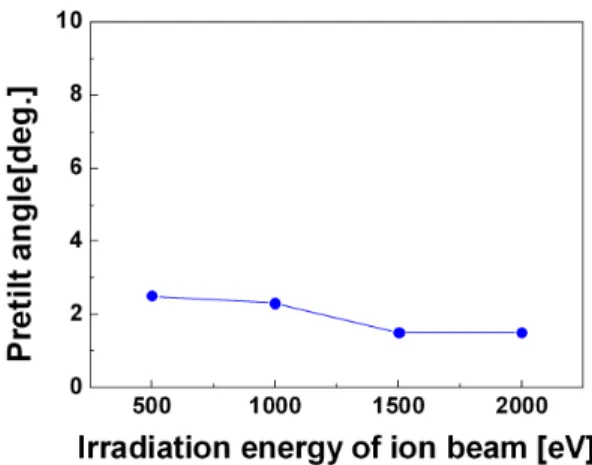
Figure 3 shows the measured pretilt angle as a function of exposure energy. The contour covers a narrow range of angles from 2.3° to 1.8°, including error values. The pretilt angle
Fig 2. Microphotographs of LC cells aligned on the SiOF thin film layer by the density of IB irradiation (in crossed Nicols) : (a) 500 eV, (b) 1000 eV, (c) 1500 eV, (d) 2000 eV.
gradually decreases with the increasing incident energy of the IB irradiation. As a result, homogeneous alignment of NLC and control of the pretilt angle were achieved by the incident energy of the IB irradiation. The generation of the pretilt angle is dependent on the between-the-surface energy of the SiOF and LC molecules. From these results, it was found that ion-beam-aligned SiOF thin film could be applied to an in-plane switching (IPS) mode having a low pretilt angle, which rotates LC molecules horizontally, and to a fringe-field switching (FFS) mode.
We assumed that the IB irradiation energy induced the change in contact angle, as depicted in Figure 4. There is
통신위성우주산업연구회논문지 제7권 제3호
56 an important relationship between the surface energy on the treated SiOF surface and the alignment of LC molecules. As the IB irradiation energy increased, so did the contact angle increase. The contact angles of NLC on the SiOF thin film surfaces with IB conditions of 60 sec, 45°, and 500, 100, 15000, and 2000 eV were optimized at 63, 64, 68, and 68°, respectively. A physical investigation using AFM was performed, as the contact angle is also related to the surface morphology. The rms roughness values of the IB irradiated SiOF under the same conditions show that rms roughness changed from 3.5±0.5 to 3.0±0.5 nm.
Fig 3. Pretilt angle of nematic LC when the ion beam was irradiated on the SiOF thin film layer.
Fig 4. Comparison of contact angle results in terms of LC alignment under IB irradiation: (a) 500, (b) 1000, (c) 1500, and (d) 2000 eV.
Figure 5 shows the thermal stability experiment microphotographs of an LC cell with an SiOFthin film. To determine LC anchoring energy, a thermal stability experiment was carried out. After each LC cell was annealed by specific heat and slowly cooled, the LC
alignment effect was observed in a microphotograph. The LC alignment remained constant during the application of heat within the 20-200℃temperature range. When heat reached 230℃ LC alignment was destroyed. On the basis of this result, we determined the uppermost thermal stability limit of SiOF film to be 200℃ Without taking times into account, the results of the thermal stability experiment were the same.
Figure 6 shows a plot of the response time (RT) characteristics in the TN cells homogeneously aligned on the IB irradiated SiOF layers under the same conditions.
The rising time was 9.2ms and the decay time was 18ms.
Fig 5. Thermal stability photomicrographs of twisted nematic LCD cells on SiOF surfaces irradiated with the IB energy of 2000 eV and the incident angle of 45° of (a) 20, (b) 180, (c) 200, and (d) 230 °C (A: analyzer, P: polarizer).
Fig 6. Response time as a function of voltage for TN cells.
SiO 기판에 이온빔 조사를 통해서 제조한 IPS Cell의 특성에 관한 연구
57
Ⅳ. Conclusion
In conclusion, we have demonstrated a method for IPS mode by the IB irradiation on SiOF thin film surfaces as a non-contact alignment process. We achieved a good alignment characteristic using the ion beam alignment method on the SiOF thin film when the SiOF4 and O2 gas is 5 sccm and 5 sccm at the CVD system. The contour covers a narrow range of angles from 2.3° to 1.8°, including error values. The pretilt angle gradually decreases with the increasing incident energy of the IB irradiation. Therefore, ion beam alignment method using the SiOF thin film was achieved the IPS alignment of NLC, the control of stable pretilt angle and good thermal stability of manufactured LC cell.
Reference
[1] B. Park, K.-J. Han, Y. Jung, H.-H. Choi, H.-K. Hwang, S.
Lee, S.-H. Jang, and H. Takezoe, J. Appl. Phys. 86, 1854 (1990).
[2] S. Park, C. Padeste, H. Schift, J. Gobrecht, and T. Scharf, Adv. Mater. (Weinheim, Ger.) 17, 1398 (2005).
[3] F. S. Yeung, J. Y. Ho, Y. W. Li, F. C. Xie, O. K. Tsui, P.
Sheng, and H. S. Kwok, Appl. Phys. Lett. 88, 051910 (2006).
[4] H. K. Kang, J. Y. Hwang, C. J. Park, D. S. Seo, K. C. Kim, H. J. Ahn, J. B. Kim, and H. K. Baik, Mol. Cryst. Liq.Cryst.
434, 135 (2005).
[5] H. Yokoyama, Mol. Cryst. Liq.Cryst. 165, 269 (1998).
[6] H. Yokoyama, S. Kobayashi, and H. Kamei, J. Appl. Phys.
61, 4501 (1987).
[7] D. S. Seo, S. Kobayashi, D. Y. Kang, and H. Yokoyama, Jpn.
J. Appl. Phys. 34, 3607 (1995).
[8] D. S. Seo, and J. Y. Hwang, Jpn. J. Appl. Phys. 39, 816 (2000).
[9] P. Chaudhari, J. Lacey, J. Doyle, E. Galligan, S.-C. A. Lien, A. Callegari, G.Hougham, N. D. Lang, P. S. Andry, R. John, K.-H. Yang, M. Lu, C. Cai, J. Speidell, S. Purushothaman, J. Ritsko, M. Samant, J. Stöhr, Y. Nakagawa, Y. Katoh, Y.
Saitoh, K. Sakai, H. Satoh, S. Odahara, H. Nakano, J.
Nakagaki, and Y. Shiota, Nature 411, 56 (2001).
[10] P. K. Son, J. H. Park, S. S. Cha, J. C. Kim, and T. H. Yoon, Appl. Phys. Lett. 88, 263512 (2006).
[11] B. Y. Oh, W. K. Lee, Y. H. Kim, and D.S. Seo, J. Appl.
Phys. 105, 054506 (2009).
[12] N. Jehanathan, B. Walmsley, Y. Lie, and J. Dell, J. Alloys.
Comp., 437, 332 (2007).
[13] T. Homma and Y. Murao, IEEE IEDM Tech. Diges.t 289 (1991).
[14] T. Homma, R. Yamaguchi, and Y. Murao, J. Electrochem.
Soc. 140, 687 (1993).
[15] T. Fukada and T. Akahori, Ext. Abst. 25th conference on SSDM, 158 (1993).
저자
한 정 민(Jeong-Min, Han)
․1999년 2월 : 숭실대학교 전기공학과 석사졸업
․2007년 8월 : 연세대학교 대학원 전기 전자공학과 박사졸업
․2009년 3월 ∼ 현재 : 서일대학교 조교 수
<관심분야> : 정보디스플레이, 태양광발전
서 대 식(Dae-Shik, Seo)
․1993년 2월 : 동경농공대학교 대학원 박사졸업
․2001년 3월 ∼ 현재 : 연세대학교 전기 전자공학부 교수
<관심분야> : 정보디스플레이, 기능성유기박막