• 검색 결과가 없습니다.

Expression Profiling of MLO Family Genes under Podosphaera xanthii Infection and Exogenous Application of Phytohormones in Cucumis melo L.

N/A
N/A
Protected

Academic year: 2021

Share "Expression Profiling of MLO Family Genes under Podosphaera xanthii Infection and Exogenous Application of Phytohormones in Cucumis melo L."

Copied!
12
0
0

로드 중.... (전체 텍스트 보기)

전체 글

(1)

Expression Profiling of MLO Family Genes under Podosphaera xanthii Infection and Exogenous Application of Phytohormones in Cucumis melo L.

Jewel Howlader

, Hoy-Taek Kim

, Jong-In Park, Nasar Uddin Ahmed, Arif Hasan Khan Robin, Hee-Jeong Jung and Ill-Sup Nou*

Department of Horticulture, Sunchon National University, 255 Jungang-ro, Suncheon-si, Jeollanam-do 57922, Korea Received March 22, 2016 /Revised April 12, 2016 /Accepted April 14, 2016

Powdery mildew disease caused by Podosphaera xanthii is a major concern for Cucumis melo production worldwide. Knowledge on genetic behavior of the related genes and their modulating phytohormones often offer the most efficient approach to develop resistance against different diseases. Mildew Resistance Locus O (MLO) genes encode proteins with seven transmembrane domains that have sig- nificant function in plant resistance to powdery mildew fungus. We collected 14 MLO genes from

‘Melonomics’ database. Multiple sequence analysis of MLO proteins revealed the existence of both evolutionary conserved cysteine and proline residues. Moreover, natural genetic variation in con- served amino acids and their replacement by other amino acids are also observed. Real-time quantita- tive PCR expression analysis was conducted for the leaf samples of P. xanthii infected and phyto- hormones (methyl jasmonate and salicylic acid) treated plants in melon ‘SCNU1154’ line. Upon P. xan- thii infection using 7 different races, the melon line showed variable disease reactions with respect to spread of infection symptoms and disease severity. Three out of 14 CmMLO genes were up-regulated and 7 were down-regulated in leaf samples in response to all races. The up- or down-regulation of the other 4 CmMLO genes was race-specific. The expression of 14 CmMLO genes under methyl jasmo- nate and salicylic acid application was also variable. Eleven CmMLO genes were up-regulated under salicylic acid treatment, and 7 were up-regulated under methyl jasmonate treatments in C. melo L.

Taken together, these stress-responsive CmMLO genes might be useful resources for the development of powdery mildew disease resistant C. melo L.

Key words : Cucumis melo, Mildew Resistance Locus O, phytohormone treatment, Podosphaera xanthii, powdery mildew

†Authors contributed equally.

*Corresponding author

*Tel : +82-61-750-3249, Fax : +82-61-750-3208

*E-mail : [email protected]

This is an Open-Access article distributed under the terms of the Creative Commons Attribution Non-Commercial License (http://creativecommons.org/licenses/by-nc/3.0) which permits unrestricted non-commercial use, distribution, and reproduction in any medium, provided the original work is properly cited.

Journal of Life Science

2016 Vol. 26. No. 4. 419~430 DOI : http://dx.doi.org/10.5352/JLS.2016.26.4.419

Introduction

Melon (Cucumis melo L.), a cucurbitaceous fruit, is ninth among horticultural crops in terms of worldwide total pro- duction [14]. Powdery mildew (PM), one of the world’s most widespread diseases caused by plant pathogenic fungi, af- fects around 10,000 species of angiosperms [16]. Both field and greenhouse cultivated cucurbit crops are threatened by these fungi, which decrease the quantity as well as the qual- ity of crop yields [20]. Currently, frequent fungicide applica- tions are the main management practices used to address PM; however, the use of PM resistant plant is the most desir-

able control strategy [35].

Mildew Resistance Locus O (MLO) is a disease resistance gene first discovered in barley in 1997 [4]. This gene family encodes plasma membrane localized seven transmembrane domain (TM) proteins with C-terminal calmodulin binding domain (CaMBD) and an extracellular N-terminus [4, 9, 21].

MLO proteins with the 20 amino acid CaMBD in barley en- hance the susceptibility of plant to PM diseases [21-22].

Interaction of MLO proteins with PM fungi modulates the

plant defense signaling mechanism resulting in PM suscepti-

bility [38]. The invariable cysteine and proline residues in

extracellular loops or in TM domains are necessary for MLO

protein function and/or durability [11]. In addition, second

and third cytoplasmic loops in MLO proteins are important

for PM susceptibility [40]. Moreover, histological reports

show that MLO mediated resistance involves the formation

of cell wall appositions just before penetration of the PM

fungus to the host cell [1, 7] and this resistance is also parti-

ally related to the actin cytoskeleton [30].

(2)

The MLO genes are observed both in higher plants and in certain mosses [9, 10]. In spite of different developmental expression of MLO proteins they are also highly induced by biotic and exogenous application of plant defense signal- ing compounds, such as, methyl jasmonate and salicylic acid etc. [5, 12, 21, 23, 37]. Besides plant defense roles, the homo- zygous MLO genes related to some biological functions like spontaneous death of mesophyll cells resulting in increased leaf senescence [24, 37, 46]. In mlo resistant and MLO suscep- tible barley lines an epidermal oxidative burst has been re- ported caused by the Blumeria graminis f. sp. hordei. This burst is more prominent in the resistant mlo mutants plants compared to the MLO susceptible (wild-type MLO) plants [19, 37].

Vesicle associated and actin dependent plant defense sys- tems at PM fungus penetration sites are negatively regulated by functional MLO proteins [34]. The targeting of such func- tional MLO proteins by PM fungi is believed to be the reason for pathogenesis. After PM fungus inoculation, MLO suscep- tible genes responded with up-regulation at early stages in barley [37], tomato [2], grape [12, 45] and pepper [47]. Fur- thermore, over-expression of a functional MLO allele causes MLO super-susceptibility to the PM pathogen [22, 46].

Conversely, in barley, stable broad-spectrum resistance is conferred by recessive mutations of MLO proteins [4]. A similar durable broad-spectrum resistance to powdery mil- dew due to the loss of MLO function has been found to be conferred by mutant SlMLO1 cloned from tomato [2]. In Arabidopsis, a large reduction of disease susceptibility to Golovinomyces orontii was observed in a mutant AtMLO2 gene [7]. In addition, triple mutation of AtMLO2, AtMLO6 and AtMLO12 were also necessary to obtain absolute resist- ance to PM [7].

The medium size gene family MLO are variably dis- tributed and 39, 15, 17, 12, 21, 13 and 38 MLO genes were noticed in soybean, Arabidopsis, grape, rice, apple, cucumber, and cotton, respectively [8, 10, 13, 26, 36, 42, 44]. MLO genes have been thoroughly studied both in many monocots and dicots. Despite a number of studies, there are very little re- sults available related to gene expression level of MLO genes under the infection of different races of PM fungus, Podosphaera xanthii. Moreover, behavior of those genes under the exogenous application of different phytohormones that modulate PM resistance signaling of the melon plants are also not much existing in the literature. However, the com- plete genome sequence database of melon ‘Melonomics’of-

fers a scope for comprehensive investigation of MLO family genes [15].

In this study, we identified candidate CmMLO genes re- lated to powdery mildew resistance through expression analysis under pathogenic infections with seven different races of Podosphaera xanthii. Besides that, the expression of MLO genes have also been explored under two different plant defense signaling molecules, methyl jasmonate (MeJA) and salicylic acid (SA). In previous studies, MLO genes were induced under the exogenous application of different phyto- hormones in Arabidopsis [5], barley [37], and grapes [12], pepper [23], rice [21], cotton [44]. Results of this study would be helpful for PM race-specific resistance variety develop- ment in cucurbitaceae family.

Materials and Methods

Sequence analysis of MLO proteins in C. melo L.

Sequences for melon MLO proteins were retrieved from the Melon Genome Database (https://melonomics.net/) us- ing keyword ‘MLO’.  Multiple protein sequence alignments were constructed with the 14 CmMLO proteins using Gene Doc (www.psc.edu/biomed/genedoc) [31].

Plant materials

The melon variety C. melo ‘SCNU1154’ line susceptible to all identified races of PM fungus was selected for this study.

Overnight soaked seeds were sown in sterilized soil mixture for germination. Seeds were germinated at 5 days after sowing. Seedlings were grown in the plastic pots in a culture room at 22°C temperature, 16:8 h light/dark with a photon flux density of 140 µmolm

-2

s

-1

. The relative humidity was kept between 65% and 75% in the culture room.

Biotic stress treatments

Six week old seedlings were treated with seven different races of P. xanthii. The seven races viz., KPH19, KPH01, BN968, DH487, BN625, SN102 and BN103, of P. xanthii were initially cultured on detached leaves of SCNU1154 melon line in petri dishes containing fungal growth media (mixture of 5 g agar powder + 20 g D-mannitol + 10 g saccharose in 1,000 ml distilled water) in the growth chamber at 22°C with 16:8 h day: night photoperiodic cycle and a photon flux density of 140 μmolm

-2

s

-1

. The relative humidity was 80%

during the culture period. To induce biotic stress, active fun-

gal inocula were dusted manually using the sterilized pencil

(3)

Table 1. Specific primer sequences used for real-time quantitative PCR amplification of MLO genes of Cucumis melo L.

Sl. No. Gene name Forward primer (5´-3´) Reverse primer (5´-3´) Melt. Temp.

(°C)

Product size (bp) 01

02 03 04 05 06 07 08 09 10 11 12 13 14 15

CmMLO1 CmMLO2 CmMLO3 CmMLO4 CmMLO5 CmMLO6 CmMLO7 CmMLO8 CmMLO9 CmMLO10 CmMLO11 CmMLO12 CmMLO13 CmMLO14 Cm-Actin

TTGACCGAACATTTACTTCC CACCTCTACTTGGGCTGTAG GCAATTGGTACCACTCGGCTCG

CATCAGCAGGATACACATTG GCTTGAGAGCTTTGTTTCTG ATGCCTCATCATCTACAACC TCGAAGGTCAAGAAATCACT GCACTGGTTACTCAGATGGG GCAGCTATAGCACTGTGCC TCTGTTAAGACTGCCAGGTT GCATCATGGGACAAGTCCGC GCCACCAACAAGTGGTTAATC

GCCCTCCGATATGGTTCT CCGTTCTCCATGTTGTATTT TGCCCAGAAGTTCTATTCCAGC

ACAATAACCAGCCTGTGAAG GGTTGTTGAGTTACCGTCAG GTCCCAACGGTCGGTGTCGAAC

CAGCACGGTCTATTCTAACC CCAGCCACTTTCCAGTGAGGTG

TAAAGAGCACATGAAACACG CAGTTCGGAGTAAAGTCGTC GTCGTCGTCCTCAAGTGACATC GATAGAATGTGCAGAGTCACG CAACGAAAATAGTCAGCACA CTGAGCCCAGCCAACTAGCCC GATGATGTAGGCAGGTTTCTCC CCACCGGTACTCCTTTCACC AAAGGAGAGGGGTGTTTTAG CATAGTTGAACCACCACTGAGGAC

58 61 58 58 58 61 58 58 58 58 58 61 58 58 58

180 198 182 153 181 189 185 177 152 162 176 179 189 194 147 brushes onto the adaxial part of the 5

th

leaf from the ground.

To maintain a high humidity level, the inoculated plants were wrapped with polythene leaving perforations for the exchange of air until the development of typical symptoms.

Control plants were also similarly brushed with a sterilized pencil brush without any fungal inoculum. Sampling was carried out at 18 d post inoculation from the local 5

th

leaf in both the infected and non-infected plants. The collected samples were snap-frozen immediately in liquid nitrogen and kept at -80°C for RNA isolation.

Imposition of phytohormone stress treatments Seedlings with three true leaf stages were used for two phytohormone stress treatments. The seedlings were exoge- nously sprayed with 100 μM solutions of SA, and MeJA at their adaxial position. The treated plants were covered by polyvinyl bags upto 48 hr, leaving perforations to exchange air. Just before the treatment imposition, a non-treated plant was sampled and considered as ‘control (0 hr)’. However, spraying of sterile water to the plants upto 48 h regarded as ‘mock’ samples. For all treatments, including mock treat- ments, leaf samples (1

st

and 2

nd

leaves) were harvested at 0 hr, 30 min, 1 hr, 3 hr, 6 hr, 12 hr, 24 hr and 48 hr. The harvested samples were immediately frozen and then stored at -80°C until subsequent analysis.

RNA extraction

Total RNA was extracted from control and treated frozen samples using an RNeasy mini kit (Qiagen, Hilden, Germany) after which it was treated with RNase-free DNase

(Promega, Madision, USA) to eliminate the contaminants of genomic DNA. The cDNA synthesis was subsequently per- formed by using the Superscript® III First-Strand synthesis kit (Invitrogen, California, USA) following the kit’s manual.

Quantitative PCR expression analysis

Real-time quantitative PCR (qPCR) was carried out using 1 μL of 50 ng cDNA in a 20 μL reaction volume comprising 2× qPCR BIO SyGreen Mix Lo-Rox SYBR® Green Super-mix with ROX (PCR Biosystems Ltd., London, UK). Specific pri- mers for all genes were used for real-time PCR whereas Cm-Actin primers from C. melo (Gene Bank Acc. AY859055) [6] were used as internal control (Table 1). The real-time PCR conditions were subjected to the following conditions:

pre-incubation at 95°C for 5 min, followed by 3-step amplifi- cations at 95°C for 15 s, 58°C for 15 s, and 72°C for 20 s for 40 cycles. The melting temperature was set at 95°C for 10 s, 65°C for 60 s, and 97°C for 1 s as a default setting.

The fluorescence was measured at the last step of each cycle and three replications were used per sample. Amplification, detection and data analysis were performed by using LightCycler96 (Roche, Mannheim, Germany). The calcu- lation of relative gene expression was conducted on the basis of the 2

-∆∆ct

method [27].

Statistical analyses

Analysis of variance was conducted following a general-

ized linear model by using Minitab statistical software ver-

sion 15 (Minitab Inc., State College, PA, USA) to find out

significant variation between sampling points under each

(4)

Fig. 1. Sequence alignment of CmMLO proteins. The alignment was generated by CLUSTALW using default parameters. The positions of the seven transmembrane regions (TM1-TM7) inferred from the experimentally determined topology of HvMLO [9] and the approximate position of the calmodulin binding domain (CaMDB) [22] are indicated. Asterisks (*) indicate conserved proteins and narrow coloured boxes indicate variation within conserved sequences.

treatment.

Results

Sequence analysis of MLO proteins in C. melo L.

We recovered 14 CmMLO sequences from the Melon Genome database ‘Melonomics’ using keyword ‘MLO’. All 14 CmMLO proteins showed variable numbers of TM do- mains (Fig. 1). We found CmMLO2, CmMLO3 and CmMLO13 contained evolutionarily conserved cysteine (Cys) and proline (Pro) residues in TM2 and TM5 domains, as well as in extracellular loops 1 and 3 (Fig. 1). However, we observed natural mutations of these conserved residues in CmMLO5, CmMLO7, CmMLO8, CmMLO9 and CmMLO10 (red boxes in Fig. 1). In CmMLO7, CmMLO8, CmMLO9 and

CmMLO10 proteins, we also observed genetic variation of the conserved glutamine (Q) in TM2 domain, as well as re- placements of lysine (K) by arginine (R), phenylalanine (F) by tyrosine (Y), and aspartate (D) by glutamate (E) in intra- cellular loop 2, and of methionine (M) by isoleucine (I) in intracellular loop 3 (red boxes in Fig. 1). In intracellular loop 3, proline is replaced by alanine (Ala) and glycine (Gly) in CmMLO4 and CmMLO6, respectively (red box in Fig. 1).

Glutamine is replaced by serine and methionine in the TM6 domain of CmMLO4 and CmMLO5, respectively, whereas glutamine is mutated to leucine (Leu) in the TM7 domain of CmMLO4 and CmMLO6. A conserved cysteine in intra- cellular loop 2 is also deleted in CmMLO1 and mutated in CmMLO10, CmMLO11, and CmMLO14 (red box in Fig. 1).

Moreover, NCBI BLAST results between functionally sus-

(5)

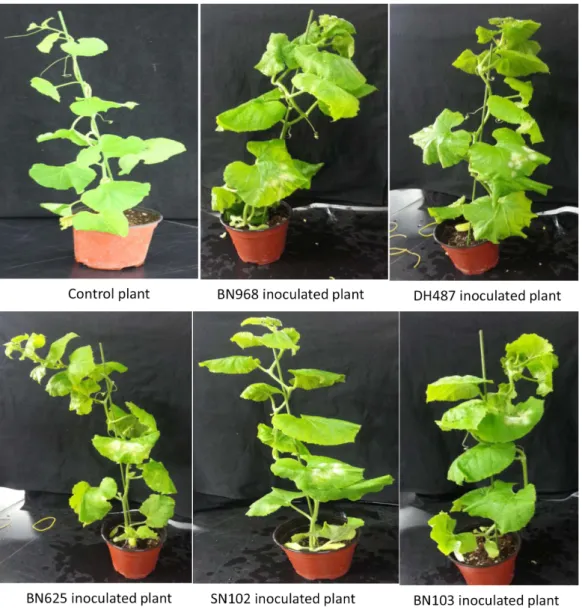
Fig. 2. A representation of disease symptoms infected by different races of powdery mildew fungus (Podosphaera xanthii) viz., BN968, DH487, BN625, SN102, and BN103 in C. melo ‘SCNU1154’ plants at 18 days post inoculation. The white circles indicate the inoculated 5

th

leaf number from the ground level.

ceptible cucumber CsaMLO8 proteins and the 14 CmMLO proteins of C. melo revealed a high degree of similarity, espe- cially with CmMLO2, CmMLO3 and CmMLO13 (data not shown).

Powdery mildew disease progress by different races Inoculated leaf showed the sharp visible disease progress by different races of PM fungus compared to control at 18 d post inoculation (Fig. 2). Disease intensity was not similar in response to different PM races (Fig. 2). The diseases pro- gressed comparatively quick under DH487, BN625, SN102 and BN103 races. The disease area was gradually enlarged and scattered by DH487, BN625, and SN102 races (Fig. 2).

On the other hand, disease area was concentrated in case

of BN103 race (Fig. 2). The minimum disease development was recorded by BN968 race (Fig. 2).

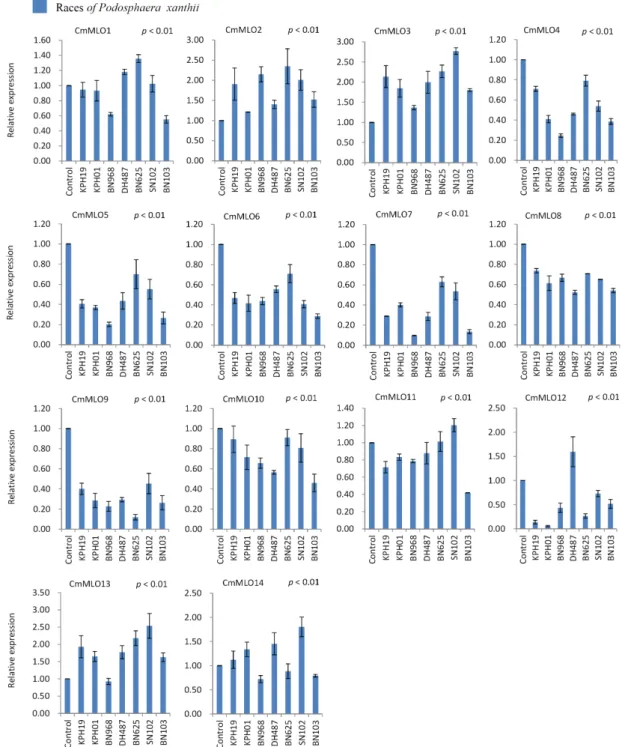
qPCR expression study after biotic stresses Three genes, namely CmMLO2, CmMLO3 and CmMLO13, were generally up-regulated in response to all seven races viz., KPH19, KPH01, BN968, DH487, BN625, SN102 and BN103 of PM fungus P. xanthii compared to control (Fig.

3). CmMLO3 and CmMLO13 displayed maximal expression

in response to race SN102 and were approximately 3.0 and

2.5 fold up-regulated, respectively (Fig. 3). Seven other

genes, namely CmMLO4, CmMLO5, CmMLO6, CmMLO7,

CmMLO8, CmMLO9 and CmMLO10, were generally down-

regulated in response to all seven races of P. xanthii com-

(6)

Fig. 3. Real-time quantitative PCR relative expression analysis of CmMLO genes after infection with seven races of Powdery mildew fungus Podosphaera xanthii in C. melo ‘SCNU1154’ plants. The error bars represent the standard error of the means of three independent replicates.

pared to control (Fig. 3). The approximate relative expressions ranged between 0.1 to 0.8 fold among the down-regulated genes (Fig. 3). The relative expression levels of the remaining four genes (CmMLO1, CmMLO11, CmMLO12 and CmMLO14) were race specific. CmMLO1 was slightly up-regulated in re- sponse to two races namely DH487 and BN625 but that was markedly down-regulated in response to another two races

viz., BN968 and BN103 (Fig. 3). The down-regulation of

CmMLO11 was observed in response to five races viz.,

KPH19, KPH01, BN968, DH487 and BN103 whereas this gene

was up-regulated against only one race SN102 and showed

almost equal expression against BN625 race (Fig. 3). For

CmMLO12, very low expression was noted in response to

all races except DH487 (Fig. 3). CmMLO14 showed com-

(7)

Fig. 4. Real-time quantitative PCR relative expression analysis of CmMLO genes in response to exogenous application of SA in C. melo ‘SCNU1154’ plants. The error bars represent the standard error of the means of three independent replicates.

paratively higher relative expression in response to four races viz., KPH19, KPH01, DH487, and SN102 and com- paratively lower relative expression in response to three oth- er races viz., BN968, BN625, and BN103 (Fig. 3).

Expression analysis after phytohormone stress treatments

We also performed the relative expression level of all 14 CmMLO genes under the exogenous application of two sig- naling molecules viz. SA and MeJA. In case of SA treatment, we observed gradual up-regulation and down-regulation among eleven CmMLO genes compared to control (Fig. 4).

CmMLO1, CmMLO3, CmMLO4, CmMLO5, CmMLO6, CmMLO7, CmMLO10 and CmMLO11 gradually increased in expression until 12 hr after stress treatment and declined thereafter (Fig.

4). CmMLO2, CmMLO13 and CmMLO14 had the highest lev- el of expression at 3 hr after treatment (Fig. 4). The approx- imate relative expression of up-regulated genes ranged be- tween 2.0 and 12 fold (Fig. 4). The other three genes, CmMLO8, CmMLO9, and CmMLO12 exhibited no remark- able responses in stressed plants compared to controls (Fig.

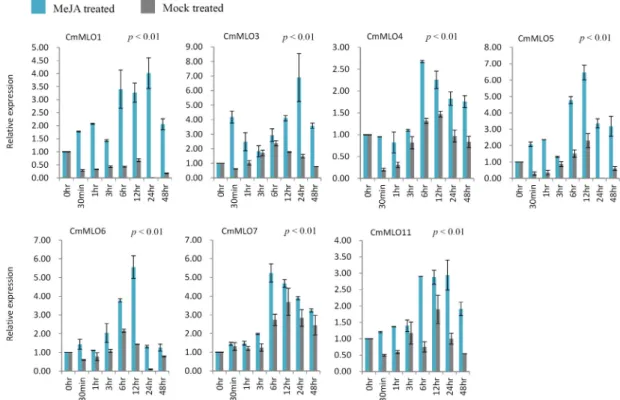
4). In response to MeJA treatment, seven CmMLO genes

were up-regulated and down-regulated compared to control

(Fig. 5). CmMLO4 and CmMLO7 showed low expression at

an early stage but gradually reached a peak at 6 hr and after-

wards declined (Fig. 5). The approximate relative expression

of these two genes ranged between 2.7 and 5.1 fold up-regu-

lation (Fig. 5). CmMLO5 and CmMLO6 had also low ex-

pression level at an early stage but progressively touched

a peak at 12 hr and subsequently declined (Fig. 5). The ap-

(8)

Fig. 5. Real-time quantitative PCR relative expression analysis of CmMLO genes after exogenous application of MeJA in C. melo

‘SCNU1154’ plants. The error bars represent the standard error of the means of three independent replicates.

proximate relative expression level of these two genes ranged between 5.5 and 6.5 fold up-regulation compared to control (Fig. 5). Although CmMLO1, CmMLO3 and CmMLO11 showed irregular expression at early stages but exhibited maximum up-regulation at 24 hr and then declined (Fig. 5).

The approximate relative expression of these two genes ranged between 3 and 7 fold up-regulation (Fig. 5). The re- maining seven genes, CmMLO2, CmMLO8, CmMLO9, CmMLO10, CmMLO12, CmMLO13 and CmMLO14 displayed no noteworthy responses in treated plants compared to con- trol (Fig. 5).

Discussion

We conducted qPCR expression analysis of all 14 CmMLO genes under seven races of P. xanthii infection and two exog- enous phytohormone treated samples to explore transcript accumulation level. The disease development was sharply visible at 18 d post inoculation and interestingly the disease intensity and pattern were not similar against different PM races (Fig. 2). In literature, as evolutionary variation is ob- served in cucurbit powdery mildew pathogen [28], pathoge- nicity may vary in different pathotypes and races [25, 29].

We identified three up-regulated genes, CmMLO2, CmMLO3

and CmMLO13, however, behavior of these three genes to- wards resistance or susceptibility is subject of further investigation. Previous results indicated that the higher the up-regulation of the gene under P. xanthii infection was often associated with susceptibility reaction of pathogen [2, 3, 7, 12, 36, 37, 42].

The functions of MLO proteins in molecular biology still remain elusive. The vesicle fusion events are controlled by MLO at the plasma membrane of host cells [12]. PM fungus may use MLO proteins as an ‘invasion door’ for the estab- lishment of successful penetration before haustorium for- mation [34] by modulating plant antifungal defense re- actions [13]. In addition, the TM domain and extracellular loops of CmMLO2, CmMLO3 and CmMLO13 contained evolutionarily conserved cysteine and proline residues, which could be related to susceptibility to PM fungus (Fig.

1). It was also reported that transmembrane domains con- taining conserved proline residues may be related to he- lix-helix interactions of polytopic membrane proteins (‘helix packing’) required for MLO function [32].

In our study, CmMLO4, CmMLO5, CmMLO6, CmMLO7,

CmMLO8, CmMLO9 and CmMLO10 genes showed marked

down-regulation in response to all seven races viz., KPH19,

KPH01, BN968, DH487, BN625, SN102 and BN103 of P. xan-

(9)

thii (Fig. 3). Experimental evidence indicates that mutation of MLO genes might be involved in producing rapid cell wall-localized H

2

O

2

bursts at the sites of attempted pene- tration by PM fungi beneath the epidermis of cells that might lead to PM resistance [37]. We observed down-regulated CmMLO genes are naturally mutated in those conserved po- sitions (Fig. 1). In cucumber, PM resistance is related to dele- tion or loss of function of CsaMLO8 in the hypocotyl tissue [2]. In barley, MLO function was deactivated due to loca- tion-specific mutagenesis of proline residues [11]. In addi- tion, MLO protein in mutant barley, with a cysteine to ala- nine mutation at extracellular loop 1, had reduced protein accumulation in the host cells compared to barley with wild-type MLO [11]. In our study, along with natural varia- tion of evolutionarily conserved cysteine and proline resi- dues in the TM domain and extracellular loop [11], we also found some new amino acid substitutions e.g., glutamine (Q), lysine (K), phenylalanine (F), aspartate (D) and methio- nine (M) in the intracellular loop (Fig. 1 a), which might facilitate PM resistance conferred by CmMLO genes. As the second and third cytoplasmic loops of MLO proteins play a critical role in powdery mildew susceptibility [40], any mu- tation of these positions might be involved in PM resistance.

Interestingly, we observed that CmMLO1, CmMLO11, CmMLO12, and CmMLO14 genes showed race-specific re- sponsiveness to P. xanthii (Fig. 3). This race-specific ex- pression could be due to interaction of cognate genes involv- ing race-specific resistant (R) genes in the host and a corre- sponding fungal avirulent (Avr) gene [17, 41]. The current concept of plant fungus interactions suggests that PM fun- gus might produce microbial effector molecules of unknown characteristics that would interact only with resistant genes of the host cells for hypersensitive reactions. The absence of resistant genes possibly leads to a compatible disease re- action [33]. This result suggested that the effector proteins produced by the different races of P. xanthii were variable and that different MLO genes were required for their effec- tive recognition. We also observed that the cysteine residues were not conserved in intracellular loop 2 of CmMLO11, CmMLO12, and CmMLO14 and were deleted in CmMLO1 (Fig. 1). The role of deleted/mutated cysteine residues in PM race-specific MLO resistance in melon awaits further investigation.

We also investigated two plant defense signaling mole- cules, SA and MeJA, in our present study. Under SA treat- ment, eleven CmMLO genes including three PM susceptible

genes (CmMLO2, CmMLO3 and CmMLO13) showed up-reg- ulation compared to control plants (Fig. 4). As exogenous application of SA induces some plant defense genes against biotrophic pathogens in Arabidopsis [43], we may speculate that SA treatments might change the responses of those three genes to PM fungus in melon. This hypothesis requires further validation by applying exogenous SA after P. xanthii infection. Previous study exhibited that exogenous applica- tion of defense signaling compound SA induced PM fungus (Erisyphe necator) responsive genes (VvMLO3, VvMLO4, VvMLO9 and VvMLO17) in grapes [12]. Exogenous applica- tion of SA also increased transcript accumulation of OsMLO genes in rice [21].

We identified seven CmMLO genes that showed up-regu- lation in response to exogenous application of MeJA com- pared to control plant (Fig. 5). We also observed that out of three genes those were up-regulated under P. xanthii in- fections, only CmMLO3 was highly induced whereas two other up-regulated genes were not induced by MeJA treat- ment (Fig. 5). Jasmonic acid plays a key role in plant defense, programmed cell death and leaf senescence [39]. Signaling molecules MeJA also induced OsMLO gene expression in rice [21]. However, in this study MeJA did not induce high expression of CmMLO genes as compared to SA treatments probably because this fungus is biotrophic (Fig. 4 and 5) [18].

However, the effectiveness of exogenous SA over MeJA sug- gests that MLO genes might follow SA mediated signaling.

However, this speculation is a subject of further inves- tigations. In pepper, CaMLO2 is highly induced by exoge- nous application of SA whereas it is not induced by JA treat- ments [23]. From all of these results, we may infer that re- sponses of CmMLO genes would be different to these two signaling molecules.

Conclusions

We identified 14 CmMLO genes from Melonomics data-

base. Sequence analysis revealed an invariable number of

TM domains among all CmMLO genes. We systemically

studied the expression level of all 14 CmMLO genes in re-

sponse to seven races of P. xanthii fungus and two different

phytohormone stress conditions. Up-regulation of three

genes with conserved cysteine and proline residues whether

related to PM susceptibility or resistance is matter of further

investigation. The seven down-regulated genes under PM

infection might bear site-specific variation, but that spec-

(10)

ulation deserves further investigation. We identified four race-specific candidates CmMLO genes responded under PM stress, suggesting the nature of effector proteins produced by those genes might be different. Moreover, 11 and 7 CmMLO genes were induced by the exogenous application of signaling molecules SA and MeJA, respectively, suggest- ing possible roles of these two molecules in PM disease control. Taken together, it can be concluded that data pre- sented here will be potential resources for developing stress resistant variety of C. melo L. by applying molecular breed- ing techniques against biotic stress.

Acknowledgments

This work were funded by the Export Promotion Technol- ogy Development Program (Grant No. 312065-05-4-HD030) and Golden Seed Project (Center for Horticultural Seed Development, Grant No. 213003-04-4-SB110), Ministry of Agriculture, Food and Rural Affairs (MAFRA), Republic of Korea.

References

1. Aist, J. R. and Bushnell, W. R. 1991. Invasion of plants by powdery mildew fungi, and cellular mechanisms of resistance. In The Fungal Spore and Disease Initiation in Plants and Animals. Edited by Cole GT, Hoch HC. New YorK: plenum press 321-345.

2. Bai, Y., Pavan, S., Zheng, Z., Zappel, N., Reinstädler, A., Lotti, C. De Giovanni, C., Ricciardi, L., Lindhout, P., Visser, R. G. F., Theres, K. and Panstruga, R. 2008. Naturally occur- ring broad-spectrum powdery mildew resistance in a Cen- tral American tomato accession is caused by loss of MLO function. Mol. Plant Microbe. Interact. 21, 30-39.

3. Berg, J. A., Appiano, M., Martinez, M. S., Hermans, F. W.

K., Vriezen, W. H., Visser, R. G. F., Bai, Y. and Schouten, H. J. 2015 A transposable element insertion in the suscepti- bility gene CsaMLO8 results in hypocotyl resistance to pow- dery mildew in cucmber. BMC Plant Biol. 15, 243.

4. Büschges, R., Hollricher, K., Panstruga, R., Simons, G., Wolter, M., Frijters, A., van Daelen, R., van der Lee, T., Diergaarde, P., Groenendijk, J., Töpsch, S., Vos, P., Salamini, F. and Schulze-Lefert, P. 1997. The barley Mlo gene: a novel control element of plant pathogen resistance. Cell 88, 695- 705.

5. Chen, Z., Hartmann, H. A., Wu, M. J., Friedman, E. J., Chen, J., Pulley, M., Schulze-Lefert, P., Panstruga, R. and Jones, A. M. 2006. Expression analysis of the AtMLO gene family encoding plant-specific seventransmembrane domain pro- teins. Plant Mol. Biol. 60, 583-597.

6. Cheng, H., Kun, W., Liu, D., Su, Y. and He, Q. 2012.

Molecular cloning and expression analysis of CmMlo1 in melon. Mol. Biol. Rep. 39, 1903-1907.

7. Consonni, C., Humphry, M. E., Hartmann, H. A., Livaja, M., Durner, J., Westphal, L., Vogel, J., Lipka, V., Kemmerl- ing, B., Schulze-Lefert, P., Somerville, S. C. and Panstruga, R. 2006. Conserved requirement for a plant host cell protein in powdery mildew pathogenesis. Nat. Genet. 386, 716-720.

8. Deshmukh, R., Singh, V. K. and Singh, B. D. 2014. Compara- tive phylogenetic analysis of genome-wideMlogene family members from Glycine max and Arabidopsis thaliana. Mol.

Genet. Genomics 289, 345-359.

9. Devoto, A., Piffanelli, P., Nilsson, I., Wallin, E., Panstruga, R., Von Heijne, G., Panstruga, R., Von Heijne, G. and Schulze-Lefert, P. 1999. Topology, subcellular localization, and sequence diversity of the Mlo family in plants. J. Biol.

Chem. 274, 34993-35004.

10. Devoto, A., Hartmann, H. A., Piffanelli, P., Elliott, C., Simmons, C., Taramino, G., Goh, C. S., Cohen, F. E., Emer- son, B. C., Schulze-Lefert, P. and Panstruga, R. 2003.

Molecular phylogeny and evolution of the plant-specific seven-transmembrane MLO family. J. Mol. Evol. 56, 77-88.

11. Elliott, C., Muller, J, Miklis, M., Bhat, R. A., Schulze-Lefert, P. and Panstruga, R. 2005. Conserved extracellular cysteine residues and cytoplasmic loop-loop interplay are required for functionality of the heptahelical MLO protein. Biochem.

J. 385, 243-254.

12. Feechan, A., Jermakow, A. M., Torregrosa, L., Panstruga, R. and Dry, I. B. 2008. Identification of grapevine MLO gene candidates involved in susceptibility to powdery mildew.

Funct. Plant Biol. 35, 1255-1266.

13. Feechan, A., Jermakow, A. M. and Dry, I. B. 2009. Grapevine MLO candidates required for powdery mildew pathoge- nicity. Plant Signal Behav. 4, 522-523.

14. Fita, A., Bowen, H. C., Hayden, R. M., Nuez, F., Pico, B.

and Hammond, J. P. 2012. Diversity in Expression of Phosphorus (P) Responsive Genes in Cucumismelo L. PLoS One 7, e35387.

15. Garcia-Mas, J., Benjak, A., Sanseverino, W., Bourgeois, M., Mir, G. and Gonzalez, V. M. 2012. The genome of melon (Cucumis melo L.). Proc. Natl. Acad. Sci. USA 109, 11872-11877.

16. Glawe, D. A. 2008. The powdery mildews: a review of the world most familiar (yet poorly known) plant pathogens.

Annu. Rev. Phytopathol. 46, 27-51.

17. Glazebrook, J. 1999. Genes controlling expression of defense responses in Arabidopsis. Curr. Opin. Plant Biol. 2, 280-286.

18. Glazebrook, J. 2005. Contrasting mechanisms of defense against biotrophic and necrotrophic pathogens. Annu. Rev.

Phytopathol. 43, 205-227.

19. Hückelhoven, R., Fodor, J., Preis, C. and Kogel, K. H. 1999.

Hypersensitive cell death and papilla formation in barley attacked by the powdery mildew fungus are associated with hydrogen peroxide but not with salicylic acid accumulation.

Plant Physiol. 119, 1251-1260.

20. Jarvis, W. R., Gubler, W. D. and Grove, G. G. 2002. Epidemi-

ology of powdery mildews in agricultural pathosystems. In:

(11)

Bélanger RR, Bushnell WR, Dik AJ, Carver TLW, eds. The Powdery Mildews: A Comprehensive Treatise. St Paul MN, USA: APS Press 169-99.

21. Kim, M. C., Lee, S. H., Kim, J. K., Chun, H. J., Choi, M.

S., Chung, W. S., Moon, B. C., Kang, C. H., Park, C. Y., Yoo, J. H., Kang, Y. H., Koo, S. C., Koo, Y. D., Jung, J. C., Kim, S. T., Schulze-Lefert, P., Lee, S. Y. and Cho, M. J. 2002a.

MLO, a modulator of plant defense and cell death, is a novel calmodulin-binding protein. J. Biol. Chem. 277, 19304-19314.

22. Kim, M. C., Panstruga, R., Elliott, C., Müller, J., Devoto, A., Yoon, H. W., Park, H. C., Cho, M. J. and Schulze-Lefert, P. 2002b. Calmodulin interacts with MLO protein to regulate defense against mildew in barley. Nature 416, 447-450.

23. Kim, D. S. and Hwang, B. K. 2012. The pepper MLO gene, CaMLO2, is involved in the susceptibility cell-death re- sponse and bacterial and oomycete proliferation. Plant J. 72, 843-855.

24. Kumar, J., Hückelhoven, R., Beckhove, U., Nagarajan, S. and Kogel, K. H. 2001. A compromised Mlo pathway affects the response of barley to the necrotrophic fungus Bipolarissor- okiniana(teleomorph: Cochliobolussativus) and its toxins.

Phytopathology 91, 127-133.

25. Lebeda, A. and Sedláková, B. 2006. Identification and survey of cucurbit powderymildew races in Czech populations.

Proceedings of Cucurbitaceae, Asheville, North Carolina, USA, 17-21 September 2006. pp 444-452.

26. Liu, Q. and Zhu, H. 2008. Molecular evolution of the MLO gene family in Oryza sativa and their functional divergence.

Gene 409, 1-10.

27. Livak, K. J. and Schmittgen, T. D. 2001. Analysis of relative gene expression data using real-time quantitative PCR and the 2

-∆∆ct

method. Methods 25, 402-408.

28. McDonald, B. A. and Linde, C. 2002. Pathogen population genetics, evolutionary potential and durable resistance.

Annu. Rev. Phytopathol. 40, 349-379.

29. Miazzi, M., Laguardia, C. and Faretra, F. 2011. Variation in Podosphaera xanthii on cucurbits in southern Italy. J.

Phytopathol. 159, 538-545.

30. Miklis, M., Consonni, C., Bhat, R. A., Lipka, V., Schulze- Lefert, P. and Panstruga, R. 2007. Barley MLO modulates actin-dependent and actin-independent antifungal defense pathways at the cell periphery. Plant Physiol. 144, 1132-1143.

31. Nicholas, K. B. and Nicholas, H. B. J. 1997. GeneDoc: a tool for editing and annotating multiple sequence alignments.

http://www.psc.edu/biomed/genedoc.

32. Orz´aez, M., Salgado, J., Gimenez-Giner, A., Perez-Paya, E.

and Mingarro, I. 2004. Influence of proline residues in trans- membrane helix packing. J. Mol. Biol. 335, 631-640.

33. Panstruga, R. 2003. Establishing compatibility between plants and obligate biotrophic pathogens. Curr. Opin. Plant Biol. 6, 320-326.

34. Panstruga, R. 2005b. Serpentine plant MLO proteins as entry portals for powdery mildew fungi. Biochem. Soc. Transact.

33, 389-392.

35. Perchepied, L., Bardin, M., Dogimont, C. and Pitrat, M. 2005.

Relationship between loci conferring downy mildew and powdery mildew resistance in melon assessed by quantita- tive trait loci mapping. Phytopathology 95, 556-565.

36. Pessina, S., Pavan, S., Catalano, D., Gallotta, A., Visser, R.

G. F., Bai, Y., Malnoy, M. and Schouten, H. J. 2014.

Characterization of the MLO gene family in Rosaceae and gene expression analysis in Malus domestica. BMC Genomics 15, 618.

37. Piffanelli, P., Zhou, F. S., Casais, C., Orme, J., Jarosch, B., Schaffrath, U., Collins, N. C., Panstruga, R. and Schulze- Lefert, P. 2002. The barley MLO modulator of defense and cell death is responsive to biotic and abiotic stress stimuli.

Plant Physiol. 129, 1076-1085.

38. Reddy, V. S., Ali, G. S. and Reddy, A. S. N. 2003. Characteri- zation of a pathogen-induced calmodulin-binding protein:

mapping of four Ca

2+

dependent calmodulin-binding domains. Plant Mol. Biol. 52, 143-159.

39. Reinbothe, C., Springer, A., Samol, I. and Reinbothe, S. 2009.

Plant oxylipins: role of jasmonic acid during programmed cell death, defence and leaf senescence. FEBS J. 276, 4666- 4681.

40. Reinstädler, A., Müller, J., Czembor, J. H., Piffanelli, P. and Panstruga, R. 2010. Novel induced mlo mutant alleles in combination with site-directed mutagenesis reveal function- ally important domains in the heptahelical barley Mlo protein. BMC Plant Biol. 10, 31.

41. Schulze-Lefert, P. and Vogel, J. 2000. Closing the ranks to attack by powdery mildew. Trends Plant Sci. 5, 343-348.

42. Schouten, H. J., Krauskopf, J., Visser, R. G. F. and Bai, Y.

2014. Identification of candidate genes required for suscepti- bility to powdery or downy mildew in cucumber. Euphytica 200, 475-486.

43. Thomma, B. P., Penninckx, I. A., Broekaert, W. F. and Cammue, B. P. 2001. The complexity of disease signaling in Arabidopsis. Curr. Opin. Immunol. 13, 63-68.

44. Wang, X., Ma, Q., Dou, L., Liu, Z., Peng, R. and Yu, S.

2016. Genome-wide characterization and comparative anal- ysis of the MLO gene family in cotton. Plant Physiol. Biochem.

103, 106-119.

45. Winterhagen, P., Howard, S. F., Qiu, W. and Kovács, L. G.

2008. Transcriptional up-regulation of grapevine MLO genes in response to powdery mildew infection. Am. J. Enol. Vit.

59, 2.

46. Wolter, M., Hollricher, K., Salamini, F. and Schulze-Lefert, P. 1993. The mlo resistance alleles to powdery mildew in- fection in barley trigger a developmentally controlled de- fense mimic phenotype. Mol. Gen. Genet. 239, 122-128.

47. Zheng, Z., Nonomura, T., Bóka, K., Matsuda, Y., Visser, R.

G. F., Toyoda, H. and Bai, Y. 2013. Detection and quantifica-

tion of Leveillula taurica growth in pepper leaves. Phytopa-

thology 103, 6.

(12)

초록:멜론 흰가루병균 및 식물 호르몬 처리하에서 MLO 유전자군의 발현검정

쥬엘 하울라다

ㆍ김회택

ㆍ박종인ㆍ나잘우딘 아메드ㆍ아리프 핫산 칸 로빈ㆍ정희정ㆍ노일섭*

(국립순천대학교 원예학과)

멜론 흰가루병(Podosphaera xanthii)은 멜론 생산량에 영향을 미치는 중요한 병해 중 하나로 알려져 있다. 작물 육종에 있어서 흰가루병을 포함한 병저항성 계통 육성은 병저항성 관련 유전자들의 유전양식 및 그 유전자들을 조절하는 식물호르몬에 대한 정보는 매우 중요하다. 식물에 있어 흰가루병균 저항성에 관여한다고 알려진 Mildew Resistance Locus O (MLO) 유전자를 멜론 database인 ‘Melonomics’으로부터 14개 동정하여 CmMLO1~14 (Cucumis melo MLO)로 표기하였다. 동정된 14개의 CmMLO유전자들의 아미노산 서열을 비교한 결과, 9개의 CmMLO 유전 자들은 흰가루병균에 대한 감수성 관련 아미노산 cysteine과 proline이 잘 보존되어 있었지만, 나머지 CmMLO 유 전자들은 다른 아미노산 서열을 가지고 있었다. 멜론 흰가루병의 7 race에 대하여 이병성을 나타내는 멜론 계통

‘SCNU1154’에 멜론 흰가루병균(P. xanthii)을 접종하고, 식물호르몬(metyl jasmonate와 salicylic acid) 처리한 후

qPCR을 통해 CmMLO 유전자들의 상대적인 발현양을 분석한 결과, 멜론 흰가루병 7 race에 대하여 14개의

CmMLO 유전자들 중 3개의 유전자들에서 발현이 증가하였고, 7개의 유전자들은 발현이 감소하였으며, 4개의

CmMLO 유전자들은 race 특이적으로 발현양이 증가 혹은 감소하였다. 또한 14개의 CmMLO 유전자들의 발현양은

methyl jasmonate와 salicylic acid를 처리하였을 때 다양한 발현 양상을 나타내었다. 11개의 CmMLO 유전자들은

salicylic acid 처리하였을 때 발현양이 증가하였으며, 7개의 유전자들은 methyl jasmonate 처리하였을 때 발현양

이 증가하였다. 이와 같이, 스트레스에 반응을 보이는 CmMLO 유전자들은 멜론 흰가루병 저항성 계통 육성을 위

한 유용한 정보가 될 것으로 기대된다.

수치

Table  1.  Specific  primer  sequences  used  for  real-time  quantitative  PCR  amplification  of  MLO  genes  of  Cucumis  melo  L.
Fig.  1.  Sequence  alignment  of  CmMLO  proteins.  The  alignment  was  generated  by  CLUSTALW  using  default  parameters
Fig.  2.  A  representation  of  disease  symptoms  infected  by    different  races  of  powdery  mildew  fungus  (Podosphaera  xanthii)  viz.,  BN968,  DH487,  BN625,  SN102,  and  BN103  in  C
Fig.  3.  Real-time  quantitative  PCR  relative  expression  analysis  of  CmMLO  genes  after  infection  with  seven  races  of  Powdery  mildew  fungus  Podosphaera  xanthii  in  C
+3

참조

관련 문서