옥수수의 steam flake 처리가 in situ 건물소화율 및 저장기간별 aflatoxin과 ochratoxin 함량에 미치는 영향
이신자․이지훈․신년학․현종환․문여황1․이상석2․이성실*
경상대학교 응용생명과학부(BK 21), 1진주산업대학교 동물생명과학과, 2순천대학교 동물자원과학과
Received September 10, 2008 /Accepted November 10, 2008
Effects of Steam Flaking on In situ DM Digestibility and Aflatoxin and Ochratoxin Contents during Storage of Corns. Shin Ja Lee, Ji Hun Lee, Nyeon Hak Shin, Jong Hwan Hyun, Yea Hwang Moon1, Sang Suk Lee2 and Sung Sill Lee*. Division of Applied Life Science(BK 21 Program), Graduate School of Gyeongsang National University, 1Department of Animal Sci. & Biotech., Jinju National University,
2Department of Animal Science & Biotechnology, Sunchon National University - This study was conducted to investigate the effects of steam flaking of corn grains on in situ dry matter degradability in the ru- men and contents of mycotoxins (aflatoxin, ochratoxin) during storage. Yellow dent corns imported from USA and India were flaked, and stored for 8 weeks under the standard temperature and pres- sure (STP; 25oC/ 1 atm.). Experimental treatments were composed of four corn grains (untreated-USA corn, USCW; steam flaked-USA corn, USCF; untreated-India corn, IDCW; steam flaked-India corn, IDCF) with 4 replications according to 9 storage periods (0, 1, 2, 3, 4, 5, 6, 7, 8 week). Two ruminally cannulated Holstein bulls were used for in situ trial. Pathogen contamination trial was performed by comparing the mycotoxin contents in corns during storage periods. Dry matter disappearance rate in the rumen was about 3.0 to 44.1% higher (P<0.05) for USCW than IDCW, but was not difference be- tween USCF and IDCF. With steam flaking of corn, dry matter degradability in the rumen was sig- nificantly (P<0.05) increased in corn from India, but was not affected in corn from USA. Aflatoxin con- tent was very low level in corns from USA and steam flaked corns, but was higher than the tolerance limit of domestic aflatoxin content regulation when IDCW was stored over 6 week under STP.
Ochratoxin content was low level in all treatments. From above results, it is reasonable that the corn imported from India might be flaked for enhance the ruminal DM degradability and safe from aflatox- in pathogen.
Key words : Corn, steam flake, in situ DM disappearance, aflatoxin, ochratoxin
*Corresponding author
*Tel:+82-55-751-5411, Fax:+82-55-751-5410
*E-mail : [email protected]
서 론
옥수수는 동물의 생산에 있어서 가장 이상적인 에너지원 으로서 축우용 배합사료 중에 약 50∼70%를 차지하고 있다 [22]. 축산물 수입자유화와 고 유가시대에서 우리나라 축산 의 지속성을 위해서는 사료비 절약을 위한 다양한 노력이 우 선되어야 할 과제이다. 사료비 절약을 위해서는 값싼 사료를 이용하는 방법과 적절한 가공처리를 통하여 영양소 이용성 을 극대화시키거나 저장과정 중 오염도를 줄이는 방법 등이 있을 것이다. 곡류사료의 건물 이용효율은 축종, 곡류의 종류 및 가공방법에 많은 영향을 받는데[43], 알곡을 가공 처리하 여 입자도와 구조가 변화되면 반추위 내에서의 영양소 이용 성 및 발효특성을 변화시켜 이용효율을 증가시킨다. 특히, 옥 수수를 steam flaking시키면 전분입자의 30~50%가 gelatin 화되고[14], 반추위 내 propionate 생산량을 증가시켜 ace- tate/propionate 비율을 감소시킬 뿐만 아니라, 반추동물에
게 있어서 보호단백질의 공급을 증가시키는 효과로 인해[33]
육우에서 증체율(14%)과 사료효율(10%)의 개선[30] 및 에너 지 이용효율의 증진효과[4,24]가 있다고 하였다. 국내에서는 주로 미국산과 남미산, 중국산, 인도산의 옥수수를 수입하고 있는데 최근에 사람이나 동물에게 독성을 유발시키는 곰팡 이 독소에 관심이 집중되면서 농산물의 오염에 중요한 요소 로 인식되고 있다[17,19]. Aflatoxin은 전 세계적으로 특정지 역에서 공급되는 사료와 식품에 오염되는 곰팡이 대사산물 중의 하나로 알려져 있으며, 주로 A. flavus와 A. parasiticus 같은 곰팡이에서 생성되는 aflatoxin에는 여러 가지 이성체 가 존재하고 있다. Aflatoxin의 이성체 가운데 aflatoxin B1와 aflatoxin G1은 발암성이 있는 것[17]으로 알려져 있다. afla- toxin B1에 수산기가 붙어 발암성이 있는 대사체인 aflatoxin M1은 오염된 사료를 섭취한 소의 젖에서 분비되고, aflatox- in의 여러 대사체는 유전독성이 매우 강하며, 간 발암성과 함 께 최기형성을 나타낸다[17]. 또한 ochratoxin A는 신장염, 간의 면역작용 저해, 기형 등을 유발하는 곰팡이 독소로서 WHO에서는 사람에게 발암 가능성이 있는 독성물질로 분류 하고 있다. 이러한 독소를 분비하는 곰팡이의 오염 여부는
가축의 사료로서 많이 이용되고 있는 옥수수로서는 반드시 점검되어야 하는데, 옥수수는 같은 품종이라도 환경조건에 따라서 영양소 성분이 차이가 날 수 있고, 그로인해 가공효 과도 다를 수 있다. 따라서 본 시험은 steam flake처리에 따 른 미국산과 인도산 옥수수의 in situ 소화율 변화와 저장기 간에 따른 독성물질 분비 곰팡이의 오염도에 미치는 영향을 알아보고자 수행되었다.
재료 및 방법 공시 재료
수입 옥수수를 원산지별(미국산, 인도산)로 분류하여 무처 리 알곡과 steam flake처리한 것으로 나누어 공시하였다. 공 시재료는 2 mm screen이 부착된 Wiley mill에서 분쇄한 다 음, 미세한 전분입자를 제거한 후, 입자가 600 μm (입자도 표 현지수 MF=2.5) 이하가 되도록 처리하여 사용하였다. 옥수 수의 flake처리는 steam controller 내의 온도가 70~80oC에 서 50분간 증기처리한 후, 5 kg/cm2의 압력으로 박편하여 압 편두께가 3 mm 정도 되게 하였다. 공시 옥수수의 화학적 조 성은 Table 1과 같다.
공시축
In situ nylon bag 실험을 위한 공시축은 평균체중이 550 kg 되는 반추위 누관이 장착된 Holstein (평균체중 550 kg) 수소 2두를 공시하였다. 공시축의 사양관리는 농후사료와 볏 짚의 급여비율을 40:60으로 하여 체중의 3% 수준으로 1일 2 회(07:00, 19:00) 분할 급여 하였다. Mineral-vitamin block을 자유롭게 섭취토록 하였으며 물은 자유롭게 음용하도록 하 였다. 급여된 사료의 조성과 화학성분은 Table 2에서와 같다.
시험 설계
옥수수 원산지 2곳(미국산, 인도산)과 steam flake 처리여 부에 따라 총 4처리를 두었으며, in situ시험은 반추위내 발효
Table 1. Chemical composition of test corns by origin
Chemical composition Corn1)
USA India
Moisture (%)
Crude protein (% DM) Ether extract (% DM) Crude fiber (% DM) Crude ash (% DM) Nifexts2) (% DM) Calcium (% DM) Phosphorus (% DM)
13.75 7.43 3.58 1.21 2.02 72.01 0.02 0.22
14.54 8.05 3.38 1.38 2.67 69.98 0.02 0.29
1)Corns imported from USA or India.
2)Nifexts: Nitrogen free extracts.
Table 2. Ingredient and chemical compositions of diets fed to rumen cannulated Holstein bulls
Items Formula feed rice straw
Ingredient,% as fed basis Yellow corn
Wheat ground Wheat bran Tapioca
Cotton seed meal Rapeseed meal Cane molasses Limestone NaCl
Vitamin-mineral premix1)
58.8 5.0 15.0 8.0 4.0 4.0 0.9 1.2 1.0 2.1 Chemical composition
Dry matter,%
Crude protein,% of DM Ether extract,% of DM Crude ash,% of DM
Neutral detergent fiber,% of DM Acid detergent fiber,% of DM Calcium,% of DM
Phosphorus,% of DM
88.08 12.72 3.29 5.90 28.16 8.17 1.02 0.34
87.97 5.12 2.50 17.16 82.76 57.52 0.34 0.11
1)Supplied per kilogram of premix: Vitamin A, 6,000 IU;
Vitamin D3, 1,022 IU; K, 0.08%; S, 0.05%; Mg, 0.03%; Zn, 50 ppm; Mn, 40 ppm; Fe, 30 ppm; Cu, 10 ppm; Co 0.5 ppm;
I, 0.53 ppm; Se, 0.13 ppm.
시간(3, 6, 9, 12, 18 및 24 시간)별 4반복으로 총 96개의 ny- lon bag을 이용하여 수행하였고, 오염도 측정시험은 보관기 간별(0, 2, 3, 4, 5, 6, 7, 8주) 4반복으로 mycotoxin 함량을 측 정하였다.
시험 방법 및 성분 분석
In situ 시험은 약 3 g의 시료를 칭량하여 nylon bag (Swiss screen P/L Co. Ltd, Nytal 25T, pore size; 45 μm)에 넣은 후, 고무줄을 이용하여 nylon bag 윗부분에서 3 cm 지 점을 묶은 후, Linnen 망(15×25 cm 크기)에 넣어 온수에 약 10분 동안 침지한 다음, 반추위 내 ventral sac 부분에 현수, 발효시켰다. 발효 시간별로 회수한 nylon bag은 즉시, 얼음 물에 침지시켜 미생물의 성장을 억제시켰다. 회수한 nylon bag은 맑은 물이 나올 때까지 세척한 후, 60oC drying oven 에서 48시간동안 건조한 후 무게를 측정하여 다음과 같이 건 물소실율을 계산하였다[45].
건물소화율(%)=발효전건물무게 발효후건물무게발효전건물무게
×
반추위 내 건물 분해율은 Nylon bag 실험을 통하여 얻어 진 발효시간대별 건물 소실율을 바탕으로 다음의 Ørskov와 McDonald [28] 공식으로 건물 분해율을 산출하였다.
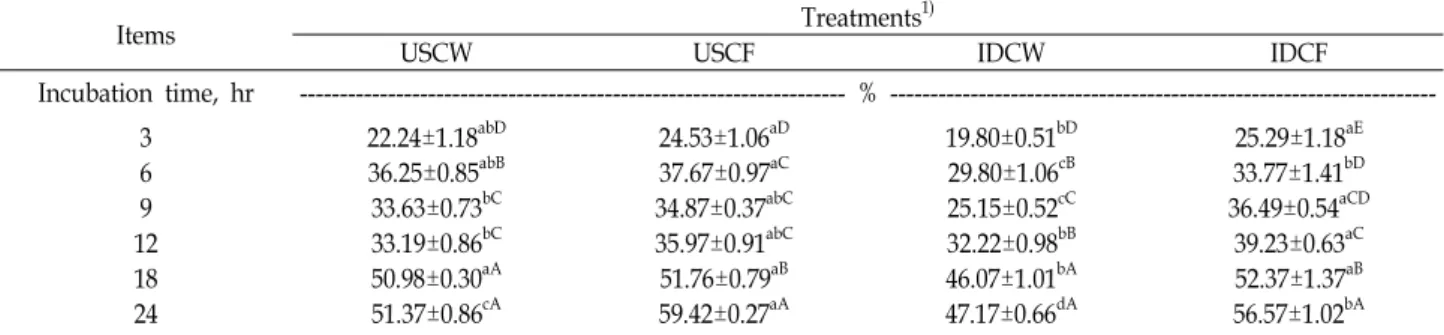
Table 3. Effects of steam flake processing and import origins of corns on the dry matter disappearance rate by incubation time in rumen
Items Treatments1)
USCW USCF IDCW IDCF
Incubation time, hr --- % --- 3
6 9 12 18 24
22.24±1.18abD 36.25±0.85abB 33.63±0.73bC 33.19±0.86bC 50.98±0.30aA 51.37±0.86cA
24.53±1.06aD 37.67±0.97aC 34.87±0.37abC 35.97±0.91abC 51.76±0.79aB 59.42±0.27aA
19.80±0.51bD 29.80±1.06cB 25.15±0.52cC 32.22±0.98bB 46.07±1.01bA 47.17±0.66dA
25.29±1.18aE 33.77±1.41bD 36.49±0.54aCD
39.23±0.63aC 52.37±1.37aB 56.57±1.02bA Mean±SE.
1) USCW, US corn-whole type; USCF, US corn-flaked type; IDCW, India corn-whole type; IDCF, India corn-flaked type.
a-dMeans with different superscripts in the same row are significantly different (P<0.05).
A-EMeans with different superscripts in the same column are significantly different (P<0.05).
P=a+b(1-e-ct)
P: 시간 “t" 경과 시의 반추위내 건물 분해율(%) a: "0"시간대의 건물 분해율(%), 즉 빠르게 분해되는 건
물부분
b: 주어진 시간에 분해될 수 있는 잠재적 건물 분해율(%) c: "b"의 시간당 분해상수
t: 반추위 내 발효시간
반추위 내 유효분해도는 건물의 반추위내 유효분해도 (effective ruminal degradability, ED)는 사료의 반추위 내 통 과속도를 시간당 6% (r=0.06)로 가정하여[27], 다음과 같은 공식으로 추정하였다[28].
ED=a+b×{c/(c+r)}
ED: 건물의 유효분해도 a, b, c: 건물 분해율 상수
r: 사료의 반추위 내 통과속도(passage rate)로서 시간 당 6%로 가정
Mycotoxin함량 측정은 공장의 표준환경(standard tem- perature and pressure, STP; 25oC/1기압) 하에서 저장기간 별 곰팡이 독소함량의 변화를 조사하기 위하여 incubator에 보관하면서 1주일 간격으로 8주간 3반복으로 aflatoxin과 ochratoxin의 함량을 측정하였다.
Aflatoxin 함량은 Vicam사 Series-4 fluorometer에 aflatox- in calibration standard를 이용하여 standard를 잡은 후, 공 정라인별로 채취한 시료 50 g과 NaCl 5 g을 합한 후 meth- anol 80 ml와 distilled water 20 ml을 1분간 교반시켜 Vicam fluted filter paper (24 cm)로 1차 여과시킨 후 증류수 40 ml 를 혼합한 후 2차 여과시켜 glass syringe (10 ml)에 10 ml를 취한다. Aflatest wash buffer 10 ml을 통과시킨 후, distilled water 10 ml 를 2회 통과시키고, cuvette에 methanol 1 ml를 aflatest에 통과시켜 모은 후 aflatest developer 1.5 ml를 합
하여 series-4 Fluorometer에서 분석을 수행하였다.
Ochratoxin 함량은 aflatoxin측정과 같은 방법으로 실시하 며, 전처리된 시료에 ochratest wash buffer 10 ml을 통과시 킨 후, distilled water 10 ml를 두 번 통과시키고, cuvette에 ochratoxin developer 1.5 ml를 ochratest에 통과시켜 추출한 후, series-4 Fluorometer에 넣어 분석을 수행하였다.
공시 재료의 일반성분 분석은 시료를 65oC의 건조기에서 3일간 건조시킨 후, 1.00 mm screen이 부착된 분쇄기(Wiley mill)를 이용하여 분쇄한 후 사용하였다. 일반성분분석은 AOAC [1] 방법에 준하였으며, 칼슘과 인의 함량은 Schwarzenbach 등[50]의 방법과 UV-vis spectrophotometer (UVmini-1240, Japan)로 분석하였다.
통계 처리
시험 결과는 SAS (statistical analysis system) package program [37]의 General Linear Model (GLM) procedure에 따라 처리되었으며, 각 처리구간에 유의성 검증을 위해 분산 분석을 실시한 후, Duncan’s multiple range test [67]로 5%
수준에서 유의성을 검정하였다.
결과 및 고찰
In situ 건물 소실율
각 처리에 따른 옥수수의 반추위내 발효시간별 in situ 건 물 소실율은 Table 3에서 보는 바와 같다. 반추위 발효 24시 간을 기준으로 USCW, USCF, IDCW 및 IDCF 처리구의 건 물 소화율은 미국산(USCW구와 USCF구) 옥수수가 인도산 (IDCW 및 IDCF) 옥수수보다 건물 소화율이 유의적(P<0.05) 으로 높았으며, steam flaking 처리(USCF 및 IDCF구)에 의 해 건물소화율이 크게 향상되었다(P<0.05). Phillippeau 등 [31]은 옥수수 품종(dent type과 flint type)에 따른 반추위 내 전분 소화율을 측정한 결과, dent종이 flint종보다 50% 이상
높았다고 하였으며, 조 등[6]은 수입국별로 옥수수의 품질을 평가한 연구에서 풍건물 기준으로 미국산 옥수수의 TME (True metabolizable energy) 값이 3,745 kcal/kg으로 가장 높게 나타났고, 그 다음이 중국산 옥수수 3,671, 아르헨티나 옥수수 3,555 그리고 중국산-Premium 옥수수 3,518 kcal/kg 순이라고 하였다. 남궁 등[25]도 이와 유사한 결과를 보고하 였는데, 본 연구에서도 인도산 옥수수보다는 미국산 옥수수 의 반추위내 소화율이 유의적으로 높아(P<0.05),옥수수의 품 종이나 생산지에 따라서 소화율과 품질 차이가 있다는 것을 알 수 있다. 옥수수로 대표되는 곡류는 70~80% 이상이 전분 으로 구성되어 있고, 전분의 소화율에 있어서 전분 자체의 구조와 아주 밀접한 관련을 가지고 있으므로 사료의 종류에 따른 반추위 내 소실율은 상당한 차이를 나타낸다[35,49]. 그 리고 전분의 구조와 전분을 둘러싸고 있는 단백질의 양과 구 성[36,44,48]에 따라 소화율이 달라질 수 있고, 곡류의 표피에 cellulose와 hemicellulose의 중합도와 wax cuticle 층의 차이 에 의해서도 달라진다[46]. 예를 들어 보리는 전분 구조가 치 밀하지 못하여 반추위 미생물의 공격이 용이하고[2], amy- lose와 환원당의 함량이 옥수수보다 상대적으로 높으므로[3]
반추위내 소실율이 옥수수보다 높다[44].
수입 원산지에 따른 옥수수의 발효시간별 in situ 건물 소 실율은 무처리 알곡은 미국산이 인도산보다 약 3.0~44.1%
높았으나, steam flaking 처리를 함으로써 건물소실율의 차 이는 없어졌다.
Steam flaking 처리에 따른 in situ 건물 소실율 향상 효과는 전 발효 시간대에서 미국산 옥수수는 알곡에 비해 1.5~15.7%
정도 증가되었으나, 인도산 옥수수는 13.7~34.3%까지 증가되 어 인도산 옥수수의 steam flaking 처리 효과가 훨씬 큰 것으로 나타났다. 이러한 결과는 steam flake 처리한 옥수수 전분입자 의 gelatin화 되는 정도는 30∼50% [14]로서 조건에 따라 차이 가 있기 때문인 것으로 사료된다. 발효시간대별로는 미국산 옥수수는 24시간대, 인도산 옥수수는 9시간대에서 steam flak- ing 처리에 의한 건물소실율 증가폭이 가장 컸다. 하 등[12]은 반추위 12시간 배양 시 무처리가 51.19, 박편처리가 67.39, 수침 처리가 54.14%로 박편처리가 32%정도 소실율을 개선하였다 고 보고하였고, Lee 등[21] 또한 무처리 옥수수와 박편처리 옥 수수를 육성우에게 약 80% 급여하였을 때, 반추위 건물 소화 율이 각각 55.6, 71.1%라고 하였다. 하지만 본 실험의 결과는 그에 미치지 못하는 결과를 나타내었다.
동물을 이용한 in vivo 실험에서 steam flaked corn이 whole corn에 비하여 starch 함량의 증가로 인하여 초기 발 효시간 대에 반추위 내 소화율이 높다는 보고[10,18,34,52]와 옥수수를 stem flaking 처리를 하면, 옥수수 전분입자의 30∼
50%가 gelatin화 되어 입자도와 구조가 변화되어 반추위 내 영양소 이용성 및 발효특성을 변화시키게 되는데, 반추위 내 propionic acid 생산이 증가되어 acetate/propionate의 비율
이 감소하며 영양소의 이용효율을 증가시켜 준다[13,14,30]는 연구보고가 있다.
반추위 내 발효시간별 건물 소실율을 기초로 유도된 분해도 공식, 비선형회귀방정식은 Table 4와 Fig. 1에 나타내었다.
분해상수 "a"값은 공식의 Y축 절편으로 반추위 발효 0시간 대 분해율을 의미하고 이론적으로는 0%이지만 수용성이거나 입자도가 너무 작아 물리적으로 nylon bag (45 um)을 빠져나 가는 등 반추위 미생물발효에 의하지 않고 nylon bag을 빠져 나가는 건물량을 나타낸다. 따라서 "a" 값에 영향을 미치는 요인으로는 화학적으로는 시험사료의 수용성 함량 차이와 물 리적으로는 nylon bag의 pore size를 고려한 사료입자도 등 이다. 본 시험에서는 물리적 영향을 줄이기 위해 미세입자를 제거하였기 때문에 "a" 값이 수용성 물질을 대표한다고 볼 수 있다. 본 시험에서 옥수수 건물의 초기 분해율을 나타내는 "a"
Table 4. Effects of steam flake processing and origins of corns on the degradation parameters and effective rumen disappearance rate of dry matter
Items Treatments1)
USCW USCF IDCW IDCF
Degradation parameters a
b c ED2) (%) r=0.06
18.96 62.06 0.0326
40.81 19.42 72.45 0.0309
44.05
15.62 95.25 0.0178
37.41 19.83 76.23 0.0282
44.20
1)USCW, US corn-whole type; USCF, US corn-flaked type;
IDCW, India corn-whole type; IDCF, India corn-flaked type.
2)Effective rumen degradability calculated with the equation of ED=a+b[c/(c+k)], where k is set at 0.06 of passage rate in rumen.
Fig. 1. Dry matter disappearance rate (%) of the test corns, USCW (◆—◆), USCF (▲—▲), IDCW (■—■) and IDCF (∗—∗), in the rumen of Holstein bulls in in situ trial.
값은 15.62~19.83% 수준으로서 인도산 옥수수의 초기 분해율 이 미국산 옥수수보다 낮았으나, steam flake 처리를 함으로써 전 처리 간에 비슷한 수준으로 증가되었다. 미국산 옥수수 건 물의 초기 분해율은 steam flake 처리에 의해 거의 영향을 받 지 않았으나 인도산 옥수수는 약 27%나 증가되었다. 하 등[12]
은 옥수수의 가공처리별 시험에서 알곡, flake 및 거친 분쇄처 리 시, "a" 값이 각각 12.8, 21.7 및 21.4%라고 하여 알곡을 flake 처리함으로써 약 70%까지 증가되었다고 하여, 처리효과가 본 시험의 결과보다 훨씬 컸다.
반추위 내에서 미생물에 의해 분해되는 건물부분을 나타 내는 "b"값은 62.06~95.25%로서 "a"값이 가장 낮았던 인도산 알곡 옥수수가 가장 높았는데, 인도산 옥수수는 steam flake 처리를 함으로써 "b"값이 약 20% 낮아졌다. "b"값은 주어진 시간동안 반추위에서 잠재적으로 분해되는 부분으로서 소화 율 추정을 위해서는 시간당 분해속도를 나타내는 "c"값이 반 드시 고려되어야 한다. 즉, 사료가 반추위 내에서 완전히 분 해될 때까지 체류하는 것이 아니기 때문에 아무리 분해 가능 한 부분인 "b" 부분이 많더라도 시간당 분해율이 낮으면 실 제로 분해되는 부분은 적게 된다. 따라서 본 시험에서 반추 위 내에서 시간당 건물의 분해율을 나타내는 "c"값은 0.0178
~0.0326이었는데, 이는 시간당 1.78~3.26%의 건물이 분해 된다는 것을 의미한다. 건물의 시간당 분해율은 미국산 옥수 수에서 높은 편이며, 잠재적으로 분해가능한 부분인 "b"값이 크게 높았던 인도산 알곡 옥수수에서 가장 낮았다.
Tamminga 등 [42]이 분쇄 옥수수의 시간당 분해율은 3.6∼
4.0%라고 한 것과 비교 하면, 낮은 편이지만, Thomas [44]가 발표한 분쇄 옥수수의 "c"값 0.026과는 유사한 수준이었다.
사료입자도 감소 등과 같은 물리적 요인에 의한 건물의 분해 상수 "c"값이 커지면 반추위내 정체시간(retention time)이 감 소하므로 영양소의 소화율이 감소될 수 있으므로[8,9,32] 이 러한 요인을 곡류의 가공 처리 시에 고려하여야 할 것으로 사료된다.
반추위 내 소실율을 기초로 얻어진 분해상수들은 사료의 반추위 내 통과속도가 고려되지 않은 값이다. 그래서 사료의 반추위 통과속도를 시간당 6% (k=0.06)로 가정하여 산출한 반추위내 유효분해도(ED) 값으로 옥수수의 반추위내 소화율 을 추정할 수 있다. 본 시험에서는 ED 값이 37.41~44.20%로 서 미국산 옥수수는 steam flake 처리에 의해 약 7.9%, 인도 산 옥수수는 약 18.2%가 향상되었다. 김 등[16]은 반추위 통 과속도를 시간당 3% (k=0.03)로 하였을 때, 유효 건물 분해도 는 알곡 옥수수는 20.8%, flake처리 옥수수는 63.5%, 거친 분 쇄옥수수는 66.8%라고 하여, 본 연구의 결과가 김 등[16]의 결과보다 크게 낮았는데, 이러한 결과는 반추위 통과속도가 느림으로써 반추위내 정체시간이 길어 미생물에 의해 분해 될 수 있는 시간이 많았기 때문이다. 손 등[41]은 반추위 통 과속도를 시간당 6% (k=0.06)로 적용하였을 때, 유효 건물 분
해도는 옥수수 알곡은 10.3∼15.1%, 분쇄 옥수수는 42.2% 였 으며, 3.8 mm로 flake처리한 옥수수는 29.4%, 2.8 mm로 flake처리한 옥수수는 36.0%, 1.5 mm로 flake처리한 옥수수 51.1%라고 하였다. 손 등[41]의 결과와 비교에 앞서, 본 시험 의 처리조건은 분쇄옥수수와 3 mm 두께의 flake처리 옥수수 구로서 본 시험의 결과가 분쇄옥수수에서는 약간 낮은 편이 었으나, flake 처리구에서 2.8 mm flake 처리옥수수보다는 높은 수준이었다.
이 등[20]은 반추위 통과속도를 시간당 6% (k=0.06)로 적 용하였을 때, 분쇄한 벼, 보리, 옥수수의 유효 건물 분해도는 각각 59.26, 86.45 및 49.53%로서 보리, 벼, 옥수수 순으로 유 효 건물분해도가 높다고 하였는데, 옥수수의 경우는 본 시험 과 거의 같은 결과를 나타내었다. 곡류의 반추위 내 분해율 이 이렇게 차이나는 이유는 곡류 70~80%로 구성되어 있는 전분 자체의 구조적 차이(amylose와 amylopectin 함량 등)에 따라 반추위내 소실율이 크게 영향을 받을 수 있다[35,49]. 또 한, 전분의 구조와 전분을 둘러싸고 있는 단백질의 양과 구 성[36,44,48]에 따라 소실율이 달라질 수 있고, 곡류의 표피에 cellulose와 hemicellulose의 중합도와 wax cuticle 층의 차이 에 의해서도 달라진다[26]. 보리는 전분의 구조가 치밀하지 못하여 반추위 미생물에 의한 공격이 용이하고[1], amylose 와 환원당의 함량이 옥수수보다 상대적으로 높으므로[3] 반 추위 내 소실율이 높다[44]. 사료 입자의 반추위 통과율(k) 또 한 소화율에 영향을 많이 끼치게 되는데, 반추위 통과속도가 시간당 6%[47]~8%[26]라고 한다면, 사료의 반추위 내 평균 정체시간(rumen rtention time)은 16.7~12.5시간[11]으로서 전분의 화학적 구조와 함께 사료입자의 반추위 내 통과속도 를 결정짓는 물리적 구조가 소화율에 크게 영향을 끼친다고 볼 수 있다. 본 시험의 결과에서 옥수수의 건물 소실율과 분 해도 상수는 하 등[12], Thomas [44], 손 등[41] 및 이 등[20]
의 결과와 매우 유사한 경향을 보였다. 반추위 내 분해율에 대한 시험결과를 종합하면, 미국산 옥수수는 무처리 알곡의 건물 분해율이 높은 편이나 flake 처리에 의한 영향이 적은 반면, 인도산 옥수수는 무처리 알곡의 건물 분해율은 낮은 편이지만, flake 처리를 하였을 때, 분해율이 크게 증가함으 로 수입원별로 경제성을 고려하여 flake 처리 여부를 결정하 여야 할 것으로 사료된다.
Aflatoxin과 ochratoxin의 함량
공시 재료를 공장 환경 표준조건(STP; 온도 25oC/1 기압) 에서 8주 동안 보관하면서 매주간 측정한 aflatoxin 및 ochra- toxin의 함량 변화는 각각 Table 5 및 Table 6에서 보는 바와 같다.
수입 옥수수 알곡의 Aflatoxin 함량은 최초 측정시에는 인 도산(9.46 ppb)이 미국산(2.62 ppb)에 비해 약 3.6배가 오염 도가 심하였는데, 이는 고온다습한 열대나 아열대 지방에서
Table 5. Changes of aflatoxin contents in the test corn by storage periods under standard temperature (25oC) and pressure (1 atm.)
Items Treatments1)
USCW USCF IDCW IDCF
Storage, week --- ppb --- 0
1 2 3 4 5 6 7 8
2.62±0.01bA 1.73±0.01bBC 1.56±0.01bBC 2.09±0.03bAB 1.14±0.52bCD 1.72±0.13bBC 0.77±0.09bD 2.44±0.13bA 1.73±0.01cBC
0.00±0.00cE 0.06±0.01cDE
0.00±0.00dE 0.14±0.05cDE
0.04±0.02cE 0.40±0.30cCD
0.86±0.01bB 0.49±0.11cC 2.53±0.02bA
9.46±0.01aE 9.98±0.42aE 11.04±0.02aE 10.39±0.01aE 9.75±0.01aE 17.91±0.01aD 25.80±1.64aC 51.32±0.02aB 83.01±0.01aA
0.00±0.00cE 0.12±0.01cC 0.71±0.01cB 0.05±0.01cD 0.11±0.01cC 0.72±0.01cB 1.27±0.02bA 0.75±0.03cB 1.24±0.02dA Mean±SE.
1)USCW, US corn-whole type; USCF, US corn-flaked type; IDCW, India corn-whole type; IDCF, India corn-flaked type.
a-dMeans with different superscripts in the same row are significantly different (P<0.05).
A-EMeans with different superscripts in the same column are significantly different (P<0.05).
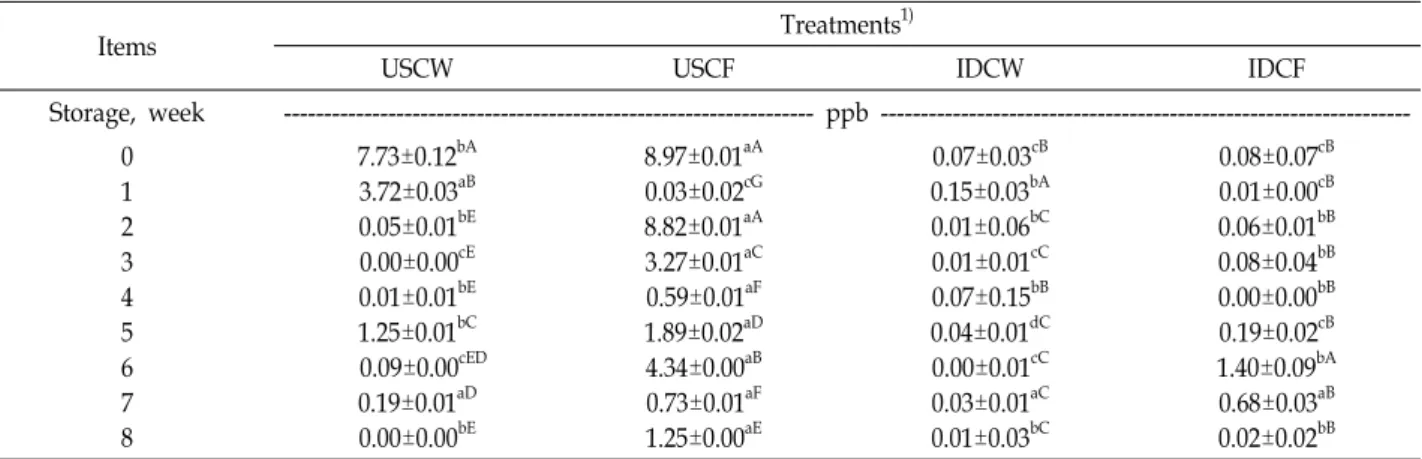
Table 6. Changes of ochratoxin contents in the test corn by storage periods under the standard temperature (25oC) and pressure (1 atm.)
Items Treatments1)
USCW USCF IDCW IDCF
Storage, week --- ppb --- 0
1 2 3 4 5 6 7 8
7.73±0.12bA 3.72±0.03aB 0.05±0.01bE 0.00±0.00cE 0.01±0.01bE 1.25±0.01bC 0.09±0.00cED
0.19±0.01aD 0.00±0.00bE
8.97±0.01aA 0.03±0.02cG 8.82±0.01aA 3.27±0.01aC 0.59±0.01aF 1.89±0.02aD 4.34±0.00aB 0.73±0.01aF 1.25±0.00aE
0.07±0.03cB 0.15±0.03bA 0.01±0.06bC 0.01±0.01cC 0.07±0.15bB 0.04±0.01dC 0.00±0.01cC 0.03±0.01aC 0.01±0.03bC
0.08±0.07cB 0.01±0.00cB 0.06±0.01bB 0.08±0.04bB 0.00±0.00bB 0.19±0.02cB 1.40±0.09bA 0.68±0.03aB 0.02±0.02bB Mean±SE.
1)USCW, US corn-whole type; USCF, US corn-flaked type; IDCW, India corn-whole type; IDCF, India corn-flaked type.
a-dMeans with different superscripts in the same row are significantly different (P<0.05).
A-GMeans with different superscripts in the same column are significantly different (P<0.05).
생산된 농산물에서 aflatoxin의 오염이 많이 되는[15] 이유 때문으로 인도산이 미국산에 비해 오염될 수 있는 조건에 많 이 노출되었기 때문으로 사료된다. 미국산 알곡 옥수수의 경 우는 전 저장기간(8주) 동안 aflatoxin의 함량 변화가 거의 나 타나지 않았으나, 인도산의 경우는 저장 초기부터 지속적으 로 증가하여 7주간 보관되었을 때부터 국내 원료허용기준치 인 50 ppb [23]를 초과하여 8주째에는 약 83 ppb 수준까지 되어 사료로서 이용할 수 없는 수준까지 오염되었다. 이는 A. flavus균에 오염된 식품은 적절한 온도(25~30oC)와 습도 (80~85%) 조건이 되면 aflatoxin을 생성하게 되므로 [5,39,40], 본 시험의 조건에서 알곡 옥수수의 수분 함량이 미
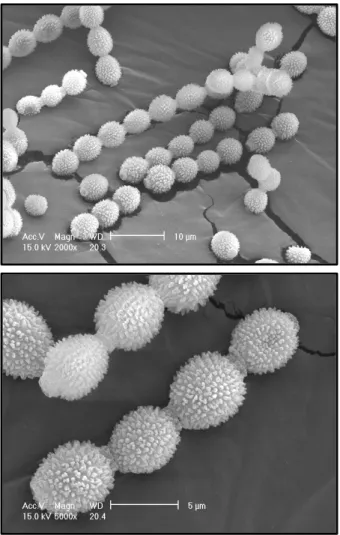
국산의 13.75%보다 인도산이 14.54%보로 높았던 것과 생산 지 환경이 미국보다 인도가 독소곰팡이의 번식에 유리하게 작용하였기 때문으로 사료된다. Aflatoxin은 주로 Aspergillus flavus와 Aspergillus parasiticus와 같은 곰팡이에 의해서 생성 되는 mycotoxin으로서 자연에 널리 퍼져 있으며, 다습하거 나 가뭄과 같은 식물이 스트레스를 받는 환경에 장기간 노출 되어, 곡류가 수확되기 전이나 보관되는 동안 오염되어, 고 수분(7% 이상) 및 고온 환경에서 잘 성장한다[50]. 실제로 인 도산 옥수수의 표면을 전자현미경(SEM)으로 관찰해 본 결 과, 많은 수의 Aspergillus flavus의 분생포자들이 옥수수 입자 에 부착하고 있는 것을 관찰할 수 있었다(Fig. 2).
Fig. 2. Ascospores of Aspergillus flavus attached on the surface of test corn (SEM Images; ×2,000, ×5,000).
옥수수 알곡을 steam flake 처리한 초기에는 원산지에 관계없이 aflatoxin이 거의 검출되지 않았으며, 저장기간이 길어져도 크게 증가되지 않음으로써 flake 처리효과가 큰 것으로 나타났다. 특히, 인도산 옥수수를 장기보관 해야 할 경우, steam flake 처리를 하는 것이 aflatoxin 오염방지를 위해서 필수적이며, 알곡으로 보관할 경우는 6주 이상을 넘 기지 않는 것이 중요할 것으로 사료된다. 그러나 미국산 옥 수수의 경우는 steam flake 처리를 하면 aflatoxin 오염을 줄일 수 있으나, 알곡의 경우도 8주의 저장기간 동안에 허 용범위를 훨씬 밑돌고 있어 보관상 별 문제는 없을 것으로 사료된다.
한편, 사료 중 ochratoxin 함량은 0~8.97 ppb 수준으로서 전체적으로 볼 때, 인도산 옥수수가 미국산 옥수수보다 낮았 으며, flake 처리를 함으로써 ochratoxin 함량은 오히려 높아 지는 경향이었다. 그러나 ochratoxin 함량은 허용기준치인 200 ppb [23]의 5%수준 이하로서 오염도에 문제는 없었다.
Ochratoxin A는 Aspergillus ochraceus 와 penicillium verruco-
sum에 의해서 생성되는 2차 대사산물이며 세계에서 가장 많 이 발생되는 식품오염 mycotoxin 중의 하나이다. 소에서는 크게 문제를 일으키지 않으나 가금류에서는 생산성 저하로 경제적 손실이 크다[51].
이상의 결과들을 종합해 보면, 미국산 옥수수는 반추위내 건물 분해율이나 mycotoxins 함량에 있어서 steam flake처리 효과가 크지 않았던 반면, 인도산 옥수수는 steam flake처리 에 의한 효과가 컸는데, 특히 aflatoxin 오염 방지를 위해서 인도산 옥수수는 국내 도입 후, 반드시 flake 처리와 같은 열 처리가 되어야 할 것으로 사료된다.
요 약
본 연구는 옥수수 수입원과 steam flake 처리에 따른 in situ 건물 분해율 및 보관기간별 mycotoxins 함량을 조사하 기 위하여 수행되었다. 미국과 인도산 옥수수(yellow dent corn)를 공시재료로 하여, steam flake 처리 효과에 대해 조 사하였다. 시험구는 총 4개의 처리구(USCW, 미국산 무처리 옥수수; USCF, 미국산 steam flaking 옥수수; IDCW, 인도산 무처리 옥수수; IDCF, 인도산 steam flaking 옥수수)를 두고, 각 처리구당 보관기간(0, 1, 2, 3, 4, 5, 6, 7, 8주)별 4반복으로 수행되었다. In situ 시험을 위해서 반추위 누관이 장착된 Holstein 수소 2두가 이용되었고, 공장환경분야 표준상태 (STP, standard temperature and pressure, 25oC 1 atm.)에서 보관기간 동안 매주, 곰팡이 독소인 aflatoxin과 ochratoxin의 농도를 측정하였다. 옥수수의 반추위 내 발효시간별 in situ 건물 소실율은 무처리구에서는 미국산이 인도산보다 약 3.0
~44.1% 높았으나, steam flaking 처리를 함으로써 건물소실 율의 차이가 없어졌다. 미국산 옥수수는 무처리 알곡의 건물 분해율이 높은 편이었으나, flake처리에 의한 영향이 적은 반 면, 인도산 옥수수는 무처리 알곡의 건물 분해율은 낮은 편 이지만 flake 처리를 하였을 때, 분해율이 크게 증가되었다.
미국산 옥수수와 flake 처리 옥수수의 aflatoxin 함량은 보관 기간 동안 매우 낮은 수준이었으나, 인도산 옥수수 알곡을 6 주 이상 보관할 경우, 허용기준치를 초과하였다. 따라서 인도 산 옥수수 알곡을 장기보관 해야 할 경우, steam flake 처리 를 하는 것이 aflatoxin 오염방지를 위해서 필수적이며, 알곡 으로 보관할 경우는 6주 이상을 넘기지 않는 것이 중요할 것 으로 사료된다.
감사의 글
본 논문은 농촌진흥청에서 수행하는 지역특화작목 연구개 발과제의 연구비지원으로 수행되었으며, 연구자는 BK 21 사 업단의 박사 후 연구원으로 인건비 지원을 받았습니다.
References
1. A.O.A.C. 1995. Official methods of analysis 16th edition.
Association of official analytical chemists, Washington, D.
C.
2. Aimone, J. C. and D. G. Wagner. 1977. Micronized wheat
Ⅱ. Influences on in vitro disappearance rate, in vitro gas production and gelatinization. J. Anim. Sci. 44, 1096-1099.
3. Banks, W. and C. T. Greenwood. 1975. The hydrodynamic behaviour of native amylose. In: Conformation of Biopolymers. Vol. 2. pp. 739, Academic Press, London.
4. Beeson, W. M. 1972. Effects of steam flaking, roasting, popping and extrusion of grains on their nutritional value for beef cattle. Proc. Symposium "Effects of processing on nutritional value of feeds". pp. 326-335, N. A. S.
Washington DC.
5. Bullerman, L. B. 1979. Significance of mycotoxins to food safety and human health. J. Food Prot. 42, 65-86.
6. Cho, J. H., I. K. Paik and Y. Hyun. 2007. Comparison of TME values of imported corns and ME values determined by In vitro method. J. Anim. Sci. & Technol. (Kor.) 49, 737-744.
7. Duncan, D. B. 1955. Multiple range and multiple F tests.
Biometrics. 11, 1.
8. Ehle, F. R. 1984. Influence of particle size on determi- nation of fibrous feed components. J. Dairy Sci. 67, 1482-1488.
9. Ehle, F. R., M. R. Murphy and J. H. Clark. 1982. In situ Particle size reduction and the effect of particle size on degradation of crude protein and dry matter in the rumen of dairy steers. J. Dairy Sci. 65, 963-971.
10. Firkins, J. L., M. L. Eastridge, N. R. St-Pierre and S. M.
Noftsger. 2001. Effects of grain variability and processing on starch utilization by lactating dairy cattle. J. Anim. Sci.
79, 218-238.
11. Ganesh, D. and D. G. Grieve. 1990. Effect of roasting row soybeans at three temperatures on in situ dry matter and nitrogen disaddearance in dairy cows. J. Dairy Sci. 73, 3222-3230.
12. Ha, J. K., S. S. Lee, B. O. Kwak, T. H. Moon and S. H.
Kang. 1994. Effects of corn processing methods on the nu- trients utilization Ⅰ. Disappearances and degradabilities of dry matter and crude protein of deedstuffs in the ru- men of Holstein cows. Korean J. Dairy Sci. 16, 1-17.
13. Hale, W. H. 1973. Influence of processing on the utilization of grains (strarch) by ruminants. J. Anim. Sci. 37, 1075-1080.
14. Hale, W. H., L. Cuitun, W. J. Soba and B. Theurer. 1967.
Effect of steam processing and flaked milo and barley on performance and digestion by steers. J. Anim. Sci. 25, 392-396.
15. Kamimura, H. 1993. Problems with mycotoxin in food sanitation. pp. 10, Hyogo International Center Japan International Cooperation Agency.
16. Kim, N. S., J. K. Ha, Y. G. Ko, H. D. Kim, W. Y. Kim and B. O. Kwak. 1996. Effects of corn processing methods on the nutrient utilization. Ⅱ. Effects of processed corn on
ruminal degradability of starch and lower gut dis- appearance rates of dry matter and crude protein in hol- stein dairy cows. Kor. J. Anim. Nutr. Feed. 20, 360-370.
17. Kim, T. M., Y. M. Cho, Y. S. Song, M. J. Seong, J. H. Kim, S. J. Lee, C. B. Park, J. T. Hong, D. J. Kim, J. K. Kang and Y. W. Yun. 2002. Relative toxicities of aflatoxins for carci- nogenic risk assessment. The Annual Report of KNTP 1, 127-143.
18. Kim, Y. K. and F. N. Owens. 1985. Starch digestion by feedlot cattle: Influence of roughage and intake level and particle size. Oka. Agric. Exp. Stat. Anim. Sci. Res. Rep. 117, 298-302.
19. Kinsler, T. W., E. F. Davis and M. G. Bolton. 1993.
Strategies for chemoprevention against aflatoxin-induced liver cancer. pp 281-306. In: ends, by Eaton DL, Groopman JD. The Toxicology of Aflatoxins. Academin Press. New York, USA.
20. Lee, S. M., T. W. Kang, S. J. Lee, J. U. Ok, Y. H. Moon and S. S. Lee. 2006. Studies on In situ and In vitro Degadabilities, Microbial Growth and Gas Production of Rice, Barley and Corn. J. Anim. Sci. & Technol. (Kor.) 48, 699-708.
21. Lee, R. W., M. L. Galyean and G. P. Lofgreen. 1982.
Effects of mixing whole shelld and steam-flaked corn in finishing diets on feedlot performance and site and extent of digestion in beef steers. J. Anim, Sci. 55, 475-583.
22. Ministry of Agriculture. 1993. Feed manufacturing Industry status.
23. Ministry of Agriculture. 2005. Feed management statute book. pp. 222.
24. Moe, P. W. and H. F. Tyrrell. 1977. Effects of feed intake and physical form on energy value of corn in timothy hay diets for lactating cows. J. Dairy Sci. 60, 752-758.
25. Namkung, H., I. K. Paik and H. S. Lee. 1993.
Determination of amino acid availability and metaboliz- able energy in Protein feedstuffs by true amino acid avail- ability (TAAA) method. K. J. Poult. Sci. 20, 189-196.
26. Nocek, J. E. 1988. In situ and other methods to estimate ruminal protein and energy disappearance rate, A review.
J. Dairy Sci. 71, 2051-2069.
27. NRC. 1984. Ruminant nitrogen usage (6th Eds.). National Academy Press, Washington, D.C., USA.
28. Ørskov, E. R. and I. Mcdonald. 1979. The estimation of protein degradability in the rumen from incubation meas- urements weighted according to rate of passage. J. Agric.
Sci. 92, 499-503.
29. Park, C. H, H. Y. Oh, O. S. Heo, S. J. Sohn, E. S. Han, J.
W. Kim and M. O. Eom. 1997. Safety evaluation of natural toxin. The annual report of Korea food & drug administration. 1, 431.
30. Perry, T. W., L. M. Hammond, R. C. Peterson and W. M.
Beeson. 1970. Value of roasting corn for finishing heifers.
Purdue Res. Prog. Rep. Perdue Univ. Agric. Exp. Sta. 379.
31. Philippeau, C., F. Le Deschault de Monredon and B.
Michalet-Doreau. 1999. Relationship between ruminal starch degradation and the physical characteristics of corn
grain. J. Anim. Sci. 77, 238-243.
32. Poppi, D. P., B. W. Norton, D. J. Minson and R. E.
Hendrichson. 1980. The validity of the critical size theory for particles leaving the rumen. J. Agric. Sci. 94, 275-280.
33. Rahnema, S. H., B. Theurer, J. A. Garcia, W. H. Hale and M. C. Young. 1987. Site of protein digestion in steers fed sorghum grain diets. Ⅱ. Effects of grain processing methods. J. Anim. Sci. 64, 1541-1547.
34. Ramirez, R. G., H. E. Kiesling, M. L. Galyean, G. P.
Lofgreen and J. K. Elliott. 1985. Influence of steam-flaked, steamed-whole or whole shelled corn on performance and digestion in beef steers. J. Anim. Sci. 61, 1-8.
35. Rooney, L. W. and R. L. Pflugfelder. 1986. Factors affect- ing starch disappearance rate with special emphasis on sorghum and corn. J. Anim. Sci. 63, 1607-1623.
36. Rooney, L. W., M. N. Khan. and C. F. Earp. 1980. The technology of sorghum products. pp. 513-554, In Inglett, G. (eds.), Recent progress in cereal chemistry: Cereals for food and Beverages. Academic Press. NY. USA.
37. SAS. 1999. SAS/STAT guide for personal computers
@8.01. SAS Inst., Gary., NC., USA.
38. Schwarzenbach, R. P., P. M. Gschwend and D. M Imboden. 1993, Environmental Organic Chemistry. pp.
681. John Willey & Sons, New York.
39. Shin, K. S., H. S. Shin, Y. W. Lee and Y. C. Jung. 1985.
The Newest Feed Hygienics. pp. 171, The publishing com- pany Shin Kwang. Seoul.
40. Smith, J. E. and M. O. Moss. 1985. Mycotoxins, formation, analysis and significance. pp. 148, New York: John Wiley
& Sons.
41. Son, K. N., Y. K. Kim, S. K. Lee and H. S. Kim. The ef- fects of processing methods of corn on In vitro DM digest- ability and in sacco degradability in the rumen. 2003. J.
Anim. Sci. & Technol. (Kor.) 45, 433-442.
42. Tamminga, S., P. Van der Togt, C. J. Van der Koelen, C.
Melieftste, M. Luttikuis and G. D. H. Classon. 1989. The
behavior of starch in the rumen of dairy cows. Modeling No. 14. Inst. Livest. Feeding Nutri. Lelystad. Netherlands.
43. Theurer, C. B., O. Lozano, A. Alio, A. Delgado-Elorduy, M. Sadik, J. T. Huber and R. A. Zinn. 1999. Steam-proc- essed corn and sorghum grains flaked at different den- sities alter ruminal, small intestinal, and total tract dis- appearance rate of starch by steers. J. Anim. Sci. 77, 2824-2831.
44. Thomas, E. E. 1988. The effect of particle size and steam treatment of feedstuffs on rate and extent of digestion (in vitro and in situ). J. Anim. Sci. 66, 243-249.
45. Van Keuren, R. W. and W. W. Heineman. 1962. Study of a nylon bag technique for in vivo estimation of froage dis- appearance rate. J. Anim. Sci 21, 340-345.
46. Van Soest, P. V. 1982. Carbohydratee. pp. 108, Nutritional Ecology of the Ruminants. O&Books, INC., Corrallis. OR, USA.
47. Vérité, R., B. Michalet-Doreau, P. Chapoutot, J. L. Peyraud and C. Poncet. 1987. Vision Du systmed des protines di- gesstible dans l'intestin (PDI). Bull. Tech. CRZV. Theix, INRA, 70, 19-34.
48. Wall, J. S. and L. W. Paulis. 1978. Corn and sorghum grain proteins. pp. 135-219, In Pomeranz, Y. (ed.) Advances in Cereal Science and Technology Ⅱ. Am.
Assoc. Cereal Chem., St. Paul. MN, USA.
49. Whister, R. L. and J. R. Daniel. 1984. Molecular structure of atarch. pp. 153-182, In : Chemistry and TEchnology (2nd Ed.). Academic Press. NY, USA.
50. Wikipedia®, 2008a. Aflatoxin A., Wikimedia Foundation, Inc., a U.S.
51. Wikipedia®, 2008b. Ochratoxin A., Wikimedia Foundation, Inc., a U.S.
52. Zinn, R. A. and F. N. Owens. 1983. Influence of feed in- take level on site of digestion in steers fed a high concen- trate diet. J. Anim. Sci. 56, 471-475.