Kor. J. Hort. Sci. Technol. 29(3):172-180, 2011
Changes in Bioactive Compounds Contents of ‘Maehyang’ and
‘Seolhyang’ Strawberry Fruits by UV Light Illumination
Sung Kyeom Kim
1,2, Ro Na Bae
3, and Changhoo Chun
1,2*1Department of Plant Science, Seoul National University, Seoul 151-921, Korea
2Research Institute for Agriculture and Life Sciences, Seoul National University, Seoul 151-921, Korea
3National Instrumentation Center for Environmental Management, Seoul National University, Seoul 151-921, Korea
Abstract. The net photosynthetic rate of ‘Seolhyang’ strawberry plants was measured daily for 7 days after treatment at three UV illumination dosages (0, 9.8, and 29.5 kJ・m
-2). The net photosynthetic rates of the strawberry plants with 9.8 and 29.5 kJ・m
-2UV light illumination decreased by 20.2 and 61.4%, respectively, at 7 days after UV light treatments. UV treatments with two illumination dosages (7.9 and 15.7 kJ・m
-2) altered the phenolic compounds contents during the cultivation period when compared to those in the control fruits.
The anthocyanin content with 7.9 kJ・m
-2UV light illumination of ‘Seolhyang’ increased by 18.7% compared with those in control fruits at the 11 DAT. However, the anthocyanin content of ‘Maehyang’ was not significantly different among treatments during experiment period. The highest level of ellagic acid was found with 7.9 kJ・m
-2UV light illumination in both cultivars at the 11 DAT. Our results showed that strawberries illuminated with UV light during cultivation period had higher bioactive compounds contents than control fruits. These results suggest that UV light treatments may be a useful non-chemical way of promoting strawberry fruits quality.
Additional key words: anthocyanin, ascorbic acid, ellagic acid, Fragaria × ananassa, net photosynthetic rate, organic acid, sugar
*Corresponding author: [email protected]
※ Received 24 December 2010; Accepted 17 March 2011. This study was supported by “Regional Joint Agricultural Research Project of RDA (granted No. 20070201070016)” granted by RDA, Korea.
Introduction
In recent years, consumers have been paying more attention to the health and nutritional aspects of horticultural products (Scalzo et al., 2005). Fruits and vegetables contain high levels of bioactive compounds that impact on health benefits apart from basic nutritional value (Oomah and Mazza, 2000). Anti- oxidants can inhibit the oxidation of lipids or other molecules by inhibiting oxidizing chain reactions therefore play an important role in health protection (Velioglu et al., 1998).
Strawberry is one of the richest sources of natural antioxidants among fruits (Heinonen et al., 1998; Wang et al., 1996).
Ascorbic acid is required for the prevention of scurvy and the maintenance of healthy skin, gums, and blood vessels (Harris, 1996). Aaby et al. (2007) reported that ascorbic acid was the single most important contributor to the electrochemical response in strawberries. Anthocyanins have been shown to protect cells against harmful free radicals and to be associated with lowering incidence and mortality rates of cancers and heart diseases, in addition to a number of other health benefits
(Velioglu et al., 1998). Ellagic acid comprises 51% of the phenolic compounds in strawberries (Häkkien et al., 2000) and is found both in free form and esterifies to glucose in water soluble hydrolysable ellagitannins (Clifford and Scalbert, 2000). Ellagic acid is a promising inhibitor of certain chemically induced cancers (De Flora and Ramel, 1988; Hayatsu et al., 1988; Stoner, 1989). Additionally, sugars in food are of the major interests with regard to chronic diseases (Anderson et al., 1990; Terry et al., 2001; Weisburger, 2001). Different types of sugars give rise to different glycemic responses;
the glycemic potential of glucose is, for example, higher than that of sucrose, which in turn is higher than that of fructose (Miller, 1994). Interestingly, different types of indigestible sugars give rise to different profiles of short-chain fatty acids (Parks, 2002). Thus, sugar type is of great importance from a nutritional point of view.
Recently, interest in the role of antioxidants in human
health has promoted in the research field of horticulture and
food science to determine how their content and activity can
be enhanced through cultural practices or postharvest handling
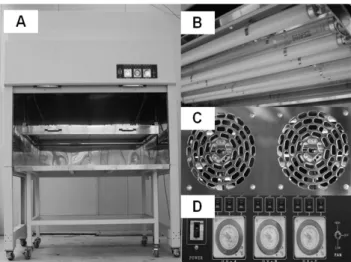
Fig. 1. The device developed for UV light illumination treatment (A), consisting of a lighting (B), ventilation (C), and control (D) modules.
A
B
C
Fig. 2. The vertical and horizontal profiles of light intensity in UVs-A (A), B (B), and C (C).
(Ayala-Zavala et al., 2004). UV light illumination as a postharvest treatment has proven beneficial to delay fruit senescence and especially control decay in different fruit and vegetable species (Allende and Artes, 2003; Allende et al., 2006; Baka et al., 1999; Erkan et al., 2001; Maharaj et al., 1999; Marquenie et al., 2003). The exposure to UV light illumination delays fruit softening, which is one of the main factors determining fruit postharvest shelf-life (Pan et al., 2004). In strawberry, UV light illumination reduced both natural rots (Nigro et al., 2000) and induced infections of Botrytis cinerea and Monilinia fructigena (Marquenine et al., 2002). Both the direct germicidal effect of UV light illumination on plant pathogens and the induction of disease resistance in tissue help to reduce rot development during storage (Ben-Yehoshua et al., 1992; Mercier et al., 1993, 2001; Nigro et al., 2000). Phenylalanine ammonia-lyase activity increases after UV light illumination (Ensminger, 1993; Hadwiger and Schwochau, 1971; Nigro et al., 2000).
The enzyme plays a key role in the biosynthesis of phenolic compounds, many of which have antifungal and antioxidant activity (Chappel and Hahlbrock, 1984). A previous study (Perkins-Veazie et al., 2007) has indicated that postharvest application of UV light might be effective in stimulating the antioxidant content of blueberries. The effect of altering the level of UV light in growing systems has been found to affect the pigment and colorless phytochemical contents of some crop plants. Ordidge et al. (2010) found that the phenolic levels of strawberries, raspberries, and blueberries were unresponsive to the UV light transparency of the plastic film under which the crops were grown. However, little information is available on the effect of UV light illumination on the bioactive compound content in strawberry fruit during cultivation period. Therefore, the purpose of this study was
to determine the changes in the bioactive compound contents in strawberry fruit illuminated with UV light at different dosages (illumination durations × UV light intensity) during cultivation period.
Materials and Methods
Characteristics of UV Light Illumination Device
The UV light illumination device consisted of a lighting,
ventilation, and time control modules (Fig. 1). That device
[1150 × 1660 × 2000 mm (L × W × H, outside)] was equipped
with nine 40-watt UV lamps, two pans, and three analog
timers. The peak wavelengths of the UVs-A (G40TBL, Sankyo
Denki, Co. Ltd., Kanagawa, Japan), B (G40T10E, Sankyo
Denki, Co. Ltd., Kanagawa, Japan), and C (G40T10, Sankyo
Denki, Co. Ltd., Kanagawa, Japan) lamps were 352, 306, and 254 nm, respectively, which lamps equipped with three per each UV lamps. That UV light module can move in the vertical direction (maximum 940 mm and minimum 250 mm from bench ground). We measured UV light intensity using a digital radiometer (KH-97503, Cole-Parmer Instrument Company, Vernon Hills, IL, USA) and vertical (distance were 940, 600, and 400 mm, respectively, from light module) and horizontal [500 × 1000 mm (L × W)] profiles were obtained.
UV-A, B, and C light intensities were 5.7 ± 1.1, 5.2 ± 1.3, and 5.5 ± 1.7 W・m
-2, respectively, at 600 mm distance from light source (Fig. 2) and we used this position for all UV light illumination treatment.
Net Photosynthesis Measurement
For 7 days after the UV light illumination treatment, we measured the daily net photosynthetic rate of ‘Seolhyang’
strawberry plant that were exposed to 16.4 W・m
-2of UV radiation level for 0, 10, and 30 min once in two days, thus resulting in three different dosages (0.0, 9.8, and 29.5 kJ・m
-2) using a portable gas exchange system (Li 6400-40, Li-Cor Co., Inc., Lincoln, NE, USA). Flow rate and photosynthetic photon flux was maintained at 500 μmol・s
-2and 500 μmol・m
-2・s
-1, respectively. Leaf temperature was also set at 25℃ and RH at 40-60%. The leaf area clipped by the leaf chamber was 200 mm
2. All the measurements were replicated three times.
Production of Strawberry Fruit and UV Light Illumination Korean-bred cultivars ‘Maehyang’ and ‘Seolhyang’ straw- berry plants were grown at the Experimental Farm of Seoul National University, located in Suwon, Korea (37 16 12N, 126 59 20E, and elevation 30 m). The cultivation type was hydroponic culture in a glasshouse. The strawberry plants were grown in 800 × 300 × 200 mm (L × W × H, outside) plastic containers filled with a mixture of peatmoss (BM-4, Berger Peat Moss Ltd, Quebec, Canada) and perlite (Parat No 3, Kyung Dong Ceratech Co., Ltd, Seoul, Korea) (1:1, v/v). The plants were fertigated with 450 mL/plant/day using Yamasaki nutrition solution (N; 5.5 me・L
-1, P; 1.5 me・L
-1, K; 3.0 me・L
-1, Ca; 2.0 me・L
-1, Mg; 1.0 me・L
-1, S; 1.0 me・L
-1) and an automatic drip fertigation system (Agro 5000, Agro Co. Ltd., Wonju, Korea). UV light illumination treatment was performed starting with full elongation of the third fruit cluster and ending with cluster harvest. Strawberry plants were subjected to two UV light illumination durations (8 and 16 min) at 16.4 W・m
-2of radiation level resulting two dosages (7.9 and 15.7 kJ・m
-2) once in two days using the UV light illumination device. The plants in control treatment were not subjected to UV light illumination. Ripe secondary or tertiary strawberry fruits were harvested at the optimal
fruit maturity, when about 90% of the fruit surface had reached a fully red color. The ripe strawberry fruits were harvested at three different times (harvesting date 11, 19, and 26 days after treatment). All the measurements were replicated three times.
Extraction and Analysis of Sugars and Organic Acids Fruit samples (5 g) were homogenized with 20 mL of distilled water, filtered using No. 2 filter papers and filtered again through a 0.45 μm syringe filter. The filtrate was diluted and injected into a chromatography system (Dionex 2500, Dionex Co., New York, NY, USA). For sugar analysis, the solvent was 18 mM sodium hydroxide at a flow of 1 mL・min
-1. CarboPac PA10 (4 × 250 mm: Dionex Co., New York, NY, USA), and an amperonmetry detector with an Au electrode were used. Fructose and glucose content were calculated using external standards. Total sugar content was calculated by summing the fructose and glucose contents.
The same extract used in the sugar analysis was used in organic acid analysis. An IonPac ICE-AS6 column (9 × 250 mm; Dionex Co., New York, NY, USA) was used for separa- tion of acids and 0.4 mM heptafluorobutyric acid was used as an eluent at a flow rate of 1 mL・min
-1. A suppressed detector, with an anion-ICE micromembrane suppressor and 5 mN tetrabutylammonium hydroxide was used. An external standard was used to calculate organic acid content. Since citric and malic acids were predominantly found in the straw- berry extract, the total organic acid content was calculated by summing the contents of those two acids.
Extraction and Analysis of Ascorbic Acid
The strawberry fruit samples (10 g) were homogenized with 50 mL of buffer solution (4% metaphosphoric acid) and filtered using NO. 2 filter paper. The mixture was filtered through a 0.45 μm syringe filter and injected into an HPLC system (Ultimate 3000, Dionex, Sunnyvale, CA, USA) for L-ascorbic acid analysis under the following conditions. The mobile phase was acetonitrile and 50 mM NH
4H
2PO
4(70:30, v/v), and the flow rate was 1.0 mL・min
-1. The components were detected at 254 nm. A C18 reverse phase column (4.6
× 250 mm, 0.5 μm; Supelcosil TM C-18, Supelco, Bellefonte, PA, USA) was used for analysis (Kim et al., 2006).
Extraction and Analysis of Anthocyanin
Anthocyanin was extracted from the epidermal fruit tissue
(2 g), less than 2 mm thick, by homogenizing with 5 mL
HCl (1%)-methanol solution. The extraction was filtered through
No. 2 filter paper and measured with a spectrophotometer
at 520 nm (UV-2550, Shimadzu, Kyoto, Japan). Total antho-
cyanin content was expressed as mg pelargonidin 3-glucoside
Days after treatment
0 2 4 6
Net photosynthetic rate (μmol.CO2.m-2.s-1) 0 5 10 15 20 25 30
0 kJ m-2 9.8 kJ m-2 29.5 kJ m-2 0 kJ・m-2 9.8 kJ・m-2 29.5 kJ・m-2
Fig. 3. Net photosynthetic rate of ‘Seolhyang’ strawberry plants as affected by UV illumination treatment. Vertical bars show standard deviation (n = 3).
(ε = 36,000 L・mol
-1・cm
-1) 100 g
-1FW (Ferreyra et al., 2007).
Extraction and Analysis of Ellagic Acid
The strawberry fruit samples (2.5 g) were homogenized with 7.5 mL water and the mix was added to 12.5 mL methanol and 5.0 mL 6.0 M HCl. The mixture was then refluxed for 2 h at 85℃ and filtered through a 0.45 μm syringe filter prior to injection into an HPLC system (Ultimate 3000, Dionex, Sunnyvale, CA, USA). Solvent A was 1%
formic acid and solvent B was acetonitrile with 0.5 mL・min
-1flow rate. The gradient was: 0-15 min, 10-55% of B in A;
15-20 min, 55-100% of B in A; 20-25 min, 100-10% of B in A; and 25-35 min, 10-10% of B in A. Using the gradient, the best purity and separation were achieved for the ellagic acid peak in strawberry. The peak was obtained using a UV/Vis detector at 260 nm with a C18 column (4.6 × 150 mm, 5 μm; Zorbax SB-C18, Agilent Co., New York, NY, USA).
Statistical Analysis
Statistical analysis was done to evaluate significant differences among treatments within same harvesting date and cultivar.
ANOVA was used to assess differences in sugars, organic acids, anthocyanin, ascorbic acid, and ellagic acid contents.
Differences were considered statistically significant with a P ≤ 0.05.
Results and Discussion
Net Photosynthetic Rate
The initial net photosynthetic rates of strawberry plants with 9.8 and 29.5 kJ・m
-2UV light illumination were 20.3 and
22.3 μmol・CO
2・m
-2・s
-1, respectively, but the rates decreased by 20.2 and 61.4%, respectively, at 7 days after UV light treatment (Fig. 3). On the other hand, the net photosynthetic rate of strawberry plants in the control treatment was 20.7 μmol・CO
2・m
-2・s
-1at 7 days after treatment, which was 60.5%
greater than the initial value. The effects of increased UV light radiation are manifold, with marked decreases in yields of agricultural crop plants (Mazza et al., 1999; Teramura, 1983), damage to photosystems II and I, disturbance in carboxylating enzyme, DNA damage, and oxidative stress (Mazza et al., 1999). Valkama et al. (2003) revealed that UV light-treated strawberry plants develop marginally thinner leaves with a reduced ratio of starch to chloroplast area in their cells, thus suggesting that there is a negative influence of UV light illumination treatment on the photosynthetic processes. Results indicated that suitable UV light illumination dosage could determine 9.8 kJ・m
-2without severe damage in related organ for photosynthesis.
Sugar and Organic Acid Content
The fructose, glucose, and total sugar contents of ‘Maehyang’
and ‘Seolhyang’ fruits were significantly different among treatments at the 11 DAT (Table 1). The mean fructose, glucose, and total sugar contents with 7.9 kJ・m
-2UV light illumination of ‘Maehyang’ were 30.7, 24.3, and 54.9 mg・g
-1FW, respectively, representing the highest values among all treatments. Our results revealed that the sugar content increased in the UV light-treated strawberry fruits of ‘Maehyang’ in an early period after UV light illumination. However, the mean fructose, glucose, and total sugar contents with 7.9 kJ・m
-2UV light illumination of ‘Seolhyang’ were 10.5, 11.3, and 21.9 mg・g
-1FW, respectively, representing the lowest value among all treatment. Those of ‘Seolhyang’ decreased by over 50% UV light treatment. The total sugar content of strawberry fruits decreased slightly immediately after UV light illumination treatment (Pan et al., 2004). There were different from response to sugars contents of strawberry fruits by UV light illumination dependent on cultivars and treatment periods. Citric and total acid contents of ‘Seolhyang’ were significantly different among treatments at the 11 and 19 DAT.
The means of total organic acids content with 15.6 kJ・m
-2UV light illumination of ‘Seolhyang’ were 6.3 and 6.1 mg・g
-1FW, respectively, those were the lowest content among all treatments. Organic acids are minor components of strawberry fruit, but they are important attributes for flavor, which, in combination with sugars, have an impact on the sensory quality of the strawberry fruit (Wang et al., 2002). Application of UV light illumination increase total sugars/acid ratio of
‘Seolhyang’ fruits by decreasing organic acids contents without
changing sugars contents, while it does not improve those
Table 1. The sugar and organic acid contents of ‘Maehyang’ and ‘Seolhyang’ strawberry fruits as affected by UV illumination treatment.
Cultivar Dosage
(kJ・m-2)
Sugar content (mg・g-1 FW) Organic acid content (mg・g-1 FW)
TS/TOz Glucose Fructose Total Citric acid Malic acid Total
11 DAT
Maehyang 0 21.9 b 18.0 b 39.9 b 4.3 b 1.9 a 6.2 a 6.6 a
7.9 30.7 a 24.3 a 54.9 a 5.6 ab 2.9 a 8.4 a 6.6 a
15.6 24.0 b 19.9 b 43.9 b 6.2 a 2.4 a 8.6 a 5.3 a
Seolhyang 0 27.5 a 23.7 a 51.2 a 7.0 a 2.4 a 9.4 a 5.5 a
7.9 10.5 c 11.3 c 21.9 c 8.2 a 1.0 b 9.1 a 2.4 b
15.6 19.9 b 17.0 b 36.9 b 5.1 b 1.3 b 6.3 b 5.8 a
19 DAT
Maehyang 0 27.5 a 22.3 a 49.8 a 4.2 a 1.8 a 6.0 a 8.7 a
7.9 20.5 b 17.1 b 37.6 b 5.6 a 2.3 a 7.8 a 4.9 b
15.6 26.5 a 21.6 a 48.1 a 5.6 a 2.3 a 7.9 a 6.3 ab
Seolhyang 0 24.8 a 20.4 a 45.2 a 6.8 a 1.7 ab 8.4 a 5.4 a
7.9 26.0 a 21.0 a 47.1 a 6.8 a 2.0 a 8.8 a 5.4 a
15.6 24.0 a 19.6 a 43.6 a 5.0 b 1.1 b 6.1 b 7.4 a
26 DAT
Maehyang 0 19.5 a 16.6 a 36.1 a 5.3 ab 2.4 a 7.6 a 4.8 a
7.9 19.9 a 16.8 a 36.7 a 4.9 b 2.4 a 7.3 a 5.0 a
15.6 24.3 a 20.1 a 44.3 a 6.3 a 2.6 a 8.9 a 5.1 a
Seolhyang 0 17.6 b 15.2 b 32.8 b 4.9 a 1.7 a 6.6 a 5.0 a
7.9 22.2 a 18.3 a 40.5 a 4.3 a 2.0 a 6.4 a 6.4 a
15.6 22.6 a 18.8 a 41.4 a 5.2 a 1.6 a 6.8 a 6.2 a
zTS/TO: Total sugar/organic acid.
yMean separation within columns by LSD test at 5% significance level.
of ‘Maehyang’ fruits, indicating that its effect may vary by cultivars.
Ascorbic Acid Content
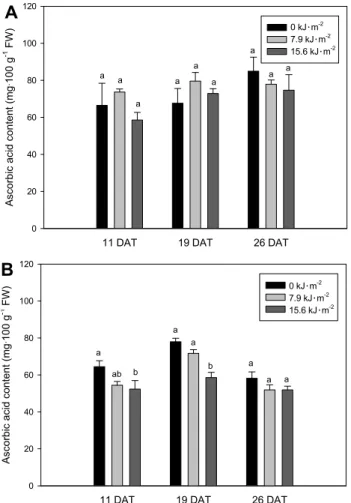
Significant differences were found in ascorbic acid contents of ‘Seolhyang’ among treatments at the 11 and 19 DAT (Fig.
4). The ascorbic acid contents with 15.6 kJ・m
-2UV light illumination treatment of ‘Seolhyang’ were 52.4 and 58.6 mg・100 g
-1FW, respectively, which those decreased by 18.8 and 24.9%, respectively, compared with those in control fruits.
However, the ascorbic acid contents of ‘Maehyang’ were not significantly different among treatment during experiment period. Lee and Kader (2000) have indicated that the ascorbic acid content could be modified by several preharvest factors.
For example, higher light intensity increases the sugar pro- duction and ascorbic acid synthesis. Several studies have already focused on the UV light impact on nutritional cons- tituents of fruits and vegetables (González-Barrio et al., 2006;
Pan et al., 2004; Pérez et al., 1999). UV light elicits plant defense responses such as the production of phytoalexins
(Maharaj et al., 1999), including ascorbic acids in strawberries (Pérez et al., 1999). Ascorbic acid is able to scavenge oxygen radicals, thus preventing oxidative stress (Klopotek et al., 2005). Thus, changes in the amount of ascorbic acid in UV light-treated strawberries can be attributed to the activation of an antioxidative system that promotes the biosynthesis of ascorbic acids from the carbohydrate pool (Pérez et al., 1999). However, Allende et al. (2007) found that the UV light illumination did not have a lasting effect on the synthesis of ascorbic acids or phenolic compounds of strawberries.
Anthocyanin Content
Significant differences were found in anthocyanin contents of ‘Seolhyang’ among treatments at the 11 and 26 DAT (Fig. 5). At the 11 DAT, the anthocyanin content with 7.9 kJ・m
-2UV light illumination of ‘Seolhyang’ was 55.0 mg・
100 g
-1FW, which that increased by 18.7% compared with
those in control fruits. At the 26 DAT, the anthocyanin content
with 15.6 kJ・m
-2UV light illumination of ‘Seolhyang’ was
51.2 mg・100 g
-1FW, which increased by 19.5% compared
11 DAT 19 DAT 26 DAT Ascorbic acid content (mg.100 g-1 FW)
0 20 40 60 80 100 120
0 KJm-2 7.9 KJm-2 15.6 KJm-2
a a
a a
a a
a
a a 0 kJ・m-2 7.9 kJ・m-2 15.6 kJ・m-2
A
11 DAT 19 DAT 26 DAT
Ascorbic acid content (mg.100 g-1 FW) 0 20 40 60 80 100 120
0 KJm-2 7.9 KJm-2 15.6 KJm-2
a
ab b a
a
b a
a a
B
0 kJ・m-2 7.9 kJ・m-2 15.6 kJ・m-2
Fig. 4. The ascorbic acid content of ‘Maehyang’ (A) and ‘Seolhyang’
(B) strawberry fruits as affected by UV illumination treatment.
Vertical bars show standard deviation (n = 3). Different letters indicate statistically significant differences at P ≤ 0.05.
11 DAT 19 DAT 26 DAT
Anthocyanin content (mg100 g-1 FW) 0 20 40 60
80 0 KJm-2
7.9 KJm-2 15.6 KJm-2
a a
a
a a
a a a a
A
0 kJ・m-27.9 kJ・m-2 15.6 kJ・m-2
Anthocyanin content (mg.100 g-1 FW)
11 DAT 19 DAT 26 DAT
Anthocyanin content (mg.100 g-1 FW) 0 20 40 60 80
0 KJm-2 7.9 KJm-2 15.6 KJm-2
b a
ab
a a
a a
b b
B
0 kJ・m-2 7.9 kJ・m-2 15.6 kJ・m-2
Fig. 5. The anthocyanin content of ‘Maehyang’ (A) and ‘Seolhyang’
(B) strawberry fruits as affected by UV illumination treatment.
Vertical bars show standard deviation (n = 3). Different letters indicate statistically significant differences at P ≤ 0.05.
with those in control fruits. However, the anthocyanin contents of ‘Maehyang’ were not significantly different among treatments during experiment period. Several reports have indicated that UV light exposure promotes anthocyanin synthesis in other fruits, including apples (Dong et al., 1995), sweet cherries (Kataoka et al., 1996), grapes (Kataoka et al., 2003), and boysenberries (Vicente et al., 2004). Enhancement of antho- cyanin levels by UV light illumination also has been reported in strawberries and sweet cherries (Baka et al., 1999; Kataoka et al., 1996). The increase in total phenols and anthocyanins in blueberries by UV light illumination appears to be dose- dependent at lower doses (0.43-2.15 kJ・m
-2) (Wang et al., 2009); however, higher doses (4.30-6.45 kJ・m
-2) tend to suppress these increases. On the other hand, Pan et al. (2004) has reported a delay in the accumulation of anthocyanin by UV light illumination in strawberry fruit. This phenomenon has also been reported in strawberries where high doses of UV light exposure are thought to cause too much stress and possibly result in injury (Baka et al., 1999). Phenylalanine ammonia-lyase (PAL) activity increases after UV light irra-
diation (Ensminger, 1993; Hadwiger and Schwochau, 1971;
Nigro et al., 2000). The enzyme plays a key role in the biosynthesis of phenolic compounds, many of which have flavonoids and anthocyanins (Chappel and Hahlbrock, 1984).
Nigro et al. (2000) reported that low doses of UV light (0.5 kJ・m
-2) increase PAL activity, whereas higher doses (2.50 kJ・m
-2) cause a smaller increase the activity. The amount of anthocyanins in fruit treated with a dose of 4.1 kJm
-2of UV light was similar or slightly lower than that in the controls, probably because the activity of PAL is not signi- ficantly increased at this dose. However, our results suggest that anthocyanin content of strawberry fruits increased in relatively higher dosage of UV light illumination; it could be range 7.9-15.6 kJ・m
-2during cultivation period.
Ellagic Acid Content
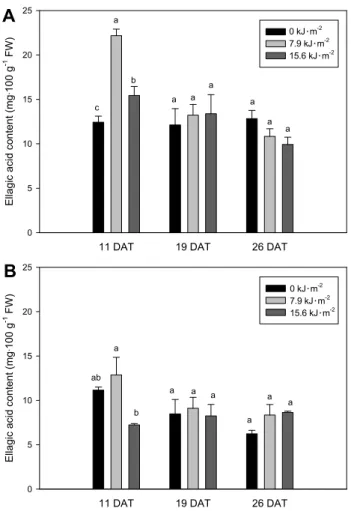
We found large differences in the ellagic acid content of
‘Maehyang’ among treatments at 11 DAT (Fig. 6). The highest
level of ellagic acid was found with 7.9 kJ・m
-2UV light
illumination in both cultivars. We revealed that the ellagic
11 DAT 19 DAT 26 DAT Ellagic acid content (mg.100 g-1 FW)
0 5 10 15 20 25
0 KJm-2 7.9 KJm-2 15.6 KJm-2 a
b
c a a
a a
a a
A
0 kJ・m-2 7.9 kJ・m-2 15.6 kJ・m-2
11 DAT 19 DAT 26 DAT
Ellagic acid content (mg.100 g-1 FW) 0 5 10 15 20 25
0 KJm-2 7.9 KJm-2 15.6 KJm-2
ab a
b
a a a
a
a a
0 kJ・m-2 7.9 kJ・m-2 15.6 kJ・m-2
B
Fig. 6. The ellagic acid content of ‘Maehyang’ (A) and ‘Seolhyang’
(B) strawberry fruits as affected by UV illumination treatment.
Vertical bars show standard deviation (n = 3). Different letters indicate statistically significant differences at P ≤ 0.05.
acid content of strawberry fruit was enhanced by an adequate dosage of UV light illumination during cultivation periods.
The levels of secondary compounds in soft fruit have previously been shown to be influenced by environmental factors during storage periods (Kalt et al., 2001; Wang and Zheng, 2001), but the effect of cultivation under different UV regimes is not known. With both cultivars of strawberry tested, the June-bearer ‘Elsanta’ and the ever-bearer ‘Everest’, UV-blocking film reduced total phenolics, anthocyanin and ellagic acid in some of the crops but the effect was not observed with all crops under all conditions. When crops were grown under polyethylene film that partially or completely block UV light or UV-transparent film the amount of health-beneficial phenolics was similar compared with each other (Ordidge et al., 2010).
UV illumination on strawberry plants cultivated in greenhouse for a few minutes in night time may increase contents of bioactive compounds such as anthocyanin and ellagic acid dependant cultivars and treatment periods. However, it is not clear, yet that tendency of response to UV light stress.
Insensitiveness of strawberry to environmental stresses might be the major reason of the small influence on bioactive
compounds contents of fruits by applying UV light treatment.
Literature Cited
Aaby, K., D. Ekeberg, and G. Skrede. 2007. Characterization of phenolic compounds in strawberry (Fragaria × ananassa) fruits by different HPLC detectors and contribution of individual compounds to total antioxidant capacity. J. Agric. Food Chem.
55:4395-4406.
Allende, A. and F. Artes. 2003. UV-C radiation as a novel tech- nique for keeping quality of fresh processed ‘Lollo Rosso’
lettuce. Food Res. Intl. 36:739-746.
Allende, A., A. Marín, B. Buendía, F. Tomás-Barberán, and M.I.
Gil. 2007. Impact of combined postharvest treatments (UV-C light, gaseous O3, superatmospheric O2 and high CO2) on health promoting compounds and shelf-life of strawberries.
Postharvest Biol. Technol. 46:201-211.
Allende, A., J.L. McEvoy, Y. Luo, F. Artes, and C.Y. Wang.
2006. Effectiveness of two-sided UV-C treatments in inhibiting natural microflora and extending the shelf-life of minimally processed ‘Red Oak Leaf’ lettuce. Food Microbiol. 23:241-249.
Anderson, J.W., D.A. Deakins, T.L. Floore, B.M. Smith, and S.E. Whitis. 1990. Dietary fiber and coronary heart disease.
Crit. Rev. Food Sci. Nutr. 29:95-147.
Ayala-Zavala, F.J., S.Y. Wang, C.Y. Wang, and G.A. Gonzalez- Aguilar. 2004. Effect of storage temperatures on antioxidants capacity and aroma compounds in strawberry fruit. Food Sci.
Technol. 37:687-695.
Baka, M., J. Mercier, F. Corcuff, F. Castaigne, and J. Arul.
1999. Photochemical treatment to improve storability of fresh strawberries. J. Food Sci. 64:1068-1072.
Ben-Yehoshua, S., V. Rodov, J.J. Kim, and S. Carmeli. 1992.
Preformed and induced antifungal materials of citrus fruits in relation to the enhancement of decay resistance by heat and ultraviolet treatments. J. Agric. Food Chem. 40:1217-1221.
Chappel, J. and K. Hahlbrock. 1984. Transcription of plant defence genes in response to UV light or fungal elicitor. Nature 311:
76-78.
Clifford, M.N. and A. Scalbert. 2000. Ellagitannins-nature, occurrence and dietary burden. J. Sci. Food Agric. 80:1118-1125.
De Flora, S. and C. Ramel. 1988. Mechanisms of inhibitors of mutagenesis and carcinogensis. Classification and overview.
Mutation Res. 202:285-306.
Dong, Y.H., D. Mitra, A. Kootstra, C. Lister, and J. Lancaster.
1995. Postharvest stimulation of skin color in Royal Gala apples. J. Amer. Soc. Hort. Sci. 120:95-100.
Ensminger, P.A. 1993. Control of development in plants and fungi by far-UV radiation. Physiol. Plant 88:501-508.
Erkan, M., C.Y. Wang, and D.T. Krizek. 2001. UV-C radiation reduces microbial populations and deterioration in Cucurbita pepo fruit tissue. Environ. Expt. Bot. 45:1-9.
Ferreyra, R.M., S.Z. Viña, A. Mugridge, and A.R. Chaves. 2007.
Growth and ripening season effects on antioxidant capacity of strawberry cultivar Selva. Sci. Hort. 112:27-32.
González-Barrio, R., D. Beltrán, E. Cantos, M.I. Gil, J.C. Espín, and F. Tomás-Barberán. 2006. Comparison of ozone and UV-C treatments on the postharvest stilbenoid monomer, dimer, and
trimer induction in var. ‘Superior’ white table grapes. J. Agric.
Food Chem. 54:4222-4228.
Hadwiger, L.A. and M.E. Schwochau. 1971. Ultraviolet light- induced formation of pisatin and phenylalanine ammonia lyase.
Plant Physiol. 47:588-590.
Häkkien, S.H., S.O. Kärenlampi, H.M. Mykkänen, I.M. Heinonen, and A.R. Törrönen. 2000. Ellagic acid content in berries: Influence of domestic processing and storage. Eur. Food Res. Technol.
212:75-80.
Harris, J.R. 1996. Subcellular biochemistry, ascrobic acid: Bio- chemistry and biocemical cell biology, Vol. 25. Plenum, New York, NY., USA.
Hayatsu, H., S. Arimoto, and T. Negishi. 1988. Dietary inhibitors of mutagenesis and carcinogenesis. Mutation Res. 202:429-446.
Heinonen, I.M., A.S. Meyer, and E.N. Frankel. 1998. Antioxidant activity of berry phenolics on human low-density lipoprotein and liposome oxidation. J. Agric. Food Chem. 46:4107-4112.
Kalt, W., A. Howell, J.C. Duy, C.F. Forney, and J.E. McDonald.
2001. Horticultural factors affecting antioxidant capacity of blueberries and other small fruit. HortTechnology 11:523-528.
Kataoka, I., K. Beppu, A. Sugiyama, and S. Taira. 1996. Enhancement of coloration of ‘Satohnishki’ sweet cherry fruit by postharvest irradiation with ultraviolet radiation. Environ. Control Biol.
34:313-319.
Kataoka, I., A. Sugiyama, and K. Beppu. 2003. Role of ultra- violet radiation in accumulation of anthocyanin in berries of
‘Gros Colman’ grapes (Vitis vinfera L.). J. Jpn. Soc. Hort. Sci.
72:1-6.
Kim, S., K.S. Kim, and J.B. Park. 2006. Changes of various chemical components by the difference of the degree of ripening and harvesting factors in two single-harvested peppers (Capsicum annuum L.). Kor. J. Food Sci. Technol. 38:615-620.
Klopotek, Y., K. Otto, and V. Böhm. 2005. Processing strawberries to different products alters contents of vitamin C, total phe- nolics, total anthocyanins, and antioxidant capacity. J. Agric.
Food Chem. 53:5640-5646.
Lee, S.K. and A.A. Kader. 2000. Preharvest and postharvest factors influencing vitamin C content of horticultural crops.
Postharvest Biol. Technol. 20:207-220.
Maharaj, R., J. Arul, and P. Nadeau. 1999. Effect of photochemical treatment in the preservation of fresh tomato (Lycopersicon esculentum cv. Capello) by delaying senescence. Postharvest Biol. Technol. 15:13-23.
Marquenie, D., C.W. Michiels, A.H. Geeraerd, A. Schenk, C.
Soontjens, J.F. Van Impe, and B.M. Nicolaí. 2002. Using survival analysis to investigate the effect of UV-C and heat treatment on storage rot of strawberry and sweet cherry. Intl.
J. Food Microbiol. 73:187-196.
Marquenie, D., C.W. Michiels, J.F. Van Impe, E. Schrevens, and B.N. Nicolai. 2003. Pulsed white light in combination with UV-C and heat to reduce storage rot of strawberry. Postharvest Biol. Technol. 28:455-461.
Mazza, C.A., D. Battista, A.M. Zina, M. Szwarcberg-Bracchitta, C.V. Giordano, A. Acevedo, A.L. Scopel, and C.L. Ballare.
1999. The effects of solar ultraviolet-B radiation on the growth and yield of barley are accompanied by increased DNA damage and antioxidant responses. Plant Cell Environ. 22:61-70.
Mercier, J., J. Arul, R. Ponnampalam, and M. Boulet. 1993. Induc- tion of 6-methoxymellein and resistance to storage pathogens in carrot slices by UV-C. J. Phytopathol. 137:44-54.
Mercier, J., M. Baka, B. Reddy, R. Corcuff, and J. Arul. 2001.
Shortwave ultraviolet irradiation for control of decay caused by Botrytis cinerea in bell pepper: Induced resistance and germicidal effects. J. Amer. Soc. Hort. Sci. 126:128-133.
Miller, J.C. 1994. Importance of glycemic index in diabetes. Amer.
J. Clin. Nutr. 59 (Suppl.):747S-752S.
Nigro, F., A. Ippolito, V. Lattanzio, D.D. Venere, and M. Salerno.
2000. Effect of ultraviolet-C light on postharvest decay of strawberry. J. Plant Pathol. 82:29-37.
Oomah, B.D. and G. Mazza. 2000. Functional foods, p. 1176-1182.
In: F.J. Francis, (ed.), The wiley encyclopedia of science and technology. Wiley, New York, NY, USA.
Ordidge, M., P. Garcí-Macías, N.H. Battey, M.H. Gordon, P.
Hadley, P. John, J.A. Lovegrove, E. Vysini, and A. Wagstaffe.
2010. Phenolic contents of lettuce, strawberry, raspberry, and blueberry crops cultivated under plastic films varying in ultra- violet transparency. Food Chem. 119:1224-1227.
Pan, J., A. Vicente, G. Martínez, A. Chaves, and P. Civello.
2004. Combined use of UV-C irradiation and heat treatment to improve postharvest life of strawberry fruit. J. Sci. Food Agric. 84:1831-1838.
Parks, E.J. 2002. Dietary carbohydrate’s effects on lipogenesis and the relationship of lipogenesis to blood insulin and glucose concentrations. Br. J. Nutr. 87 (Suppl. 2):S247-S253.
Pérez, A.G., C. Sanz, J.J. Rios, R. Olias, and J.M. Olias. 1999.
Effect of ozone treatment on postharvest srawberry quality.
J. Agric. Food Chem. 47:1652-1656.
Perkins-Veazie, P., J.K. Collins, and L. Howard. 2007. Blueberry fruit response to postharvest application of ultraviolet radiation.
Postharvest Biol. Technol. 47:280-285.
Scalzo, J., A. Politi, N. Pellegrini, B. Mezzetti, and M. Battino.
2005. Plant genotype affects total antioxidant capacity and phenolic contents in fruit. Nutrition 21:207-213.
Stoner, G.D. 1989. Ellagic acid: Anaturally ocurring inhibitor of chemically-induced cancer. Proc. Ann. Mtg. Amer. Strawberry Growers Assn., Gran Rapids, MI., USA.
Teramura, A.H. 1983. Effects of ultraviolet-B radiation on the growth and yield of crop plants. Physiol. Plant 58:415-427.
Terry, P., E. Giovannucci, K.B. Michels, L. Bergkvist, H. Hansen, L. Holmberg, and A. Wolk. 2001. Fruit, vegetables, dietary fiber, and risk of colorectal cancer. J. Natl. Cancer Inst.
93:525-533.
Valkama, E., M. Kivimäenpää, H. Hartikainen, and A. Wulff.
2003. The combined effects of enhanced UV-B radiation and selenium on growth, chlorophyll fluorescence and ultrastructure in strawberry (Fragaria × ananassa) and barley (Hordeum vulgare) treated in the field. Agric. For. Meteorol. 120:267-278.
Velioglu, Y.S., G. Mazza, L. Gao, and B.D. Oomah. 1998. Anti- oxidant activity and total phenolics in selected fruits, vegetables, and grain products. J. Agric. Food Chem. 46:4113-4117.
Vicente, A.R., B. Repice, G.A. Martinez, A.R. Chaves, P.M. Civello, and G.O. Zozzi. 2004. Maintenance of fresh boysenberry fruit quality with UV-C light and heat treatments combined with low storage temperature. J. Hort. Sci. Biotechnol. 79:
246-251.
Wang, C.Y., C. Chen, and S.Y. Wang. 2009. Changes of flavonoid content and antioxidant capacity in blueberries after illumi- nation with UV-C. Food Chem. 117:426-431.
Wang, H., G. Cao, and R.L. Prior. 1996. Total antioxidant capacity of fruits. J. Agric. Food Chem. 44:701-705.
Wang, S.Y. and W. Zheng. 2001. Effect of plant growth tem-
perature on antioxidant capacity in strawberry. J. Agric. Food Chem. 49:4977-4982.
Wang, S.Y., W. Zheng, and G.J. Galletta. 2002. Cultural system affects fruit quality and antioxidant capacity in strawberries.
J. Agric. Food Chem. 50:6534-6542.
Weisburger, J.H. 2001. Eat to live, not live to eat. Nutrition 16:767-773.