알코올 발효 조건에 따른 토마토 과실주의 품질특성
장세영1․우승미1․조용준1․김옥미2․김이호3․정용진1†
1계명대학교 식품가공학과 및 (주)계명푸덱스
2(주)SWE Korea
3농업회사법인 참사랑달성
Quality Characteristics of Tomato Wine on Fermentation Conditions
Se-Young Jang1, Seung-Mi Woo1, Yong-Jun Jo1, Ok-Mi Kim2, I-Ho Kim3, and Yong-Jin Jeong1†
1
Dept. of Food Science and Technology, Keimyung University and Keimyung Foodex Co., Ltd, Daegu 704-701, Korea
2
Society of Wine Educator, Korea Co., Ltd, Daegu 706-101, Korea
3
Chamsarangdalseong, Daegu 711-856, Korea
Abstract
This study investigated alcohol fermentation conditions for preparation of tomato wine. The alcohol contents of tomato wines prepared from semi-mature and full-mature tomato were about 11% whereas that of immature tomato was slightly lower (10.6%). When characteristics of tomato alcohol fermentation were examined on pre-treatment conditions, the wine from full mature-crushed whole tomato contained lower alcohol at 10.6%
than those of full mature-crushed tomato removed stem and full mature-tomato juice removed stem (about 11%).
For the effect of initial sugar, the alcohol content and sugar content of tomato wine increased in proportion to the concentration of initial sugar (8.8~14.4% and 5.5~9.2oBrix). However, initial titratable acidity and pH did not affect the alcohol contents during fermentation, and suggesting needed to be supplementation for sensory improvement of tomato wine. When the quality characteristics of tomato wine fermented under these optimal conditions were investigated, alcohol content, sugar content, titratable acidity and pH were found to be 11.1%, 6.1oBrix, 0.68% and 3.7, respectively. For alcohol components, the total amounts of methanol and fusel oil were 346 ppm and 313 ppm. In addition, maltose showed the highest level of 264.6 mg% in the free sugar analysis of tomato wine whereas sucrose contained 18.7 mg%.
Key words: tomato, alcohol fermentation, wine, yeast, quality
†Corresponding author. E-mail: [email protected]
†Phone: 82-53-580-5557, Fax: 82-53-580-6477
서 론
토마토는 가지과(Lycopersicon esculentum Mill)에 속하 는 일년생 작물로써 우리나라 기후풍토에도 적합하여 전국 적으로 재배되고 있다(1). 국내 토마토의 생산면적은 2001년 이후 급격히 증가하여 2007년에는 7,353 ha로 전년보다 약 11% 증가하였고, 생산량도 10.7% 증가한 479,851톤으로 나 타났다(2). 또한, 대구광역시의 토마토 면적은 2004년 116 ha에서 꾸준히 증가하여 2007년 225 ha로 나타났으며, 생산 량도 2004년 8,143톤에서 2007년 20,059톤으로 2배 이상 증 가하였다(2). 토마토는 미국 타임지 선정 ‘몸에 좋은 10가지 식품’ 중 하나로 라이코펜(lycopene)이 세포의 산화를 막아 노화를 억제하고, 심혈관 질환과 각종 암의 예방효과가 있다 고 보고되었으며(3), 비타민 A가 딸기에 비하여 8배 이상 함유되어 있고, 비타민 C는 채소작물 가운데 가장 많은 양이 함유되어있다. 토마토의 유기산 함량은 citric acid가 0.5~
21%를 차지하며, 유리아미노산이 0.07~0.09% 함유되어 독 특한 맛을 주고 노화방지, 퇴행성 질환 억제, 인체면역기능 강화, 루틴 성분으로 인해 혈관을 튼튼하게 하고 혈압을 내 리는 역할도 한다(4). 또한, 니코틴의 해독과 함께 숙취에도 효과적인 것으로 알려져 있으며(5), 풍부한 식이섬유는 육류 등의 지질을 많이 섭취하게 되는 현대인의 건강 유지에도 대단히 중요한 역할을 한다(6). 그러나 토마토는 주로 완숙 되기 전인 breaker 단계에서 수확하여 유통되고 있다. Pink 단계이후에 수확하는 것이 미숙과에 비해 품질이 우수하나 유통 중 품질변화가 급격히 일어나는 특성으로 인해 완숙과 를 유통할 경우 부패 및 연화로 인해 품질이 나빠지는 문제 가 발생된다(7). 토마토에 관한 연구는 저장 수명 연장에 관 하여(5,7) 활발히 진행 중이며, 토마토 및 토마토 분말의 기 능성 조사(8-10), 토마토 분말을 첨가한 설기떡 제조(4), 토 마토의 품종별 주스제조 적성(1)에 관한 연구 등이 보고되고 있다. 토마토는 서양에서는 저장성이 높은 주스, 페이스트,
퓨레, 케첩 등의 음료 및 조미료 개발로 그 용도가 다양하고 소비량도 많으나, 우리나라에서는 주로 생식용으로 소비되 고 있으며 케첩, 주스로는 소량 이용되고 있어서 소비촉진과 고부가가치 지역 브랜드 상품으로 개발하기 위한 다양한 가 공품 개발이 요구된다(1). 국내산 과실을 이용한 알코올 발 효 및 주류제조에 관한 연구는 활발히 이루어지고 있으나 (11-14) 토마토의 알코올 발효에 관한 연구는 없는 실정으로 토마토를 이용한 독창성 있는 주류의 개발이 기대된다. 토마토 는 당 함량이 낮고 pH는 높아서 알코올 발효과정에서 전처 리조건, 보당, pH 조절 등과 같은 발효조건과 숙성과정에서 의 성분변화 등에 관한 다양한 연구기반의 조사가 요구된다.
본 연구에서는 토마토의 전처리, 숙성정도 및 알코올 발효 조건에 따른 이화학적 특성을 비교 조사하여 독창성 있는 토마토 과실주 개발에 기초자료로 활용하고자 한다.
재료 및 방법
재료 및 시약
본 실험에 사용된 토마토는 당도 4.5 oBrix, pH 4.2, 적정산 도 0.45%였으며 대구광역시 달성군에서 2009년 수확된 것 을 구입하여 4oC에서 냉장보관하면서 사용하였다. 과실주 제조에 사용된 혼합산(acid blend) 및 효모 Lalvin EC-1118 은 (주)와인킷 코리아(Winekit Korea Co., Ltd., Seoul, Korea)에서 구입하여 사용하였다.
Starter 및 주모 배양
Starter는 YPD 배지(yeast extract 1%, peptone 2%, glu- cose 2%, pH 6.0)에 시판되는 Saccharomyces cerevisiae 효 모 Lalvin EC-1118을 0.02%(w/v) 접종하여 30oC, 24시간 배양한 후 사용하였다. 주모 배양은 토마토 마쇄액 200 g에 10 oBrix가 되도록 설탕으로 보당하여 autoclave(121oC, 15 분)한 후 starter를 5%(v/v) 접종하였으며, 항온배양기 (HB-103-2H, Hanbaek Scientific Co., Bucheon, Korea)에 서 30oC, 24시간 동안 정치배양 시켜 사용하였다.
토마토의 발효조건에 따른 알코올 발효
토마토 숙기에 따른 알코올 발효 특성을 조사하기 위해 미숙, 중간 및 완숙된 각각의 토마토 마쇄액을 사용하였으 며, 전처리 조건에 따른 토마토 알코올 발효 특성 조사에서 는 완숙 토마토 마쇄액(A), 꼭지 제거된 완숙 토마토 마쇄액 (B) 및 꼭지 제거된 완숙 토마토 착즙액(C)으로 나누어 전처 리하였다. 각각 전처리한 토마토 1 kg에 설탕으로 18, 20, 22, 24 및 26 oBrix로 보당하여 초기당도에 따른 알코올 발효 특성을 조사하였고, 초기산도에 따른 영향은 혼합산(acid blend)을 이용하여 0.0, 0.5, 0.7 및 0.9%로 각각 보산 후 starter 5%(v/v)를 접종하여 항온배양기에서 30oC, 3일 동안 정치배양 시켰다. 발효 종료 후 부직포로 1차 여과한 다음 13,000 rpm으로 5분 동안 원심분리 시킨 상등액을 분석시료
로 사용하였다.
최적조건에서의 알코올 발효
상기 설정된 조건을 토대로 하여 꼭지 제거된 완숙 토마토 마쇄액 30 kg에 설탕으로 20 oBrix가 되도록 보당하고 혼합 산을 이용하여 초기산도를 0.5%로 조정한 후 starter를 5%
(v/v) 접종하여 항온배양기에서 30oC, 7일 동안 정치배양 시 켰다. 발효 종료 후 부직포로 1차 여과한 다음 5oC 이하에서 1개월간 racking 시킨 후 분석시료로 사용하였다.
알코올 함량 및 당도
발효액의 알코올 함량은 시료 100 mL를 취하여 증류한 다음 주정계를 이용하여 측정하였으며 Gay Luccac Table을 이용하여 15oC로 보정하였고(15), 당도는 digital refrac- tometer(PR-101, ATAGO Co., Tokyo, Japan)를 사용하여 측정하였다.
적정산도 및 pH
적정산도는 일정량의 시료를 취하여 1% phenolphthalein 지시약을 2~3방울 떨어뜨린 다음 0.1 N NaOH로 중화 적정 하였으며 lactic acid(%)로 환산하였고, pH는 pH me- ter(Metrohm 691, Metrohm, Herisau, Switzerland)로 실온 에서 측정하였다.
색도
색도는 UV-visible spectrophotometer(UV-1601, Shimadzu Co., Kyoto, Japan)를 이용하여 명도(L), 적색도(a) 황색도(b) 값을 측정하여 Hunter’s color value로 나타내었으며, 이때 대조구는 증류수(L=99.99, a=0.06, b=-0.10)를 사용하였다.
알코올 성분
알코올 성분 분석은 국세청 주류분석규정(15)에 따라 gas chromatography(Hewlett packard-6980, Hewlett packard Co., Palo Alto, CA, USA)로 분석하였으며, 표준물질로 무수 알코올(99.9%)을 사용하여 각각의 알코올 성분을 일정량 (0~200 ppm) 첨가하여 작성한 standard curve를 이용하여 정량하였다. 이때 사용한 column은 fused silica capillary column(30 m×0.25 mm)이었으며, detector는 FID, injector temperature는 250oC, detector temperature는 260oC, car- rier gas는 N2(30 mL/min)를 사용하였다.
유리당
유리당 분석은 알코올 발효액을 Sep-pak C18 cartridge에 통과시킨 다음 0.45 μm membrane filter로 여과하여 High Performance Liquid Chromatography(HPLC, Waters 2487, Waters Co., Milford, MA, USA)로 분석하였다(16). 분석 column은 carbohydrate analysis column(3.9×300 mm, Waters Co.), mobile phase는 75% acetonitrile(J.T.baker Co., Phillipsburg, NJ, USA)을 사용하였고 flow rate는 1.0 mL/min, injection volume은 20 μL로 하여 RI detector
(M410 RI, Waters Co.)로 분석하였다.
결과 및 고찰
토마토의 숙성정도에 따른 영향
미숙, 중간 및 완숙된 각각의 토마토 마쇄액을 이용하여 토마토 숙기에 따른 알코올 발효 특성을 조사한 결과 Fig.
1, 2 및 Table 1과 같다. 알코올 함량에서는 중간 및 완숙과가 약 11%로 비슷한 함량을 나타내었고 미숙과는 10.6%로 조 금 낮았다. 적정산도에서는 숙성이 많이 될수록 낮은 수치를 나타내어 관능적으로 큰 차이를 보일 것으로 생각되며, pH 는 적정산도와 상반되는 경향을 보였다. 색도 중 L 및 a값은 모든 시료에서 흡광도가 각각 96.5 및 -3.5 전후로 비슷하게 나타났다. b값은 미숙과에서 11.9로 가장 낮게 나타났고 완
Fig. 1. Effect of maturity on alcohol and sugar contents of tomato wine. Values are mean
±
SD (n=3).Fig. 2. Effect of maturity on titratable acidity and pH of to- mato wine. Values are mean
±
SD (n=3).Table 1. Effect of maturity on Hunter's color values of toma- to wine
Tomato maturity Hunter's color value
L a b
Immature Semi-mature
Full-mature
96.8±0.01) 96.2±0.0 96.6±0.0
-3.1±0.0 -3.3±0.0 -3.9±0.0
11.9±0.0 13.1±0.0 13.8±0.0
1)Values are mean±SD (n=3).
숙과에서 13.8로 가장 높았으며, 갈색도는 b값과 유사한 경 향을 보여 완숙과로 제조된 토마토 알코올 발효액이 미숙과 로 제조된 토마토 알코올 발효액에 비하여 노란색 계통의 색소성분을 더 많이 함유하고 있는 것으로 나타났다(no da- ta). 토마토에는 항암작용이 뛰어난 라이코펜이 함유되어 있 으나 산화되기 쉽고 물에 불용성이며 에탄올 및 메탄올에도 거의 녹지 않는 것으로 알려져 있다(17). 따라서 토마토 알코 올 발효액의 여과과정 중 붉은색 색소 침출은 어려운 것으로 판단되었다.
토마토 전처리 조건에 따른 영향
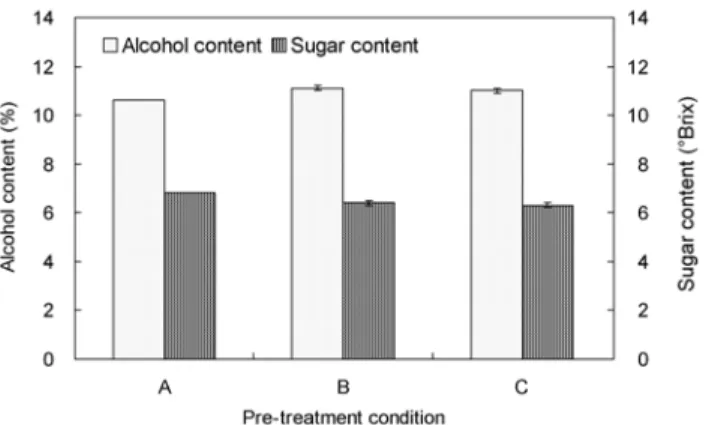
완숙 토마토 마쇄액(A), 꼭지 제거된 완숙 토마토 마쇄액 (B) 및 꼭지 제거된 완숙 토마토 착즙액(C)으로 나누어 전처 리 조건에 따른 토마토 알코올 발효 특성을 조사한 결과 Fig.
3, 4 및 Table 2와 같다. 알코올 함량에서는 (A)가 10.6%로 낮게 나타났고, (B) 및 (C)가 약 11%로 나타났다. 적정산도 및 pH에서는 모든 시료에서 각각 0.45% 및 4.4 전후로 비슷 한 수치를 보여 전처리 방법의 차이가 알코올 발효에는 큰 영향을 미치지 않는 것으로 나타났다. 색도의 b값에서는 (A), (B), (C) 순으로 높게 나타났다. (A)에서는 꼭지 첨가로
Fig. 3. Alcohol and sugar contents of tomato wine prepared by pre-treatment conditions. A: full mature-crushed whole to- mato, B: full mature-crushed tomato removed stem, C: full ma- ture-tomato juice removed stem. Values are mean
±
SD (n=3).Fig. 4. Titratable acidity and pH of tomato wine prepared by pre-treatment conditions. A: full mature-crushed whole to- mato, B: full mature-crushed tomato removed stem, C: full ma- ture-tomato juice removed stem. Values are mean
±
SD (n=3).Table 2. Hunter's color values of tomato wine by pre-treat- ment conditions
Pre-treatment condition
Hunter's color value
L a b
A1) B C
97.0±0.02) 96.6±0.0 96.8±0.0
-4.2±0.0 -3.9±0.0 -3.9±0.0
14.2±0.0 13.8±0.0 13.4±0.0
1)Refer to Fig. 3.
2)Values are mean±SD (n=3).
인해 쓴맛 및 풋내가 나타나 관능적으로 부정적인 영향을 미칠 것으로 생각되며, (B) 및 (C)에서는 알코올 발효능은 비슷하였으나 착즙액을 원료로 사용할 경우 색소 침출능이 조금 떨어지는 것으로 나타나 본 연구에서는 토마토 전처리 조건으로 꼭지 제거된 완숙 토마토 마쇄액(B)을 선정하였다.
초기당도 및 초기산도에 따른 영향
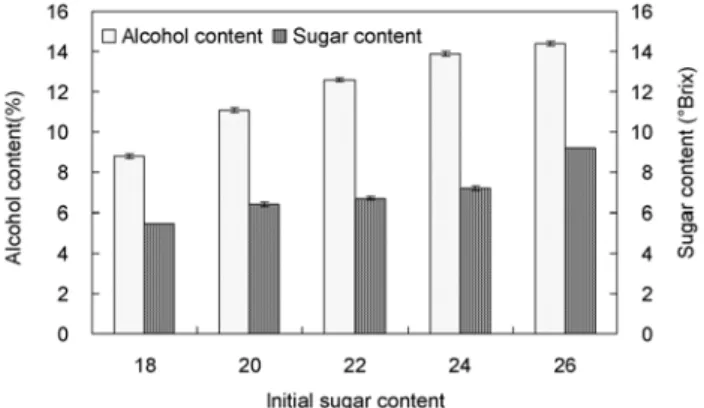
초기당도에 따른 토마토 알코올 발효 특성을 조사한 결과 Fig. 5, 6 및 Table 3과 같다. 적정산도 및 pH는 각각 0.45~
0.52% 및 4.2~4.4의 범위로 초기당도에 따른 차이가 크지 않은 것으로 나타났다. 알코올 함량 및 당도는 초기당도가 높아질수록 각각 8.8~14.4% 및 5.5~9.2 oBrix로 높게 나타 났다. Kim 등(18)이 포도의 초기당도를 24 oBrix로 조정하여 9일 동안 알코올 발효를 시킨 결과 14.7%의 알코올 함량을
Fig. 5. Effect of initial sugar concentrations on alcohol and sugar contents of tomato wine. Values are mean
±
SD (n=3).Fig. 6. Effect of initial sugar concentrations on titratable acidity and pH of tomato wine. Values are mean
±
SD (n=3).Table 3. Effect of initial sugar concentrations on Hunter's color values of tomato wine
Initial sugar con- centration (oBrix)
Hunter's color value
L a b
18 20 22 24 26
97.2±0.11) 96.6±0.0 97.1±0.2 96.6±0.0 96.9±0.0
-3.9±0.0 -3.9±0.0 -4.0±0.0 -4.0±0.0 -4.0±0.0
13.2±0.0 13.8±0.0 13.7±0.0 13.6±0.0 14.0±0.0
1)Values are mean±SD (n=3).
나타내어 본 결과의 13.9%보다는 높게 나타났다. 이러한 결 과는 발효기간에 의한 차이로 생각되며 본 연구에서도 발효 기간을 연장하면 초기당도가 높았던 시료 순으로 알코올 함 량이 더 증가할 것으로 예상된다. 한편, Choi 등(19)은 복분 자 발효주를 제조할 때 관능검사를 통한 알코올의 적정량은 11∼13%라고 보고된 바 있어, 토마토를 이용한 알코올 발효 는 초기당도 20~22 oBrix가 적정할 것으로 생각되며, 이후 숙성․저장 및 관능적인 특성을 고려하여 초기당도를 조정 하고자 하였다.
초기산도에 따른 토마토 알코올 발효 특성을 조사한 결과 Fig. 7, 8 및 Table 4와 같다. 알코올 함량은 대조구에서 11.2%로 가장 높았으며 다른 시료들은 10.5% 전후로 비슷한
Fig. 7. Alcohol and sugar contents of tomato wine by initial total acidity. Values are mean
±
SD (n=3).Fig. 8. Titratable acidity and pH of tomato wine by initial total acidity. Values are mean
±
SD (n=3).Table 4. Hunter's color values of tomato wine by initial ti- tratable acidity
Initial titratable acidity (%)
Hunter's color value
L a b
0 0.5 0.7 0.9
97.4±0.01) 97.4±0.0 96.3±0.0 96.8±0.0
-3.9±0.0 -4.1±0.0 -4.0±0.0 -4.5±0.0
12.0±0.0 12.7±0.0 12.5±0.0 13.9±0.0
1)Values are mean±SD (n=3).
Table 5. Quality characteristics of tomato wine fermented under the optimal condition
Quality characteristics Tomato wine Alcohol content (%)
Sugar content (oBrix) Titratable acidity (%)
pH
L Hunter's color a b Brown color
11.1 6.1 0.68 3.7 96.5 -4.8 78.7 0.21
함량을 나타내었고 당도는 6.2 oBrix 전후로 나타나 초기산 도에 따른 큰 차이를 보이지 않았다. 적정산도는 초기산도가 높을수록, pH는 초기산도가 낮을수록 증가하는 경향이었다.
색도의 b값 및 갈색도는 초기산도가 높을수록 조금 증가하 였다. 와인의 총산은 맛을 결정하는 중요한 요소이며 총산 함량이 낮은 와인은 맛이 밋밋하고 보관 도중에 쉽게 상할 수 있는 반면, 총산 함량이 높은 와인은 거칠고 신맛이 강하 다(20). 따라서 토마토를 이용한 알코올 발효의 경우 초기산 도가 알코올 발효과정에는 큰 영향을 미치지 않았지만 관능 적인 특성을 고려할 때 초기산도 0.5% 이상은 신맛이 강하 게 나타나 향후 숙성과정 등을 고려한 조건의 보완이 요구되 었다.
최적조건에서의 알코올 발효 특성
상기 설정된 조건을 토대로 알코올발효 후 5oC 이하에서 1개월간 racking 시킨 후 발효액의 품질특성을 조사하였다.
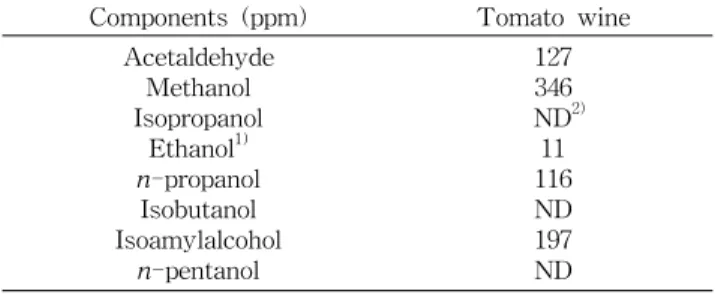
Table 5와 같이 알코올 함량은 11.1%, 당도는 6.1 oBrix, 적정 산도는 0.68%, pH는 3.7로 나타났다. Table 6에서 보는 바와 같이 주요 알코올 성분으로는 acetaldehyde, methanol, ethanol, n-propanol, isoamylalcohol 등 5종이 분석되었다.
Acetaldehyde는 127 ppm으로 나타났으며, methanol은 346 ppm으로 나타났다. 국내 식품공전 규격(21)에서 과실주의 methanol 함량 1,000 ppm 이하에는 적합한 것으로 나타났 다. 또한, n-propanol과 isoamylalcohol 등 fusel oil류 총량은 313 ppm으로 나타났다. 효모의 아미노산 발효로 생성되는 fusel oil은 원료 중의 아미노산 함량 및 효모의 종류에 따라 그 함량이 달라지며 미량 존재할 경우에는 주류의 맛과 향을 높이는 역할을 함으로써 품질에 중요한 요인이 된다(22,23).
Table 7에서 보는 바와 같이 주요 유리당 함량은 fructose, glucose, sucrose 및 maltose 4종이 분석되었다. Maltose가
Table 6. Alcohol components of tomato wine fermented under the optimal condition
Components (ppm) Tomato wine
Acetaldehyde Methanol Isopropanol
Ethanol1)
n-propanol
Isobutanol Isoamylalcoholn-pentanol
127 346 ND2)
11 116 ND 197 ND
1)Unit: %.
2)ND: not detected.
Table 7. Free sugar components of tomato wine fermented under the optimal condition
Components (mg%) Tomato wine
Free sugar
Fructose Glucose Sucrose Maltose
71.5 142.8 18.7 264.6
264.6 mg%로 가장 높게 나타났으며 glucose, fructose 및 sucrose가 각각 142.8, 71.5 및 18.7 mg%로 나타나 보당에 사용된 설탕이 발효에 대부분 이용된 것을 알 수 있었다.
이상의 결과 토마토의 알코올발효 조건을 설정할 수 있었으 며, 이를 바탕으로 토마토 과실주의 발효조건을 확립할 수 있을 것으로 기대된다.
요 약
본 연구에서는 토마토를 이용한 알코올 발효 조건을 조 사하였다. 그 결과, 토마토 숙기정도에 따른 알코올 함량은 중간 및 완숙구간이 약 11%로 비슷한 함량을 나타내었고 미숙구간은 10.6%로 조금 낮았다. 토마토 전처리 조건에 따 른 토마토 알코올 발효 특성을 조사한 결과, 알코올 함량은 완숙 토마토 마쇄액(A)이 10.6%로 낮게 나타났고, 꼭지 제 거된 완숙 토마토 마쇄액(B) 및 꼭지 제거된 완숙 토마토 착즙액(C)이 약 11%로 각각 나타났다. 초기당도에 따른 영 향에서 알코올 함량은 초기당도가 높아질수록 각각 8.8~
14.4%로 높게 나타났다. 초기산도 및 pH는 발효기간 중 알 코올 함량에는 큰 차이가 없었으나 향후 토마토 과실주의 관능적 특성을 고려하여 보완이 요구되었다. 상기 설정된 조건으로 알코올발효 시킨 발효액의 품질특성을 조사한 결 과, 알코올 함량은 11.1%, 당도는 6.1 oBrix, 적정산도는 0.68%, pH는 3.7로 나타났다. 알코올 성분은 methanol이 346 ppm, fusel oil류 총량이 313 ppm으로 나타났다. 유리당 은 maltose가 264.6 mg%로 가장 높게 나타났으며 sucrose 가 18.7 mg%로 나타났다. 이상의 결과 토마토를 이용한 알 코올 발효조건을 설정 할 수 있었으며, 향후 다양한 용도로 활용이 기대되었다.
문 헌
1. Park SW. 1993. Studies on the juice manufacturing proper- ties of various tomato varieties. J Korean Soc Food Nutr 22: 428-432.
2. Korea Agro-Fisheries Trade Corporation. 2007. Culture and production trend of tomatoes. Available from: http:
//www.kati.net/new_kati/jsp/itemService/summary/out- line.jsp?strMode=view&intMenuCode=2246&itemSeq=01&
itemSeq2=01&itemSeq3=02&tmpTab=Prod&itemView=Prod.
Accessed October 9, 2009.
3. Yu YM, Youn YN, Hua QJ, Cha GH, Lee YH. 2009.
Biological hazard analysis of paprikas, strawberries and to- matoes in the markets. J Food Hyg Safety 24: 174-181.
4. Lee JS, Cho MS, Hong JS. 2008. Quality characteristics of
Sulgidduk containing added tomato powder. Korean J Food Cookery Sci 24: 375-381.
5. Choi WS, Hwang KT, Kim KM. 2009. Prolongation of cher- ry tomato shelf-life using perforated film packaging. Korean
J Food Preserv 16: 139-146.
6. Moon KD, Lee CH, Kim JK, Shon TH. 1992. Storage of tomatoes by polyethylene film packaging and CO2 treat- ment. Korean J Food Sci Technol 24: 603-609.
7. Choi JH, Jeong MC, Kim BS, Kim DM. 2007. Effect of high CO2 pre-storage treatment on the quality of tomatoes (Lycopersicon esculentum Mill.) during ripening. Korean
J Food Preserv 14: 578-583.
8. Kim IS, Jin SK, Hur IC, Choi SY, Jung HJ, Lee JK, Kang SH, Woo GM, Kang SN. 2009. Effect of tomato powder on meat patties as nitrite alternatives. Korean J Food Sci Ani
Resour 29: 382-390.
9. Chen JC, Shi J, Xue SJ, Ma Y. 2009. Comparison of lycopene stability in water- and oil-based food model systems under thermal- and light-irradiation treatments. Food Sci Tech-
nol 42: 740-747.
10. Kim IY, Kim SD, Jang MR, Jung SY, Han KY. 2002.
Tomatine and lycopene content in tomatoes and tomato products by HPLC. Report of Seoul Institute Health
Environment 38: 161-168.
11. Jung GT, Ju IO, Ryu J, Choi JS, Choi YG. 2003. Studies on manufacture of wine using apricot. Korean J Food
Preserv 10: 493-497.
12. Lee SJ, Lee JE, Kim SS. 2004. Development of Korean red wines using various grape varieties and preference measurement. Korean J Food Sci Technol 36: 911-918.
13. Lee JM, Kim SK, Lee GD. 2003. Monitoring on alcohol fer- mentation characteristics of strawberry. J Korean Soc
Food Sci Nutr 32: 679-683.
14. Lee OS, Jeong YJ, Kim HI, Whang K, Park NY. 2002.
Effects of pectinase treatment on alcohol fermentation of persimmon. J Korean Soc Food Sci Nutr 31: 578-582.
15. Korea national tax service liquor analysis regulation. 2008.
National Tax Service Technical Service Institute, Korea.
p 62-66.
16. Shin JS, Jeong YJ. 2003. Changes in the components of ace- tic acid fermentation of brown rice using raw starch digest- ing enzyme. J Korean Soc Food Sci Nutr 32: 381-387.
17. Charoensiri R, Kongkachuichai R, Suknicom S, Sungquag P. 2009. β-carotene, lycopene and alpha-tocopherol con- tents of selected Thai fruits. Food Chem 113: 202-207.
18. Kim JS, Kim SH, Han JS, Yoon BT, Yook C. 1999. Effects of sugar and yeast addition on red wine fermentation using campbell early. Korean J Food Sci Technol 31: 516-521.
19. Choi HS, Kim MK, Parkm HS, Kim YS, Shin DH. 2006.
Alcoholic fermentation of bokbunja (Rubus coreanus Miq.) wine. Korean J Food Sci Technol 38: 543-547.
20. 조호철. 2005. 내 손으로 빚는 매혹의 맛과 향기 와인 가이드&
홈메이드 와인 무작정 따라하기. (주)도서출판 길벗, 서울. p 235.
21. Food Code. 2002. Korea Food Industry Association, Korea.
p 202.
22. Park CS, Lee TS. 2002. Quality characteristics of Takju prepared by wheat flour Nuruks. Korean J Food Sci
Technol 34: 296-302.
23. Jeong YJ, Kim HI, Whang K, Lee OS, Park NY. 2002.
Effects of pectinase treatment on alcohol fermentation of persimmon. J Korean Soc Food Sci Nutr 31: 578-582.
(2009년 12월 14일 접수; 2010년 2월 12일 채택)