--- 투고일 : 10/5 수정일 : 11/7 채택일 : 11/12
* 교신저자 : 김보경, 부산시 진구 양정2동 산 45-1 동의대학교부속 한방병원 한방신경정신과 Tel : 051-850-8809, E-mail : [email protected]
동의신경정신과 학회지 J. of Oriental Neuropsychiatry Vol. 19. No. 3, 2008
수면장애와 동반된 임상증상에 따른 심박변이도와 수면 관련 설문간의 상관성 연구
양동호, 오경민 , 김보경 동의대학교 한의과 대학원 신경정신과학교실
The Relation of HRV, PSQI and IQ with Symptoms of Insomnia Patients
Dong-Ho Yang, Kyong-Min Oh, Bo-Kyung Kim
Dept. of Oriental Neuropsychiatry, graduate school of Oriental Medicine. Dongeui University, Busan, Korea.
Abstract
Objective : This study was to investigate the relation of what insomnia patients' symptoms with Heart Rate Variability(HRV), Pittsburgh Sleep Quality Index(PSQI) and Insomnia Questionaire(IQ).
Methods : For this study, we carried out HRV, PSQI and IQ of 43 patients with insomnia who have come to Donguei oriental hospital of Donguei university from September 2007 to May 2008. We studied the relationship HRV with PSQI and IQ. For every symptom, this study classified the patients as none-symptom, symptom groups and analyzed each group's HRV, PSQI and IQ.
Result :
1. The rate of xerostomia in female group is significantly higher than male group.
2. P1(hypnagogic time), P3(awakening time), LF has negative correlation with age. The score of P1(hypnagogic time), P3(awakening time), P4(time of recoverable sleep) in the group whose age is more than 50 are higher than the group whose age is lesser than 50.
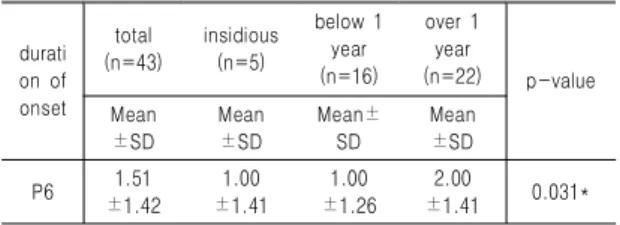
3. The frequency of using hypnotics(P6) in the group whose duration of onset are over 1 year was significantly higher than the score in the group whose duration of onset were below 1 year.
4. The accompanied symptoms in the group who started sleep disorder after stressor are higher than the number in the group whose duration of onset were poor-defined.
5. The drinking group have lower rate of anorexia, higher score of P1(hypnagogic time) and TP than non-drinking group.
6. The score of P-total(general quality of sleep) have negative correlation with NN50, HF, TP and positive correlation with LF/HF.
7. The score of P1(hypnagogic time) have negative correlation with LF.
8. The score of P5a(frequency of delayed hypnagogue) have positive correlation with LF/HF.
9. The score of P5e(frequency of cough or snoring) have negative correlation with RMSSD.
10. The score of I1a(degree of onset insomnia), I1b(degree of maintenance insomnia) have negative correlation with NN50, pNN50, HF.
11. The score of I1c(degree of termination insomnia) have negative correlation with RMSSD, NN50, pNN50, HF, TP and positive correlation with MHR, LF/HF.
12.. The score of P5i(frequecy of night pain), LF/HF in the group with headache are higher than the group without headache.
13. The score of P5a(frequency of delayed hypnagogue), P5c(frequency of awakening for urine of stoo)l in the group with xerostomia are higher than the group without xerostomia.
14. The score of P9(degree of unrecoverable sleep) and I5a(degree of onset insomnia) in the group with chest discomfort are lower than the group without chest discomfort.
15. The score of P7(frequency of drowsiness for daytime) in the group with palpitation are lower than the group without palpitation.
16. The score of P5c(frequency of awakening for urine of stool), P5f(frequency of burning sensation), P5h(frequency of nightmare), I1c(degree of termination insomnia) in the group with burning sensation of upper trunk are higher than the group without burning sensation.
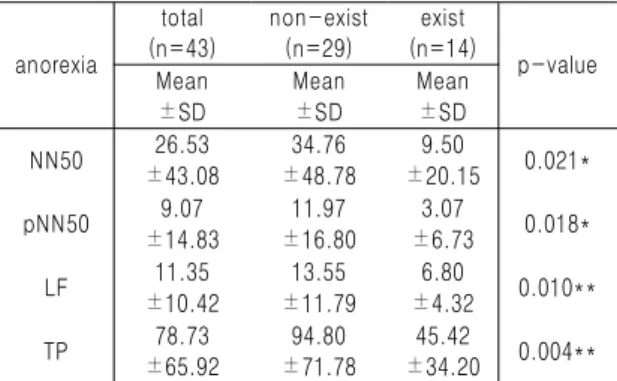
17. The score of NN50, pNN50, LF, TP in the group with anorexia are lower than the group without anorexia.
18. The score of P-total(general quality of sleep), P2(duration for sleep start) in the group with constipation are higher than the group without constipation.
19. The score of P4(recoverable sleep time) in the group with depression are higher than the group without depression.
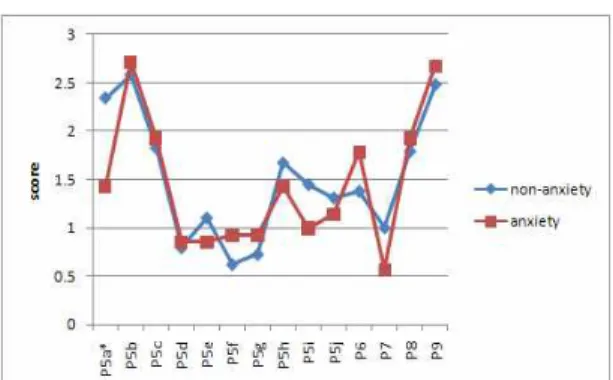
20. In the the group with anxiety, the score of P1(time of hypnagogue), P5a(frequency of onset insomnia) are lower and the score of I1b(degree of maintenance insomnia), I4(objective degree of impairment by insomnia) are higher than the group without anxiety.
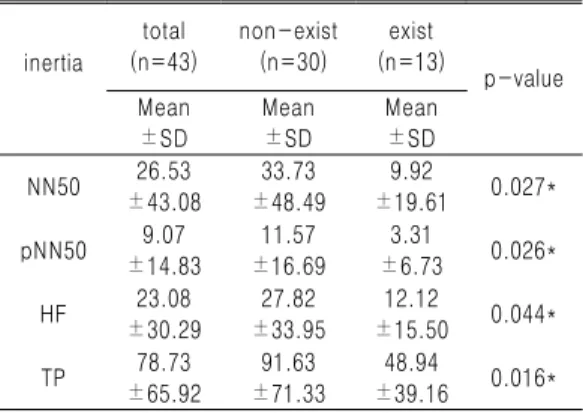
21. The score of NN50, pNN50, HF, TP in the group with inertia are lower than the group without inertia.
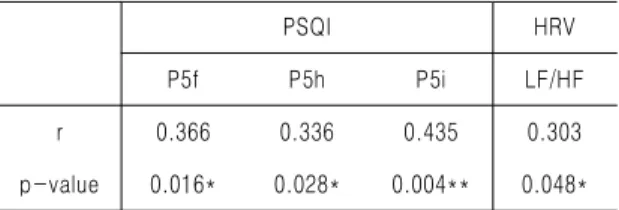
22. The accompanied symptoms haver posirive correlation with P5f(frequency of burning sensation), P5h(frequency of nightmare), P5i( frequency of night pain) and LF/HF.
Conclusion : This study provides insights into the complicated relations of the pattern of sleep disorder with many symptoms such as headache, chest discomfort, depression and any others. And this study showed that autonomic nervous system have important function in the regulation of sleep.
Key Words : Insomnia, HRV, Body syptoms, PSQI
Ⅰ. 緖 論
수면은 인간의 가장 기본적인 욕구 중 하나 로써, 낮 동안 소모되고 소실된 부분을 회복시
켜 주는 기능, 발생학적 기능, 인성학적 기능, 인지적 기능, 감정조절 기능 등을 가지고 있으 며, 그 중 중추신경계를 중심으로 한 항상성 회복이 가장 중요한 기능이다1).
수면에 문제가 생기거나 박탈당할 경우, 심
하면 자아붕괴, 환각, 망상이 나타나고, 사망에 까지 이를 수 있다2).
DSM-Ⅳ에서는 수면장애를 불면증, 과수면 증, 호흡관련 수면장애 등이 포함된 이상 수면 과 야경, 악몽, 몽유병 등의 사건수면을 합하 여 원발성 수면장애로 나누며 정신장애나 신 체질환 및 약물중독 등으로 인한 수면장애와 구분하고 있다3).
또한 수면장애는 수면시간의 양적, 질적인 문제뿐만 아니라, 성별이나 연령과 같은 인구 학적인 요소와 통증이나 호흡곤란과 같은 수 면을 방해하는 증상을 포함하여 피로, 우울, 불안 등 제반 신체적․정신적 요소와 종합적 으로 관련된다4-11).
수면장애와 관련된 중요한 요소 중 하나로 스트레스를 들 수 있다. 스트레스는 수면장애 를 야기하고, 수면 부족은 스트레스를 야기하 는 악순환을 일으킨다4).
스트레스에 대한 신체의 반응은 ‘싸우느냐 도망치느냐’로 요약되며, 스트레스 요인이라는 외적인 변화에 대한 내적인 평형유지의 과정 을 항상성으로 표현하게 된다. 신체의 항상성 유지는 주로 자율신경계 활동에 의해 조절되 며, 자율신경계의 활동을 관찰하여 스트레스의 정도나 인체의 적응상태를 유추해 볼 수 있다
3,16-17).
자율신경계의 교감신경은 흥분, 긴장, 응급 상황시 주로 작용하고, 부교감신경은 스트레스 없이 편안한 상황에서 활동하며 주로 휴식, 이 완과 관련이 있고, 신체의 에너지 소비를 최소 화하고 에너지를 보존하는 기능을 수행하게 된다3).
심장박동 또한 자율신경계에 의해 영향을 받게 된다. 심장박동수는 동방결절의 자발적 흥분을 교감신경과 부교감신경이 동시에 조절 함으로써 발생하게 되므로, 심장박동의 변화를 살피면 신체의 전반적인 자율신경상태를 유추
할 수 있다18).
한의학에서 볼 때 심박변이도는 脈搏을 통 해 病情을 파악하는 脈學의 기본원리와 부합 되는데, ≪東醫寶鑑≫에서 “河間云 脉者血氣之 先 斯論得之矣. 人身之脉血氣之所爲而不知所以 周流不息者 正乾道乾乾之意 亦猶理之寓乎氣 所以爲血氣之先. 先之一字厥有旨焉.”이라 하였 고, 또 “噫. 折一臂 瞽一目而不夭 脉少有變則 病患隨之 可不愼哉”라고 하여 脈의 미세한 변 화에서도 病情을 파악할 수 있고, 脈搏의 變動 을 통해서 인체의 전반적인 陰陽의 상태를 판 단할 수 있다고 하였다18-19).
본 연구에서는 D 대학교 부속한방병원에 수 면장애를 주증상으로 내원한 환자를 대상으로 피츠버그 수면 질 지수와 불면에 관한 질문, 심박변이도 및 수면장애에 동반된 증상 등을 조 사 및 비교 연구하였고, 상술한 바와 같이 수면 장애와 관련이 있는 다양한 유발원인, 각종 신 체적․정신적 증상들과 자율신경계의 기능과 의 관계에 대해 약간의 지견을 얻었기에 이에 보고하는 바이다.
Ⅱ. 硏究對象 및 方法
1. 연구대상
본 연구는 2007년 가을부터 2008년 봄까지 D 대학교 부속한방병원 신경정신과에 수면장애를 주증상으로 내원한 환자 중 PSQI와 IQ에 성실히 응답하고, HRV 검사를 수행한 43명을 대상으로 하였다.
수면에 관한 설문지를 시행하지 못할 정도로 기억력 저하나 의식의 혼란을 보이는 환자는 제 외되었다.
2. 평가방법 (1) 동반 증상
대상 환자 43명의 초진 시 치료가 시작되기 전 에 공통적으로 작성되는 개인력 조사를 토대로 수면 장애 이외에 환자들이 호소하는 각종 신체 적, 정신적 증상을 가능한 모두 정리하였다.
(2) 심박변이도(Heart Rate Variability, HRV) 심박변이도의 측정은 디나미카(Dinamica, (주) 메디미르, 한국)를 사용하였고, 검사실에서 정해 진 간호사가 측정하였다. 측정방법은 환자를 편 안하게 앉히고 충분히 안정시킨 뒤, 좌우 손목과 발목 부위에 전극을 부착하고, 부정맥 등을 제외 한 정상맥 300회를 측정하였다. 측정시간동안 가 능한 잡음을 없애기 위해 환자에게 말하지 않고, 움직이지 않도록 지시하였다.
상기 방법으로 측정된 HRV(Heart Rate Variability) 측정항목 중, 본 연구에서는 5분 전후 의 단기측정 분석에서 흔히 사용되어지는 RMSSD, NN50, pNN50와 HF, LF, LF/HF ratio, 5min Total Power와 5min Mean Heart Rate가 사용되었다.
(3) 수면장애 관련 설문
대상 환자들의 수면장애에 대한 평가는 PSQI 와 IQ를 통해 시행되었다. 2가지 설문지는 모두 초진시 개인력 조사와 함께 치료가 시작되기 전 에 시행 되었으며, 환자 본인이 직접 작성하도록 하였다.
① 피츠버그 수면 질 지수 (Pittsburgh Sleep Quality Index, PSQI)
1989년 Buysse에 의해 개발된 이래 수면 질과 수면 방해를 측정하는데 효과적인 수면 측정 도 구 중 하나로 활용된다.
본 척도는 검사시점에서 지난 한달 간 수면의 질과 수면기간의 불편 정도를 측정하는 자기보고 식 질문지이다.
처음 4개의 문항은 잠자리에 든 시간, 잠들기까 지 걸린 시간, 기상시간, 실제로 잠잔 시간을 직접 기입하는 형태이며, 그 이외에 수면 중 발생하는 각종 요소들과 수면제 복용횟수, 업무방해 등의 빈도를 일주일에 0회, 1회이하, 2회, 3회 이상으로 나누어 각각 0에서 3점까지 배정하고, 자각적인 수면의 질을 ‘매우 좋은’에서 ‘매우 나쁜’까지 나 누어 대답하도록 구성되어 있다. 각각의 문항은 주관적 수면 질, 수면잠복기, 수면시간, 일상적 수 면 효율성, 수면 방해, 수면제 사용, 주간기능 장 애 등 7가지 요소로 나누어져 다시 0에서 3점까지 주어지게 된다.
전체 PSQI 점수는 수면에 아무런 문제가 없는 0점에서 심각한 수면장애를 나타내는 21점까지 로 나타나며, 전체 PSQI 점수가 5점 이하이면 숙 면인(good sleeper), 5점 이상이면 비숙면인(poor sleeper)으로 규정하고 있다(부록 1).
② 불면증에 관한 질문 (Insomnia Questionaire, IQ)
잠들기 어려움, 잠을 유지하기 어려움, 쉽게 깸, 수면에 대해 만족함, 타인이 보는 자신의 수면장 애로 인한 삶의 질 손상정도, 수면장애에 대한 환 자의 걱정하는 정도 등에 대한 7개 문항으로 구성 되어 있으며, 각각의 문항별로 ‘없다’, ‘약간 정도’,
‘중간정도’, ‘심하다’, ‘매우 심하다’에 0점에서 4점 까지 배정되어있다. 각각의 문항은 점수가 높을 수록 수면장애 및 수면장애와 관련된 상태가 나 쁜 것이 되며, PSQI와 달리 모든 문항은 환자의 주관적 대답에 의존하도록 되어있다(부록 2).
3. 통계처리
본 연구의 통계처리는 SPSS 12.0K for Windows를 사용하였다. 성별, 연령, 음주, 흡연 등의 일반적 사항과 頭痛, 眩暈 등 각 증상의 유무 에 따른 집단간 차이 비교는 독립표본 T검정을 하 였고, 심박변이도와 피츠버그 수면 질 지수 및 불 면증에 관한 질문의 점수간의 상관성 등은
Pearson 상관계수를 사용하여 비교하였다.
4.용어의 정리
본 연구에서 사용되는 용어의 정의는 다음과 같다.
(1) PSQI : 피츠버그 수면 질 지수 (Pittsburgh Sleep Quality Index)
P-total : 피츠버그 수면 질 지수 총점 P1, P2, P3, P4, P5a, P5b, P5c, P5d, P5e, P5f, P5g, P5h, P5i, P5j, P6, P7, P8, P9 : 피츠 버그 수면 질 지수의 각 문항(부록 1)
(2) IQ : 불면증에 관한 질문 (Insomnia Questionaire)
I1a, I1b, I1c, I2, I3, I4, I5 : 불면증에 관한 질문의 각 문항(부록 2)
(3) HRV : 심박변이도 (Heart Rate Variability) MHR (Mean Heart Rate) : 5분간 측정한 평균 심박동수
RMSSD : 연속된 심박간격(NN간격)들의 변 이의 제곱 평균값의 루트값
NN50 : 연속된 심박간격(NN간격)들의 변이 가 50ms 이상인 간격들의 수
pNN50 : 전체 심박간격(NN간격) 수 중 NN50의 비
HF : 0.15-0.4Hz 사이에 해당하는 High Frequency의 Power
LF : 0.04-0.15Hz 사이에 해당하는 Low Frequency의 Power
LF/HF : LF와 HF의 비율
TP (Total Power) : 주파수 영역 분석에서 0.4Hz이하의 전체 NN간격의 분산
Ⅲ. 結 果
1. 대상 환자들의 일반적인 특징
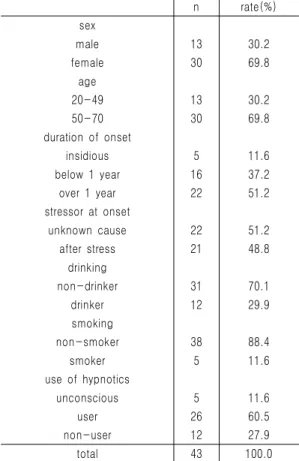
본 연구의 대상자들은 전체 43명으로 남자 13 명(30.2%), 여자 30명(69.8%)이며, 그 중 20-49세 는 13명(30.2%), 50-70세는 30명(69.8%)이다.
초진 시 내원일을 기준으로 발병시기가 1년 이 상인 환자는 22명(51.2%)이며, 1년 이하인 환자는 16명(37.2%), 발병시기가 정확하지 않은 환자는 5 명(11.6%)이었다(Table 1).
발병 당시 금전적 문제, 배우자 또는 가족간의 불화, 충격적 사건・사고 등 스트레스 상황이 분 명히 존재했던 환자는 21명(48.8%)이며, 별다른 이유 없이 발생한 환자는 22명(51.2%)이었다 (Table 1).
스트레스 요인은 배우자와의 갈등(16.3%), 업 무 관련 스트레스(11.6%), 경제적 문제(9.3%), 가 족관계(7.0%), 건강의 문제(7.0%), 사건․사고의 발생(7.0%), 대인관계의 문제(7.0%)의 순으로 나 타났다.
전체 43명 중 음주자는 12명(29.9%), 비음주자 는 31명(70.1%)이었고, 성별에 따른 음주자 비율 은 남성(69.2%)이 여성(10.0%)보다 높게 나타났 다. 흡연자는 전체 43명 중 5명(11.6%), 비흡연자 는 38명(88.4%)이었다.
수면제를 사용하고 있거나 사용해본 적이 있는 환자는 26명(60.5%), 사용하지 않는 환자는 12명 (27.9%), 수면제 복용여부가 불확실한 환자는 5명 (11.6%)이었다(Table 1).
수면제 복용집단 26명 중 복용기간이 1년 이상 인 환자는 10명(38.5%), 1년 이하인 환자는 14명 (53.8%), 복용기간이 불확실한 환자는 2명(7.7%) 이었다(Table 2).
n rate(%) sex
male 13 30.2
female 30 69.8
age
20-49 13 30.2
50-70 30 69.8
duration of onset
insidious 5 11.6
below 1 year 16 37.2
over 1 year 22 51.2
stressor at onset
unknown cause 22 51.2
after stress 21 48.8
drinking
non-drinker 31 70.1
drinker 12 29.9
smoking
non-smoker 38 88.4
smoker 5 11.6
use of hypnotics
unconscious 5 11.6
user 26 60.5
non-user 12 27.9
total 43 100.0
Table 1. General Statistics of Subjects
Duration of using hypnotics n rate(%)
unconscious 2 7.7
below 1 year 14 53.8
over 1 year 10 38.5
total 26 100.0
Table 2. The Period of Using Hypnotics
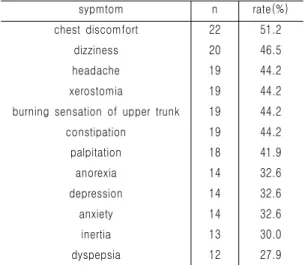
연구의 대상이 된 수면장애 환자들에게서 나타 난 수면장애 이외의 증상은 전체 53가지이며 각 증상별 빈도는 Table 3와 같다. 본 연구에서는 53 가지 증상 중 가장 빈도가 높은 胸悶(chest discomfort), 眩暈(diziness), 頭痛(headache), 口乾・口渴(xerostonia), 上熱感(burning sensation of upper trunk) 등 12가지 증상을 연구대상으로 하였다(Table 4).
symptom n symptom n
upper trunk urine and feces
headache 19 anorexia 14
dizziness 20 dyspepsia 12
neck and nuchal pain 7 brash 4
shoulder and back pain 7 nausea 6
hyperemia of eye 7 dysuria 1
facial spasm or paralysis 6 frequent urination 3
xerostomia 19 constipation 19
obstructive feeling of
throat 3 diarrhea 2
tinnitus 4 dream
clumsiness or vibration of
voice 4 somniloquism 2
bitterness 2 frequent
nightmare 8
chest mental state
chest discomfort 22 depression 14
chest pain 5 anxiety 14
pain of Jun-jung 7 inertia 13
palpitation 18 hypervigilance 3
repetitious suspiration 4 frequent anger 5 pain and sense excessive thought 3 pain or discomfort of
abdomen 8 suicidal ideation 5
pain or discomfort of limb 3 change of
personality 1 burning sensation of
upper trunk 19 memory
impairment 7
coldness of abdomen 4 visual
disturbance 3 crossing of chillness and
burning sensation 5
hearing
disturbance 2 weight
chillness 2 weight increase 3
pruritus 2 weight decrease 1
sweat other symptoms 9
night sweat 2
hydropedesis 4
limb
sensory anomaly of limb 6
sweat of limb 2
tremor of limb 4 burning sensation of limb 2 coldness of limb 3
Table 3. Accompanied Symptoms of the Patients with Sleep Disorder
sypmtom total (n=43)
male (n=13)
female
(n=30) p-value
headache 44.2 38.5 46.7 0.629
dizziness 46.5 46.2 46.7 0.976
xerostomia 44.2 15.4 56.7 0.006**
Table 5. Comparison of Prevalance Rate between Male and Female
chest
discomfort 51.2 30.8 60.0 0.082
palpitation 41.9 23.1 50.0 0.090
burning sensation¥
44.2 30.8 50.0 0.248
anorexia 32.6 23.1 36.7 0.395
dyspepsia 27.9 38.5 23.3 0.321
constipation 44.2 30.8 50.0 0.254
depression 32.6 30.8 33.3 0.873
anxiety 32.6 30.8 33.3 0.873
inertia 30.2 15.4 36.7 0.132
** : p<0.01, ¥ : burning sensation of upper trunk** : p<0.01
¥ : burning sensation of upper trunk
sypmtom n rate(%)
chest discomfort 22 51.2
dizziness 20 46.5
headache 19 44.2
xerostomia 19 44.2
burning sensation of upper trunk 19 44.2
constipation 19 44.2
palpitation 18 41.9
anorexia 14 32.6
depression 14 32.6
anxiety 14 32.6
inertia 13 30.0
dyspepsia 12 27.9
Table 4. Major Part of Symptoms with Sleep Disorder
2. 일반적 특성에 따른 동반증상, PSQI, IQ, HRV 의 비교
(1) 성별
성별에 따른 주요 동반증상의 동반 비율에 서 消化不良을 제외한 모든 증상이 여성에게 서 높게 나타났으며, 그 중 口乾・口渴 (xerostomia)은 여성이 남성보다 유의하게 높 은 동반비율을 나타내었다(Table 5, Figure 1).
성별에 따른 동반증상의 평균 개수는 여성 이 남성보다 많지만, 유의한 차이는 없는 것으 로 나타났다(Table 6).
연구 대상자들의 PSQI와 IQ 총점 및 각 문 항의 평균 점수와 HRV 항목에서 성별에 따른 유의한 차이는 나타나지 않았다(Table 7, 8).
unit : %
Fig. 1. Comparison of prevalance rate between male and female
total (n=43)
male (n=13)
female
(n=30)
p-val Mean± ue
SD
Mean±
SD
Mean±
SD accompanied
symptoms
8.9 ± 3.8
7.8
±3.7
9.4
±3.8 0.194 Table 6. Comparison of Accompanied Symptoms between Male and Female
unit : number of accompanied sympto
total(n=43) male(n=13) female(n=30) p- value
Mean±SD Mean±SD Mean±SD
P S Q I
P-
total 14.38 ±2.96 13.96 ±3.22 14.57 ±2.87 0.544 P1 23.66 ±1.73 24.19 ±2.31 23.43 ±1.39 0.187 P2 96.27 ±62.04 70.38 ±42.15 107.48 ±66.39 0.071 P3 30.53 ±2.20 30.69 ±2.67 30.45 ±2.02 0.748 P4 4.34 ±1.85 4.76 ±2.31 4.17 ±1.63 0.344 P5a 2.05 ±1.25 2.00 ±1.22 2.07 ±1.28 0.875 P5b 2.63 ±0.76 2.62 ±0.96 2.63 ±0.67 0.944 P5c 1.86 ±1.15 1.69 ±1.18 1.93 ±1.14 0.533 P5d 0.81 ±1.20 0.69 ±1.11 0.87 ±1.25 0.667 P5e 1.02 ±1.24 1.23 ±1.30 0.93 ±1.23 0.478 P5f 0.72 ±1.14 0.69 ±1.03 0.73 ±1.20 0.915 P5g 0.79 ±1.06 0.54 ±0.88 0.90 ±1.12 0.310 P5h 1.59 ±1.23 1.27 ±1.13 1.73 ±1.26 0.259 P5i 1.30 ±1.35 0.85 ±1.34 1.50 ±1.33 0.148 P5j 1.26 ±1.26 0.96 ±1.33 1.38 ±1.24 0.321 P6 1.51 ±1.42 1.85 ±1.41 1.37 ±1.43 0.315 P7 0.86 ±1.17 1.15 ±1.21 0.73 ±1.14 0.283 P8 1.84 ±1.21 2.08 ±0.86 1.73 ±1.34 0.322 P9 2.55 ±0.68 2.65 ±0.55 2.50 ±0.73 0.502
I Q
I1a 3.00 ±1.21 3.25 ±1.14 2.90 ±1.24 0.404 I1b 3.00 ±1.14 3.00 ±1.21 3.00 ±1.13 1.000 I1c 2.93 ±1.21 2.92 ±1.44 2.93 ±1.13 0.973 I2 3.74 ±0.45 3.83 ±0.39 3.70 ±0.47 0.387 I3 2.86 ±1.22 3.33 ±0.78 2.67 ±1.32 0.051 I4 2.49 ±1.31 2.50 ±1.17 2.48 ±1.38 0.970 I5 3.38 ±0.94 3.58 ±0.79 3.30 ±0.99 0.382 Table 7. Comparison of PSQI and IQ between Male and Female
total (n=43)
male (n=13)
female (n=30)
p-value Mean±
SD
Mean±
SD
Mean±
SD
MHR 72.7±
13.68
77.77±
14.29
70.5±
13.03 0.110 RMSSD 31.24±
24.45
30.48±
24.35
31.56±
24.9 0.896
NN50 26.53±
43.08
28.08±
43.23
25.87±
43.73 0.879
pNN50 9.07±
14.83
9.69±
14.96
8.8±
15.03 0.859
HF 23.08±
30.29
21.85±
30.08
23.61±
30.88 0.863
LF 11.35±
10.42
9.71±
9.21
12.06±
10.98 0.504
LF/HF 1.09±
0.99
1.17±
0.92
1.06±
1.04 0.740
TP 78.73±
65.92
72.00±
67.72
81.64±
66.07 0.665 Table 8. Comparison of HRV between Male and Female
P-total : general quality of sleep, P1 : time of hypnagogue, P2 : duration for sleep start(min), P3 : time of awakening, P4 : recoverable sleep time(hour), P5a : frequency of onset insomnia in 30 minute, P5b : frequency of awakening in midnight or early morning, P5c : frequency of awakening for urine of stool, P5d : frequency of nocturnal dyspnea, P5e : frequency of cough or snoring, P5f : frequency of burning sensation, P5g : frequency of chillness, P5h : frequency of nightmare, P5i : frequency of night pain, P5j : frequency of other reasons what interrupt for sleep, P6 : frequency of using hypnotics, P7 : frequency of drowsiness for daytime, P8 : frequency of disturbance for working, P9 : degree of unrecoverable sleep, I1a : degree of onset insomnia, I1b : degree of maintenance insomnia, I1c : degree of termination insomnia, I2 : dissatisfaction for sleep, I3 : amount of disturbance for daytime working, I4 : objective degree of impairment by insomnia, I5 : amout of worriment about insomnia
MHR (beat/min) : Mean heart rate for 5 minute, RMSSD (ms) : The square root of the mean of the sum of the squares of differences between adjacent NN intervals, NN50 : Number of pairs of adjacent NN intervals differing by more than 50ms in the entire recording, pNN50 (%) : NN50 count divided by the total number of all NN intervals, HF (ms2) : Power in high frequency range, LF (ms2) : Power in low frequency range, LF/HF : Ratio LF(ms2)/ HF(ms2), TP (ms2) : =Total power.
The variance of NN intervals
(2) 연령
PSQI 문항 중 P1, P3와 HRV 항목 중 LF에 서 연령에 따른 유의한 음(-)의 상관성을 나타 내었다(Table 9). 그 외 항목에서는 연령에 따 른 유의한 상관성이 나타나지 않았다.
연령에 따른 집단별 평균 비교에서 PSQI 문 항 점수 중 P1, P3, P4에서 20-49세 집단이 50-70세 집단에 비해 유의하게 높은 것으로 나 타났다(Table 10).
age
total (N=43) 28-49 (N=13)
50-70
(N=30) p-value Mean±SD Mean±SD Mean±SD
P1 23.66±1.73 24.97±1.99 23.09±1.26 0.001***
P3 30.53±2.2 31.92±2.39 29.92±1.85 0.005**
P4 4.34±1.85 5.49±2.43 3.85±1.3 0.037*
Table 10. Comparison of P1, P3, P4, P5a, P8 between Groups of Different Age
PSQI HRV
P1 P3 LF
r -0.575 -0.597 -0.349
p-value 0.000*** 0.000*** 0.022*
Table 9. Correlation of Age with P1, P3, LF
durati on of onset
total (n=43)
insidious (n=5)
below 1 year (n=16)
over 1 year
(n=22) p-value Mean
±SD Mean
±SD Mean±
SD Mean
±SD P6 1.51
±1.42 1.00
±1.41 1.00
±1.26 2.00
±1.41 0.031*
Table 11. Comparison of P6 between Groups Divided by Duration of Sleep Disorder
r : Pearson correlation coefficient, P1 : time of hypnagogue, P3 : time of awakening, LF (ms2): Power in low frequency range
* : p<0.05 , *** : p<0.001
P1 : time of hypnagogue, P3 : time of awakening, P4 : recoverable sleep time
* : p<0.05 , ** : p<0.01, *** : p<0.001
(3) 발병 시기
발병 1년 이상인 집단이 발병 1년 이하인 집단에 비해 P6에서 유의하게 높은 평균점수 를 나타내었다(Table 11).
P6 : frequency of using hypnotics
* : p<0.05
(4) 발병요인
발병시 스트레스 요인이 존재했던 집단이
그렇지 않은 집단에 비해 유의하게 높은 평균 증상 개수를 나타내었다(Table 12).
stressor at onset
total (n=43)
unknown cause (n=22)
after stress
(n=21)
p-value Mean
±SD
Mean
±SD
Mean
±SD accompanie
d symptoms 8.93
±3.83 7.45
±3.47
10.48
±3.64 0.008**
Table 12. Comparison of Accompanied Symptoms with Stress
unit : number of accompanied symptoms
** : p<0.01
(5) 음주
食慾低下(anorexia) 동반 비율은 음주자가 비음주자보다 유의하게 낮게 나타났으며, PSQI 문항 중 P1, HRV 항목 중 TP에서 음주 자는 비음주자보다 유의하게 높게 나타냈다 (Table 13).
drinking total (n=43)
non-dr inker (n=31)
drinker (n=12)
p-value Mean±
SD
Mean±
SD
Mean±
SD anorexia 32.56±
47.41
41.94±
50.16
8.33±
28.87 0.010**
P1 23.66±
1.73
23.22±
1.3
24.79±
2.2 0.006**
TP 78.73±
65.92
65.88±
56.24
111.92±
79.36 0.038*
Table 13. Comparison of Anorexia, P1 and TP between Non-Drinker with Drinker
P1 : time of hypnagogue, TP (ms2) : =Total power. The variance of NN intervals
* : p<0.05 , ** : p<0.01
(6) 흡연, 수면제 복용여부, 복용기간
흡연, 수면제 복용여부, 수면제 복용기간에 따라 유의한 차이가 나는 PSQI, IQ, HRV항목 은 없다.
MHR RMSSD NN50 pNN50 HF LF LF/HF TP
PS QI
P-to tal
r -0.478 -0.47 6
-0.43
4 0.365 -0.38 0 p-value 0.001**
* 0.001*
**
0.004
** 0.016
* 0.012
*
P1 r -0.36
9
p-value 0.015
P5a
r 0.321
p-value 0.036
*
P5e r -0.369
p-value 0.015*
QI I1a
r -0.311 -0.30 6
-0.37
6
p-value 0.045* 0.049* 0.014
*
I1b
r -0.573 -0.57 1
-0.48
8
p-value 0.000**
* 0.000*
**
0.001
***
I1c
r 0.309 -0.319 -0.553 -0.55 3
-0.55
0 0.405 -0.33 4
p-value0.049
* 0.042* 0.000**
* 0.000*
**
0.000
*** 0.009
**
0.033
*
xerosto mia
total (n=43)
non-exis
t (n=24) exist (n=19)
p-value Mean
±SD
Mean
±SD Mean ±SD P5a 2.05
±1.25 1.67
±1.34 2.53 ±0.96 0.019*
P5c 1.86
±1.15 1.46
±1.18 2.37 ±0.90 0.006**
3. HRV와 PSQI 및 IQ의 상관성 비교
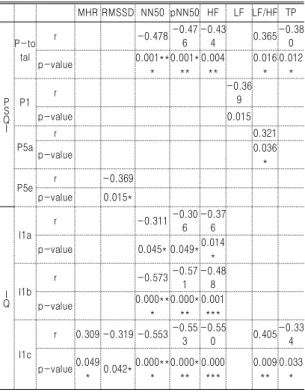
PSQI와 IQ의 각 항목과 HRV의 각 항목 간 에 유의한 상관성을 나타낸 것은 Table 22와 같이 나타났다. 유의한 상관성을 나타낸 항목 중 LF/HF와 MHR은 PSQI 및 IQ와 양(+)의 상관성을 나타내었고, 그 이외의 RMSSD, NN50, pNN50, HF, LF는 음(-)의 상관성을 나 타내었으며, 이상의 유의한 상관성을 나타낸 항목들만 Table 14에 제시하였다.
Table 14. Correlation of HRV with PSQI and IQ
r : Pearson correlation coefficient, P-total : general quality of sleep, P1 : time of hypnagogue, P5a : frequency of onset insomnia in 30 minute, P5e : frequency of cough or snoring, I1a : degree of onset insomnia, I1b : degree of maintenance insomnia, I1c : degree of termination insomnia,
* : p<0.05 , ** : p<0.01, *** : p<0.001
4. 동반증상에 따른 PSQI, IQ, HRV의 비교
(1) 頭痛(headache)
頭痛(headache)을 가진 집단이 그렇지 않은
집단에 비해 PSQI의 P5i 문항과 HRV의 LF/HF에서 유의하게 높은 평균수치를 나타냈 다(Table 15).
Table 15. Comparison of P5i and LF/HF between Groups with and without Headache
headache total (n=43)
non-exist (n=24)
exist (n=19)
p-value Mean
±SD
Mean
±SD
Mean
±SD
P5i 1.3
±1.35
0.92
±1.25
1.79
±1.36 0.034*
LF/HF 1.09
±0.99 0.8 ±0.68 1.46
±1.21 0.041*
P5i : frequency of night pain, LF/HF : Ratio LF(ms2)/ HF(ms2),
* : p<0.05
(2) 眩暈(diziness)
眩暈(diziness)의 유무에 따라 유의한 차이가 나는 문항이나 항목은 없었다.
(3) 口乾・口渴(xerostomia)
口乾・口渴(xerostomia)이 존재하는 집단이 그렇지 않은 집단에 비해 PSQI의 문항 중 P5a, P5c에서 유의하게 높은 평균 점수를 나타 냈다(Table 16).
Table 16. Comparison of P5a and P5c between Groups with and without Xerostomia
P5a : frequency of onset insomnia in 30 minute, P5c : frequency of awakening for urine of stool
* : p<0.05 , ** : p<0.01
chest discomfort
total (n=43)
non-exist (n=21)
exist
(n=22) p-value Mean ±SD Mean ±SD Mean ±SD
P9 2.55 ±0.68 2.76 ±0.44 2.34 ±0.81 0.040*
I5 3.38 ±0.94 3.67 ±0.58 3.10 ±1.14 0.049*
palpita tion
total (n=43)
non-exist (n=25)
exist (n=18)
p-value Mean ±SD Mean
±SD
Mean
±SD
P7 0.86
±1.17
1.16
±1.21
0.44
±0.98 0.046*
burning sensation
¥
total (n=43)
non-exist (n=24)
exist (n=19)
p-value Mean
±SD
Mean
±SD
Mean
±SD
P5c 1.86
±1.15
1.54
±1.22
2.26
±0.93 0.039*
P5f 0.72
±1.14
0.38
±0.82
1.16
±1.34 0.034*
P5h 1.59
±1.23
1.25
±1.22
2.03
±1.11 0.038*
I1c 2.93
±1.21
2.59
±1.40
3.32
±0.82 0.048*
anorexia
total (n=43)
non-exist (n=29)
exist (n=14)
p-value Mean
±SD
Mean
±SD
Mean
±SD
NN50 26.53
±43.08
34.76
±48.78
9.50
±20.15 0.021*
pNN50 9.07
±14.83
11.97
±16.80
3.07
±6.73 0.018*
LF 11.35
±10.42
13.55
±11.79
6.80
±4.32 0.010**
TP 78.73
±65.92
94.80
±71.78
45.42
±34.20 0.004**
(4) 胸悶(chest discomfort)
胸悶(chest discomfort)이 존재하는 집단이 그렇지 않은 집단에 비해 PSQI와 IQ 문항 중 P9, I5에서 유의하게 낮은 평균 점수를 나타냈 다(Table 17).
Table 17. Comparison of P9 and I5 between Groups with and without Chest Discomport
P9 : degree of unrecoverable sleep, I5 : amout of worriment about insomnia
* : p<0.05
(5) 驚悸․怔忡(palpitation)
驚悸․怔忡(palpitation)이 존재하는 집단이 그렇지 않은 집단에 비해 PSQI와 IQ 문항 중 P7에서 유의하게 낮은 평균 점수를 나타냈다 (Table 18).
Table 18. Comparison of P7 between Groups with and without Palpitation
P7 : frequency of drowsiness for daytime
* : p<0.05
(6) 上熱感(burning sensation of upper trunk)
PSQI와 IQ 문항 중 P5c, P5f, P5h, I1c에서 上熱感(burning sensation of upper trunk)이 존재하는 집단이 그렇지 않은 집단에 비해 유 의하게 높은 평균점수를 나타냈다(Table 19).
Table 19. Comparison of P5c, P5f, P5h and I1c between Groups with and without Burning Sensation of Upper Trunks
P5c : frequency of awakening for urine of stool, P5f : frequency of burning sensation, P5h : frequency of nightmare, I1c : degree of termination insomnia
* : p<0.05, ¥ : burning sensation of upper trunk
(7) 食慾低下(anorexia)
食慾低下(anorexia)가 존재하는 집단이 그렇 지 않은 집단에 비해 HRV 항목 중 NN50, pNN50, LF, TP에서 유의하게 낮은 평균 수치 를 나타냈다(Table 20).
Table 20. Comparison of NN50, pNN50, LF and TP between Groups with and without Anorexia
NN50 : Number of pairs of adjacent NN intervals differing by more than 50ms in the entire recording, pNN50 (%) : NN50 count divided by the total number of all NN intervals, LF (ms2) : Power in low frequency range, TP (ms2) : =Total power. The variance of NN intervals
* : p<0.05 , ** : p<0.01
constip ation
total (n=43)
non-exist (n=24)
exist (n=19)
p-value Mean
±SD
Mean
±SD
Mean
±SD P-total 14.38
±2.96
13.52
±2.62
15.47
±3.06 0.030*
P2 96.27
±62.04
78.63
±46.19
118.55
±72.90 0.034*
depres sion
total (n=43)
non-exist (n=29)
exist (n=14)
p-value Mean
±SD
Mean
±SD
Mean
±SD
P4 4.345
±1.854
3.908
±1.773
5.250
±1.740 0.024*
anxiety total (n=43)
non-exist (n=29)
exist (n=14)
p-value Mean
±SD
Mean
±SD
Mean
±SD
P1 23.66
±1.73
24.03
±1.87
22.89
±1.08 0.041*
P5a 2.05
±1.25
2.34
±1.04
1.43
±1.45 0.048*
I1b 3.00
±1.14
2.75
±1.24
3.54
±0.66 0.038*
I4 2.49
±1.31
2.21
±1.26
3.08
±1.26 0.048*
inertia
total (n=43)
non-exist (n=30)
exist (n=13)
p-value Mean
±SD
Mean
±SD
Mean
±SD NN50 26.53
±43.08
33.73
±48.49
9.92
±19.61 0.027*
pNN50 9.07
±14.83
11.57
±16.69
3.31
±6.73 0.026*
HF 23.08
±30.29
27.82
±33.95
12.12
±15.50 0.044*
TP 78.73
±65.92
91.63
±71.33
48.94
±39.16 0.016*
(8) 消化不良(dyspepsia)
消化不良(dyspepsia) 유무에 따라 유의한 차 이가 나는 PSQI 및 IQ 문항이나 HRV 항목은 없었다.
(9) 便秘(constipation)
便秘(constipation)가 존재하는 집단이 그렇 지 않은 집단에 비해 PSQI 문항 중 P-total, P2에서 유의하게 높은 평균 점수를 나타냈다 (Table 21).
Table 21. Comparison of P-total and P2 between Groups with and without Constipation
P-total : general quality of sleep, P2 : duration for sleep start
* : p<0.05
(10) 憂鬱(depression)
憂鬱(depression)이 존재하는 집단이 그렇지 않은 집단에 비해 PSQI 문항 중 P4에서 유의 하게 높은 평균 점수를 나타냈다(Table 22).
Table 22. Comparison of P4 between Groups with and without Depression
P4 : recoverable sleep time * : p<0.05
(11) 不安(anxiety)
不安(anxiety)이 존재하는 집단이 그렇지 않
은 집단에 비해 PSQI 문항 중 P1, P5a에서 유 의하게 낮은 평균 점수와, IQ 문항 중 I1b, I4 에서 유의하게 높은 평균수치를 나타냈다 (Table 23).
Table 23. Comparison of P1, P5a, I1b and I4 between Groups with and without Anxiety
P1 : time of hypnagogue, P5a : frequency of onset insomnia in 30 minute, I1b : degree of maintenance insomnia, I4 : objective degree of impairment by insomnia
* : p<0.05
(12) 無氣力(inertia)
HRV 항목 중 NN50, pNN50, HF, TP에서 無氣力(inertia)이 존재하는 집단이 그렇지 않 은 집단에 비해 유의하게 낮은 평균수치를 나 타냈다(Table 24).
Table 24. Comparison of NN50, pNN50, HF and TP between Groups with and without Inertia
PSQI HRV
P5f P5h P5i LF/HF
r 0.366 0.336 0.435 0.303
p-value 0.016* 0.028* 0.004** 0.048*
NN50 : Number of pairs of adjacent NN intervals differing by more than 50ms in the entire recording, pNN50 (%) : NN50 count divided by the total number of all NN intervals, HF (ms2) : Power in high frequency range, TP (ms2) : =Total power.
The variance of NN intervals
* : p<0.05
(13) 증상개수
증상의 개수와의 상관성 비교에서 PSQI 문 항 중 P5f, P5h, P5i와 HRV 항목 중 LF/HF에 서 증상개수와 유의한 양(+)의 상관성을 나타 냈다(Table 25).
Table 25. Correlation of Accompanied Symptoms with P5f, P5h, P5i and LF/HF
r : Pearson correlation coefficient, P5f : frequency of burning sensation, P5h : frequency of nightmare, P5i : frequency of night pain, LF/HF : Ratio LF(ms2)/ HF(ms2)
* : p<0.05 , ** : p<0.01
Ⅳ. 考 察
사람에게 수면은 전체 삶의 1/3을 차지하는 기초적인 생리 기능으로, 인간의 식욕, 성욕과 더불어 가장 기본적인 욕구에 해당한다. 수면 의 기능으로는 낮 동안 소모되고 손상된 부분, 특히 중추신경계 기능을 회복시켜주는 기능과, 발생학적 기능, 인성학적 기능, 감정들을 정화 하고 조절하는 기능을 가진다1).
한의학에서는 수면을 인체의 衛氣가 주간 에는 陽分을 순행하여 目張而寤하고 야간에는 陰分을 순행하여 目暝而寐한다고 하여 營衛氣 血의 순행이 주간과 야간에 변동함에 따른 陰 陽消長의 과정으로 해석한다3).
수면은 연령, 성별과 같은 인구학적 요인20), 호흡기 질환, 심혈관계 질환, 위장관계 질환 등 질환적 요인21)과 불안, 우울, 정신질환, 스 트레스 등 정신적 요인22)에 의해 영향을 받으 며, 소음, 조명, 사적인 공간의 허용여부 등의 환경적 요인23)도 수면에 영향을 미친다. 수면 에 문제가 발생할 경우 불쾌한 기분, 집중력 감소, 작업 능률의 저하와 피로감, 공격성, 기 억력 감퇴, 대인관계에 대한 불만족을 야기한 다24). 미국의 국립수면재단과 갤럽의 조사에서 는 불면증이 삶의 질과 관련된 일상생활의 주 요 기능에 부정적인 영향을 미친다고 보고되 었고25), Baker 등26)의 연구에서는 장기간의 수 면부족이 현훈, 불안정, 지남력 장애, 피해의식, 주의력장애, 감각장애, 일시적 수전증 등을 초 래한다고 하였다. 또한 수면장애는 그로 인한 부작용이 개인적 문제 뿐만 아니라 생산성 저 하, 사고증가, 건강비용 증가와 같은 광범위한 사회경제적 문제를 발생시키게 된다27). 즉 수 면 장애는 수면 자체의 양적 혹은 질적인 문 제 뿐만 아니라 전반적인 신체적․정신적 기 능과 연관된다고 볼 수 있다.
수면의 가장 중요한 기능은 항상성의 회복 이며1), 인체의 회복 기능에 있어서 많은 부분 이 자율신경계의 교감신경과 부교감신경의 균 형 및 활동에 영향을 받는다1,3). 자율신경계의 상태를 측정하기 위한 방법으로 심박변이도가 널리 사용된다. 심장박동수는 자율신경계의 교 감신경과 부교감신경 모두의 영향을 받으며, 체내의 환경의 변화에 따라 시시각각 변화하 는데 이러한 시간에 따른 심장박동의 주기적 인 변화를 심박변이도(Heart Rate Variability, HRV)라고 하며28), 1996년 유럽심장학회와 북 미 심조율 전기생리학회의 Task Force를 통해 심박변이도의 측정방법, 생리적 해석 그리고 임상적 사용의 표준이 제정되었다. 심박변이도 의 분석은 시간 영역 분석법(time-domain