The Effects of Online-based Lifelong Education Program through Key Words Card Production and Class Demonstration on Job Preparation Skills for Workplace of Workers with Developmental
Disabilities
Young-Jun Kim 1* , Ryang-Hee Kwon 2
1
Researcher, Center for Extracurricular Activities, Duksung Women’s University
2
Professor, Department of Social Welfare, Busan Digital University
핵심어 카드 제작 및 수업시연 온라인 평생교육프로그램이 시간제 발달장애 근로자의 직장출근준비기술에 미치는 효과
김영준 1* , 권량희 2
1
덕성여자대학교 비교과통합관리센터 연구원,
2부산디지털대학교 사회복지학과 부교수
Abstract The purpose of this study was to verify the effects of the online lifelong education program which is a key words card production and demonstration on the job preparation skills for work for part-time developmental disabilities. The subjects of this study were three developmental disabilities workers working in a restaurant business on a part-time basis, and the experimental environment was composed of the home and subway stations where they reside. The study method used a single subject study, and the baseline, intervention, and maintenance were reflected as the design conditions of the experiment. As a result, the subjects of the study effectively acquired and maintained the job preparation skills for work work through the online lifelong education program for the production and demonstration of key words cards. Through the results of this study, it was possible to discuss and conclude that the significant functional relationship between the independent variables and the dependent variables is valid.
Key Words : Key Words Card Production, Class Demonstration, Online-based Lifelong Education Program, Job Preparation Skills, Developmental Disabilities
요 약 본 연구는 핵심어 카드 제작 및 수업시연 온라인 평생교육프로그램이 시간제 발달장애 근로자의 직장출근준비 기술에 미치는 효과를 검증하는 데에 목적을 두어 실시되었다. 연구 대상은 시간제로 식당사업체에 근무하고 있는 세 명의 발달장애 근로자들이며, 이들이 거주하는 가정과 지하철역을 실험 환경으로 구성하였다. 연구 방법은 단일대상연 구를 사용하였으며, 이에 따라 기초선, 중재, 유지를 실험의 설계 조건으로 반영하였다. 연구 결과, 연구 대상들은 핵심 어 카드 제작 및 수업시연 온라인 평생교육프로그램을 통하여 직장출근준비기술을 효과적으로 습득 및 유지한 것으로 나타났다. 연구 결과를 통해, 본 연구는 구성된 독립변인과 종속변인이 상호간에 갖는 유의미한 기능적 관계가 타당하 다는 측면을 논의 및 결론지을 수 있었다.
주제어 : 핵심어 카드 제작, 수업시연, 온라인 평생교육프로그램, 직장출근준비기술, 발달장애
*Corresponding Author : Young-Jun Kim([email protected]) Received July 30, 2021
Accepted September 20, 2021
Revised August 26, 2021
Published September 28, 2021
1. Introduction
1.1 The Needs and Objectives of Research Even if the developmental disabled are employed after school graduation through special education in school age, post management is essential in terms of job adaptation and maintenance[1]. The term follow-up management means lifelong education that should be guaranteed throughout the life of the developmental disabled in adulthood[2].
Since lifelong education does not correspond to the support system of compulsory education, it is virtually difficult for all developmental disabilities to be guaranteed the opportunity. In addition, it is more difficult to support differentiated learning according to the needs of lifelong education of the developmental disabled, and some subjects are receiving benefits from welfare centers for the disabled or related centers due to individual efforts and infrastructure[3]. Therefore, it is emphasized that lifelong education programs that can be customized to the individual education needs of the developmentally disabled are developed and operated in various forms and forms.
Lifelong education programs for people with developmental disabilities are often tended to be actively operated by welfare centers for the disabled, but it is also possible at the university where research and development infrastructure is strongly established[4]. In the university field, educational opportunities and benefits can be provided to the developmental disabled in the area during the practical training process through the curriculum of the department, and more officially, it is possible through the administrative system of the affiliated lifelong education center[5]. In particular, the lifelong education center attached to the university can build various infrastructures related to lifelong education for the disabled through departments and research institutes, so it is easy to develop and apply effective programs by comprehensively
evaluating the current situation of the developmentally disabled. The university-affiliated lifelong education center can put in the professional manpower to actually plan and oversee the program, and the contents, methods and procedures of the program can be effectively organized from the above professional manpower. From this point of view, it is also important to recognize the necessity of active operation of lifelong education centers affiliated with universities for lifelong education programs for the disabled[6].
The procedures and methods of programs that can be developed for the developmental disabled at the university-affiliated lifelong education center may vary, but the current social situation and composition require a more realistic approach in preparation for COVID-19[5]. Due to gastric infections, the paths and opportunities for people with developmental disabilities to actively access lifelong education centers attached to universities are not autonomous, and the effects of education and performance management themselves may not be clear.
Therefore, the scene of online learning activities
should be activated to satisfy the learning
cognitive effect of the developmental disabled
according to the rapid and concise intervention
procedure and to ensure that the developmental
disabled can maintain the learning situation
safely[7]. When understanding this superficially, it
may be difficult to fully manage the learning
effects of people with developmental disabilities
through online-based learning activities
themselves. First of all, family members or people
around them should be waiting at all times to
help people with developmental disabilities at
home for online-based learning, and the
possibility of the developmental disabilities being
able to concentrate in online learning situations
is not clear. Despite this dilemma, the
developmental disabled people are in a position
to receive lifelong education, so the dilemma
should be solved.
The main techniques that should be considered for the developmental disabled to perform online-based learning at home in order to guarantee lifelong education programs can be various, but it should be a technique that should be able to clearly promote the learning cognitive effects of the developmental disabled[3].
Online-based learning that people with developmental disabilities approach in the home is part of the video modeling that is actually built based on evidence in the field of special education or lifelong education for the disabled, and a technique that can increase the learning cognitive effect of people with developmental disabilities is needed in the intervention procedure of video modeling[4, 5]. In the case study trend applying online-based video modeling to reference scenes such as home or school to the developmental disabled, it is difficult to promote learning of the developmental disabled by relying on video modeling itself because video modeling and direct action demonstration procedures are combined[5, 6]. In addition, in the procedure of guiding online-based video modeling to the developmental disabled in reference scenes such as home, the instructor performs the procedure of applying the intervention while watching video videos with the developmental disabled, which is the learner, rather than using the real-time video technique through zoom service[1][5-7]. This research trend is not suitable as an intervention procedure to solve COVID-19 which is a big limitation in the current social situation, and it is also somewhat inappropriate in the learning procedures and methods of the developmental disabled in the adult-centered lifelong education subjects, not the compulsory education support system such as school-age special education. Therefore, it is necessary to learn self-directedly and to efficiently improve the learning cognitive effect in the process of
using online-based video modeling in reference scenes such as home.
Typically, it is necessary to recognize the contents of the target behaviors that the developmental disabled people want to learn and to generalize them as demonstrations of their actions. For this, there are many cases in which the existing precedent studies apply the teaching materials such as self-checklists and visual clues to the developmental disabled[3-5], but there are many limitations in the procedures applied to the developmental disabled, who are the subjects of lifelong education, on the online basis. This is because the instructor needs to explain repeatedly how to use teaching materials such as visual clues and self-checklists to the developmental disabled, and also the time and space portability may not be easy in some cases.
In addition, the teaching materials such as self-checklists can be effectively used when the developmental disabled person watches the video scenes of video modeling together and the promotion of the instructor is accompanied, so it is easy to cause a time and space burden[3].
Therefore, keyword techniques can be considered in order to supplement and improve these limitations, and keywords are extracted to help people with developmental disabilities easily recognize the learning contents of target behaviors, thereby inducing interest and motivation in learning[8].
Keyword technique is a clue that allows
people with developmental disabilities to
intensively recognize the contents of the target
behaviors to be learned, such as the surface
meaning of the term, and it plays an advantage
in terms of speed and content understanding
rather than learning in general sentences[8]. In
the field of special education or lifelong
education for the disabled, keyword techniques
have been reflected as procedures to improve
basic learning ability in the field of learning
poorness or learning disabilities, rather than
being applied in the aspect of intervention such as self-reliance ability of the developmental disabled or adaptation to adult occupational life[1]. Keyword technique is expected to perform the same as behavioral demonstration when the cognitive condition is adjusted interestingly by combining with the field that the developmental disability, who is the learner, usually prefers. Even if the action demonstration in the actual environment is not parallel, it can promote the generalization to the action demonstration[9]. In addition, in the context of lifelong education, which requires self-directed learning, the developmental disabled people seem to be able to recall or express the contents of the target behaviors learned according to the keyword technique[8, 12]. According to the above, it is expected that effective learning effects can be expected if the procedures for combining keyword techniques and self-demonstration are reflected as the intervention components of educational programs for lifelong education of the developmental disabled.
However, this learning effect is not universal in all the target behaviors that people with developmental disabilities learn through lifelong education programs. This is because the intervention technique based on the keyword technique and the self-demonstration technique can not complement both the learning cognitive effect and the substitution of the behavior demonstration of the developmental disabled.
Considering this, it is possible to see the basic skills of occupation or job skills suitable for business reference as appropriate target behaviors that are easy for people with developmental disabilities to generalize behavioral demonstrations through learning recognition of keywords[10]. Especially, for the developmental disabled, the basic skills can be explained by the preparation skills for work, and the possibility of learning the target behaviors for the preparation of work for the
developmental disabled by the keyword technique and the self-demonstration for the self-directed inspection can be judged. The job preparation skills required in the context of lifelong education of the developmental disabled maintain the interlinked style among the adult life routines rather than including separate target behaviors, so if you actively learn keyword techniques and self-demonstration intervention techniques, you can expect the advantages that can be linked and applied after the learning[11].
This study also considers that the work of verifying the correlation between independent and dependent variables should be done in the future.
As mentioned above, this study aims to develop and operate cases where people with developmental disabilities can access lifelong education programs according to individual learning needs and situations at home based on online. Looking at the current research trends, it is found that the case of the lifelong education center affiliated with the university, which is educated to the developmental disabled people in the region based on the online, and the procedures and methods of the intervention are not clearly generalized[8]. Therefore, this study aims to introduce the case of lifelong education programs that can improve the cognitive effect of learning and meet educational needs in a quick and concise form at home through educational support and help of lifelong education centers affiliated with universities.
2. Method
2.1 Research Subject
The subjects of this study were three people
with developmental disabilities who had been
employed within the last month after staying at
home without being employed after graduating
from high school in a special school. Although
they are subject to each study, they live in a neighborhood and have worked in the same business, which makes them suitable for participating in this study because they have common lifelong education needs.
The intervention program, which is an independent variable composed in this study, was applied in a single subject research level because the cases applied in the existing research trends were insufficient. The process and method of the intervention program also reflects the scene where the instructor is using real-time images through the study subjects and zoom service, so it is difficult to group the number of subjects with more than three. In addition, it is possible to secure more reliable research results and discussion points by constructing three research subjects with similar basic and background information, especially in the design characteristics of a single subject research.
This study finally obtained the consent of the subjects, and their basic information is the same as Table 1. For reference, their basic information was able to be cooperated by their special school
high school teachers and parents who graduated.
This study obtained the consent of the participants in the study through oral and picture data considering the linguistic ability of the subjects. In other words, not only did the consent of the subjects and their families get verbally, but also the intervention scene about the situation of the participation of the study was shown as an example picture, and it was confirmed whether they were confident in the participation. In this way, the procedure of consent was conducted three times in consideration of ethical dimension by showing the example scene of the intervention scene to the subjects. As a result, the subjects not only agreed to participate in the study but also showed interest and willingness.
In particular, the subjects of this study did not have the ability to self-reliance on subway transfer technology, which is a job preparation technology to learn through lifelong education program, and accompanied the work of the mother to the car. The business where the research subjects work is located just in front of the exit of the subway station, so it became the foundation for the research subjects to improve their self-reliance when they acquire the above move skills.
2.2 Research Design
The design of this study was composed of experimental conditions of baseline, intervention, and maintenance according to a single object study. And the main technique of the research design was the multiple probe design across subjects. The study period is 7 months in total, specifically from August 2020 to February 2021.
In the baseline stage, the purpose of this study was to understand the current level of the subjects by conducting the study in the situation that they did not provide any help or promotion.
When the subjects showed the results of the
Item Subject A Subject B Subject C
Age 20 21 20
Gender Man Man Man
Basic learning ability
The basic abilities of reading, writing,
and counting are met
It is difficult to calculate complex numbers
Often, complex language content is misinterpreted
Linguistic ability
Basic communication with the other party is possible
Less understanding of
complex vocabulary
Not good at focusing on the
other person's words
Home independence
A strong tendency to rely
on mothers
Isolated by myself and play computer games
often
Practicing self-reliance in family life, such
as using a washing machine alone
Subway movement
ability
I have never used it, and there is no concept of the
distance between subway stations
I only have experience riding the subway with
my mother
I have never used it, and there is no concept of the
distance between subway stations
Table 1. Basic Information of Research Subject
performance of the stable tendency of the target behavior at the baseline stage, the intervention was applied sequentially by the subjects. After the intervention, the performance evaluation of the target behavior of the subjects was conducted, and when the subjects showed 90% of the performance results for three consecutive sessions, the application of the intervention was terminated. The maintenance phase was conducted three weeks after the intervention ended, and the implementation method is the same as the baseline stage.
2.3 Research Environment
The research environment consisted of the home and subway stations where the subjects resided.,In the home, the study room equipped with computer facilities was used so that the subjects could be applied to the intervention, and the subjects were applied to the intervention through zoom service. And on the desk, there were various materials for the research subjects to produce core language cards.
Next, the subway station was used at the level used by the general public without any reconstruction, and it was used using the traffic card that the subjects usually possessed. The subway station was used because the transfer number 1 was required from the home where the subjects reside to the business.
2.4 Composition of Target Behavior
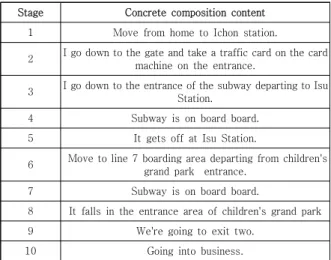
The goal behavior of this study consisted of the technology of the subjects approaching and moving the subway station. The task analysis was composed of 10 steps so that the subjects could recognize and learn the target behavior more systematically and easily. The task analysis was conducted by experts in lifelong education for the disabled in the university-affiliated lifelong education center. The results of the task analysis on the target behavior are the same as Table 2.
Stage Concrete composition content 1 Move from home to Ichon station.
2 I go down to the gate and take a traffic card on the card machine on the entrance.
3 I go down to the entrance of the subway departing to Isu Station.
4 Subway is on board board.
5 It gets off at Isu Station.
6 Move to line 7 boarding area departing from children's grand park entrance.
7 Subway is on board board.
8 It falls in the entrance area of children's grand park
9 We're going to exit two.
10 Going into business.
Table 2. Organization of Task Analysis on Target Behaviors
The section moving through the subway in the process of the target behavior of the subjects is the same as Figure 1.
Fig. 1. Target Behavioral Movement Section
2.5 The Composition of Independent Variables
The intervention program, which is an
independent variable of this study, was planned,
developed and operated at the university-affiliated
lifelong education center. The university-affiliated
lifelong education center that planned this study
was to collect the pilot cases before activating
the lifelong education curriculum and education
program for the developmental disabled in the
region, and also to collect the pilot cases as part
of the training course for professional manpower
in the related departments.
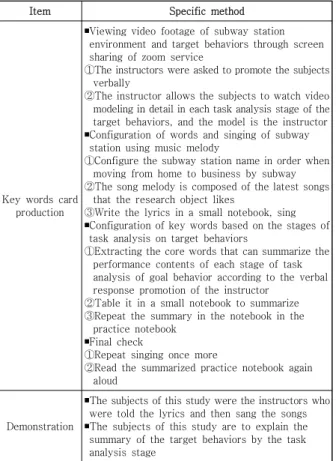
The intervention program of this study was conducted through zoom service between the instructor and the learner, and the basic guidance and attention of the mother and family were combined so that the subjects of the study, who are learners, could concentrate their attention when using zoom service in the study room at home. Since the scene of the intervention was composed of online-based zoom service, the intervention time for each subject of the study was applied equally. The composition of the specific intervention procedure is equal to Table 3
Item Specific method
Key words card production
■Viewing video footage of subway station environment and target behaviors through screen sharing of zoom service
①The instructors were asked to promote the subjects verbally
②The instructor allows the subjects to watch video modeling in detail in each task analysis stage of the target behaviors, and the model is the instructor
■Configuration of words and singing of subway station using music melody
①Configure the subway station name in order when moving from home to business by subway
②The song melody is composed of the latest songs that the research object likes
③Write the lyrics in a small notebook, sing
■Configuration of key words based on the stages of task analysis on target behaviors
①Extracting the core words that can summarize the performance contents of each stage of task analysis of goal behavior according to the verbal response promotion of the instructor
②Table it in a small notebook to summarize
③Repeat the summary in the notebook in the practice notebook
■Final check
①Repeat singing once more
②Read the summarized practice notebook again aloud
Demonstration
■The subjects of this study were the instructors who were told the lyrics and then sang the songs
■The subjects of this study are to explain the summary of the target behaviors by the task analysis stage
Table 3. The Configuration Procedure and Method of Independent Variables
The instructor, who is an expert in the university-affiliated lifelong education center, repeatedly provided language promotion to the research subjects through zoom service, and performed two procedures of independent variables. Two procedures were applied in the
independent variable composition of this study.
Each intervention session was assigned an hour and a half. The intervention scene in relation to the contents of the program presented in Table 3 consisted of the instructor and three subjects participating in the real-time video scene through zoom service. The three subjects participated in the intervention process to further promote the learning cognitive effect of the subjects. The subjects of this study were able to compare and share the procedure that reflected the step contents of each task analysis of the target behaviors with keywords and song lyrics according to the melody of the song they preferred in the production of keyword cards with the procedures that other colleagues composed differently. The subjects showed behaviors that imitate learning contents according to the song melody produced by other colleagues through voice function in real-time video through zoom service, and the instructor provided verbal feedback on the learning behavior of these subjects to ensure the effect of learning recognition. In addition, the subjects of the study increased their willingness to participate in learning by showing the behavior of sharing the feeling of song melody routinely while telling each other keywords related to learning contents.
On the other hand, the subjects of the study
participated in the procedure of demonstration
of the class easily as they increased their
participation and willingness in the production
of keyword cards. The subjects of the study
enjoyed singing according to the melody
reflected in the keyword composition, and
showed the behavior of expressing and
explaining important keywords to the instructor
with a loud voice for each step of the task
analysis of the target behaviors corresponding to
the learning contents. For example, the subjects
of the study shouted the keywords of Ichon
Station to professors and colleagues and
expressed feedback that "Teacher, I have to go to Ichon Station to get to work!" Accordingly, the instructor gave feedback on the contents of the expression of the research subjects as appropriateness, provided praise and encouragement, and judged the appropriateness of the learning cognitive effect.
For reference, the subjects of the study showed more fluent behavior of expressing the demonstration of the class to the instructors and colleagues while quickly producing keyword cards as they went to the later stage of the intervention. In conclusion, it was also the basis for comparative analysis of the interrelationship between the intervention scene of this study and the results of the positive response to the dependent variables of the subjects.
2.6 Data Measurement
Data were measured in the subway station, which is a performance evaluation environment, and the professors and the subjects of the study were met at the subway station. The data measurement time was applied differently for each subject of the study, and the formula was used to measure the data, which was converted into percentages of the number of steps performed by positive reactions among the total number of steps for task analysis of target behavior.
The operational definition of positive and misresponsive was constructed based on whether the subjects were performed accurately according to the contents of each task analysis step of the goal behavior without being provided with the help or promotion of the instructor. For example, when the subject of the study overlooks the contents of the task analysis step by step in performing the dependent variable or shows the reaction to perform according to his will, he did not recognize it as a positive response. And the subjects did not recognize it as a positive response when they exchanged and received
mutual words regardless of the help or promotion of the instructor when measuring the data. In addition, when the subjects started their responses in an accurate manner within 5 seconds of each step of task analysis in performing the target behaviors, they were recognized as positive responses.
2.7 Interobserver Reliability
To ensure the reliability of data measurement, the reliability measurement between observers was conducted. Students from the department of special education of the graduate school participated in the measurement of the reliability among observers, and they were provided with pre-training by experts in the lifelong education center affiliated with the university that planned this study. Experts and graduate students measured the reliability between actual observers when the results of the data measurement were more than 98% each other.
The reliability measurement between observers was made in all sessions of experimental conditions, and the formula for converting the number of matching numbers, centering on the number of task analysis steps of target behavior, into percentages was reflected in each session.
As a result, the reliability measurement results between the observers by the subjects were commonly calculated as 100%. The measurement was completed.
2.8 Intervention Fidelity
The intervention fidelity was measured to
verify how faithfully the independent variables of
this study are applied to the subjects. The same
graduate students who participated in the
reliability measurement between observers
participated in the intervention scene of the
professor to measure the intervention fidelity,
and the professor informed the graduate students
about the intervention procedures and methods.
And the fidelity of the intervention was conducted in all the intervention sessions.
The question of the fidelity of intervention was calculated by checking the examples and nos based on how faithfully the procedure elements of Table 3 were applied. The measurement formula is to convert the number of matches from the number of presupposed observations into a percentage. The fidelity of intervention was calculated as 100% for each study subject.
The reason why the results of the study were 100% for each study subject was that not only the three subjects participated in the intervention scene in the real-time video through zoom service, but also focused on the effect of the instructor's learning recognition on the research subjects.
2.9 Social Validity
Social validity was conducted on five professors who majored in lifelong education for the disabled. Social validity was measured using the Likert 5-point scale, and it was measured with the focus on how universally the independent and dependent variables are available in the field of lifelong education for the developmental disabled. In particular, the study measured social validity by focusing on whether independent variables in this study can be used as effective lifelong education textbooks by reflecting appropriate intervention procedures and methods through online-based learning of people with developmental disabilities who are staying in the home or those with developmental disabilities who come and go home and work.
The result of the average of the response results of the five professors participating was 4.85 points. Additionally, the functional implication of the social validity of this study is that even though the developmental disabled people maintain their professional life in adulthood, they did not acquire the basic move
skills applied in this study, which made them not achieve complete self-reliance. Therefore, the activation of lifelong education programs linked to special education in school age should be considered importantly.
3. Results
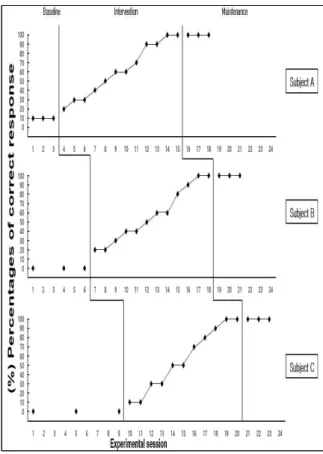
The results of this study showed that the subjects of the study effectively acquired dependent variables through independent variables. The specific results are as shown in Figure 2.
Fig. 2. The Rate of Positive Response to Target Behaviors
The subjects were found to be barely aware of
the performance of the target behavior during
the baseline phase according to the sequence of
the task analysis. The subjects did not have
geographical information moving from home to
subway station, so it was difficult to perform the first stage of task analysis. The study was conducted in step 1 of the task analysis of the study subject A. As a result, the subjects showed very poor results in the performance of target behavior during the baseline stage.
Since the intervention was applied to the subjects, the subjects showed a stable tendency to perform the positive response of the target behavior. The subjects did not recognize the geographical information coming and going from home and subway stations at the baseline stage, but they recognized this information well since the intervention was applied and performed it in a positive response. And as the application session of intervention increased, the subjects recognized subway stations that were not well remembered and recognized before, and they recognized the geographical position of which gate to approach for the destination. However, the subjects showed a lot of difficulties in performing the movement again when transferring to the subway station, and it was found that the intervention data gradually erased the misresponse by repeatedly reading and checking the related key words. In particular, the subjects were shown to have the same cognitive effect as the core words acquired in the intervention scene, reflecting the level of behavioral demonstration by accurately recognizing that the letters on the signs shown in the transfer section are the same as the key words acquired in the intervention scene.
Also, the subjects frequently showed problem behaviors that distracted when they were on the subway for their destination. Despite having to get off at the subway station corresponding to the destination, they showed problems such as misrepresentation to get off in advance or reading the words of the core word aloud at the subway station. In the case of the subject B, the behavior of boarding the subway itself is a positive response, but the behavior is often
observed as a slow response time and treated as a misreaction. The above case is not due to the slowness of the walking of the study target B, but the study target B is related to the misrepresentation of the subway late, saying to oneself that the key word on the notebook is written on that sign. As the intervention application session increased, the subjects finally showed the performance of the target behavior as more than 90% positive reaction, and the intervention was terminated. As a result, the subjects of the study erased the misresponse shown in each stage of task analysis of target behavior at the second half of the intervention.
In the maintenance stage after the intervention was completed, the subjects showed a complete positive response to the target behaviors. In the maintenance stage, the subjects did not show any misresponse to the target behaviors shown at the baseline or intervention stage.
The results of this study showed a positive response rate of the subjects with a stable tendency in the whole experimental conditions, and corresponded to quantitative results that are mutually favorable to the results of previous studies.
4. Discussion and Conclusion
The independent variables applied in this study were effective for dependent variables of the subjects, which can be concluded in that the functional relationship is significant. This study suggests several discussions and suggestions based on the functional implications of these conclusions.
First, this study applied lifelong education program in terms of educational cases, and educational institutions that planned and supervised the application correspond to lifelong education centers affiliated with universities.
Lifelong education for the developmental
disabled is not a welfare service but an educational support, so it should have a perspective linked to special education in school age. Only when case studies related to this should be activated, the possibility of that perspective can be realized[8]. Although it is difficult to reflect such realistic possibilities in the current welfare centers for the disabled, this study is valuable in that it has prepared an application plan to solve the difficulties at the lifelong education center attached to the university where research and development related infrastructure for the lifelong education for the disabled are strongly established[9]. In fact, this study can be a basic data at a time when educational standard of activity is needed for people with developmental disabilities to learn lifelong education knowledge and skills such as self-reliance ability in home or community scenes. Overall, this study could suggest the possibility that the developmental disabled can easily learn the lifelong education program by specifying the procedures and methods of teaching and learning activities, so that it could present a view leading the university-affiliated lifelong education center to a long-term school-type lifelong education institution such as a special school in school age.
In the future, the university-affiliated lifelong education center is expected to work with related departments such as special education departments to develop lifelong education learning materials for the developmental disabled and to establish long-term models and plans to run classes[10].
Second, this study revealed that it is possible to develop and operate lifelong education programs for people with developmental disabilities through mutual cooperation between the university-affiliated lifelong education center and the family. This study focused on preparing teaching and learning activities that can support lifelong education of people with developmental
disabilities by the university-affiliated lifelong education center, paying attention to COVID-19[11]. Accordingly, the experiment procedure for learning in the home was constructed, not by the developmental disabled people approaching and learning at the university-affiliated lifelong education center. In this regard, this study is not meaningful in that it actually embodied the cooperative function of the family for the lifelong education center attached to the university, but it is meaningful in that it presented the possibility. Because parents and families of the developmental disabilities who were the subjects of this study played an auxiliary role in helping them to concentrate on the online-based learning situation provided by the university-affiliated lifelong education center at home, but they can expect intervention scenes and activities that actually guide the developmental disabilities by pre-training family members at the university-affiliated lifelong education center[12]. Therefore, the case study project that develops lifelong education textbooks through cooperation between the university-affiliated lifelong education center and the family should be activated.
Third, this study suggests the possibility that
people with developmental disabilities can
achieve self-reliance ability such as vocational
basic skills without accessing actual self-reliance
living environment such as subway station
through the principle of key words card
production which was a major component of
intervention program which is an independent
variable. Since the intervention scene of this
study is based on online, it is more urgently
required to demonstrate the direct behavior of
the developmental disabled people who were the
subjects of the study and to approach the actual
community environment[13]. However, this study
was more intended to promote the learning
cognitive effect of the developmental disabled
people who were the subjects of the study as the
keyword principle. According to this cognitive effect, the developmental disabled people could actually generalize the performance of target behavior in a real community environment such as a subway station as a positive response.
Therefore, the generalization condition was not actually reflected in relation to the experimental conditions according to the research design of this study, but the other part implicitly reflected the effect of generalization. However, as in this study, the possibility of minimizing direct action demonstration in the actual community environment and achieving self-reliance ability of people with developmental disabilities will not be open[14]. It is judged that online-based lifelong education program textbooks and cases should be activated by developing a list of target behaviors that can make the most of the intervention program in this study while paying attention to the possibility.
Fourth, the combination of keyword card production and class demonstration in the process and method of the intervention program, which is an independent variable of this study, is a result of considering the learning cognitive effect and efficiency of the developmental disabled people who were the subjects of the study. If this study applied only one of the two procedures and methods of intervention program, which is an independent variable, it would have been difficult to raise the cognitive effect of the developmental disabled on the target behavior[15]. First, if the developmental disabled people who were the subjects of the study used only keyword card production, it would be difficult to expect the demonstration level of actual goal behavior or to recognize the contents of each task analysis step for the performance of goal behavior in detail[16]. This study is because the demonstration of the class applied after the production of the kilt card included the effects of self-teaching and self-directed learning for the developmental
disabled who were the subjects of the study[17].
Conversely, if the class demonstration was applied only with the absence of keyword card production in the composition of the procedures and methods of intervention, the developmental disabled people who were the subjects of the study would have had difficulty in recognizing the contents of the task analysis on the target behavior in detail. In addition, it is judged that more efforts were required to allocate the effective size of the intervention and the application time of the intervention[18-20].
Therefore, the new types of follow-up studies to verify the effectiveness of the two components composed of the intervention procedures and methods of this study in the generalization dimension should be developed in various ways.
The more in-depth discussion on the method and results of this study is that the study subjects were composed of three subjects, which improved the advantage of the application of intervention, and that the technique to increase the effect of learning recognition was applied continuously as two procedures. The target behaviors acquired by the subjects in this study are mostly promoted by the intervention procedure in which the instructor and the learner visit the subway station directly to conduct the action demonstration or parallel video modeling and action demonstration[2-3].
This study did not approach subway stations for
intervention scenes, and recognized the
environmental situation and structure of subway
stations only by video modeling of real-time
image context through zoom service. In the
cognitive process, the subjects of the study
functioned to replace the procedure of the
action demonstration by creating keyword cards
and demonstrating the class[21-23]. In addition
to video modeling, the existing precedent studies
show that the size of the effectiveness is different
from the case of presenting the size of the
effectiveness[7]. If this study reflected the subway
station which is the actual environment in the composition of the intervention environment of the subjects, the validity of the intervention elements of keyword production and class demonstration would be significantly reduced[24-26]. Therefore, it is thought that there was no significant intervention of other factors in relation to the results of this study.
On the other hand, the reason why the intervention procedure of the keyword card production and the demonstration of the class is effective is because the types of target behaviors acquired by the subjects correspond to the job preparation skills for workplace[27-29].
Therefore, it is important to consider the perspective of comparing the types of learning contents that developmental disabilities acquire in the context of lifelong education with the intervention procedures. This is the result of enhancing the validity of the independent variable from the perspective of the dependent variable, and it is far from the viewpoint of discussing whether the intervention of other factors other than the intervention in the procedure of the independent variable. However, it is emphasized once again that it should be considered importantly in order to establish a mutually significant functional relationship between independent variables and dependent variables[30, 31]. Compared to previous studies that applied video modeling to people with developmental disabilities, the part that increased the intervention effect only by the unique procedure of video modeling is deeply related to the above complex factors[4-6].
Subsequently, further studies should be conducted on which variables are considered and effective in relation to the composition of independent and dependent variables in the process of parallelizing and flexing video modeling and action demonstrations.
Finally, the limitation of this study is that the number of people with developmental disabilities
who participated in the study was three. The basis of this study, including the procedures and methods of the intervention program of this study, was the pilot study, but the single subject study was suitable, but in the future, it is necessary to make efforts to carry out the group experiment study in order to generalize the results of the study[32, 33].
In addition to the above discussions, one more discussion and suggestion in terms of specificity, the intervention program, which is an independent variable of this study, can be used as a program of practical training courses to train lifelong education professionals for the disabled. The independent variable of this study can be a basic case because it can be used as a practical program of lifelong education practice theory that should be organized and operated in special education department to train lifelong education professionals for the disabled.
Therefore, it is expected that the program of this study will be utilized when graduate students belonging to the Department of Special Education complete the cooperative course or convergence major related to lifelong education for the disabled.
REFERENCES
[1] Y. J. Kim. (2017). The Effects of Independence Life Training through Collaboration of Lifelong Education Center at University in Majoring Course on the Wash Staff Employment Task Skills for Individuals with Developmental Disabilities. Korean Journal of Physical, Multiple, & Health Disabilities, 60(3), 67-90.
DOI : 10.20971/kcpmd.2017.60.3.67
[2] Y. J. Kim & J. H. Jang. (2017). The Effects of In-Basket based Connection Learning in Lifelong Education Center at University through Workplace Instruction of Employer on Cooking Skills for Workers with Developmental Disabilities. Korean Journal of Physical, Multiple, & Health Disabilities, 60(4), 121-141.
DOI: 10.20971/kcpmd.2017.60.4.121
[3] Y. J. An & M. J. Lee. (2020). Analysis of Video
Modeling Interventions for People with Intellectual
Disabilities Using Quality Indicators. Journal of Intellectual Disabilities, 22(4), 195-220.
DOI : 10.35361/KJID.22.4.8
[4] B. K. Kim & Y. J. Park. (2018). A Meta Analysis of the Effects of Video Modeling Interventions for Students with Disabilities: Focused on Single Subjects Experimental Design Studies. Korean Journal of Special Education, 52(4), 69-86.
DOI : 10.15861/kjse.2018.52.4.69
[5] T. K. Na & S. H. Lee. (2019). The Effects of School Life Safety Instruction Using Video Modeling on School Safety Knowledge and Safety Behaviors of Elementary School Students with Developmental Disabilities in Special School. Journal of the Korean Association for Persons with Autism, 19(2), 59-84.
DOI : 10.33729/kapa.2019.2.3
[6] Y. M. Oh & S. H. Jung. (2020). Effects of Video Modeling and Least-to-Most Prompting on the Daily Living Skills in a High School Student with Intellectual Disabilities. Journal of Intellectual Disabilities, 22(3), 103-123.
DOI : 10.35361/KJID.22.3.5
[7] W. R. Kim & M. W. Ok. (2019). A Review of Research on Using Augmented Reality and Virtual Reality for Learning Achievement and Attitude of Students with Disabilities. The Korea Journal of Learning Disabilities, 16(3), 51-72.
DOI : 10.47635/KJLD.2019.16.3.51
[8] J. S. Ha & J. H. Park. (2013). The Effect on the Mathematical Word Problem Solving Ability of Students as at Risk for Mathematics Disability only, at Risk for both Reading and Mathematics Disabilities, or not at Risk using a Direct Instruction and Keyword Strategy. The Journal of Special Children Education, 15(3), 23-44.
DOI : 10.21075/kacsn.2013.15.3.23
[9] T. S. Lee & J. Y. Yoo. (2006). Effects of Semantics-Based-Representation Instruction on the arithmetic word problem solving performance of students with low achievement and mathematics learning disabilities. Journal of Special Education:
Theory and Practice, 7(2), 1-21.
[10] Y. J. Kim & J. K. Park. (2014). Survey of Parents' Awareness on Independence Living Supports of Adulthood after High School Graduates of Children with Intellectual Disabilities. Journal of Intellectual Disabilities, 16(3), 229-255.
[11] Y. J. Kim & J. H. Kim. (2011). Teachers' Perceptions of Special High Schools on the Future Planning Assessment for Students with Intellectual Disabilities.
Journal of Intellectual Disabilities, 13(2), 29-54.
[12] Y. J. Kim. (2015). A Study on Applications of School Age Evidence-based Transition Education Practices for Independent Living of Persons with Development Disabilities from Perspectives of Lifelong Learning, Korean Journal of Physical, Multiple, & Health
Disabilities, 58(1), 137-166.
DOI : 10.20971/kcpmd.2015.58.1.137
[13] Y. J. Kim & M. A. Do. (2015). The Effect of Social Story Intervention through Storybook Reading Activities on the Meal Preparation Skills at Work for Individuals with Intellectual Disabilities Who is in the Transition Classroom of a Special Education School, SECONDARY EDUCATION RESEARCH, 63(4), 465-504.
DOI : 10.25152/ser.2015.63.4.465
[14] Y. J. Kim & M. A. Do. (2015). The Effect of Residential Independence Training using Problem Solving Format of Study Materials on Work Preparation Skill of Individuals with Intellectual Disabilities, Journal of the Korean Association for Persons with Autism, 15(3), 101-126.
[15] J. H. Choi & Y. S. Han. (2015). Efficacy of Interventions for Lifespan Development and Vocational Training in Individuals with Disabilities: A Meta-Analysis of Single-Case Research, Korean Journal of Physical, Multiple, & Health Disabilities, 58(3), 137-162.
DOI : 10.20971/kcpmd.2015.58.3.137
[16] Y. J. Kim & M. A. Do. (2014). Discussion on Learning Style Assessment Methods in Evidence-Based Instructional Techniques for Independent Training of Students with Developmental Disabilities from the Perspective of Transition Education, JOURNAL OF EMOTIONAL & BEHAVIORAL DISORDERS, 30(4), 153-213.
[17] Y. J. Kim. (2018). The Effects of the Basic Literacy Education in Lifelong Education Center at University Connection Task based Homework on the Cooking Skills for Adults with Intellectual Disabilities Living in Group Home, The Study of Lifelong Education and Welfare for People with Disabilities, 4(1), 1-30.
[18] Y. J. Kim & R. H. Kwon. (2021). Organized the Scope of Professional Competency Performance of Lifelong Educators for the Disabled: Qualification Classification Convergence System Development of Coordinator and Professional Educator, The Journal of Humanities and Social Science, 12(1), 1123-1138.
DOI : 10.22143/HSS21.12.1.79
[19] J. Y. Kim. (2020). A Study on the Development of a Lifelong Education Support System Model for the People with Developmental Disabilities: Focused on the Case of Gyeonggi-do, The Study of Lifelong Education and Welfare for People with Disabilities, 6(2), 1-28.
[20] Y. J. Kim. (2018). A Curriculum to Improve the Cooperation Course of 「Fostering Lifelong Educators for Disabled」in the Special Education Department of University, Journal of Skills and Qualifications, 7(1), 187-213.
[21] J. S. Park. (2013). The Effects of Transition Activities
to Promote Daily Living The Effects of Transition
Activities to Promote Daily Living in Higher Education
Settings. JOURNAL OF SPECIAL EDUCATION &
REHABILITION SCIENCE, 52(3), 23-44.
[22] S. D. Hong & E. H. Cho. (2018). Research Trends in Lifelong Education Programs for Developmental Disabilities. Korean Journal of Elementary Education, 29(3), 95-113.
DOI : 10.20972/kjee.29.3.201809.95
[23] K. R. Kim & K. J. Lee. (2017). Establishment and Future Challenges of Lifelong Education Support for People with Disabilities According to Amendment of Lifelong Education Act. The Journal of Lifelong Education & Welfare for Disabled, 3(1), 1-30.
[24] D. S. Kang. (2017). The Effects of an Independent Living-Focused Continuing Education Program Targeting Adults with Developmental Disabilities.
Teacher Education Research, 56(1), 12-28.
DOI : 10.15812/ter.56.1.201703.12
[25] K. Y. Kim. (2019). Qualitative case study about the experience of management for lifelong education for learner with developmental disabilities. The Journal of Developmental Disabilities, 23(2), 29-47.
DOI : 10.34262/kadd.2019.23.2.47
[26] Y. J. Kim & R. H. Kwon. (2021). A Case Study on the Effect of the Extracurricular Program of Convergence Major in Lifelong Education of Persons with Disabilities in Universities on Restaurant Employment Skills of High School Students with Intellectual and Developmental Disabilities, Journal of Convergence for Information Technology, 11(7), 136-144.
DOI : 10.22156/CS4SMB.2021.11.07.136
[27] Y. J. Kim. (2020). The Convergence of Academic Speciality in Lifelong Education for the Disabled by Evidence-Based Practices of Special Education: A Viewpoint of Preparing General Lifelong Education, The Journal of Social Convergence Studies, 4(4), 75-89.
DOI : 10.37181/JSCS.2020.4.4.075
[28] Y. J. Kim. (2016). The Effects of Human Resource Development Program(HRDP) through Visual Support of Supervisors in Private Enterprise on Task Intensive Ability for Workers with Intellectual Disabilities, The Journal of Special Children Education, 18(4), 55-88.
DOI : 10.21075/kacsn.2016.18.4.55
[29] Y. J. Kim. (2016). The Effects of Diary Writing Activity based on Interactions with Co-Workers on the Bathroom Hygiene Management Skills of Workers with Autism Spectrum Disorder. Korean Journal of Special Education, 51(1), 21-43.
[30] Y. J. Kim & Y. S. Kang. (2013). Effects of the Smart Phone Mother Modeling's Intervention Package on RAMEN Cooking Skill for Students with Intellectual Disabilities. Korean Journal of Special Education, 48(3), 89-110.
[31] Y. J. Kim & Y. S. Kang. (2013). The Effects of the Social Story Intervention Referencing Mother's Mind on the Travel Skill for Students with Intellectual
Disabilities. Journal of Intellectual Disabilities, 15(4), 91-110.
[32] Y. J. Kim. (2015). The Effects of Job Training using Multiple Instructional Approaches on Coffee Shop Task Skills of Students with Mild Intellectual Disabilities, Journal of Educational Innovation Research, 25(2), 57-89.
[33] Y. J. Kim. (2014). Teacher Education of Special Education Teachers to Develop and Implement Community-Referenced Instructional Programs for Students with Autism Spectrum Disorders, JOURNAL OF EMOTIONAL & BEHAVIORAL DISORDERS, 30(1), 47-81.
김 영 준(Young-Jun Kim) [정회원]
․ 2007년 2월 : 대구대학교 유아특수교 육과(특수교육학사)
․ 2009년 2월 : 대구대학교 특수교육학 과(문학석사)
․ 2013년 8월 : 순천향대학교 교육과학 과(교육학박사)
․ 2013년 9월 ~ 2015년 7월 : 부산대 학교 박사후과정
․ 2020년 12월 ∼ 현재 : 덕성여자대학교 연구원
․ 관심분야 : 대학교육과정, 장애인평생교육
․ E-Mail : [email protected]
권 량 희(Ryang-Hee Kwon) [정회원]