한수지 49(6), 743-749, 2016
743
Copyright © 2016 The Korean Society of Fisheries and Aquatic Science pISSN:0374-8111, eISSN:2287-8815
Korean J Fish Aquat Sci 49(6),743-749,2016
Original Article
서 론
바지락
(Ruditapes Philippinarum)
은 진판새목(Lamellibran- chia)
백합과(Family Veneridae)
에속하며,
우리나라전해안에 널리분포하고있다.
바지락은간출시간3-4
시간되는곳에서부터수심
3-4 m
사이인조간대에주로분포하는패류로서1910
년경기도연안의간석지에서양식이시작되었고,
본격적인양 식은1980
년대에시작된것으로알려져있다(Park et al., 2010).
바지락은꼬막
,
가무락등과함께영세어민의주요소득원의하 나가되고있는데,
정부의계속적인지원정책에힘입어양식초제조방법을 달리하여 제조한 껍질붙은 냉동바지락(Tapes philippinarum) 의 껍질 개패율 및 품질특성 비교
박시영·강경훈·이재동·윤문주·강영미
1·성태종
2·권수현
3·추이권
4·김정균*
경상대학교 해양식품생명의학과/해양산업연구소, 1경상대학교 수산식품산업화 기술지원센터, 2한국국제대학교 외식조리학과,
3신선해양, 4태일식품
Comparison of Opened Rates and Quality Characteristics of Frozen Baby-clam In-shell Tapes philippinarum Prepared by Different
Processing Method
Si-Young Park, Kyung-Hun Kang, Jae-Dong Lee, Moon-Joo Yoon, Young-Mi Kang
1
, Tae-Jong Seoung2
, Su-Hyun Kweon3
,Yi-Kwon Choo4
and Jeong-Gyun Kim*Department of Seafood and Aquaculture Science/Institute of Marine Industry, Gyeongsang National University, Tongyeong 53064, Korea
1
Research Center for Industrial Development of Seafood, Gyeongsang National University, Tongyeong 53064, Korea
2
Department of Food Science and Culinary, International University of Korea, Jinju 52833, Korea
3
Company of SH Seafood, Gyeongnam, Goseong 52958, Korea
4
Company of Taeil food, Gyeongnam, Tongyeong 53003, Korea
We compared two different processing methods for preparing high quality frozen in-shell baby clam products. In the first method, sand and mud were removed from the clams, then they were vacuum packed in polyethylene film, boiled at 97°C for 6 min, and snap frozen in a cold air blast freezer (sample 1). The second processing method was similar, except the boiling process was excluded (sample 2). Both frozen products were boiled for 4 min, and then shucked and minced. Various quality metrics, such as the opening rates of shells, chemical composition, pH, volatile basic nitrogen (VBN), salinity, thiobarbituric acid (TBA), amino-N, total amino acids and free amino acids were measured, and sensory evaluation was conducted. The opening rates of shells of sample 1 and sample 2 were 98.3% and 4.67%, respectively. The proximate composition of sample 1 and sample 2 was 75.2% and 78.7% moisture, 19.7% and 16.2%
crude protein, 2.45 and 2.2% crude lipid, 2.8% and 2.1% ash, and 2.1% and 1.9% salinity, respectively. The L, a, b and ⊿E values were similar: 48.6 and 49.2, 3.9 and 3.9, 15.7 and 15.5, and 50.7 and 50.1 for sample 1 and sample 2, respectively. The sensory evaluation score of sample 1 was higher than that of sample 2. Sample 1 was deemed to be superior to sample 2; therefore, we determined that the boiling process is needed for manufacturing high-quality frozen clam products.
Key words: Boiled, Baby clam, Frozen, Shell-attached, Opened rates of shell
This is an Open Access article distributed under the terms of the Creative Commons Attribution Non-Commercial Licens (http://creativecommons.org/licenses/by-nc/3.0/) which permits unrestricted non-commercial use, distribution, and reproduction in any medium, provided the original work is properly cited.
http://dx.doi.org/10.5657/KFAS.2016.0743 Korean J Fish Aquat Sci 49(6) 743-749, December 2016
Received 28 October 2016; Revised 21 November 2016; Accepted 27 November 2016
*Corresponding author: Tel: +82. 55. 772. 9141 Fax: +82. 55. 772. 9149
E-mail address: [email protected]
박시영
ㆍ
강경훈ㆍ
이재동ㆍ
윤문주ㆍ
강영미ㆍ
성태종ㆍ
권수현ㆍ
추이권ㆍ
김정균744
기에는그생산능력이점차증가하는추세이었다
(Park, 1984).
2010
년이후바지락의국내총생산량은2010
년36,248 M/T, 2011
년37,929 M/T
이었으나, 2012
년25,028 M/T, 2013
년18,145 M/T, 2014
년19,951 M/T, 2015
년25,517 M/T, 2016
년14,992 M/T
으로그생산량이감소되고있는추세이다(Korean Fisheries Society, 2016).
바지락을물속에넣어가열하면
succinic acid
에의해독특하 고시원한맛이나며,
특히,
바지락은Fe
함량이많아임산부,
어린이,
노약자에게는빈혈을예방하고,
인체의cholesterol
수 치를낮추는데매우효과가큰것으로알려져있다(Choi et al., 2014a; Korean intellectual property office, 2006a).
어패류는성장과번식이빠르고이동이거의없기때문에어 민들이양식하기편리하며
,
주산란기인7
월초순부터8
월중순 을제외하고는항시채취되고있다.
최근들어건강에대한소 비자들의관심이매우높아지고있고이러한현상에편승하여 어패류에대한선호도가증가되고있는데,
그이유는어패류에함유되어있는영양소때문인것으로분석된다
(Kim and Jin,
2012). 2-4
월경가장맛이좋은것으로알려져있는바지락은보 통1-2%
소금물에여러시간담구어토사하게한후,
국,
찌개,
젓갈,
통조림등으로사용된다(Choi et al., 2014).
바지락에관한연구로는바지락의가공적성
(Lee et al., 1975),
레토르트파우치조미바지락의제조및저장중의품질안정성(Lee et al., 1984),
개량조개세절보일드통조림및바지락훈 제기름담금통조림(Park., 1984),
패류건제품의저장중지질 산화(Cho et al., 1988),
바지락을이용한풍미소재의가공및품 질특성(Moon et al., 2003),
가열시간이바지락육수품질에미 치는영향(Choi et al., 2014)
등이있다.
바지락에관한특허로 는포장생바지락(Korean intellectual property office, 2004a),
바지락조개국의가공방법(Korean intellectual property office, 2004b),
생바지락포장방법(Korean intellectual property of- fice, 2005),
바지락조개의가공및포장방법(Korean intellec- tual property office, 2006a),
바지락을이용한만두의제조방 법(Korean intellectual property office, 2006b),
완숙바지락 살(Korean intellectual property office, 2007a),
바지락해장국(Korean intellectual property office, 2007b),
바지락된장제조 방법(Korean intellectual property office, 2008),
바지락조미포 및이의제조방법(Korean intellectual property office, 2009),
바지락수라들깨탕제조방법(Korean intellectual property of- fice, 2014)
등이등록되어있다.
우리나라사람들은껍질붙은바지락을사용하여바지락국을 끓여서먹는습성이있으므로껍질붙은냉동바지락의제조방법 을검토할필요성이있다고판단되었다
.
따라서본연구에서는 생바지락을냉동시키는방법과자숙바지락을냉동시키는방 법으로껍질붙은냉동바지락을제조한후이들냉동품을자숙 하였을때의껍질개패율및이화학적특성을비교하였다.
재료 및 방법
실험재료
본실험에서사용한원료는경남고성소재
㈜
태양수산에서 각장3.5-4.5 cm (
평균4.0 cm),
각고2.5-3.5 cm (
평균3.0 cm),
체중6.9-11.0 g (
평균8.9 g)
인껍질붙은바지락을제공받아실 험에사용하였다.
껍질붙은 냉동바지락 제조방법
바지락을
3%
식염수중에서12
시간동안토사시켜펄및모 래를토출시킨후수세한다음,
껍질부분의협잡물등을제거시 키고세척하였다.
이어서투명한폴리에틸렌필름에 껍질붙은바지락
500 g
을살쟁임한후진공포장하였다.
진공포장된상태로
97℃
의스팀을6
분간불어넣어바지락껍질이약간벌어 지도록가열한후찬물로급냉시켰다.
이어서air blast
방식으로
-60℃
에서급속동결한후-20℃
의냉동고에서저장하였다(Sample-1).
별도로가열공정을거치지않은시료도함께동결하여대조시료로하였다
(Sample-2).
본실험에서는1
주일간냉 동시킨껍질붙은냉동바지락을진공포장된상태로끓는물에 침지하여4
분간끓인후개봉하고탈각하였고,
바지락육을선 별하여10
분간액을탈수시킨후육을homogenizer (PT-MR 2100, PolytronⓇ, Switzerland)
로갈아서시료로사용하였으 며,
관능평가및조직감의경우는바지락육을그대로사용하 였다.
껍질 개패율
자숙공정을거쳐서제조한껍질붙은냉동바지락과자숙공정 을거치지않고제조한껍질붙은냉동바지락의껍질개패율을 조사하였다
.
즉,
동결된시료를포장지에들어있는그대로끓는 물에4
분간삶은후개봉하여패각이50%
이상벌어진바지락 의수를세어껍질개패율을계산하였다.
일반성분, pH, 염도 및 brix
일반성분은
AOAC (1995)
법에 따라,
수분은상압가열건조 법,
조지방은Soxhlet
법,
회분은건식회화법,
조단백질은semi- micro Kjeldahl
법으로정량하였으며, pH
는시료육에10
배량의 순수를가하여균질화한후pH meter (pH 1500, Eutech Instru- ments, Singapore)
로써 측정하였다.
염도는Mohr
법(AOAC, 1995)
으로측정하였으며, brix
는hand-held refractometer (N1, Atago Co., Japan)
로측정하였다.
휘발성염기질소 함량, TBA값 및 아미노질소 함량
지질산패도를나타내는thiobarbituric acid (TBA)
값은시료5 g
을정평한후Tarladgis
등의수증기증류법(Tarladgis, 1960)
으로 측정하였다.
휘발성염기질소(volatile basic nitrogen,
VBN)
함량은Conway unit
를사용하는미량확산법(Ministry
껍질붙은 냉동바지락의 껍질 개패율 및 품질특성
745
of Social Welfare of Japan, 1960)
으로측정하였으며,
아미노 질소함량은Formol
적정법(Kohara T, 1982)
으로측정하였다. 색조
각 시료의
L
값(lightness,
명도), a
값(redness,
적색도), b
값(yellowness,
황색도)
및⊿E
값(color difference,
색차)
을직시 색차계(ZE-2000, Nippon Denshoku, Japan)
로써측정하였고,
이때표준백판(standard plate)
의L
값은99.98, a
값은-0.01, b
값은0.01
이었다.
본실험에서는각시료의육을homogenizer
로갈아실험에사용하였다.
조직감
바지락 육질부분의 조직감은 레오메터
(Rheometer Com- pac-100, Sun Scientific Co., Japan)
를 사용하여 절단시험(Shear-press test)
으로 바지락 시료의 질김도를 측정하였다.
즉,
바지락시료는최대한균일한것으로시료를선정하여레오 메터로써절단하는데소요되는힘으로나타내었다.
이때max force
값의계산은rheology data system ver. 2.01
에의해처리 하였다.
총아미노산
총아미노산의분석을위한시료는
0.2 g
을정밀히취하여시험 관에넣고6 N HCl
을2 mL
가하고,
밀봉하여110℃
의heating block (HF21, Yamato, Japan)
에서48
시간동안가수분해시켰 다. Glass filter
로여과하고얻은여액을진공회전증발기(RW- 0528G, Lab. Companion, Korea/C-WBE-D, Changshin Sci., Korea/Rotary evaporator N-1000, EYELA, Japan)
로60℃
에 서감압농축하여, sodium citrate buffer (pH 2.2)
로25 mL
되게 정용하여제조하였다.
총아미노산의분석은전처리한각시료 의일정량을아미노산자동분석기(Automatic amino acid ana- lyzer S-433, Sykam, Germany)
에주입하여실시하였으며,
이 를토대로동정및정량하였다.
유리아미노산
유리아미노산함량은시료
20 g
에20% trichloroacetic acid (TCA) 30 mL
를가하고vortex mixer (G-560, Scientific Indus- tries, USA)
로30
분간균질화한 후원심분리기(SUPRA 22K Plus, Hanil Science Industrial Co., Ltd, Korea)
로8,000 rpm
에서15
분간원심분리시킨다음100 mL
로정용하였고,
분액 여두에옮겨에틸에테르를가한후격렬히흔들어상층부의에 테르층을버리고하층부만을취하여진공회전증발기로농축하 였다. Lithium citrate buffer (pH 2.2)
를사용하여25 mL
로정 용한후아미노산자동분석계(Automatic amino acid analyzer S-433, Sykam, Germany)
로측정하였다.
관능검사
관능검사는
10
인의관능검사원을구성하여냄새,
맛,
조직감및색조등관능적기호도의척도가되는항목에대하여
5
단계 평점법(5:
아주좋음, 4:
좋음, 3:
보통, 2:
싫음, 1:
아주싫음)
으 로평가하였고,
평가점수중최고및최저값을뺀나머지점수 의평균값으로결과를나타내었다.
데이터통계처리는ANOVA test
를이용하여분산분석한후, Duncan
의다중위검정(Steel and Torrie, 1980)
으로최소유의차검정(P<0.05)
을실시하였다.
결과 및 고찰
껍질 개패율
껍질붙은냉동바지락의껍질개패율측정결과는
Table 1
과같다
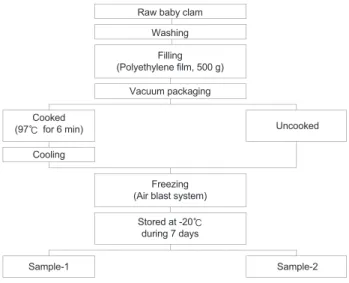
. Sample-1 (
바지락을진공포장하고자숙공정을거친후동결한시료
)
과Sample-2 (
바지락을진공포장한후자숙공정을거치지않고동결한시료
)
의껍질개패율을비교한결과, Sam-
ple-1
은98.3% (
바지락300
개중295
개의패각이열림)
이었고, Sample-2
는4.67% (
바지락300
개중14
개의패각이열림)
이 었다.
즉,
껍질붙은냉동바지락을제조할경우자숙공정을거친 후냉동시키는것이자숙공정없이냉동시킨경우보다그껍질Table 1. Comparison of opened rates of shell of frozen baby-clam in shell Tapes philippinarum prepared by different processing method
Samples Opened
shells (ea) Unopened
shell (ea) Opened shells (%)
Sample-1 295 5 98.3
Sample-2 14 286 4.67
Sample-1, Sample-2: refer to the comment in Fig. 1.
Fig. 1. Flowsheet of processing of frozen baby-clam in shell Tapes philippinarum. Sample-1, Cooked and frozen baby-clam in shell;Sample-2 : Uncooked and frozen baby-clam in shell.
Raw baby clam Washing
Filling (Polyethylene film, 500 g)
Vacuum packaging Cooked
(97℃ for 6 min) Uncooked
Cooling
Freezing (Air blast system)
Stored at -20℃
during 7 days
Sample-1 Sample-2
0.402
0.374
0 0.1 0.2 0.3 0.4 0.5
Sample-1 Sample-2
TBA value (O.D.)
348.3
466.3
0 100 200 300 400 500 600
Sample-1 Sample-2
Amino-N (mg/100 g)
1,152
980
0 300 600 900 1,200 1,500 1,800
Sample-1 Sample-2
Hardness (g/cm
2)
박시영
ㆍ
강경훈ㆍ
이재동ㆍ
윤문주ㆍ
강영미ㆍ
성태종ㆍ
권수현ㆍ
추이권ㆍ
김정균746
개패율이월등히높음을알수있었다
.
일반적으로바지락을이 용하여탕류를제조할경우바지락패각이열려있는상태인것 이소비자들의선호도가높기때문에냉동바지락을제조할경 우본실험에서와같은자숙공정을거쳐냉동품으로제조하는 것이좋을것으로판단되었다.
일반성분, pH, 휘발성염기질소 및 염도
껍질붙은냉동바지락의일반성분함량
, pH
및휘발성염기질 소함량및염도는Table 2
와같다. Sample-1
및Sample-2
의수 분함량은각각75.2
및78.7%,
조단백질함량은각각19.7
및16.2%,
조지방함량은각각2.4
및2.2%,
조회분함량은각각2.8
및2.1%
이었다.
이와같이자숙후냉동시킨Sample-1
은자숙공정없이냉동시킨
Sample-2
에비해수분함량은낮았으나조단백질
,
조지방및조회분함량은높은값이었는데,
그이 유는자숙과정에서Sample-1
이Sample-2
에비해육즙이많 이빠져나왔기때문에수분함량이낮아졌고상대적으로다른 성분들은그값이높아졌다고판단되었다. Moon et al. (2003)
은바지락을이용하여풍미소재를조제하였는데이때사용한 바지락원료육의일반성분을측정한결과수분78.9%,
조단백 질12.4%,
조지방1.2%
및조회분2.7%
이었다고보고하여본 실험의결과와비교하여조단백질을제외한나머지값들이거 의비슷하였다. Sample-1
및Sample-2
의pH
는각각7.03
및6.95
이었고,
휘발성염기질소함량은각각6.8
및5.5 mg/100 g
이었다. Sample-1
및Sample-2
의염도는각각1.9
및2.1%
로
Sample-1
이Sample-2
에비해그값이낮았는데그이유는Sample-1
이자숙과정에서더많은양의육수가빠져나왔고,
그 과정에서염분도같이빠져나왔기때문으로판단되었다. Choi
et al. (2014)
은바지락육수를제조하기위하여가열처리하였 는데,
그결과가열시간이길어질수록육수의염도가증가하였 다고보고하였다.
색조
Sample-1
과Sample-2
의표면색깔의차이를살펴보기위해 직시색차계로써색조를측정한결과는Table 3
과같다. Sam- ple-1
의명도(L
값),
적색도(a
값),
황색도(b
값)
및색차(⊿E
값)
는 각각48.6, 3.9, 15.7
및50.7
이었고Sample-2
는각각49.2, 3.9, 15.5
및50.1
로두시료의색조는비슷한값이었다. Lee et al.
(1984)
은레토르트파우치조미바지락의제조과정중40℃
에서
3
시간건조한바지락의경우살균전에는명도,
적색도,
황색 도및색차는각각42.1, 0.0, 11.7
및55.8
이었으며,
살균후에 는각각39.5, 1.0, 8.7
및58.2
라고보고하였는데,
본실험의결 과와비교하여명도,
적색도및황색도는낮고색차값은높은것 을알수있었다.
TBA값
껍질붙은냉동바지락의지질의산화정도를
TBA
값으로살펴 본결과는Fig. 2
와같다. Sample-1
및Sample-2
의TBA
값은각 각0.402
및0.374
로Sample-1
이Sample-2
에비해약간높은 Table 2. Comparison of proximate composition, pH, volatile basic nitrogen (VBN), and Salinity of frozen baby-clam in shell Tapes philip- pinarum prepared by different processing methodSamples Proximate composition (g/100 g)
pH VBN
(mg/100 g) Salinity (%)
Moisture Crude protein Crude lipid Ash
Sample-1 75.2±0.1a 19.7±0.1a 2.4±0.2a 2.8±0.2a 7.03 6.8±1.4 1.9±0.3
Sample-2 78.7±0.1b 16.2±0.2b 2.2±0.3a 2.1±0.0b 6.95 5.5±0.0 2.1±0.3
Sample-1, Sample-2: refer to the comment in Fig. 1. Values are the means±standard deviation of three determination. Means within each column followed by the same letter are not significantly different (P<0.05).
Table 3. Comparison of color value of frozen baby-clam in shell Tapes philippinarum prepared by different processing method
Color value Sample-1 Sample-2
L 48.6±0.3 49.2±0.3
a 3.9±0.1 3.9±0.3
b 15.7±0.5 15.5±0.2
⊿E 50.7±0.4 50.1±0.1
Sample-1, Sample-2: refer to the comment in Fig. 1. Values are the means±standard deviation of three determination.
Fig. 2. Comparison of thiobarbituric acid (TBA), value of frozen baby-clam in shell Tapes philippinarum prepared by different pro- cessing method. Sample-1, Sample-2: refer to the comment in Fig.
1. Values are the means±standard deviation of three determination.
Raw baby clam Washing
Filling (Polyethylene film, 500 g)
Vacuum packaging Cooked
(97℃ for 6 min) Uncooked
Cooling
Freezing (Air blast system)
Stored at -20℃
during 7 days
Sample-1 Sample-2
0.402
0.374
0 0.1 0.2 0.3 0.4 0.5
Sample-1 Sample-2
TBA value (O.D.)
348.3
466.3
0 100 200 300 400 500 600
Sample-1 Sample-2
Amino-N (mg/100 g)
1,152
980
0 300 600 900 1,200 1,500 1,800
Sample-1 Sample-2
Hardness (g/cm
2)
껍질붙은 냉동바지락의 껍질 개패율 및 품질특성
747
값이었다
. Cho et al. (1998)
은바지락건제품을4℃
에서저장할경우저장중
TBA
값은계속증가하였으나, 25℃
에서저장할경우저장
30
일까지는그값이증가하다가그이후에는감소하 는경향이었으며,
그리고저장30
일의경우4℃
및25℃
에서저 장한바지락건제품의TBA
값은각각0.11
및0.08
로25℃
에비 해4℃
에서저장할경우그값이높았다고보고하였다. 아미노질소 함량
제조방법을달리하여제조한껍질붙은냉동바지락의자숙후 아미노질소함량은
Fig. 3
과같다. Sample-1
및Sample-2
의아 미노질소함량은각각348.3
및466.3 mg/100 g
으로Sample-1
의값이Sample-2
의값보다낮았는데,
그이유는Sample-1
이 자숙과정에서더많은양의육수가빠져나온것과연관성이있 는것으로판단되었다. Cho et al. (1998)
은바지락건제품을4℃
및25℃
에서저장할경우저장60
일까지는아미노질소함 량이증가하다가그이후에는감소하는경향이었으나, 60
일이 상저장했을경우4℃
및25℃
에서저장한바지락건제품의그 값은각각270.0
및350.0 mg/100 g
로4℃
에비해25℃
에서 저장할경우그값이높았다고보고하였다.
그리고Noh et al.
(2011)
은조미홍합레토르트파우치제품의경우아미노질소함량은
Fo
값이증가함에따라육성분이계속열분해되어그값이 미미하나마증가하는경향이었다고보고하였다.
조직감
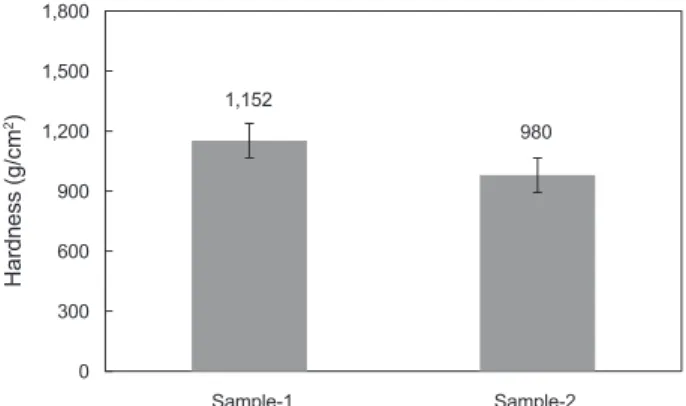
제조방법을 달리하여 제조한 껍질붙은 냉동바지락의 조직 감을비교하기위해레오메터로측정한결과는
Fig. 4
와같다. Sample-1
및Sample-2
의조직감은각각1,152
및980 g/cm
2으 로Sample-1
의조직감값이더높았는데,
그이유는Sample-1
이자숙과정에서더많은양의육수가빠져나와조직이단단해 졌기때문으로판단되었다. Lee et al. (1984)
은레토르트파우 치조미바지락의경우살균전에는47,500 g/cm
2,
살균후에는36,000 g/cm
2로살균후조직감값이더높았다고보고하였다. Noh et al. (2011)
은레토르트파우치조미홍합을고온살균할경 우, Fo
값이증가할수록hardness
값이증가되어가열살균시고 온에서의열처리로인한조직의연화보다가압에따른수분의 유출로인해조직이오히려단단해짐을알수있다고보고하여 본실험에서와같이열처리를많이한시료의조직감값이높은 점은일치하였다.
총아미노산 함량
제조방법을달리하여제조한껍질붙은냉동바지락의총아미 노산함량은
Table 4
에나타내었으며, Sample-1
및Sample-2
는각각16,890.7
및13,994.5 mg/100 g
이었다. Sample-1
및Sample-2
의두시료모두glutamic acid
가각각2,263.5 (13.4)
및1,857.0 (13.3) mg/100 g
으로가장함량이많았으며,
그다음 이aspartic acid, lysine
및arginine
의순이었다Joo et al. (1996)
은바지락을40, 50
및60℃
의온도에서수분이
10%
전후가될때까지건조할경우각온도에서의총아미노산함량은각각
6,420.47, 5,374.93
및5,411.29 mg/100 g
로건 조온도가높을수록총아미노산의함량이낮아졌으며,
건조바 지락의주요아미노산은glutamic acid, aspartic acid, glycine
및lysine
이라고보고한바있다.
Moon et al. (2003)
은바지락을이용하여풍미소재를조제하 였는데이때사용한바지락원료육의총아미노산함량을측정 한결과12,676.8 mg/100 g
이었다고보고하였고,
주요아미노 산으로는glutamic acid
함량이1,363.3 mg/100 g
으로가장많 았으며,
그다음이arginine, aspartic acid
및proline
의순이라고 보고하여본실험의결과와차이가있었다.
유리아미노산 함량
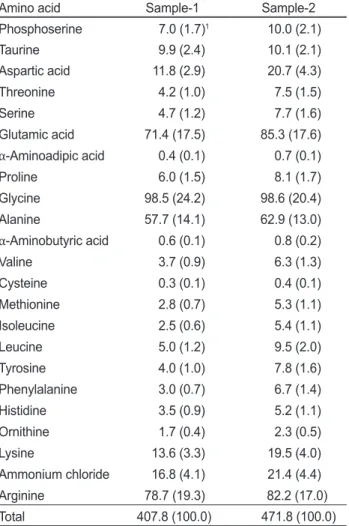
제조방법을달리하여제조한껍질붙은냉동바지락의유리아 미노산함량은
Table 5
에나타내었으며,
총유리아미노산함량 Fig. 3. Comparison of amino-N content of frozen baby-clam inshell Tapes philippinarum prepared by different processing meth- od. Sample-1, Sample-2: refer to the comment in Fig. 1. Values are the means±standard deviation of three determination.
Raw baby clam Washing
Filling (Polyethylene film, 500 g)
Vacuum packaging Cooked
(97℃ for 6 min) Uncooked
Cooling
Freezing (Air blast system)
Stored at -20℃
during 7 days
Sample-1 Sample-2
0.402
0.374
0 0.1 0.2 0.3 0.4 0.5
Sample-1 Sample-2
TBA value (O.D.)
348.3
466.3
0 100 200 300 400 500 600
Sample-1 Sample-2
Amino-N (mg/100 g)
1,152
980
0 300 600 900 1,200 1,500 1,800
Sample-1 Sample-2
Hardness (g/cm
2)
Fig. 4. Comparison of hardness value of frozen baby-clam in shell Tapes philippinarum prepared by different processing method.
Sample-1, Sample-2: refer to the comment in Fig. 1. Values are the means±standard deviation of three determination.
Raw baby clam Washing
Filling (Polyethylene film, 500 g)
Vacuum packaging Cooked
(97℃ for 6 min) Uncooked
Cooling
Freezing (Air blast system)
Stored at -20℃
during 7 days
Sample-1 Sample-2
0.402
0.374
0 0.1 0.2 0.3 0.4 0.5
Sample-1 Sample-2
TBA value (O.D.)
348.3
466.3
0 100 200 300 400 500 600
Sample-1 Sample-2
Amino-N (mg/100 g)
1,152
980
0 300 600 900 1,200 1,500 1,800
Sample-1 Sample-2
Hardness (g/cm
2)
박시영
ㆍ
강경훈ㆍ
이재동ㆍ
윤문주ㆍ
강영미ㆍ
성태종ㆍ
권수현ㆍ
추이권ㆍ
김정균748
은각각
407.8
및471.8 mg/100 g
이었다.
두시료모두glycine
함량이각각98.5 (24.2%)
및98.6 (20.4%) mg/100 g
으로가장 함량이많았으며,
다음이glutamic acid, arginine
및alanine
의 순이었다. Sample-1
의총유리아미노산함량이Sample-2
의그 값보다낮았는데,
그이유는Sample-1
이자숙과정에서더많은 양의육수가빠져나왔기때문인것으로판단되었다.
Choi et al. (2014)
은가열시간이바지락육수의품질에미치는영향을조사하기위해서바지락과부원료를물에함께넣어
20,
30, 40, 50
및60
분간가열한후유리아미노산함량을측정한 결과,
총유리아미노산함량은각각2,684.9, 3,322.9, 3,526.1, 3,655.9
및3,841.3 μL/L
로가열시간이증가할수록그값이높 아진다고하였는데,
본실험에서의Sample-1
은Sample-2
에비 해흘러나온육수의양이많아서총유리아미노산함량이적어 진것과상관이있는것으로판단되었다.
관능적 특성
제조방법을달리하여제조한껍질붙은냉동바지락의관능적 특성을살펴보기위해색조
,
냄새,
맛및조직감등관능적특성 에대하여5
단계평점법(5:
아주좋음, 4:
좋음, 3:
보통, 2:
싫음, 1:
아주싫음)
으로관능검사를실시한결과는Table 6
과같다.
Table 4. Comparison of total amino acid of frozen baby-clam in shell Tapes philippinarum prepared by different processing method(mg/100 g)
Amino acid Sample-1 Sample-2
Aspartic acid 1,734.0 (10.3) 1,359.6 (9.7)1
Threonine 835.5 (4.9) 489.2 (3.5)
Serine 909.0 (5.4) 817.0 (5.8)
Glutamic acid 2,263.5 (13.4) 1,857.0 (13.3)
Proline 1,072.5 (6.3) 915.7 (6.5)
Glycine 1,071.0 (6.3) 844.5 (6.0)
Alanine 1,045.5 (6.2) 922.3 (6.6)
Cysteine 110.2 (0.7) 87.0 (0.6)
Valine 813.0 (4.8) 654.5 (4.7)
Methionine 504.0 (3.0) 441.3 (3.2)
Isoleucine 723.0 (4.3) 613.5 (4.4)
Leucine 1,279.5 (7.6) 1,005.6 (7.2)
Tyrosine 481.5 (2.9) 415.4 (3.0)
Phenylalanine 648.0 (3.8) 523.4 (3.7)
Histidine 364.5 (2.2) 300.6 (2.1)
Lysine 1,491.0 (8.8) 1,235.3 (8.8)
Ammonia 321.0 (1.9) 303.3 (2.2)
Arginine 1,224.0 (7.2) 1,209.3 (8.6)
Total 16,890.7 (100.0) 13,994.5 (100.0)
1Percentage (%) to total amino acid. Sample-1, Sample-2: refer to the comment in Fig. 1.
Table 5. Comparison of free amino acid of frozen baby-clam in shell Tapes philippinarum prepared by different processing method
(mg/100 g)
Amino acid Sample-1 Sample-2
Phosphoserine 7.0 (1.7)1 10.0 (2.1)
Taurine 9.9 (2.4) 10.1 (2.1)
Aspartic acid 11.8 (2.9) 20.7 (4.3)
Threonine 4.2 (1.0) 7.5 (1.5)
Serine 4.7 (1.2) 7.7 (1.6)
Glutamic acid 71.4 (17.5) 85.3 (17.6)
⍺-Aminoadipic acid 0.4 (0.1) 0.7 (0.1)
Proline 6.0 (1.5) 8.1 (1.7)
Glycine 98.5 (24.2) 98.6 (20.4)
Alanine 57.7 (14.1) 62.9 (13.0)
⍺-Aminobutyric acid 0.6 (0.1) 0.8 (0.2)
Valine 3.7 (0.9) 6.3 (1.3)
Cysteine 0.3 (0.1) 0.4 (0.1)
Methionine 2.8 (0.7) 5.3 (1.1)
Isoleucine 2.5 (0.6) 5.4 (1.1)
Leucine 5.0 (1.2) 9.5 (2.0)
Tyrosine 4.0 (1.0) 7.8 (1.6)
Phenylalanine 3.0 (0.7) 6.7 (1.4)
Histidine 3.5 (0.9) 5.2 (1.1)
Ornithine 1.7 (0.4) 2.3 (0.5)
Lysine 13.6 (3.3) 19.5 (4.0)
Ammonium chloride 16.8 (4.1) 21.4 (4.4)
Arginine 78.7 (19.3) 82.2 (17.0)
Total 407.8 (100.0) 471.8 (100.0)
1Percentage (%) to total free amino acid. Sample-1, Sample-2: refer to the comment in Fig. 1.
Table 6. Comparison of sensory evaluation of frozen baby-clam in shell Tapes philippinarum prepared by different processing method
Sensory evaluation Sample-1 Sample-2
Color 4.6±0.2a 2.5±0.2b
Odor 4.5±0.2a 2.5±0.7b
Taste 4.2±0.4a 3.6±0.8b
Texture 4.8±0.1a 2.1±0.2b
Over all
acceptance 4.5±0.8a 3.0±0.6b
Values are the means±standard deviation of three determination.
Means within each line followed by the same letter are not signifi- cantly different (P<0.05). Sample-1, Sample-2 : refer to the com- ment in Fig. 1. 5 scales average: 1, very poor; 2, poor; 3, accept- able; 4, good; 5, very good.
껍질붙은 냉동바지락의 껍질 개패율 및 품질특성
749
색
,
냄새,
맛및조직감및종합적평가모든검사에서Sample-1
의선호도가더높았다.
따라서냉동바지락을제조할경우본실 험에서와같은자숙공정을거쳐냉동품으로제조하는것이바 람직하다고판단되었다.
References
AOAC. 1995. Official methods of analysis. 16th ed. Association of Official Analytical Chemists, Washington DC, U.S.A., 69-74.
Cho HS, Cho TY, Lee KH, Lee NG, Joo DS, Kim GE and Lee JH. 1988. Lipid oxidation in dried shellfish during the stor- age. J Kor Fish Soc 31, 594-598.
Choi EJ, Kim DS, Bae GK and Choi SK. 2014. The effect of heating time on the quality of short necked clam stock. Kor J Chulinary Res 20, 65-78.
Joo OS, Choi JS, Kang KS, Ha YR, Cho YU and Shim KH.
1996. Changes in amino acid contents during drying and storage of shellfish meat. J Kor Soc Food Sci Nutr 25, 768- Kim SH and Jin YH. 2012. Food culinary science. Jigu Publish-773.
ing Co. Seoul, Korea, 227, 236, 238-239, 308.
Kohara T. 1982. Handbook of food analysis. Keonpakusha, To- kyo, Japan, 51-55.
Korean Fisheries Society. 2011. Korean fisheries yearbook.
Korean intellectual property office. 2004a. A wrapping short- necked clam. application number 2020040004180, regis- tration number 2003512830000.
Korean intellectual property office. 2004b. application number 1020010069626, registration number 1004304130000 . Korean intellectual property office. 2005. The packing
method of raw short-necked clams. application num- ber 1020050039190, registration number 1020050053560 . Korean intellectual property office. 2006a. Surf clam processing
and packing a method. application number 1020040046421 , registration number 1005497340000 .
Korean intellectual property office. 2006b. Method for prepar- ing a bun using short-necked clam. application number 1020060039304, registration number 1006068650000.
Korean intellectual property office. 2007a. Full ripened short- necked clam meat. application number 1020060139162 ,reg- istration number 1007537620000 .
Korean intellectual property office. 2007b. Haejang-guk using a short-necked clam. application number 1020060122916 , registration number 1007151480000 .
Korean intellectual property office. 2008. Thin-shelled surf clam soybean paste manufacturing method. application number 1020070082175, registration number 1008646750000.
Korean intellectual property office. 2009. Slices of seasoned and dried manila clam and manufacturing method thereof.
application number 1020080126684, registration number 1010645650000.
Korean intellectual property office. 2014. Method for manu- facturing Perilla soup containing short-necked clam. ap- plication number 1020130003813, registration number 1020140091850 .
Lee EH, Kim JG and Cha YJ. 1984. Studies on processing and keeping quality of retort pouched foods (4) Preparation and keeping quality of retort pouched seasoned baby clam. Bull Kor Fish Soc 17, 499-505.
Lee, EH, Pybun JH, Kim SH and Chung SY. 1975. Suitability of shellfishes for processing 1. Suitability of baby clam for processing. Bull Kor Fish Soc 8, 20-30.
Noh YN, Yoon HD, Kong CS, Nam DB, Park TH and Kim JG.
2011. Preparation of retort pouched seasoned sea mussel and its quality stability during storage. J Fish Mar Sci Edu 23, 709-722.
Ministry of Social Welfare of Japan. 1960. Guide to experiment of sanitary insfection. Ⅲ. Volatile basic nitrogen. Kenpaku- sha. Tokyo, Japan, 30-32.
Moon JH, Kim JT, Kang ST, Hur JH and Oh KS. 2003. Process- ings and quality characteristics of flavoring substance from the short-neck clam, Tapes Philippinarum. J Kor Fsih Soc 36, 210-219.
Park KJ, Choi YS, Heo S, Kang HW, Han HS and O HC. 2010.
Report on the sediment types, environmental parameters, density and biometry of Manila clam, Ruditapes philippi
narum in Gyeonggi bay off the West coast of Korea. Kor J
Malacol 26, 267-273.Park YH. 1984. Evaluation of thermal processes for canned marine products (3) Canned minced hen-clams in brine and canned smoked baby-clams in oil. J Kor Fish Soc 17, 306- Steel R GD and Torrine JH. 1980. Principle and procedures 312.
of statistics, 1st ed., McGraw-Hill Kogakusha, Tokyo, Ja- pan,187-221.
Tarladgis BG, Watts MM and Younathan MJ. 1960. A distilla- tion method for quantitative determination of malonalde- hyde in rancid food. J American Oils Chem Soc 37, 44-48.