https://doi.org/10.11626/KJEB.2021.39.1.119
Review paper
한반도 자생생물 조사·발굴 연구사업 고찰(2006~2020)
배연재1,2,*, 조기종2, 민기식3, 김병직1, 현진오4, 이진환5, 이향범6, 윤정훈7, 황정미8, 염진화1
1환경부 국립생물자원관, 2고려대학교 환경생태공학부, 3인하대학교 생명과학과, 4㈜동북아생물다양성연구소,
5상명대학교 생명과학과, 6전남대학교 농생명화학과, 7성균관대학교 식품생명공학과, 8고려대학교 한국곤충연구소
Review of the Korean Indigenous Species Investigation Project
(2006-2020) by the National Institute of Biological Resources under the Ministry of Environment, Republic of Korea
Yeon Jae Bae1,2,*, Kijong Cho2, Gi-Sik Min3, Byung-Jik Kim1, Jin-Oh Hyun4, Jin Hwan Lee5, Hyang Burm Lee6, Jung-Hoon Yoon7, Jeong Mi Hwang8 and Jin Hwa Yum1
1National Institute of Biological Resources, Ministry of Environment, Incheon 22689, Republic of Korea
2Division of Environmental Science and Ecological Engineering, Korea University, Seoul 02841, Republic of Korea
3Department of Biological Sciences, Inha University, Incheon 22212, Republic of Korea
4Northeastern Asia Biodiversity Institute, Hanam 12982, Republic of Korea
5Department of Life Science, Sangmyung University, Seoul 03016, Republic of Korea
6Department of Agricultural Biological Chemistry, Chonnam National University, Gwangju 61186, Republic of Korea
7Department of Food Science and Biotechnology, Sungkyunkwan University, Suwon 16419, Republic of Korea
8Korean Entomological Institute, Korea University, Seoul 02841, Republic of Korea
Korean J. Environ. Biol.
39(1) : 119-135(2021) ISSN 1226-9999(print) ISSN 2287-7851(online)
* Corresponding author Yeon Jae Bae
Tel. 032-590-7001, 02-3290-3408 E-mail. [email protected]
Received: 24 February 2021 Revised: 23 March 2021
Revision accepted: 25 March 2021
Abstract: Korea has stepped up efforts to investigate and catalog its flora and fauna to conserve the biodiversity of the Korean Peninsula and secure biological resources since the ratification of the Convention on Biological Diversity(CBD) in 1992 and the Nagoya Protocol on Access to Genetic Resources and the Fair and Equitable Sharing of Benefits (ABS) in 2010. Thus, after its establishment in 2007, the National Institute of Biological Resources(NIBR) of the Ministry of Environment of Korea initiated a project called the Korean Indigenous Species Investigation Project to investigate indigenous species on the Korean Peninsula. For 15 years since its beginning in 2006, this project has been carried out in five phases, Phase 1 from 2006-2008, Phase 2 from 2009-2011, Phase 3 from 2012-2014, Phase 4 from 2015-2017, and Phase 5 from 2018-2020. Before this project, in 2006, the number of indigenous species surveyed was 29,916. The figure was cumula- tively aggregated at the end of each phase as 33,253 species for Phase 1(2008), 38,011 species for Phase 2(2011), 42,756 species for Phase 3(2014), 49,027 species for Phase 4 (2017), and 54,428 species for Phase 5(2020). The number of indigenous species surveyed grew rapidly, showing an approximately 1.8-fold increase as the project progressed.
These statistics showed an annual average of 2,320 newly recorded species during the project period. Among the recorded species, a total of 5,242 new species were reported in scientific publications, a great scientific achievement. During this project period, newly
서 론
우리나라는 현대 생명과학의 토대가 되는 박물학의 역 사가 일천하다고 말할 수 있다. 성리학으로 대표되는 인본 주의를 표방한 긴 조선왕조(1392~1910년) 시대가 끝나 고, 일제강점기(1910~1945년), 한국전쟁(1950~1953년),
그리고 전후 복구기(1950년대)와 산업화 시대(1960~80 년대)를 거치면서 자연과학의 토대가 되는 한반도 자생생 물종을 조사하여 기록하는 분류학적 연구가 성장할 수 있 는 여건이 마련되기 어려웠다. 낙동강 페놀 오염사건(1991 년) 이후 환경오염에 대한 경각심과 자연 보전의 중요성에 대한 국민적 관심이 커지게 되었고, 2000년대에 들어서 서
recorded species on the Korean Peninsula were identified using the recent taxonomic classifications as follows: 4,440 insect species(including 988 new species), 4,333 inverte- brate species except for insects(including 1,492 new species), 98 vertebrate species(fish) (including nine new species), 309 plant species(including 176 vascular plant species, 133 bryophyte species, and 39 new species), 1,916 algae species(including 178 new species), 1,716 fungi and lichen species(including 309 new species), and 4,812 prokaryo- tic species(including 2,226 new species).
The number of collected biological specimens in each phase was aggregated as follows: 247,226 for Phase 1(2008), 207,827 for Phase 2(2011), 287,133 for Phase 3(2014), 244,920 for Phase 4(2017), and 144,333 for Phase 5(2020). A total of 1,131,439 specimens were obtained with an annual average of 75,429. More specifically, 281,054 insect specimens, 194,667 invertebrate specimens(except for insects), 40,100 fish specimens, 378,251 plant specimens, 140,490 algae specimens, 61,695 fungi specimens, and 35,182 prokaryotic specimens were collected.
The cumulative number of researchers, which were nearly all professional taxonomists and graduate students majoring in taxonomy across the country, involved in this project was around 5,000, with an annual average of 395. The number of researchers/assistant researchers or mainly graduate students participating in Phase 1 was 597/268; 522/191 in Phase 2; 939/292 in Phase 3; 575/852 in Phase 4; and 601/1,097 in Phase 5. During this project period, 3,488 papers were published in major scientific journals. Of these, 2,320 papers were published in domestic journals and 1,168 papers were published in Science Citation Index(SCI) journals. During the project period, a total of 83.3 billion won(annual average of 5.5 billion won) or approximately US $75 million(annual average of US $5 million) was invested in investigating indigenous species and collecting specimens.
This project was a large-scale research study led by the Korean government. It is con - sidered to be a successful example of Korea’s compressed development as it attracted almost all of the taxonomists in Korea and made remarkable achievements with a massive budget in a short time. The results from this project led to the National List of Species of Korea, where all species were organized by taxonomic classification. Infor- mation regarding the National List of Species of Korea is available to experts, students, and the general public(https://species.nibr.go.kr/index.do). The information, including descriptions, DNA sequences, habitats, distributions, ecological aspects, images, and multi media, has been digitized, making contributions to scientific advancement in research fields such as phylogenetics and evolution. The species information also serves as a basis for projects aimed at species distribution and biological monitoring such as climate-sensitive biological indicator species. Moreover, the species information helps bio-industries search for useful biological resources. The most meaningful achievement of this project can be in providing support for nurturing young taxonomists like graduate students. This project has continued for the past 15 years and is still ongoing. Efforts to address issues, including species misidentification and invalid synonyms, still have to be made to enhance taxonomic research. Research needs to be conducted to investigate another 50,000 species out of the estimated 100,000 indigenous species on the Korean Peninsula.
Keywords: Biodiversity on the Korean Peninsula, new Korean records, new species, National List of Species of Korea, biological specimens, National Institute of Biological Institute(NIBR), Korean indigenous species investigation project
울 도심을 흐르는 청계천 복원사업(2003~2005년)을 계기 로 자연생태계 회복에 대한 사회 분위기가 전국으로 퍼져 나갔다. 이 시기에 전국자연환경조사사업(1987년~현재) 등 생물 분포에 대한 전국적인 모니터링 사업이 진행되었 다. 한편, 생물다양성협약(1992년)과 나고야의정서(2010 년)로 대표되는 국제적 환경 변화에 대처하기 위하여 우리 나라는 이들 조약에 가입하였고, 생물다양성의 보전과 생 물주권 확보를 위한 자생생물의 조사·발굴 연구에 박차 를 가하였다. 이러한 자생생물 조사·발굴 연구는 2007년에 설립된 환경부 소속 국립생물자원관(National Institute of Biological Resources, NIBR)의 주도로 진행되었다.
한반도 자생생물에 관한 연구는 일제강점기 동안 소수 의 서양인과 일본인 학자, 그리고 정태현(1882~1971년), 조복성(1905~1971년), 석주명(1908~1950년) 등 소수의 한국인 박물학자에 의하여 시작되었다. 한국전쟁 이후 현 대식 분류학을 배운 한국인 분류학자들의 주도로 1990년 대 중반까지 고등식물, 조류(鳥類), 양서파충류, 어류, 무척 추동물(곤충 제외), 곤충류 등 28,462종의 한반도 자생생물 이 기록되었고(Korean National Council for Conservation of Nature 1996), 국립생물자원관이 설립된 해인 2007년 이전 까지 29,916종이 기록되었다(Table 1).
2006년 환경부에 의하여 시작되어 국립생물자원관이 수행해 온 한반도 자생생물 조사·발굴 사업은 국가 주도 의 집중적인 연구사업으로서 1단계(2006~2008년), 2단계 (2009~2011년), 3단계(2012~2014년), 4단계(2015~2017 년) 및 5단계(2018~2020년)의 연구가 지속되고 있다. 공간 적으로 한반도의 육상 및 수서 생태계를 포함하였지만, 현 실적으로는 남한의 산림, 토양, 담수, 연안을 대상으로 조사 연구하였고, 북한의 생물상은 간접적으로 얻은 생물표본 및 문헌자료를 근거로 연구하였다. 조사·발굴 사업의 대상 분류군은 동물계에서 척추동물(주로 어류 대상), 무척추동 물(곤충류 제외), 곤충으로 나누어 연구하였고, 식물계는 관속식물과 하등식물로, 미생물은 조류(algae), 균류(fungi), 원핵생물(prokaryotes)로 나누어 연구를 진행하였다. 필요 에 따라 특수 환경 미생물, 특이 서식지 무척추동물, 천적 곤충류 등 특정 환경과 서식지의 생물군을 대상으로 집중 적인 연구를 수행하였다. 기후변화 등으로 최근에 한반도 에 유입된 외래종의 경우 조사·발굴 연구 결과에는 포함하 였으나 따로 통계 자료를 구하지는 않았다.
본 사업의 결과로 도출된 종 수와 표본 수 등의 통계자 료는 국가생물다양성 통계자료집(National Biodiversity
Center 2015, 2017~2020), 자생생물 조사·발굴 사업의 연 도별 최종 보고서 등을 이용하였다(NIBR 2007, 2008, 2009, 2010a-b, 2011a-b, 2012a-l, 2013a-i, 2014a-h, 2015a-g, 2016a-f, 2017a-f, 2018a-f, 2019a-k).
본 사업에 참여한 각 단계별 연구원/보조연구원(주로 대학원생)의 수는 1단계 597/268명, 2단계 522/191명, 3단 계 939/292명, 4단계 575/852명, 그리고 5단계 601/1,097 명으로 전체년도의 참여연구자 연평균 395명, 총 연인원 5,000여 명(중복 포함)이 참여하여 전국의 거의 모든 분류 학자와 분류학 전공의 대학원생이 참여하였다. 무척추동물 분야 7명, 곤충 분야 3명, 미생물 분야 1명을 포함하여 2012 년~2020년 동안 총 11명의 외국인 분류학자가 단기 한국 방문을 통하여 본 사업에 참여하였다. 본 사업은 한반도 자 생 미기록 생물종을 찾아내어 전문 학술지에 기록하는 생 물종 발굴 사업과 한반도 자생생물종의 표본을 채집하여 보관하는 표본 확보 사업으로 나누어 진행하였다.
본 자생생물 조사·발굴 연구사업의 이전에 약 29,916종 (2006년)이던 한반도 자생생물 누적 종 수가 본 사업의 각 단계가 마무리되는 시점인 1단계 33,253종(2008년), 2단계
Table 1. Number of recorded Korean indigenous species Year National Species List
of Korea(NIBR)
Number of Korean indigenous species discovered from this project
1996 28,4621) -
20072) 29,9163) 844
2008 33,253 716
2009 33,253 694
20104) 36,921 800
2011 38,011 914
2012 39,150 1,133
2013 41,483 1,319
2014 42,756 1,448
20155) 45,295 1,515
2016 47,003 1,519
2017 49,027 1,400
2018 50,827 1,383
2019 52,628 1,358
2020 54,428 1,300
1)Korean National Council for Conservation of Nature(1996)
2)Year of NIBR establishment
3) Ministry of Environment of Korea(2005): Total of known species in Korea prior to the establishment of NIBR
4) NIBR(2010a): 1st edition of the National Species List of Korea(NIBR) was published including results of the years 2008-2010 of this project
5) NIBR(2015a): 2nd edition of the National Species List of Korea(NIBR) was published including results of the years 2011-2015 of this project
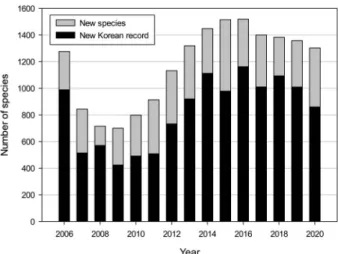
38,011종(2011년), 3단계 42,756종(2014년), 4단계 49,027 종(2017년), 그리고 5단계 54,428종(2020년)으로 급속히 증가하여 본 사업의 5단계 약 15년의 연구 결과로 한반도 기록종이 약 1.8배 증가하였다(Fig. 1). 이 통계자료는 이 기 간 동안 연평균 2,320종의 한반도 미기록종이 새로이 기록 된 것을 보여준다. 또한, 전체 발굴종 중에서 총 5,242종의 신종이 포함되었다. 자생생물종 발굴의 전반기에는 각 연 구자의 소속기관이나 개인적으로 소장하고 있는 표본에 서 많은 부분의 미기록종이 연구되었으나, 사업이 지속되 어 새로이 채집된 표본이 늘어나면서 이들로부터 대부분 의 미기록종이 밝혀졌다. 사업의 초반에는 관속식물과 대 형 동물종이 먼저 연구되었고, 점차 무척추동물과 곤충류 의 발굴종 수 비율이 높아졌으며, 후반부에는 균류, 원핵생 물 등 미생물 연구가 상대적으로 증가하였다.
생물표본은 각 단계가 마무리되는 시점인 1단계에 247,226점(2008년), 2단계 207,827점(2011년), 3단계 287,133점(2014년), 4단계 244,920점(2017년), 그리고 5단 계에 144,333점(2020년)이 수집되어 연평균 75,429점, 총 1,131,439점의 생물표본이 수집되었다. DNA 채취용 생체 표본은 1단계 이후 연평균 2,378점이 채집되어 총 35,678 점이 수집되었다. 각 종마다 수집하는 표본 수는 분류군의 특성을 고려하여 수집 개체의 범위를 정하여 분류군의 다 양성을 높이고자 하였다.
한반도 자생생물종의 기록은 논문 출판으로 공식화된 다. 사업 기간 중에 전문 학술지 출판 실적은 급속히 증가 하여 사업 기간 동안 국내학술지 논문은 연평균 154편 및
총 2,320편, SCI급 국제학술지 논문은 연평균 77편 및 총
1,168편이 출판되었다. 일부는 국제학술지나 국내학술지의
특별호 형태로 출판되었다.
본 사업 기간 중 투입된 예산은 자생생물종 조사·발굴 사업 및 생물표본 확보사업에 총 833억원, 연평균 55억원 이 소요되었다.
1~2단계의 조사·발굴 연구는 1개 사업단에서 관리하였 고, 3단계(2011년) 이후는 주요 분류군별로 나누어 연구를 수행하였다. 각 분류군별 사업의 내용과 성과는 다음과 같 다.
분류군별 성과
1. 곤충
곤충은 지구상에 930,187종이 기록되어 전체 생물종 1,834,340종의 50.7%를 차지할 정도로 가장 다양한 생물 종으로 알려져 있다(National Biodiversity Center 2020). 반 면, 한반도 자생생물 조사·발굴 사업이 시작되기 이전인 2005년에 전체 생물종 29,916종 중에서 곤충이 12,053종 (약 40.2%)이 기록되어 있었으므로 가장 조사·발굴 연구 가 부족한 분류군으로 평가되었다(NIBR 2019a). 특히, 본 사업의 시행 초기(1~2단계)에 국내의 곤충 분류학자와 연 구 인프라가 부족하여 자생 곤충 발굴에 어려움이 있었다. 본 사업 기간 동안 참여한 곤충 분야의 연평균 연구자(연 구원/연구조원) 수는 1단계 16/15명, 2단계 15/31명, 3단계 23/54명, 4단계 25/65명, 그리고 5단계 25/59명이었다.
본 사업의 결과로서 1~5단계(2006~2020년) 동안 총
4,440종의 곤충 종이 한반도에서 새로이 기록되었다. 전체
발굴된 곤충 종 중에서 신종은 988종(22.3%)이며, 미기록 종은 3,452종(77.7%)을 차지하였다. 다양한 곤충 분류군에 서 연간 약 150종 이상이 한반도에서 새로이 밝혀졌으며, 2012년부터 현재까지 연간 200종 이상의 신종 및 미기록종 이 새로이 기록되었다(Figs. 2, 3). 특히 2016년, 2020년에는 각각 465종, 450종의 곤충 신종 및 미기록종이 기록되어 자 생생물 조사·발굴 사업 기간 중 가장 많이 기록되었다.
본 사업에서 수집된 곤충 표본은 총 281,054점이다. 이 표본 숫자는 새로이 기록된 종의 표본을 포함하여 종동정 까지 완료된 확증표본과 국립생물자원관에서 100점 이하 로 소장하고 있는 표본을 모두 포함한 숫자이다. 2006년부 터 2011년까지 매년 약 13,000점 이상 표본을 수집하였고,
Fig. 1. Number of Korean indigenous species newly recorded from this study.
2012년에서 2016년 동안은 매년 20,000점 이상의 표본을 수집하였으며, 2016년부터는 국립생물자원관에서 많이 소 장하고 있는 종의 수집을 지양하여 점차 수집된 표본 수가 감소하였다. 5대 곤충 목(딱정벌레목, 노린재목, 나비목, 벌 목, 파리목)에 속하는 분류군 표본이 84% 이상을 차지하였 으며, 그중에서 딱정벌레목이 33%로 가장 많았다.
자생생물 조사·발굴 사업의 결과로 곤충 분야에서 총
784편(2,470종)의 학술논문이 출판되었으며, 그중에서 SCI 급 국제학술지 논문은 290편(779종)이다.
2. 무척추동물(곤충 제외)
무척추동물 분야는 척삭동물문(Chordata)의 척추동물 아문(Vertebrate)과 절지동물문(Arthropoda)의 육각아문
(Hexapoda)을 제외한 모든 동물분류군을 포함하였다. 동
물성 단세포성 원생생물(Protista)인 원생동물(Protozoa)도 포함하였다.
무척추동물(곤충 제외)은 전 세계에 약 50만 종이 기록 되어 있으며, 최근까지 새로운 문(Phylum)이 발견될 정도 로 매우 다양성이 높은 것으로 알려져 있다. 한반도 발굴 생 물종의 20%(1.1만여 종) 이상을 차지하는 무척추동물은 생 물종의 발굴 가능성이 높으며 활용가치가 높은 자생생물 다양성의 핵심분류군이라 말할 수 있다. 뿐만 아니라 2006 년 자생생물 조사·발굴 사업 이후 매년 약 140종 이상의 종 발굴이 이루어지고 있으며, 여전히 미발굴 국내 서식종 이 많을 것으로 추정되기 때문에 지속적인 종 발굴이 가능 할 것으로 판단된다. 하지만 무척추동물(곤충 제외) 분야는 전공자의 은퇴 등으로 인한 일부 분류군의 연구 단절로 다 양한 종의 발굴에 어려움을 겪고 있다. 이러한 문제점은 자
Fig. 2. Number of Korean indigenous insect(Hexapoda) species newly recorded from this study.
Fig. 3. Selected insect species newly recorded in Korea from this project. A. Nannophya koreana Bae, 2020(Libelluridae)(한국꼬마잠자리), a pygmy dragonfly previously misidentified as Nannophya pygmaea Rambur, 1842; B. Vespa velutina nigrithorax du Buysson, 1905(Vespidae) (등검은말벌), an invasive harmful vespid wasp first recorded in Busan in 2003 and spread rapidly throughout the Korean peninsula; C. Satur- nia jonasii Butler, 1877(Saturniidae)(한라산누에나방), a saturnid moth found on Jeju island and regarded as an indicator of climate change;
D & E. Sialis koreana Jung and Bae, 2012(Sialidae)(한국좀뱀잠자리), dorsal(D) and lateral(E), a rare alderfly found in the highland wetlands (Yong-neup) of Daeamsan, Gangwon-do. All photos are reused from original papers or project reports.
A
C
B
D
E
생생물 조사·발굴 사업과 같은 분류학자를 위한 연구사업 을 통해 해소될 수도 있을 것이며, 이를 통해 무척추동물 분 야가 앞으로 생물주권 확보에 기여하는 데 도움이 될 것이 다.
2006년에 시작된 자생생물 조사·발굴 연구사업은 2020 년 현재 5단계 3차년도까지 15년간 진행 중이며, 이 기간 동안 총 4,248종의 무척추동물 신종과 미기록종을 발굴하 였다. 전체 발굴종 중에서 신종은 1,492종(35.1%)이며, 미 기록종은 2,841종으로 신종보다 약 2배 많은 66.9%를 차
지하였다. 2006년 사업 시작 이래 다양한 분류군에서 연간
약 130종 이상을 발굴하였으며, 2011년부터 2016년까지는 연간 300종 이상의 신종과 미기록종을 발굴하였다(Figs. 4, 5). 특히 2014년에는 연간 470종의 무척추동물 신종과 미 기록종을 발굴하여, 자생생물 조사·발굴 연구사업 기간 중 최대치를 기록하였다. 발굴종의 논문 출판이 지연되면서 최근 연간 발굴종 수가 다소 줄어들었지만, 150종 이상의 신종과 미기록종이 꾸준히 추가되고 있다.
본 사업 기간 동안 확보된 표본은 총 194,667점이다. 이
표본은 새로이 발굴된 종의 표본을 포함하여 종동정이 완 료된 확증표본과 자원관에서 100점 이하로 소장하고 있는 종들의 표본을 모두 포함한 숫자이다.
Fig. 5. Selected invertebrate species newly recorded in Korea from this project. A. Cacospongia dokdoensis Sim, Lee & Kim, 2016(Tho- rectidae)(독도카코해면). The specific name, dokdoensis, is named after its locality, Dokdo, Ullreung-gun, Korea; B. Nebalia koreana Song, Moreira & Min, 2012(Nebaliidae)(한국잎새우). This is the first representative of the subclass Phyllocarida Packard, 1879(Crustacea, Mala- costraca) from the temperate regions of Northeast Asia; C. Cleantiella ampliscutula Kim, Jung & Yoon, 2020(Idoteidae)(톱니갯주걱벌레), a genus of Cleantiella only distributed in Far East Asia; D. Ekpontocypris koreana Karanovic, 2020(Pontocyprididae). This was the first repre- sentative of the family Pontocyprididae Muller, 1894 from Korea. All photos are reused from original papers or project reports.
B
C D
A
Fig. 4. Number of Korean indigenous invertebrate species(includ- ing protozoa and excluding Hexapoda) newly recorded from this study.
자생생물 조사·발굴 연구사업 무척추동물 분야의 결과 로 발표된 논문은 총 574편이며, 이 중 SCI급 국제학술지 논문은 231편이다.
3. 척추동물(어류)
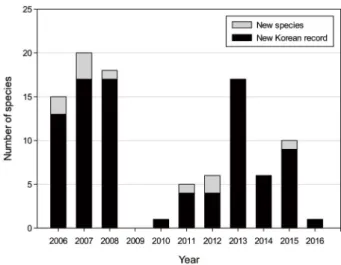
대형 척추동물인 포유류, 조류, 파충류 및 양서류는 한반 도에서 거의 모든 종이 알려졌으며, 또한 대부분의 종들이 멸종위기종이나 보호종에 포함되어 표본의 채집에 제약이 있다. 따라서 척추동물 분야에서는 어류를 대상으로 2006 년부터 2016년까지 11년간 수행되었으며, 총 99종의 신종 후보종 또는 한반도 미기록종이 발굴되었다. 전체 발굴종 중 신종 후보종은 9종(9.1%)이며, 한반도 미기록종은 89 종(90.9%)으로 발굴종의 대부분을 차지하였다. 2006년 사 업 시작 이래 다양한 분류군에서 연평균 8.9종의 신종 후보 종 또는 한반도 미기록종이 발굴되었으며, 2007년에 20종 으로 가장 많았고, 2008년과 2013년은 17종으로 두 번째로 많았으며, 2009년에는 한 종도 발굴되지 않았다(Figs. 6, 7).
자생생물 조사·발굴 연구사업의 어류 분야에서 수집 된 생물표본은 총 18,380점이다. 어류표본은 2014년도에 3,831점으로 가장 많은 수의 표본이 수집되었고, 2010년에 450점으로 가장 적었으며, 연평균 1,670점의 표본이 수집 되었다. 해당 표본은 발굴종 표본을 포함하여 종동정까지 완료된 표본이며, 그동안 국립생물자원관에 소장되지 않았 던 표본과 소수 소장된 표본이 주를 이루었다. 종동정 확증 표본 이외에 유전자 분석용 조직시료 1,259점과 DNA 시료
32점을 확보하였다.
자생생물 조사·발굴 연구사업 어류 분야의 연구결과로 발표된 논문은 총 37편이며, 이 중 SCI급 국제학술지 논문 은 2편이다. 2010년 이전에 발표된 논문수는 총 9편이었으 며, 2011년 이후에 총 28편으로 증가하였다.
4. 식물
식물 분야 1단계(2006~2008년), 2단계(2009~2011년), 3 단계(2012~2014년)는 매년 10~11명의 교수급 연구자들이 연구원으로 참여하였다. 1단계를 준비단계라 한다면, 2~3
Fig. 6. Number of Korean indigenous fish species newly recorded from this study.
A
C D
B
Fig. 7. Selected fish species newly recorded in Korea from this project. A. Obliquogobius yamadai(Gobiidae)(깊은바다노란띠망둑) collected from the southern coastal waters of Jejudo Island, Korea; B. Scorpaenopsis neglecta(Scorpaenidae)(쏠치우럭) from the southern coastal waters of Jejudo Island, Korea; C. Gymnogobius cylindricus(Gobiidae)(가는살망둑) from the western coastal waters of the Korean peninsula;
D. Hemirampus far(Hemiramphidae)(검무늬학공치) from the northern coastal waters of Jejudo Island, Korea. All photos are reused from original papers or project reports.
단계에서는 선태식물이 포함되어 많은 미기록종 및 신종이 발굴된 시기였다. 이때에는 식물다양성이 풍부하고 특이성 도 높은 제주도, 울릉도, 서해와 남해 도서지역, 석회암지역 등을 대상으로 조사 및 발굴이 진행되었다. 특이할 점은 다 른 분류군들과는 달리 이때에도 대상지역을 정한 후에 조 사를 수행하는 방식으로 이루어졌는데, 신종 및 미기록종 발굴 목표와 함께 표본 수집 목표도 설정되었기 때문이라 할 수 있다. 4단계(2015~2017년)와 5단계(2018~2020년) 는 매년 2~8명의 교수급 연구원들이 참여하였다. 신종 및 미기록종 발굴의 한계점에 도달했다고 판단되는 4단계부 터는 예산이 축소되었고 선태식물 분야도 제외되면서, 신종 및 미기록종 발굴보다는 미조사 지역의 식물상을 조사하고 표본을 확보하는 데 주안점을 두고 진행되었다.
식물 분야에서는 교수를 비롯한 박사 학위 전문가들이 연구책임자 및 연구원으로 참여하였을 뿐만 아니라, 식물 분류학을 전공하는 대학원생과 학부생들이 참여함으로써 이들이 현장에서 식물을 익히고 연구 아이디어를 얻을 수 있는 기회를 제공하는 효과도 거두었다.
식물 분야는 관속식물(Tracheophyta)과 선태식물(Bryo- phyta)을 포함하였다. 전체 사업 기간인 2006년부터 2020 년까지 309종의 신종 및 국내 미기록종을 발굴하였다. 전
Fig. 9. Selected plant species newly recorded in Korea from this project. A. Isoetes hallasanensis H.-K. Choi, Ch. Kim & J. Jung(Isoetaceae) (한라물부추). Isoetes is an endangered species in Korea and urgent conservation action is needed; B. Selaginella heterostachys Baker(Se- laginellaceae)(각시비늘이끼). Selaginella occurs mostly in the tropical regions of the world and unusually, it is distributed in the central part of Korea, so additional ecological investigation is needed; C. Cyclosorus penangianus(Hook.) Copel.(Thelypteridaceae)(큰별고사리), the first recorded fern species from Jeju Island; D. Sium ternifolium B.Y. Lee & S.C. Ko(Apiaceae)(세잎개발나물), a new species first collected from Mt. Chiak-san. All photos are reused from original papers or project reports.
A
C D
B
Fig. 8. Number of Korean indigenous plant species newly recorded from this study.
체 발굴종 중 신종은 39종, 미기록종은 270종으로 미기록 종이 신종보다 6배 이상 많은 87.4%를 차지하였다(Figs. 8, 9). 선태식물이 포함된 2단계와 3단계(2009~2014년) 기 간 동안 신종 및 미기록종 발굴이 크게 증가하였다. 4단계
(2015년)부터 선태식물이 제외된 이후 관속식물 분야에서
신종 및 미기록종이 발굴되었다. 신종으로 발굴된 선태류 는 지리은행비늘이끼(Tritomaria koreana Bakalin, S.-S. Choi
& B.-Y. Sun), 칠선망울이끼(Solenostoma jirisanense Bakalin &
S. S. Choi) 등을 꼽을 수 있고, 관속식물 신종으로는 긴다 람쥐꼬리(Huperzia jejuensis B.-Y Sun & J. Lim), 세잎개발나 물(Sium ternifolium B. Y. Lee & S. C. Ko), 한라물부추(Isoetes hallasanensis H.-K. Choi, Ch. Kim & J. Jung) 등을 들 수 있다. 선태식물 미기록종은 126종으로 전체 미기록종의 46.7%
를 차지하였다. 관속식물 미기록종은 144종으로 양치식물 인 각시비늘이끼(Selaginella heterostachys Baker), 오름깃고사 리(Pteris fauriei Hieron.), 큰별고사리(Cyclosorus penangianus (Hook.) Copel.), 피자식물인 남흑삼릉(Sparganium fallax Graebn.), 빌레나무(Maesa japonica(Thunb.) Moritzi & Zoll.), 진도사초(Carex taihokuensis Hayata) 등이 있다. 또한, 물석 송(Lycopodium cernuum L.) 등은 북한에서 이미 기록되어 있어서 미기록종으로는 등록하지는 못하였지만, 남한에서 예상 밖의 자생지를 발견하는 성과를 거두기도 하였다.
자생생물 조사·발굴 연구사업 식물 분야에서 확보된 표 본은 총 378,251점이다. 4단계 이후 사업 범위와 규모가 축 소됨에 따라 표본 확보량도 함께 감소하였다.
본 사업의 결과로 발표된 논문은 총 32편이며, 관속식물 분야 논문은 25편, 선태식물 분야는 7편이다. 3단계까지는 신종 및 미기록종 발표 논문이 주를 이루었으며, 4단계 이후 는 조사 지역별 식물상 논문이 연간 1편 이상 발표되었다.
5. 조류(algae)
조류(algae)는 현미경적 크기의 단세포로부터 거대한 해
조류에 이르기까지 크기가 다양하고, 여러 진화계열에 속 하는 이질적인 생물집단이다. 해조류는 가엽(blade), 가경 (stipe), 가근(holdfast)의 형태로 분화되어 고착생활을 하고 크기가 커서 대형조류(macroalgae)라고 하며, 이와 같은 형 태로 분화되어 있지 않고 단세포로 부유생활을 하고 크기 가 작은 무리를 식물플랑크톤 또는 미세조류(microalgae) 라고 부른다. 두 분류군은 공통적으로 엽록소를 가지고 있 어서 광합성을 통하여 무기물을 유기물로 저장한다.
조류는 지구상에 최저 36,000종, 최대 1,000만 종(Norton
et al. 1996) 이상이 존재할 것으로 추정하고 있다. 반면, 한 반도 자생생물 조사·발굴 사업이 시작되기 이전인 1996 년 ‘국내 생물종 문헌조사’에서 집계된 한반도 자생생물종 28,462종 중에서 미세조류와 해조류가 3,609종으로 12.7%
를 차지하였다(Korean National Council for Conservation of Nature 1996).
본 사업 기간 동안 참여한 자생 조류 분야의 연평균 연구원 수는 연인원 1단계(2006~2008년) 37명, 2단계 (2009~2011년) 31명, 3단계(2012~2014년) 29명, 4단계 (2015~2017년) 30명, 그리고 5단계(2018~2020년)에는 55 명이었다.
식물플랑크톤은 해산 및 담수의 돌말류(Diatoms), 와 편모조류(Dinoflagellates), 녹조류(Green algae), 황갈조류 (Chrysophytes), 은편모조류(Cryptophytes), 남조류(Blue- green algae), 유글레나조류(Euglenoids) 등을 포함하였으며, 해조류에서는 해양성 거대 녹조류(Chlorophyta), 갈조류 (Phaeophyta), 홍조류(Rhodophyta) 등을 대상으로 하였다.
조류 분야에서는 2006년부터 2020년까지 총 1,916종의 신종 및 국내 미기록종이 발굴되었다. 전체 발굴종 중에서 신종은 178종(9.3%)이며, 국내 미기록종은 1,738종으로 신 종보다 훨씬 많은 90.7%를 차지하였다. 2006~2008년 사업 시작 초기에는 신종 발굴이 저조하였으나, 2009년부터 점 차 증가하여 2011년, 2013~2015년 매년 20종 이상을 발굴 하였다(Figs. 10, 11). 2006~2010년까지 신종 및 국내 미기 록종의 발굴이 해마다 148종 이상이었으며, 2010년에 최 고치인 195종을 발굴하였다. 2016년부터는 자생 조사·발 굴 사업의 축소로 목표량이 감소되어 신종 및 국내 미기록 종의 목표량이 100종 미만이어서 달성치도 이에 비례하여 62~93종으로 낮았다.
본 사업 기간(2006~2000년) 동안 확보된 조류 분야의 표본수는 총 140,490점이었다. 사업 초기인 2006년 표본 수집 목표는 16,000점, 2007년 16,580점, 2008년 10,000점 이었으나 3년 동안 목표치보다 많은 47,479점을 수집하였 다. 2010년과 2011년에 목표량은 각각 10,000점 미만이었 으며, 2012년, 2013년, 2014년에는 목표량이 각각 10,500점, 11,500점, 10,750점이었으나 역시 3년간 34,341점으로 확 보하여 초과 달성하였다. 2015년부터는 본 사업의 축소로 목표량이 감소되어 10,000점 미만이었다. 특히, 2016, 2017 년, 2018년에는 목표량이 각각 4,000점, 4,500점, 3,000점으 로 낮았다. 따라서 4단계(2015~2017년) 23,637점, 5단계 (2018~2020년) 7,033점으로 점점 감소하는 추세다.
2006년부터 2020년까지 자생생물 조사·발굴 연구사업 에서 발굴한 조류 분야의 신종 및 국내 미기록종의 출판
율은 63.9%였다. 사업 초기인 2006년과 2007년에는 신종 과 미기록종의 정당공표 의무 사항이 없었으므로 출판율 이 미미했으나 2008년부터 출판종 수가 급격하게 증가하 였다. 다만, 2006년과 2007년도에 발굴된 신종 및 국내 미 기록종에 대하여도 출판을 유도하였으므로 해를 거듭할 수록 급격하게 출판율이 증가되어 2012년, 2013년, 2014 년, 2017, 2018년에는 각각 103.8%, 171.9%, 127.3%, 174.1%,
116.6%로 높아 이전에 미출판 누적 종의 정당공표에 크게
기여하였다. 신종 및 국내 미기록종의 정당공표를 한 학술 지는 SCI급 국제학술지 논문이 35편에 47종이며, 국내학술 지 논문이 112편에 1,063종이었다.
6. 균류·지의류
그동안 균류(fungi) 연구는 주로 이핵체(dikarya)에 속 하는 자낭균류(ascomycete) 및 담자균류(basidiomycete
fungi)에 치중되어 왔다. 오늘날 균류는 다양한 분자분
류학적 접근을 통해 Ascomycota, Basidiobolomycota,
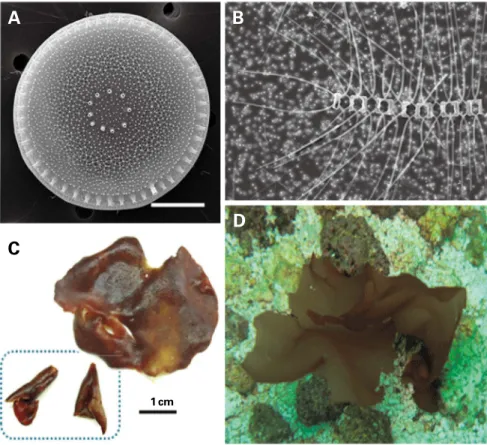
Fig. 11. Selected algae species newly recorded in Korea from this project. A. Conticribra weissflogiopsis Park & Lee sp. nov. 2014, distrib- uted in brackish waters in Incheon, Korea; B. Chaetoceros atlanticus var. koreanus Lee & Lee var. nov. 2014, with setae showing grid-like rows of small poroids and a tetragonal cross-section; C. Pachymeniopsis volvita M.Y. Yang & M.S. Kim, 2015(Halymeniaceae); D. Amalthea rubida H.W. Lee & M.S. Kim, 2016(Halymeniaceae)(붉은연도박).
A
C
B
D
1cm
Fig. 10. Number of Korean indigenous algae species newly rec- orded from this study.
Basidiomycota, Blastocladiomycota, Chytridiomycota, Entomophthoromycota, Entorrhizomycota, Glomeromycota, Kickxellomycota, Monoblepharomycota, Mortierellomycota, Mucoromycota, Neocallimastigomycota, Zoopagomycota 등 을 포함하여 19개의 문(phylum)까지 확대 개편되고 있는 실정이다. 국내 자생균류 및 지의류는 5,421종으로 추정되 며, 표본은 5만여 점에 이른다. 국립생물자원관이 주도해온 조사·발굴 사업을 통해 발굴된 종수는 2020년을 기준으 로 총 1,716종(신종 309종, 미기록종 1,407종)이다(Figs. 12,
13). 한반도 자생생물종의 약 9%를 차지하는 균류는 여전
히 미기록종의 발굴 가능성이 높으며, 식용, 약용 등 활용가 치가 높다. 본 연구를 통해 한반도에 자생하고 있는 균류에 대한 포괄적인 탐색 조사를 수행하여 신종 및 미기록종을 발굴하고, 자생생물 표본, 배양체 및 유전자원 등을 확보하 여 분류체계 구축 및 정보체계화에 기여하고자 하였다.
균류·지의류 분야의 1단계(2006~2008년)에서는 하등 생물 분야의 버섯 영역에 속하여 사업이 진행되었다. 2단계
(2009~2011년)에서는 원핵생물 분야의 균류 조사·발굴팀 에 속하여 진행되었으며, 3~5단계(2012~2000년)에서는 독립적으로 수행되었다. 사업 초기에는 국내에 자생하는
Fig. 13. Selected fungi species newly recorded in Korea from this project. A. Mucor cheongyangensis Hyang B. Lee & T.T.T. Nguyen(Muco- raceae), a new species isolated from the surface of Lycorma delicatula collected at Cheongyang, Chungnam province, Korea, which has the potential to degrade microplastics(Cited from Nguyen and Lee 2020); B. Absidia koreana Hyang B. Lee, H.W. Lee & T.T.T. Nguyen(Cunning- hamellaceae), a new species isolated from a soil sample collected from Dokdo Island, Gyeongsangbuk-do, Korea(Cited from Ariyawansa et al. 2015); C. Metarhizium guizhouense Q.T. Chen & H.L. Guo(Clavicipitaceae), a newly recorded species isolated from a soil sample col- lected from Dokdo Island, Gyeongsangbuk-do, Korea, with the potential to act as a biocontrol agent to control insects(Cited from Lee et al.
2015); D. Aspergillus koreanus Hyang B. Lee, T.T. Duong & T.T.T. Nguyen(Aspergillaceae), a new species isolated from a soil sample collected on Sinsido Island, Jeollabuk-do, Korea with potential applications in industrial biotechnology(Cited from Hyde et al. 2016).
A
C D
B
Fig. 12. Number of Korean indigenous fungal species newly rec- orded from this study.