and Gardner 1924; Hamel 1931-1939; Hollenberg 1969;
Abbott and Hollenberg 1976; Tanaka and Chihara 1980;
Fletcher 1987; Womersley 1987; Parente and Saunders 2019). Currently, 17 Ralfsia species are recognized world- wide (Guiry and Guiry 2020). Of them, four Ralfsia spe- cies were reported from Korea: Ralfsia fungiformis (Gun- nerus) Setchell and N.L. Gardner, R. verrucosa (Areschoug) Areschoug, R. confusa Hollenberg, and R. integra Hol- lenberg (Lee and Kang 1986; Lee and Kang 2002; Keum 2010).
Ralfsia longicellularis was described from Peter the Great Bay, Far East Russia by Perestenko in 1980. It is mainly characterized by a thick dark brown thallus, curved cells in the creeping and ascending parts of the filaments forming a unilateral symmetry, basal layer and erect filament cells’
width to length ratio of 1 : 1.5-10, and narrow-shaped spo-
https://doi.org/10.11626/KJEB.2020.38.1.101
INT R ODUCTION
The crustose brown algal genus, Ralfsia, was described by Berkely (in Smith and Sowerby 1843). It is character- ized by having thalli crustose, flat and expanded, more or less circular in outline, attached to the substratum with or without rhizoids; erect vegetative filaments tightly adher- ent, straight or curved, branched or simple, arising from a basal layer; unilocular sporangia clavate, ovoid to pyriform, sessile or pedicellate arising from the supporting cells of paraphysis; plurilocular reproductive organs intercalary, arising from a cell located in the submerged part of the erect filament, composed of one to four rows of pluriloc- ular reproductive filaments with one to several terminal sterile cells; chloroplasts mostly plate-shaped, generally one per cell; hairs in tufts, scattering over thallus (Setchell
Note
Ralfsia longicellularis (Ralfsiales, Phaeophyceae): a Far East Asian endemic brown alga from Korea
Antony Otinga Oteng’o and Boo Yeon Won*
Department of Life Science, Chosun University, Gwangju 61452, Republic of Korea
Korean J. Environ. Biol.
38(1) : 101-105(2020) ISSN 1226-9999(print) ISSN 2287-7851(online)
* Corresponding author Boo Yeon Won Tel. 062-230-7983
E-mail. [email protected]
Received: 5 February 2020 Revised: 26 February 2020
Revision accepted: 27 February 2020
Abstract: Ralfsia longicellularis is known as an endemic species in Far East Asia. In this study, we report R. longicellularis as a new record from Korea based on morphological and molecular analyses. Molecular analyses based on plastid-encoded rbcL gene sequ- ences and morpho-anatomical studies were undertaken on Ralfsia species, a poorly studied genus from Korea. Ralfsia longicellularis is mainly characterized by a dark brown thallus;
770-1200μm thick, curved cells in the creeping and ascending parts of the filaments;
basal layer and erect filament cells with a width-to-length ratio of 1:1.5 to 10; narrow- shaped sporangia on-stalk cells at the base of the paraphyses; and mostly uniseriate plurilocular reproductive organs capped with 1-2 sterile cells. The R. longicellularis sam- ples from Korea in this study were similar to ones collected from the type locality(Peter the Great Bay, Russia) in morphology. The rbcL analyses also revealed that our Korean R. longicellularis samples were placed in the same clade with Russian materials, within a Ralfsia clade but distinct from the congeners.
Keywords: rbcL, Ralfsia longicellularis, Ralfsiales, Phaeophyceae
rangia on stalk cells at the base of paraphyses (Perestenko 1980). Since its description, R. longicellularis has only one report worldwide (Guiry and Guiry 2020). In the analysis of the biogeographical structure of flora in Vostok Bay, Sea of Japan, it was reported as part of Asian low-boreal species (A lB) (Kozhenkova 2009). This may allude to the fact that R. longicellularis is endemic to the northern region of Far East Asia.
We collected the unidentified samples that fit the genus Ralfsia’s description, from coasts of Korea. We observed their detailed morphology and analyzed molecular data based on the plastid-encoded rbcL gene for their phyloge- netic relationships. In this study, we add Ralfsia longicellu- laris to the Korean marine algal inventory.
MATE R IALS AND METHODS
1. Morphology
Samples of Ralfsia were collected from shallow intertid- al zones of Korea (Taean, Buan, and Wando) and Russia (Vladivostok). Vouchers were air-dried and preserved in silica gel for morphological and molecular studies. For morphology, samples were detached from substrate by use of a single-edged blade, then embedded in a matrix (O.C.T., CellPath, Ltd., Newtown, Wales, UK) and sectioned (8- 10 μm thickness) using freezing microtome (Shandon Cryotome FSE, Thermo Shandon, Ltd., Loughborough, UK), stained in a 1 : 1 mixture of aqueous aniline blue and acetic acid. Photomicrographs were taken using an Olym- pus DP71 camera mounted on an Olympus microscope (BX51TRF; Olympus, Tokyo, Japan) and a digital camera (Nikon D40; Nikon, Japan). Representative voucher spec- imens examined in this study are deposited in the herbar- ium of Chosun University (CUK) and the National Insti- tute of Biological Resources (NIBR), Korea.
2. Molecular study
Genomic DNA was extracted using a NucleoSpin Plant II Kit (Macherey-Nagel, Düren, Germany). The extracted DNA was stored at -20°C and used to amplify rbcL. The rbcL gene was amplified using the primer combinations NDrbcL2-DRL1R and DRL2F-R3A (Kogame et al. 1999;
Hwang et al. 2005) with HelixAmp Ready-2x-Go Series (NanoHelix Co., Ltd., Daejeon, Korea). All PCR amplifica- tions were carried out with a Veriti 96 well Thermal cycler
(Applied Biosystem). PCR products were purified using a PCRquick-spin
TMPCR product purification kit (iN- tRON Biotechnology, Inc, Seongnam, Korea). New rbcL sequences obtained from Ralfsia longicellularis have been deposited in EMBL/GenBank under the accession num- bers MT000915 (CUK18752), MT000917 (CUK18820), MT000918 (CUK19216), MT000916 (CUK19269) and MT000914 (CUK20024).
Nineteen rbcL sequences (781 bp) were aligned, includ- ing sequences of other species of Ralfsiales previously pub- lished in GenBank and two outgroup taxa, Tilopteris mer- tensii (Turner) Kützing and Sargassum muticum (Yendo) Fensholt, with ClustalW (Thompson et al. 1994). Phyloge- netic analyses were conducted using raxmlGUI1.5b2 (Sil- vestro and Michalak 2012). Maximum likelihood analyses were conducted using the GTR
+G
+I model, with 1,000 bootstrap replicates. Bayesian inference was performed using MrBayes 3.2.6 (Huelsenbeck and Ronquist 2001;
Ronquist and Huelsenbeck 2003). Markov chain Monte Carlo runs were conducted for 2 million generations, each with one cold chain and three heated chains using the GTR
+Γ
+I evolutionary model and sampling and print- ing every 1,000 generations. Summary trees were generat- ed using a burn-in value of 800.
R ESULTS AND DISCUSSION
1. Morphological observations
Class Phaeophyceae F.R. Kjellman, 1891
갈조강Order Ralfsiales Nakamura ex P.-E. Lim & H. Kawai in Lim et al., 2007
바위딱지목Family Ralfsiaceae W.G. Farlow, 1881
바위딱지과Genus Ralfsia M.J. Berkeley, 1843
바위딱지속 Ralfsia longicellularis L. P. Perestenko, 1980 긴세포바위딱지(신칭)(Fig. 1A-E)Material examined. NIBROR0000001763 (deposited in
the National Institute of Biological Resources), CUK19216
(
=MBRB0103TC19216D1), MT000918, Pado-ri, Sow-
uon-myeon, Taean-gun, Chungcheongnam-do, Korea
(36°43′05.65″N, 126°07′33.79″E), November 3, 2018,
T.O. Cho and B.Y. Won, at 1 m depth by hand; CUK18752
(
=MBRB0103TC18752D1), MT000915, Pado-ri, Sow-
uon-myeon, Taean-gun, Chungcheongnam-do, Korea
(36°43ʹ05.65ʺN, 126°07ʹ33.79ʺE), March 3, 2018, T.O.
Cho and B.Y. Won, at 1 m depth by hand; CUK18820 (
=MBRB0103TC18820D1), MT000917, Jeongdo-ri, Wando-eup, Wando-gun, Jeollanam-do, Korea (34°17ʹ 50.04ʺN, 126°42ʹ08.14ʺE), April 1, 2018, T.O. Cho and B.Y. Won, at 1 m depth by hand; CUK19269 (
=MBRB 0103TC19269D1), MT000916, Chaeseokang, Byeonsan-
myeon, Buan-gun, Jeollabuk-do, Korea (35°37ʹ27.04ʺN, 126°27ʹ56.88ʺE), January 26, 2019, T.O. Cho and B.Y.
Won, at 1 m depth by hand; CUK20024 (
=MBRB0103 TC20024D1), MT000914, Ulitsa Leytenanta Shmidta, Vladivostok, Russia (43°06ʹ21.78ʺN, 131°52ʹ11.07ʺE), October 10, 2019, T.O. Cho and B.Y. Won, at 1 m depth by
Fig. 1. Ralfsia longicellularis CUK18820(MT000917) from Jeongdo-ri, Wando-eup, Wando-gun, Jeollanam-do, Korea. A. Dark brown crus- tose thallus with overlapping lobes on the margin. B. Radial longitudinal section showing the apical part of erect vegetative filaments(top) and the mid-portion of erect filaments(middle), both having cells longer than wide, and the basal portion of the thallus(bottom), presenting curved cells. C. Chloroplasts(arrows), parietal and single per cell. D. Sorus(arrowhead) with plurilocular reproductive organs. E. Plurangial reproductive filaments capped with one(asterisk) to two(arrowheads) sterile cells. Scale bars: A=1.0cm; D=200μm; B=100μm; C &
E=20μm.
A B
C
D E
hand.
Description. Thallus thick, crustose, epilithic, dark brown (almost black in the dry state), with uneven surface, may have overlapping lobes (Fig. 1A, arrows) at margins, sev- eral centimeters across, 770-1200 μm thick, undersurface irregularly distributed with rhizoids 8.4-14 μm wide. In the creeping and ascending parts of the filaments (Fig. 1B, bottom), the cells are curved, often with oblique partitions, 8.5-11(14) μm width, with a ratio of width to length 1 : 1.5-7, forming horizontal rows. The lower layer of creep- ing ascending filaments is 0.3 times the thickness of the thallus. The cells of vertical filaments (Fig. 1B, middle) are cylindrical 5.5-8.5 μm width, with a ratio of width to length 1 : 1.5-10. Cells of the upper third (Fig. 1B, top) of vertical filaments taper to the top with 4-8 μm width and a ratio of width to length 1 : 1-5. Chloroplasts (Fig. 1C, arrows) parietal, single per cell, mostly on the apical part of the cell. Reproductive portions of sori (Fig. 1D, arrow- head), scattered throughout the thallus. Narrow-shaped unilocular sporangia, on 1-2(3) stalk cells, 22.5-31
×65- 92 μm. Paraphyses of 10-13 cells, 190-210 μm long. Api- cal cells of paraphysis 8.5-10 μm wide. Plurilocular repro- ductive organs 90-265 μm long, uniseriate, occasionally biseriate, capped with one (Fig. 1E, asterisk) to two (Fig.
1E, arrowheads) sterile cells. Sterile cell 5-8 μm width and 1.8-3 times as long as the width. Hair unknown.
Habitat. Epilithic at intertidal zone.
World Distribution. Asia; Russia (Far East) (Guiry and Guiry 2020) and Korea.
Identifier. Antony Otinga Oteng’o and Boo Yeon Won.
2. Phylogenetic analyses
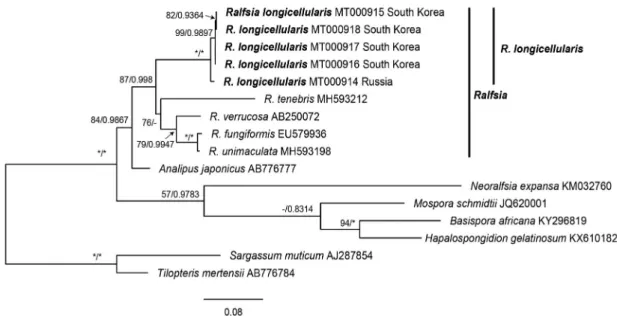
The 781 rbcL bp portion was sequenced for Ralfsia longi- cellularis. Phylogenetic analyses revealed that both Korean and Russian R. longicellularis sequences were placed within the same clade (Fig. 2). The analyses revealed R. longicel- lularis differs from its nearest neighbor R. tenebris by 7.7- 7.9% and the generitype, R. fungiformis, by 8.7-8.8% gene sequence divergence. Intra-specific genetic divergence within R. longicellularis was 0.0-1.0%.
Remarks. Ralfsia longicellularis was originally described by Perestenko (1980) from Russia. This species has only been described and reported (Kozhenkova 2009) from Russia.
Most characteristics from the protologue of R. longicellu- laris from Peter the Great Bay, Russia (Perestenko 1980) are an exact match with our Korean samples. However, the protologue had unilocular sporangia, while Korean samples presented plurangial reproductive structures. This shows that both types of reproductive organs are borne on separate thalli. The original description had no molecular analysis. Our study included molecular analyses. The rbcL genetic divergence between Korean samples and those from Vladivostok (within Peter the Great Bay) was 1%.
Fig. 2. Phylogenetic tree of Ralfsia and other species in Ralfsiales based on Bayesian and RA×ML analysis with rbcL sequences. Value above the branches=Bayesian posterior probabilities >0.75, Maximum likelihood bootstrap values in >50%. Values lower than BPP 0.75 or BS 50 are indicated by hyphens(-). Values of BPP 1.00 or BS 100 are indicated by asterisks(*).
Therefore, Korean samples are the same species as Russian ones. We add this species as Ralfsia longicellularis in list of Korean macroalgal flora.
ACKNOWLEDGEMENTS
This study was supported by the Basic Science Re- search Program through the National Research Founda- tion of Korea (NRF) funded by the Ministry of Education (2019R1F1A1060346) and by Marine Biotechnology Pro- gram grants (20170431) funded by the Ministry of Oceans and Fisheries of Korea. This research was also supported by a grant from the National Institute of Biological Re- sources (NIBR), funded by the Ministry of Environment (MOE) of the Republic of Korea (NIBR 201601204).
R EFE R ENCES
Abbott IA and GJ Hollenberg. 1976. Marine Algae of California.
Stanford University Press, Stanford, CA.
Fletcher RL. 1987. Seaweeds of the British Isles. Vol. 3. Part 1.
Fucophyceae(Phaeophyceae). British Museum(Natural His- tory), London, UK.
Guiry MD and GM Guiry. 2020. Algaebase. Worldwide electronic publication, National University of Ireland, Galway. Available from http://www.algaebase.org; searched on 5 January 2020.
Hamel G. 1931-1939. Phéophycées de France. Verlag nicht er- mittelbar, Paris, France.
Hollenberg GJ. 1969. An account of the Ralfsiaceae(Phaeophyta) of California. J. Phycol. 5:290-301.
Huelsenbeck JP and F Ronquist. 2001. MrBayes: Bayesian infer- ence of phylogeny. Bioinformatics 17:754-755.
Hwang IK, HS Kim and WJ Lee. 2005. Polymorphism in the brown alga Dictyota dichotoma(Dictyotales, Phaeophyceae) from Korea. Mar. Biol. 147:999-1015.
Keum YS. 2010. Sphacelariales, Cutleriales, Ralfsiales. pp. 100- 104. In: Algal Flora of Korea. Volume 2, Number 2. Heterokon- tophyta: Phaeophyceae: Ishigeales, Dictyotales, Desmarestia- les, Sphacelariales, Cutleriales, Ralfisales, Laminariales(Anon.
eds.). National Institute of Biological Resources, Incheon.
Kogame K, T Horiguchi and M Masuda. 1999. Phylogeny of the order Scytosiphonales(Phaeophyceae) based on DNA se- quences of rbcL, partial rbcS, and partial LSU nrDNA. Phyco- logia 38:496-502.
Kozhenkova SI. 2009. Retrospective analysis of the marine flora of Vostok Bay, Sea of Japan. Russ. J. Mar. Biol. 35:263-278.
Lee IK and JW Kang. 1986. A check list of marine algae in Korea.
Korean J. Phycol. 1:311-325.
Lee Y and S Kang. 2002. A Catalogue of the Seaweeds in Korea.
Cheju National University Press, Jeju. pp. [8], 1-662.
Parente MI and GW Saunders. 2019. A molecular survey of Ralfsia sensu stricto(Ralfsiales, Phaeophyceae) in Canada uncovers three new species: R. robertii sp. nov., R. tenebris sp. nov., and R. unimaculata sp. nov. Botany 97:135-147.
Perestenko LP. 1980. The Seaweeds of Peter the Great Bay. Aka- demia NAUK SSSR, Leningrad, Russia.
Ronquist F and JP Huelsenbeck. 2003. MrBayes 3: Bayesian phylogenetic inference under mixed models. Bioinformatics 19:1572-1574.
Setchell WA and NL Gardner. 1924. Phycological contributions, VII. Univ. Calif. Publ. Bot. 13:1-13.
Silvestro D and I Michalak. 2012. raxmlGUI: a graphical front-end for RaxML. Org. Divers Evol. 12:335-337.
Smith JE and J Sowerby. 1843. Supplement to the English Bot- any of the late Sir J. E. Smith and Mr. Sowerby. The descrip- tions, synonyms, and places of growth by William Jackson Hooker, LL.D. Regius Professor of Botany in the University of Glasgow, F.R.S. F.S.A. L.S. &c. &c. and other eminent bota- nists. The figures by James De Carle Sowerby, F.L.S. &c. Vol.
III. Sold by the proprietor, J. Sowerby, 3 Mead Place, Lam- beth, Longman and Co. and Sherworrd and Co., Patenoster Row, London, UK. pp. viii-2867.
Tanaka J and M Chihara. 1980. Taxonomic study of the Japanese crustose brown algae(2). Ralfsia(Ralfsiaceae, Ralfsiales), part 1. J. Jpn. Bot. 55:337-342.
Thompson JD, DG Higgins and TJ Gibson. 1994. CLUSTAL W:
improving the sensitivity of progressive multiple sequence alignment through sequence weighting, position-specific gap penalties and weight matrix choice. Nucleic Acids Res.
22:4673-4680.
Womersley HBS. 1987. The Marine Benthic Flora of Southern Australia. Part II. South Australian Government Printing Divi- sion, Adelaide.