• 검색 결과가 없습니다.

Comparative analysis of terrestrial arthropod community and biomass in differently managed rice fields in Korea

N/A
N/A
Protected

Academic year: 2021

Share "Comparative analysis of terrestrial arthropod community and biomass in differently managed rice fields in Korea"

Copied!
18
0
0

로드 중.... (전체 텍스트 보기)

전체 글

(1)

health and amenity features of agriculture. Recently, ag- riculture including rice culture is at a turning point from conventional farming which uses various agricultural pesticides to environmentally friendly farming or organic farming which uses environment friendly substances for plant pest and disease control worldwide including Korea for food security and sustainable agriculture. Agri-envi-

https://doi.org/10.11626/KJEB.2019.37.3.317

IntroductIon

Rice (Oryza sativa L.) is the most important staple crops in East and South Asia, the Middle East, Latin America, and the West Indies. Rice is normally grown as an annual plant with irrigated water. Over the last ten years, there has been an increased awareness of environment, human

Original article

Comparative analysis of terrestrial arthropod community and biomass in differently managed rice fields in Korea

Sue-Yeon Lee, Myung-Hyun Kim 1 , Jinu Eo 1 , Young Ju Song 1 and Seung-Tae Kim 2, *

Division of Microorganism Resources, National Institute of Biological Resources, Incheon 22689, Republic of Korea

1

Climate Change & Agroecology Division, Department of Agricultural Environment, National Institute of Agricultural Sciences, RDA, Wanju 55365, Republic of Korea

2

Life and Environment Research Institute, Konkuk University, Seoul 05029, Republic of Korea

Korean J. Environ. Biol.

37(3) : 317-334 (2019) ISSN 1226-9999 (print) ISSN 2287-7851 (online)

* Corresponding author Seung Tae Kim Tel. 02-2049-6163

E-mail. [email protected]

Received: 5 July 2019 First Revised: 24 July 2019 Second Revised: 27 August 2019 Revision accepted: 28 August 2019

Abstract: The present study was conducted to investigate the differences in managed farming practices, including low-intensive farming, duck farming, and golden apple snail farming, in a rice ecosystem by comparing terrestrial arthropod communities. A total of 75 species from 70 genera belonging to 43 families in 11 orders were identified from 9,622 collected arthropods. Araneae, Hemiptera, and Coleoptera were the richest taxa.

Collembola was the most abundant, followed by Diptera, Hemiptera, and Araneae. Bray- Curtis similarity among the farming practices was very high (76.7%). The biodiversity of each farming practice showed a similar seasonality pattern. The richest species group was the predators, followed by the herbivores. The species richness and diversity of ecologically functional groups among the farming practices were not statistically significant, except for the abundance of predators in golden apple snail farming.

The biodiversity seasonality of ecological functional groups in each farming practice showed similar patterns. The biomass of Araneae, Hemiptera, Coleoptera, and Diptera was greater than the other taxa, in general. The biomass of each ecological functional group showed little difference and the biomass fluctuation patterns in each farming practice were almost the same. Collectively, the community structures and biodiversity of terrestrial arthropods among the farming practices in the present study were not different. The present study may contribute to sustain rich biodiversity in irrigated rice fields and to advanced studies of food webs or energy flow structures in rice fields for ecological and sustainable agriculture.

Keywords: arthropod community, rice field, farming practice, ecological functional

group, biodiversity, biomass, seasonality

(2)

ronment schemes including organic farming and other environmentally friendly practices are today considered the most important instruments to counteract the negative effects of modern agriculture (EEA 2004).

Community of rice ecosystem may vary with farming practices as well as with contiguous environment, varieties and cropping patterns. Arthropods are the main terrestrial invertebrates in rice fields. Arthropod community in rice fields consists mainly of insect and spiders. At rice esta- blishment, arthropod species colonize and increase in diversity and abundance with successional age and their composition is known to change with the rice growth.

Fernando (1993) stated that the ecology of the rice fields is dominated by rapid physical, chemical and biological changes. They also influent on the biomass change in rice ecosystem. Loevinsohn (1994) has discussed various for- ces that determine the presence and abundance of insect pests in rice agroecosystems, including their adaptations to the rice environment, the influence of the cropping system, and the dynamics of the pest populations in relation to the cultural environment. Seasonal fluctuation of arthropod abundance, diversity, species richness and biomass through community structure are thus important considerations in designing rice pest management strategies. Although the species composition of terrestrial arthropod pests and natural enemies in rice ecosystem throughout the world is frequently documented, only a few studies have examined the overall biodiversity in rice fields. And investigation on the biomass in rice ecosystem was very rare until now.

Previous studies on the rice field biota in Korea mainly deal with inventory and seasonal fluctuation of certain rice insect pests, their natural enemies and the effect of insecti- cidal application on the both have been partially surveyed.

Despite the recent growth of organic agriculture, there has been a lack of research-based information on which to base a greater understanding of the mechanisms operating in organic farming systems (Geoff et al. 2007).

The primary objective of present study was to investigate the differences among different farming practices in rice ecosystem through comparing community structure and biomass based on an intensive field survey. The specific objectives of the study were: First, to compare the commu- nity structures depend on the farming practices including ecological functional groups, Second, to determine the bio- mass of rice plant and arthropods, Third, to investigate the seasonal fluctuation of abundance and biomass throughout the rice growing season.

MaterIals and Methods

1. study sites

The study was conducted on two environmentally frie n- dly (duck farming and golden apple snail farming (Pomacea canaliculata)) and low intensively managed irrigated rice fields of Hongseong area in Chungcheongnam-do, Korea in 2010 (Fig. 1). Environmentally friendly and low intensively managed fields with the same variety were selected close together (within 3 km each other) to minimize the differ- ences of community structure from regional micro-envi- ronmental variables and host plant preference. Investigated fields were about 0.2 ha (2,000 m 2 ) each. The fields were tilled and irrigated for about 10 days before transplanting.

Rice seedlings were transplanted on around 5 June. Agri- cultural practices according to farming practices were sum- marized in Table 1.

2. sampling and identification

Rice plants, soil and terrestrial arthropods were sampled total of 16 occasions by weekly during the rice growing season from transplanting to harvest. A battery-powered suction device (DC 12V, Bioquip Co., Rancho Dominguez, CA) was used to collect insects and spiders inhabiting the lower and middle parts of the rice plant above the water surface. Also, sweep net (38 cm in diameter) was used to collect insects and spiders inhabiting the upper and top section of the rice plant. Suction and sweeping were ran- domly selected in each occasion and made in 0.5 m 2 , re- spectively. Sampling fields were replicated 3 times in each

Fig. 1. Map of investigation area (LIF, low intensive farming; DF,

duck farming; GASF, golden apple snail farming).

(3)

farming practice. Each sampling was taken place at least 10 m apart from the plot edges. Sampled insects and spiders were brought to the laboratory and freeze to kill in -25°C and identified to species level under a dissecting micro- scope. Sampled arthropods were divided into five function- al groups, general arthropods, herbivores, predators, para- sitoids and filter feeder/detritivores as shown in Table 3.

3. rice growth stages

Rice growth stages were determined as 5 stages; seedling stage (7-21 DAT), tillering stage (28-49 DAT), booting stage (56-63 DAT), heading stage (70-77 DAT) and ri- pening stage (84-112 DAT), based on the observation of rice growth in the fields. DAT in the manuscript and tables means days after transplanting.

4. Measurement of biomass

Samples (rice plant, insects and spiders) of each sam- pling date were dried in glass vials at 72°C for 72 hours for measurement of biomass and weighted to 2 nd decimal point. Growth stage of insects and spiders include adults and juveniles from field samples were used to measure dry weight. In this way, measured biomass may reflect the real age structure of arthropods in the field. Abbreviations N and B in Appendix 1-3 means number of individuals and biomass, respectively.

5. data analysis

Data from suction and sweeping are combined before an-

alyzing. Because arthropods have different phenology and habitual space depends on the individual species, combined data may be more reliable for a comprehensive understand- ing of whole community structure. Community structure and biomass for each farming practice were compared. The total abundance of arthropods and species richness was de- termined seasonally for each farming practice. Biodiversity was calculated by means of the Shannon’s diversity index (Shannon and Weaver 1949).

To summarize and compare terrestrial arthropods com- positions among three different farming practices, a si- milarity matrix of Bray-Curtis similarity values (Clarke and Warwick 2001) obtained from the terrestrial arthropod community data was analyzed.

Multivariate analyses and calculation of the biodiversity index were performed using PRIMER v5.0 software (Clarke and Warwick 2001). One-way ANOVA (Proc GLM) in SAS (SAS Institute 2004) was used to compare differences among farming on the number of individuals, number of species and Shannon’s diversity index. Mean separation was conducted with the Tukey HSD test.

results

1. terrestrial arthropod community structure, biodiversity and seasonality A total of 75 species of 70 genera belonging to 43 fami- lies in 11 orders were identified from sampled arthropods, including a total of 9,622 individual arthropods (3,657

Table 1. Control characteristics in rice fields according to farming practices Farming practices Rice variety Rice

transplanting Control characteristics Control target Low intensive farming

Glutinous rice (Oryza sativa var.

glutinosa) 5, June

Pesticides treated once at early after transplanting Lissorhoptrus oryzophilus

Duck farming Ducks released during 45-50 DAT Pests / Weeds

Golden apple snail

farming Golden apple snails released throughout the rice

growing season Weeds

Table 2. Comparisons of species richness, abundance and species diversity of arthropods in the farming practices Indices

Farming practices ANOVA

Low intensive

farming Duck farming Golden apple snail

farming F p

Species richness (mean±SE) 38.67±2.73

ab

41.00±1.00

a

33.00±0.58

b

5.78

(2, 6)

0.040

Abundance (mean±SE) 1219.33±89.76

a

1080.33±43.35

ab

908.67±40.67

b

6.27

(2, 6)

0.034

Species diversity (mean±SE) 2.17±0.03 2.28±0.04 2.20±0.02 3.99

(2, 6)

0.079

(4)

from low intensive farming, 3,241 from duck farming and 2,724 from golden apple snail farming); 53 species of 50 genera belonging to 34 families in 10 orders from low in- tensive farming, 60 species of 58 genera belonging to 36 families in 10 orders from duck farming and 51 species of 47 genera belonging to 30 families in 9 orders from golden apple snail farming. A list of collected insects and spiders and their total abundance in the different farming practices throughout the rice growing season is presented in Appen-

dix 1-3.

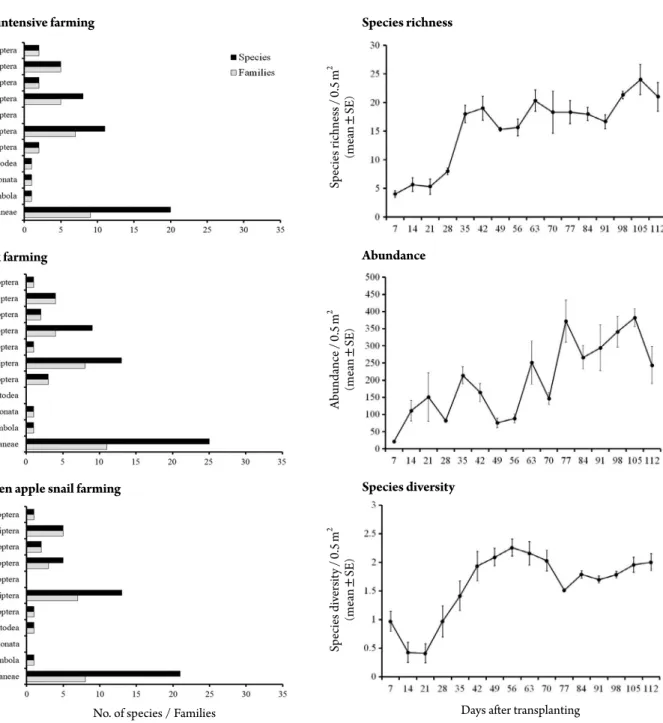
Of the 75 species collected, 42 were represented by < 10 individuals, and 15 of these species were represented by only a single individual. Araneae (41.33%), Hemiptera (22.67%), Coleoptera (14.67%) and Diptera (6.67%) were by far the richest taxa collected in species richness (Fig. 2), collectively accounting for 85.33% of the total species rich- ness. However, Collembola (33.29%) by only a single spe- cies was the most abundant followed by Diptera (24.15%),

Fig. 3. Seasonality of arthropod biodiversity in rice fields.

Species richness

Abundance

Species diversity Spe cie s r ichne ss / 0.5 m

2

( m ea n± SE ) Abund anc e / 0.5 m

2

( m ea n± SE ) Spe cie s d iv er sit y / 0.5 m

2

( m ea n± SE )

Days after transplanting Fig. 2. Taxonomic richness of arthropods in each farming practice.

Low intensive farming

Duck farming

Golden apple snail farming

Ar thr opod or de rs

No. of species / Families

(5)

Hemiptera (18.46%), Araneae (19.90%) and Coleoptera (3.20%) in order (Fig. 5), collectively accounting for 99.00% of the total number of individuals collected. This composition structure was the almost same in different farming practices (Fig. 2).

Species richness among farming practices ranged 51 to 60 species. Species richness (F 2, 6 = 5.78, p = 0.040) and

abundance (F 2, 6 = 3.99, p = 0.034) of golden apple snail farming was statistically significant with duck farming and

Fig. 4. Seasonality of species richness, abundance, and species diversity of arthropods in each farming practice.

Species richness

Abundance

Diversity Spe cie s r ichne ss / 0.5 m

2

( m ea n± SE ) Abund anc e / 0.5 m

2

( m ea n± SE ) Div er sit y / 0.5 m

2

( m ea n± SE )

Days after transplanting

Fig. 5. Seasonality of percent occupation of ecological functional groups in each farming practice.

Low intensive farming

Duck farming

Golden apple snail farming M ea n oc cu pa nc y r at e / 0.5 m

2

( % )

Days after transplanting

(6)

low intensive farming, respectively (Table 2). According to Bray-Curtis similarity, community structure of arthro- pods was divided into two groups; low intensive farming and golden apple snail farming vs. duck farming. Similarity among farming practices, however, was very high in 76.7%.

Seasonality of species richness, abundance and species diversity of the total throughout the rice growing season are shown in Fig. 3. Species richness increased from 21 DAT and showed serrated pattern with 3 peaks. Abundance in- creased just after transplanting and showed serrated pattern

Table 3. Taxa allocated to ecological functional groups Ecological

functional group Order Family Scientific name

General arthropods Diptera Diptera Diptera spp.

Tabanidae Tabanidae sp.

Herbivores Orthoptera Acrididae Oxya chinensis sinuosa Gryllidae Gryllidae sp.

Tettigoniidae Tettigoniidae sp.

Hemiptera Aphididae Sitobion avenae

Cicadellidae Nephotettix cincticeps, Recilia dorsalis Coreidae Cletus schmidti

Delphacidae Laodelphax striatellus, Nilaparvata lugens, Sogatella furcifera Derbidae Diostrombus politus

Hebridae Hebrus nipponicus Lygaeidae Lygaeidae sp.

Miridae Trigonotylus coelestialium, Miridae sp.

Pentatomidae Antheminia varicornis, Eysarcoris aeneus, Scotinophara lurida, Pentatomidae sp.

Coleoptera Curculionidae Lissorhoptrus oryzophilus, Curculionidae sp.

Elateridae Aeoloderma agnata Lepidoptera Noctuidae Naranga aenescens

Pyralidae Cnaphalocrocis medinalis Predators Odonata Coenagrionidae Ischnura asiatica

Mantodea Mantidae Tenodera aridifolia Hemiptera Ochteridae Ochterus marginatus Neuroptera Chrysopidae Chrysopidae sp.

Coleoptera Carabidae Agonum daimio, Anoplogenius cyanescens, Lachnocrepis prolixa, Odacantha aegrota

Coccinellidae Propylea japonica, Scymnini sp.

Staphylinidae Paederus fuscipes, Stenus distans Diptera Sciomyzidae Sepedon aenescens

Araneae Araneidae Larinioides cornutus, Neoscona adianta, Neoscona scylloides Clubionidae Clubiona kurilensis

Ctenidae Anahita fauna Gnaphosidae Zelotes sp.

Linyphiidae Bathyphantes gracilis, Erigone koshiensis, Gnathonarium dentatum, Ummeliata insecticeps

Lycosidae Arctosa ebicha, Pirata subpiraticus, Trochosa ruricola Nesticidae Nesticella mogera

Pisauridae Dolomedes sulfureus

Salticidae Mendoza canestrinii, Mendoza elongate, Myrmarachne formicaria, Sibianor pullus Tetragnathidae Pachygnatha clercki, Pachygnatha quadrimaculata, Pachygnatha tenera,

Tetragnatha maxillosa, Tetragnatha vermiformis

Theridiidae Chrysso octomaculata, Enoplognatha abrupta, Paidiscura subpallens, Parasteatoda oculiprominens

Thomisidae Ebrechtella tricuspidata, Ozyptila nongae, Xysticus sp.

Parasitoids Hymenoptera Braconidae Braconidae sp.

Ichneumonidae Ichneumonidae sp.

Diptera Tachinidae Tachinidae sp.

Filter feeder/

detritivores Collembola Tomoceridae Tomoceridae sp.

Diptera Chironomidae Chironomidae sp.

(7)

with 5 large or small peaks. Species richness increased from 21 DAT with the peak at 56 DAT and stabilized at 84 DAT.

Biodiversity of each farming practice showed a similar sea- sonality pattern.

2. structure and seasonality of ecological functional groups

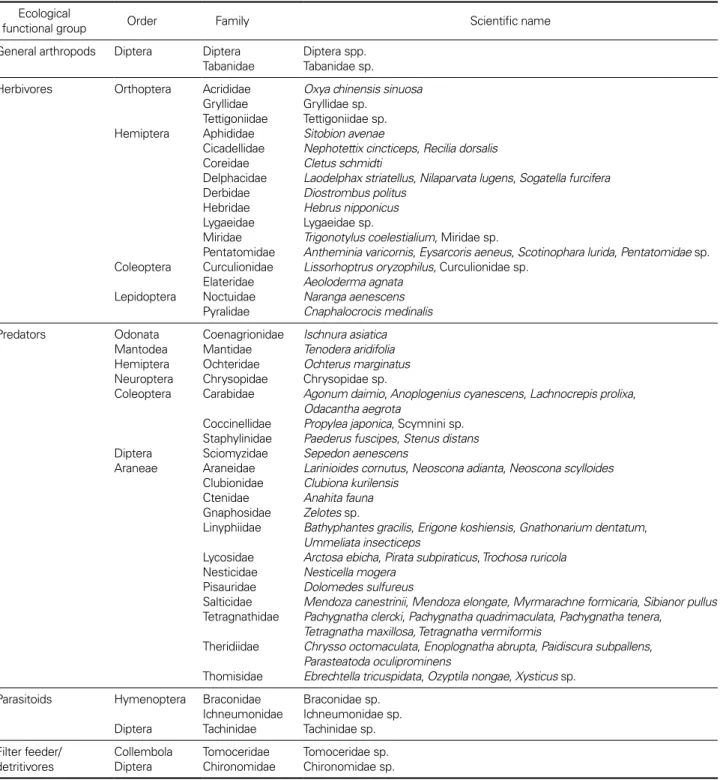
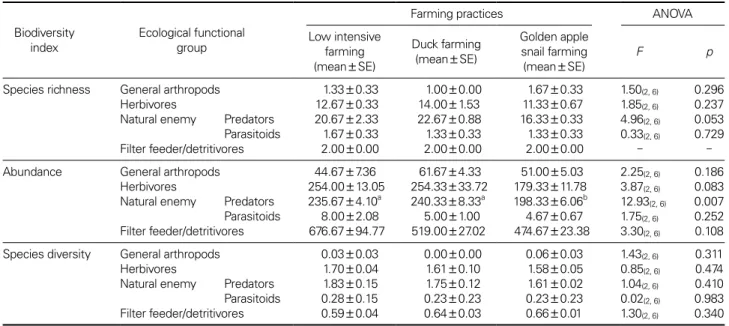
Taxa allocated to ecological functional groups based on the feeding habit are shown in Table 3. Species richness of predators and herbivores were higher than the others, accounting for 44 species of 20 families and 24 species of 16 families, respectively. The most abundant arthropods of ecological functional groups were almost same in each farming practice. The most abundant general arthropod was Diptera spp. The most abundant herbivores were Ne- photettix cincticeps of Cicadellidae and Sogatella furcifera of Delphacidae in Hemiptera. Tomoceridae sp. of Collembola and Chironomidae sp. of Diptera belonging to filter feeders or detritivores were found in very high number throughout the rice growing season. The most abundant parasitoids were Braconidae sp. of Hymenoptera which was observed throughout the season in all farming practices. Rice field spiders were the most abundant among natural enemy groups. They made up approximately 92.4% (low intensive farming 89.2%, duck farming 93.1% and golden apple snail farming 94.9%) in abundance from the whole natural ene- my groups. The most abundant spider species which is the main predator group in rice fields was Pirata subpiraticus of

Lycosidae.

Species richness and diversity of ecological functional groups among farming practices were not statistically sig- nificant. However, abundance of predators in golden apple snail farming was statistically significant with the others (F 2, 6 = 12.93, p = 0.007). Filter feeder/detritivores were the most abundant followed by herbivores and predators.

Species diversity was the highest in predators followed by herbivores (Table 4).

Seasonality of species richness, abundance and species diversity of ecological functional groups in each farming practice throughout the rice growing season which were shown in Fig. 4 showed a similar pattern. Seasonal fluctu- ations of biodiversity showed serrated pattern and their values increased with the time to harvest. Species richness increased rapidly at 35 DAT and reached the 2 nd peak at 105 DAT. Abundance showed 5 peaks at 21, 35, 63, 77 and 105 DAT, respectively. Species diversity showed rap- idly increase after transplanting and decreased at 70 DAT.

General patterns of seasonality of abundance and relative portion of ecological functional groups among farming practices showed somewhat different. Despite this, some ecological functional groups showed common fluctuation in seasonality. Herbivores which was a mainly Lissorhoptrus oryzophilus in seedling stage (7-20 DAT) and mixed of planthoppers, leafhoppers and moths with L. oryzophilus after late tillering stage (49 DAT) were abundant in early transplanting period (7 DAT) and late tillering stage (49 DAT) to ripening stage (84-112 DAT). Predators which

Table 4. Comparisons of species richness in the functional groups in the farming practices

Biodiversity

index Ecological functional group

Farming practices ANOVA

Low intensive farming (mean±SE)

Duck farming (mean±SE)

Golden apple snail farming

(mean±SE) F p

Species richness General arthropods 1.33±0.33 1.00±0.00 1.67±0.33 1.50

(2, 6)

0.296

Herbivores 12.67±0.33 14.00±1.53 11.33±0.67 1.85

(2, 6)

0.237

Natural enemy Predators 20.67±2.33 22.67±0.88 16.33±0.33 4.96

(2, 6)

0.053 Parasitoids 1.67±0.33 1.33±0.33 1.33±0.33 0.33

(2, 6)

0.729

Filter feeder/detritivores 2.00±0.00 2.00±0.00 2.00±0.00 - -

Abundance General arthropods 44.67±7.36 61.67±4.33 51.00±5.03 2.25

(2, 6)

0.186

Herbivores 254.00±13.05 254.33±33.72 179.33±11.78 3.87

(2, 6)

0.083

Natural enemy Predators 235.67±4.10

a

240.33±8.33

a

198.33±6.06

b

12.93

(2, 6)

0.007 Parasitoids 8.00±2.08 5.00±1.00 4.67±0.67 1.75

(2, 6)

0.252 Filter feeder/detritivores 676.67±94.77 519.00±27.02 474.67±23.38 3.30

(2, 6)

0.108 Species diversity General arthropods 0.03±0.03 0.00±0.00 0.06±0.03 1.43

(2, 6)

0.311

Herbivores 1.70±0.04 1.61±0.10 1.58±0.05 0.85

(2, 6)

0.474

Natural enemy Predators 1.83±0.15 1.75±0.12 1.61±0.02 1.04

(2, 6)

0.410

Parasitoids 0.28±0.15 0.23±0.23 0.23±0.23 0.02

(2, 6)

0.983

Filter feeder/detritivores 0.59±0.04 0.64±0.03 0.66±0.01 1.30

(2, 6)

0.340

(8)

were mainly composed of spiders were abundant from ear-

ly tillering stage (14 DAT) to ripening stage. Herbivores fluctuated with the opposite of predators. In other words, when predators increased, herbivores decreased and vice versa (Fig. 5).

3. Biomass fluctuation of rice plant and arthropods

Density and biomass of each arthropod are shown in

Table 5. Comparisons of rice biomass and ecological functional groups in the farming practices

Ecological functional group

Farming practices ANOVA

Low intensive farming

(mg, mean±SE) Duck farming (mg, mean±SE)

Golden apple snail farming

(mg, mean±SE) F p

Rice 314516.38±127168.03 261498.17±11180.17 245432.10±102878.26 1.60

(2, 6)

0.278

Arthropods

General arthropods 52.14±12.63 41.01±2.13 50.49±8.29 1.67

(2, 6)

0.265

Herbivores 999.48±228.53

a

434.53±96.28

ab

201.9±29.70

b

8.09

(2, 6)

0.020

Natural enemy Predators 591.81±68.81 576.23±39.16 399.33±24.78 4.98

(2, 6)

0.053

Parasitoids 0.85±0.20 1.43±0.59 0.33±0.07 2.25

(2, 6)

0.186

Filter feeder/detritivores 44.62±5.17 38.52±4.19 48.57±3.85 1.30

(2, 6)

0.339 Fig. 6. Abundance and biomass of arthropod orders in each farm-

ing practice.

Low intensive farming

Duck farming

Golden apple snail farming Abund anc e a nd b iom as s ( N o. of ind iv idual s a nd m g / 0.5 m

2

)

Order

Fig. 7. Seasonality of biomass of rice and arthropods in each farming practice.

Rice

Arthropods Biom as s ( mg / 0.5 m

2

) ( m ea n± SE ) Biom as s ( mg / 0.5 m

2

) ( m ea n± SE )

Days after transplanting

(9)

Appendix 1-3. In the biomass of arthropod families, Ara- neae was the highest in duck farming and golden apple snail farming, whereas Orthoptera was the highest in low inten- sive farming (Fig. 6). Hemiptera, Coleoptera and Diptera were greater than the other taxa in general. Despite high abundance of Colembolla and Diptera, their biomasses

were relatively too low. Biomass of rice plant among farm- ing practices was not significantly different as well as in general arthropods, predators, parasitoids and filter feeder/

detritivores. Biomass of herbivores of low intensive farming (F 2, 6 = 8.09, p = 0.020) was significantly different with the others (Table 5).

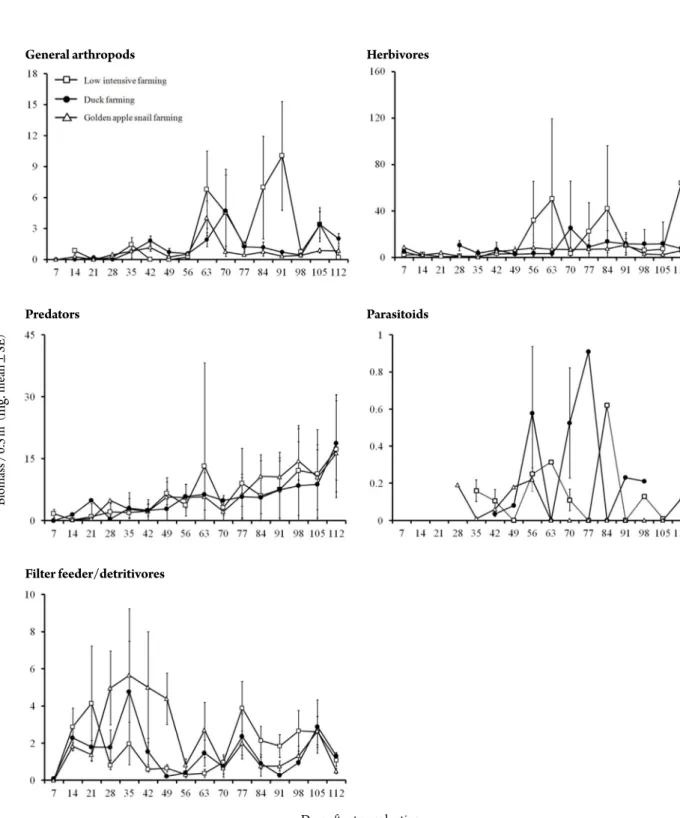
Biomass of rice plant and arthropods increased with rice growth from transplanting to harvest in all farming prac- tices (Fig. 7). Biomass fluctuation of ecological functional groups among farming practices is shown in Fig . 8. Though biomass of each ecological functional group showed little difference, fluctuation pattern of biomass in each farming practice was almost same. Total arthropod biomass in- creased gradually at late seedling stage (28 DAT) and was higher at late booting stage (63 DAT) and late ripening stage (112 DAT). Seasonal fluctuation of each ecological functional group among farming practices is shown in Fig . 9.

All ecological functional groups showed similar fluctuating pattern except parasitoids. Seasonality of biomass of each ecological functional group was; (1) general arthropods increased from 56 DAT with 2 peaks, (2) herbivores were increased from 49 DAT and decreased from 91 DAT, (3) predators increased gradually from transplanting to harvest and parasitoids were the most unstable and fluctuating in each farming practice, and (4) filter feeder/detritivores were higher at the first half than the second half around 63 DAT.

dIscussIon

Most of the rice fields in Korea is now cultivated once a year with an intensive irrigated system. Irrigated rice fields are characterized as temporary aquatic agricultural ecosys- tems with a dry period, managed with a variable degree of intensity and various farming practices (Halwart 1994).

Although being a monoculture agricultural ecosystem, a rice field undergoes three major ecological phases; aquat- ic, semi-aquatic and a terrestrial dry phase, during a single paddy cultivation cycle (Fernanado 1995).

Community and biodiversity in rice fields have been rela- tively well documented from tropical Asia; Heckman (1974, 1979) in Laos and Thailand, Heong et al. (1991) and Schoenly et al. (1996) in Philippines, and Bambaradeniya et al. (2004) in Sri Lanka. However, previous studies related to rice field fauna in Korea mainly deal with agronomic as- pects, where the individual rice pests, their natural enemies

Fig. 8. Seasonality of arthropod biomass in each farming practice.

Low intensive farming

Duck farming

Golden apple snail farming M ea n b iom as s ( mg / 0.5 m

2

)

Days after transplanting

(10)

and resistant rice varieties, insecticidal effects to insect pests and natural enemies have been surveyed restrictively. As a result, there is not fully understandable documentation on the overall community and biodiversity from Korean rice

fields. Moreover, despite increase of various environmen- tally friendly farming during last two decades, there was not comparative study between conventional farming and envi- ronmentally friendly farming. Therefore, present study will

Fig. 9. Seasonality on biomass of ecological functional groups in each farming practice.

General arthropods Herbivores

Predators Parasitoids

Filter feeder/detritivores Biom as s / 0.5 m

2

( m g. m ea n± SE )

Days after transplanting

(11)

be a key study to understand the terrestrial arthropod fauna in Korean rice fields.

Present study identified a total of 75 species of 70 genera belonging to 43 families in 11 orders from 9,622 collect- ed arthropods. Paik (1967) implicated 98 rice insect pests based on the former reports from Korean rice fields with 16 economically important species and Korean Society of Plant Protection (1986) listed 143 rice insect pests. Among them, some of the important species, rice stem borer (Chi- lo suppressalis), rice leaf beetle (Oulema oryzae), rice stem maggot (Chlorops oryzae) and rice leafminer (Hydrellia gris- eola) were not collected in study area. The colonization and occurrence of arthropods in rice fields depend not only on its irrigated conditions, but also on the presence of the rice plants and agricultural practices. Compositional structure among farming practices in present study, however, were the almost same. Araneae, Hemiptera, Coleoptera and Dip- tera were by far the richest taxa accounting for 85.33% of the total and Collembola by only a single species was the most abundant followed by Diptera, Hemiptera, Araneae and Coleoptera accounting for 99.00% of the total number of individuals collected. Our results indicate that terrestrial arthropod community in irrigated rice fields is structured by a few dominant taxa and surrogate that only a small number of hydrophilic taxa could adapt to the irrigated conditions in rice fields. Though golden apple snail farming was statistically significant with low intensive farming and duck farming in species richness and abundance, Bray-Cur- tis similarity showed very high similarity by 76.7% among farming practices. Biodiversity of each farming practice also showed a similar seasonality pattern.

In the ecological functional groups based on the feeding habit, most abundant arthropods of ecological functional groups were almost same in each farming practice. The most abundant herbivores were green rice leafhopper (Ne- photettix cincticeps) and white backed planthopper (Sogatella furcifera) in Hemiptera. Rice field spiders (Araneae) were the most abundant among natural enemy groups occupy- ing approximately 92.4%. Spiders have been known to play an important role in regulating insect pests in agricultural ecosystem (Specht and Dondale 1960; Nyffeler and Benz 1987; Sunderland 1999). Kiritani (1979) stated that low- er pest densities have been attributed to spider activity in Asian rice fields. And the role of spiders as predators in re- ducing insect pests in rice fields were clearly described by many publications (Hamamura 1969; Sasaba et al. 1973;

Gavarra and Raros 1973; Kobayashi 1977; Chiu 1979;

Holt et al. 1987; Tanaka 1989; Barrion and Litsinger 1995;

Settle et al. 1996). Contribution of spiders on the naturally occurred biological control seems to be universal in irriga- ted rice fields worldwide. Among the rice field spiders, the most abundant spider species was Pirata subpiraticus (Lycosidae). Rice field spiders are generalist predators and comprise 145 species of 84 genera in 22 families in Korea (Kim 1998). Among them, P. subpiraticus is the most abun- dant spider species throughout Korea (Park et al. 1972;

Choi and Namkung 1976; Okuma et al. 1978; Paik et al.

1979; Paik and Namkung 1979; Yoon and Namkung 1979;

Paik and Kim 1979; Im and Kim 1996; Yun 1997; Lee et al.

1998; Kim 1998; Kim et al. 2011). Predatory capacity of P.

subpiraticus is the highest among rice field spiders (Paik et al. 1979; Lee and Kim 2001) and prey mostly on planthop- pers and leafhoppers (Kim 1998; Yu et al. 2002). Hence, P.

subpiraticus may play a greater role in suppressing planthop- pers and lesfhoppers in Korean rice fields.

Species richness and diversity among farming practices was not statistically significant. Species richness and diver- sity were high in predators and herbivores were the next.

Filter feeder/detritivores were the most abundant followed by herbivores and predators. In most instances, the spe- cies richness and abundance of the predator populations may be greater than those of pest populations, when little or no insecticides are used (Way and Heong 1994). How- ever, abundance of predators in golden apple snail farming was statistically significant with the others. This result was caused by the decrease of the spiders. Rice fields of gold- en apple snail farming were damaged by wind and most of rice plants were collapsed covered with muddy soils. This condition, insufficient prey and unfavorable microhabitat, might accelerate the dispersal of spider assemblage to adja- cent habitat. From the collective results, biodiversity among farming practices is also similar as well as in community composition. Additionally, draining of water resulted in a short semi-aquatic or dry phage after heading stage. During this phase, 14 arthropod species were newly introduced into the main fields from the levee. The dry rice plants also provided an ideal habitat for insects, while certain species of spiders also remained in the field. This confirmed the fact that newly introduced species enter the main fields when the fields begin to dry contribute to the biodiversity of rice fields.

Present study did not find remarkably different season-

ality pattern in arthropod community as well as in ecologi-

cal functional groups among farming practices. However,

pa rasitoids showed very low abundance with fluctuating

seasonality pattern. Generally, parasitoids are specialist pre-

(12)

dator which has narrow prey range and more sensitive to in- secticides than generalist predators like spiders. Their small number and fluctuating pattern may be caused by long- term use of insecticides and prey selectivity. Present study found that when predators increased, herbivores decreased and vice versa. This surrogate that predators regulate insect pest population practically in terms of naturally occurred biological control. Seasonality has an important meaning more than simple numerical fluctuation of certain commu- nity. Wealthy information on the seasonality of ecological functional groups is essential for control decision making through scouting system. Integrated Pest Management (IPM) is a technology that resonates with the concepts of sustainable agricultural development. It is undeniable fact that IPM has been developed with plenty of ecological information such as agricultural environments, ecological characteristics of pests and natural enemies including com- munity structure, biodiversity and seasonality, and develop- ment of low toxic and selective pesticides.

Present study determined the biomass of rice plants and terrestrial arthropods inhabiting in rice fields. In the bio- mass of arthropod families, Araneae was the highest and Hemiptera, Coleoptera and Diptera were greater than the other taxa in general. Menhinick (1967) reported that spi- ders constitute over 50% of both numbers and biomass of carnivorous arthropods. Though biomass of herbivores of low intensive farming was significantly different with the others, those of rice plant and ecological function- al groups among farming practices seems to have similar biomass structure. The difference was caused by a single species with small number captured, adults of rice grass- hopper (Oxya chinensis sinuosa), of which dry weight was 207.7 mg. Dry weight of rice grasshopper was heavier 32 folds than total mean of other arthropods. Biomass is one of another way to understand community structure and is generally a better indicator of the functionality of a species within a community through food web or energy flow, as it is strongly correlated with metabolism. Provencher and Riechert (1994) used computer simulations and field tests to show that an increase in spider species richness leads to a decrease in prey biomass. As Persson (1991) and Brown et al. (2004) stated, biomass is a key variable in ecology, par- ticularly in terms of energy flow, productivity and food-web dynamics, and is a strong indicator of community structure.

Collectively, we conclude that community structure and biodiversity of terrestrial arthropods among farming practices in present study are not different. In other words, current farming practices in rice field ecosystem in Korea,

operating on a temporal scale, may not be a major contri- buting factor to its rich and varied biodiversity. Certainly, cropping system or farming practices may influence the terrestrial arthropod community. However, our conclusion is reasonable with some points of view. Low intensive farm- ing which use less insecticides for control of Lissorhoptrus oryzophilus did not disturb the overall community structure and biodiversity because of the limited efficacy and short duration of insecticides at early rice growing stage. Though, ducks may feed arthropods besides weeds, they did not influence the overall community structure and biodiver- sity. Because they were exposed to rice fields during 45- 50 DAT and biodiversity began to colonize at 45-50 DAT with accumulation of arthropods. Golden apple snails for weed control which are present throughout the rice grow- ing season through self-reproduction and omnivorous also did not change the overall community structure and bio- diversity because they mainly inhabit under the irrigated water unlike terrestrial arthropods inhabiting above water surface and don’t feed arthropods.

Until the late 1980s, biological conservation limited to undisturbed natural habitats. However, the focus on the bi- ological conservation expanded to agricultural ecosystem for conservation of agricultural biodiversity and sustainable agriculture and since then. The study of biodiversity asso- ciated with agricultural ecosystems such as rice fields is of significance for agroecologists and conservation biologists, since maintenance of biological diversity is essential for productive agriculture, and ecologically sustainable agricul- ture is in turn essential for maintaining biological diversity (Pimental et al. 1992). As Bambaradeniya and Amarasing- he (2004) stated, there also do not seem to be ecological studies contrasting the biodiversity of traditional rain-fed ricelands with more intensive irrigated systems. Compara- tive biodiversity studies that would yield such temporal (i.e.

before and after the replacement) or spatial (rice ecosystem

vs. adjoining natural ecosystem, or traditional vs. intensive

cultivation) contrasts could make a valuable contribution

to knowledge that may result in the development of more

ecologically friendly rice ecosystem. Maintaining or en-

hancing agricultural practices while using less pesticides

through effective using of natural enemies will be promot-

ed. Biodiversity implications of IPM are newly interesting

research field. The results of the present study may clearly

contribute to the irrigated rice fields towards sustaining a

rich biodiversity and to advanced study such as food web

or energy flow structure in rice fields in terms of ecological

and sustainable agriculture.

(13)

acknowledgeMents

The study was supported by a grant from the Rural De- velopment Administration (RDA) (PJ012285012019 and 201104010305570010400) of Ministry of Agriculture, Food and Rural Affairs (MAFRA), Republic of Korea .

references

Bambaradeniya CNB and FP Amarasinghe. 2004. Biodiversity associated with the rice field agroecosystem in Asian coun- tries: A brief review. International Water Management Insti- tute, Battaramulla. p. 24.

Bambaradeniya CNB, JP Edirisinghe, DN De Silva, CVS Guna- tilleke, KB Ranawana and S Wijekoon. 2004. Biodiversity as- sociated with an irrigated rice agro-ecosystem in Sri Lanka.

Biodivers. Conserv. 13:1715-1753.

Barrion AT and JA Litsinger. 1995. Rice land spiders of South and South-East Asia. Centre for CABI International, UK and Inter- national Rice Research Institute, Manila. p. 700.

Brown JH, JF Gillooly, AP Allen, VM Savage and GB West. 2004.

Toward a metabolic theory of ecology. Ecology 85:1771- 1789.

Chiu SC. 1979. Biological control of brown plant hopper. pp.

335-355. In Brown Plant Hopper, Threat to Rice Production in Asia. International Rice Research Institute, Los Banos, La- guna.

Choi SS and J Namkung. 1976. Survey on the spiders of the rice paddy field (I). Kor. J. Pl. Prot. 15:89-93.

Clarke KR and RM Warwick. 2001. Change in Marine Commu- nities: An Approach to Statistical Analysis and Interpretation (2nd Eds.). PRIMER-E, Plymouth.

EEA. 2004. High Nature Value Farmland - Characteristics, Trends and Policy Challenges. European Environment Agency, Co- penhagen. p. 26.

Fernando CH. 1993. Rice field ecology and fish culture - an over- view. Hydrobiologia 259:91-113.

Fernando CH. 1995. Rice fields are aquatic, semi-aquatic, terres- trial and agricultural: a complex and questionable limnology.

Trop. Limnol. 1:121-148.

Gavarra M and RS Raros. 1973. Studies on the biology of preda- tor wolf spider, Lycosa pseudoannulata Bos. et Str. (Araneae:

Lycosidae). Philipp. Entomol. 2:427.

Geoff Z, MG Geoff, K Stefan, RW Mark, DW Steve and W Eric.

2007. Arthropod pest management in organic crops. Annu.

Rev. Entomol. 52:57-80.

Halwart M. 1994. Fish as biocontrol agents in rice. The potential of common carp Cyprinus carpio (L.) and Nile tilapia Oreo-

chromis niloticus (L.). Verlag Josaf Margraf, Weikersheim. p.

169.

Hamamura T. 1969. Seasonal fluctuation of spider populations in paddy fields. Acta Arachnol. 22:40-50.

Heckman CW. 1974. Seasonal succession of species in a rice paddy in Vientiane, Laos. Int. Rev. Gesamten Hydrobiol.

59:489-507.

Heckman CW. 1979. Rice field ecology in North East Thailand.

Monogr. Biol. 34:228.

Heong KL, GB Aquino and AT Barrion. 1991. Arthropod commu- nity structures of rice ecosystems in the Philippines. Bull.

Entomol. Res. 81:407-416.

Holt J, AJ Cook, TJ Perfect and GA Norton. 1987. Simulation anal- ysis of brown plant hopper (Nilaparvata lugens) population dynamics on rice in the Philippines. J. Appl. Ecol. 24:87-102.

Im MS and ST Kim. 1996. Study on the ecology of the spiders as natural enemy on insect pest of main crops I.-The fauna and population structure of the spiders at rice paddy field and levee. J. Life Sci. Konkuk Univ. 3:37-72.

Kim ST. 1998. Studies on the ecological characteristics of the spider community at paddy field and utilization of the Pirata subpiraticus (Araneae: Lycosidae) for control of Nilaparvata lugen (Homoptera: Delphacidae). Ph.D. dissertation, Konkuk University, Korea. p. 90.

Kim ST, SY Lee, JK Jung and JH Lee. 2011. Spiders as important predators in Korean rice fields. pp. 285-289. In Organic is Life-Knowledge for Tomorrow (Neuhoff D et al. eds.). ISO- FAR.

Kiritani K. 1979. Pest management in rice. Annu. Rev. Entomol.

24:279-312.

Kobayashi S. 1977. Changes in population density of the spiders in paddy fields during winter. Acta Arachnol. 27:247-251.

Korean Society of Plant Protection. 1986. List of plant diseases, insect pests and weeds from Korea. Korean Society of Plant Protection, Suwon. pp. 257-259.

Lee JH, KH Kim and HJ Lee. 1998. Arthropod community in small rice fields associated with different planting methods in Suweon and Icheon. Korean J. Appl. Entomol. 21:15-26.

Lee JH, JH Yun, ST Kim, HH Park and KI Uhm. 2000. Arthropod community structures in rice fields in Korea. pp. 257-269. In Ecology of Korea (Lee DW et al. eds.). Bumwoo Publishing Company, Seoul.

Lee JH and ST Kim. 2001. Use of spiders as natural enemies to control rice pests in Korea. FFTC extension bulletin 501, Tai- wan. p. 13.

Loevinshon ME. 1994. Rice pests and agricultural environment.

pp. 487-515. In Biology and Management of Rice Insects

(Heinrichs EA eds.). Wiley Eastern Ltd., Manila.

Menhinick EF. 1967. Structure, stability, and energy flow in plants

(14)

and arthropods in a Serica lespedeza stand. Ecol. Monogr.

37:255-272.

Nyffeler M and G Benz. 1987. Spiders in natural pest control: a review. J. Appl. Entomol. 103:321-329.

Okuma C, MH Lee and N Hokyo. 1978. Fauna of spiders in a paddy field in Suweon, Korea. Esakia 11:81-88.

Paik JC, YB Lee, HR Lee and KM Choi. 1979. Studies on the physiology, ecology and control of the rice insect pests. Res.

Report RDA, Suwon. pp. 341-367.

Paik KY and JS Kim. 1979. Survey on the spider-fauna and their seasonal fluctuation in paddy fields in Taegu, Korea. Kor. J. Pl.

Prot. 12:125-130.

Paik WH. 1967. Insect pests of rice in Korea. pp. 657-674. In The Major Insect Pests on the Rice Plant (Pathak MD ed.). Johns Hopkins Univ. Press, Baltimore.

Paik WH and J Namkung. 1979. Studies on the rice paddy spi- ders from Korea. Seoul National Univ. Press, Suwon. p. 101.

Park JS, SC Lee, BH Lee, YI Kim, KT Park and KJ Ahn. 1972. In- fluences of insecticides on the rice insect pests. Res. Report RDA, Suwon. pp. 146-169.

Persson L. 1991. Trophic cascades: abiding heterogeneity and the trophic level concept at the end of the road. Oikos 85:385- 397.

Pimental D, U Stachow, D Takacs, HW Brubaker, AR Dumas and JJ Meaney. 1992. Conserving biological diversity in agricul- tural/forestry systems. Bioscience 42:354-362.

Provencher L and SE Riechert. 1994. Model and field test of prey control effects by spider assemblages. Environ. Entomol.

23:1-17.

Samal P and FBC Misra. 1975. Spiders: the most effective nat-

ural enemies of the brown plant hoppers in rice. Rice Ento- mol. Newsl. 3:31.

SAS. 2004. SAS 9.1.2 Qualification Tools User’s Guide. SAS Inst.

Cary, North Carolina, USA.

Sasaba T, K Kiritani and S Kawahara. 1973. Food preference of Lycosa in paddy fields. Bull. Kochi Instit. Agri. For. Sci. 5:61- 63.

Settle WH, H Ariawan, ET Artuti, W Cayhana, AL Hakim, D Hin- dayna, AS Lestari and S Pajaringsih. 1996. Managing tropical rice pests through conservation of generalist natural ene- mies and alternative prey. Ecology 77:1975-1988.

Shannon CE and W Weaver. 1949. The mathematical theory of communication. University of Illinois Press, Illinois, USA.

Specht HB and CD Dondale. 1960. Spider populations in New Jersey apple ochards. J. Econ. Entomol. 53:810-814.

Sunderland K. 1999. Mechanisms underlying the effects of spi- ders on pest populations. J. Arachnol. 27:308-316.

Way MJ and KL Heong. 1994. The role of biodiversity in the dy- namics and management of insect pests of tropical irrigated rice-a review. Bull. Entomol. Res. 84:567-587.

Yoon JK and J Namkung. 1979. Distribution of spiders on paddy fields in the suburbs of Kwangju City. Kor. J. Pl. Prot. 18:137- 141.

Yu XP, XS Zheng, HX Xu, ZX Lu, JM Chen and LY Tao. 2002. A study on the dispersal of lycosid spider, Pirata subpiraticus between rice and Zizania fields. Acta Entomol. Sin. 45:636- 640.

Yun JC. 1997. Arthropod community structure and changing pat-

terns in rice ecosystems of Korea. Ph.D. dissertation, Seoul

National University, Korea. p. 105.

(15)

Appendix 1 . List of arthropods with densit y and biomass in lo w -intensiv e f arming Order Scientific name

D AT 7 14 21 28 35 42 49 56 63 70 77 84 91 98 10 5 11 2 N B N B N B N B N B N B N B N B N B N B N B N B N B N B N B N B Collembola Tomoceridae sp.     1 0.1 3 0.1 36 1.4 57 2.5 46 2.0     10 0.4 31 1.0 66 3.1 301 17 .5 18 1 9.0 19 0 7.2 213 10.9 16 4 9.7 95 4.1 Odonat a Isc hnura asiatica 1 3.9 1 3.1 1 2.4 1 3.4 1 2.1 1 2.9 Mantodea Tenodera aridif olia 1 196.5 Orthoptera Oxy a c hinensis sinuosa 2 290.4 4 537 .7 1 169.2 1 290.4 3 863.4 Tet tigoniidae sp. 1 20.8 1 11 .7 1 61 .8 Hemiptera Ey sarcoris aeneus 1 8.0 Hebr us nipponicus 1 0.2 1 0.2 4 0.5 Laodelphax striatellus 1 0.0 1 0.2 2 0.5 3 0.9 2 0.7 11 3.0 Ly gaeidae sp. 1 2.5 Miridae sp. 1 0.2 1 0.1 2 0.3 1 0.0 Nephotet tix cincticeps 1 0.9 12 13.4 34 37 .3 35 39.0 44 44.2 55 61 .7 32 23.3 62 23.4 Nilapar vat a lugens 1 0.4 1 1.0 66 31 .7 5 3.1 16 14.2 5 4.8 R ecilia dorsalis 2 0.9 Scotinophara lurida 1 18.1 1 8.4 8 104.8 2 45.6 4 11 6.0 Sitobion a venae 3 0.2 4 1.0 71 13.1 92 16.8 Sogatella furcif era 4 0.6 1 0.3 2 0.4 3 0.6 23 7.6 14 6.5 15 3.2 13 6.0 16 4.5 13 5.7 1 0.3 Coleoptera A eoloderma agnat a 1 0.9 Lac hnocrepis prolixa 1 21 .7 1 17 .2 1 8.7 1 24.5 Lissorhoptr us or yz ophilus 4 4.6 4 5.3 1 1.3 1 1.1 2 2.6 6 7.4 8 9.5 5 5.9 4 4.8 3 3.0 4 4.2 1 1.1 Odacantha aegrot a 2 6.2 Paeder us fuscipes 1 1.5 1 1.4 1 2.1 Prop ylea japonica 1 0.4 Scymnini sp. 1 0.3 Stenus dist ans 1 0.8 1 0.4 1 0.7 1 0.9 2 0.7 1 0.5 Hymenoptera

Braconidae sp. Ic 2 0.3 3 0.2 2 0.3 7 0.6 3 0.2 1 0.6 2 0.1 1 0.0 hneumonidae sp. Diptera Chironomidae sp. 6 0.0 16 1 11 .5 271 16.4 33 2.7 61 9.4 15 1.6 7 1.9 10 1.4 9 0.9 8 1.8 10 2.0 10 3.8 2 0.2 14 5.1 18 6.0 1 0.3 Diptera spp. 3 1.7 1 0.2 16 2.9 3 0.0 5 0.8 14 13.5 9 1.0 25 4.0 26 20.9 7 20.1 9 2.1 12 6.8 3 0.4 Sepedon aenescens 5 13.5 1 2.1 7 23.0 4 14.4 3 9.3 2 6.2 3 9.6 2 5.8 1 4.8 2 8.7 Tabanidae sp. 1 17 .2 Tac hinidae sp. 3 0.2 Lepidoptera Cnaphalocrocis medinalis 1 0.7 1 3.2 1 1.6 Naranga aenescens 1 0.5 1 2.6 2 7.6 2 9.5 Araneae Arctosa ebic ha 1 19.1 2 62.7 2 128.5 1 60.7 B ath yphantes gracilis 1 0.5 1 0.0 Chr ysso octomaculat a 1 0.1 1 0.1 1 0.0 1 0.2 1 1.0 2 0.3 3 0.2 Clubiona kurilensis 1 1.0 2 0.2 2 3.2 1 0.2 4 9.2 1 5.0 2 10.8 8 5.2 8 11 .1 12 21 .6 8 13.1 Enoplognatha abr upt a 3 3.9 5 3.3 1 0.8 1 7.0 2 9.8 2 1.8 Erigone k oshiensis 1 0.2 1 0.1 Gnathonarium dent at um 1 0.0 1 0.1 1 0.4 2 0.4 1 0.5 Mendoza canestrinii 2 1.6 1 3.9 Mendoza elongat a 2 6.0 Neoscona adiant a 2 0.1 1 0.1 1 15.7 Nesticella mogera 1 0.4 Pac hy gnatha clerc ki 1 0.0 3 1.0 5 12.4 2 3.5 6 22.6 1 2.7 1 1.5 5 9.3 1 0.3 4 11 .8 5 10.1 5 7.6 8 31 .0 10 16.1 3 11 .0 Pac hy gnatha quadrimaculat a 1 0.7 1 0.6 1 0.4 Paidiscura subpallens 1 0.0 1 0.0 1 0.6 1 0.0 Pirat a subpiraticus 1 4.2 2 2.6 1 0.3 10 13.9 14 13.6 14 18.4 14 24.5 21 8.4 20 19.2 33 49.3 38 58.9 63 89.7 78 156.1 29 108.0 26 132.7

(16)

Appendix 2. List of arthropods with densit y and biomass in duc k f arming Order Scientific name

D AT 7 14 21 28 35 42 49 56 63 70 77 84 91 98 10 5 11 2 N B N B N B N B N B N B N B N B N B N B N B N B N B N B N B N B Collembola Tomoceridae sp. 26 1.4 37 1.5 29 1.3 19 1.2 13 4 6.1 17 0.3 226 11 .1 86 3.4 31 0.8 11 9 3.2 19 2 11 .5 75 4.4 Odonat a Isc hnura asiatica 1 6.7 Orthoptera Gr yllidae sp. 1 2.6 Oxy a c hinensis sinuosa 1 17 .9 1 39.7 1 4.7 1 279.0 Tet tigoniidae sp. 1 27 .0 1 79.7 Hemiptera Antheminia v aricornis 1 31 .2 1 49.0 Clet us sc hmidti 1 19.4 Diostrombus polit us 2 3.7 Hebr us nipponicus 1 0.1 1 0.2 1 0.0 2 0.3 Laodelphax striatellus 1 0.4 6 1.4 1 0.2 6 2.2 4 1.5 Miridae sp. 4 0.3 2 0.0 4 0.6 1 0.1 1 0.2 Nephotet tix cincticeps 2 1.4 1 2.1 2 2.4 8 14.4 27 38.3 51 34.3 55 43.9 10 9 76.1 69 66.6 21 17 .6 14 5.8 Nilapar vat a lugens 5 1.0 4 2.6 11 8.1 11 6.0 R ecilia dorsalis 4 1.8 2 1.1 1 0.8 Scotinophara lurida 1 0.6 1 1.0 1 17 .5 3 84.6 4 123.6 Sitobion a venae 1 0.1 2 0.3 10 1.0 29 6.5 Sogatella furcif era 17 10.9 10 3.6 11 2.9 77 19.1 46 21 .9 16 7.6 6 2.4 4 1.0 3 1.1 3 2.0 Trigonot ylus coelestialium 3 1.7 1 0.5 Neuroptera Chr ysopidae sp. 1 3.2 Coleoptera A gonum daimio 1 5.1 Anoplogenius cy anescens 1 4.1 Lac hnocrepis prolixa 1 12.1 1 10.0 1 19.4 1 5.3 2 39.2 Lissorhoptr us or yz ophilus 11 14.8 1 1.2 2 2.7 2 2.4 10 13.4 12 14.8 14 18.6 9 12.5 2 2.2 Odacantha aegrot a 1 2.9 1 1.4 6 23.2 Paeder us fuscipes 2 4.5 Prop ylea japonica 1 2.8 1 0.1 Scymnini sp. 1 0.5 1 0.7 Stenus dist ans 1 0.9 1 0.3 3 1.2 1 0.6 2 2.4 1 1.1 Hymenoptera

Braconidae sp. Ic 2 0.1 2 0.1 2 0.3 1 0.0 3 1.1 1 0.9 1 0.2 1 0.2 hneumonidae sp. Diptera Chironomidae sp. 11 0.3 83 6.9 10 4 5.4 53 9.3 18 8 27 .1 55 8.0 13 0.6 5 0.8 20 2.7 11 4.0 4 0.7 12 2.1 2 0.2 2 0.7 1 0.0 2 0.8 Diptera spp. 1 0.0 1 0.2 8 2.3 20 5.5 8 1.4 9 1.7 20 5.8 22 14.2 21 3.7 14 2.4 15 2.2 9 1.4 7 6.8 30 6.1 Sepedon aenescens 2 5.8 1 4.1 Tac hinidae sp. 2 1.5

Appendix 1 . List of arthropods with densit y and biomass in lo w -intensiv e f arming Order Scientific name

D AT 7 14 21 28 35 42 49 56 63 70 77 84 91 98 10 5 11 2 N B N B N B N B N B N B N B N B N B N B N B N B N B N B N B N B Sibianor pullus 1 2.7 Tetragnatha maxillosa 1 1.0 4 9.3 1 1.4 1 0.7 1 1.6 4 1.9 3 1.8 5 15.8 1 0.7 2 0.7 Tetragnatha v ermif ormis 1 0.8 1 1.5 Ummeliat a insecticeps 1 0.2 6 1.4 4 0.6 2 0.5 4 1.8 1 0.2 7 5.3 5 1.0 1 0.5 12 7.3 6 3.9 15 6.7 1 0.6 20 7.6 2 1.3 Xy sticus sp. 1 0.0 1 3.3 1 0.4 5 36.2 1 4.9

Continued

(17)

Appendix 2. List of arthropods with densit y and biomass in duc k f arming Order Scientific name

D AT 7 14 21 28 35 42 49 56 63 70 77 84 91 98 10 5 11 2 N B N B N B N B N B N B N B N B N B N B N B N B N B N B N B N B Lepidoptera Naranga aenescens 3 11 .7 1 1.3 1 3.5 1 4.4 1 4.5 Araneae Anahit a f auna 1 8.8 Arctosa ebic ha 1 59.1 B ath yphantes gracilis 3 1.1 Chr ysso octomaculat a 2 0.6 4 1.5 1 0.9 Clubiona kurilensis 1 0.0 3 4.5 2 0.2 2 6.9 2 7.4 2 6.3 4 2.1 7 8.7 8 11 .6 9 13.6 Dolomedes sulfureus 3 12.5 3 27 .1 Ebrec htella tricuspidat a 2 4.8 Enoplognatha abr upt a 1 0.7 2 5.3 2 6.8 1 1.0 2 0.8 1 0.9 Erigone k oshiensis 1 0.1 Gnathonarium dent at um 2 0.2 3 0.2 2 0.5 1 0.6 4 0.7 2 0.7 Larinioides cornut us 1 0.9 Mendoza canestrinii 1 17 .7 Neoscona adiant a 1 0.0 Ozyptila nongae 1 1.4 Pac hy gnatha clerc ki 2 0.2 1 0.1 3 15.0 5 14.4 4 0.4 7 7.9 9 17 .3 5 7.0 1 0.0 10 13.3 2 5.4 11 51 .9 26 137 .6 23 141 .0 Pac hy gnatha quadrimaculat a 3 1.6 5 4.1 Pac hy gnatha tenera 1 1.7 Paidiscura subpallens 1 0.0 1 0.4 Parasteatoda oculiprominens 1 0.2 Pirat a subpiraticus 3 12.7 6 0.9 5 7.2 16 60.3 8 42.3 25 57 .3 12 3.8 43 68.7 52 127 .9 70 101 .8 47 127 .6 60 85.5 43 11 6.2 Tetragnatha maxillosa 2 0.8 2 7.9 5 14.0 2 1.3 5 16.6 2 1.4 4 6.1 5 9.7 1 1.9 2 3.1 3 1.5 Troc hosa r uricola 1 22.6 Ummeliat a insecticeps 1 0.0 5 3.4 5 3.5 3 1.5 5 3.3 3 2.6 4 3.4 2 0.6 2 0.5 5 2.1 5 2.4 Xy sticus sp. 1 1.1 4 3.8 4 0.9   Zelotes sp.                                                         2 6.6 1 1.3

Continued

(18)

Appendix 3. List of arthropods with densit y and biomass in golden apple snail f arming Order Scientific name

D AT 7 14 21 28 35 42 49 56 63 70 77 84 91 98 10 5 11 2 N B N B N B N B N B N B N B N B N B N B N B N B N B N B N B N B Collembola Tomoceridae sp.                 4 0.3 9 0.3         87 1.8 5 0.1 14 6 8.3 91 4.2 98 3.2 15 1 5.3 17 3 8.0 54 1.8 Mantodea Tenodera aridif olia 1 0.0 Orthoptera Tet tigoniidae sp. 1 16.8 1 18.3 Hemiptera Clet us sc hmidti 1 17 .4 Ey sarcoris aeneus 1 3.7 Laodelphax striatellus 2 0.4 3 0.5 2 0.1 3 0.9 Miridae sp. 1 0.3 1 0.0 1 0.6 Nephotet tix cincticeps 1 1.1 16 11 .8 8 13.7 30 35.5 45 26.7 34 26.7 28 18.4 22 16.1 7 3.4 Nilapar vat a lugens 7 4.4 2 1.1 Oc hter us marginat us 4 10.5 Pent atomidae sp. 1 1.9 R ecilia dorsalis 2 0.7 Scotinophara lurida 6 27 .2 2 42.6 2 48.0 1 25.3 Sitobion a venae 2 0.0 3 0.4 28 5.6 3 0.6 Sogatella furcif era 11 3.3 1 0.3 5 1.3 35 8.9 55 22.3 4 1.9 5 1.9 4 1.6 2 0.0 1 0.7 1 0.5 Trigonot ylus coelestialium 1 0.4 1 2.5 Coleoptera Curculionidae sp. 1 0.4 Lac hnocrepis prolixa 1 16.4 Lissorhoptr us or yz ophilus 21 25.9 6 8.6 9 12.1 1 1.3 3 3.8 14 17 .8 41 47 .9 39 50.2 3 3.2 1 1.4 1 0.9 3 3.2 Odacantha aegrot a 3 8.4 Stenus dist ans 1 0.8 1 0.8 1 0.9 1 0.4 1 0.2 Hymenoptera Braconidae sp. Ic hneumonidae sp. 1 0.2 1 0.0 2 0.1 2 0.2 2 0.1 1 0.0 1 0.0 1 0.1 Diptera Chironomidae sp. 5 0.0 63 5.5 44 4.1 66 14.9 14 8 28.0 13 5 24.7 46 13.2 9 2.4 58 14.4 7 1.9 7 1.7 7 0.4 3 0.6 4 0.0 4 0.7 Diptera spp. 1 0.0 2 0.3 1 0.5 19 2.4 24 3.5 1 0.3 10 1.7 21 6.0 12 1.5 12 1.4 15 2.2 4 0.6 11 1.2 13 1.7 5 1.7 Sepedon aenescens 2 7.8 1 3.3 Tabanidae sp. 2 14.0 Tac hinidae sp. 3 0.3 Lepidoptera Naranga aenescens 1 10.8 1 2.4 Araneae Chr ysso octomaculat a 1 0.3 Clubiona kurilensis 2 0.2 1 1.4 2 5.7 4 5.3 7 6.6 6 8.2 13 16.9 4 3.7 Ebrec htella tricuspidat a 1 0.4 1 0.4 Enoplognatha abr upt a 1 0.3 2 1.9 1 8.0 1 0.1 1 4.2 2 0.2 1 0.7 Erigone k oshiensis 1 0.2 Gnathonarium dent at um 3 0.9 Mendoza canestrinii 1 0.2 1 1.8 1 0.6 Mendoza elongat a 1 1.8 Myrmarac hne f ormicaria 1 0.5 Neoscona adiant a 3 0.1 1 0.1 1 31 .1 1 16.6 Neoscona scylloides 1 29.0 Pac hy gnatha clerc ki 1 0.4 4 0.2 1 0.0 2 1.0 1 5.4 2 0.5 7 4.0 4 2.2 5 5.6 9 10.3 11 27 .3 2 14.0 Pac hy gnatha quadrimaculat a 1 0.6 1 1.4 1 0.4 1 0.5 1 0.0 2 1.0 1 1.0 Paidiscura subpallens 1 0.2 Parasteatoda oculiprominens 1 0.0 Pirat a subpiraticus 2 3.7 2 13.8 5 12.8 6 16.7 14 22.2 18 44.7 31 74.4 16 15.5 36 54.0 31 48.2 36 59.0 53 11 3.0 52 89.2 44 94.5 Tetragnatha maxillosa 1 0.8 5 13.9 7 7.9 5 5.5 4 8.8 2 10.3 3 5.1 2 1.5 1 3.5 1 2.3 Tetragnatha v ermif ormis 1 3.7 Troc hosa r uricola 1 35.5 Ummeliat a insecticeps 2 0.9 1 0.2 3 0.9 3 0.6 2 0.5 7 2.8 4 3.5 2 2.3 6 5.5 5 2.8 3 0.6 2 0.3 5 1.3   Xy sticus sp.                         1 0.0     1 0.3     1 3.0     5 22.0 4 15.8 4 5.8 12 96.1

수치

Fig. 1. Map of investigation area (LIF, low intensive farming; DF,  duck farming; GASF, golden apple snail farming).
Table 1. Control characteristics in rice fields according to farming practices     Farming practices Rice variety Rice
Fig. 3. Seasonality of arthropod biodiversity in rice fields.
Fig. 5. Seasonality of percent occupation of ecological functional  groups in each farming practice.
+6

참조

관련 문서