Print ISSN: 2288-4637 / Online ISSN 2288-4645 doi:10.13106/jafeb.2020.vol7.no8.371
1
First Author. College of Management, Nanhua University, Taiwan.
Email: [email protected]
2
Corresponding Author. PhD Student, Department of Business Administration, Nanhua University, Taiwan [Postal Address: No. 55, Sec. 1, Nanhua Rd., Dalin Township, Chiayi County 62249, Taiwan]
Email: [email protected]
3
Faculty of Economics-Management, Dong Nai Technology University, Vietnam. Email: [email protected]
4
Department of Accountancy, Universitas Airlangga, Indonesia.
Email: [email protected]
5
International School, Vietnam National University, Ha Noi, Vietnam.
Email [email protected].
© Copyright: The Author(s)
This is an Open Access article distributed under the terms of the Creative Commons Attribution Non-Commercial License (http://Creativecommons.org/licenses/by-nc/4.0/) which permits unrestricted noncommercial use, distribution, and reproduction in any medium, provided the original work is properly cited.
An Integrated Framework of Customer-based Brand Equity and Theory of Planned Behavior: A Meta-analysis Approach
Wann-Yih WU
1, Thi-Yen DO
2, Phuoc-Thien NGUYEN
3, Nadia ANRIDHO
4, Minh-Quan VU
5Received: June 03, 2020 Revised: June 28, 2020 Accepted: July 09, 2020
Abstract
The objectives of this study are (1) to review previous studies in the context of brand management in consumer behaviors using costumer based brand equity (CBBE) and theory of planned behavior (TPB) as the basic foundation of the study; and (2) to develop a comprehensive research model by integrating relevant research constructs using meta-analysis. This study reviewed a total 173 studies from 58 published papers with 40 journals during 1991~2014 and developed a comprehensive framework with 16 research hypotheses. The results showed that (1) brand image, brand personality, brand association, and subjective norm are the important antecedents of brand attitudes; (2) brand awareness, brand trust, perceived quality, and perceived behavioral control are the important antecedents of brand loyalty; (3) brand attitude positively influences brand loyalty, which further influences brand equity; and (4) brand equity positively influences behavioral intention.
This study fills in the research gap by integrating more research variables into CBBE model, particularly to include the influence of social context on consumer behavior through TPB. These results indicated that the integration between CBBE and TPB is meaningful and the comprehensive model can explain more variances than that of the individual model. Limitations, and recommendations for future research in this area are provided.
Keywords: Customer-Based, Brand Equity, Planned Behavior Theory, Meta-Analysis JEL Classification Code: M00, M30, M31
1. Introduction
Brand is one of the important assets of a company (M’zungu et al., 2010). Increasing the effectiveness of brand
management is an important task for manager. One way to do it is by building up strong brand equity. Many researchers and practitioners have already paid much attention to brand equity and thus, it has become a popular marketing concept (Atilgan et al., 2005). One of the famous models of brand equity is customer-based brand equity model which emphasizes on the cognitive customer-based or costumers’
perceptions about a brand (Aaker, 1991; Keller, 1993). Aaker (1991) conceptualized brand equity as five components of sources: brand loyalty, brand awareness, perceived brand quality, brand associations (or brand image), and other proprietary assets (patents, trademarks, etc.). Keller (1993) viewed brand equity as the level of awereness, familiarity, the strength, favorability, and uniqueness of brand associations that consumers hold in memory. However, as Gambetti et al. (2012) mentioned, previous studies of customer- based brand equity have several weaknesses such as: (1) just focusing on the individual dimensions of consumer behavior and neglecting the influences of social, cultural, and relational context of brand equity on consumer behavior;
and (2) just focusing on many fragmented views of brand
equity. Therefore, it is difficult to develop a comprehensive framework of brand-related constructs. This study intends to fill this research gap by integrating more research variables into CBBE model, particularly to include the influence of social context on consumer behavior.
Theory of Planned Behavior (TPB) from Ajzen (1991) is one of the most important theories that is widely used to explain consumer behaviors in the literature. TPB consists of subjective norms, perceived behavioral control, attitude, and behavioral intention. Consumers’ loyalty and purchasing behavior toward certain brand can be explained by TPB (Olsen, 2007). Several previous studies have evaluated TPB through meta-analysis. Among others, Notani (1998) who examined moderators of perceived behavioral control’s predictiveness in TPB; Rivis and Sheeran (2003) who evaluated descriptive norms as an additional predictor in TPB; and Rise et al. (2010) who worked on the role of self-identity in TPB; etc. However, none of them conducted TPB meta-analysis in the context of brand management. Therefore, this study tries to fill in the research gap by conducting meta-analysis study to integrate CBBE and TPB into a more comprehensive research model.
The integration of CBBE and TPB is important because strong brand equity can enhance consumers’ positive evaluation toward the brand which further influences repurchase behavior (Yoshida & Gordon, 2012). Positive customer-based brand equity will lead to greater revenues, lower costs, and higher profits. It also has direct implications for company to achieve premium price, consumers’
willingness to seek out new distribution channels, the effectiveness of marketing communications, and the success of brand extensions and licensing opportunities (Keller, 2003).
A plenty of empirical studies have identified the key success factors to CBBE and TPB, however, meta-analysis study in these contexts remains rare. This study seeks to review previous research and identify the effect size for each hypothesis of the integrative model which consists of the components of CBBE and TPB in consumer behavior research. Therefore, the objectives of this study are (1) to review previous studies in the context of brand management in consumer behaviors which using CBBE and TPB as the basic foundation of the study; and (2) to develop a comprehensive research model by integrating CBBE and TPB.
2. Literature Review
2.1. The Antecedents of Brand Attitude
This study identifies brand image, brand personality, brand association, and subjective norm as the four
important antecedents of brand attitude. Brand image is essential to differentiate a product from its competitors (Ismail & Spinelli, 2012). It is a set of perceptions about a brand as reflected by brand association held in the consumers’ memory. Brand personality is defined as human characteristics which associate with a brand, while brand association is defined as the category of brand’s assets and liabilities that include anything ‘linked’ in memory to a brand (Aaker, 1991, 1997).
Both of brand image and brand personality sometimes have been used interchangeably in several studies (Ismail
& Spinelli, 2012). This study proposes that brand image positively influences brand personality because most previous studies’s results directed to that direction (Peterson, 1997; Hosany et al., 2006; Chen & Phou, 2013; Oh & Park, 2020). Through the brand image, brand personality can be built up (Chen & Phou, 2013). Moreover, when product information is given about the personality of the brand, it may increase consumers’ attention to the brand and stimulate active information processing which further enhances the emergence of brand association (Freling & Forbes, 2005).
Thus, the following hypotheses are developed:
H1: Brand image has positive influence on brand personality.
H2: Brand personality has positive influence on brand association.
Consumer behaviors can be influenced by internal and external factors (Lin, 2008). Brand image, brand personality, and brand association tend to influence consumers’ attitude toward the brand from the internal side or consumers’
cognition side. Brand image and brand association remain in consumers’ memory, while brand personality used to convey consumers’ ideal-self, and consumer perception can be used by the consumers to make brand evaluation (Faircloth et al., 2001; Guthrie et al., 2008). Brands with positive image and association in consumers’ mind and that bear similar personality with consumers tend to lead to consumers’
positive attitude toward such brands. On the other hand, subjective norm tends to influence brand attitude from the external side. Based on TPB, subjective norm is reflected by a consumer’s tendency to conform to the expectations of others regarding purchase decisions making in order to gain rewards or to avoid punishment from others (Zhan & He, 2012). Consumers tend to have the similar attitude toward a brand with other people in their community. Therefore, the following hypotheses are developed:
H3: Brand image has a positive influence on brand attitude.
H4: Brand personality has a positive influence on brand
attitude.
H5: Brand association has a positive influence on (a) brand attitude and (b) brand trust.
H6: Subjective norm has a positive influence on brand attitude.
2.2. The Antecedents of Brand Loyalty
Brand awareness, brand trust, perceived quality, and perceived behavioral control are the important antecedents of brand loyalty. Brand loyalty is consumers’ tendency to be loyal to a brand, as demonstrated by the intention to purchase from the brand as a primary choice (Yoo & Donthu, 2001). Brand awareness is consumers’ ability to recognize or recall that a brand is a member of a certain product category. Perceived quality can be defined as consumer’s overall impression of the relative superiority of the brand.
Brand trust can be defined as the confident expectations of the brand’s perceived credibility and benevolence (Kumar et al., 2013). This study proposes that brand awareness and perceived quality positively influence brand trust. More brand awareness and higher brand perceived quality lead to higher consumers’ trust toward a brand. Thus, the following hypotheses are developed:
H7: Brand awareness has a positive influence on brand trust.
H8: Perceived quality has a positive influence on brand trust.
Furthermore, this study proposes that brand awareness, brand trust, perceived quality, and perceived behavioral control positively influence brand loyalty. Consumer with higher awareness, higher trust, and higher perceived quality toward the brand will be more committed toward that brand (Pappu et al., 2005; Anuwichanont & Mechinda, 2009;
Kumar et al., 2013). When a consumer highly trusts a brand and perceived that a brand has good quality, they tend to have higher commitment to be loyal to that brand.
In addition, Ajzen (1991) defined perceived behavioral control as the person’s beliefs on how easy or difficult performance of the behavior is likely to be. Olsen (2007) defined perceived behavioral control as the internal and external resources, as well as the contextual factors that make it difficult to act upon the motivation to consume and to engage in repurchase loyalty toward a product category. Furthermore, perceived behavioral control is an important predictor of motivation, intention, and behavior (Olsen, 2007). Lee, et al. (2009) also found that perceived behavioral control positively influences consumer loyalty.
Consumers may need an opportunity to be involved to consume and/or engage in repurchase loyalty (Olsen, 2007;
Park & Park, 2019). Therefore, the following hypotheses are proposed:
H9: Brand awareness has a positive influence on brand loyalty.
H10: Brand trust has a positive influence on brand loyalty.
H11: Perceived quality has a positive influence on brand loyalty.
H12: Perceived behavioral control has a positive influence on brand loyalty.
2.3. The Effect of Brand Attitude and Brand Loyalty
Brand attitude is consumers’ overall evaluation of the brand. Brand attitude depends on consumer perceptions regarding a brand and can be a predictor of consumers’
behavior toward brand (Shimp, 2010). Brand loyalty is consumer commitment to re-buy or re-patronize a preferred product or service in the future (Oliver, 1997). Previous research showed that brand attitude positively influences brand loyalty (Liu et al., 2012). Keller (1993) argued that loyalty toward a brand is an outcome of effectively managed attitude toward the brand. Consumers with more positive attitude towards a brand tend to be more loyal towards it.
Furthermore, brand attitude and brand loyalty are the key components to value brand equity (Liu et al., 2012; Moisescu
& Allen, 2010). Consumer’s self-reported brand value is driven by her/his attitude toward the brand which further enhances brand equity (Faircloth et al., 2001). In addition, brand loyalty has been found to be the strongest driver of brand equity (e.g. Yoo et al., 2000; Atilgan et al., 2005; Yasin et al., 2007; Buil et al., 2013). Loyal consumers show more favorable responses toward a brand which further contribute to the growth of brand equity. Therefore, the following hypotheses are developed:
H13: Brand attitude has a positive influence on brand loyalty.
H14: Brand attitude has a positive influence on brand equity.
H15: Brand loyalty has a positive influence on brand equity.
2.4. The Effect of Brand Equity
Brand equity is one of the core concepts in marketing
(Buil et al., 2013). Aaker (1991) defined brand equity as “a
set of brand assets and liabilities linked to a brand, its name
and symbol that add to or subtract from the value provided
by a product or service to a firm and/or to that firm’s
customers”. Brand value can be derived from the impact
of brand knowledge on consumer’s response to the brand
marketing (Aaker, 1991; Agarwal & Rao, 1996; Keller,
1993).
Previous research showed that brand equity reinforces consumers’ attitudinal and behavioral loyalty at the individual consumer level (Yoshida and Gordon, 2012). Brand equity can lead to consumers’ intentions to repurchase a product, positive word-of-mouth intentions, and consumers’ retention over time (Cobb-Walgren et al., 1995; Johnson et al., 2006;
Vogel et al., 2008; Yoshida & Gordon, 2012; Buil et al., 2013). Thus, the following hypothesis is developed:
H16: Brand equity has a positive influence on behavioral intention.
3. Methodology 3.1. Research Model
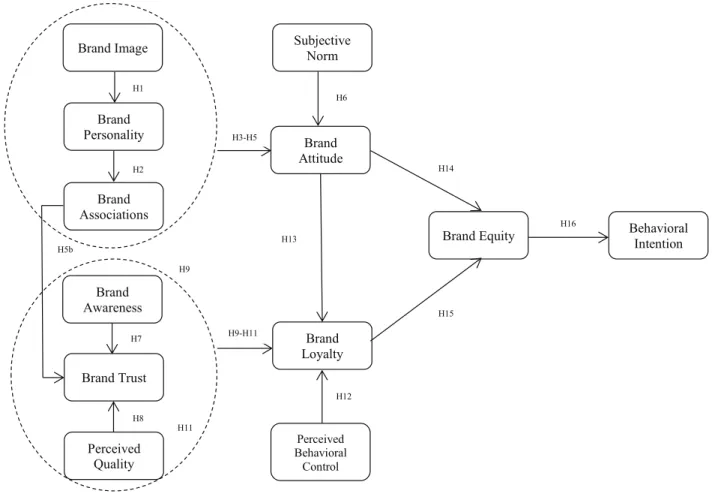
Based on the literature review of CBBE and TPB in brand management, an integrated research model is developed
as shown in Figure 1. This meta-analysis model describes the relationship between the components of CBBE (e.g., brand image, brand association, brand awareness, perceived quality, brand loyalty, and brand equity) and TPB (e.g., brand attitude, subjective norms, perceived behavioral control, and behavioral intention). Brand personality and brand trust are also included because authors see that those two constructs are considered important by many researchers in the brand management research.
Brand image, brand personality, brand association, and subjective norms are the important antecedents of brand attitude while brand awareness, brand trust, perceived quality, and perceived behavioral control are the important antecedents of brand loyalty. Furthermore, brand attitude positively influences brand loyalty; and both brand attitude and brand loyalty positively influence brand equity which further enhance consumers’ behavioral intention.
Brand Awareness
Brand Trust
Perceived Quality
Perceived Behavioral
Control
H11
H9-H11 H9
H7
H8
H12
Brand Loyalty
Behavioral Intention Brand Equity
H13
H15 H14
H16
Brand Personality
Brand Associations
Brand Image Subjective
Norm
Brand Attitude
H1 H6
H3-H5 H2
H5b
Figure 1: Research model
3.2. Meta-Analysis
This study employs meta-analysis study to empirically test the above 16 research hypotheses. Meta-analysis is the process to summarize, to evaluate, and to analyze the findings of quantitative research (Kirca & Yaprak, 2010). In case that some primary studies lack of sufficient power (i.e., sample size) to achieve significant results, meta-analysis is important to solve that problem (Lipsey & Wilson, 2001). Meta-analysis can be more accurate to conclude the conflicting findings by correcting the distorting effects of artifacts into a single estimation result from multiple independent studies that bear on the same relationship (Hunter & Schmidt, 2004).
To collect the data, this study firstly sought the relevant literatures in various databases such as ABI/Inform, JSTOR, Elsevier Science Direct, Wiley Online Library, Taylor
& Francis Online Journals, and many others. Keywords which related consumer-based brand equity and theory of planned behavior (e.g., brand awareness, brand attitude, brand loyalty, etc.) were used to find the suitable data for this study.
Total 173 studies from 58 published papers written in English were included in this study. All papers have brand management foundation in consumer behaviors field. In order to measure the effect size of the hypotheses, this study used correlation coefficient (r) between two variables. The reason for using correlation coefficient as the primary effect size is that because it is easier to be interpreted and most of meta-analytical studies have used it as the criteria (Byron
& Khazanchi, 2010; Shrinivas & Shaffer, 2005; Hechenova, 2003). Comprehensive Meta-Analysis (CMA) 2 software was used to calculate the correlations coefficient which obtained from r value, t-value, z-value, and p-value in each paper. Effect size results (r) can be categorized into small (r
< 0.1), medium (r = 0.25), and large (r >0.40); as suggested by Lipsey and Wilson (2001).
Furthermore, Q-statistic test was adopted to check the homogeneity of the effect size distribution. Lipsey and Wilson (2001) explained that Q-statistic is distributed as a chi-square with degree of freedom = n-1, where n = number of studies. This Q-statistic test has assumed that all of the effect sizes estimating the same population mean is a reasonable assumption. The criterion for Q-statistic is that Q-value should be higher than Chi-square, and then it suggests that the null hypothesis of homogeneity is rejected. In this case, it can be concluded that the differences in effect size may be attributed to factors other than sampling. Therefore, the heterogeneity between the variance existed.
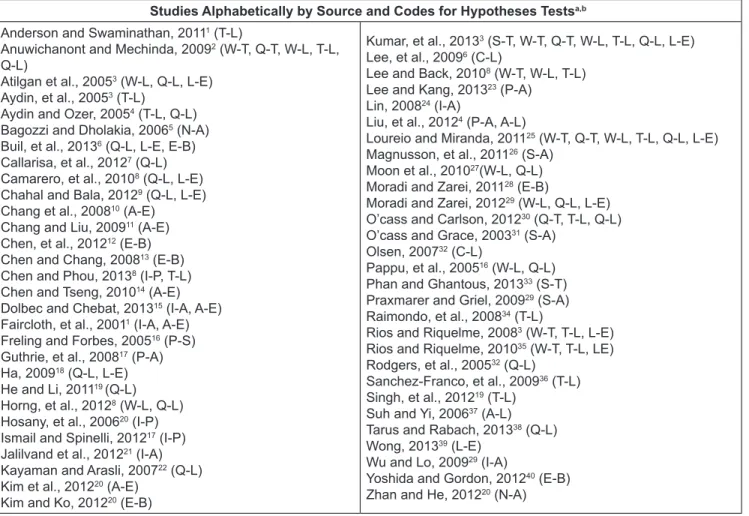
Table 1 shows the coding of all the studies which is included in this study. The sources for 58 published papers are come from 40 different journal publications.
3.3. Structural Equation Model
In order to test if our research model is fit, we run structural equation modelling using LISREL. Correlation coefficient matrix and median sample size were used as data input. We analyzed path coefficient and goodness of fit results.
4. Results and Discussions 4.1. Meta-Analysis
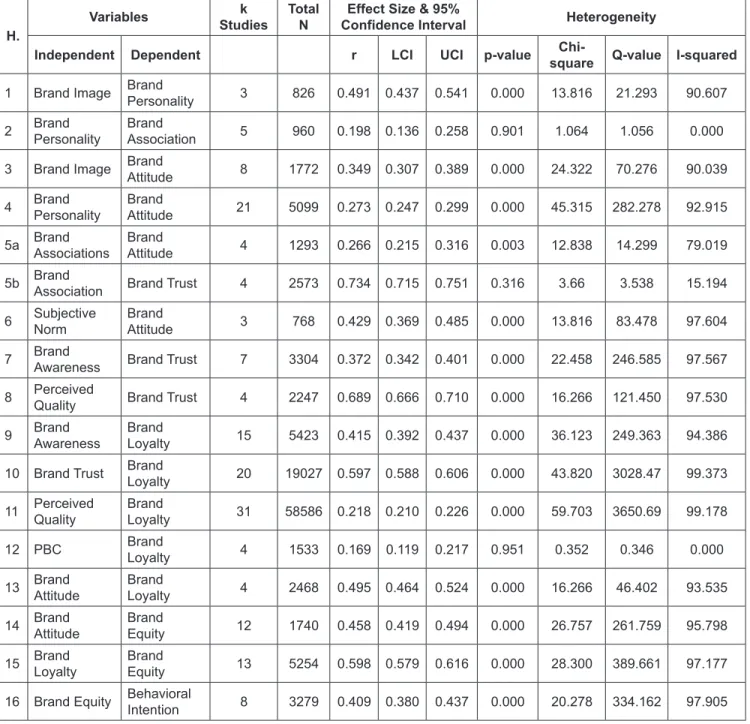
Table 2 shows the meta-analysis results for this study. The correlations (r) shown are the mean values of correlations among previous studies. First, for the antecedents of brand attitude (H1-H6), the results show that brand image has positive influence on brand personality (r=0.491) and brand attitude (r=0.349); brand personality has positive influences on association (r=0.198) and brand attitude (r=0.273); brand association (r=0.266) and subjective norm (r=0.429) have positive influence on brand attitude. Furthermore, brand association (r=0.734) also has positive influence on brand trust. All of the hypotheses have Q-values higher than Chi- square except for H2 and H5b but the difference is not big. It means that these hypotheses are significantly heterogeneous from the variance attributed to factors rather than from the sampling errors. Thus, H1 until H6 are supported.
Brand image positively influences brand personality.
This resultis in line with previous studies (e.g., Chen &
Phou, 2013; Hosany et al., 2006). Brand personality can be built up by the image of the brand. Brand personality also positively influences brand associations (Freling &
Forbes, 2005). When product information is given about the personality of the brand, it leads to the emergence of brand association. Furthermore, brand image, brand personality, brand associations, and subjective norm positively influence brand attitude (Faircloth et al., 2001; O’Cass & Grace, 2003; Guthrie et al., 2008; Lin, 2008; Zhan & He, 2012;
Lee & Kang, 2013). A brand which has positive image and association in consumers’ mind and has similar personality with consumers tends to lead to consumers’ positive attitude toward the brand. Consumers also may choose a brand or evaluate a brand positively when the other people around them also have the same evaluation.
Second, for the antecedents of brand loyalty (H7- H12), the results show that brand awareness (r=0.372) and perceived quality (r=0.689) have positive influence on brand trust; brand awareness (r=0.415), brand trust (r=0.597), perceived quality (r=0.218), and perceived behavioral control (r=0.169) have positive influence on brand loyalty.
All of the hypotheses have Q-values higher than Chi-square
except for H12 but the difference is not big. It means that
these hypotheses are significantly heterogeneous from the
Table 1: Studies alphabetically by source and codes for hypotheses tests a,b
Studies Alphabetically by Source and Codes for Hypotheses Tests
a,bAnderson and Swaminathan, 2011
1(T-L)
Anuwichanont and Mechinda, 2009
2(W-T, Q-T, W-L, T-L, Q-L) Atilgan et al., 2005
3(W-L, Q-L, L-E)
Aydin, et al., 2005
3(T-L)
Aydin and Ozer, 2005
4(T-L, Q-L) Bagozzi and Dholakia, 2006
5(N-A) Buil, et al., 2013
6(Q-L, L-E, E-B) Callarisa, et al., 2012
7(Q-L) Camarero, et al., 2010
8(Q-L, L-E) Chahal and Bala, 2012
9(Q-L, L-E) Chang et al., 2008
10(A-E)
Chang and Liu, 2009
11(A-E) Chen, et al., 2012
12(E-B) Chen and Chang, 2008
13(E-B) Chen and Phou, 2013
8(I-P, T-L) Chen and Tseng, 2010
14(A-E) Dolbec and Chebat, 2013
15(I-A, A-E) Faircloth, et al., 2001
1(I-A, A-E) Freling and Forbes, 2005
16(P-S) Guthrie, et al., 2008
17(P-A) Ha, 2009
18(Q-L, L-E) He and Li, 2011
19(Q-L) Horng, et al., 2012
8(W-L, Q-L) Hosany, et al., 2006
20(I-P) Ismail and Spinelli, 2012
17(I-P) Jalilvand et al., 2012
21(I-A) Kayaman and Arasli, 2007
22(Q-L) Kim et al., 2012
20(A-E)
Kim and Ko, 2012
20(E-B)
Kumar, et al., 2013
3(S-T, W-T, Q-T, W-L, T-L, Q-L, L-E) Lee, et al., 2009
6(C-L)
Lee and Back, 2010
8(W-T, W-L, T-L) Lee and Kang, 2013
23(P-A)
Lin, 2008
24(I-A)
Liu, et al., 2012
4(P-A, A-L)
Loureio and Miranda, 2011
25(W-T, Q-T, W-L, T-L, Q-L, L-E) Magnusson, et al., 2011
26(S-A)
Moon et al., 2010
27(W-L, Q-L) Moradi and Zarei, 2011
28(E-B)
Moradi and Zarei, 2012
29(W-L, Q-L, L-E) O’cass and Carlson, 2012
30(Q-T, T-L, Q-L) O’cass and Grace, 2003
31(S-A)
Olsen, 2007
32(C-L)
Pappu, et al., 2005
16(W-L, Q-L) Phan and Ghantous, 2013
33(S-T) Praxmarer and Griel, 2009
29(S-A) Raimondo, et al., 2008
34(T-L)
Rios and Riquelme, 2008
3(W-T, T-L, L-E) Rios and Riquelme, 2010
35(W-T, T-L, LE) Rodgers, et al., 2005
32(Q-L)
Sanchez-Franco, et al., 2009
36(T-L) Singh, et al., 2012
19(T-L)
Suh and Yi, 2006
37(A-L) Tarus and Rabach, 2013
38(Q-L) Wong, 2013
39(L-E)
Wu and Lo, 2009
29(I-A)
Yoshida and Gordon, 2012
40(E-B) Zhan and He, 2012
20(N-A)
a
Codes in parentheses:I= Brand Image; P= Brand Personality; S= Brand Association; W= Brand Awareness; T= Brand Trust; Q= Perceived Quality; N= Subjective Norm; A= Brand Attitude; L= Brand Loyalty; C= Perceived Behavioral Control; E= Brand Equity; B= Behavioral Intention.
b
Journals are footnoted in alphabetical order: (1)Journal of Marketing Theory and Practice, (2)Journal of Business & Economic Research, (3)Marketing Intelligence & Planning, (4)European Journal of Marketing, (5)International Journal of Research in Marketing, (6)Journal of Consumer Marketing, (7)Tourism Management Perspectives, (8)Tourism Management, (9)International Journal of Health Care Quality Assurance, (10)Asia Pacific Management Review, (11)The Service Industries Journal, (12)Social Behavior and Personality, (13)Journal of Air Transport Management, (14)Transportation Journal, (15)Journal of Retailing, (16)Journal of Product & Brand Management, (17)Journal of Fashion Marketing and Management, (18)Seoul Journal of Business, (19)Journal of Business Ethics, (20)Journal of Business Research, (21)Journal of Destination Marketing & Management, (22)Managing Service Quality, (23)Academy of Marketing Studies Journal, (24)International Journal of Commerce & Management, (25)Journal of Service Science and Management, (26)International Marketing Review, (27)Journal of Global Academy of Marketing Science, (28)Australian Journal of Basic and Applied Sciences, (29)Asia Pacific Journal of Marketing and Logistics, (30)Australasian Marketing Journal, (31)Journal of Services Marketing, (32)Psychology and Marketing,
(33)International Journal of Bank Marketing, (34)Journal of Service Research, (35)Journal of Research in Interactive Marketing, (36) Information & Management, (37)Journal of Consumer Psychology, (38)The TQM Journal, (39)International Journal of Hospitality Management, (40)Sport Management Review.
variance attributed to factors rather than from the sampling errors. Therefore, H7 until H12 are supported.
Both of brand awareness and perceived quality positively influence brand trust. The results are in line with previous studies (e.g., Anuwichanont & Mechinda, 2009; Kumar et al., 2013). Moreover, brand awareness, brand trust, perceived
quality, and perceived behavioral control positively influence
brand loyalty (Aydin et al., 2005; Pappu et al., 2005; Olsen,
2007; Lee et al., 2009; Kumar et al., 2013). Consumer
with high awareness, high trust, high perceived quality of
the brand, and high opportunity to be involved in purchase
decision making will be more committed toward that brand.
Table 2: Meta-analysis results
H. Variables k
Studies Total
N Effect Size & 95%
Confidence Interval Heterogeneity
Independent Dependent r LCI UCI p-value Chi-
square Q-value I-squared 1 Brand Image Brand Personality 3 826 0.491 0.437 0.541 0.000 13.816 21.293 90.607 2 Brand
Personality Brand
Association 5 960 0.198 0.136 0.258 0.901 1.064 1.056 0.000
3 Brand Image Brand Attitude 8 1772 0.349 0.307 0.389 0.000 24.322 70.276 90.039
4 Brand
Personality Brand
Attitude 21 5099 0.273 0.247 0.299 0.000 45.315 282.278 92.915
5a Brand Associations Brand
Attitude 4 1293 0.266 0.215 0.316 0.003 12.838 14.299 79.019
5b Brand Association Brand Trust 4 2573 0.734 0.715 0.751 0.316 3.66 3.538 15.194 6 Subjective
Norm Brand
Attitude 3 768 0.429 0.369 0.485 0.000 13.816 83.478 97.604
7 Brand
Awareness Brand Trust 7 3304 0.372 0.342 0.401 0.000 22.458 246.585 97.567
8 Perceived
Quality Brand Trust 4 2247 0.689 0.666 0.710 0.000 16.266 121.450 97.530
9 Brand
Awareness Brand
Loyalty 15 5423 0.415 0.392 0.437 0.000 36.123 249.363 94.386
10 Brand Trust Brand
Loyalty 20 19027 0.597 0.588 0.606 0.000 43.820 3028.47 99.373
11 Perceived Quality Brand
Loyalty 31 58586 0.218 0.210 0.226 0.000 59.703 3650.69 99.178
12 PBC Brand
Loyalty 4 1533 0.169 0.119 0.217 0.951 0.352 0.346 0.000
13 Brand Attitude Brand
Loyalty 4 2468 0.495 0.464 0.524 0.000 16.266 46.402 93.535
14 Brand Attitude Brand
Equity 12 1740 0.458 0.419 0.494 0.000 26.757 261.759 95.798
15 Brand Loyalty Brand
Equity 13 5254 0.598 0.579 0.616 0.000 28.300 389.661 97.177
16 Brand Equity Behavioral Intention 8 3279 0.409 0.380 0.437 0.000 20.278 334.162 97.905
Third, brand attitude has a positive influence on brand loyalty (r=0.495) and brand equity (r=0.458); while brand loyalty has a positive influence on brand equity (r=0.598). All of the hypotheses have Q-values higher than Chi-square. It means that these hypotheses are significantly heterogeneous from the variance attributed to factors rather than from the sampling errors. Thus, H13, H14, and H15 are supported.
Brand attitude positively influences brand loyalty. This resultsis in line with Suh and Yi (2006) and Liu, et al.(2012).
Consumers with more positive attitude towards a brand tend to be more loyal. Both brand attitude and brand loyalty positively influence brand equity (Faircloth et al., 2001;
Atilgan et al., 2005; Kim et al., 2012; Buil et al., 2013)
Consumer’s self-reported brand value is driven by her/his
attitude toward the brand and loyal consumers show more favorable response to a brand which further leads to greater brand equity.
Finally, brand equity has a positive influence on behavioral intention (r=0.409). ItsQ-value is higher than Chi-square. It means that these hypotheses are significantly heterogeneous from the variance attributed to factors rather than from the sampling errors. Therefore, H16 is supported.
The result is in line with previous studies (Chen & Chang, 2008; Moradi & Zarei, 2011; Chen et al., 2012; Kim &
Ko, 2012; Yoshida & Gordon, 2012; Buil et al., 2013).
Consumers who perceive a higher value in a brand are more likely to buy it (Aaker, 1991). Consumers are more willing to purchase a product at a higher price which implies greater brand equity for the brand (Chen et al., 2012). It indicates stronger purchase intention in consumer’s mind.
4.2. Structural Equation Model
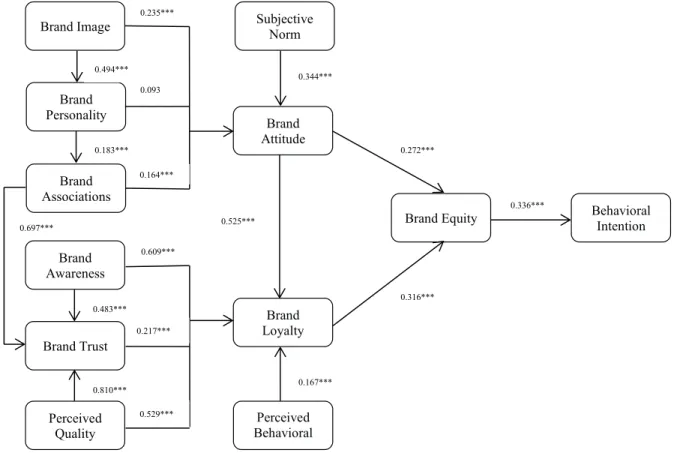
Figure 2 shows the results of path coefficients of SEM.
Goodness of fit index shows that the proposed model is fit with previous meta-analysis statistics. GFI=0.980, AGFI=0.959, SRMR=0.0315, and Ⅹ
2(38) = 293.84, p<0.001.
All the results are consistent with meta-analysis results which are positive significant except for H4 (brand personality-brand attitude) which shows non-significant result. The non-significant result for the effect of brand personality on brand attitude may be due to the divergence of previous findings. Liu, et al. (2012) also found that brand personality has no effect on brand attitude.
Brand loyalty shows stronger effect on brand equity (β=0.316) than brand attitude (β=0.272). This result is also shown in meta-analysis result. Brand loyalty has higher r value (0.458) than brand attitude (0.598). It is consistent with previous studies that brand loyalty is the strongest predictor of brand equity (Atilgan et al., 2005).
5. Conclusions and Limitations 5.1. Conclusions
The objectives of this study are (1) to review previous studies in the context of brand management in consumer behaviors which using CBBE and TPB as the basic foundation of the study, and (2) to develop a comprehensive research model by integrating CBBE and TPB. Through the
Brand Awareness
Brand Trust
Perceived
Quality Perceived
Behavioral Control
0.529***
0.217***
0.609***
0.483***
0.810***
***
0.167***
Brand Loyalty
Behavioral Intention Brand Equity
0.525***
0.316***
0.272***
0.336***
Brand Personality
Brand Associations
Brand Image Subjective
Norm
Brand Attitude
0.494***
0.344***
0.164***
0.235***
0.183***
0.093
0.697***