해양생태독성 평가용 표준시험생물로서 섬모충류
Mesodinium rubrum
에 대한 연구안경호․박경수1)*․이승민2)
국립수산과학원 갯벌연구소, 1)안양대학교 해양생명공학과, 2)국립수산과학원 서해수산연구소 (2011년 4월 15일 접수; 2011년 6월 15일 수정; 2011년 7월 27일 채택)
Potential of Marine Ciliate Mesodinium rubrum as a Standard Test Species for Marine Ecotoxicological Study
Kyoung Ho An, Gyung Soo Park1)*, Seung Min Lee2) Tidal Flat Research Institute, NFRDI, Gunsan 573-882, Korea
1)Department of Marine Biotechnology, Anyang University, Incheon 417-833, Korea
2)West Sea Fisheries Research Institute, NFRDI, Incheon 400-420, Korea (Manuscript received 15 April, 2011; revised 15 June, 2011; accepted 27 July, 2011)
Abstract
The mixotrophic marine ciliate Mesodinium rubrum possesses a highly modified algal endosymbiont as a nutrition source for the species. Accordingly, we assumed that the species can reflect the ecotoxicity on marine producer (as phytoplankton) and consumer (as zooplankton) both. A series of experiments were conducted to identify the potential of the species as a standard test species for marine ecotoxicological study. The comparison of species sensitivity on reference toxic materials was made using potassium dichromate for phytoplankton and copper chloride for zooplankton. The ciliate revealed the highest sensitivity on both reference materials among the seven test species including phytoplankton, benthic copepod and rotifer species. The toxicity end point of the species was 72hr-EC50=1.52 mg/L (as potassium dichromate) estimated by population growth inhibition (PGI), which is more sensitive than the most sensitive phytoplankton Skeletonema costatum (72hr-EC50=3.05 mg/L). As comparison to rotifer, it also revealed higher sensitivity on copper chloride; 72hr-EC50=0.38 mg/L for ciliate and 48hr-EC50=0.48 mg/L for rotifer. Also, the elutriate toxicity test of various ocean disposal wastes were conducted to identify the potential of ciliate toxicity test application using industrial waste sludges. The toxicity of leather processing waste sludge was highest on the ciliate, followed by dyeing waste sludge and dye production waste sludge as an increasing order of toxicity. 72h-EC50 of ciliate PGI test was 1.83% and that of S. costatum 3.84% for leather waste sludge which showed highest toxicity. The toxicity test results also revealed that the highest sensitivity was observed on ciliate species on ocean disposed sludge wastes. Also, ciliate toxicity test well discriminated the degree of toxicity between sludge sources; 72h-EC50 values were 1.83% for leather processing waste sludge, 16.75% for dye production waste sludge and 27.75% for textile production waste sludge. Even the laboratory culture methods of the species were not generally established yet, the species has high potential as the standard test species for marine toxicity test in terms of the dual reflection of phyto- and zooplankton toxicity from single test, sensitivity and test replicability.
Key Words : Ecotoxicity, Phototrophic ciliate, Mesodinium rubrum, Standard test species
1)
*Corresponding author : Gyung Soo Park, Department of Marine Biotechnology, Anyang University, Incheon 417-833, Korea
Phone: +82-32-930-6032 E-mail: [email protected]
1. 서 론
수서생태계의 기초생산자를 이용한 독성시험은 국 제적으로 다양한 시험방법이 개발되어 사용 중이며 (이 등, 2008a; APHA 등, 1995; ISO, 1995; NIWA,
1998), 1차 소비자인 동물플랑크톤을 이용한 독성시 험법(이 등, 2008b; ASTM, 1996; Forget 등, 1998;
Snell과 Persoone, 1989) 역시 다양하게 개발되어 있 다. 그러나 해양생태계에서 혼합영양을 하는 원생동 물에 대한 독성시험법은 아직 개발된 적이 없다. 따라 서 해양으로 배출되는 미지의 독성물질에 대하여 해 양생태계를 구성하는 생산자와 소비자의 영향을 동시 에 평가하기 위하여 동·식물적 특성을 모두 갖고 있는 해양섬모충류인 M. rubrum 종을 표준시험생물 후보 종으로 선정하였다. M. rubrum은 전 세계 연안에 널 리 분포하는 적조 원인 생물이며(Lindholm, 1985;
Powers, 1932; Taylor 등, 1971), 내부에 공생 조류인 Teleaulax sp.를 섭식함으로써 공생조류의 색소를 이용 한 광합성작용에 의해 영양을 공급받기도 한다(Barber 등, 1969; Hibberd, 1977; Oakley와 Taylor 1978).
일반적으로 독성실험은 미지의 물질이나 여러 물 질이 공존할 때 발생하는 독성 상승효과 등에 대한 생 물학적 영향을 구명하는 실험과정으로서 동일물질에 대한 상이한 생물학적 반응을 보이는 점을 고려하여 다양한 시험생물을 이용한다. 특히 해양생태계에서 는 박테리아, 식물플랑크톤, 동물플랑크톤 및 소형 어 류 등을 이용한 시험방법이 다양하게 개발되어 이용 되고 있다(박 등, 2008a; 박 등, 2008b; APHA 등, 1995; ISO, 1995; NIWA, 1998; OECD, http://oberon.
sourceoecd.org; USEPA, 2002). 그러나 상기 생물은 생태계의 분해자, 생산자 및 소비자를 각각 대표하는 생물군으로서 어느 한 종의 실험결과가 다른 종의 실험 결과를 대변할 수 없는 상호 독립된 결과를 보인다. 따 라서 생리, 생태적으로 동물 및 식물적 특성을 모두 지 닌 M. rubrum은 독성시험시 동물 및 식물적 특성을 모 두 반영할 수 있다는 장점이 있다. 따라서 본 연구의 목 적은 상기 생물종이 해양생태계의 유해물질에 대한 동·
식물학적 특성을 모두 반영할 수 있는 해양생태독성 평 가용 표준시험생물로서의 가능성을 규명하는데 있다.
2. 재료 및 방법
2.1. 시험생물
해양섬모충류인 M. rubrum은 전 세계 연안에 널리 분포하는 종으로, 본 시험에 사용된 종은 서해연안의
곰소만(35°40´N, 126°40´E)에서 채집되었으며, 군산 대학교 해양과학대학 해양학과 이원호 교수 실험실에 서 5년 이상 단일종 배양을 통하여 실험실에서 보유하 고 있는 M. rubrum (strain MR-MAL01)으로 독성실 험을 실시하였다(Yih 등, 2004). 시험생물은 독성시험 이전에 시험 조건과 동일한 환경에서 최소 2회 이상의 계대배양 (약 7일)이 이루어졌으며, 독성시험 이전에 개체군성장이 지수성장기에 도달될 수 있도록 독성시 험 24시간 이전에 500 mL 폴리카보네이트병에 M.
rubrum과 먹이생물인 은편모조류 Teleaulax sp.
(strain CR-MAL01)를 1:5 비율로 넣어주고 72시간의 실험기간 동안에는 추가로 먹이공급을 하지 않았다.
M. rubrum은 항온온도 15℃에서 배양하였으며, 조도 는 형광등을 이용하여 60 μEm-2s-1로 연속명기를 유지 하였고 영양배지는 f/2 배지를 이용하였다(Table 1).
본 실험과 비교 대상으로 이용된 식물플랑크톤 6종, 저서성요각류인 Tigriopus japonicus, 그리고 윤충류 인 Brachionus plicatilis는 국내 표준시험종으로 선정
Parameters Conditions Test type static non-renewal
Endpoint population growth inhibition (EC50) Test organism Mesodinium rubrum
Test duration 72 hr Test temperature 15±1℃ Test salinity 20∼30 psu
Light type fluorescent lamp (universal white) Light intensity 60 μEm-2s-1
Photoperiod continuous
Test chamber size 70 mL (polycarbonate bottle) Test solution volume 50 mL
Dilution water natural or artificial seawater Renewal of test solution none
Aeration none
Food Teleaulax sp.
Initial cell density 50∼100 cells/mL Feeding regime none
Culture media f/2 media
Cell density counting every 24hr (T0, T24, T48, T72) Test concentrations five+control
Number of replicates per
concentration 3
Table 1. Summary of test conditions for the toxicity test with the marine protozoan ciliate Mesodinium rubrum
되어 광범위하게 이용되는 종으로 판단되어 본 결과 의 비교 대상으로 선정하였다 (박 등, 2008b; 이 등, 2008a; 이 등, 2008b).
2.2. 시험용액의 제조
혼합영양 생물인 M. rubrum의 독성물질에 대한 민 감도를 검증하기 위하여, 우선 ISO (1995)에서 제시한 식물플랑크톤의 표준독성물질인 Potassium dichromate (K2Cr2O7, Merck, Germany)를 사용하였으며, 동물플 랑크톤의 표준독성물질인 copper chloride (CuCl2, Aldrich, USA)를 이용하여 개체군성장저해율을 측정 하였다. 농도별 표준용액은 최고 농도의 표준용액을 제조한 후 이를 순차적으로 희석하였으며, 대조구를 포함하여 6개 농도 구간에서 각각의 농도별로 살아있 는 개체를 계수하여 72시간 개체군성장률(EC50)을 측 정하였다(이 등, 2008a).
또한 해양으로 유입되는 유해물질에 대한 독성실 험을 위하여 산업폐수오니를 채취하여 독성실험에 이 용하였다. 채취된 오니는 냉장 상태로 운반하여 폐기 물공정시험법에 따라 용출하였으나, 상기 오니가 해 양으로 투기되어 해양생물에 미치는 영향을 구명하고 자 하므로 모래 및 카본필터로 여과한 자연해수를 0.45 μm membrane filter로 재여과하여 용출하였다. 하 수오니 추출은 여과해수(26.2~28.0 psu)와 오니의 비율 을 10:1(V:W)로 혼합하여, 진탕기(JEIO TECH, Korea) 로 6시간 동안 잘 흔든 후 용출된 폐수는 GF/C 필터 (0.45 μm, Whatman, USA)로 여과하여 실험에 사용 하였다. 독성실험을 위한 하수오니 추출액은 용출한 시료를 최고 농도(100%)로 설정한 후 이를 순차적으 로 희석하여 대조구(0%)를 포함한 6개 농도(6.3, 12.5, 25.0, 50.0, 100.0%)를 제조하여 3 반복으로 실험하였 다. 시험용기는 70 mL 폴리카보네이트 병을 이용하 였으며, 시험용액을 각 농도별로 50 mL씩 시험용기 에 분주하였다.
2.3. 독성실험
지수성장기의 시험생물을 50 mL 시험용액에 초기 세포농도가 약 50~100 cells/mL이 되도록 접종한 후 f/2 영양배지를 넣어주었으며, 시험생물 접종시 각 시 험구마다 최소 3회 이상 나누어 접종하였다. 시험 시
작시 각 시험구별로 염분, 수온, 용존산소 및 pH를 측 정하여 독성시험지에 기록하였다. 섬모충의 개체군성 장률을 측정하기 위하여 24시간 간격으로 시험용기에 서 2 mL의 시료를 채취하여 Lugol 용액으로 고정한 후 현미경하에서 섬모충의 개체수를 계수하였다. 개 체군성장률(r)은 r=(lnNt-lnNo)/t (r=개체군성장률, Nt= 실험 종료 후의 세포밀도, No=초기세포밀도, t=배양시 간)의 식으로 구하였다. 각 농도별로 r값을 계산한 후 이를 이용하여 72시간 반수영향농도(50% effective concentration, EC50)를 계산하였다.
2.4. 자료분석
독성실험에 대한 end points는 대조구의 개체군성 장률 대비 50%에 이르는 성장저해율인 EC50 (50%
population growth inhibition concentration)을 계산하 였다. 계산 방법은 각 실험구에서의 개체군성장률을 계산한 후 Linear interpolation 방법으로 EC50을 산정 하였다. 성장률 자료는 Shapiro-Wilk's test (1965)로 자료의 정규분포를 그리고 Bartlett's test (Snedecor와 Cochran, 1989)로 분산의 동일성을 검증하였으며, NOEC (No observed effective concentration)와 LOEC (Lowest observed effective concentration)의 산출은 Dunnett's test (1964)를 이용하여 유의수준 α=0.05에 서 검증하였다. 상기 자료분석은 독성자료 처리 프로 그램인 TOXCALC (Tidepool Scientific Software, USA)을 이용하였다.
3. 결 과
3.1. 표준독성물질을 이용한 민감도 실험
생태독성시험에 사용하는 표준시험종의 가장 중요 한 조건은 독성물질에 대한 민감도가 높아야 하며, 생 태계를 구성하는 생산자, 소비자 및 분해자에 대한 표 준시험생물별 표준독성물질이 규정되어 있다 (이 등, 2008a; ISO, 1995). 따라서 해양 생태계의 생산자를 대표하는 식물플랑크톤과 1차 소비자인 동물플랑크 톤의 표준독성시험물질인 potassium dichromate와 copper chloride를 이용하여 M. rubrum의 표준독성물 질에 대한 민감도를 실험하였다.
해양생태계의 1차 소비자인 동물플랑크톤과 섬모
충의 독성 민감도 비교를 위하여 표준독성물질인 copper chloride에 대한 개체군성장률저해 실험을 실 시한 결과, M. rubrum의 72h-EC50은 0.38 (0.37-0.38) mg/L로, 해산 윤충류 Brachionus plicatilis의 48h-EC50
인0.48 (0.47-0.49) mg/L 보다 더 낮은 농도에서 반수 개체군성장률저해를 보임으로써 표준물질에 대한 독 성 민감도가 윤충류보다 더 높은 것으로 나타났다 (Table 2).
Species name EC50 95% CI NOEC LOEC M. rubrum 0.38 0.37-0.38 0.25 0.50 B. plicatilis 0.48 0.47-0.49 < 0.13 0.13 Table 2. Comparison of 72hr EC50 and 48hr EC50 using
copper chloride as a reference material with M.
rubrum and rotifer B. plicatilis (unit : mg/L).
NOECs and LOECs were calculated by multiple comparison test (Dunnett's Test) at α=0.05 significance level
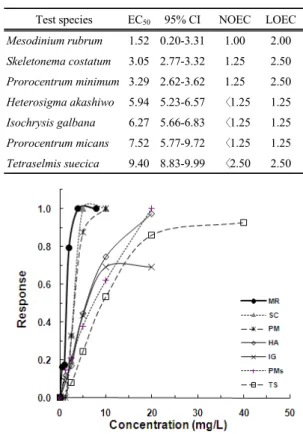
또한 해양생태계의 주요 생산자인 식물플랑크톤과 섬모충의 독성 민감도 비교를 위하여 표준독성물질인 potassium dichromate에 대한 개체군성장률저해 실험 을 실시한 결과, 섬모충이 다른 6종의 식물플랑크톤보 다 더 민감한 것으로 나타났다. M. rubrum의 72시간 EC50은 1.52(0.20-3.31) mg/L로 가장 낮은 농도에서 반수개체군성장저해를 보였다. 식물플랑크톤중 가장 민감한 종인 규조류 Skeletonema costatum의 EC50은 3.05(2.27-3.32) mg/L로 M. rubrum 보다 2배 높은 농 도에서 반수개체군성장저해를 보였고, 가장 둔감한 종인 Tetraselmis suecica의 EC50은 9.40(8.83-9.99) mg/L로 6배 이상 높은 농도에서 반수개체군성장저해 를 보임으로서 M. rubrum의 민감도가 가장 높은 것으 로 나타났다. 즉 식물플랑크톤 6종의 EC50 보다 더 낮 은 농도에서 반수개체군성장률저해를 보임으로써 섬 모충이 표준독성물질에 대한 민감도가 시험 대상종중 가장 높은 것으로 나타났다(Table 3, Fig. 1).
따라서 해양섬모충류인 M. rubrum은 해산 윤충류 및 식물플랑크톤과 비교하여 표준독성물질인 copper chloride와 potassium dichromate에 대한 민감도가 가 장 높은 것으로 나타났다(Table 2, Table 3).
Test species EC50 95% CI NOEC LOEC Mesodinium rubrum 1.52 0.20-3.31 1.00 2.00 Skeletonema costatum 3.05 2.77-3.32 1.25 2.50 Prorocentrum minimum 3.29 2.62-3.62 1.25 2.50 Heterosigma akashiwo 5.94 5.23-6.57 〈1.25 1.25 Isochrysis galbana 6.27 5.66-6.83 〈1.25 1.25 Prorocentrum micans 7.52 5.77-9.72 〈1.25 1.25 Tetraselmis suecica 9.40 8.83-9.99 〈2.50 2.50 Table 3. Comparison of 72hr EC50's using potassium
dichromate as a reference material with M. rubrum and 6 phytoplankton species (unit : mg/L). NOECs and LOECs were calculated by multiple comparison test (Dunnett's Test) at α=0.05 significance level
Fig. 1. Concentration-response curve for M. rubrum and 6 phytoplankton species (SC; S. costatum, PM; P.
minimum, HA; H. akashiwo, IG; I. galbana, PMs; P.
micans, TS; T. suecica) exposed to potassium dichromate.
3.2. 해양 배출 오염물질을 이용한 적용 실험
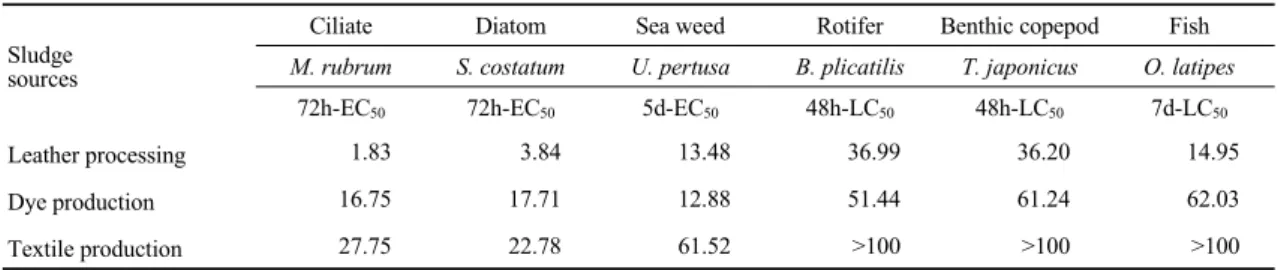
생태독성시험에 사용하는 표준시험종의 중요한 조 건은 위의 표준물질에 대한 독성 민감도 이외에 실제 해양오염물질에 적용이 가능하여야 한다. 따라서 현 재 해양투기가 이루어지고 있는 산업폐수오니(피혁, 염색, 염료)를 이용하여 섬모충, 규조류, 해조류, 윤충 류, 저서요각류, 어류를 대표하는 6종에 대한 독성실 험을 실시하였다. 동일 물질에 대한 6종의 독성실험결 과, 섬모충은 다른 5종에 비하여 독성 민감도가 가장 높거나 또는 가장 민감도가 높은 다른 시험종과 유사
Sludge sources
Ciliate Diatom Sea weed Rotifer Benthic copepod Fish
M. rubrum S. costatum U. pertusa B. plicatilis T. japonicus O. latipes 72h-EC50 72h-EC50 5d-EC50 48h-LC50 48h-LC50 7d-LC50
Leather processing 1.83 3.84 13.48 36.99 36.20 14.95
Dye production 16.75 17.71 12.88 51.44 61.24 62.03
Textile production 27.75 22.78 61.52 >100 >100 >100
Table 4. Comparison of toxicity endpoints estimated by various species using three industrial waste sludge elutriates. Seaweed toxicity data were provided by Dr. TJ Han at Incheon University
한 민감도를 보였다.
피혁공장폐수오니, 염색공장폐수오니, 염료공장폐 수오니에 대한 각 시험종의 반수개체군성장률저해농 도(EC50) 또는 반수치사농도(LC50)를 산출한 결과, 대 부분의 시험생물군에서 피혁공장폐수오니의 독성이 가장 강하게 나타났으며, 그 다음으로 염색공장폐수 오니, 염료공장폐수오니 순으로 강한 독성을 보였다.
즉, 서로 다른 생물군을 이용한 생물검정실험에서 해 양으로 유입되는 오염물질에 대한 독성결과가 뚜렷하 게 구분되었다(Table 4).
가장 강한 독성을 나타낸 피혁공장폐수오니에서 해양섬모충인 M. rubrum의 72h-EC50=1.83%로 가장 민감한 반응을 보였으며, 그 다음으로 민감한 종은 규 조류인 S. costatum으로 72h-EC50=3.84%로 나타났다 (Table 4). 가장 둔감한 종은 저서요각류인 T. japonicus 와 윤충류인 B. plicatilis로 48시간 LC50이 각각 36.20%, 36.99%로 나타났다. 따라서 해양섬모충은 다른 시험생물과 비교하여 해양투기 물질인 산업폐수 오니의 추출액 독성시험에서 가장 민감한 종으로 나 타났으며, 가장 둔감했던 윤충류보다 20배정도 민감 한 결과를 보였다(Table 4).
4. 고 찰
생태독성평가시 해양생태계를 대표하는 분해자, 생산자 및 소비자 그룹중 생태계 내에서의 영양학적 역할, 경제성 및 종의 유용성 등을 고려하여 표준시험 생물을 선정하게 된다(박 등, 2005; 박 등, 2008a; 박 등, 2008b; Burton, 1992; Rand와 Petrocelli, 1985).
따라서 영양학적으로 소비자인 동시에 먹이생물의 색 소를 이용하여 생산자의 역할을 하는 해양섬모충류
M. rubrum은 매우 유용한 표준시험종으로 판단된다.
그러나 섬모충류를 이용한 독성 시험 가능성은 많 이 연구되어 왔으나, 본 연구에서처럼 M. rubrum이 혼합영양식자 임을 고려하여 생산자 및 소비자의 특 성을 동시에 고려한 연구는 없었다. 섬모충류를 이용 한 독성시험 연구가 제한된 이후로 (Persoone와 Dive, 1978), 담수산 섬모충류를 이용한 중금속 독성 시험 (Madoni, 2000), 약품독성 (Dimitrov 등, 2003), 담수 산 섬모충류를 이용한 살충제 독성시험 (Dive 등, 1981; Hussain 등, 2008), 중금속 및 POPs (Twagilimana 등, 1998; Nalecz-Jawecki와 Sawicki, 2002), 유류 및 유화제 독성 시험 (Rogerson과 Berger, 1981) 등 다양 한 분야에 이용되어 왔다. 특히 중금속 및 지속성 오염 물질에 민감한 것으로 알려져 있으며 (Twagilimana 등, 1998; Madoni, 2000). 많은 연구자들이 섬모충류 를 독성시험시 battery test의 일환으로 이용할 것을 제 시해 왔다 (Rojickova-Padrtova 등, 1998; Novotny 등, 2006). 따라서 섬모충류를 이용한 많은 국제적 연 구 결과를 고려할 때 아래의 문제점만 보완된다면 매 우 경제적인 표준시험종으로 이용될 수 있을 것으로 판단된다.
해양생태독성시험용 표준생물은 염분에 대한 광범 위한 내성을 보이는 종을 선호한다. 그 이유는 시험생 물이 협염성 (stenohaline species)일 경우 시험대상물 질의 염분을 조절하여야하며 그 과정에서 시험대상물 질의 독성이 변할 수 있기 때문이다(박 등, 2008b). 그 러나 기존의 연구 결과 M. rubrum의 염분 내성 범위 는 10~30 psu(김 등, 2004; 명, 2004)로 다른 시험생물 에 비하여 염분 내성 범위가 좁은 것으로 나타났다 (박 등, 2008a, 2008b; 이 등, 2008a, 2008b). 따라서
섬모충을 이용한 독성시험시 시험대상물질의 염분이 10-30 psu 범위를 벗어날 경우에는 시험물질을 초순 수로 희석하거나 염을 첨가하여 위의 염분 범위로 조 절해야 한다.
또한 표준시험생물은 독성시험시 많은 양 (또는 수) 이 필요하므로 실험실에서 상시 배양할 수 있는 종을 선호한다. 그 이유는 시험종이 지속적으로 단일 배양 이 이루어지지 않을 경우 독성물질에 대한 반응이 일 정하지 않을 수 있으며, 독성 실험시에 충분한 양의 시 험생물을 확보하는데 어려움이 있기 때문이다 (박 등 2008a, 2008b). 그러나 상기 시험생물은 일부 실험실 (예, 군산대학교)에서 상시 배양이 이루어지고 있기는 하나 다른 시험생물에 비하여 계대 배양 체제가 잘 보 급되지 않은 단점이 있다.
따라서 M. rubrum의 지속적 대량배양 체제만 구축 된다면 해양섬모충류인 M. rubrum은 매우 유용한 독 성시험용 표준생물로 생각된다. 특히 시험생물의 민 감도가 다른 시험생물에 비하여 가장 높았으며, 실제 해양오염물질에 대한 독성 정도의 판별력 및 일관성 이 뚜렷하여 시험 생물로서의 가능성이 높은 것으로 판단된다.
감사의 글
본 연구는 국립수산과학원 R&D과제 (RP-2008- ME-031)로 수행되었으며, 시험생물인 해양섬모충류 시료를 제공해주신 군산대학교 이원호 교수님과 실험 에 대한 조언을 주신 명금옥 박사님께 감사드립니다.
참 고 문 헌
김형섭, 김영길, 양재삼, 이원호, 2004, 곰소만의 금강하 구역에서 광합성 섬모류 Mesodinium rubrum 개체 군의 변동, 한국해양학회지 바다, 9, 164-172.
명금옥, 2004, 해양광합성 섬모류 Mesodinium rubrum 종주와 먹이생물인 은편모류 종주간의 상호작용을 조절하는 생태학적 요인, 석사학위 논문, 군산대학 교 대학원.
박경수, 이상희, 이승민, 윤성진, 박승윤, 2005, 해양생태 독성평가를 위한 표준시험생물로서의 식물플랑크 톤에 관한 연구, 한국환경과학회지, 14, 1129-1139.
박경수, 강주찬, 윤성진, 이승민, 황운기, 2008a, 어류 자
어의 사망률을 이용한 해양생태독성 시험방법에 관 한 연구, 한국해양학회지 바다, 13, 140-146.
박경수, 이승민, 한태준, 이정석, 2008b, 해양생태독성평
가를 위한 표준시험방법 개발에 관한 연구, 한국해
양학회지 바다, 13, 106-111.
이승민, 박경수, 안경호, 박승윤, 이상희, 2008a, 식물플 랑크톤의 개체군성장저해율을 이용한 해양생태독 성 시험방법에 관한 연구, 한국해양학회지 바다, 13, 112-120.
이승민, 박경수, 윤성진, 강영실, 오정환, 2008b, 윤충류 Brachionus plicatilis 및 저서요각류 Tigriopus japonicus의 초기 생활사를 이용한 해양생태독성 시 험방법에 관한 연구, 한국해양학회지 바다, 13, 129-139.
APHA, AWWA, WEF, 1995, Standard Methods for the Examination of Water and Wastewater, American Public Health Association, American Water Works Association, Water Environment Federation, Washington DC, 1-47.
ASTM, 1996, Standard Guide for Acute Toxicity Test with the Rotifer Brachionus, ASTM (American Society for Testing and Materials) 11.05, E1440-91, ASTM, W. Conshohocken, PA.
Barber, R. T., White, A. W., Siegelman, H. W., 1969, Evidence for a cryptomonad symbiont in the ciliate Cyclotrichium meunieri, J. Phycol., 5, 86-88.
Burton, G. A., 1992, Sediment Toxicity Assessment, Lewis Publishers Inc., Chelsea, 457.
Dimitrov, S. D., Mekenyan, O. G., Sinks, G. D., Schultz, T. W., 2003, Global modeling of narcotic chemicals:
ciliate and fish toxicity, J. of Molecular Structure (Theochem), 622, 63-70.
Dive, D., Leclerc, H., Persoone, G., 1981, Pesticide toxicity on the ciliate protozoan Colpidium campulum:
Possible consequences of the effect of pesticides in the aquatic environment, Ecotoxicology and Environmental Safety, 4, 129-133.
Dunnett, C. W., 1964, New table for multiple comparisons with a control, Biometrics, 20, 482.
Forget, J., Pavillon, J. F., Menasria, M. R., Bocquene, G., 1998, Mortality and LC50 for several stages of marine copepod Tigriopus brevicornis (Muller) exposed to the metals arsenic and Cadmium and the pesticides atrazine, carbofuran, dichlorvos, and malathion, Ecotoxicology and Environmental
Safety, 40, 239-244.
Hibberd, D. J., 1977, Ultrastructure of the cryptomonad endo-symbiont of the red-water ciliate Mesodinium rubrum, J. Mar. Biol. Assoc. UK., 57, 45-61.
Hussain, M. M., Amanchi, N. R., Solanki, V. R., Bhagavathi, M., 2008, Low cost microbioassay test for assessing cytopathological and physiological responses of ciliate model Paramecium caudatum to carbofuran pesticide, Pesticide Biochemistry and Physiology, 90, 66.70.
ISO, 1995, Water quality- marine algal growth inhibition test with Skeletonema costatum and Phaeodactylum tricornutum, The International Organization for Standardization, ISO 10253, 7.
Lindholm, T., 1985, Advances in Aquatic Microbiology, (eds Jannasch H.W. & Williams P.J.) Academic, London, 3, 1-48.
Madoni, P., 2000, The acute toxicity of nickel to freshwater ciliates, Environmental Pollution, 109, 53-59.
Nalecz-Jawecki, G., Sawicki, J., 2002, The toxicity of tri-substituted benzenes to the protozoan ciliate Spirostomum ambiguum, Chemosphere, 46, 333-337.
NIWA, 1998, Marine Algae (Dunaliella tertiolecta) Chronic Toxicity Test Protocol, National Institute of Water and Atmospheric Research, New Zealand, 30.
Novotny, C., Dias, N., Kapanen, A., Malachova, K., Vandrovcova, M., Itavaara, M., Lima, N., 2006, Comparative use of bacterial, algal and protozoan tests to study toxicity of azo- and anthraquinone dyes, Chemosphere, 63, 1436-1442.
Oakley, B. R., Taylor, F. J. R., 1978, Evidence for a new type of endosymbiotic organization in a population of the ciliate Mesodinium rubrum from British Columbia, BioSystems, 10, 361-369.
Persoone, G., Dive, D., 1978, Toxicity test on ciliates, Ecotoxicology and Environmental Safety, 2, 105-114.
Powers, P. B. A., 1932, Cyclotrichium meunieri sp. nov.
(Protozoa, Ciliata) cause of red water in the Gulf of Maine, Biol. Bull. Woods Hole, 63, 74-80.
Rand, G. M., Petrocelli, S. R., 1985, Fundamentals of Aquatic Toxicology, Hemisphere Publishing Corporation, Washington, 666.
Rogerson, A., Berger, J., 1981, The toxicity of the dispersant Corexit 9527 and oil-dispersant mixtures to ciliate protozoa, Chemosphere, 10, 33-39.
Rojickova-Padrtova, R., Marsalek, B., Holoubek, I., 1998, Evaluation of alternative and standard toxicity assays for screening of environmental samples: selection of an optional test battery, Chemosphere, 37, 495-507.
Shapiro, S. S., Wilk, M. B., 1965, An analysis of variance test for normality (complete samples), Biometrika, 52, 591-611.
Snedecor, G. W., Cochran, W. G., 1989, Statistical Methods, Eighth Edition, Iowa State University Press.
Snell, T. W., Persoone, G., 1989, Acute toxicity bioassays using rotifers, I. A test for brackish and marine environments with Brachionus plicatilis, Aquatic Toxicology, 14, 65-80.
Taylor, F. J. R., Blackbourn, D. J., Blackbourn, J., 1971, The red-water ciliate Mesodinium rubrum and its 'incomplete symbionts': a review including new ultrastructural observations (RV), J. Fish. Res.
Board Can., 28(3), 391-407.
Twagilimana, M., Bohatier, J., Groliere, C. A., Bonnemoy, F., Sargos, D., 1998, A New Low-Cost microbiotest with the protozoan Spirostomum teres:
Culture conditions and assessment of sensitivity of the ciliate to 14 pure chemicals, Ecotoxicology and Environmental Safety, 41, 231-244.
USEPA, 2002, Methods for measuring the acute toxicity of effluents and receiving water to freshwater and marine organisms, United States Environmental Protection Agency, 1-122.
Yih, W. Y., Kim, H. S., Jeong, H. J., Myung, G., Kim, Y. G., 2004, Ingestion of cryptophyte cells by the marine photosynthetic ciliate Mesodinium rubrum, Aqu. Mic. Ecol., 36, 165-170.