Abstract
BACKGROUND: Mefentrifluconazole and triticonazole are the triazole fungicides. The maximum residue levels for agricultural products need to be set up. Therefore, development of the official analytical method for determination of mefentrifluconazole and triticonazole residues from agricultural crops was necessary due to safety management, and then a simultaneous analytical method was developed for the determination of mefentrifluconazole and triticonazole in agricultural crops.
METHODS AND RESULTS: Samples were extracted using acetonitrile and purified using dispersive solid phase extraction, and then detected with liquid chromatograph- tandem mass spectrometry (LC-MS/MS). Matrix-matched calibration curves (0.0025-0.25 μg/mL) were linear into a sample extract with r2>0.99. For validation, the recovery test was carried out at three fortification levels (LOQ, 10 LOQ and 50 LOQ) from agricultural samples. The results for mefentrifluconazole and triticonazole ranged between 92.3 to 115.3% and 91.4 to 108.5%, respectively and RSD (relative standard deviation) values were also below 6.0%.
Furthermore, inter-laboratory was conducted to validate the method.
CONCLUSION: All values were corresponded with the criteria ranges requested by both the CODEX (CAC/GL
*Corresponding author: Sang Soon Yun Phone: +82-43-719-4211; Fax: +82-43-719-4200;
E-mail: [email protected]
Korean J Environ Agric. 2020;39(2):130-137. Korean Online ISSN: 2233-4173
Published online 2020 June 26. https://doi.org/10.5338/KJEA.2020.39.2.17 Print ISSN: 1225-3537
농산물 중 메펜트리플루코나졸 및 트리티코나졸 살균제의 동시 분석법 개발 및 검증
박지수1, 이한솔1, 이수정1, 신혜선1, 심재한2, 윤상순1*, 정용현1, 오재호1
1식품의약품안전처 식품의약품안전평가원 식품위해평가부 잔류물질과, 2전남대학교 농업생명과학대학
Development and Validation of a Simultaneous Analytical Method for the Detection of Mefentrifluconazole and Triticonazole Fungicide in Agricultural Crops
Ji-Su Park1, Han Sol Lee1, Su Jung Lee1, Hye-Sun Shin1, Jae-Han Shim2, Sang Soon Yun1*, Yong-hyun Jung1 and Jae-Ho Oh1 (1Pesticide and Veterinary Drug Residues Division, Food Safety Evaluation Department, National Institute of Food and Drug Safety Evaluation, Ministry of Food and Drug Safety, Cheongju 28159, Korea, 2College of Agriculture and Life Sciences, Chonnam National University, Gwangju 61186, Korea)
Received: 15 June 2020/ Revised: 17 June 2020/ Accepted: 19 June 2020 Copyright ⓒ 2020 The Korean Society of Environmental Agriculture
This is an Open-Access article distributed under the terms of the Creative Commons Attribution Non-Commercial License (http://creativecommons.org/licenses/by-nc/3.0) which permits unrestricted non-commercial use, distribution, and reproduction in any medium, provided the original work is properly cited.
ORCID Ji-Su Park
https://orcid.org/0000-0002-0960-4906 Han Sol Lee
https://orcid.org/0000-0003-4455-0381
Su Jung Lee
https://orcid.org/0000-0002-5325-8342
Hye-Sun Shin
https://orcid.org/0000-0001-7364-3902
Jae-Han Shim
https://orcid.org/0000-0002-5361-2903 Sang Soon Yun
https://orcid.org/0000-0002-7920-2232
Yong-hyun Jung
https://orcid.org/0000-0002-7789-0836
Jae-Ho Oh
https://orcid.org/0000-0002-4298-1965
130
Research Article Open Access
40-1993, 2003) and MFDS guidelines (2016). Therefore, the proposed method can be used as an official analytical method for determination of mefentrifluconazole and triticonazole (triazole fungicides) in the Republic of Korea.
Key words: Agricultural Products, Analytical Method, Fungicide, Mefentrifluconazole, Triticonazole
서 론
트리아졸계(triazole) 살균제는 1,2,4-트리아졸 링을 포함 한 침투성 살균제이며 전 세계 살균제 시장에서 두 번째로 큰 규모를 가진 계열 농약이다[1]. 과수, 열매, 채소 등 다양한 종류의 농작물에 해를 가하는 흰가루병, 녹병 등의 방제에 사 용되며 ergosterol 생합성을 촉매하는 cytochrome P450 효 소인 CYP51 (sterol 14α-demethylase)을 탈메틸화시켜 생 합성을 저해한다. 결국 세포 내 ergosterol의 고갈 및 비기능 적인 14α-methyl sterol의 축적이 균 원형질막의 구조 및 기 능을 변화시켜 세포 생존력을 억제하여 효과적인 살균 작용 을 가진다[2-4]. 이러한 작용기작으로 인해 트리아졸계는 탈메 틸화 억제제(demethylation inhibitor; DMI)에 속하고 모르 폴린계와 통틀어 스테롤 생합성 억제제(sterol biosynthesis ihibitor; SBI)라고 한다. 일부 트리아졸계 살균제는 포자의 형성을 저해하는 특성을 가지므로 균 발병전 또는 발병초기 에 처리하여야 더욱 효과적이다. 포자는 발아관 형성에 충 분한 sterol을 포함하고 있어 살균제가 포자 발아에는 큰 영 향을 미치지 않기 때문에 균이 이미 감염된 식물에서 포자 를 생성하기 시작하면 효과가 감소한다. 메펜트리플루코나 졸(mefentrifluconazole)은 사과의 검은별무늬병 및 핵과류 의 균핵병, 포도의 흰가루병 등을 방제하며 식물체 표면과 조 직 내부 모두에 활성을 보이는 살균제이다. 살포된 성분은 잎 으로 흡수되어 증산작용에 의해 선단조직으로 이동하고, 이러 한 이행성 및 잎에서의 이동에 의해 조직 내 깊은 층까지 퍼 진 균까지 방제가 가능하다. 트리티코나졸(triticonazole)은 토양 및 종자 매개 질병의 방제를 위한 살균제로 토양관주처 리 및 종자 습분 처리하여 사용하고 있으며 종자에 처리하였 을 때 종자, 외피, 씨뿌리를 통해 묘목으로 천천히 흡수된 후 식물 세포 내의 아포플라스트(apoplast)에 분포한다.
국외 농약의 규제 기관 중 유럽(European commission; EC) 의 경우 농약의 안전 관리를 위해 PLS (Positive list system) 제도를 운영하고 있기 때문에 2종 살균제 모두에 현미, 밀, 우 유 등 약 360품목의 잔류허용기준(Maximum residue limits;
MRL)이 설정되어 있다. 메펜트리플루코나졸은 미국(united states environmental protection agency; US EPA)에 밀, 계 란 등 57품목에 0.01-30 mg/kg의 MRL이 설정되어 있으며, 트 리티코나졸의 경우 일본(The Japan food chemical research foundation; JFCRF)과 캐나다(Pest management regulatory agency; PMRA)에서 각각 보리, 우유 등 35품목과 23품목 에 0.01-0.05 mg/kg의 MRL을 설정하여 잔류 농약을 관리
하고 있다. 국외 기관 모두 2종 살균제의 농산물 중 잔류물의 정의를 모화합물로 정의하고 있으며, 국내 또한 모화합물로 예정하고 있다. 현재 국내에 트리티코나졸을 유효성분으로 하 여 등록된 농약은 총 2품목으로 단제 및 살균⋅살충효과를 가진 유효성분과 합제로 생산되어 벼와 잔디에 발병하는 마 름병 등을 방제하는 데 사용하고 있다. 또한 메펜트리플루코 나졸의 경우 국내에 등록된 농약은 없지만 국외에서 다양한 작물에 사용되고 있고 수입될 수 있음을 감안하면, 현재 국내 에 두 농약에 대한 MRL이 어떠한 작물에도 설정되어 있지 않아 농산물 중 안전성 문제가 대두될 수 있다. 그러므로 농 산물 유통 시 안전의 기준이 되는 MRL을 다양한 농산물에 설정하고, 효율적으로 잔류량을 검사할 수 있는 간단한 공정 시험법이 마련되어야 한다.
따라서 본 연구에서는 트리아졸계 살균제인 메펜트리플루 코나졸과 트리티코나졸 2종의 잔류량을 신속⋅간편하게 동시 분석할 수 있는 공정 시험법을 마련하고 농산물 5종(현미, 감 자, 대두, 감귤, 고추)에 모두 적용할 수 있도록 개발하여 국 내외의 재배 및 수입 농산물에 대한 안전관리의 기초자료로 활용하고자 하였다.
재료 및 방법
시약 및 재료
메펜트리플루코나졸(99.4%) 표준품은 원제사인 BASF에서 제공받아 사용하였고, 트리티코나졸(99.2%) 표준품은 Sigma Aldrich (Buchs, Switzerland)에서 구입하여 사용하였다(Fig.
1). 아세토니트릴(acetonitrile)은 HPLC 등급으로 Merck (Darmstadt, Hesse, Germany)에서 구입하여 사용하였고, 추출에 사용된 kit (Part No. 186006813)는 Waters (Leinster, Ireland)로부터 구입하였으며 정제에 사용된 kit (Part No. 5982- 0029)는 Agilent Technologies (California, USA)에서 구입하 였다. 멤브레인 필터(PTFE, 0.2 μm × 13 mm)는 Teknokroma (SantCugat Del Valles, Barcelona, Spain)에서 구입하여 사 용하였고 검체는 식품공전에서 규정하는 대표 농산물 5품목 현 미(곡류), 감자(서류), 대두(두류), 감귤(과일류), 고추(채소류)를 무농약 농산물로 구입하여 균질화한 후 밀봉된 용기에 담아 – 50℃에 보관한 후 실험에 사용하였다.
Fig. 1. Structures of mefentrifluconazole and triticonazole.
표준원액 및 표준용액의 조제
메펜트리플루코나졸과 트리티코나졸 표준품을 각각 20.12 mg, 20.16 mg씩 칭량하고 20 mL의 아세토니트릴에 용해하 여 1,000 μg/mL (1,000 ppm)의 표준원액을 조제하였다.
각 표준원액 1,000 μg/mL을 혼합하여 100 μg/mL의 혼합 표준용액이 되게 희석하였다. Matrix-matched calibration 을 위해 0.0025, 0.005, 0.01, 0.025, 0.05, 0.125 및 0.25 μ g/mL의 농도가 되도록 검체의 무처리 추출물(matrix)로 희 석하여 90% 이상의 matrix가 첨가된 표준용액을 조제하였 다. 표준원액과 표준용액은 모두 갈색 vial에 담아 4℃에 보 관하여 실험에 사용하였다.
추출 및 정제
균질화한 검체 5 g (곡류 및 두류는 약 1 kg을 혼합하여 표준체 420 μm를 통과하도록 분쇄한 후 5 g, 과일류, 채소류, 서류는 약 1 kg을 분쇄한 후 5 g)을 정밀히 달아 50 mL 원심 분리관에 넣는다(곡류 및 대두의 경우 증류수 5 mL를 넣어 습윤화하고 30분간 방치). 아세토니트릴 20 mL를 가한 뒤 10 분간 진탕 후 무수황산마그네슘 4 g과 염화나트륨 1 g, 구연 산이나트륨⋅1.5수화물(hydrogencitrate sesquihydrate) 0.5
g, 구연산삼나트륨⋅2수화물(trisodium citrate dihydrate) 1 g을 추가하여 1분간 흔들고 4℃, 4,000 G에서 10분간 원심 분리하여 상층액 8 mL를 취한다. 무수황산마그네슘 1,200 mg과 PSA 400 mg, C18 400 mg, GCB 45 mg이 미리 담 겨져 있는 15 mL 원심 분리관에 상층액 8 mL를 가하고 30초간 와류교반기 등을 이용하여 충분히 혼합한 후 이를 4℃, 4,000 G에서 10분간 원심 분리한다. 정제된 상층액을 멤브레인 필터(PTFE, 0.2 μm)로 여과하여 시험용액으로 사 용하였다.
LC-MS/MS 분석조건
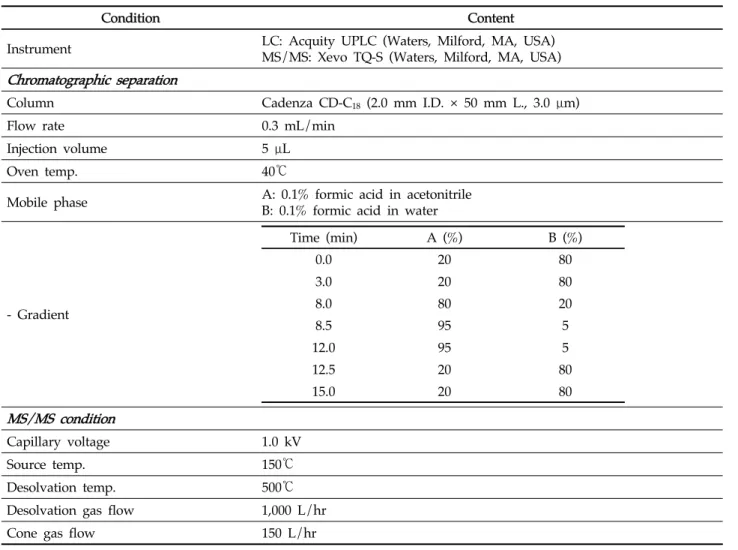
메펜트리플루코나졸과 트리티코나졸 2종을 동시분석하기 위하여 LC-MS/MS (Waters, Miliford, USA)를 사용하였 고, 분석용 컬럼으로 Cadenza CD-C18 (2.0 mm I.D. × 50 mm L., 3.0 μm)을 선택하였으며 이동상으로 0.1% 포름산 함유된 아세토니트릴과 0.1% 포름산 함유된 물을 사용하여 최적의 기울기 용리 방식을 적용하였다. 각 대상성분의 이온 화 방식은 ESI (electro-spray ionization)법의 positive-ion mode를 사용하였으며 LC-MS/MS의 분석조건은 Tables 1, 2와 같다.
Condition Content
Instrument LC: Acquity UPLC (Waters, Milford, MA, USA) MS/MS: Xevo TQ-S (Waters, Milford, MA, USA) Chromatographic separation
Column Cadenza CD-C18 (2.0 mm I.D. × 50 mm L., 3.0 μm)
Flow rate 0.3 mL/min
Injection volume 5 μL
Oven temp. 40℃
Mobile phase A: 0.1% formic acid in acetonitrile B: 0.1% formic acid in water
- Gradient
Time (min) A (%) B (%)
0.0 20 80
3.0 20 80
8.0 80 20
8.5 95 5
12.0 95 5
12.5 20 80
15.0 20 80
MS/MS condition
Capillary voltage 1.0 kV
Source temp. 150℃
Desolvation temp. 500℃
Desolvation gas flow 1,000 L/hr
Cone gas flow 150 L/hr
Table 1. LC-MS/MS parameters for the analysis of mefentrifluconazole and triticonazole
Compound
Molecular weight (g/mol)
Exact mass (g/mol)
Precursor ion (m/z)
Cone voltage
(v)
Product ion (m/z)
CE a) (eV)
Mefentrifluconazole 397.8 397.08 398 35
70 b) 47
182 49
134 47
Triticonazole 317.8 317.13 318 25
70 b) 16
125 24
189 24
a) Collision energy.
b) Quantification ion.
Table 2. MRM (multiple reaction monitoring) conditions of mefentrifluconazole and triticonazole for analysis in ESI positive mode
시험법 유효성 검증
확립된 메펜트리플루코나졸과 트리티코나졸 동시시험법은 식품의약품안전처 식품의약품안전평가원의 ‘식품 등 시험법 마련 표준절차에 관한 가이드라인(MFDS, 2016)’과 ‘CODEX 가이드라인(CAC/GL 40-1993, 2003)’에 근거하여 직선성 (linearity), 검출한계(limit of detection; LOD), 정량한계 (limit of quantification; LOQ), 회수율(recovery), 정확성 (accuracy), 반복성(repeatability)에 대해 유효성을 검증하 였다. 혼합표준원액을 0.0025-0.25 μg/mL의 농도가 되도록 검체의 무처리 추출액으로 희석하여 각 농도 범위에 대한 peak 의 면적으로 검량선(matrix-matched calibration)을 작성하 였고, 검량선의 결정계수(coefficient of correlation; r2)를 구하였다. 또한 크로마토그램 상에서 신호 대 잡음비(signal to noise ratio; S/N ratio)가 각각 3, 10 이상이 되는 농도 를 검출한계, 정량한계로 설정하였다. 시험법의 정확성 및 반 복성을 검증하기 위하여 무처리 시료에 혼합표준용액을 첨가 하여 회수율 실험을 진행하였다. 대표 농산물 5품목에 대하여 처리농도는 정량한계, 정량한계 10배, 정량한계 50배에 해당하 는 농도로 처리하여 각각 5반복 실험을 수행하였고 평균 회수 율과 상대표준편차(relative standard deviation; RSD)를 계 산하여 시험법의 정확성과 반복성을 평가하였다. 또한 전남대 학교와 실험실 간 검증을 진행하여 시험법의 유효성을 확인 하였다.
결과 및 고찰
추출 및 정제 조건 확립
메펜트리플루코나졸은 pKa값을 가지지 않아 모든 pH 범 위에서 해리하지 않고 트리티코나졸의 경우 pH 4~11에서 비해리 상태로 존재하는 비극성 화합물이다(Fig. 2). 농산물 중 잔류된 농약을 추출 시 주로 에틸 아세테이트(ethyl acetate) 와 아세톤(acetone), 아세토니트릴(acetonitrile) 등이 사용되 어 왔다. 에틸아세테이트의 경우 물과 혼합되지 않아 다른 비 극성 유기용매를 첨가하여 물과 추출물과의 분리가 불필요한
Fig. 2. pKa graph of triticonazole.
장점이 있지만 대부분의 비극성 유지 성분들이 다량 추출되 며 극성 화합물들을 추출하기에는 어려움이 있다[5]. 아세톤 의 경우 극성도의 범위가 넓어 다양한 극성을 가진 화합물들 을 추출하기에 용이하나 아세토니트릴에 비해 공 추출물(추 출 시 시료에서 같이 추출되는 간섭물질)의 양이 많아 세분화 된 정제과정이 필요하고, 아세토니트릴의 경우 추출 시 공 추 출물의 양이 적고 염(MgSO4, NaCl 등)을 첨가하여 추출액 에 혼합되어 있는 검체의 수분과의 분리가 용이하다[6,7]. 또 한 수화된 검체 내부에 존재하는 농약 화합물들을 추출하기 위하여 비극성 유기용매보다는 검체 내부로의 침투가 용이한 수용성 유기용매를 사용하는 추세이다[6]. 국내에서는 모니터 링 목적으로 다종농약다성분 분석법을 이용하고 있으며 최근 국외에서는 잔류농약 연구에서 비교적 적은 용매 사용량과 시간 소모가 적고 간편한 장점이 있는 QuEChERS법을 이용 하여 시료 전처리 및 모니터링을 하고 있다[8-10]. 또한 트리 아졸계 살균제를 QuEChERS법을 이용하여 추출 및 d-SPE 정제한 연구가 보고되어 있어[4,10] 본 연구에서는 다종농약 다성분 분석법과 QuEChERS법을 비교 검토하였다. 다종농
약다성분 분석법을 검토한 결과 평균 회수율은 감귤 및 대두 에서 메펜트리플루코나졸의 경우 72.1%, 90.4%이었으며 트리 티코나졸의 경우 44.5%, 93.4%로 감귤에서 회수율이 저조하 였으며 전처리에 소모되는 시간 및 용매량이 많은 단점이 있 다. QuEChERS법은 사용되는 시약의 종류에 따라 original 법과 acetate염을 첨가하는 AOAC 2007.01법, citrate염을 첨가하는 CEN 15662법으로 나눌 수 있으며 시료의 종류에 따라 여러 종류의 흡착제를 다양한 조합으로 사용할 수 있 는 d-SPE (dispersive-solid phase extraction)로 정제하 는 시험법이다[11]. 흡착제 중 PSA (primary secondary amine)의 경우 당, 유기산 등 극성 간섭물질을 제거하며 C18
(octadecysilane)의 경우 지방과 같은 비극성 간섭물질을 제 거하고, GCB (graphitized carbon black)의 경우 클로르필 등의 색소제거에 효과적이다. 하지만 GCB의 경우 분자 구조 가 평면 구조를 가지는 농약의 경우 흡착되어 회수율이 낮아 진다고 보고되어 있다[5]. 세가지 추출 방법 및 d-SPE 정제 법(MgSO4 1200 mg, PSA 400 mg, C18 400 mg, GCB 45 mg) 모두 적용하였을 때 회수율은 Table 3과 같이 우수하였 다. 최근 농산물품질관리원에서 CEN 15662법을 이용한 동 시다성분 시험법을 사용하고 있고, 식약처가 고시하고 있는 동시다성분 시험법의 단점을 보완하여 향후 시험법의 통일성 을 위하여 메펜트리플루코나졸과 트리티코나졸의 시료 전처 리는 CEN 15662법을 이용한 추출 후 d-SPE로 정제하는 시 험법으로 확립하였다.
기기분석조건 확립
메펜트리플루코나졸과 트리티코나졸은 Log Pow 값이 각 각 3.4, 3.29로 비극성을 띄며, 구조내의 방향족 화합물에 – CH3 같은 조색단이 포함되어 있어 흡광계수를 증가시켜 LC-UVD로의 분석이 가능하지만[12], positive list system (PLS) 도입에 따른 정량한계 0.01 mg/kg 수준을 확보할 수 있고, 선택성이 높아 낮은 농도 수준에서도 분석 가능한 액체 크로마토그래프-질량분석기를 분석기기로 사용하였다. 분석 용 컬럼으로는 비극성 작용기와 상호 작용하여 극성 간섭물 질과의 분리가 가능한 C18 컬럼을 사용하였다. 트리아졸계 살 균제의 경우 이동상으로는 0.1% 포름산 함유된 아세토니트릴 과 0.1% 포름산 함유된 물을 사용하여 [M+H]+이온 생성이 용 이함으로 본 연구에서 사용하였다[13]. 메펜트리플루코나졸 (exact mass: 397.08)과 트리티코나졸(exact mass: 317.13)
표준 용액(1 μg/mL)을 각각 일정한 속도(10 μL/min)로 질량 검출기에 직접 주입하여 [M+H]+형태인 질량을 각각 398 m/z, 318 m/z을 확인 하였고, 이 때 각 성분의 cone voltage 는 5-50 V로 조절하여 메펜트리플루코나졸의 경우 35 V, 트 리티코나졸의 경우 25 V로 최적화하였다. 분석 대상의 선택성 과 검출강도를 극대화시키기 위하여 MS/MS 분석 시 MRM (multiple reaction monitoring) mode로 분석하였고 collision cell의 collision energy를 조절하여 최적의 product ion을 선 정하여 감도가 가장 큰 이온을 정량이온(quantification ion)으 로, 다음으로 큰 이온을 정성이온(qualification ion)으로 설 정하였다(Table 2).
시험법 유효성 검증
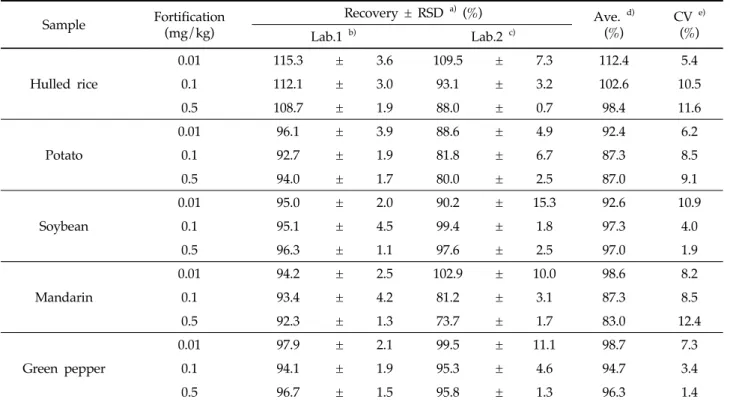
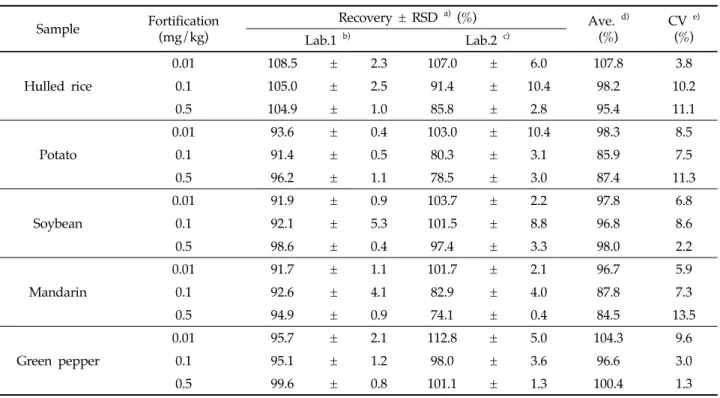
메펜트리플루코나졸과 트리티코나졸의 혼합표준용액, 무 처리 시료, 혼합표준용액을 첨가한 회수율 시료의 크로마토그 램을 서로 비교하여 선택성(selectivity)을 확인하였다. 무처 리 시료 크로마토그램 상의 메펜트리플루코나졸과 트리트코 나졸의 머무름 시간과 질량 대 전하비(m/z)가 동일한 간섭물 질이 검출되지 않아 본 시험법은 대상 성분을 분석함에 있어 높은 분리능과 선택성을 확인할 수 있었다(Fig. 3). 혼합표준 원액을 무처리 시험용액으로 희석하여 0.0025-0.25 μg/mL 농도로 제조한 후 5 μL를 LC-MS/MS에 주입하여 분석한 결과 농산물 5품목 표준용액에서 결정계수(r2) 0.99이상으로 높은 직선성(linearity)을 확인하였다. 검출한계는 크로마토그 램 상에서 신호 대 잡음비(S/N ratio)를 3 이상, 정량한계는 10 이상 되는 최소검출농도를 구하고 시험법의 희석배수를 고려하여 계산한 결과 시험법의 검출한계는 0.003 mg/kg, 정량한계는 0.01 mg/kg이었다. 시험법의 정량한계, 정량한 계 10배, 정량한계 50배 수준인 0.01과 0.1, 0.5 mg/kg의 처리농도로 5반복 회수율 실험을 통해 시험법의 정확성, 정 밀도 및 반복성을 평가하였다. 그 결과 메펜트리플루코나졸 의 평균회수율은 92.3-115.3%, 트리티코나졸의 평균회수율은 91.4-108.5%이었고 RSD는 각각 4.5%, 5.3% 이하로 확인되 었다(Tables 4, 5). 본 연구 결과는 Codex 가이드라인의 잔류 농약 분석 기준(CODEX Alimentarius Commission, 2003) 및 식품의약품안전평가원 ‘식품 등 시험법 마련 표준절차에 관한 가이드라인(MFDS, 2016)’에 부합하므로 농산물 중 잔 류하는 메펜트리플루코나졸과 트리티코나졸을 분석하는데 적 합함을 확인 할 수 있었다.
Sample
Recovery ± RSD a) (%)
Mefentrifluconazole Triticonazole
Original AOAC EN Original AOAC EN
Soybean 87.4 ± 6.7 80.3 ± 5.1 86.9 ± 4.1 89.4 ± 3.0 83.7 ± 2.2 87.3 ± 2.5 Mandarin 97.2 ± 3.3 95.7 ± 6.6 98.2 ± 3.2 104.3 ± 4.8 107.0 ± 8.9 98.9 ± 6.3
a) Mean values of 3 times repetitions with relative standard deviation.
Table 3. The recovery results of mefentrifluconazole and triticonazole according to three QuEChERS method in soybean and mandarin samples
Fig. 3. Representative MRM (quantification ion) chromatograms of (A) mefentrifluconazole and (B) triticonazole in mandarin at (a) control sample, (b) matrix-matched standard at 0.025 μg/mL, and (c) 10×LOQ recovery.
Sample Fortification (mg/kg)
Recovery ± RSD a) (%) Ave. d) (%)
CV e) Lab.1 b) Lab.2 c) (%)
Hulled rice
0.01 115.3 ± 3.6 109.5 ± 7.3 112.4 5.4
0.1 112.1 ± 3.0 93.1 ± 3.2 102.6 10.5
0.5 108.7 ± 1.9 88.0 ± 0.7 98.4 11.6
Potato
0.01 96.1 ± 3.9 88.6 ± 4.9 92.4 6.2
0.1 92.7 ± 1.9 81.8 ± 6.7 87.3 8.5
0.5 94.0 ± 1.7 80.0 ± 2.5 87.0 9.1
Soybean
0.01 95.0 ± 2.0 90.2 ± 15.3 92.6 10.9
0.1 95.1 ± 4.5 99.4 ± 1.8 97.3 4.0
0.5 96.3 ± 1.1 97.6 ± 2.5 97.0 1.9
Mandarin
0.01 94.2 ± 2.5 102.9 ± 10.0 98.6 8.2
0.1 93.4 ± 4.2 81.2 ± 3.1 87.3 8.5
0.5 92.3 ± 1.3 73.7 ± 1.7 83.0 12.4
Green pepper
0.01 97.9 ± 2.1 99.5 ± 11.1 98.7 7.3
0.1 94.1 ± 1.9 95.3 ± 4.6 94.7 3.4
0.5 96.7 ± 1.5 95.8 ± 1.3 96.3 1.4
a) Mean values of 5 (Lab.1) or 3 (Lab.2) times repetitions with relative standard deviation.
b) National Institute of Food and Drug Safety Evaluation.
c) Chonnam National University.
d) Recovery average of inter-laboratory.
e) Coefficient of variation of inter-laboratory.
Table 4. Inter-laboratory validation results of analytical method for mefentrifluconazole in samples
Sample Fortification (mg/kg)
Recovery ± RSD a) (%) Ave. d) (%)
CV e) Lab.1 b) Lab.2 c) (%)
Hulled rice
0.01 108.5 ± 2.3 107.0 ± 6.0 107.8 3.8
0.1 105.0 ± 2.5 91.4 ± 10.4 98.2 10.2
0.5 104.9 ± 1.0 85.8 ± 2.8 95.4 11.1
Potato
0.01 93.6 ± 0.4 103.0 ± 10.4 98.3 8.5
0.1 91.4 ± 0.5 80.3 ± 3.1 85.9 7.5
0.5 96.2 ± 1.1 78.5 ± 3.0 87.4 11.3
Soybean
0.01 91.9 ± 0.9 103.7 ± 2.2 97.8 6.8
0.1 92.1 ± 5.3 101.5 ± 8.8 96.8 8.6
0.5 98.6 ± 0.4 97.4 ± 3.3 98.0 2.2
Mandarin
0.01 91.7 ± 1.1 101.7 ± 2.1 96.7 5.9
0.1 92.6 ± 4.1 82.9 ± 4.0 87.8 7.3
0.5 94.9 ± 0.9 74.1 ± 0.4 84.5 13.5
Green pepper
0.01 95.7 ± 2.1 112.8 ± 5.0 104.3 9.6
0.1 95.1 ± 1.2 98.0 ± 3.6 96.6 3.0
0.5 99.6 ± 0.8 101.1 ± 1.3 100.4 1.3
a) Mean values of 5 (Lab.1) or 3 (Lab.2) times repetitions with relative standard deviation.
b) National Institute of Food and Drug Safety Evaluation.
c) Chonnam National University.
d) Recovery average of inter-laboratory.
e) Coefficient of variation of inter-laboratory.
Table 5. Inter-laboratory validation results of analytical method for triticonazole in samples
실험실간 시험법 검증
시험법의 유효성을 확인하기 위해 외부 실험기관인 전남 대학교와 실험실간 검증을 수행하고자 개발한 시험법을 제공 한 후 동일한 방법으로 분석을 수행하여 회수율 및 상대표준 편차를 비교하였다. 검증 결과 각 농도별 평균회수율은 메펜트 리플루코나졸은 73.7-109.5%, 트리티코나졸은 74.1-112.8%이 었고 RSD는 각각 15.3%, 10.4%이하로 확인되었다(Tables 4, 5). 두 실험실 간의 회수율 결과에 따른 평균값은 메펜트리 플루코나졸의 경우 83.0-112.4%, 트리티코나졸은 84.5-107.8%
이었고, RSD는 모두 14.0% 이하로 모든 처리구에서 Codex 가이드라인(codex alimentarius commission, 2003) 및 식품 의약품안전평가원의 가이드라인(MFDS, 2016)에서 제시한 기 준 처리농도 >1 mg/kg와 ≤0.01 mg/kg의 45%, >0.01 mg/kg와 ≤0.1 mg/kg의 32%보다 낮아 적합한 것으로 확 인되었다.
Note
The authors declare no conflict of interest.
Acknowledgment
This study was supported by the Ministry of Food and
Drug Safety (MFDS), Republic of Korea under the paradigm of a study on risk assessment and establishment of new analytical method for safety management of pesticide residues in food (19161MFDS020).
References
1. Lv X, Pan L, Wang J, Lu L, Yan W, Zhu Y, Xu Y, Guo M, Zhuang S (2017) Effects of triazole fungicides on androgenic disruption and CYP3A4 enzyme activity.
Environmental pollution, 222, 504-512, https://doi.org/10.1016/j.envpol.2016.11.051.
2. Song J, Zhang S, Lu L (2018) Fungal cytochrome P450 protein Cyp51: What we can learn from its evolution, regulons and Cyp51-based azole resistance. Fungal Biology Reviews, 32(3), 131-142,
https://doi.org/10.1016/j.fbr.2018.05.001.
3. Mueller DS (2006) Fungicides: triazoles. Integrated crop management news, 150-151.
4. Zhang Y, Wu X, Li X, Duan T, Xu J, Dong F, Liu X, Guo L, Zheng Y (2019) A fast and sensitive ultra-high- performance liquid chromatography-tandem mass spectrometry method for determining mefentrifluconazole
in plant- and animal-derived foods. Food Additives &
Contaminants: Part A, 36(9), 1348-1357.
https://doi.org/10.1080/19440049.2019.1628361.
5. Mandal S, Poi R, Ansasry I, Hazra Dk, Bhattacharyya S, Karmakar R (2020) Validation of a midified QuEChERS method to determine multiclass multipesticide residues in apple, banana and guava using GC-MS and LC-MS/
MS and its application in real sample analysis. SN Applied Sciences, 2, 1-14.
https://doi.org/10.1007/s42452-020-19090-2.
6. Anastassiades M, Lehotay SJ, Štajnbaher D, Schenck FJ (2003) Fast and easy multiresidue method employing acetonitrile extraction/partitioning and “Dispersive solid- phase extraction” for the determination of pesticide residues in produce. Journal of AOAC International, 86(2), 412-431. https://doi.org/10.1093/jaoac/86.2.412.
7. Ko AY, El-aty AMA, Rahman MM, Jang J, Kim SW, Choi JH, Shim JH (2014) A modified QuEChERS method for simultaneous determination of flonicamid and its metabolites in paprika using tandem mass spectrometry.
Food Chemistry, 157, 413-420.
https://doi.org/10.1016/j.foodchem.2014.02.038.
8. Barci PEP, Alves LS, Avellar AAS, Cendon LR, Santos PJD, Stringhini FM, Prestes OD, Zanella R (2020) Modified QuEChERS method for multiresidue determination of pesticides in Pecan Nuts by liquid chromatography tandem mass spectrometry. Food Analytical method, 13, 793-801. https://doi.org/10.1007/s12161-019-01696-0.
9. Melo MG, Carqueijo A, Freitas A, Barbosa J, Silva S (2020) Modified QuEChERS extraction and HPLC-MS/
MS for simultaneous determination of 155 pesticide residues in Rice (Oryza sativa L.). Foods, 9(1), 18.
https://103390/foods9010018.
10. Su Y, Wang W, Hu J, Liu X (2020) Dissipation behavior, residues distribution and dietary risk assessment of temborione and its metabolite in maize via QuEChERS using HPLC-MS/MS technique. Ecotoxicology and Environmental Safety, 191, 1-7.
https://doi.org/10.1016/j.ecoenv.2020.110187.
11. Tan Q, Fan J, Gao R, He R, Wang T, Zhang Y, Zhang W (2016) Stereoselective quantification of triticonazole in vegetables by supercritical fluid chromatograhy.
Talanta, 164, 362-367.
https://doi.org/10.1016/j.talanta.2016.08.077.
12. Park SM, Do JA, Lim SH, Yoon JH, Pak WM, Shin HS, Kuk JH, Chung HW (2018) Development and validation of analytical method for determination of fungicide spiroxamine residue in agricultural commodities using LC-MS/MS. Journal of Food hygiene and Safety, 33(4), 296-305.
https://doi.org/10.13013/JFHS.2018.33.4.296.
13. Raina FR, Behdarvandan A, Mohamad AA (2018) The challenges of fungicide analyses using gas chromatography and liquid chromatography-mass spectrometry methods.
Austin Environmental Sciences, 3(1), 1031-1037.