DCT and Homomorphic Encryption based Watermarking Scheme in Buyer-seller Watermarking Protocol
Teak-Young Seong†, Ki-Chang Kwon††, Suk-Hwan Lee†††, Kwang-Seok Moon††††, Ki-Ryong Kwon†††††
ABSTRACT
Buyer-seller watermarking protocol is defined as the practice of imperceptible altering a digital content to embed a message using watermarking in the encryption domain. This protocol is acknowledged as one kind of copyright protection techniques in electronic commerce. Buyer-seller watermarking protocol is fundamentally based on public-key cryptosystem that is operating using the algebraic property of an integer. However, in general usage, digital contents which are handled in watermarking scheme mostly exist as real numbers in frequency domain through DCT, DFT, DWT, etc. Therefore, in order to use the watermarking scheme in a cryptographic protocol, digital contents that exist as real number must be transformed into integer type through preprocessing beforehand. In this paper, we presented a new watermarking scheme in an encrypted domain in an image that is based on the block-DCT framework and homomorphic encryption method for buyer-seller watermarking protocol. We applied integral-processing in order to modify the decimal layer. And we designed a direction-adaptive watermarking scheme by analyzing distribution property of the frequency coefficients in a block using JND threshold. From the experimental results, the proposed scheme was confirmed to have a good robustness and invisibility.
Key words: Intellectual Property, Buyer-seller Watermarking Protocol, Security, Cryptographic Protocol, Watermarking.
※ Corresponding Author : Ki-Ryong Kwon, Address:
(608-738) (599-1) Daeyeon-3dong, Namgu, Busan, Korea, TEL : +82-51-629-6250, FAX : +82-51-629-6264, E-mail
Receipt date : May 16, 2014, Revision date : Oct. 18, 2014 Approval date : Oct. 22, 2014
†Interdisciplinary Program of Information Security, Pukyong National University
(E-mail : [email protected])
†††††Dept. of IT Cooperative System, Gyeongbuk Provincial College (E-mail : [email protected])
†††††Dept. of Information Security, Tongmyong Univer- sity (E-mail : [email protected])
†††††Dept. of Electronics Engineering, Pukyong National University (E-mail : [email protected])
†††††Interdisciplinary Program of Information Security,
Pukyong National University
※ This work was supported by a Research Grant of Pukyong National University (2014Year)
1. INTRODUCTION
Advancement of computing and the networking technology, which enables high-speed calculation and ability to connect each person via internet have been growing very rapidly over the past decade.
Like a two-sided coins, while this advancement provided availability for users to perform various operations like composing, editing, transforming, duplicating, and fast distribution of numerous mul-
timedia contents. It also permits malicious users to do unauthorized duplication and redistribution easily. Therefore, this technology is considered bring detrimental effect upon the protection of in- tellectual property right.
There are various kinds of techniques to solve these problems. Among them digital watermarking techniques are considered one of the most promis- ing solutions. The idea of digital watermarking techniques is to embed tiny signals or message in
certain digital contents in order to keep ownership information. So, at discovery of a pirate copy sometime later, the owner can assert the lawful ownership of the original digital contents through the detecting process of watermarks [1-3].
In several company which utilized watermarking techniques, it has been studied cryptographic pro- tocols that can offer a reliable business transaction process to all of the parties in electronic commerce, and buyer-seller watermarking protocol is one of those protocols. Buyer-seller watermarking proto- col combines a cryptographic protocol with a digi- tal watermarking scheme. This method will pro- vide clarification of copyright responsibility at dis- covery of a pirate copy by some illegal users.
In the previous study, symmetric protocols were proposed. But, unfortunately, they were designed for both a buyer and a seller can access water- marked contents. Accordingly, when it is found an illegal replica, they have the customer's right problem which is not able to clarify responsibility issue [4]. Therefore, asymmetric protocols which were proposed after that time, is designed as a buyer can be only able to access watermarked con- tents while doing the transaction. In this way, they solved the problem of clarifying the responsible person at discovery of a pirate copy in symmetric protocols [5-7]. However, these protocols also have another problem. Once the seller discovers a pi- rated copy, it is possible for her to transplant the watermark embedded in the illegal copy into an- other copy of a digital content, provided both copies are sold to the same buyer. This problem is called unbinding problem. Chin-Laung Lei et al.[8] pro- posed a watermarking protocol that solves unbind- ing problem by designed buyer-seller water- marking protocol based on anonymous certificates and one time public-key cryptosystem for seller not to use the watermark embedded in the illegal copy, in the event of discovery.
In watermarking techniques for digital images as one of the representative digital contents, it is
desirable to embed watermarks in the frequency components based on DFT, DCT, DWT and etc.
for robustness, invisibility and capacity purpose. In the buyer-seller watermarking protocol, pub- lic-key cryptosystem is operated in the basis of the algebraic property of an integer, but generally, im- ages which are handled in most watermarking schemes exist as real number in frequency domain.
These data type differences produce some prob- lems in combining watermarking techniques with cryptographic protocols directly. But, previous re- searchers are mostly had not considered on how to implement watermarking scheme in an en- crypted domain.
Therefore, in this paper, the author presented a study of a new watermarking scheme in an en- crypted domain in an image that is based on the block-DCT framework and homomorphic en- cryption method for buyer-seller watermarking protocol. Our study started with investigation about how to divide frequency coefficients exists as real number into integer and decimal layer in order to implement watermarking scheme in a public-key cryptosystem. We applied integral- processing in order to modify the decimal layer.
Also, for robustness and invisibility requirements in watermarking scheme, we designed a direc- tion-adaptive watermarking scheme based on lo- cally edge-properties of each block in an image by analyzing distribution property of the frequency coefficients in a block using JND threshold.
2. RELATED WORKS
Previous research in cryptographic protocols utilized watermarking scheme to embed the in- formation into the image. Unfortunately, there is an issue with data type compatibility between the public-key cryptosystem and the targeted object of operation (frequency domain) in those protocols which use the algebraic property of an integer and real number respectively. Therefore, it is difficult to embed the information with frequency co-
Fig. 1. Requantization procedure.
efficients in encrypted domain. But almost none of previous researchers were considered to apply wa- termarking scheme in the protocols.
For the implementation of watermarking scheme in watermarking protocol, Kuribayashi and H.
Tanaka [9] proposed a new scheme that combines ownership information, a kind of binary bit stream, with frequency coefficients transformed integer type through re-quantization method in encrypted domain. In this scheme, frequency coefficients transformation by integral-processing is employed which resulting an easy watermarking application scheme in cryptographic protocol. But, due to the larger reconstruction of quantization table based on the original image, this scheme is vulnerable to JPEG compression attack by the original quantiza- tion table, which usually processed in the size of 8×8 pixels. Moreover, the watermarks are easily removed by JPEG compression and reverse of even and odd number, because after pre-setting a quan- tization coefficient to the nearest even number, a re-quantized coefficient is added to '1' when the embedded bit is '1', otherwise it is leaved intact.
Fig. 1 shows re-quantization method.
And Lee et al. [10,11] proposed another water- marking scheme for 3D vector contents in the Anonymous buyer seller watermarking protocol.
Basically, this method works in the memon’s [7]
buyer seller watermarking protocol. But in this watermarking scheme, to guarantee buyer’s ano- nymity in the purchase process, Lei’s water- marking generation sub protocol is applied. So this scheme can overcome piracy tracing, customer's right, and unbinding problems.
Other related method which has an important role in the proposed method is homomorphic en- cryption based on bilinear pairing on elliptic curve.
It is a form of encryption where one can perform a specific algebraic operation on the plaintext by performing an algebraic operation on the ciphertext.
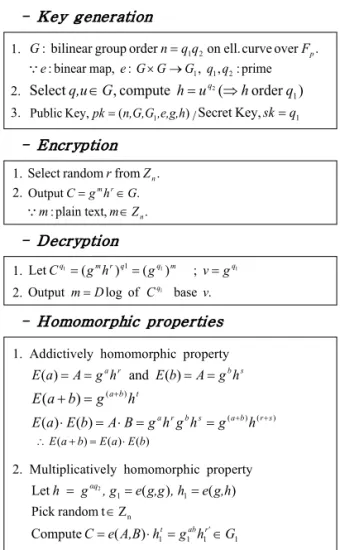
In 2007, Goh [12] proposed a homomorhic en- cryption using bilinear map on elliptic curve. This
cryptographic security scheme has been proven by its ability to solve the difficult subgroup decision problem on elliptic curve. It is similar to Paillier and Okamoto-Uchiyama cryptosystem. In this al- gorithm, key generation, encryption, decryption and homomorphic properties are elaborated as follows.
- Key generation
1. G: bilinear grouporder n=q1q2on ell.curveover Fp. prime : , ,
: , map binear
: e G G G1 q1q2
e ´ ®
Q
2. Select q,uÎG ,compute h=uq2(Þhorder q1) 3. PublicKey,pk =(n,G,G1,e,g,h)/Secret Key,sk =q1
- Encryption 1.Select randomrfromZn. 2.Output C=gmhrÎG.
. ,plain text : nZmm Î Q
- Decryption
1. Let Cq1=(gmhr)q1=(gq1)m ; v=gq1 2.Output m=Dlog of Cq1 base v.
- H omomorphic properties 1. Addictively homomorphic property
s b r
ah Eb A g h
g A a
E( )= = and ( )= =
t b
a h
g b a
E( + )= (+)
) ( )
) (
( )
(a Eb A B gahrgbhs gabhrs
E × = × = = + +
) ( ) ( )
(a b Ea Eb
E + = ×
\
2. Multiplicatively homomorphic property ) ( ) (
Let h = gαq2, g1=eg,g, h1=eg,h Zn
t random
Pick Î
G h g h A,B e
C ( ) 1t 1ab 1r' 1
Compute = × = Î
And many buyer-sellers watermarking proto- cols have proposed and the literature is rich in the
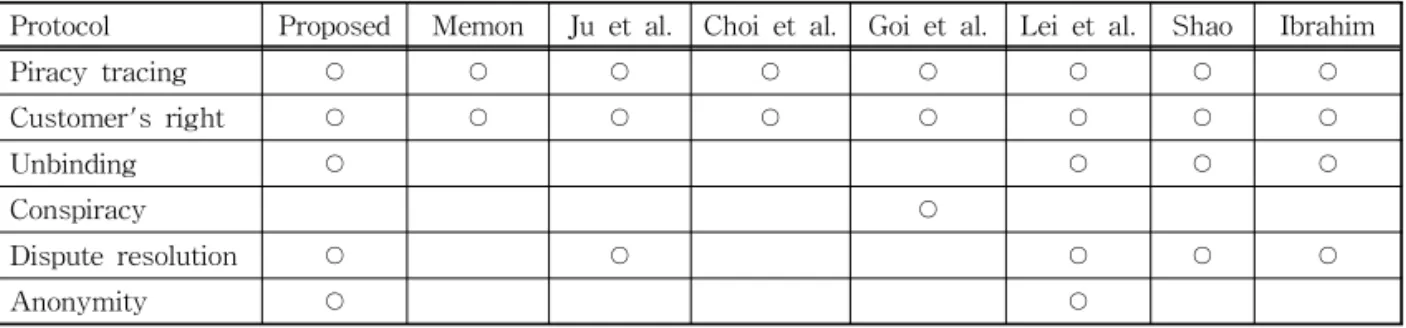
Table 1. Feature of buyer-seller watermarking protocols
Protocol Proposed Memon Ju et al. Choi et al. Goi et al. Lei et al. Shao Ibrahim
Piracy tracing ○ ○ ○ ○ ○ ○ ○ ○
Customer's right ○ ○ ○ ○ ○ ○ ○ ○
Unbinding ○ ○ ○ ○
Conspiracy ○
Dispute resolution ○ ○ ○ ○ ○
Anonymity ○ ○
Fig. 2. Block diagram of the proposed watermarking scheme.
Fig. 3. Region segmentation in a block.
relevant area [13-18]. Since the first introduction of the concept, several alternative design solutions have following problems;
1. The piracy tracing problem 3. The unbinding problem.
4. The conspiracy problem 5. The anonymity problem
In the Table 1, the feature of several buyer-sell- er watermarking protocols are explained.
3. PROPOSED WATERMARKING SCHEME
In buyer-seller watermarking protocol, gen- erally the protocol consists of 3-party nodes which include the buyer, the seller, and reliable certifi- cation authority. Also according to procedure of the protocol, it is divided into three sub-protocols.
They are watermark generation protocol, water- marking protocol and dispute resolution protocol.
We focused our research on watermarking protocol to apply watermarking scheme in encrypted do-
main.
Firstly, the buyer creates two keys, encryption key pkB and decryption key skB. And the buyer encrypts embedded watermark w with encryption function EpkB( ). Secondly, the seller receives en- crypted watermark EpkB(w) and pkB from the buyer and encrypts contents for sale, contents , with
)
B(
Epk . So, EpkB(contents) is formed. Then, the sell- er combines EpkB(w) with EpkB(contents) through
the homomorphic operation and sends EpkB(w)ÅEpkB(contents) )
( )
(w E contents
EpkB Å pkB to the buyer where “Å” is a linear operator. At this time, due to homomorphic oper-
ation on public-key cryptosystem, E (w) E (contents) E (w contents)
B B
B pk pk
pk Å = Å
) (
) ( )
(w E contents E w contents
EpkB Å pkB = pkB Å . Finally, the seller sends the encryption contents EpkB(wÅcontents) to the buyer and the watermarked contents can be obtained with decryption function DskB( ).
3.1 Embedding scheme
In image watermarking, the existing techniques can be classified into two broad categories based on their working domain, they are spatial-domain and frequency-domain techniques. Generally, it is known that frequency-domain watermarking schemes are stronger than spatial-domain one about requirements of the watermarking techni- ques i.e. robustness, invisibility, etc. Therefore, on a block-DCT framework, our proposed scheme is to embed watermarks into suitable frequency co- efficients using JND threshold and is designed with consideration of blind detection. The embedding process is as follows:
1)Adaptive decision of the watermarked blocks:
First, we get frequency coefficients using block DCT, the size of block is 8×8, and then each block is separated into vertical, horizontal and diagonal regions as shown in Fig. 4.
For the analysis of the distribution characteristic of AC components, JND (just noticeable difference)
is calculated considering frequency, luminance and contrast sensitivity based on HVS (human visual system). We apply Watson’s method [10] due to its well performance. But, for the improvement of calculating speed, we apply S. Suthaharan’s meth- od [11] to obtain frequency sensitivity. Next, using partitioned regions and JND, embedded blocks are chosen adaptively according to the following rules.
} 2 0 , 8 1 ,
|
{ ,, ,, ,,
, = k k ³T <p< £q<
ZnV pqn pqn pqn (1)
} 8 1 , 2 0 ,
|
{ ,, ,, ,,
, = k k ³T £p< <q<
ZnH pqn pqn pqn (2)
} 8 2 , 8 2 ,
|
{ ,, ,, ,,
, = k k ³T £p< <q<
ZnD pqn pqn pqn (3)
} ,
|
{ ,, ,, , , ,
,JND pqn pqn nV nH nD
n k k Z Z and Z
Y = Î (4)
îí ì
-
= ³
otherwise embedding
Non
Th Y n Embedding
Jn nJND
. ) ( .
(5) Where Jn the n-th block in an image is, kp,q,n is frequency coefficient in each block Jn. AndTh.
is threshold. When Jn is chosen for the watermark embedding, the watermarked image coefficient
n q
k&p,, is determined using equation (6).
ïî ïí ì
=
=
=
=
)]
( ), ( ), ( max[
) (
)]
( ), ( ), ( max[
) (
)]
( ), ( ), ( max[
) (
, , , ,
, 1 , 1
, , , ,
, 1 , 0
, , , ,
, 0 , 1 , ,
D n H n V n D
n n
D n H n V n H
n n
D n H n V n V
n n n q p
Z n Z n Z n Z
n k
Z n Z n Z n Z
n k
Z n Z n Z n Z
n k
k& (6)
2) Dividing DCT coefficients into integer and decimal layers: Considering watermark insertion based on public-key cryptosystem, in this step, we divide frequency coefficients which appear as real number into integer and decimal layers with the decimal layer is modified integer type through in- tegral-processing as shown in equation (8).
D n q p I
n q p n q
p k k
k,, = ,, + ,, (7)
l D
n q p D
n q
p k
k
Int.( ,,)= ,, ´10 (8)
Where kpI,q,n is interger part on kp,q,n, kDp,q,n is Decimal part and Int.(kpD,q,n) is the integer type one about kDp,q,n. l is the length of significant figures under a decimal point.
3) Watermark insertion: Through the previously mentioned step, the obtained layers are combined
Fig. 4. Compression quality q vs. BER (Bit Error Rate).
with encrypted water- marks using (9)~(17).
2 / ) 50 / ) 100
(( ,
,
,qn uv
p q Q
e = - ´ (9)
If watermark = 1 and k&p,q,n=k1,0,n or k0,1,n, then
)
| (|
)
( ,, ,, ,,
, ,
I n q p I
n q p n q p I
n q
p signk k e
k¢ = & × & + (10)
)) .(
|) .(|
( )
( ,, ,, ,,
, ,
D n q p D
n q p n
q p D
n q
p signk Int k Int e
k¢ = & × & + (11)
)
| (|
)
( , , , , , ,
, ,
I n p q I
n p q n p q I
n p
q signk k e
k¢ = & × & - (12)
)) .(
|) .(|
( )
( , , , , , ,
, ,
D n p q D
n p q n
p q D
n p
q signk Int k Int e
k¢ = & × & - (13)
else if watermark = 1 and k&p,q,n=k1,1,n, then )
| (|
)
( ,, ,, ,,
, ,
I n q p I
n q p n q p I
n q
p signk k e
k¢ = & × & + (14)
)) .(
|) .(|
( )
( ,, ,, ,,
, ,
D n q p D
n q p n
q p D
n q
p sign k Int k Int e
k¢ = & × & + (15)
)
| (|
)
( 1,0, 1,0, 1,0,
, 0 , 1
I n I
n n I
n signk k e
k¢ = & × & - (16)
)) .(
|) .(|
( )
( 1,0, 1,0, 1,0, ,
0 , 1
D n D
n n
D
n sign k Int k Int e
k¢ = & × & - (17)
else
Non-embedding
Where k¢pI,q,n and kp¢D,q,n are watermarked and be- come k&Ip,q,n and k&pD,q,n, Qp,q is quantization table.
3.2 Extracting scheme
The extraction process is simple. Because wa- termarked contents that are delivered to the buyer after the watermark embedding process are decrypted. So, watermark extraction process is performed simply without encryption and de-
cryption key.
} 2 0 , 8 1 ,
|
{ ,, ,, ,,
, = k k ³T <p< £q<
ZnV pqn pqn pqn (18)
} 8 1 , 2 0 ,
|
{ ,, ,, ,,
, = k k ³T £p< <q<
ZnH pqn pqn pqn (19)
} 8 2 , 8 2 ,
|
{ ,, ,, ,,
, = k k ³T £p< <q<
ZnD pqn pqn pqn (20)
} ,
|
{ ,, ,, , , ,
,JND pqn pqn nV nH nD
n k k Z Z and Z
Y = Î (21)
ïï î ïï í ì
< = -
³
³ = -
³
=
2 )
| (
|
|
|
|
| . ) ( 0
2 )
| (
|
|
|
|
| . ) ( 1
1 , 0 0 , 1 , 1 , 0 , 0 , 1 .
1 , 0 0 , 1 , 1 , 0 , 0 , 1 .
Q k Q
k and Th Y n
Q k Q
k and Th Y n w
n n JND
n
n n JND
n
n (22)
Where wn is extracted watermark and Qp,q is quantization table. We alter AC1, AC2and AC4that have same quantization step size and design. The difference between AC1 and AC2 is more than or equal to Qp,q/2 in the watermark embedding process. So, using equation (18)~(22), watermarks can be extracted simply.
4. EXPERIMENTAL RESULTS
In these experiments, we use five MATLAB standard images that have different frequency characteristics "Airplane", "Barbara", “Co”, Girl”, and "Gold". They have 256 level gray level with the size of 512×512. For the embedded information we use a combination of the English alphabets and Arabian figures which have been converted into the bit stream using 8 bit extended ASCII codes.
In all experiments, the number of characters of em- bedded information was 35, and the length of the converted bit stream was 280. At the same time, we scrambled each bit for the watermarking security. We set the threshold value (Th.=5) and the quality factor (q=10)considering robustness of watermarks against JPEG compression in the fol- lowing simulations. To evaluate the proposed wa- termarking scheme, we estimated the invisibility parameter using PSNR (peak signal-to-noise ra- tio) between original images and watermarked one and evaluate robustness against JPEG compression by measuring number of error bits in watermarks as shown in Table 2 and Fig. 4.
Table 2. The number of watermark-allowable blocks, embedded bits, and PSNR in each image
Image Airplane Barbara Co Girl Gold
Watermark allowable block 2026 2725 3025 2519 3228
PSNR 52.36 48.93 45.66 47.53 44.61
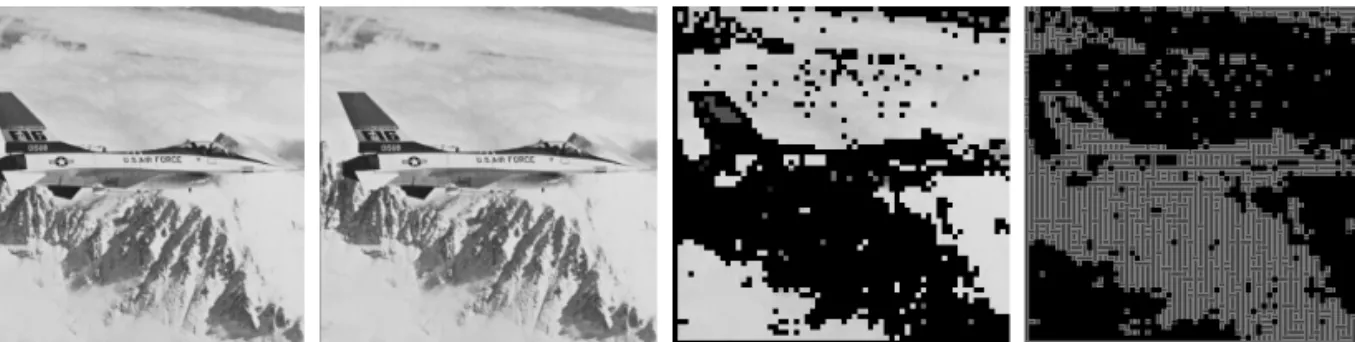
Fig. 5. Original image Airplane (top-left), watermarked image(top-right), watermark allowable block(bottom-left), difference image between original and watermarked one(bottom-right).
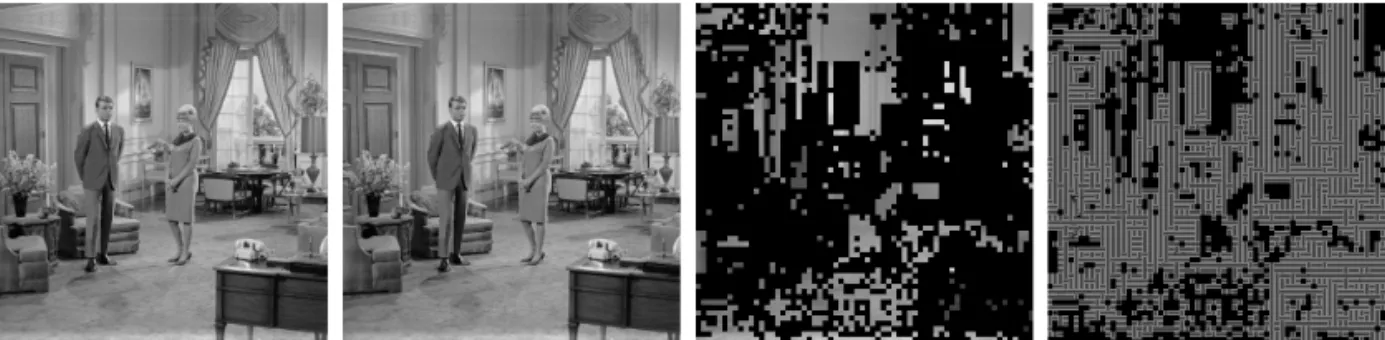
Fig. 6. Original image Barbara (top-left), watermarked image(top-right), watermark allowable block(bottom-left), difference image between original and watermarked one(bottom-right).
In JPEG compression simulations, error bits ap- peared when quality factor q is 50, but, because we inserted same watermarks several times over and set q = 10, it is possible to extract watermarks until quality factor q reach 10.
5. CONCLUSIONS
Watermarking scheme which is based on DCT and homomorphic encryption has some application difficulties in buyer-seller watermarking protocol due to incompatibility of data type in public-key cryptosystem. We learned that Kuribayashi and H.
Tanaka's scheme employed integral-processing quantization to transform frequency coefficients which make it easier to apply watermarking scheme in cryptographic protocol but unfortu-
nately, this method also showed some disadvantages in robustness issue due to its watermarks are easi- ly removed by JPEG compression and reverse of even and odd number. To improve the robustness and invisibility of the previously available method, the author proposed a new watermark embedding algorithm into frequency coefficients considering edge-properties of each block with JND threshold.
Also, the author managed to perform embedding process by divided frequency coefficients into in- teger and decimal layer and modified decimal layer into integer type, damage of frequency information is less than Kuribayashi and H. Tanaka's scheme.
Moreover, by considering the size of general con- tents and watermarks after encryption procedure, the amount of insertion bit is relatively small in proposed scheme.
Fig. 7. Original image Co (top-left), watermarked image (top-right), watermark allowable block (bottom-left), difference image between original and watermarked one(bottom-right).
Fig. 8. Original image Girl (top-left), watermarked image (top-right), watermark allowable block (bottom-left), difference image between original and watermarked one (bottom-right).
Fig. 9. Original image Gold (top-left), watermarked image (top-right), watermark allowable block(bottom-left), difference image between original and watermarked one (bottom-right).
Therefore, further research about techniques that can increase the amount of insertion in- formation is needed in the future.
REFERENCES
[ 1 ] M.D. Swanson, M. Kobayashi, and A.H.
Tewfik, “Multimedia Data Embedding and Watermarking Technologies,”Proceedings of the IEEE, Vol. 86, No. 6, pp. 1064-1087, 1998.
[ 2 ] C.I. Podilchuk and W. Zeng, “Image-adaptive Watermarking using Visual Models,” IEEE
J ournal on Selected Areas Communications, Vol. 16, Issue 4, pp. 525-539, 1998.
[ 3 ] I.J. Cox, J. Kilian, T. Leighton, and T.
Shamoon, “Secure Spread Spectrum Water- marking for Multimedia,”IEEE Transactions on Image P rocessing, Vol. 6, No. 12, pp.
1673-1687, 1997.
[ 4 ] Birgit Pfitzmann, “Trials of Traced Traitors,”
Proceeding of the First International Work- shop on Information Hiding, pp. 49-64, 1996.
[ 5 ] B. Pfitzmann and M. Schunter, “Asymmetric Fingerprinting,” Advances in Cryptology,
EUROCRYP T’96, LNCS 1592, pp. 150-164, 1996.
[ 6 ] B. Pfitzmann and M. Waidner, “Anonymous Fingerprinting,” Advances in Cryptology, EUROCRYP T’97, LNCS 1233, pp. 88-102, 1997.
[ 7 ] N. Memon and P.W. Wong, “A Buyer-seller Watermarking Protocol,” IEEE Transactions on Image Processing, Vol. 10, No. 4, pp. 643- 649, 2001.
[ 8 ] C.L. Lei and M.H. Chan, “An Efficient Anon- ymous Buyer-Seller Watermarking Protocol,”
IEEE Transactions on Image Processing, Vol. 13, No. 12, pp. 1618-1626, 2004.
[ 9 ] M. Kuribayashi and H. Tanaka, “A Water- marking Scheme Applicable for Fingerprint- ing Protocol,” Proceeding of International Workshop on Digital Watermarking, IWDW 2003, LNCS 2939, pp. 532-543, 2004.
[10] K.G. Kwon, J.H. Lee, S.H. Lee, and K.R.
Kwon, “POCS based Digital Watermarking in Buyer-seller Watermarking Protocol,” Journal of Korea Multimedia Society, Vol. 10, No. 5, pp. 569-582, 2007.
[11] S.H. Lee, S.G. Kwon, and K.R. Kwon,
“Geometric Multiple Watermarking Scheme for Mobile 3D Content based on Anonymous Buyer-seller Watermarking Protocol,” Journal of Korea Multimedia Society, Vol. 12, No. 2, pp. 244-256, 2009.
[12] E.J. Goh, Encryption Schemes from Bilinear Maps, Doctor’s Thesis of Stanford University
of Computer Science, 2007.
[13] M. Deng, T. Bianchi, A. Piva, and B. Preneel,
“An Efficient Buyer-Seller Watermarking Protocol based on Composite Signal Repre- sentation,” P roceedings of the 11th ACM Workshop on Multimedia and Security, ACM MM&Sec., pp. 9-18, 2009.
[14] V.V. Das and J.F. Rahman, “An Enhanced Privacy Preserving Buyer-seller Protocol for Anonymous Transaction,”ACEEE Internatio- nal Journal on Communication, Vol. 1, No. 2, pp. 57-61, 2010.
[15] A. Rail, J. Balasch, and B. Preneel, “A Privacy-preserving Buyer–seller Water- marking Protocol based on Priced Oblivious Transfer,” IEEE Transactions On Informat- ion Forensics and Security, Vol. 6, No. 1, pp.
202-212, 2011.
[16] S. Wu and Q. Pu, “Comments on a Buyer- seller Watermarking Protocol for Large Scale Networks,”International Journal of Network Security, Vol. 14, No. 1, pp. 53-58, 2012.
[17] Bjorn Terelius, “Towards Transferable Watermarks in Buyer-seller Watermarking Protocols,” IEEE International Workshop on Information Forensics and Security, pp. 197- 202, 2013.
[18] F. Guo, Y. Mu, and W. Susilo, “Subset Membership Encryption and its Applications to Oblivious Transfer,”IEEE Transactions on Information Forensics and Security, Vol. 9, No. 7, pp. 1098-1107, 2014.
Teak-Young Seong received a B.S. and a M.S. de- grees from Busan University of Foreign Studies in 2004 and 2006 respectively. He is doing a Ph. D. course in Interdiscipli- nary Program of Information Security at Pukyong National University. His research interests include multimedia signal and image processing, digital watermarking.
Gi-Chang Kwon
received a B.S., a M.S., and Ph.D.
degrees from Andong National University in 1985, Daegu Uni- vsrsity in 1993, and Yeongnam University in 2000. Currently, he is a professor in Department of IT Cooperative System at Geong- buk Provincial College. His research interests include multimedia contents and image processing, digital contents and smart system.
Suk-Hwan Lee
He received a B.S., a M.S., and a Ph. D. degrees in Electrical Engineering from Kyungpook National University, Korea in 1999, 2001, and 2004 respec- tively. He is currently an asso- ciate professor in Department of Information Security at Tongmyong University. His research interests include multimedia security, digital image processing, and computer graphics.
Kwang-Seok Moon He received the B.S., and M.S., and Ph.D degrees in Electronics Engineering in Kyungpook Na- tional University, Korea in 1979, 1981, and 1989 respectively. He is currently a professor in de- partment of Electronic engin- eering at Pukyong National University. His research interests include digital image processing, video wa- termarking, and multimedia communication.
Ki-Ryong Kwon
He received the B.S., M.S., and Ph.D. degrees in electronics en- gineering from Kyungpook National University in 1986, 1990, and 1994 respectively. He worked at Hyundai Motor Company from 1986-1988 and at Pusan University of Foreign Language from 1996- 2006. He is currently a professor in Department of IT Convertgence and Application Engineering at the Pukyong National University. He has researched University of Minnesota in USA on 2000-2002 with Post-Doc. and Colorado State University on 2011-2012 with visiting professor. He is currently the General Affair Vice President of Korea Multimedia Society. His research interests are in the area of digital image proc- essing, multimedia security and watermarking, bio- informatics, weather radar information processing.