Received: July 14, 2021 Revised: August 05, 2021 Accepted: August 07, 2021
수행경험에 따른 수행가능성 및 필요성 조사
송가인 · 신선정 · 신보미 · 유상희 · 배수명 강릉원주대학교 치과대학 치위생학과 및 구강과학연구소
A study on the performance and necessity of dental hygienists for oral health promotion activities for the elderly according to their learning experiences and performance experiences
Ga-In Song · Sun-Jung Shin · Bo-Mi Shin · Sang-Hee Yoo · Soo-Myoung Bae
Department of Dental Hygiene, College of Dentistry & Research Institute of Oral Science, Gangneung-Wonju National University
Corresponding Author: Soo-Myoung Bae, Department of Dental Hygiene, College of Dentistry, Gangneung-Wonju National University, 7, Jukheon-gil, Gangneung-si, Gangwon-do, 25457, Korea. Tel : +82-33-640-2756, Fax : +82-33-642- 6410, E-mail : [email protected]
ABSTRACT
Objectives: The purpose of this study was to investigate the awareness of the performance and necessity of oral health promotion activities and seek ways to revitalize the professional role of dental hygienists in oral healthcare for the efficient oral care of the elderly. Methods: Eighty- five dental hygienists in charge of oral health promotion projects at public health centers and 38 dental hygienists in network dental clinical trials were investigated for their learning experience, performance experience, feasibility, and necessity of dental hygienists for general and oral health service items for the elderly. The collected data were analyzed using frequency analysis, chi- square test, and Mann-Whitney U test. Results: The degree of performance possibility according to the learning experience and performance experience of the dental hygienist for the whole body and oral health promotion activity items for the elderly showed that the degree of performance possibility was higher among those with experience compared to the non-experienced person, and it was statistically significantly higher (p<0.05). Conclusions: The dental hygienist’s professional oral health service is a necessary system to improve practical knowledge and skills and to provide a wide range of professional oral health services for the elderly.
Key Words: Dental health service, Dental hygienist, Elderly, Oral health, Oral health promotion 색인: 구강건강, 구강건강증진, 구강보건서비스, 노인, 치과위생사
서론
세계적으로 사회 · 경제적 변화에 따라 국민소득의 증가, 의료기술의 발달, 식습관 개선, 보건환경 변화 등 에 의해 평균수명이 연장되고 있다. 우리나라는 65세 이상 고령 인구의 비율이 2015년 12.8%에서 2030년 25%, 2040년 33.9%, 2050년 이후에는 40%를 초과할 것으로 전망하고 있으며[1], OECD는 노인 인구 비율 이 2020년에서 2050년까지 약 4%에서 6%까지 증가할 것으로 예상하고 있다[2]. 또한 UN의 2019 세계인구 전망 보고에 따르면 2050년에는 65세 이상 인구가 세계 인구의 16%를 차지할 것으로 예측하고 있다[3].
2019년 국민 구강건강실태조사에 의하면, 60세 이전의 20개 이상 치아보유율은 91.7%로 나타났으나 70세 이후 50.2%로 급격하게 감소하였으며, 만 60세 이상 노인의 의치 필요자율은 45.8%, 저작불편 호소 율은 68.8%로 노인들의 구강상태 및 관련된 삶의 질은 열악한 실정이다[4]. 또한 만 60세 이상 노인의 상 실치아 수는 연령에 따라 60-69세는 6.2개, 70-79세는 10.1개, 80세 이상은 13.8개로 연령이 증가할수록 상 실치아 수도 증가하고 있다[5]. 치아 상실은 저작 능력 저하 및 기능 제한으로 인해 음식 섭취를 함에 있어 식사의 양과 질에 영향을 미치며 건강 생활 유지의 어려움[6]과 구강건강 삶의 질에도 크게 영향을 미치는 것으로 보고되고 있다[7].
노인 구강건강 문제는 향후 치과 진료 수요의 증가와 계속구강건강관리에 대한 요구 또한 높아져 치과 위생사의 노인 구강건강관리 및 교육에 대한 필요성도 높아질 것으로 예상되며, 이러한 예방적 구강건강 관리는 주로 예방업무에 종사하는 치과위생사가 전문적으로 관리하여야 한다[8]. 하지만 지역사회 및 치 과 병 · 의원에서는 노인 환자를 관리하고 접할 수 있는기회가 빈번함에도 불구하고 치과위생사들은 노인 환자들을 일반 성인 환자들과 별 차이 없이 치료 위주의 서비스를 제공하고 하는 문제점을 가지고 있으며, 노인 구강관리에 대한 충분한 교육이 부족한 현실이다[9].
노인의 구강건강증진 및 유지를 위해서는 치과위생사가 전문적인 역할을 수행할 수 있도록 적극적인 지 원과 관심 및 참여가 필요하며[9], 치과위생사의 역할 수행을 위해서는 환자가 구강건강을 유지하거나 관 리하는데 도움이 되는 구강보건교육 내용을 기반으로 지식과 태도 및 행동을 변화시킬 수 있도록 교육내 용관리 및 노력이 이루어져야 한다[10].
고령화 시대에 따른 노인요양시설 거주 노인들에 대한 구강건강 관련 연구 및 치과위생사의 구강관리경 험에 대한 인식조사와 같은 단면연구[11-13]들이 진행되어왔으나 구체적인 전신 및 구강건강관리 항목에 대한 치과위생사의 인식 연구는 미비한 실정이다.
이에 본 연구는 지역사회 노인들을 위한 구강보건서비스를 제공하고 있는 보건소 치과위생사뿐만 아니 라 임상에 근무하고 있는 치과위생사들을 대상으로 구강건강증진 활동에 대한 학습경험, 수행경험 및 수 행가능성과 필요성에 대한 인식을 조사하고자 하였다.
연구방법
1. 연구설계
본 연구는 00대학교 기관생명윤리위원회에서 심사면제 되었다(GWNU IRB R2018-11). 노인 대상 구강 건강증진 활동 항목에 대한 설문지 개발을 위해 국내·외 문헌을 참조하여 설문문항 항목[14,15]을 선정하 였으며, 치위생학과 교수 3인으로 구성된 전문가 집단의 검토를 통해 설문지를 개발하였다. 개발한 설문
2. 연구대상
본 연구는 2018년 7월 2일부터 7월 31일까지 조사하였다. 전국 254곳 보건소에 대하여 설문지를 배부하 여 구강건강증진사업 담당 치과위생사 중 연구 참여에 동의한 94명의 치과위생사를 대상으로 설문조사를 시행하였고 회수율은 37.0%였다. 네트워크 치과 임상 치과위생사는 서울·경기 지역에 소재하고 있는 치 과 중 연구자의 편의에 따라 무작위로 추출하여 75곳을 선정한 후 하루 15명 이상 노인 환자를 접하며 연 구 참여에 동의한 7곳의 네트워크 치과 의료기관에 재직 중인 치과위생사를 대상으로 조사하였으며 총 42 부를 배부하여 39부를 회수하였고 회수율은 92.9%였다. 본 연구는 회수된 설문 자료 중 불성실한 설문지 보건소 9부, 임상 1부를 제외하고, 총 123부를 분석에 이용하였다.
3. 연구도구
본 연구는 구강건강증진 활동 사정 항목 21문항과 수행 항목 7문항, 일반적 특성 4문항으로 구성하였다.
연구대상자의 일반적 특성 중 연령, 근무 경력 항목은 자기기입식 방법으로 작성하도록 하였으며, 성별, 학 력 항목은 각각 보기를 제시한 후 선택하도록 구성하였다.
노인의 전신 및 구강 관리에 대한 구강건강증진 활동 사정 및 수행 항목은 일본의 치과위생사 인증제도 및 개호보험에 따른 치과위생사의 역할과 우리나라 치과위생사의 구강보건 업무 범위 및 권한 안에서의 노인의 구강건강관리 현황, 우리나라 치과위생사의 방문구강위생 사례 및 요양시설에서 요양보호사에 의 한 노인의 구강건강관리 사례, 치과위생사에 의한 노인의 구강건강관리 교육내용[16-18]을 참고하여 개발 한 후, 선정된 구강보건서비스 항목에 대한 학습경험, 수행경험, 수행가능성, 필요성을 조사할 수 있도록 구성하였다. 노인의 전신 및 구강 관리에 대한 구강보건서비스 항목의 수행가능성 및 필요성을 평가하는 문항은 ‘전혀 그렇지 않다’ 1점에서 ‘매우 그렇다’ 5점까지 5점 리커트 척도로 이루어져 있으며, 점수가 높 을수록 구강건강관리 수행가능성 및 필요성이 높음을 의미한다. 수행가능성과 필요성에 대한 설문문항의 Cronbach’s α는 각 0.948, 0.984이었다.
4. 자료분석
본 연구의 수집된 자료는 PASW Statistics 25.0(SPSS Inc., Chicago, IL, USA)를 이용하여 분석하였으 며, 유의수준은 0.05로 하였다. 연구대상자의 일반적 특성을 확인하기 위해 빈도분석을 실시하였으며, 노 인 대상의 전신 및 구강건강증진 활동 항목에 대한 치과위생사의 학습경험 및 수행경험을 확인하기 위해 근무기관에 따라 교차분석(chi-square test)을 실시하였다. 노인 대상의 전신 및 구강건강증진 활동 항목 에 대한 치과위생사의 학습경험 및 수행경험에 따른 수행가능성과 필요성 차이를 비교하기 위하여 Mann- Whitney U test를 실시하였다.
연구결과
1. 조사대상자의 일반적 특성
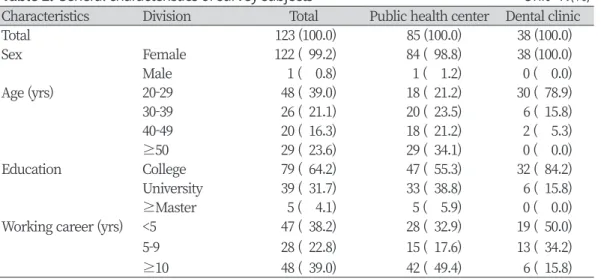
연구 대상자 중 성별은 여자 99.2%, 남자 0.8%로 보건소 한 곳을 제외하고 모두 여성인 것으로 나타났 다. 연령은 보건소에서 50세 이상이 34.1%로 가장 높게 나타났으며, 임상에서는 20-29세가 78.9%로 가장 높게 나타났다. 학력은 보건소와 임상 모두 전문대학 졸업이 각각 55.3%, 84.2%로 가장 높게 나타났다. 근 무경력은 보건소는 10년 이상이 49.4%, 임상은 5년 미만이 50.0%로 가장 높게 나타났다<Table 1>.
2. 노인 대상의 전신 및 구강건강증진 활동 항목에 대한 치과위생사의 학습경험
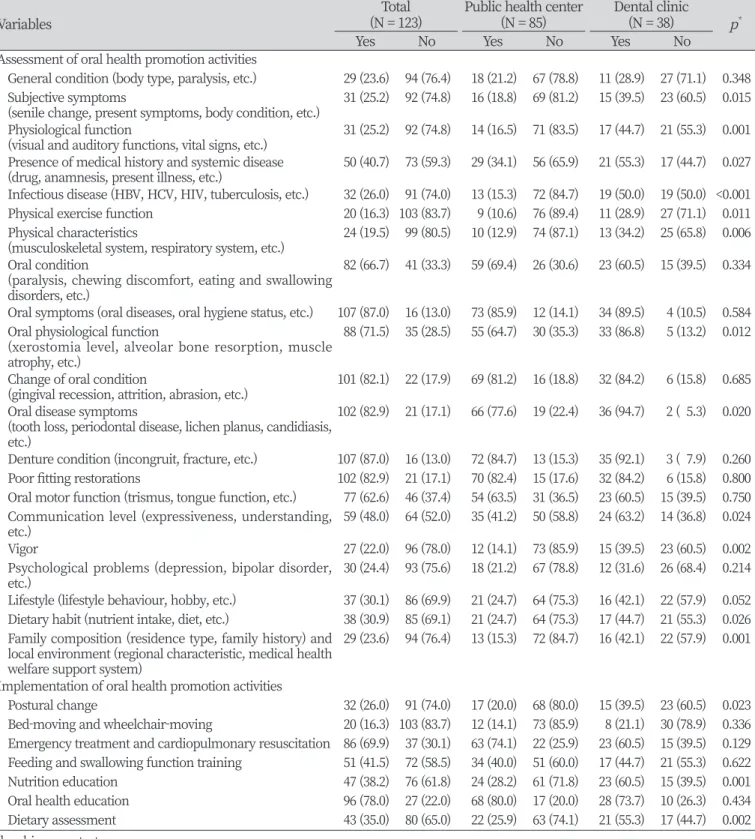
노인 대상의 전신 및 구강건강증진 활동 사정 항목에 대하여 치과위생사의 학습경험을 확인한 결과, 보 건소 치과위생사는 구강자각증상(85.9%), 의치관리(84.7%), 불량수복물(82.4%) 항목들에 대한 학습경험 율은 다른 항목들에 비해 높게 나타났으나, 신체운동기능(10.6%), 신체적특성(12.9%), 기력(14.1%) 항목 들에 대한 학습경험율은 낮게 나타났다. 임상 치과위생사는 구강질환증상(94.7%), 의치관리(92.1%), 구강 자각증상(89.5%) 항목들에 대한 학습경험율은 다른 항목들에 비해 높게 나타났으나, 전신적상태(28.9%), 신체운동기능(28.9%), 심리적문제(31.6%) 항목들에 대한 학습경험율은 낮게 나타났다.
수행 항목에 대한 학습경험은, 보건소 치과위생사와 임상 치과위생사 모두 구강보건교육 수행 항목이 각 80.0%, 73.7%로 가장 높게 나타났으며, 침상이동 및 휠체어이동 수행 항목의 학습경험은 각 14.1%, 21.1%로 가장 낮게 나타났다<Table 2>.
3. 노인 대상의 전신 및 구강건강증진 활동 항목에 대한 치과위생사의 수행경험
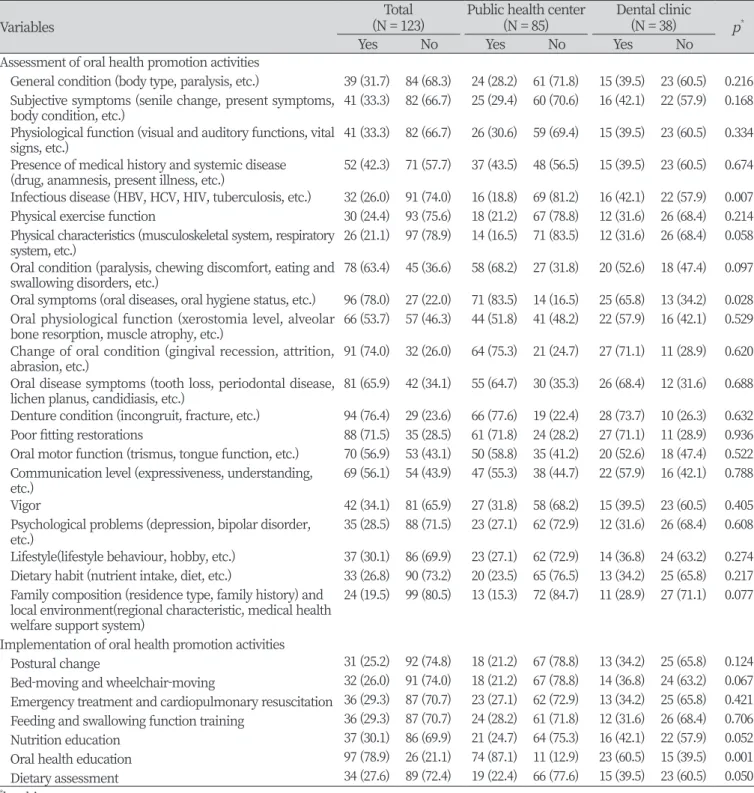
노인 대상의 전신 및 구강건강증진 활동 사정 항목에 대하여 치과위생사의 수행경험을 확인한 결과, 보 건소 치과위생사는 구강자각증상(83.5%), 의치관리(77.6%), 구강변화(75.3%) 항목들에 대한 수행경험율 은 다른 항목들에 비해 높게 나타났으나, 가족구성 및 지역환경(15.3%), 신체적특성(16.5%), 감염증유무 (18.8%) 항목들에 대한 수행경험율은 낮게 나타났다. 임상 치과위생사는 의치관리(73.7%), 구강변화 (71.1%), 불량수복물(71.1%) 항목들에 대한 수행경험율은 다른 항목들에 비해 높게 나타났으나, 신체운동 기능(31.6%), 신체적특성(31.6%), 심리적문제(31.6%) 항목들에 대한 수행경험율은 낮게 나타났다.
수행 항목에 대한 수행경험은, 보건소 치과위생사와 임상 치과위생사 모두 구강보건교육 수행 항목이 각 87.1%, 60.5%로 가장 높게 나타났으나, 보건소 치과위생사는 체위변경(21.2%), 침상이동 및 휠체어이 동(21.2%) 항목들에 대한 수행경험이 가장 낮게 나타났고, 임상 치과위생사는 섭식·연하기능훈련(31.6%) 에 대한 수행경험이 가장 낮게 나타났다<Table 3>.
Table 1. General characteristics of survey subjects Unit : N(%)
Characteristics Division Total Public health center Dental clinic
Total 123 (100.0) 85 (100.0) 38 (100.0)
Sex Female 122 ( 99.2) 84 ( 98.8) 38 (100.0)
Male 1 ( 0.8) 1 ( 1.2) 0 ( 0.0)
Age (yrs) 20-29 48 ( 39.0) 18 ( 21.2) 30 ( 78.9)
30-39 26 ( 21.1) 20 ( 23.5) 6 ( 15.8)
40-49 20 ( 16.3) 18 ( 21.2) 2 ( 5.3)
≥50 29 ( 23.6) 29 ( 34.1) 0 ( 0.0)
Education College 79 ( 64.2) 47 ( 55.3) 32 ( 84.2)
University 39 ( 31.7) 33 ( 38.8) 6 ( 15.8)
≥Master 5 ( 4.1) 5 ( 5.9) 0 ( 0.0)
Working career (yrs) <5 47 ( 38.2) 28 ( 32.9) 19 ( 50.0)
5-9 28 ( 22.8) 15 ( 17.6) 13 ( 34.2)
≥10 48 ( 39.0) 42 ( 49.4) 6 ( 15.8)
Table 2. The dental hygienist’s learning experience on whole body and oral health promotion activities for the elderly Unit : N(%)
Variables Total
(N = 123) Public health center
(N = 85) Dental clinic (N = 38) p*
Yes No Yes No Yes No
Assessment of oral health promotion activities
General condition (body type, paralysis, etc.) 29 (23.6) 94 (76.4) 18 (21.2) 67 (78.8) 11 (28.9) 27 (71.1) 0.348 Subjective symptoms
(senile change, present symptoms, body condition, etc.) 31 (25.2) 92 (74.8) 16 (18.8) 69 (81.2) 15 (39.5) 23 (60.5) 0.015 Physiological function
(visual and auditory functions, vital signs, etc.) 31 (25.2) 92 (74.8) 14 (16.5) 71 (83.5) 17 (44.7) 21 (55.3) 0.001 Presence of medical history and systemic disease
(drug, anamnesis, present illness, etc.) 50 (40.7) 73 (59.3) 29 (34.1) 56 (65.9) 21 (55.3) 17 (44.7) 0.027 Infectious disease (HBV, HCV, HIV, tuberculosis, etc.) 32 (26.0) 91 (74.0) 13 (15.3) 72 (84.7) 19 (50.0) 19 (50.0) <0.001 Physical exercise function 20 (16.3) 103 (83.7) 9 (10.6) 76 (89.4) 11 (28.9) 27 (71.1) 0.011 Physical characteristics
(musculoskeletal system, respiratory system, etc.) 24 (19.5) 99 (80.5) 10 (12.9) 74 (87.1) 13 (34.2) 25 (65.8) 0.006 Oral condition
(paralysis, chewing discomfort, eating and swallowing disorders, etc.)
82 (66.7) 41 (33.3) 59 (69.4) 26 (30.6) 23 (60.5) 15 (39.5) 0.334
Oral symptoms (oral diseases, oral hygiene status, etc.) 107 (87.0) 16 (13.0) 73 (85.9) 12 (14.1) 34 (89.5) 4 (10.5) 0.584 Oral physiological function
(xerostomia level, alveolar bone resorption, muscle atrophy, etc.)
88 (71.5) 35 (28.5) 55 (64.7) 30 (35.3) 33 (86.8) 5 (13.2) 0.012
Change of oral condition
(gingival recession, attrition, abrasion, etc.) 101 (82.1) 22 (17.9) 69 (81.2) 16 (18.8) 32 (84.2) 6 (15.8) 0.685 Oral disease symptoms
(tooth loss, periodontal disease, lichen planus, candidiasis, etc.)
102 (82.9) 21 (17.1) 66 (77.6) 19 (22.4) 36 (94.7) 2 ( 5.3) 0.020
Denture condition (incongruit, fracture, etc.) 107 (87.0) 16 (13.0) 72 (84.7) 13 (15.3) 35 (92.1) 3 ( 7.9) 0.260 Poor fitting restorations 102 (82.9) 21 (17.1) 70 (82.4) 15 (17.6) 32 (84.2) 6 (15.8) 0.800 Oral motor function (trismus, tongue function, etc.) 77 (62.6) 46 (37.4) 54 (63.5) 31 (36.5) 23 (60.5) 15 (39.5) 0.750 Communication level (expressiveness, understanding,
etc.) 59 (48.0) 64 (52.0) 35 (41.2) 50 (58.8) 24 (63.2) 14 (36.8) 0.024
Vigor 27 (22.0) 96 (78.0) 12 (14.1) 73 (85.9) 15 (39.5) 23 (60.5) 0.002
Psychological problems (depression, bipolar disorder,
etc.) 30 (24.4) 93 (75.6) 18 (21.2) 67 (78.8) 12 (31.6) 26 (68.4) 0.214
Lifestyle (lifestyle behaviour, hobby, etc.) 37 (30.1) 86 (69.9) 21 (24.7) 64 (75.3) 16 (42.1) 22 (57.9) 0.052 Dietary habit (nutrient intake, diet, etc.) 38 (30.9) 85 (69.1) 21 (24.7) 64 (75.3) 17 (44.7) 21 (55.3) 0.026 Family composition (residence type, family history) and
local environment (regional characteristic, medical health welfare support system)
29 (23.6) 94 (76.4) 13 (15.3) 72 (84.7) 16 (42.1) 22 (57.9) 0.001
Implementation of oral health promotion activities
Postural change 32 (26.0) 91 (74.0) 17 (20.0) 68 (80.0) 15 (39.5) 23 (60.5) 0.023
Bed-moving and wheelchair-moving 20 (16.3) 103 (83.7) 12 (14.1) 73 (85.9) 8 (21.1) 30 (78.9) 0.336 Emergency treatment and cardiopulmonary resuscitation 86 (69.9) 37 (30.1) 63 (74.1) 22 (25.9) 23 (60.5) 15 (39.5) 0.129 Feeding and swallowing function training 51 (41.5) 72 (58.5) 34 (40.0) 51 (60.0) 17 (44.7) 21 (55.3) 0.622 Nutrition education 47 (38.2) 76 (61.8) 24 (28.2) 61 (71.8) 23 (60.5) 15 (39.5) 0.001 Oral health education 96 (78.0) 27 (22.0) 68 (80.0) 17 (20.0) 28 (73.7) 10 (26.3) 0.434 Dietary assessment 43 (35.0) 80 (65.0) 22 (25.9) 63 (74.1) 21 (55.3) 17 (44.7) 0.002
*by chi-square test
Table 3. The dental hygienist’s performance experience on the whole body and oral health promotion activity items for the elderly Unit : N(%)
Variables Total
(N = 123) Public health center
(N = 85) Dental clinic (N = 38) p*
Yes No Yes No Yes No
Assessment of oral health promotion activities
General condition (body type, paralysis, etc.) 39 (31.7) 84 (68.3) 24 (28.2) 61 (71.8) 15 (39.5) 23 (60.5) 0.216 Subjective symptoms (senile change, present symptoms,
body condition, etc.) 41 (33.3) 82 (66.7) 25 (29.4) 60 (70.6) 16 (42.1) 22 (57.9) 0.168 Physiological function (visual and auditory functions, vital
signs, etc.) 41 (33.3) 82 (66.7) 26 (30.6) 59 (69.4) 15 (39.5) 23 (60.5) 0.334
Presence of medical history and systemic disease
(drug, anamnesis, present illness, etc.) 52 (42.3) 71 (57.7) 37 (43.5) 48 (56.5) 15 (39.5) 23 (60.5) 0.674 Infectious disease (HBV, HCV, HIV, tuberculosis, etc.) 32 (26.0) 91 (74.0) 16 (18.8) 69 (81.2) 16 (42.1) 22 (57.9) 0.007 Physical exercise function 30 (24.4) 93 (75.6) 18 (21.2) 67 (78.8) 12 (31.6) 26 (68.4) 0.214 Physical characteristics (musculoskeletal system, respiratory
system, etc.) 26 (21.1) 97 (78.9) 14 (16.5) 71 (83.5) 12 (31.6) 26 (68.4) 0.058
Oral condition (paralysis, chewing discomfort, eating and
swallowing disorders, etc.) 78 (63.4) 45 (36.6) 58 (68.2) 27 (31.8) 20 (52.6) 18 (47.4) 0.097 Oral symptoms (oral diseases, oral hygiene status, etc.) 96 (78.0) 27 (22.0) 71 (83.5) 14 (16.5) 25 (65.8) 13 (34.2) 0.028 Oral physiological function (xerostomia level, alveolar
bone resorption, muscle atrophy, etc.) 66 (53.7) 57 (46.3) 44 (51.8) 41 (48.2) 22 (57.9) 16 (42.1) 0.529 Change of oral condition (gingival recession, attrition,
abrasion, etc.) 91 (74.0) 32 (26.0) 64 (75.3) 21 (24.7) 27 (71.1) 11 (28.9) 0.620
Oral disease symptoms (tooth loss, periodontal disease,
lichen planus, candidiasis, etc.) 81 (65.9) 42 (34.1) 55 (64.7) 30 (35.3) 26 (68.4) 12 (31.6) 0.688 Denture condition (incongruit, fracture, etc.) 94 (76.4) 29 (23.6) 66 (77.6) 19 (22.4) 28 (73.7) 10 (26.3) 0.632 Poor fitting restorations 88 (71.5) 35 (28.5) 61 (71.8) 24 (28.2) 27 (71.1) 11 (28.9) 0.936 Oral motor function (trismus, tongue function, etc.) 70 (56.9) 53 (43.1) 50 (58.8) 35 (41.2) 20 (52.6) 18 (47.4) 0.522 Communication level (expressiveness, understanding,
etc.) 69 (56.1) 54 (43.9) 47 (55.3) 38 (44.7) 22 (57.9) 16 (42.1) 0.788
Vigor 42 (34.1) 81 (65.9) 27 (31.8) 58 (68.2) 15 (39.5) 23 (60.5) 0.405
Psychological problems (depression, bipolar disorder,
etc.) 35 (28.5) 88 (71.5) 23 (27.1) 62 (72.9) 12 (31.6) 26 (68.4) 0.608
Lifestyle(lifestyle behaviour, hobby, etc.) 37 (30.1) 86 (69.9) 23 (27.1) 62 (72.9) 14 (36.8) 24 (63.2) 0.274 Dietary habit (nutrient intake, diet, etc.) 33 (26.8) 90 (73.2) 20 (23.5) 65 (76.5) 13 (34.2) 25 (65.8) 0.217 Family composition (residence type, family history) and
local environment(regional characteristic, medical health welfare support system)
24 (19.5) 99 (80.5) 13 (15.3) 72 (84.7) 11 (28.9) 27 (71.1) 0.077
Implementation of oral health promotion activities
Postural change 31 (25.2) 92 (74.8) 18 (21.2) 67 (78.8) 13 (34.2) 25 (65.8) 0.124
Bed-moving and wheelchair-moving 32 (26.0) 91 (74.0) 18 (21.2) 67 (78.8) 14 (36.8) 24 (63.2) 0.067 Emergency treatment and cardiopulmonary resuscitation 36 (29.3) 87 (70.7) 23 (27.1) 62 (72.9) 13 (34.2) 25 (65.8) 0.421 Feeding and swallowing function training 36 (29.3) 87 (70.7) 24 (28.2) 61 (71.8) 12 (31.6) 26 (68.4) 0.706 Nutrition education 37 (30.1) 86 (69.9) 21 (24.7) 64 (75.3) 16 (42.1) 22 (57.9) 0.052 Oral health education 97 (78.9) 26 (21.1) 74 (87.1) 11 (12.9) 23 (60.5) 15 (39.5) 0.001 Dietary assessment 34 (27.6) 89 (72.4) 19 (22.4) 66 (77.6) 15 (39.5) 23 (60.5) 0.050
*by chi-square test
4. 노인 대상의 전신 및 구강건강증진 활동 항목에 대한 치과위생사의 학습경험에 따른 수행가능성 및 필요성
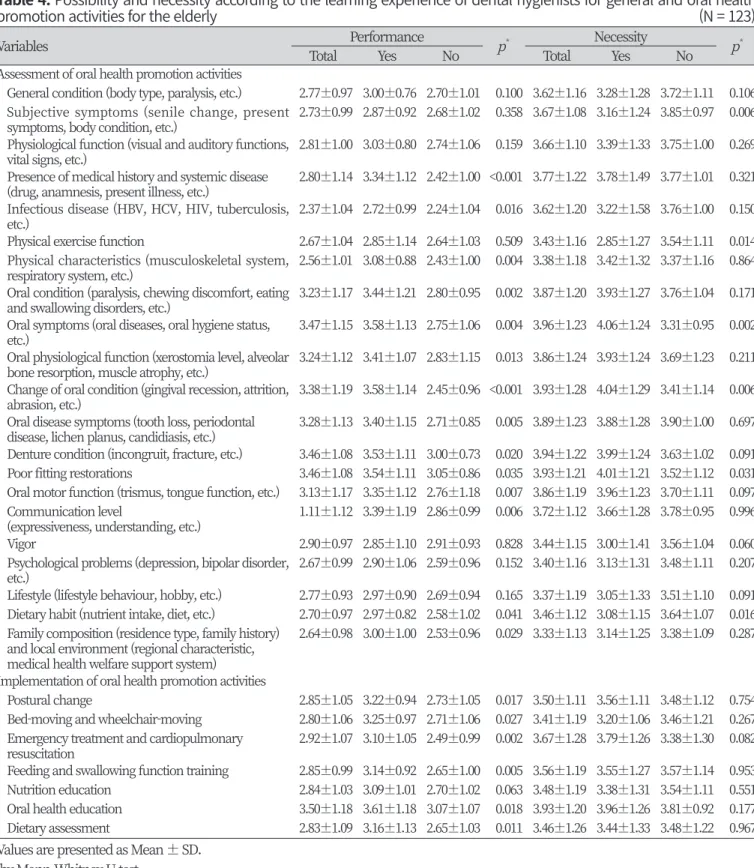
노인 대상의 전신 및 구강건강증진 활동 사정 항목에 대한 치과위생사의 학습경험에 따른 수행가능성 및 필요성에 대해 확인한 결과, 병력 및 전신질환 유무, 감염증 유무, 신체적특성, 구강상태, 구강자각증상, 구강 생리적기능, 구강질환 증상, 의치관리, 구강 운동기능, 의사소통, 가족구성 및 지역환경 항목들에 대 해서는 학습 경험자가 비경험자에 비해 수행가능성 정도가 통계적으로 유의하게 높게 나타났으며(p<0.05), 필요성에 대해서는 학습경험 유무에 상관없이 통계적으로 유의한 차이가 없는 것으로 나타났다. 구강자각 증상, 구강변화, 불량수복물에 대한 사정 항목은 학습 경험자가 비경험자에 비해 수행가능성 정도와 필요 성 모두 통계적으로 유의하게 높게 나타났다.
수행 항목에 대한 수행가능성 및 필요성은, 식이지도 항목을 제외한 모든 수행 항목에서 수행가능성 정 도는 통계적을 유의하게 높게 나타났으며(p<0.05), 필요성은 학습경험 유무에 상관없이 통계적으로 유의 한 차이가 없는 것으로 나타났다<Table 4>.
5. 노인 대상의 전신 및 구강건강증진 활동 항목에 대한 치과위생사의 수행경험에 따른 수행가능성 및 필요성
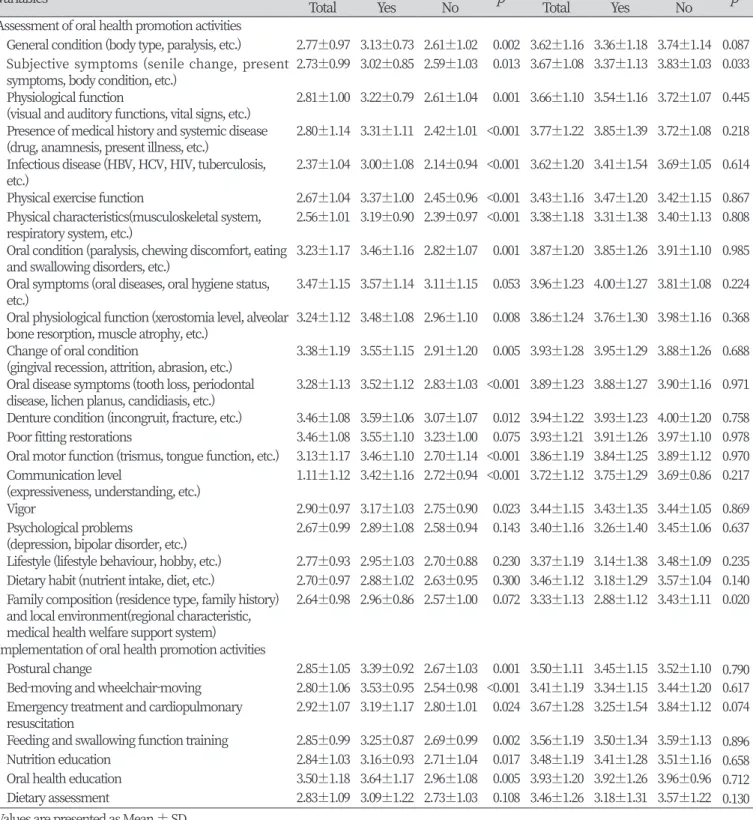
노인 대상의 전신 및 구강건강증진 활동 사정 항목에 대한 치과위생사의 수행경험에 따른 수행가능성 및 필요성에 대해 확인한 결과, 전신적상태, 생리적기능, 병력 및 전신질환의 유무, 감염증 유무, 신체운동 기능, 신체적특성, 구강상태, 구강 생리적기능, 구걍변화, 구강질환 증상, 의치관리, 구강 운동기능, 의사소 통, 기력 항목들에 대해서는 수행 경험자가 비경험자에 비해 수행가능성 정도가 통계적으로 유의하게 높 게 나타났으며(p<0.05), 필요성에 대해서는 수행경험 유무에 상관없이 통계적으로 유의한 차이가 없는 것 으로 나타났다.
노인 대상 전신 및 구강건강증진 활동 항목에 대한 치과위생사의 학습경험 및 수행경험에 따른 수행가 능성 정도는 수행 경험자가 비경험자에 비해 수행가능성 정도가 높게 나타났으며, 통계적으로 유의하게 높게 나타났다(p<0.05).
수행 항목에 대한 수행가능성 및 필요성은, 식이평가 항목을 제외한 모든 수행 항목에서 수행가능성 정 도는 통계적으로 유의하게 높게 나타났으며(p<0.05), 필요성은 수행경험 유무에 상관없이 통계적으로 유 의한 차이가 없는 것으로 나타났다<Table 5>.
Table 4. Possibility and necessity according to the learning experience of dental hygienists for general and oral health promotion activities for the elderly (N = 123)
Variables Total PerformanceYes No p* Total NecessityYes No p*
Assessment of oral health promotion activities
General condition (body type, paralysis, etc.) 2.77±0.97 3.00±0.76 2.70±1.01 0.100 3.62±1.16 3.28±1.28 3.72±1.11 0.106 Subjective symptoms (senile change, present
symptoms, body condition, etc.) 2.73±0.99 2.87±0.92 2.68±1.02 0.358 3.67±1.08 3.16±1.24 3.85±0.97 0.006 Physiological function (visual and auditory functions,
vital signs, etc.) 2.81±1.00 3.03±0.80 2.74±1.06 0.159 3.66±1.10 3.39±1.33 3.75±1.00 0.269 Presence of medical history and systemic disease
(drug, anamnesis, present illness, etc.) 2.80±1.14 3.34±1.12 2.42±1.00 <0.001 3.77±1.22 3.78±1.49 3.77±1.01 0.321 Infectious disease (HBV, HCV, HIV, tuberculosis,
etc.) 2.37±1.04 2.72±0.99 2.24±1.04 0.016 3.62±1.20 3.22±1.58 3.76±1.00 0.150
Physical exercise function 2.67±1.04 2.85±1.14 2.64±1.03 0.509 3.43±1.16 2.85±1.27 3.54±1.11 0.014 Physical characteristics (musculoskeletal system,
respiratory system, etc.) 2.56±1.01 3.08±0.88 2.43±1.00 0.004 3.38±1.18 3.42±1.32 3.37±1.16 0.864 Oral condition (paralysis, chewing discomfort, eating
and swallowing disorders, etc.) 3.23±1.17 3.44±1.21 2.80±0.95 0.002 3.87±1.20 3.93±1.27 3.76±1.04 0.171 Oral symptoms (oral diseases, oral hygiene status,
etc.) 3.47±1.15 3.58±1.13 2.75±1.06 0.004 3.96±1.23 4.06±1.24 3.31±0.95 0.002
Oral physiological function (xerostomia level, alveolar
bone resorption, muscle atrophy, etc.) 3.24±1.12 3.41±1.07 2.83±1.15 0.013 3.86±1.24 3.93±1.24 3.69±1.23 0.211 Change of oral condition (gingival recession, attrition,
abrasion, etc.) 3.38±1.19 3.58±1.14 2.45±0.96 <0.001 3.93±1.28 4.04±1.29 3.41±1.14 0.006 Oral disease symptoms (tooth loss, periodontal
disease, lichen planus, candidiasis, etc.) 3.28±1.13 3.40±1.15 2.71±0.85 0.005 3.89±1.23 3.88±1.28 3.90±1.00 0.697 Denture condition (incongruit, fracture, etc.) 3.46±1.08 3.53±1.11 3.00±0.73 0.020 3.94±1.22 3.99±1.24 3.63±1.02 0.091 Poor fitting restorations 3.46±1.08 3.54±1.11 3.05±0.86 0.035 3.93±1.21 4.01±1.21 3.52±1.12 0.031 Oral motor function (trismus, tongue function, etc.) 3.13±1.17 3.35±1.12 2.76±1.18 0.007 3.86±1.19 3.96±1.23 3.70±1.11 0.097 Communication level
(expressiveness, understanding, etc.) 1.11±1.12 3.39±1.19 2.86±0.99 0.006 3.72±1.12 3.66±1.28 3.78±0.95 0.996
Vigor 2.90±0.97 2.85±1.10 2.91±0.93 0.828 3.44±1.15 3.00±1.41 3.56±1.04 0.060
Psychological problems (depression, bipolar disorder,
etc.) 2.67±0.99 2.90±1.06 2.59±0.96 0.152 3.40±1.16 3.13±1.31 3.48±1.11 0.207
Lifestyle (lifestyle behaviour, hobby, etc.) 2.77±0.93 2.97±0.90 2.69±0.94 0.165 3.37±1.19 3.05±1.33 3.51±1.10 0.091 Dietary habit (nutrient intake, diet, etc.) 2.70±0.97 2.97±0.82 2.58±1.02 0.041 3.46±1.12 3.08±1.15 3.64±1.07 0.016 Family composition (residence type, family history)
and local environment (regional characteristic, medical health welfare support system)
2.64±0.98 3.00±1.00 2.53±0.96 0.029 3.33±1.13 3.14±1.25 3.38±1.09 0.287
Implementation of oral health promotion activities
Postural change 2.85±1.05 3.22±0.94 2.73±1.05 0.017 3.50±1.11 3.56±1.11 3.48±1.12 0.754 Bed-moving and wheelchair-moving 2.80±1.06 3.25±0.97 2.71±1.06 0.027 3.41±1.19 3.20±1.06 3.46±1.21 0.267 Emergency treatment and cardiopulmonary
resuscitation 2.92±1.07 3.10±1.05 2.49±0.99 0.002 3.67±1.28 3.79±1.26 3.38±1.30 0.082 Feeding and swallowing function training 2.85±0.99 3.14±0.92 2.65±1.00 0.005 3.56±1.19 3.55±1.27 3.57±1.14 0.953 Nutrition education 2.84±1.03 3.09±1.01 2.70±1.02 0.063 3.48±1.19 3.38±1.31 3.54±1.11 0.551 Oral health education 3.50±1.18 3.61±1.18 3.07±1.07 0.018 3.93±1.20 3.96±1.26 3.81±0.92 0.177 Dietary assessment 2.83±1.09 3.16±1.13 2.65±1.03 0.011 3.46±1.26 3.44±1.33 3.48±1.22 0.967 Values are presented as Mean ± SD.
*by Mann-Whitney U test
Table 5. Possibility and necessity according to dental hygienist’s performance experience in general and oral health promotion activities for the elderly (N = 123)
Variables Total Performance Yes No p* Total NecessityYes No p*
Assessment of oral health promotion activities
General condition (body type, paralysis, etc.) 2.77±0.97 3.13±0.73 2.61±1.02 0.002 3.62±1.16 3.36±1.18 3.74±1.14 0.087 Subjective symptoms (senile change, present
symptoms, body condition, etc.) 2.73±0.99 3.02±0.85 2.59±1.03 0.013 3.67±1.08 3.37±1.13 3.83±1.03 0.033 Physiological function
(visual and auditory functions, vital signs, etc.) 2.81±1.00 3.22±0.79 2.61±1.04 0.001 3.66±1.10 3.54±1.16 3.72±1.07 0.445 Presence of medical history and systemic disease
(drug, anamnesis, present illness, etc.) 2.80±1.14 3.31±1.11 2.42±1.01 <0.001 3.77±1.22 3.85±1.39 3.72±1.08 0.218 Infectious disease (HBV, HCV, HIV, tuberculosis,
etc.) 2.37±1.04 3.00±1.08 2.14±0.94 <0.001 3.62±1.20 3.41±1.54 3.69±1.05 0.614
Physical exercise function 2.67±1.04 3.37±1.00 2.45±0.96 <0.001 3.43±1.16 3.47±1.20 3.42±1.15 0.867 Physical characteristics(musculoskeletal system,
respiratory system, etc.) 2.56±1.01 3.19±0.90 2.39±0.97 <0.001 3.38±1.18 3.31±1.38 3.40±1.13 0.808 Oral condition (paralysis, chewing discomfort, eating
and swallowing disorders, etc.) 3.23±1.17 3.46±1.16 2.82±1.07 0.001 3.87±1.20 3.85±1.26 3.91±1.10 0.985 Oral symptoms (oral diseases, oral hygiene status,
etc.) 3.47±1.15 3.57±1.14 3.11±1.15 0.053 3.96±1.23 4.00±1.27 3.81±1.08 0.224
Oral physiological function (xerostomia level, alveolar
bone resorption, muscle atrophy, etc.) 3.24±1.12 3.48±1.08 2.96±1.10 0.008 3.86±1.24 3.76±1.30 3.98±1.16 0.368 Change of oral condition
(gingival recession, attrition, abrasion, etc.) 3.38±1.19 3.55±1.15 2.91±1.20 0.005 3.93±1.28 3.95±1.29 3.88±1.26 0.688 Oral disease symptoms (tooth loss, periodontal
disease, lichen planus, candidiasis, etc.) 3.28±1.13 3.52±1.12 2.83±1.03 <0.001 3.89±1.23 3.88±1.27 3.90±1.16 0.971 Denture condition (incongruit, fracture, etc.) 3.46±1.08 3.59±1.06 3.07±1.07 0.012 3.94±1.22 3.93±1.23 4.00±1.20 0.758 Poor fitting restorations 3.46±1.08 3.55±1.10 3.23±1.00 0.075 3.93±1.21 3.91±1.26 3.97±1.10 0.978 Oral motor function (trismus, tongue function, etc.) 3.13±1.17 3.46±1.10 2.70±1.14 <0.001 3.86±1.19 3.84±1.25 3.89±1.12 0.970 Communication level
(expressiveness, understanding, etc.) 1.11±1.12 3.42±1.16 2.72±0.94 <0.001 3.72±1.12 3.75±1.29 3.69±0.86 0.217
Vigor 2.90±0.97 3.17±1.03 2.75±0.90 0.023 3.44±1.15 3.43±1.35 3.44±1.05 0.869
Psychological problems
(depression, bipolar disorder, etc.) 2.67±0.99 2.89±1.08 2.58±0.94 0.143 3.40±1.16 3.26±1.40 3.45±1.06 0.637 Lifestyle (lifestyle behaviour, hobby, etc.) 2.77±0.93 2.95±1.03 2.70±0.88 0.230 3.37±1.19 3.14±1.38 3.48±1.09 0.235 Dietary habit (nutrient intake, diet, etc.) 2.70±0.97 2.88±1.02 2.63±0.95 0.300 3.46±1.12 3.18±1.29 3.57±1.04 0.140 Family composition (residence type, family history)
and local environment(regional characteristic, medical health welfare support system)
2.64±0.98 2.96±0.86 2.57±1.00 0.072 3.33±1.13 2.88±1.12 3.43±1.11 0.020
Implementation of oral health promotion activities
Postural change 2.85±1.05 3.39±0.92 2.67±1.03 0.001 3.50±1.11 3.45±1.15 3.52±1.10 0.790 Bed-moving and wheelchair-moving 2.80±1.06 3.53±0.95 2.54±0.98 <0.001 3.41±1.19 3.34±1.15 3.44±1.20 0.617 Emergency treatment and cardiopulmonary
resuscitation 2.92±1.07 3.19±1.17 2.80±1.01 0.024 3.67±1.28 3.25±1.54 3.84±1.12 0.074 Feeding and swallowing function training 2.85±0.99 3.25±0.87 2.69±0.99 0.002 3.56±1.19 3.50±1.34 3.59±1.13 0.896 Nutrition education 2.84±1.03 3.16±0.93 2.71±1.04 0.017 3.48±1.19 3.41±1.28 3.51±1.16 0.658 Oral health education 3.50±1.18 3.64±1.17 2.96±1.08 0.005 3.93±1.20 3.92±1.26 3.96±0.96 0.712 Dietary assessment 2.83±1.09 3.09±1.22 2.73±1.03 0.108 3.46±1.26 3.18±1.31 3.57±1.22 0.130 Values are presented as Mean ± SD.
*by Mann-Whitney U test
총괄 및 고안
노인의 전신 상태에 영향을 미치는 구강건강은 노년기 건강 관련 삶의 질을 결정하는데 중요한 요인이 다[19]. 노인은 생리적 노화를 겪게 되고 신체 운동력이 저하되어 일상생활을 혼자 수행하기 어려우며, 구 강위생능력 저하로 인해 치아우식증 및 치주질환과 같은 구강질환이 증가하여 치아상실율이 높다는 문제 점을 가지고 있다[20]. 또한 치매, 뇌졸중과 같은 만성질환과 함께 구강건강 문제에 노출되기 쉬운 문제가 있어 노인들의 적절한 구강관리를 위해서는 전문적인 지식과 기술을 갖춘 치과위생사의 역할이 중요하다.
치과위생사는 노인의 구강건강 향상을 위한 구강보건서비스를 제공하기 위해 노인의 특성에 대한 이해와 전문적인 지식이 필요하며, 질 높은 구강건강관리를 수행하기 위한 치과위생사의 역량 향상과 이를 위해 지속적으로 교육과 노력이 필요하다. 이에 노인 대상의 구강건강증진 활동에 대한 치과위생사의 인식을 조사하여 치과위생사 인력 양성의 효율적인 방안을 모색하고 전문적인 구강의료서비스 제공을 위한 기초 자료를 제공하고자 한다.
노인 대상의 전신 및 구강건강증진 활동 사정 항목에 대한 치과위생사의 학습경험은 보건소 치과위생 사와 임상 치과위생사 모두 구강자각증상이 각 85.9%, 89.5%, 의치관리가 각 84.7%, 89.5%로 학습경험율 이 높게 나타났으며, 수행 항목에서는 구강보건교육이 각 80.0%, 73.7%로 가장 높게 나타났다. 형[21]의 연구에서도 치과위생사가 노인에게 구강보건교육 경험 비율이 41.6%로 다른 구강관리 항목에 비해 경험 이 높게 나타나 본 연구와 비슷한 결과를 보였다. 이 등[22]의 연구에서도 노인의 구강관리와 학습에 대한 필요성이 67.8%로 나타나 학습경험에 대한 중요성을 강조하였으며 노인의 구강관리를 위한 심화 교육 필 요성을 주장한 바 있다. 장과 박[23]의 연구에서는 노인의 구강건강 증진을 위해서는 의치관리 교육이 중 요하다고 주장한 바 있으며, 한[24]의 연구에서는 노인요양시설 노인을 위한 구강건강서비스로 구강검진 및 구강위생관리, 틀니조정 및 수리를 제안한 바 있다. 노인의 구강 관리 시 생리적·심리적 기능의 감퇴, 만 성질환 같은 다양한 전신적 문제를 가지고 있는 노인의 특성을 고려한 구강건강서비스를 제공하기 위해서 는 전문화된 치과위생사의 교육이 필요하겠으며, 이를 위해서는 노인치위생학 교과목 운영 활성화 및 교 육과정 개설과 같은 방안이 마련되어야 할 것으로 사료된다.
노인 대상의 전신 및 구강건강증진 활동 사정 항목에 대한 치과위생사의 수행경험은 보건소 치과위생 사와 임상 치과위생사 모두 의치관리가 각 77.6%, 73.7%, 구강변화가 각 75.3%, 71.1%로 수행경험율이 높게 나타났으며, 수행 항목에서는 구강보건교육이 각 87.1%, 60.5%로 가장 높게 나타났다. 신[25]은 구 강보건교육이 노인의 구강관리 습관 개선 및 구강질환 예방을 위해 중요하다고 주장한 바 있으며, 김[26]
은 구강건강증진을 위해서는 예방적 행위 및 보건교육과 같은 의료행태가 중요하다고 강조한 바 있다. 치 과위생사는 노인 구강건강관리를 위한 전문 치과의료인으로서 심신의 상태가 다른 연령층에 비해 미약한 노인의 예방적 관리를 위해서는 노인 전문 구강위생관리 매뉴얼이 개발될 필요가 있겠으며, 치과위생사 의 역량 강화를 위한 실무적 프로그램 마련이 필요할 것으로 사료된다.
노인 대상의 전신 및 구강건강증진 활동 항목에 대한 치과위생사의 학습경험에 따른 수행가능성과 필 요성은 대부분의 항목에서 학습 경험자가 비경험자에 비해 수행가능성 정도가 통계적으로 유의하게 높게 나타났으며(p<0.05), 필요성에 대해서는 학습유무에 상관없이 통계적으로 유의한 차이가 없는 것으로 나 타났다. 최 등[27]의 연구에서는 구강건강관리 지식이 높을수록 구강건강관리 수행도가 높게 나타나 본 연 구와 유사한 결과를 보였다. 김[28] 등의 연구에서는 구강보건교육 경험이 높을수록 필요성이 높게 나타나
노인 대상의 전신 및 구강건강증진 활동 항목에 대한 치과위생사의 수행경험에 따른 수행가능성과 필 요성은 대부분의 항목에서 수행 경험자가 비경험자에 비해 수행가능성 정도가 통계적으로 유의하게 높게 나타났으며(p<0.05), 필요성에 대해서는 수행경험 유무에 상관없이 통계적으로 유의한 차이가 없는 것으 로 나타났다. 고와 김[29]의 연구에서는 다양한 전신적 문제를 지닌 노인의 구강건강관리를 위해서는 일상 적 구강관리가 아닌 전문적 구강위생관리를 위한 방법과 필요성을 강조했으며, 김 등[30]은 전문치과위생 사는 뛰어난 기술과 지식, 경험을 갖추어야 한다고 주장하였다. 치과위생사는 노인의 구강관리를 위한 전 문인력으로서 노인의 특성을 고려한 다양한 항목의 서비스를 제공할 수 있도록 교육한다면 더욱 효과적 인 인력으로 활용할 수 있을 것이다. 이룰 위해서는 구강보건지식 뿐만 아니라 경험이 필요하며 전문적인 관리를 위한 실습 프로그램의 개발 및 실습 위주의 보수교육 내용 개선이 필요할 것으로 생각된다.
본 연구는 서울·경기 일부 지역의 치과위생사 및 일부 보건소 치과위생사들을 대상으로만 연구하였다 는 점에서 우리나라 전체 치과위생사의 의견에 대해 일반화하기 어려우나 구강건강증진 활동에 대한 보 건소 및 임상 치과위생사의 의견을 확인하였고, 이를 통해 양질의 구강보건서비스를 제공하기 위한 치과 위생사 인력의 효율적인 방안을 확인하였다는 점에서 의의가 있다. 향후 노인의 구강건강 관리를 위한 전 문인력 양성 및 노인요양시설의 구강보건교육 활성화 및 치과위생사 의무배치를 위한 기초자료로 활용될 수 있을 것으로 기대하며, 구강건강증진 활동 항목에 대한 적용에 의한 노인의 구강건강증진 효과 확인 및 평가 등에 대한 연구가 이루어져야 할 것으로 생각된다.
결론
본 연구는 사회적 변화에 따라 급격하게 증가하고 있는 노인의 구강건강증진 및 효율적인 구강관리를 위해 노인 구강건강증진 활동에 대한 보건소 치과위생사와 임상 치과위생사의 인식을 조사하고자 하였으 며, 다음과 같은 결과를 얻었다.
1. 노인 대상의 전신 및 구강건강증진 활동 사정 항목에 대한 치과위생사의 학습경험은 보건소 치과위 생사와 임상 치과위생사 모두 구강자각증상이 85.9%, 89.5%, 의치관리가 각 77.6%, 73.7%로 학습경험율 이 높게 나타났으며, 수행 항목에서는 구강보건교육이 각 80.0%, 73.7%로 가장 높게 나타났다.
2. 노인 대상의 전신 및 구강건강증진 활동 사정 항목에 대한 치과위생사의 수행경험은 보건소 치과위 생사와 임상 치과위생사 모두 의치관리가 각 77.6%, 73.7%, 구강변화가 각 75.3%, 71.1%로 수행경험율이 높게 나타났으며, 수행 항목에서는 구강보건교육이 각 87.1%, 60.5%로 가장 높게 나타났다.
3. 노인 대상의 전신 및 구강건강증진 활동 항목에 대한 치과위생사의 학습경험에 따른 수행가능성과 필 요성은 대부분의 항목에서 학습 경험자가 비경험자에 비해 수행가능성 정도가 통계적으로 유의하게 높게 나타났으며(p<0.05), 필요성에 대해서는 학습유무에 상관없이 통계적으로 유의한 차이가 없는 것으로 나 타났다.
4. 노인 대상의 전신 및 구강건강증진 활동 항목에 대한 치과위생사의 수행경험에 따른 수행가능성과 필 요성은 대부분의 항목에서 수행 경험자가 비경험자에 비해 수행가능성 정도가 통계적으로 유의하게 높게 나타났으며(p<0.05), 필요성에 대해서는 수행경험 유무에 상관없이 통계적으로 유의한 차이가 없는 것으 로 나타났다.
급속한 고령화 현상에 따른 노인 인구의 구강건강관리를 위해서는 치과위생사의 전문적인 지식 및 수행 능력이 요구되고 구강건강증진 활동 항목들에 대한 교육과정 운영 및 실습 위주의 교육이 필요할 것으로 생각된다. 치과위생사의 보수교육을 통해 지속적 교육과 실제로 이러한 구강건강증진 활동 항목들이 임상 에서 수행될 수 있도록 제도적 환경이 마련되어야할 것이다.
Conflict of Interest
The authors declared no conflicts of interest.
Authorship
Conceptualization: GI Song, SM Bae, SJ Shin, BM Shin; Data collection: GI Song; Formal analysis:
SH Yoo, GI Song; Writing - original draft: GI Song; Writing - review & editing: SM Bae, BM Shin, SJ Shin, SH Yoo
References
[1] Statistics Korea. United Nations. World population prospects 2019 highlights[Internet]. Statisitcs Korea.[cited 2021 June 17]. Available from: http://kostat.go.kr/portal/korea/kor_nw/1/1/index.board?
bmode=read&aSeq=377226.
[2] OECD. Sizing Up the challenge ahead[Internet]. Sizing up the challenge ahead: Future demographic trends and long-term care costs; 2011.[cited 2021 June 18]. Available from: http://www.oecd.org/
general/searchresults/?q=Sizing up the challenge ahead&cx=012432601748511391518:xzeadub0b0a&
cof=FORID:11&ie=UTF-8.
[3] Statistics Korea. Population and housing census. 2019 Future population special estimation. [Internet].
Statisitcs Korea.[cited 2021 June 17]. Available from: http://kosis.kr/index/index.do.
[4] Statistics Korea. Korean national health and nutrition survey [Internet]. Korea centers for disease control and prevention; 2019.[cited 2021 July 09]. Available from: http://knhanes.kdca.go.kr/knhanes/
sub04/sub04_04_01.do.
[5] Jun MJ, Ruy SY. Oral health and behavior by tooth loss : The sixth Korea national health and nutrition examination survey. J Korea Entertain Ind Assoc 2016;10(5):259-68.
[6] Wayler AH, Chauncey HH. Impact of complete dentures and impaired natural dentition on masticatory performance and food choice in healthy aging men. J Prosthet Dent 1983;49(3):427-33. https://doi.o rg/10.1016/0022-3913(83)90289-5
[7] Lee HO, Kim J. Effects of elders’ oral health beliefs and oral health behaviors on their quality of Life. J Dent Hyg Sci 2008;8(2):57-63.
[8] Baek DH. Public oral health. 3rd ed. Seoul: Komunsa; Public oral health materials development committee; 2014: 2-28.
[9] Park JR, Kwon SH. A study on the dental hygienist’s awareness on the elderly long-term care insurance system. J Dent Hyg Sci 2009;9(3):279-86.
[10] Kim IS, Oh JS. Seoul: Komunsa; Oral health education; 2002: 9-36.
[11] Lee YS, Lee HJ. Relationship between oral health status and health related quality of life in elderly people living in long-term care facilities. J Korean Oral Health Sci 2020;8(1):66-72. https://
doi.org/10.33615/jkohs.2020.8.1.66
[12] Park JR, Kwon SH. Elderly convalescence facility workers’ knowledge about oral health and subjective oral health care is the degree of the elderly. J Dent Hyg Sci 2010;10(6):425-30.
[13] Lee JH, Kim YS, Yoon YJ. Awareness according to experience of oral health care for elderly patients in dental hygienists. J Korean Dent Hyg Sci 2015;17(3):151-9.
[15] Park MS, Nam YS. A comparative study on elderly welfare system between Korea and Japan. Journal Eurasian Studies 2010;7(1):301-18.
[16] Nam YO, Yoo JH. Education, certification system and extent of duty in dental hygienists of developed countries. J Korean Soc Dent Hyg 2014;14(4):453-62. https://doi.org/10.13065/jksdh.2014.14.04.453 [17] Kang BW, Kim NH, Park JR, Lee HS, Jang JH, Jung JY, et al. Geriatric dental hygiene. 1st ed. Seoul:
Koonja; 2012: 1-211.
[18] Park MS, Kim SL, Kim JA, Jung JA, Kwon SJ, Kwon HS, et al. Geriatric dental hygiene. 1st ed. Seoul:
Dhpub; 2012: 1-211.
[19] Kwoun JH, Lee SK. The relationship between chewing ability and nutritional intake status in the elderly of rural community. Korean J Community Nutr 1998;3(4):583-93.
[20] Michelle MM, Calabrese JM. Oral health and nutrition in the elderly. Nutr Clin Care 2001;4(1):34-42.
https://doi.org/10.1046/j.1523-5408.2001.00109.x
[21] Hyeong JH. A study regarding awareness of dental hygienists for elder’s dental health[Master’s thesis].
Jeonju: Univ. of Jeonbuk National, 2012.
[22] Lee JH, Kim YS, Yoon YJ. Awareness according to experience of oral health care for elderly patients in dental hygienists. J Korean Soc Dent Hyg 2015;17(3):151-9.
[23] Jang IS, Park S. The effect of denture care skills education program on denture self-care, denture satisfaction and oral health-related quality of Life (OHIP-14) among the elderly. J Korean Biol Nurs Sci 2016;18(4):239-46. https://doi.org/10.7586/jkbns.2016.18.4.239
[24] Han DH, Kim NH, Ko SM, Kwak JM, So JS, Lee SK, et al. A study for the introduction of dental outsourcing in elderly care facilities. J Korean Dent Assoc 2015;53(10):688-95.
[25] Shin SM. A study on the oral health education experiences and need of the elderly[Master’s thesis].
Yongin: Univ. of Dankook, 2010.
[26] Kim MJ. Related factors to perception and practice for oral health among patients visiting dental clinics[Master’s thesis]. Gimhae :Univ. of Inje, 2010.
[27] Choi SE, Han MA, Park J, Ryu SY. Performance of elderly oral health management and related factors among care workers in long-term-care hospitals. J Korean Soc Dent Hyg 2017;17(5):791-803. https://
doi.org/10.13065/jksdh.2017.17.05.791
[28] Kim GU, Kim JH. A study on the knowledge and awareness of care workers on the geriatric oral health.
Journal of the Korea Convergence Society 2015;6(6):9-15. https://doi.org/10.15207/JKCS.2015.6.6.009 [29] Ko SM, Lim SR. Oral hygiene care for elderly in care facility. JKDA 2015;53(10):678-87.
[30] Kim CH, Lee SM, Kim HM. Proposal for the introduction of a Korean-style professional dental hygienist system. Changwon: Korean association of dental hygiene professors; 2019: 93-103.