• 검색 결과가 없습니다.

Accuracy evaluation of near-surface air temperature from ERA-Interim reanalysis and satellite-based data according to elevation

N/A
N/A
Protected

Academic year: 2021

Share "Accuracy evaluation of near-surface air temperature from ERA-Interim reanalysis and satellite-based data according to elevation"

Copied!
6
0
0

로드 중.... (전체 텍스트 보기)

전체 글

(1)

1. Introduction

The near-surface air temperature (Ta), that was defined as temperature of 2m above from the ground of meteorological stations, is one of useful variables in

various research fields such as meteorology, climatology, and hydrology (e.g. Wenbin et al., 2013).

Ta is conventionally observed at meteorological stations with high accuracy (Stisen et al., 2007), but these point data cannot consider variation by space

Accuracy evaluation of near-surface air temperature from ERA-Interim reanalysis and satellite-based

data according to elevation

Jae-Hyun Ryu, Kyung-Soo Han

and Eun-Bin Park

Department of Spatial Information Engineering, Pukyong National University

Abstract : In order to spatially interpolate the near-surface temperature (Ta) values, satellite and reanalysis methods were used from previous studies. Accuracy of reanalysis Ta was generally better than that of satellite- based Ta, but spatial resolution of reanalysis Ta was large to use at local scale studies. Our purpose is to evaluate accuracy of reanalysis Ta and satellite-based Ta according to elevation from April 2011 to March 2012 in Northeast Asia that includes various topographic features. In this study, we used reanalysis data that is ERA- Interim produced by European Centre for Medium-Range Weather Forecasts (ECMWF), and estimated satellite-based Ta using Digital Elevation Meter (DEM), Normalized Difference Vegetation Index (NDVI), difference between brightness temperature of 11 μm and 12μm, and Land Surface Temperature (LST) data.

The DEM data was used as auxiliary data, and observed Ta at 470 meteorological stations was used in order to evaluate accuracy. We confirmed that the accuracy of satellite-based Ta was less accurate than that of ERA- Interim Ta for total data. Results of analyzing according to elevation that was divided nine cases, ERA-Interim Ta showed higher accurate than satellite-based Ta at the low elevation (less than 500 m). However, satellite- based Ta was more accurate than ERA-Interim Ta at the higher elevation from 500 to 3500 m. Also, the width of the upper and lower quartile appeared largely from 2500 to 3500 m. It is clear from these results that ERA- Interim Ta do not consider elevation because of large spatial resolution. Therefore, satellite-based Ta was more effective than ERA-Interim Ta in the regions that is range from 500 m to 3500 m, and satellite-based Ta was recommended at a region of above 2500 m.

Key Words : near-surface air temperature, ERA-Interim, elevation

Received October 18, 2013; Revised November 8, 2013; Accepted November 20, 2013.

Corresponding Author: Kyung-Soo Han ([email protected])

This is an Open-Access article distributed under the terms of the Creative Commons Attribution Non-Commercial License

(http://creativecommons. org/licenses/by-nc/3.0) which permits unrestricted non-commercial use, distribution, and reproduction in

any medium, provided the original work is properly cited

(2)

(Prihodko and Goward, 1997; Wenbin et al., 2013). A lot of studies about spatial interpolation for Ta have been attempted. Reanalysis and satellite are representative methods in order to spatially interpolate Ta values. Reanalysis Ta data, such as ERA-Interim of European Centre for Medium-Range Weather Forecasts (ECMWF), Climatic Research Unit (CRU), and National Centers for Environmental Prediction/

National Center for Atmospheric Research (NCEP/

NCAR), have been produced. In the previous studies, satellite-based Ta was estimated through empirical and physical method (Prihodko and Goward, 1997;

Cresswell et al., 1999; Stisen et al., 2007; Yan et al., 2009; Wenbin et al., 2013). Satellite-based Ta has commonly lower accuracy than reanalysis Ta data.

However, reanalysis Ta data have high bias from complex topography and high local elevation (Zhao et al., 2008). Relatively large spatial resolution of reanalysis data can be caused high error values, because Ta is affected by topography (e.g. elevation). In the previous studies, relation of Ta and elevation was analyzed. Ta decreases approximately from 0.55 ℃ to 0.60 ℃ per 100 m of elevation change (Rolland, 2003;

Frauenfeld et al., 2005). You et al. (2010) showed that relationship of elevation, Ta trend magnitude, and mean Ta. Han et al. (2005) estimated Ta considering Digital Elevation Meter (DEM) that is related to the moist adiabatic lapse rate.

Our main objective in this study are to perform accuracy evaluation of analysis Ta and satellite-based Ta data according to variance of elevation. We analyzed data quality of analysis Ta and satellite-based Ta data in order to evaluate accuracy according to elevation, and presented optimal elevation threshold of Ta data for reanalysis Ta and satellite-based Ta data.

2. Data & Method

The study area was set to the Northeast Asia region

(Fig. 1). This region included the Taebaek mountains in the Korean Peninsula, Nushan mountains, Taihang mountains in the China, and Kiso mountains in Japan.

Observed Ta data from the 64 Korea Meteorological

Administration (KMA) and the 406 Global

Telecommunication System (GTS) were used to

evaluate accuracy of reanalysis Ta and satellite Ta. Data

of midday and 15:00 local time were used in order to

match with satellite-based Ta data and reanalysis Ta

data from April 2011 to March 2012. The satellite-

based Ta was estimated using the Communication,

Ocean and Meteorological Satellite (COMS) satellite

and the Systeme Pour l’Observation de la (SPOT)

satellite data. The methodology was considered

moisture conditions of surface and atmosphere, and

was applied for weighting function for estimating

satellite-based Ta (Kim and Han, 2013). This satellite-

based algorithm estimated midday Ta, and spatial

resolution of satellite-based Ta is 1 km. ERA-Interim

reanalysis data at 15:00 local time was used instead of

NCEP/NCAR, because NCEP is less reliable than

ERA-40 which is previous versions of ERA-Interim

(You et al., 2010). The ERA-Interim reanalysis near-

surface air temperature (ERA-Interim Ta) data was

provided every 6 hours based on UTC. The ERA-

Interim Ta was calculated using a bilinear interpolation

method (Simmons et al., 2004), and spatial resolution

of ERA-Interim Ta data is 0.75 degree. To determine

Fig. 1. Study region in Northeast Asia. The squares mean GTS

meteorological stations, and the circles mean KMA

meteorological stations.

(3)

elevation, DEM from United States Geological Survey (USGS) was used in Northeast Asia. In this study, USGS 30 ARC-second global elevation data (GTOPO30) was used as auxiliary data. GTOPO30 was retrieved from eight sources of elevation information that consist of raster and vector data (Harding et al., 1999).

Satellite-based Ta was estimated as following equation 1:

Ta

k

= a

k

·DEM + b

k

·NDVI + c

k

·(BT

11

_ BT

12

) + d

k

·LST + e

k

(1) where unit of DEM is m, and Normalized Difference Vegetation Index (NDVI) is vegetation index. BT

11

and BT

12

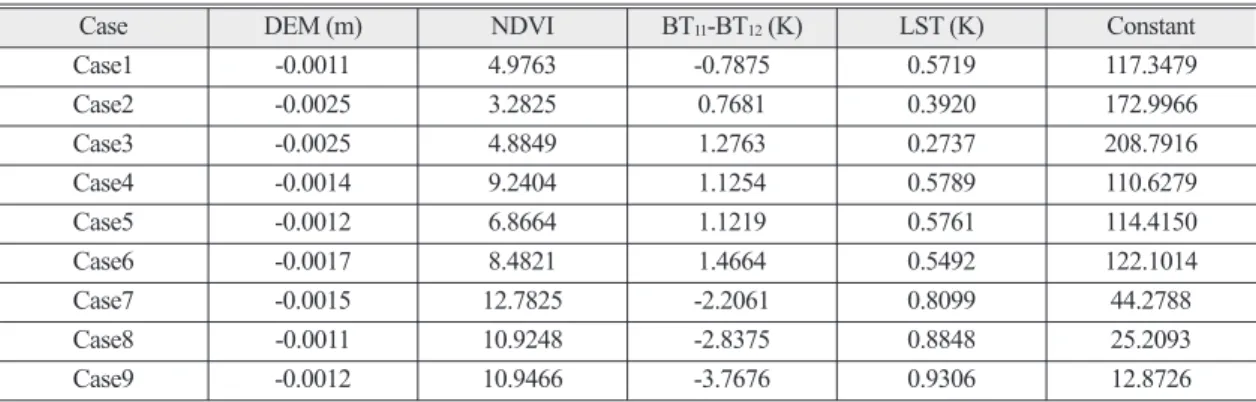
means brightness temperature of 11μm and 12μm from COMS satellite, unit of those is degrees Kelvin (K), and unit of LST is degrees Kelvin (K). Table 1 showed coefficients for variables. According to elevation data, we were divided into nine cases to evaluate effects of elevation for ERA-Interim and satellite Ta. The elevation was separated as follows: 0

~ 500 m, 500 ~ 1000 m, 1000 ~ 1500 m, 1500 ~ 2000 m, 2000 ~ 2500 m, 2500 ~ 3000 m, 3000 ~ 3500 m, 3500 ~ 4000 m, and more than 4000 m.

3. Results

Standard Deviation (SD) of elevation was computed based on spatial resolution of ERA data. SD of

elevation was distributed within 300 m in general (Fig.

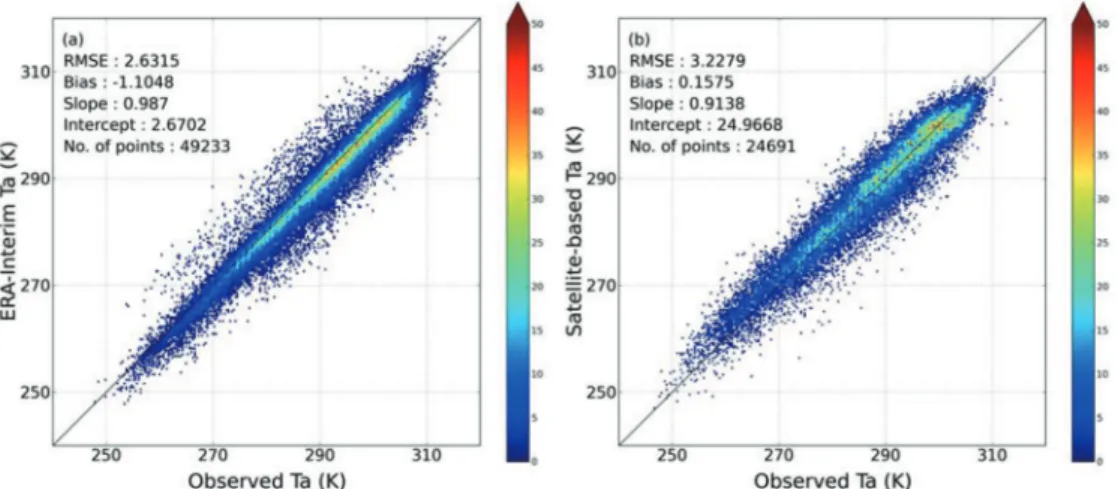
2). Mean value of SD was 177.97 m, and median value of SD was 149.58 m in Northeast Asia. We estimated satellite-based midday Ta using various variables, and evaluated accuracy of ERA-Interim Ta and satellite- based Ta. The validation results of the accuracy for ERA-Interim Ta and satellite-based Ta using meteorological station data were shown in Fig. 3. The determinant coefficient for between observed Ta and ERA-Interim Ta was 0.9582, and determinant coefficient for between observed Ta and satellite-based Ta was 0.9289. The RMSE was 2.6315 K, and bias was -1.1048 K from ERA-Interim Ta (Fig. 3a), and the RMSE was 3.2279 K, and bias was 0.1575 K from satellite-based Ta (Fig. 3b). The slope of ERA-Interim Ta was close to 1 than the slope of satellite-based Ta, and the intercept of ERA-Interim Ta was close to 0 than the intercept of satellite-based Ta.

Table 1. Coefficient of variables for each case

Case DEM (m) NDVI BT

11

-BT

12

(K) LST (K) Constant

Case1 -0.0011 4.9763 -0.7875 0.5719 117.3479

Case2 -0.0025 3.2825 0.7681 0.3920 172.9966

Case3 -0.0025 4.8849 1.2763 0.2737 208.7916

Case4 -0.0014 9.2404 1.1254 0.5789 110.6279

Case5 -0.0012 6.8664 1.1219 0.5761 114.4150

Case6 -0.0017 8.4821 1.4664 0.5492 122.1014

Case7 -0.0015 12.7825 -2.2061 0.8099 44.2788

Case8 -0.0011 10.9248 -2.8375 0.8848 25.2093

Case9 -0.0012 10.9466 -3.7676 0.9306 12.8726

Fig. 2. Standard deviation distribution of elevation based on

spatial resolution of ERA data.

(4)

The distribution for accuracy of classified Ta data depending on elevation was shown in Fig. 4. Low elevation from 0 to 500 m represented that ERA- Interim Ta was better than satellite-based Ta. However, elevation from 500 to 3500 m represented that satellite- based Ta was better than ERA-Interim Ta. ERA- Interim Ta and satellite-based Ta were analyzed depending on elevation (Fig. 5). ERA-Interim Ta had box plot of irregular size from more than 2500 m (Fig.

5a). The upper and lower quartile, and the minimum values of ERA-Interim Ta were better than that of satellite-based Ta within less than 2000 m, but median Fig. 4. RMSE of ERA-Interim Ta and satellite-based Ta

according to elevation.

Fig. 3. (a) scatter plot about correlation between observed Ta and ERA-Interim Ta, (b) scatter plot about correlation between observed Ta and satellite-based Ta.

Fig. 5. (a) box plot of difference between observed Ta and ERA-Interim Ta depending to elevation, (b) box plot of difference between

observed Ta and satellite-based Ta according to elevation.

(5)

values were largely located apart the zero point from more than 2500 m as follows: 2500 ~ 3000 m : -6.7212 K, 3000 ~ 3500 m : -3.0674 K, 3500 ~ 4000 m : - 2.2709 K, and more than 4000 m : -2.6420 K. The width of the upper and ERA-Interim quartile from 2500 to 3500 m was coarse. On the other hand, satellite- based Ta had box plot of constant range in all cases respectively (Fig. 5b). The maximum and minimum values for difference between observed Ta and satellite- based Ta were located from -10 to 10 K. Although median and mean values were located a little away from the zero point over 2500 m, the median values were a little as follows: 2500 ~ 3000 m : -1.1189 K, 3000 ~ 3500 m : -0.0625 K, 3500 ~ 4000 m : 2.2047 K, and more than 4000 m : 1.7150 K.

4. Discussion

Accuracy of satellite-based Ta and reanalysis Ta were evaluated according to elevation in Northeast Asia. RMSE, Bias, and intercept value of ERA-Interim data were better than that of satellite-based data. These results mean that the accuracy of ERA-Interim Ta was higher than the accuracy of satellite-based Ta, and the ERA-Interim Ta tends to underestimate trends of the ground truth like previous studies (Fauenfeld et al., 2005; You et al., 2010). However, the accuracy of ERA-Interim Ta and satellite-based Ta was different depending on the elevation. Error of ERA-Interim Ta was higher than that of satellite-based Ta from 500 ~ 3500 m. This result indicates that ERA-Interim Ta does not take higher elevation into account, because large spatial resolution of ERA-Interim data is large. When considering elevation of the study area, satellite-based Ta was better than ERA-Interim Ta from 56.12% of study area. Colombi et al. (2007) reported that satellite- based Ta was better than the Inverse Distance Weighting (IDW) interpolation method from region of high elevation (more than 2000 m). Therefore, satellite-

based Ta is more effective than ERA-Interim Ta at the region that is range from 500 to 3500 m, and the threshold of elevation for ERA-Interim Ta was established at the region of above 2500 m in the Northeast Asia. Further study is required to evaluate accuracy of satellite-based Ta and reanalysis data considering various climate factors such as wind speed, humidity.

Acknowledgment

This work was funded by the Korea Meteorological Administration Research and Development Program under Grant CATER 2012-2066.

References

Colombi, A., C.D. Michele, M. Pepe, and A. Rampini, 2007. Estimation of daily mean air temperature from MODIS LST in Alpine areas, EARSeL eProceedings, 6: 38-46.

Cresswell, M.P., A.P. Morse, M.C. Thomson, and S.J.

Connor, 1999. Estimating surface air temperature, from Meteosat land surface temperatures, using an empirical solar zenith angle model, International Journal of Remote Sensing, 20: 1125-1132.

Frauenfeld, O.W., T. Zhang, and M.C. Serreze, 2005.

Climate change and variability using European Centre for Medium-Range Weather Forecasts reanalysis (ERA-40) temperatures on the Tibetan Plateau, Journal of Geophysical Research, 110: D02101.

Han, K.S., A.A. Viau, Y.S. Kim, and J.L. Roujean,

2005. Statistical estimate of the hourly near-

surface air humidity in eastern Canada in

merging NOAA/AVHRR and GOES/IMAGER

observations, International Journal of Remote

(6)

Sensing, 26: 4763-4784.

Harding, D.J., D.B. Gesch, C.C. Carabajal, and S.B.

Luthcke, 1999. Application of the shuttle laser altimeter in an accuracy assessment of GTOPO30, a global 1-kilometer digital elevation model, International Archives of Photogrammetry and Remote Sensing, 32: 81- 85.

Kim, D.Y., and K.S. Han, 2012. Remotely sensed retrieval of midday air temperature considering atmospheric and surface moisture conditions, International Journal of Remote Sensing, 34:

247-263.

Prihodko, L., and S.N. Goward, 1997. Estimation of air temperature from remotely sensed surface observations, Remote Sensing of Environment, 60: 335-346.

Rolland, C., 2003. Spatial and seasonal variations of air temperature lapse rates in Alpine regions, Journal of Climate, 16: 1032-1046.

Simmons, A.J., P.D. Jones, V. da Costa Bechtold, A.C.M. Beljaars, P.W. Kallberg, S. Saarinen, S.M. Uppala, P. Viterbo, and N. Wedi, 2004.

Comparison of trends and low-frequency variability in CRU, ERA-40, and NCEP/

NCAR analyses of surface air temperature, Journal of Geophysical Research: Atmospheres (1984-2012), 109: D24115.

Stisen, S., I. Sandholt, A. Nørgaard, R. Fensholt, and L. Eklundh, 2007. Estimation of diurnal air temperature using MSG SEVIRI data in West Africa, Remote Sensing of Environment, 110:

262-274.

Wenbin, Z., L. Aifeng, J. Shaofeng, 2013. Estimation of daily maximum and minimum air temperature using MODIS land surface temperature products, Remote Sensing of Environment, 130: 62-73

Yan, H., J. Zhang, Y. Hou, and Y. He, 2009. Estimation of air temperature from MODIS data in east China, International Journal of Remote Sensing, 30: 6261-6275.

You, Q., S. Kang, N. Pepin, W.A. Flugel, Y. Yan, H.

Behrawan, and J. Huang, 2010. Relationship between temperature trend magnitude, elevation and mean temperature in the Tibetan Plateau from homogenized surface stations and reanalysis data, Global and Planetary Change, 71: 124-133.

Zhao, T., W. Guo, and C. Fu, 2008. Calibrating and

evaluating reanalysis surface temperature error

by topographic correction, Journal of Climate,

21: 1440-1446.

수치

Fig. 2.  Standard deviation distribution of elevation based on spatial resolution of ERA data.
Fig. 3.  (a) scatter plot about correlation between observed Ta and ERA-Interim Ta, (b) scatter plot about correlation between observed Ta and satellite-based Ta.

참조

관련 문서