JESK
http://jesk.or.kr eISSN:2093-8462Agricultural Labor Environment and Work Safety
Kyung-Suk Lee, Insoo Kim, Min-Tae Seo, Myungsun Ko, Kyung-Su Kim, Hye-Seon Chae, Dong-Phil Choi Rural Developmemt Administration, National Institute of Agricultural Sciences, Jeollabuk-do, 55365
Corresponding Author Insoo Kim
Rural Developmemt Administration, National Institute of Agricultural Sciences, Jeollabuk-do, 55365
Mobile : +82-10-6418-5998 Email : [email protected]
Received : March 17, 2016 Revised : April 25, 2016 Accepted : July 10, 2016
Objective:This study introduced the status of studies and the projects related with agricultural accident prevention carried out by the Rural Development Administration.
This study was conducted to promote Korean farmers' agricultural safety activation by analyzing study trends on farmers' agricultural work safety.
Background: Agriculture is one of the dangerous industries, and the agricultural accident rate is on the rise, due to recent serious aging and increased female work force. Such a phenomenon emerges as a serious problem from the social perspective, and therefore measures for farmers' healthy and safe agricultural activities and accident prevention are required.
Method: This study conducted literature review related with domestic and international agricultural safety and health. This study also examined the hazard factors of agricultural labor and injuries, agricultural safety and health system and policy, support and education for farmers' safety practice, and the status of convenience tools and protection equipment, based on major study activities performed by the Rural Development Administration for recent four to five years.
Results: Through the study results, the status of Korea's agricultural safety system, compensation support policy, safety education of farmers for actual practice, and diverse channels including media were confirmed. This study also presented the R&D implementation status on convenience equipment and protective gear to prevent agricultural diseases and safety accidents.
Conclusion: This study found out that continuous monitoring and efforts are required to prevent accidents for the Korea's agricultural labor environment and agricultural safety, and that social bond of sympathy formation is demanded through effect analysis on the implemented projects including education and support projects. Furthermore, it can be understood that agricultural accident prevention should be carried out through shift from current government-led top down approach to bottom-up approach from itself.
Application: The results of this study can be utilized as useful data for farmers' safety and health.
Keywords: Agricultural labor, Safety and health, Agricultural safety technology, Farmer's syndrome
Copyright@2016 by Ergonomics Society of Korea. All right reserved.
○ccThis is an open-access article distributed under the terms of the Creative Commons Attribution Non-Commercial License (http://
creativecommons.org/licenses/by-nc/3.0/), which permits unrestricted non-commercial use, distribution, and reproduction in any medium, provided the original work is properly cited.
1. Introduction
Since the industrial modernization, agricultural labor force outflow has deepened in Korea, and therefore agricultural technology has depended much on agricultural machines and materials including agricultural pesticides, which becomes a major factor increasing farmers' agricultural work-related injuries. Farmers' serious aging
and increasing trend of female farmers are reported to cause occupational diseases including musculoskeletal diseases, according to excessive labor burden and physical limitation (Ahn, 2001). In the period when agricultural mechanization was slow, farmer's syndrome was mainly raised as farmers' health problem (Nam et al., 1980; Moon et al., 1993). Farmer's syndrome is the mental and physical disorder symptoms revealed a lot to farmers, whose job is agricultural work. Farmer's syndrome was mentioned by Kumagai for the first time in 1943, and the study on farmer's syndrome in Korea started in the latter part of the 1970s. Although farmer's syndrome-positive cases' ratio shows difference according to survey area and research method, it is reported to be about 30~40% (Park and Kim, 2001). According to the study result of Lee et al. (2006), 37.0% of 1,233 agricultural workers in eight provinces in Korea were reported to have farmer's syndrome, and the situation is serious. Three to four items of the major symptoms of farmer's syndrome are reported to be related with musculoskeletal diseases, and the farmers exposed to long-term agricultural activities are also reported that wider gap is shown between two legs, and back is bent (Baek et al., 2008). Excessive agricultural activities, labor for long hours and inappropriate protective gear wearing are connected with unexpected agricultural safety accidents. Therefore, studies to improve inferior agricultural environment are needed.
The studies associated with agricultural work in Korea started gradually in the 2000s, and study on agricultural safety and health, guidance and education projects began to be expanded through agricultural safety model demonstration projects, centered on Rural Development Administration (RDA) from 2006, after the Special Act on the Quality of Life of Farmers, Fishermen and Forestry Employees was enacted in 2004. A study project to identify agricultural accident damages and causes (farmers' health level evaluation, exposure to harmful agricultural environment and status of safety accident) was carried out in 2006. A report on farmers' health level evaluation including farmer's syndrome and agricultural accident situation was published in 2007. Survey on the status of agricultural safety and health, and recognition on agricultural safety and health each year from 2006 to 2008 was performed. As part of establishing an agricultural labor accident prevention management system, various efforts including analysis on agricultural environment by kind of crop and accident causes, agricultural accident monitoring, statistics production on agricultural diseases and burns, and agricultural safety and health technology support are currently underway. As such, agricultural labor-related accident status and cause survey, system study for agricultural labor accident prevention and guarantee, educational materials development for farmers' agricultural behavioral change, field education to improve agricultural site's agricultural activities, and agricultural aiding tools and personal protective gear technologies are studied, centered on RDA, and the outcomes are diffused to agricultural sites.
This study presents the trends of recent studies carried out, centered on the RDA, and relevant projects. The results of this study are expected to be helpful to the identification of study trends for farmers' safety and health, and future agricultural safety study dissemination.
2. Agricultural Labor's Hazard Factors and Farmers' Injuries
According to International Labor Organization (ILO) (2016), ILO reports agriculture as one of the three hazard industries, and the fact that agriculture is no longer safe work is well known around the world. Regarding the Incidence rates (1) of nonfatal occupational injuries and illnesses by case type and ownership released in the U.S. in 2013, crop production showed 5.2%, animal production 6.2%, and support activities and forestry 6.0% out of total industry's mean injury rate, 3.1%, and thus nearly two times higher injuries were reported to occur, compared to other industries (B.L.S., 2014a).
Concerning the number and rate of fatal occupational injuries, agriculture, forestry and fishing were shown the highest, following construction, transportation and warehousing. Therefore, agriculture was confirmed to be dangerous industry (B.L.S., 2014b).
Compared to the fatal injuries of the U.S. and Europe, those of the agriculture, forestry and fishing workers were higher than other industries, and it was reported that the U.S. showed two times higher than Europe (Andy Kiersz, 2014).
According to the data surveyed by RDA in Korea in 2009, the work-related injury estimation rate of farmers who took a rest for four days and more was 3.2% (Chae et al., 2013). In the national health and nutrition survey carried out by Centers for Disease Control and Prevention as a sample survey, the work-related injury rate of the workers who took day off for four days and more was 1.7%, based on employees in Korea. When they were classified into occupation groups, the injury rate of workers in the agriculture, forestry and fishing industries including injuries of workers taking four days and less of day off was reported to be 4.1%. Farmers' injury estimation rate surveyed in 2011 was 3.0%, which implies that more than four times higher farmers' injuries occurred, compared to 0.7% of mean industrial accident compensation rate released by the Ministry of Employment and Labor (MOEL, 2012). The causes of such injuries include the use of agricultural machines and agricultural pesticides, and injuries by animals (Sprince et al., 2008). The hazard and harmful factors in agricultural work show different characteristics according to the kind of crop. Concerning rice cultivation, working posture (squatting, back bending) is the representative characteristic in the agricultural pesticides, ultraviolet rays, and field crops. Repetitive wrist use is the representative characteristic in the weight carrying and facility house, and working posture (upper-limb task) is the representative characteristic in the dust, thermal conditions and fruit trees.
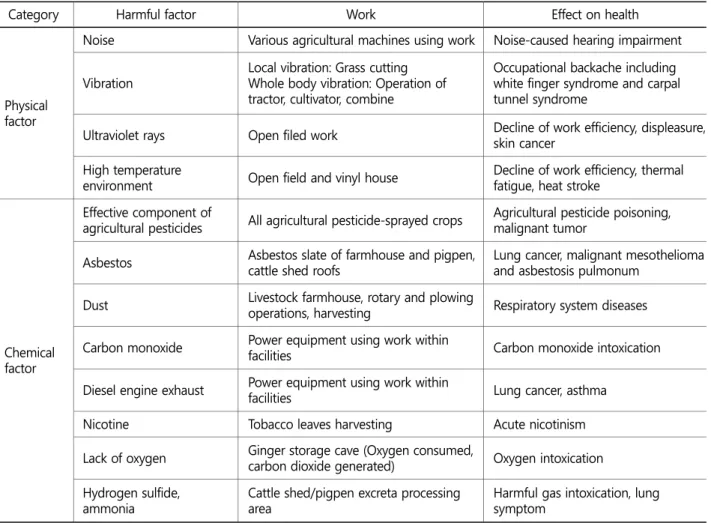
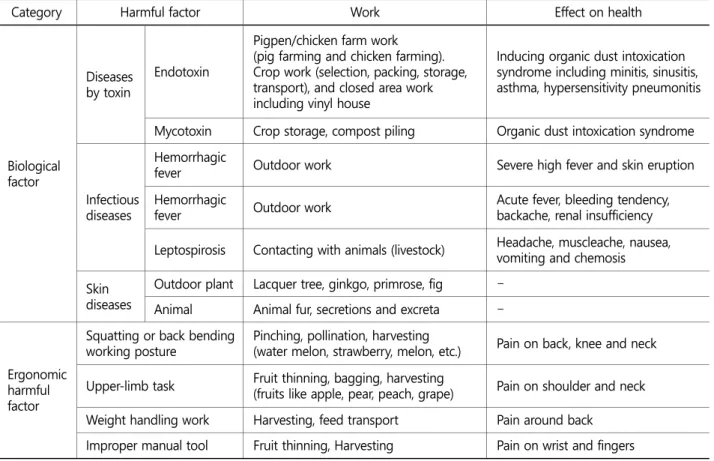
Organic dust, harmful gas and microorganisms are representative characteristics in the livestock industry. Upon looking at the hazard factors of agricultural labor environment that can affect farmers' diseases and injuries, they are reported as shown in Table 1 (RDA, 2012; Kwon et al., 2012).
Table 1. Agricultural hazard factors
Category Harmful factor Work Effect on health
Physical factor
Noise Various agricultural machines using work Noise-caused hearing impairment
Vibration Local vibration: Grass cutting Whole body vibration: Operation of tractor, cultivator, combine
Occupational backache including white finger syndrome and carpal tunnel syndrome
Ultraviolet rays Open filed work Decline of work efficiency, displeasure, skin cancer
High temperature
environment Open field and vinyl house Decline of work efficiency, thermal fatigue, heat stroke
Chemical factor
Effective component of
agricultural pesticides All agricultural pesticide-sprayed crops Agricultural pesticide poisoning, malignant tumor
Asbestos Asbestos slate of farmhouse and pigpen,
cattle shed roofs Lung cancer, malignant mesothelioma and asbestosis pulmonum
Dust Livestock farmhouse, rotary and plowing
operations, harvesting Respiratory system diseases Carbon monoxide Power equipment using work within
facilities Carbon monoxide intoxication
Diesel engine exhaust Power equipment using work within
facilities Lung cancer, asthma
Nicotine Tobacco leaves harvesting Acute nicotinism
Lack of oxygen Ginger storage cave (Oxygen consumed,
carbon dioxide generated) Oxygen intoxication Hydrogen sulfide,
ammonia Cattle shed/pigpen excreta processing
area Harmful gas intoxication, lung
symptom
According to recent RDA's work-related disease and injury statistical data on farmers and fishermen, farmers' work-related injury rate was 3.0% in 2013, and work-related disease prevalence was 5.0% in 2012, which were high. Regarding the work-related injury rates concerned with agricultural work, they were 3.5% in rice cultivation and fruits, 2.7% in field crops, 2.3% in livestock farming and 2.9% in facility farming in the order. As for the work-related disease prevalence, field crops (6.6%), rice cultivation (5.9%), fruits (5.8%), facility (3.0%) and livestock (1.1%) were shown in the order (RDA, 2013a, 2013b). Although there is slight differences according to kinds of crops in terms of Korea's agricultural accident situation, high accident rate has been shown, therefore countermeasures are urgent. The current farmhouse population declining trend, deepening aging (KOSTAT, 2014), and farmer labor force condition Table 1. Agricultural hazard factors (Continued)
Category Harmful factor Work Effect on health
Biological factor
Diseases by toxin
Endotoxin
Pigpen/chicken farm work (pig farming and chicken farming).
Crop work (selection, packing, storage, transport), and closed area work including vinyl house
Inducing organic dust intoxication syndrome including minitis, sinusitis, asthma, hypersensitivity pneumonitis
Mycotoxin Crop storage, compost piling Organic dust intoxication syndrome
Infectious diseases
Hemorrhagic
fever Outdoor work Severe high fever and skin eruption
Hemorrhagic
fever Outdoor work Acute fever, bleeding tendency,
backache, renal insufficiency Leptospirosis Contacting with animals (livestock) Headache, muscleache, nausea,
vomiting and chemosis Skin
diseases
Outdoor plant Lacquer tree, ginkgo, primrose, fig - Animal Animal fur, secretions and excreta -
Ergonomic harmful factor
Squatting or back bending
working posture Pinching, pollination, harvesting
(water melon, strawberry, melon, etc.) Pain on back, knee and neck Upper-limb task Fruit thinning, bagging, harvesting
(fruits like apple, pear, peach, grape) Pain on shoulder and neck Weight handling work Harvesting, feed transport Pain around back
Improper manual tool Fruit thinning, Harvesting Pain on wrist and fingers
Table 2. Research on agricultural work-related injuries and diseases
Researcher Year Project Details
RDA 2009~2013 Survey on agricultural work accident
status and causes Establishment and operation of agricultural safety accidents monitoring system RDA & Suwon
Univ. 2014~2018 Work-related accidents, national statistical quality improvement and management support
Design and quality control of farmers' work- related disease and injury survey
RDA & Suwon
Univ. 2014~2018 Effect factor analysis of agricultural work
related accidents Estimation of farmers' work-related disease and injury size and analysis on their characteristics
deterioration including the increase of female farmers influence farmers' health status (Lee et al., 2010). In Korea, most farmers are engaged in small-sized and combined agriculture, and thus they are exposed to the hazard factors mentioned above for the long- term. Studies to examine farmers' injuries and their correlation with work are carried out by RDA as shown in Table 2.
3. Agricultural Safety and Health System and Policy for Farmers' Productive Welfare Enhancement
During one's life cycle, maintaining and preserving healthy life and labor force by preventing diseases and accidents are very important at national competitiveness retention level, which can enormously contribute to national financial stabilization such as medical cost. The Korea Health Industry Development Institute devised differentiated national nutrition management measures, based on each life cycle period's demand in order to maintain overall national health level, tried to contribute to the establishment of customized welfare policy for people's life-long welfare, and intended to expand future growth engine through solving health gap according to income and region in 2010 (KHIDI, 2010). Currently, the Ministry of Public Safety and Security makes a plan for support of safety education by life cycle period. From such a context, active discussions are needed to expand industrial accident compensation insurance (IACI) by life cycle period so that all the people can be protected in life and workplaces from infant period to old age, and to solve dead zone. Although farmers, consisting of the biggest business type as an occupation group, and their families reach about 3 million, Korea's first social insurance system was introduced in 1864, and the insurance's subscription scope was expanded to the workplaces with one employee and more after July 2007. Therefore, currently workers in almost all workplaces have become the subjects of the IACI. However, the insurance targets legal workers, most farmers could not receive accident compensation in relation with agricultural work thus far.
In a study on the method to expand and apply the IACA, it reported that farmers can cause instability in life and poverty, due to disability, the suspension of income and death arising from agricultural accidents, which should not be ignored in view of the importance of agriculture as a food resource. In many countries, the insurance is especially applied to farmers, although the insurance is not applied to owner-operators like technicians or merchants (KLI, 2002). Upon looking into OECD countries, 18 countries make farmers subscribe obligatorily, taking up 40% of the total. Four countries let the farmers subscribe the IACI randomly, and eight countries (27%) exclude farmers as the subjects of the IACI (KLI, 2002). The workers who are the subjects of the IACI in Korea were 28.5% (based on the end of 2009). However, the insured of the IACI in Germany reached 92.6% (based on the end of 2008) of the total population, as the subjects of the IACI are comprehensive ones including pseudo workers, owner-operators, farmers, students, public servants and soldiers (Yoon, 2012).
Korea's institutional support implementation to prevent farmers' agricultural accidents is slightly late, compared with the developed countries. Concerning the German farmers' accident insurance, the Act on Accident Insurance and Medical Insurance for Employees of Agricultural, Forestry and Fishing Companies was enacted and executed in 1996. The Act was integrated into the Industrial Accident Compensation Insurance and executed in 1997, and all the farmers including owner-operator farmers are protected by the IACI. Korea laid the legal foundation for support of farmers' work-related accidents for the first time in 2004 by enacting the Promotion Act on the Quality of Life Improvement for Farmers, Forestry Workers and Fishermen and Agricultural, Mountainous and Fishing Villages Development on the part of the Ministry of Agriculture and Forestry. From 2005, Korea has been establishing the support system model for agricultural accident prevention and management, as well as recognition and competence improvement on farmers' agricultural safety management through agricultural safety demonstration village project for farmers' safety. The bill related with farmers' industrial accident compensation insurance was motioned starting from the representative motion to devise law for farmers' labor accident guarantee for the first time in 2007. The bill on the safety insurance and safety accident prevention of farmers and fishermen was presented in 2015, and the law was executed in January 2016. There were discussions for more effective execution on the Act on Safety Insurance and Safety Accident Prevention of Farmers and Fishermen. In a debate on the relevant law held in December 2015, the items taking on social insurance character including nursing allowances were included in the bill, since farmers' human accident compensation and prevention was included, and thus such a debate that more effective
benefits would be offered to the farmers, only if it is converted into social insurance mode gradually, was conducted (Kim, 2015a;
Kim, 2015b). In some debate, a problem of the bill's expansionary application, unlike gradual expansion of obligatory subscription- targeted business types and workplace size on the part of IACI that started as compulsory subscription type, was pointed out.
As such, the system and policy for farmers' welfare enhancement and safety and health for the past 20 years played an institutional role for farmers' quality of life and safety accident prevention of farmers and fishermen in large portion. Recently, the law on safety insurance and safety accident prevention of farmers and fishermen includes the details on prevention, as well as safety insurance, and thus, the foundation for practice in the agricultural safety and health sector is expected to be laid.
4. Education for Farmers' Safety Perception and Practice Activities Support
Recent interest in agricultural injuries and diseases and the system and policy support for agricultural safety and health are handled as the sustainable important area of farmers. Therefore, health and safety through accident prevention have become the basic factors of life. Although many and complex factors exist concerning the causes of safety accidents among agricultural accidents, the lack of safety awareness like insufficient safety education can be an important factor (Hong, 2014). The causes of accidents can be divided into physical, human and environmental factors, and safety factors account for more than 88% (Heinrich, 1980). Given that Korean farmers' agricultural accidents show higher occurrence rate than in the general industries, institutional support and management, in which safety awareness can be connected with safety practice activities, are required. Reconsideration of farmers' safety awareness and various educational programs on the agricultural safety that can be practiced are implemented. Upon looking at programs for preceding activities and support, the following are implemented: Agricultural safety model demonstration project, participatory action oriented program (PAOT), various online agricultural safety programs offering and cyber education and Korea Information Center of Agricultural Safety and Health activities, and recent agricultural safety and health education for those who return to agriculture, and female farmers.
The agricultural safety model demonstration project is a representative improvement project that has been implemented by RDA to solve farmers' health and safety problems in the agricultural sectors with relatively higher accident risks, compared with other business types since 2006. From 2006 to 2015, 8,147 farmers of 113 villages participate. Major details include agricultural basic safety management, agricultural pesticide poisoning prevention, basic safety sector through PAOT, agricultural environment improvement sector, and farmers' health managements sector including musculoskeletal disease prevention, education and exercise program.
According to the agricultural safety model demonstration project, the agricultural safety and health practice increase rate related with agricultural safety and health awareness and practice rose annually from 26.1% in 2011, 29.7% in 2012, 33.0% in 2013 and 36.5% in 2014, respectively (Roh et al., 2014). In light of the practice rate increase, continuous education is known to positively affect agricultural safety management awareness. Table 3 shows the status of agricultural safety model demonstration project areas and participants. PAOT is a method implementing safety and health plans through farmers becoming improvement's main player, such as agricultural improvement, best practice sharing, discussion and presentation (Kogi et al., 2003; Kawakami et al., 2009). In Korea PAOT was adopted in the industrial area from 2003, and has been applied to industrial safety sector (Yoon et al., 2005), and PAOT was implemented in each village from 2006 to 2008 (Kim et al., 2010). Education on agricultural work PAOT facilitators targeting agricultural safety project personnel, teaching aid development on Korean version PAOT for continuous agricultural work improvement activities, and study through actual application are carried out (Kim et al., 2010).
Since 2007, RDA has been offering various online agricultural safety programs through Korea Information Center of Agricultural Safety and Health (http://farmer.rda.go.kr). Online information offering has such a merit as overcoming time and place limitation in implementing education through agricultural work expert's visit, due to difficulty in taking education at a time, because of different growing period of each kind of crop, and rural village's geographic characteristics. According to the Website evaluation result of Korea Information Center of Agricultural Safety and Health by Lee et al. (2012), the number of connections was 5,641,793
(2011), which was surveyed to contribute to safety and health awareness level improvement, and the offered contents were in active form, and were insufficient in efficient safety awareness enhancement (Lee et al., 2012). In 2015, experience type and two- way contents were included through renewal, and a user experience-centered site was established. Main details are as follows:
Safety prevention management sector including agricultural work plan management, safety level diagnosis, ergonomic evaluation management, agricultural work safety management guidelines; health safety education sector including agricultural work safety experience program through cyber lecture room, agricultural work safety and health education, safety management education teaching aids; safety and health information sector including convenience equipment and protective gear information for safe and convenient agricultural activities, safety accident cases and health information offering; and research data and safety seminar data published by RDA. Through a safety experience program, one can undergo safe and health experiences on 13 items (water melon, cucumber, apple, tomato, rose, persimmon, potato, livestock, tobacco, rice, pepper, melon and grape). In addition, a variety of information, such as customized data for experts and multiculture, safety accident cases, health and safety education, agricultural work safety guidelines, and gymnastics to prevent musculoskeletal diseases, are offered at the Korea Information Center of Agricultural Safety and Health. At the Human Resources Development Center (http://hrd.rda.go.kr) of RDA, various curricula including agricultural accident concept and prevention methods through agricultural work safety cyber education open curriculum are offered. Here, people can download and utilize the teaching aids on the characteristics and management of agricultural accidents.
Figure 1 shows major education programs at the Korea Information Center of Agricultural Safety and Health. Some 5,000 cases of data including safety accident cases, health and safety education, agricultural safety guidelines, and gymnastics to prevent musculoskeletal diseases were established. Also, many books were published including multilanguage safety guidelines for multicultural family, the safety and health of poultry and pig breeding farmers and personal protective gear utilization.
Since 2013, the Ministry of Agriculture, Food and Rural Affairs has designated university hospitals or medical colleges as the Centers for Farmer's Safety & Health, and six centers are currently operated as of 2016 (Table 4). The Centers for Farmer's Safety & Health Table 3. Agricultural work safety model demonstration projects participation by region (2006~2014)
Three-year project Two-year project
Region Village
1st year 2nd year 3re year
Village
1st year 2nd year Participating
farmhouse Participant Participating
farmhouse ParticipantParticipating
farmhouse Participant Participating
farmhouse Participant Participating farmhouse Participant
Gangwon-do 9 370 670 343 611 347 588 6 299 412 300 413
Gyeonggi-do 7 279 604 288 667 287 526 6 174 316 174 316
Gyeongsangnam-
do 9 444 766 547 775 478 789 5 227 293 230 293
Gyeongsangbuk-
do 9 423 702 428 699 441 686 2 71 122 72 122
Busan 1 30 54 32 56 32 56 1 25 48 25 48
Jeollanam-do 9 52 102 445 723 450 708 5 187 314 184 314
Jeollabuk-do 9 334 574 362 580 364 577 5 195 297 195 297
Chungcheongnam-
do 9 398 726 398 726 397 726 7 360 538 360 550
Chungcheongbuk-
do 9 392 667 389 662 389 661 5 159 291 159 294
Total 71 2722 4865 3232 5499 3185 5317 42 1697 2631 1699 2647
surveys and researches farmers' health problems including occupational diseases, and carries out agricultural safety and health education and PR. Especially, the center offers the information related with agricultural work and rules of life for prevention of agricultural work-related diseases targeting farmers, and contributes to local agricultural society for farmers' health enhancement and safety awareness improvement by performing education and PR, such as presenting prevention guidelines through visit. The major survey details include the studies on back disease of farmers related with musculoskeletal diseases, lower limb disease
Table 4. Designation status of Center for Farmer's Safety & Health
Supervision institution Study theme and major activity Region
Kangwon National University Hospital Study, education and PR of back disease due to
agricultural work Gangwon-do
Industry University Cooperation Foundation at Chosun University
Survey and study of knee osteoarthritis and
prevention activities Jeollanam-do
Gyeongsang National University Hospital Survey and study of upper limb musculoskeletal
disease and disease prevention activities Gyeongsangnam-do Dankook University Hospital Agricultural pesticide poisoning disease study,
education and PR for farmers Chungcheongnam-do
Industry University Cooperation Foundation at Dongguk University (Gyeongju)
Fact-finding and hazard factors survey, education
and PR of anthropozoonosis Gyeongsangbuk-do
Jeju National University Hospital Survey and study of farmers' occupational diseases and prevention education
Jeju special self-soverning province
Major publications Website (http://farmer.rda.go.kr)
Safety experience program Agricultural disease prevention education in agricultural work Figure 1. Online education programs and publications
including knee arthritis, the disorders of shoulder, arm and hand, agricultural pesticide intoxication disease, infectious disease and farmers' injuries. It is meaningful in that the center started to study farmers' health problems related with specific agricultural work in each region per center in each stronghold region (Lee, 2014).
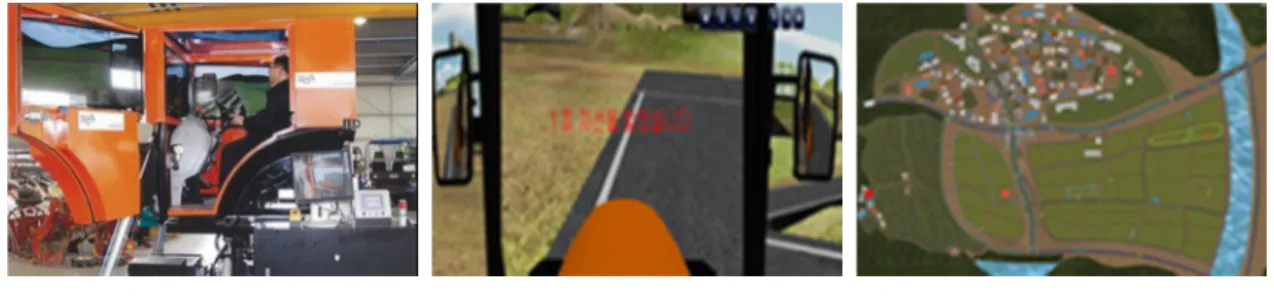
More efficient safe driving education can be offered by converting lecture style education into experience type education with ICT-based simulator development. As for tractor simulator, the simulator for agricultural machine safety education, through which driving can be exercised on the virtual space was developed (Figure 2). The development of tractor simulator is regarded to be completed in the second half of 2016 (RDA, 2014). The simulator is viewed as effective for safe driving education on the agricultural machine safety accidents arising from the lack of driving skills. From 2017, agricultural work safety and health engineer license exam is slated to be executed, and the subjects and teaching aids are currently developed. The license qualifiers can be used for active field guidance through linkage with city and county agricultural technology centers, and therefore they are expected to positively access agricultural work safety education activities.
5. Technology Support for Safe Agricultural Activity Environment Shaping
Agricultural safety technology is a method to interrupt or reduce exposure from agricultural hazard factors. And it includes convenience equipment (auxiliary equipment), process and protective gear suitable for agricultural work characteristics (Lee et al., 2010). This study reviewed convenience equipment and protective gear.
In view of social characteristics, agricultural population, female farmers' musculoskeletal disease' seriousness can be predicted to be quite high, compared to other industries. As for the labor population in the rural village, most agricultural work is carried out by aged people and women, and therefore, the prevalence rates of musculoskeletal diseases (knee arthritis, lumbar degenerative kyphosis) related with leg/knee (28.1%) and back (26.6%) were the highest (Seo et al., 2013). Musculoskeletal diseases taking up the most among chronic diseases occur form various ages, and the importance of health-related quality of life emerges from the social and medical perspectives (Jaeng, 2006). In the case of agricultural safety accident aspect, slipping or fall (30.2%), and the fall accidents in orchard (23.2%) and agricultural pesticide poisoning in facility cultivation land (17.25) were revealed in the order (MOEL, 2012).
Upon looking into the studies on convenience equipment development and protective gear up to 2008, studies were conducted on the prevention of musculoskeletal diseases by kind of crop. To correct standing posture, working foothold and platform for harvesting work were developed (RDA, 2008), and three-wheel working chair and bag holder to improve back bending posture in fruit tree and open field vegetable work were developed (RDA, 2008). In the facility crops, a pedestal for squatting posture
Simulator Course practice Road driving
Figure 2. Tractor driving simulator
improvement (Jung and Jung, 2005), and shipment system to improve sitting posture on the ground upon special crop work were representatively developed (Ahn et al., 2002; RDA, 2008). There are also studies on working clothes suitable for open field work (Choi et al., 2007) and high temperature environment within a vinyl house (Choi et al., 2005) in the case of agricultural clothing equipment, and fruit tree working clothes for convenience and functionality improvement upon fruit tree growing.
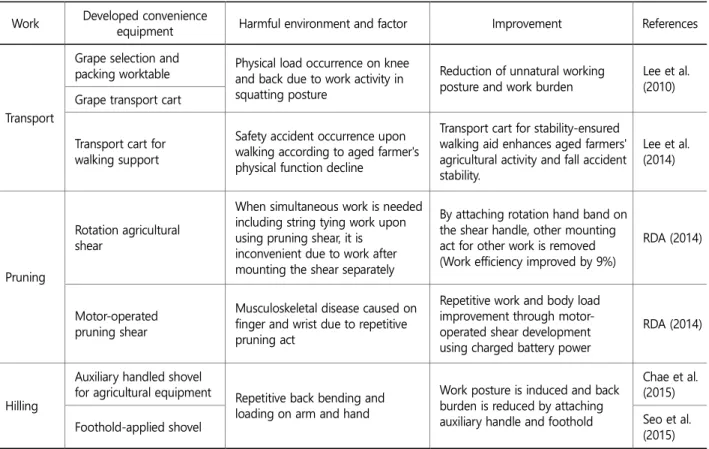
Recently, as agricultural mechanization is carried out in the various agricultural areas, farmers' direct labor has been reduced, compared to the past. However, various diseases including chronic farmer's syndrome, due to repetitive pruning for fruit trees, and excessive strength use, are remarkably revealed (Park et al., 1994). From the safety accident aspect, elderly people's fall accidents gradually increase, and the accident is a very big problem accounting for 70% of elderly people's death. Especially, the fall occurrence rate of elderly people in Korea's rural area is reported very high. Among the agricultural accidents, fall (30.2%) was the highest, and especially, about half the female farmers experience accidents from fall (Kim et al., 2014). Although 560,000 people are estimated to be engaged in the livestock industry, not many studies on livestock farmers' agricultural safety have been carried out, compared to other kinds of crops. Actually, 560,000 people are estimated to be engaged in the livestock industry (MAFRA, 2013). Regular livestock work is relatively carried out weekly, unlike general agricultural work, and it has a feature that an unexpected situation can occur in view of livestock husbandry including infections. The risk of health disorder of livestock farmers is high, due to dust, ammonia, carbon dioxide and high humidity and concentrated harmful materials within the work area, and the inferior environment can reduce work efficiency (Kim et al., 2014a, 2014b). Table 5 shows the development and application cases of grape selection and transport convenience equipment, pruning shears and shovels.
Table 5. Farm work support equipment and safety technique Work Developed convenience
equipment Harmful environment and factor Improvement References
Transport
Grape selection and
packing worktable Physical load occurrence on knee and back due to work activity in squatting posture
Reduction of unnatural working posture and work burden
Lee et al.
(2010) Grape transport cart
Transport cart for walking support
Safety accident occurrence upon walking according to aged farmer's physical function decline
Transport cart for stability-ensured walking aid enhances aged farmers' agricultural activity and fall accident stability.
Lee et al.
(2014)
Pruning
Rotation agricultural shear
When simultaneous work is needed including string tying work upon using pruning shear, it is inconvenient due to work after mounting the shear separately
By attaching rotation hand band on the shear handle, other mounting act for other work is removed (Work efficiency improved by 9%)
RDA (2014)
Motor-operated pruning shear
Musculoskeletal disease caused on finger and wrist due to repetitive pruning act
Repetitive work and body load improvement through motor- operated shear development using charged battery power
RDA (2014)
Hilling
Auxiliary handled shovel
for agricultural equipment Repetitive back bending and loading on arm and hand
Work posture is induced and back burden is reduced by attaching auxiliary handle and foothold
Chae et al.
(2015)
Foothold-applied shovel Seo et al.
(2015)
The development of work burden reducing equipment, such as worktable and posture correction for grape farmers' convenience, and convenience equipment for pruning work of fruit trees was performed (Figure 3(b)). Among them, a rotation shear for agriculture was developed in a way that a worker can conveniently and quickly cut with wearing the shear on his/her hand (RDA, 2014). As for motor-operated pruning shear's development and diffusion, work speed can be enhanced upon pruning and cutting work of fruit trees with the shear, and fatigue can be reduced on hand and wrist, and work efficiency is higher than a manual pruning shear (RDA, 2014).
RDA also conducted a research on the development of walking support transport cart to prevent fall accidents for aged people (Figure 3(a)). The transport cart for walking support was developed to help aged farmers' walking by supporting the parts of back and leg, where muscle strength is insufficient. Existing walking aids sold in the market are too light to use in the rural village environment (unpaved rough road), and there is a risk of fall, due to small width of wheels. Therefore, the weight was increased to enhance durability and safety of the frame of the walking support cart developed in consideration of those things, and the cart was developed for stable walking on rough road using wide urethane wheels. By adopting double brake system, control is possible in a hazard situation upon walking, and it was developed to comfortably rest and carry simple belongings and agricultural products by providing chair and carrying box simultaneously (Lee et al., 2014).
As a convenience equipment to reduce muscle strength consumption upon agricultural work, a foothold-applied shovel was recently developed (Figure 3(c)). By attaching a protruded foothold in the shovel shaft direction and one vertical direction, the shovel was constructed in a way that a worker can easily scoop up soil without bending back maximum, through giving force by stepping one foot on the foothold (Seo et al., 2015).
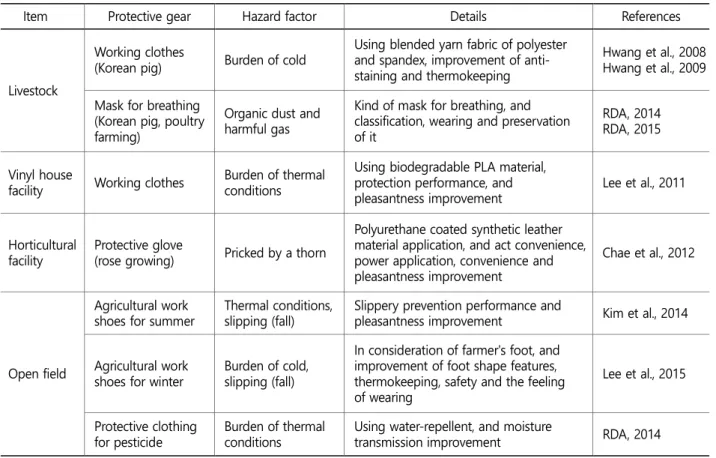
Personal protective gear has a goal to protect one's body from an accident, caused by worker's mistake and the external environment, such as workplace, and many studies have been performed to develop personal protective gear. Studies on representative protective gear, such as working clothes, protective gloves and shoes for agricultural work for livestock and vinyl house facility farmers have been carried out (Table 6). The livestock industry is one of the working environments requiring personal protective gear, since, (a) Transport cart for
walking support
(b) Rotation pruning shear (c) Auxiliary handled shovel
Figure 3. Agricultural convenience equipment
damages frequently occur, due to environmental pollution, such as foul odor and harmful gas arising from machine noise, and excreta. As the foot-and-mouth disease and avian influenza occur nationwide recently, the safe and sanitary management of livestock working area becomes more important. Working clothes improving functional problems, such as fire protection, washing attributes and flexibility, was developed to enhance work efficiency of livestock farmers and for the livestock farmers to protect their health (Hwang et al., 2009). Through a survey on preference and acceptance of the livestock farmers' working clothes, consumers' perception survey and commercialization possibility on the working clothes and protective gear of livestock farmers were presented (Hwang and Lee, 2012; Hwang et al., 2013).
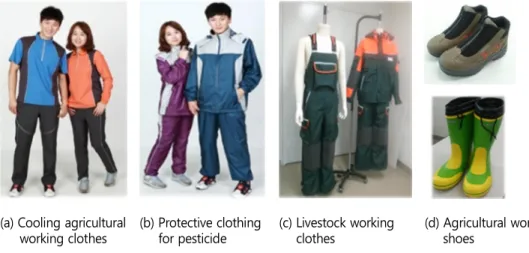
In the case of pest control work, one of the high hazard works, it is carried out intensively from late spring to early autumn, when temperature is high in general. Therefore, high heat stress is received by body temperature rise occurring from pesticide spraying upon pesticide spraying (Melin and Savourey, 2001). Due to such a reason, there was a study on protective clothing for pesticide to prevent damages, because of thermal conditions stress and pesticides by identifying and improving the problems of farmers' wearing protective gear, through which they can respond to pesticides (Figure 4(a)). Concerning the developed protective clothing for pesticide, light material fabric was used to wear lightly, and the absorption of pesticide and moisture was prevented by applying water proof function to the fabric. As a high density product, water-repellent and water absorption fabric with excellent nylon's gloss and touch was used, and design was made to wear in outdoor activities in addition to agricultural work. Other feature includes design considering night time walking safety using retro-reflection material to prevent traffic accidents.
Table 6. Personal protective gear and safety technique
Item Protective gear Hazard factor Details References
Livestock
Working clothes
(Korean pig) Burden of cold
Using blended yarn fabric of polyester and spandex, improvement of anti- staining and thermokeeping
Hwang et al., 2008 Hwang et al., 2009 Mask for breathing
(Korean pig, poultry farming)
Organic dust and harmful gas
Kind of mask for breathing, and classification, wearing and preservation of it
RDA, 2014 RDA, 2015
Vinyl house
facility Working clothes Burden of thermal conditions
Using biodegradable PLA material, protection performance, and pleasantness improvement
Lee et al., 2011
Horticultural facility
Protective glove
(rose growing) Pricked by a thorn
Polyurethane coated synthetic leather material application, and act convenience, power application, convenience and pleasantness improvement
Chae et al., 2012
Open field
Agricultural work shoes for summer
Thermal conditions, slipping (fall)
Slippery prevention performance and
pleasantness improvement Kim et al., 2014
Agricultural work shoes for winter
Burden of cold, slipping (fall)
In consideration of farmer's foot, and improvement of foot shape features, thermokeeping, safety and the feeling of wearing
Lee et al., 2015
Protective clothing for pesticide
Burden of thermal conditions
Using water-repellent, and moisture
transmission improvement RDA, 2014
RDA (2014) developed cooling agricultural working clothes for thermal conditions stress-causing working environment, such as the high temperature and humidity greenhouse, according to growing conditions of crops, as well as protective clothing for pesticide (Figure 4(a)). It used cooling material (asking fabric) with a cooling effect, and cool comforts fabrics drying moisture fast, and enhanced farmer's pleasantness in working in the high temperature and humid environment. For comfort upon agricultural work, the product has excellent flexibility with the use of highly elastic functional material, and it was designed not to cause lots of damages, even though a worker is caught up with a crop. Like protective clothing for pesticide, night time walking safety was considered by adopting a retro-reflective material (Figure 4(b)).
The development of livestock working clothes for livestock farmers (Figure 4(c), and protective boots and shoes for Korean pig farmers was recently undertaken (Figure 4(d)). Concerning agricultural work shoes, farmers' agricultural work situation and foot shapes were considered, and the shoes were developed for summer and winter uses, respectively. In the case of summer use, mesh material was applied to entire top of the foot, and thermal pleasantness was maximized. For winter use, thinsulate with excellent thermokeeping was used to maintain thermokeeping. Commonly, toes were to be protected from impact onto a rock or stones by inserting top cap. Also night time safety was elevated by attaching retro-reflective material to the side and rear parts.
R&D including many convenience equipment and protective gears was carried out for safety agricultural activity environment shaping and technical support. Policy level support for support and diffusion should be conducted preferentially. Although the satisfaction of the personnel of agricultural technology centers and representatives of agricultural cooperative units was high in the agricultural work environment improvement convenience equipment and protective gear support project achievements, there is a difficulty to meet farmhouses' desired quantity of convenience equipment with the current budget. Therefore, there is a need to gradually expand support budget by agricultural cooperative unit (Kim et al., 2011).
6. Conclusion
This study reviewed the hazard factors of agricultural labor, farmers' injuries and agricultural safety and health system and policy status, and introduced farmers' health and safety projects and study trends that have been researched and diffused by RDA. The enactment and execution of laws on the safety insurance and safety accidents prevention of farmers and fishermen are expected to be a new turning point for agricultural safety accident perception diffusion and agricultural work safety accidents prevention.
(a) Cooling agricultural working clothes
(b) Protective clothing for pesticide
(c) Livestock working clothes
(d) Agricultural work shoes
Figure 4. Example of protective clothing
The adoption of institutional compensation support for accident prevention reflecting future Korea's agricultural characteristics can be an important method.
Despite many efforts so far from the education and practice aspects for agricultural safety awareness, farmers' injuries and diseases related with agricultural activities are much higher than those of other industries. Efforts to establish a national support system including devising legal and institutional support methods, ensuring professional manpower for safety management competence cultivation, and educating farmers should be made.
RDA needs to expand an opportunity for farmers to access the educational data and programs for PR and diffusion as part of establishing an agricultural accident prevention management system. For agricultural work safety awareness improvement, safety practice projects focused on practice, as well as continuous education, should be implemented. As for convenience equipment and protective gear, technical support is considered urgent for the safe and pleasant agricultural labor environment through national level management and the R&D of inferior farmers' labor environment. ICT-fused convenience equipment and monitoring system should be developed using sensing sensor and communication network technology in consideration of agricultural facilities' environmental characteristics and farmers' agricultural work patterns.
The formation of social bond of sympathy is needed through an effect analysis for the agricultural labor environment and agricultural work safety from the results of this study. A shift from government-led top-down approach to bottom-up structure from rural village will become a cornerstone for rural village welfare service expansion.
Acknowledgements
This work was carried out with the support of "Cooperative Research Program for Agricultural Science & Technology Development (Project No. PJ008678)" Rural Development Administration, Republic of Korea.
References
Ahn, O.S., Kim, K.R., Lee, K.S. and Park, K.S., Development work to improve the system for shipment of Pleurotus ostreatus, Proceeding of The Korean Society Of Community Living Science, 6, 126-128, 2002.
Ahn, O.S., Work environment and work load of farmers in four crop cultivation. Unpublished doctoral dissertation, Seoul National University, Seoul. 2001.
Andy Kiersz, It's More Deadly To Work In The US Than In The EU, Business Insider, 2014, http://www.businessinsider.com/us-vs- eu-fatal-occupational-injuries-2014-6 (retrieved March 10, 2016).
Baek, Y.J., Lee, K.S., Hwang, L.S., Kim, K.L. and Kim, H.C., Characteristics of the Somatotypes of Korean Farmer, Journal of the Korean Society of Clothing and Textiles, 32(3), 431-442, 2008.
Bureau of Labor Statistics (B.L.S), Employer-Reported Workplace Injuries and Illnesses 2013, 2014a, http://www.bls.gov/news.release/
archives/osh_12042014.pdf (retrieved March 10, 2016).
Bureau of Labor Statistics (B.L.S), Number of fatal work injuries 1992-2013, 2014b, http://www.bls.gov/iif/oshwc/cfoi/cfch0012.pdf (retrieved March 10, 2016).
Chae, H.S., Kim, S.C., Lee, K.S., Kim, H.C., Kim, D.H. and Park, S.J., Development and Evaluation of Protective Gloves for Rose Farmers, Korean J Community Living Science, 23(2), 137-144, 2012.
Chae, H.S., Lim, C.M., Lee, K.S., Kim, S.W. and Seo, M.T., Development and evaluation of assist handle for farming tools, Proceeding of the Ergonomics Society of Korea, 620-624, 2015.
Chae, H.S., Min, K.D. and Youn, K., Estimated rate of agricultural injury: the Korean Farmers' Occupational Disease and Injury Survey, Ann Occup Environ Med. 26, 8-8, 2013.
Choi, J.H., Kim, M.J. and Lee, J.Y., Ergonomic Investigation of the workload of red pepper harvest workers in summer: a pilot study for developing personal protective clothing, Journal of The Korean Society of Living Environmental System, 14(1), 9-19, 2007.
Choi, J.H., Kim, M.J. and Lee, J.Y., Efficacy of Cooling Vests for Alleviating Heat Strain of Farm Workers in Summer, Journal of the Korean Society of Clothing and Textiles, 29(8), 1176-1187, 2005.
Heinrich, H.W., Industrial Accident Prevention, 5thed. NY: Mcgraw-Hill Company. 1980.
Hong, Y.H., Research of College Students Recognition for the Safety Management of Living and Laboratory, Fire Science Engineering, 28(4), 89-96, 2014.
Hwang, K.S. and Lee, K.S., A Study on Development of disposable pesticide protective clothing using biodegradable PLA, J Korean Soc Living Enciron Sys, 19(3), 430-438, 2012.
Hwang, K.S., Kim, H.C., Chae, H.S. and Lee, K.S., The Development of Winter Working Clothes for Stock Farming Worker, The Korean Society of Community Living Science, 12, 515-522, 2009.
Hwang, K.S., Kim, K.R., Lee, K.S., Kim, H.C. and Baek, Y.J., The Development of Working Clothes for Stock Farming Worker.
Proceeding of The Korean Society of Occupational and Environment, 193-194, 2008.
Hwang, Y.M., Kim, K.R., Lee, K.S. and Chae, H.S., An investigation of actual conditions for the development of hog raising farmers' personal protective equipment. Proceeding of The Korean Journal of Community Living Science, 101-101, 2013.
International Labour Organization (ILO), Agricultural a hazardous work, 2016, http://www.ilo.org/safework/areasofwork/hazardous- work/WCMS_110188/lang—en/index.htm (retrieved March 10, 2016).
Jaeng, J.S., A Study on Chronic Patients Life Quality, Graduate School of Kyung-Hee University, 2006.
Jung, W.S. and Jung, H.S., Evaluation of Proper Height for Squatting Stool and the Ergonomic Design of Wearable Stool, IE Interface, 18(3), 288-296, 2005.
Kawakami, T., Khai, T. and Kogi, K., Developing the WIND Training Program in Asia. Bankkok, ILO Regional Office for East Asia, 73- 90, 2009.
Kim, D.H., Lee, K.S., Oh, Y.S., Kim, K.R. and Chae, H.S., Evaluation of the Thermal Properties of Summertime Farm Working Shoes, Proceeding of The Korean Society Of Community Living Science, 157-157, 2014.
Kim, H.Y., Jung, N.S., Jang, W.S, Oh, T.S. and Lim, C.S., Survey of Farmer Informationization State and Needs for Knowledge based Agricultural Information System. J Korea Soc Rur Plan, 16(4), 139-145, 2010.
Kim, I., Kim, K.R., Lee, K.S., Chae, H.S. and Kim, S., A Survey on the Workplace Environment and Personal Protective Equipment of Poultry Farmers. J Environ Health Sci., 40(6), 454-468, 2014a.
Kim, J.S., Woo, K.H., Min, Y.S., Kim, B.K., Choi, K.S. and Park, K.S., <Field action report> Development and Application of Participatory Action Oriented Training (PAOT) for Improvement of Agricultural Working Environment in Korea. J Agr Med Commun Health, 35(4), 417-427, 2010.
Kim, K.R., Kim, I., Kim, H.C., Lee, K.S. and Chae, H.S., A Survey on the Present State of Occurrence of Safety Accidents and Safety and Health Management Levels Among Swine Farmers. J Environ Health Sci., 40(5), 413-424, 2014b.
Kim, S.K., Kim, H.C., Lee, K.S., Kang, H.T., Oh, S.S. and Ko, S.B., The Relationship between Injury and Socioeconomic Status in Reference to the Fourth Korean National Health and Nutrition Examination Survey. Ann Occup Environ Med., 26(1), 1-11, 2014.
Kim, Y.C., Woo, D.P., Hong, C.W. and Kim, D.S., The Ergonomic Evaluation of the Convenience Equipment Project in Agriculture, Proceeding of the Ergonomics Society of Korea Conference. 155-160, 2011.
Kim, Y.M., Farmers' Safety and Insurance 40 billion budget, guarantee limits, The Korean Rural Woman Weekly News, 2015a, http://www.rwn.co.kr/news/articleView.html?idxno=30851 (retrieved March 10, 2016).
Kim, Y.M, The contents of Farmers and fishermen's safety insurance and safety significance of the issues and legislation related to disaster prevention and Decree. The Journal of labor law. 34, 85-145, 2015b.
Kogi, K., Kawakami, T., Itani, T. and Batino, J.M., Low Cost Work Improvements that can Reduce the Risk of Musculoskeletal Disorders, International Journal of Industrial Ergonomics, 31, 179-184, 2003.
Korea Health Industry Development Institute (KHIDI). Development of National Nutrition Measures and Strategies across the Life Span, 2010.
Korea Labor Institute (KLI), Coverage Expansion of the Industrial Accident Compensation Insurance (IACI) - focusing on the self- employed and atypical workers, 2002, http://www.kli.re.kr/kli/rsrchReprtView.do?key=16&pblctListNo=5487&schRsrchRealmNo=4 (retrieved March 10, 2016).
Kwon, M.D., Lee, S.J. and Jeong, M., Work-related hazard among farmers, J Korean Med Assoc., 55(11), 1046-1053, 2012.
Lee, C.K., Operation of Agricultural Safety and Health Center and Future, Proceeding of Korean Society of Occupational and Environment, 118-118, 2014.
Lee, H.H., Hwang, K.S., Kim, D.H., Kwon, J.Y., Lee, K.S., Chae, H.S. and Kim, H.C., Evaluation on the Thermal Properties of Bio- degradable PLA Disposable Coveralls for Livestock Industry Workers, J. Korean Soc. Living Environ. Sys., 18(5), 562-569, 2011.
Lee, K.S., Kim, H.C., Chae, H.S., Cho, Y.H. and Min, K.D., Research on the Effect of Korea Information Center of Agricultural Safety and Health (KICASH), Korea J Community Living Sci., 23(4), 441-446, 2012.
Lee, K.S., Kim, H.C., Chae, H.S. and Kim, K.R., A Study on Agricultural Safety Technology for Ergonomic Intervention in Farm- work, Journal of the Ergonomics Society of Korea, 29(2), 225-239, 2010.
Lee, K.S., Kim, K.R., Kim, H.C. and Kim, K.S., Current status and management of agricultural industry accidents for improving quality of life of farmers. Suwon: Research center of rural resources. Rural Development Administration, 2006.
Lee, K.S., Kim, K.W., Chae, H.S., Kim, C.H., Nam, S.Y., Lee, K.M., Choi, Y.W. and Park, K.S., Evaluation of Convenience Equipment for Improve Work Efficiency and Preventing of Farm Work-related Musculoskeletal Disorders, Journal of the Ergonomics Society of Korea, 29(4), 495-503, 2010.
Lee, K.S., Kim, K.R., Kim, H.C., Chae, H.S., Kim, S.W. and Seo, M.T., Development and Evaluation of Rollator for Elderly Farmers, Journal of the Ergonomics Society of Korea, 33(6), 487-497, 2014.
Lee, K.S., Oh, S.R., Chae, H.S. and Kim, S.W., Development and evaluation of functional agricultural work shoes. Proceeding of Ergonomics Society of Korea, 584-586, 2015.
Melin, B. and Savourey, G., Sports and extreme conditions, Cardiovascular incidence in long term exertion and extreme temperature (heat, cold), Review of Practice, 51, 28-30, 2001.
Ministry of Agriculture, Food and Rural Affairs (MAFRA). Major statistics data of Food, Agriculture, Forestry and Fisheries, 2013, Available: http://ebook.mifaff.go.kr/20120905_103636 (retrieved March 10, 2016).
Ministry of Employment and Labor (MOEL). 2012 Industrial Accident Analysis. 2013, http://www.korea.kr/archive/expDocView.do?docId
=32909 (retrieved March 10, 2016).
Moon, G., Choi, J.S., Sohn, S.J. and Kim, B.W., The Epidemiologic Study of Farmers' Syndrome in Chonnam Province. Korean J Prev Med. 26(3), 21-31, 1993.
Nam, T.S., Kim, H.K., Kwon, O.H. and Lee, J.J., An epidemiological study on the Reasant's sydrome in rural korea. Korean J Rural Med. 5(1), 16-27, 1980.
Roh, S.C., Lee, J.B., Lee, C.G., Lee, S.J., Heo, Y., Song, J.S., Lee, K.O., Lee, B.S., Yu, J.H., Lee, K.S., Kim, K.R., Chae, H.S., Kim, H.C., Lim, S.H., Lee, Y.G., Kho, S.B., Aho, S.S., Kim, H., Kim, Y.D., Aho, K.J., Kim, J.S., Park, K.S. and Kim, J.H., Agricultural Work Safety Model and Demonstration Projects and Evaluation: 9 Years. The Korea Society of Occupational and Environment. 116-117, 2014.
Park, D.S. and Kim, H.S., A study on the rural elderly farmer's syndrome. Journal of Korean Gerontological Nursing Society, 3(1), 111-120, 2001.
Park, T.J., Kim, B.S. and Chon, H.J., Factors Associated with Farmers' Syndrome, Korean journal of rural medicine, 19(1), 5-13, 1994.
Rural Development Administration (RDA), Development of driver education simulator driving and operating agricultural machinery safety, 2014, http://img.kisti.re.kr/originalView/originalView.jsp (retrieved March 10, 2016).
Rural Development Administration (RDA), Farmer’s occupational disease and injuries survey, 2013a, http://kosis.kr/statisticsList/
statisticsList_01List.jsp? vwcd=MT_ZTITLE&parmTabId=M_01_01#SubCont (retrieved March 10, 2016).