2004,Vol. 48,No. 6
Printed in the RepublicofKorea
디시아노아세틸렌 및 그 이성체들의 분광학적 성질에 대한 이론 연구
전인선 • 박성우 • 이성렬*
경희대 학교 환경응용화학대 학 (2004. 10. 1 접수)
Structures and SpectroscopicProperties of Dicyanoacetylene and Isomers: Density Functional Theory Study
In-Sun Jeon, Sung-Woo Park, and Sungyul Lee*
School of Environmental Science and Applied Chemistry Kyunghee University, Kyun앙ido 449-701, Korea (Received October 1,2004)
요 약.
디시아노아세틸렌 및 그 이성체들에 대하여 밀도함수이론을 적용하였다. 구조 및 조화진동수를 계산하여 여러 가지의 이성체 구조를 예측하였고, 그 상대에너지를 비교하여 열역학적 안정성을 추정하였다.
주제어
: 디 시 아노아세 틸 렌ABSTRACT. Density functional theory calculations are presented for dicyanoacetylene N三 C-C 三 C-C 三N and its geo
metrical isomers. The structures and harmonic frequencies are computed by the BLYP theory employing the 6-311G* basis set. A variety of isomers are predicted, and the relative energies are compared to estimate their thermodynamic stability.
Keywords: Dicyanoacetylene
INTRODUCTION
Carbon
clusterscontaining cyano
groups receivedconsiderable attention
recentlybecause
oftheir interesting
spectroscopicpropertiesand astrophysi
cal
importance.Cyanopolyacetylenes,
H(GC)nGN,
are quiteinteresting due to
their unusual abundance ininterstellar
medium.Smaller
cyanopolyacetylenes1,2
werefirst observed
ininterstellar space
quitelong
ago,and recently
long chaincyanopolyacetylenes
suchas HC11
N3,4 were alsodetected.
Incontrast,
studieson dicyanopolyacetylenes
havebeen rela
tively
rare.Since
thelack of permanent dipole moments
ofthe
dicyanopolyacetylenesprecludes
their detectionby
radiospectroscopy, studieson these
clusters havebeen
focusedon the
infrared spectra.Cyanogen
(C2
N2),
themost well-known member
of theseclusters,
havebeen
detected in Titan'satmosphere
5, and good
amount ofknowl
edge has been obtained
bothby experiments6-8
andby theoretical investigations.
9'11 It hasbeen predicted10,11
that someisomers of
cyanogens,such
as CNCN, CNNCand CCNN,
arekinetically stable. C4
N2isthe next molecule of considerable interest both
in spectroscopyand
astrophysics inthe series of dicy
anoacetylenesN
三 C-(C三 C)n-C
三N. Oneof the iso
mers,NC4
N,hasbeen
detected12in
interstellarmedium, and others may
alsobegood
candidatesfor
astrophysical observation. While
NC4N,which is linear, may
bedescribed by
canonical structures interms of
alternating singleand
triplebonds,
chemicalbonding
inother geometrical isomers
isnot that
clear,and most
ofthem
areneither
singlenor
triple.Accordingly, these isomers may display a variety of geometries such
as linear, bent, nonplanaror
cyclicstructures.
In
this paper, we present
theoretical investigations on the
dicyanoacetyleneNC
4Nand
itsiso
mers
as our
continuingeffort
13'19to
calculate thespectroscopic properties
of carbonclusterscontain
ingmedium number (2-8) of
carbonatoms. We employ
the BLYPdensity functional theory,which
proved13-19 to be very
cost-effective for studying medium-sized carbonclusters,
employingthe
6-311G*basis
set.A variety of
structures (linear,bent,
cyclicand
nonplanar)are
predicted, and the harmonicfre
quencies are reported.
COMPUTATIONAL METHODS
Inthis
study
allthe
calculationsare
carried out using the GAUSSIAN94
setof programs.
20 The density functionaltheory with
the exchangefunc
tional of Becke21 andcorrelation
functional byLee etal.2 (BLYP)is
employedwith the
6-311G*basis set. Thestationary structures of themolecules
considered in
this work arecomputed by verifying that all theharmonic
frequenciesbe real. The
transition stateis obtained
byascertaining that one
of thehar
monic frequenciesbe imaginary. Intrinsic coordi
nate analysisis carried
outto follow
thereaction pathway
involvingthe transition state.
The relative energies ofthe
isomersare compared
inorder
to estimate theirthermodynamic stability, with
the zeropoint
energiesincluded.
kcal/mole 200 - 180 160 140 120 100
RESULTS ANDDISCUSSION
Fig. 1
shows that
all the structuresof the
isomersof NC4
Nwe computed
inthe
present workare pla
nar with
the exceptionof (r),
inwhichtwo three
membered
ringsare
intwisted
positions.Calcula
tions forNC
3NC
andCNC2
NC, havebeen pre
sented
elsewhere,23but we
includethem in this work
for completeness.The isomer
ofthe
lowest energyis computed to be NC4
N(a) as presented in
Fig. 1and Table
1. Itis
a linearmolecule of the canonical structure N=C-C
=C-C
=Nwith alternat
ing tripleand
single bonds, althoughsome
otherresonance
structuresmay also
contributeas we
discuss below. The isomer (b) NC
3NC is quite
stable (thatis, lowin
energy)with
ZPE-corrected energyof
only25.5
kcal/molabove
(a). Thelinear isomers (d), (e) and(h)lie
moderatelyhigher (45-60
kcal/mol) in
energythan
(a). The energiesof
the isomers
(f)
and (i), inwhichtwo
nitrogen atoms are bondedinside
thechain, are extremely
high,being
107.3
and 158.3kcal/mol,
respectively, relative to (a). Thetwo branched
isomers(k)
and(l)lie 50.2
and64.7
kcal/mol,respectively,
above (a), whilethose
((m) and(n)) with six-membered
ring structures are
ofvery high
energy,more than
150kcal/mol
above (a).Therefore,
onlytheazo
compound C4
N2
(e),and
the isomers (b) and(h)
containingone
(q)
80 60 40 20
Fig. 1. Relative energies of the isomers.
Table1. Electronic energiesE,zero-point energies (ZPE) and relative energiesDE of NC4Nand isomers
E (a.u.) ZPE (kcal/mole) AE (kcal/mole) )
) ) ) ) ) ) ) )) a b c d e f) g h i) j) ( ( ( ( ( ( ( ( ( (j
261.83824 16.08 261.79696 15.70 261.72622 15.23 261.74560 15.16 261.70633 15.21 261.66411 14.19 261.67884 14.35 261.75282 15.18 261.58199 13.61 261.65280 13.64
(k) -261.69136 14.04
(l) -261.73256 14.53
(m) -261.59049 13.01
(n) -261.58643 12.82
(o) -261.66778 13.92
(p) -261.60644 13.19
(q) -261.53719 12.46
(r) -261.65337 13.05
0 25.5 69.4 57.2 46.2 107.3 98.3 52.7 158.3 113.9 50.2 64.7 152.4 154.7 104.8 142.5 185.3 112.9
and two
isocyano groups, respectively, and thebranched isomer (k) are
moderatelyhigher in
energythan the most stable isomer
(a),indicting
theymay be
kineticallystable for
observationin
lowtemper
ature laboratory
conditions orin interstellarspace.
In particular, the molecule (b) NC3NC may be a good
candidatefor
astrophysicalobservation.
Sincethe
energies of other isomersare rather too high, they may be
quite amenableto
isomerization or dissociation reactions,and thus
may
beobserved
only inhighly
inert conditions such asin
raregas matrix.
Although the lowestenergy
isomer (a)
seemstobe
described byalternating tripleandsinglebonds,the bond
lengthsofthemolecule
indicatethat other resonance structures may also contribute. For exam
ple,
the length(1.360
A) of thetwo
CC bonds adjacent
to
the terminalCN
bondsare much
smallerthan the typical
CCsin
읺e bond
length (~1.50A), being rather close
totypical
CC doublebond length
(~1.34 A). Thecentral CCbond (1.225
A)is also a bit longer than
thetypical
CC triplebond
length (~1.20A). The bonding structures in
other isomersare
muchmore
complicated, and nosimple canoni
cal
structuresmay even be assumed
for them.The
(176.7) 1.168 N Fig.2. Structuresof theisomers.
length
(1.201
A)of theCN bond
inthe isomer (b),
forexample, is considerably longer than that (1.174
A) in (a), indicatingthat
thebond is
weakerthan
the canonicalCN
triplebond.
The terminal CCbond lengths in the isomer (c) and (d) are 1.287-1.288 A,
lyingbetween
thetypical
double and triple CCbond lengths.
The terminal NCbond
lengthens from thetriplebond (1.174
A)in (a)
to 1.180A in
(c).All
theCCbond
lengths(1.264-1.303 A) in (e) are intermediate between
the double and triple CCbond lengths.
Sincetheir
lengthsare
quite different,these CCbonds
cannot be
simplydescribed as
cumulated double bonds, and severalresonance structures must be envisaged as contributing to
theoverall
structureof the isomer
(e). Itshould also
be notedthat
the length(1.283
A) of theNN bond in the bent
isomer(f) is
much largerthan that (1.157
A)in
theazo compound
(e). Thebonding
structures
inthe branched
isomers(j)-(l)
arealso pecu
liar.
While the terminal CNbond
lengths(1.193 A)
in theisomer(j) is
largerthan
the C=N bond length (1.174
A)in
(a), thelengths(1.168 A)
ofthe termi
nal NC
bondsin
(l)are
smaller, indicatingthat they are
strongerthan the C
=N
triplebond. Although quite high
in energyabove
(a),thestructures ofthesix-membered
ringstructures (m)
and(n) are
interesting.
Some CC bonds in thesetwo
isomers are about 1.39A, similar to
typical CC doublebond
distance (~1.34 A). Moreover, someof the
distances
between the
carbonand nitrogen
atomsin these
isomersare
quitelong,
being1.47-1.52 A.
These molecules
may be studied
in inert environment
suchas in
rare gas matrix. The isomers(p)
and(q) containing
athree-membered
ringmay
beintermediate
complexes in the isomerizationreac
tioninvolving the
exchange of carbonand nitrogenatoms,
as we have shown forsimpler systems
25.
The onlynonplanar isomer (r)
containstwo
triangular ringstructures twisted
from eachother.
Thestruc
turewith
thetwo coplanar triangular
ringsis com
puted tobe
atransition
state, lying31.7 kcal/mol
above (r). The
dipolemoments
of allthe computed
structuresarerather
small(mostly
below 2Debye)
with
the exceptionof
the linearmolecules (e)
and (g)(3.88and
3.41 Debye,respectively).
Table 2. Dipole moments|丄(Debye), rotational constants Be (GHz)and harmonic frequencies (cm-1) of the isomers (a)-(f)
(a) (b) (c)
卩 - 卩 1.10 卩 1.99
Be 1.330956 Be 1.398654 Be 1.440341
v1(q) 2269 (0.0) 기1(。) 2278(53) 기1(。) 2259 (518)
V2(q) 2113 (0.0) v2(g) 2193 (28)
V
2(g) 2155(208)VMg) 608(0.0) v3(g) 2003 (166)
V
3(g) 1930 (489)V4G) 2236 (5.2) V4(。) 1220(0.16) V4(。) 1194(1.3)
기5(0) 1175 (0.07) Vs(。) 627(0.1) Vs(。) 653 (0.008)
V6(띠 527(0.0) V6(n) 524(3.7) V6(n) 468 (1.6)
V7(띠 279 (0.0) v’(n) 436 (0.009) v’(n) 450 (1.6)
V8(nu) 506(5.6) 기问 254 (0.003) 기问 215 (0.001)
V9㈤) 112 (9) 기9(丸) 116(7.5) 기9(丸) 98 (13)
(d) (e) (f)
卩 0.95 卩 3.88 卩 1.69
Be 1.447803 Be 1.409506 Be 445.78986
1.53254 1.53254
기1(。) 2294 (1386) 기1(。) 2246 (1959) 기") 2233 (1148)
vM) 2216 (255) 기2(。) 2124(60) v』A') 2048 (468)
v3(o) 1911 (157) v3(o) 1857 (387) v3(A') 1869(18)
V4(。) 1220(9.6) V4(。) 1287 (1.8) V4(A') 1197(9)
Vs(。) 665 (0.02) Vs(。) 654(0.2) V5(A') 659(5)
V6(。) 497 (5) V6(。) 499(0.2) V6(A') 486 (14)
v’(n) 434 (13) v’(n) 469 (9) v’(A') 296 (13)
vjn) 167(4.6) vjn) 193 (5) v") 172(19)
Vg(n) 52 (6.8) V9(n) 77 (3.4) V9(A') 82 (11.7)
V10(A〃) 473(8) V11(A〃) 259 (1) V12(A〃) 126(10)
The computed harmonic
frequenciesof
the molecules
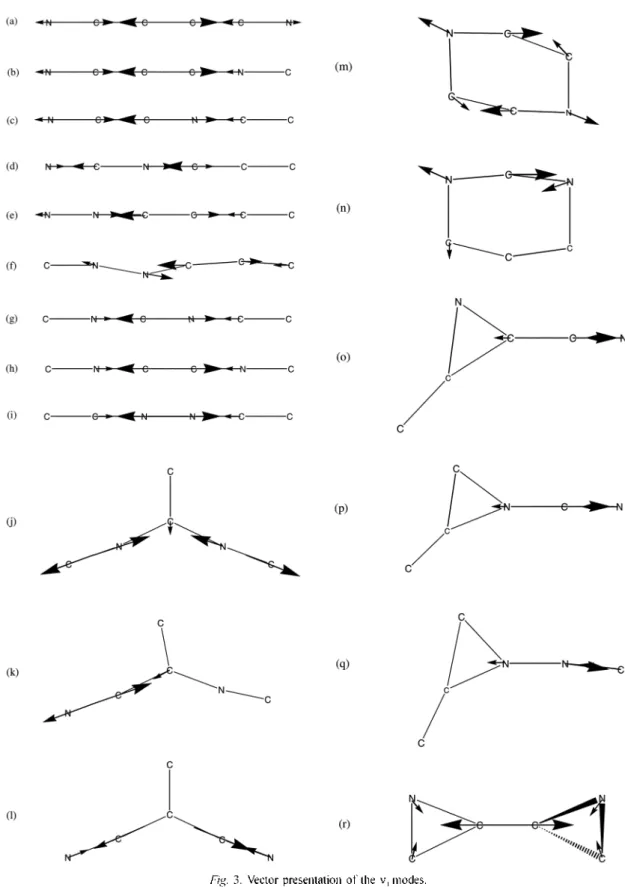
are given in Table 2-Table 4, and Fig. 3 depictsthe
v】modes ofthe
isomers. Consideringthat the calculated harmonic
frequencies ofthe low- est-eneigy isomer NC
4Ncompare very well
(mostlyto within
30 cm-1) with
experimentalobservations (seeTable 8 in [Ref. 23]), the harmonic
frequenciesgiven in Table 2-Table 4
couldprovideuseful guide
for assigningthe experimentally observed
infrared spectrato
specific isomer(s).The
v1 frequencies of
allthelinear isomers are
those ofstretching
ofthecentral bond
ofthe molecule and the concomitant
contraction ofthe two
adjacent bonds. Themagni
tude
ofthe harmonic
frequencies ofthe isomers listedin
Table2
Table4 may be considered as
goodmeasures to scrutinize the
differencein chemical bonding among the
isomers.For
example, the v】modes
of (a) and(b) depicted in Fig. 3
arevery similar,
consisting ofstretching
motions ofthecen
tral
fouratoms.The
only differenceis
thatin (a) the
v
1 mode
isthe stretching of the three CC
bonds,while in
(b) oneofthe bond
is CN,whose
length(1.300 A)
isabit
아lorterthan
theCC bond (1.360 A) in
(a). Consequently,the% frequency (2278
cm-1) of
(b)is a bit larger than that (2269
cm-1)
of(a).Withthe
exception of(j),(m),
(n),(q)
and(r),the har
monic frequenciesof
then1
modesare
2200-2300 cm-1. The
V1 frequenciesof
①and (q)
are 2071and 2016
cm-1, respectively,while
thatof
(r) is 1861 cm-1. The six-membered ring isomers
(m)and(n)are
characterizedby extremely
low-frequency (1519 and 1587 cm-1,respectively)
v1
modes ofstrong intensity. Out-of-plane bending modes of
somelinear isomers
display
quitesmall
frequencies(52,
77Table3. Dipole moments 卩(Debye), rotationalconstants Be (GHz) and harmonic frequencies (cm-1) of the isomers (g)-(l)
(g) (h) (i)
卩
3.41
卩-
卩 -Be
1.513401
Be 1.470297 Be1.543058
V1
(
。)2300
(304)V
1(Q
)2295
(0.0)V
1(Q
)2287
(0.0)V2
(
。) 2011(891)V
2(%) 1980 (0.0)V
2(%) 1803 (0.0)V3©) 1881 (34) V3(Gg) 647 (0.0) V3(Gg) 659(0.0)
V4©) 1219 (0.02) V4(%) 2073 (388) V4(%) 1974(1560)
V5©) 674(0.05) V5(%) 1251 (0.6) V5(%) 1180(7.5)
vM) 421 (0.7) V6(띠 424 (0.0) V6(띠 332 (0.09)
기7(丸) 292 (0.2) V7(띠 240 (0.0) V7(띠 144(0.0)
기仞) 185 (0.5) V^u) 400 (0.0004) V^u) 225(0.0)
기9(丸) 78 (12) V9(nu) 121 (6.8) V9G) 97 (18)
(j) (k) (l)
卩 0.58 卩 0.87 卩 1.10
8.83076 8.89792 8.77750
Be 3.09217 Be 2.86186 Be 2.68219
2.29022 2.16540 2.05441
V1(A') 2071 (54) V1(A,) 2208 (2.3) 기") 2237 (0.4)
V2(A') 2040 (288) VJA,) 2076 (128) v
』
A'
) 2229 (0.3)v") 1536(16) V") 1536(29) V") 1533 (46)
V4(A') 1104(17) v
』
A'
) 1101 (6.5) V4(A') 1113 (0.1)V5(A') 755 (6.8) 기5心) 731 (5.6) V5(A') 712 (2)
v6(Az) 500 (5.7) V6(A') 526 (2.7) V6(A') 546(0.3)
v
’
(A'
) 265 (1.3) v’
(A'
) 293 (1) v’
(A'
) 364 (1)V® 145 (4.9) V") 127 (3.5) V") 128 (7)
V9(A') 114 (2.7) W 119 (5.4) V9(A') 100 (2)
"(A”) 551 (6.6) V10(A〃) 573 (0.3) V10(A〃) 592 (1)
V11(A〃) 272 (0.0) V11(A〃) 333 (4.8) V11(A〃) 395 (0.0001)
V12(A〃) 190 (6.7) V12(A〃) 196 (8.5) V12(A〃) 215(15)
and
78cm
-1
for(d),(e) and
(g), respectively)indi
cating the molecules
arefloppywith
respectto
the mode,while
those forbranched
orsix-membered ring
isomers ①(n) areof much higher
(200-300 cm-1) harmonic frequencies. It
seemsthat the
V】modes
of
thelinear isomers ((d),
(g),(h) and (i)) displaying (antisymmetric)
movementsof
morethan two CN bonds
areof higher
frequenciesnear at
2300 cm-1. The
V】mode (2233 cm-1)
ofthe bent isomer
(f) involvesthe
antisymmetric movementsof
thecentral NC bond and the neighboring
CC bond. Althoughthe /
frequenciesof the
twolow-
est-energyisomers (a) and
(b) arerather similar,
thecomputed infrared spectrum of the isomer (b) is
characterizedbyvery
strong absorptionat 2003 cm
-1.
Thislatter
V3 (s) mode
involvesa
symmetric stretch-ing of CN bond
as showninFig. 4,and thus
may be quiteuseful
foridentifying this
potentiallykineti
cally stable
moleculeeither
in thelaboratory or ininterstellar space
byinfrared spectroscopy. Like
wise,the
V3(s)
frequency of theisomer (e) of
thethird-lowest
energyat 1857
cm-1 may also
beemployed to characterize the molecule (see
Fig. 4).The V] modesof the
branched isomers
Q), (k)and
(l)involve the stretching of
the terminalCN
(orNC)
bonds.The
V1 frequencyof
① ismuch smaller than
thoseof
(k)and
(l), in linewith the
observation
that thelength
ofthe
terminalbond (1.193 A) is significantly larger
(weaker)than
thoseof
(k) and (l). Thesebranched isomers
are alsocharacterized by
thev3
(A’)frequenciesat 1530-1540
cm-1. The
V1 modes of
the six-membered ring isomers (m) and
(m) (n) (o) Table4. Dipole moments j丄(Debye), rotational constants B° (GHz) and harmonic frequencies (cm-1) of the isomers (m)-(r)
卩 0.01 卩 0.68 卩 2.01
Be 11.55135 Be 10.16863 Be 12.51683
2.20694 5.68907 2.47965
3.58910 3.64807 2.06964
V1(A') 1519 (0.06) V1(A') 1587 (47) V1(A') 2236 (6.5)
V2(A') 1474(34) V2(A') 1258 (60) V2(A) 1835 (101)
V3(A') 993 (0.003) V3(A') 1018 (25) V3(A') 1581 (119)
V4(A') 890(0.03) V4(A') 980 (8) V4(A') 1014(33)
V5(A') 791 (12) V5(A') 879 (6) V5(A') 701(0.5)
V6(A') 691 (80) V6(A') 716 (7.8) V6(A') 551 (12)
V7(A') 609(0.08) V7(A') 623 (37) V7(A') 400 (10)
V8(A') 530 (0.001) V8(A') 519(19) V8(A') 229 (6)
V9(A') 295(36) V9(A') 92 (54) V9(A') 105(10)
"(A'') 539 (0.004) V10(A'') 594 (1.5) "(A'') 560 (1.8)
V11(A'') 528(0.09) V11(A'') 406 (1) V11(A'') 310(2)
V12(A'') 242 (11) V12(A'') 298(18) V12(A'') 213(15)
(p) (q) (r)
卩 1.58 卩 2.12
Be 12.06929 Be 11.98710
2.68619 2.84718
2.19178 2.30071
V1(A') 2207 (36) V1(A') 2016 (103)
VA 1745 (139) V2(A') 1739 (154)
v® 1419(393) V3(A') 1454 (256)
VO') 827(5) V4(A') 911(11)
V5(A') 748(69) V5(A') 736 (15.7)
V6(A') 533 (13.6) V6(A') 464 (2)
V7S') 484 (4.6) V7(A') 416(32)
v8(A
'
) 255(6) V8(A') 188 (5.5)V9(A') 125(10) V9(A') 112 (6.6)
V10(A'') 419 (5.5) V10(A'') 314 (0.05)
V11(A'') 300(0.06) V11(A'') 239 (0.2)
V12(A'') 118(7) V12(A'') 126 (8)
) ) ) ) ) ) ) ) ) ) ) ) u:
七
AA AA AA AB B9 (B9 v v v v v v v v v u
^ u
^
^
0.45 23.92533
2.28434 2.28392 1861(13.5) 1218 (0.02) 744(0.02)
474 (2) 423(0.6) 247(0.14)
161(3) 1580 (34.6)
1084(4.9) 695 (28.5) 471(2.6)
166(4)
(n) are also depicted in
Fig.3. The
movementsof the
atomsinthe
V】modesof these
two isomersare not
alongthe
bonds,and they may
be regardedas combination
ofstretching and in-plane bonding
motions,giving very
lowcharacteristic infrared fre
quencies(1519 and
1587 cm-1
). The V]modes of
(o) , (p)and (q)
consistsof
thestretching
oftheterminal CN
(orNC) bonds, and that of
theisomer
(r)containing two three-memberedrings is also of
low frequency(1861
cm-1),involving ring-distoiting motion.
One
ofthemore
interesting questionsconcerning these molecules
is thekinetic stability
ofthe low-
energy
isomers
such as(b).Since
the isocyanoiso
mer
(b)NC
3NC
iscomputed to be
only25.5kcal/
mol
above (a), itmay
bea good candidate for
astrophysical
molecule. Sincethe
energydifference between the
twointerstellar molecules HC
3N andHC2NC
iscomputedto be
26.6kcal
24,the ratio of
[NC4N/INC
3NC] ininterstellar media
maybe sim
ilar to
theestimated
interstellar abundance ratio[HC
3N]/[HC
2NC] of20-60
25, ifthe
barriers ofisomerization
of the two systemsare
comparable.We extensively
searched
forthe
dynamic(isomer
ization)path connecting these two
lowest-energyFig. 3. Vector presentationofthe v1 modes.
(b) v~N--- G*--- ©-*----*€一一N---G■一
(e) -- --- --- --- <€---GA- Fig. 4 v3(o) modes of the isomers (b) and (e).
isomers
NC4
Nand NC3NC, but failed
to findonemost
probablydue to the
sizeof
themolecules andthe rather
drastic movements of thenuclei
along the isomerization reaction.This is
leftas
a future work.In conclusion, we have
presented
the densityfunctional theory
calculations for dicyanoacetyleneand
its geometricalisomers.
Dueto the
complicated nature
of
thechemical
bonding, a lotof isomers
are
predicted. Wehope that the
present calculations wouldstimulate
furtherinvestigations
on theseinterestingmolecules.
Acknowledgments. This work was supported by Korea Research Fund (KRF-2002-070-C00046).
REFERENCES
1. Avery, L. W.; Broten, N. W.; MacLeod, J. M.; Oka, T.;
Kroto, H. W., Astrophys. J. 1976, L173.
2. Broten, N. W.; Oka, T.; Avery, L. W.; MacLeod, J. M., Astrophys. J. 1978, 223, L105.
3. Bell, M.; Feldman, P. A.; Kwok, S.; Matthews, H. E., Nature, 1982, 295, 389.
4. Snyder, L. E.; Dykstra, C. E.; Bernholdt, D. in Pro
ceedings of a meeting on Masers, Molecules and Mass Outflows in Star Forming Regions, ed. A. D. Haschick (1985).
5. Khanna, R. K.; Perera-Jarmer, M. A.; Ospina, M. J., Spectrochim. Acta 1987, 43A, 421.
6. Botschwina, P.; Flugge, J., Chem. Phys. Lett. 1991, 180,
589.
7. Botschwina, P.; Flugge, J., Chem. Phys. Lett. 1993, 210, 495.
8. Jones, J. H., J. Mol. Spectrosc. 1974, 49, 82.
9. Botschwina, P., J. Chem. Phys. 1993, 99, 6217.
10. Ding, Y. H.; Huang, X. R.; Li, Z. S.; Sun, C. C., J. Chem.
Phys. 1998, 108, 2024.
11. Ding, Y. H.; Li, Z. S.; Huang, X. R.; Sun, C. C., J.
Chem. Phys. 2000, 113, 1745.
12. Kunde, V. G.; Aikin, A. C.; Hanel, R. A.; Jennings, D.
E.; Maguire, W. C. Samuelson, R. A., Nature 1981, 292, 686.
13. Lee, S. J. Phys. Chem. 1996, 100, 13959.
14. Lee, B.; So, J.; Lee, S. Bull. Korean Chem. Soc. 1996, 17, 767.
15. Lee, S. Chem. Phys. Lett. 1997, 268, 69.
16. Lee, B.; Lee, S. Chem. Phys. Lett. 1998, 286, 171.
17. Kim, K.; Lee, B.; Lee, S. Chem. Phys. Lett. 1998, 297, 65.
18. Park, S.-W.; Lee, S. Bull. Korean Chem. Soc. 2002, 23, 1553.
19. Park, S.-W.; Park, K.-T.; Lee, S.; Kim, B. Chem. Phys.
Lett. 2000, 326, 530.
20. Frisch, M. J.; Trucks, G. W.; Schlegel, H. B.; Gill, P. M.
W.; Johnson, B. G.; Robb, M. A.; Cheeseman, J. R.;
Keith, T. A.; Petersson, G. A.; Montgomery, J. A.;
Raghavachari, K.; Al-Laham, M. A.; Zakrzewski, V.
G.; Ortiz, J. V.; Foresman, J. B.; Cioslowski, J.; Ste
fanov, B. B.; Nanayakkara, A.; Challacombe, M.; Peng, C. Y.; Ayala, P. Y.; Chen, W.; Wong, M. W.; Andres, J.
L.; Replogle, E. S.; Gomperts, R.; Martin, R. L.; Fox, D. J.; Binkley, J. S.; Defrees, D. J.; Baker, J.; Stewart, J. P.; Head-Gordon, M; Gonzalez, C.; J. A. Pople, J. A.
Gaussian, Inc. Pittsburgh, PA, 1995.
21. Becke, A. D. Phys. Rev. A 1988, 38, 3098.
22. Lee, C.; Yang, W.; Parr, R. P. Phys. Rev. B 1988, 37, 785.
23. Lee, S. J. Mol Struct. (Theochem) 1998, 427, 267.
24. Lee, S.-C.; Park, S.-W.; Lee, S. Bull. Korean Chem.
Soc. 2000, 21, 734.
25. Kawaguchi, K.; Ohishi, M.; Ishikawa, S.-I.; Kaifu, N.
Astrophys. J. 1992, 386, L51.